
IRS Forms
Form 1040-X: When and How to Amend Your Tax Return in 2026
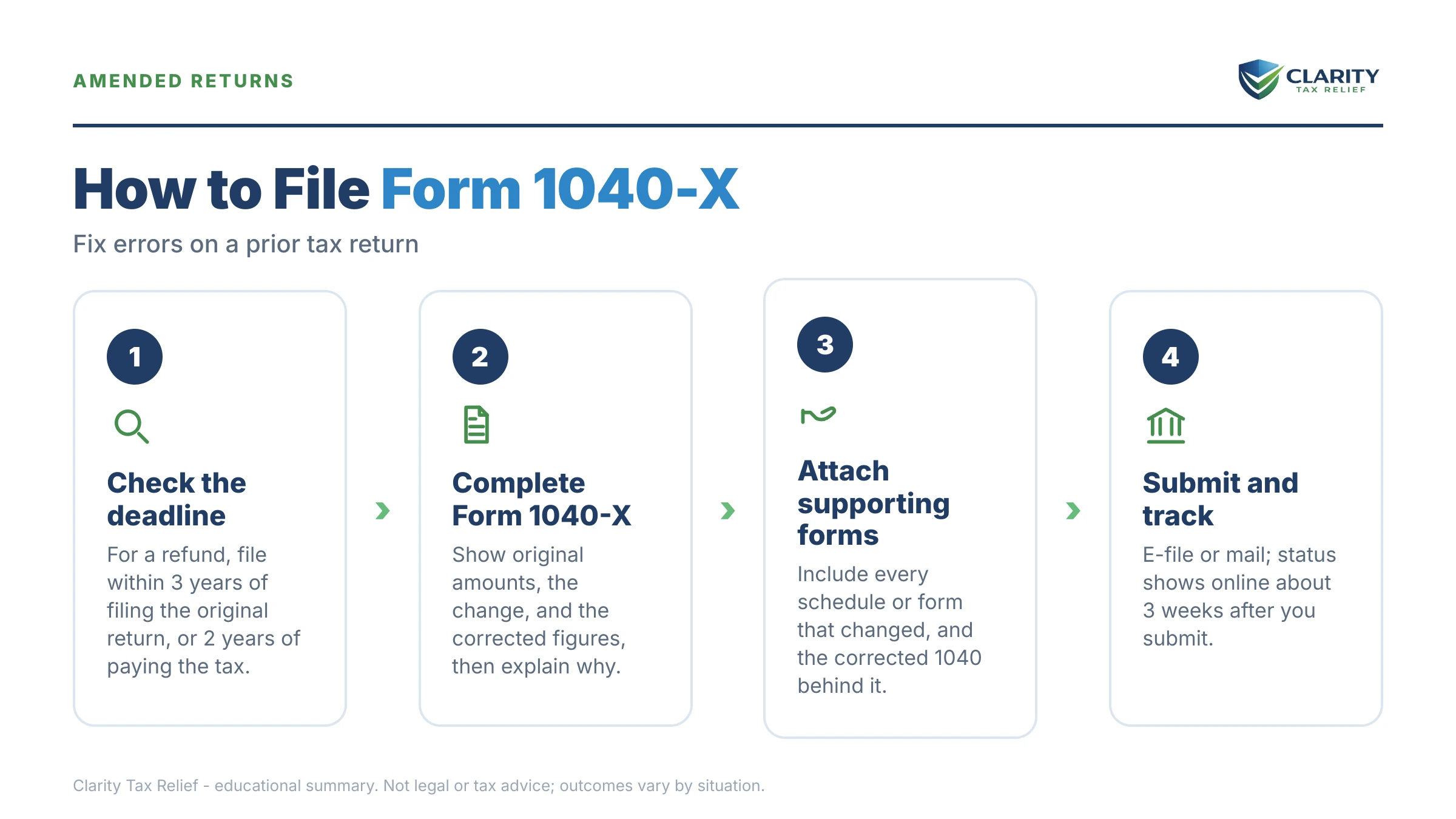
The short answer: Form 1040-X is the IRS form for correcting a tax return you already filed. You report the original figures, the change, and the corrected amounts in three columns, then explain why. Processing typically takes 8 to 12 weeks — sometimes up to 16 — and your status appears online about 3 weeks after you submit.
You filed in February, got your refund, and moved on — then a 1099 turned up that never made it onto your return. Now you're deciding whether to fix it or hope the IRS never notices. Fix it: Form 1040-X exists for exactly this, and filing it before the IRS's computers find the mismatch is almost always the cheaper path.
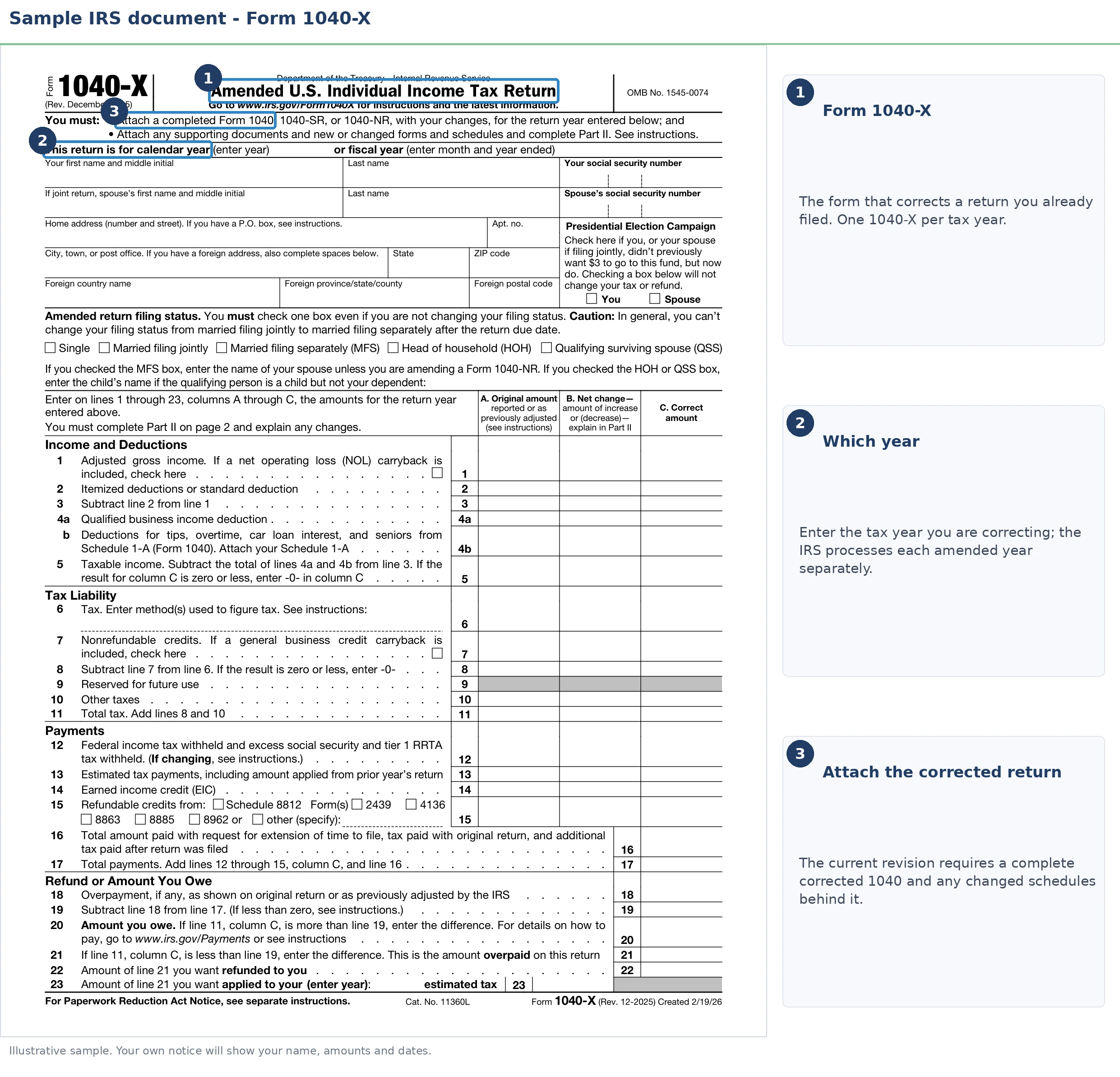
The form looks intimidating because of its three-column layout, but that layout is actually the whole trick to filling it out correctly. The image below shows you exactly what Form 1040-X looks like and where those columns sit, so you can follow along line by line.
⏱ The real clocks on an amendment: to claim a refund, Form 1040-X must generally be filed within 3 years of the date you filed the original return — or 2 years from the date you paid the tax, whichever is later. If your amendment adds tax, a different clock is running: interest and a 0.5% monthly late-payment penalty accrue from the original due date until you pay.
What Form 1040-X does — and how the three columns work
Form 1040-X amends a Form 1040 or Form 1040-NR that has already been filed and processed. You use it to change income, deductions, credits, dependents, or filing status — anything that alters the bottom line or the record the IRS holds for that year.
The form doesn't ask you to redo your whole return. Instead, every line that changes gets three entries:
- Column A — the figure from your original return (or from the IRS's most recent adjustment to it, if there was one).
- Column B — the net change: how much the figure goes up or down.
- Column C — the corrected figure. A plus B equals C, on every line.
Below the columns, you recalculate the tax on the corrected numbers and compare it to what you already paid — the result is either an additional balance due or a refund. Then, in the explanation section, you say in plain English what changed and why. One clear sentence beats a page of justification: "Adding Form 1099-NEC income of $5,400 omitted from the original return" is exactly the level of detail the IRS wants.
Two boundaries worth knowing up front. First, you generally can't switch from married filing jointly to married filing separately after the return's due date — that's one of the few filing-status changes a 1040-X can't make. Second, each tax year needs its own 1040-X; you can't fix three years on one form.
One more distinction: if the original filing deadline (including extensions) hasn't passed yet, you may not need a 1040-X at all. A corrected return filed before the deadline is a superseding return — it replaces the original entirely, which is cleaner than amending. Once the deadline passes, 1040-X is the tool.
What happens if you don't fix a known error
An unreported 1099 rarely stays unnoticed — the IRS computer-matches nearly every W-2 and 1099 it receives against the return you filed. If you know about the error and sit on it, the sequence that follows is automated and runs in a predictable order:
- Document matching. The Automated Underreporter (AUR) program compares the payer's copy of your 1099 to your return — often many months after you file, when the balance has been quietly growing the whole time.
- CP2000. The mismatch generates a CP2000 notice proposing additional tax, interest, and — in some cases — a 20% accuracy-related penalty, with a response window printed on the notice.
- CP3219A, the Notice of Deficiency. Ignore the CP2000 and the IRS issues a statutory notice giving you 90 days to petition Tax Court before the tax is assessed.
- Assessment and collections. The balance posts to your account, a CP14 bill arrives, and the standard collection notice sequence begins — now with months of extra penalties and interest attached.
Every stage of that sequence is more expensive than a voluntary 1040-X filed today. The failure-to-pay penalty runs at 0.5% per month (up to a 25% cap) from the original due date whether you amend or wait — but the accuracy-related penalty and the collection machinery are largely avoidable when you correct the return yourself. If the 1099 itself was a surprise, start with our guide on getting a 1099 you weren't expecting to confirm the income is really yours before you amend.
Found income you forgot to report?
Every month you wait adds another 0.5% failure-to-pay penalty plus interest to whatever you owe. Get your amendment — and the fastest way to shut the penalties off — reviewed free by an experienced tax professional before the IRS's matching system finds the mismatch first.
Amend, wait, or let the IRS fix it: which situations need a 1040-X
Not every mistake calls for Form 1040-X — filing one at the wrong moment can actually slow your case down. Math errors get corrected by the IRS automatically, missing attachments get requested by letter, and an open CP2000 has its own response channel.
| Your situation | Right move | Why |
|---|---|---|
| Forgot a 1099 or W-2 and no IRS notice has arrived | File Form 1040-X now | Beats the AUR match, stops months of penalty growth, and usually avoids the accuracy-related penalty a CP2000 can propose |
| Simple math or calculation error | Don't amend — wait | The IRS corrects these automatically and sends a math error notice (CP11 or CP12) showing the fix |
| Forgot to attach a form or schedule (no numbers change) | Wait for the IRS letter and respond to it | The IRS requests missing attachments by mail; a 1040-X filed on top creates duplicate processing |
| A CP2000 has already been issued for the same issue | Respond to the CP2000, not with a 1040-X | The underreporter unit already has your case; an amendment filed mid-CP2000 can cross wires and delay both |
| Missed a deduction or credit — refund due to you | File Form 1040-X within the refund window | Generally 3 years from filing or 2 years from payment, whichever is later — after that, the refund is forfeited |
| Wrong filing status or dependents | File Form 1040-X | These change the whole tax calculation — but note you generally can't switch joint to separate after the due date |
| Original filing deadline hasn't passed yet | File a superseding return instead | A corrected return filed before the deadline replaces the original entirely — cleaner than an amendment |
One compliance note that matters: amending is a tool for making the return accurate, not for making a legitimate balance disappear. If your goal is correcting an overstated assessment — an IRS substitute return, a disputed CP2000 adjustment — see our companion guide on amending a return to reduce tax debt, which covers that strategy separately.
A worked example: the forgotten $5,400 1099
Say you're a W-2 employee who filed on time in February, and a $5,400 1099-NEC from a side project arrived after you filed. Here's the hypothetical math on the amendment, using a 22% bracket:
- Self-employment tax: $5,400 × 92.35% = $4,987 of net earnings; × 15.3% ≈ $763
- Deduction for half the SE tax: about $382
- Income tax: ($5,400 − $382) × 22% ≈ $1,104
- Additional tax on Form 1040-X: roughly $1,867
Amend in September — five months after the April due date — and the failure-to-pay penalty is about 0.5% × 5 months = 2.5%, or roughly $47, plus interest. Total damage: about $1,914 plus interest, and the matter is closed.
Now run the wait-for-the-IRS version. CP2000s often arrive well over a year after you file. At 18 months, the failure-to-pay penalty alone is around 9% (≈ $168), interest has compounded far longer, and the notice can propose a 20% accuracy-related penalty (≈ $373 if asserted). The same mistake now costs $2,400 or more — and you're inside a formal IRS process instead of a routine correction. There's no failure-to-file penalty in either version, because the original return was filed on time; that 5%-per-month penalty only hits unfiled returns.
You can rough out your own penalty-and-interest numbers with our IRS penalty and interest calculator — it estimates what waiting costs month by month.
How to file Form 1040-X, step by step
- Confirm an amendment is the right move. Check the amend-or-wait table above — don't file a 1040-X for a math error the IRS will fix on its own, and don't amend if a CP2000 for the same issue is already in your mailbox.
- Gather your original return and the new document. You need the return exactly as filed (or as the IRS last adjusted it) plus the 1099, W-2, or receipt driving the change — Column A must match what the IRS has on record.
- Complete the three columns for every line that changes. Enter your original figures in Column A, the net change in Column B, and the corrected amounts in Column C, then recalculate the tax on the corrected numbers.
- Explain the change in plain language. In the explanation section, state exactly what changed and why in one or two clear sentences — for example, "Adding Form 1099-NEC income of $5,400 omitted from the original return."
- Attach every changed form and file it. Include each form or schedule affected by the change, e-file if your tax year qualifies or mail it to the address in the instructions, and pay any balance due the same day.
- Track it after 3 weeks. Check Where's My Amended Return about 3 weeks after submitting, expect 8 to 12 weeks of processing, and never refile a duplicate — that restarts the clock.
On e-filing: recent tax years can generally be amended electronically through major tax software when the original was e-filed; older years must go by paper, mailed to the address in the form's instructions (it varies by state). Check the current instructions or your software for which years qualify — and don't forget your state. Most states require their own amendment when federal income changes; California, for example, amends through the FTB using Form 540 and its amendment schedule, not a federal 1040-X.
Form 1040-X processing time: what to expect at each stage
You should generally allow 8 to 12 weeks for Form 1040-X to be processed, and in some cases up to 16 weeks. The Where's My Amended Return tool moves through three statuses — Received, Adjusted, Completed — and knowing which stage you're in prevents the two most common mistakes: panicking early and refiling a duplicate.
| Stage | Timing | What the tool shows |
|---|---|---|
| Just submitted | Weeks 0–3 | Nothing yet — the amendment isn't in the tracking system. No status is normal here; do not refile. |
| Status appears | About 3 weeks after you submit | "Received" — your 1040-X is in the processing queue. |
| Normal processing | 8–12 weeks | "Received" changes to "Adjusted" when the correction posts to your IRS account. |
| Extended processing | Up to 16 weeks — longer if there are errors, identity verification, or manual review | "Adjusted" changes to "Completed" when processing is finished; any refund, bill, or letter follows by mail. |
If you're past 16 weeks with no movement, see why your amended return is taking so long — and if your amendment involves a balance due, Where's My Amended Return when you owe explains how tracking works differently when money flows toward the IRS rather than back to you.
If your amendment increases your tax: penalties, interest, and payment options
When a 1040-X adds tax, interest and the failure-to-pay penalty are calculated from the original due date — not from the day you amend. That's why the single most cost-effective move is paying the additional tax when you file the amendment, even before the IRS processes it. Payment stops the accrual; processing speed doesn't matter once the balance is paid.
If you can't pay in full, the standard options apply: a short-term plan gives up to 180 days with no setup fee, and long-term installment agreements stretch balances under $50,000 over as many as 72 months. You can set up an IRS payment plan online once the amended balance posts to your account.
On the penalty itself, two forms of relief are worth checking. First-time penalty abatement can remove the failure-to-pay penalty if your prior three years are clean — and starting in summer 2026, the IRS's new Automatic Exemption from Penalty (AEP) begins applying that relief automatically, with no request needed. If your tax was correct all along and only a penalty or interest is in dispute, that's a job for Form 843, not an amendment.
If your amendment claims a refund
A refund claimed on Form 1040-X is generally only payable within 3 years of filing the original return or 2 years of paying the tax, whichever is later. Amend after that window and the IRS will process the correction but keep the money — a painful outcome our guide on getting a refund from 3 years ago covers in detail.
Two special refund situations use companion forms rather than (or alongside) the 1040-X. A net operating loss or certain credit carrybacks can move faster through Form 1045, Application for Tentative Refund. And a refund due to a taxpayer who has died is claimed by the survivor or representative with Form 1310 attached. Both are named in the 1040-X's own instructions — when your situation touches either, read those instructions before choosing the form.
When you can handle Form 1040-X yourself
Most single-issue amendments are genuinely do-it-yourself work. If you're adding one forgotten 1099, claiming one missed credit, or fixing a dependent, and you can pay any resulting balance, your tax software or a careful evening with the instructions will get it done — no professional required.
Experienced help changes the outcome in a narrower set of situations: multiple years need amending at once (the order you file them in can matter), the amendment interacts with an open CP2000 or audit, the new income is self-employment income that triggers estimated-tax questions going forward, the added balance is large enough that you need a payment strategy before the bill posts, or the amendment could reduce a balance the IRS is already collecting. In those cases, a review before you file is cheaper than untangling crossed wires after.
If any of those describe you, a free case review with an experienced tax professional at Clarity can map the filing order and the payment plan before the first form goes in the mail.
Terms on Form 1040-X, decoded
- Amended return — a corrected return filed after the original was processed; Form 1040-X is the individual version.
- Superseding return — a corrected return filed before the filing deadline (including extensions); it replaces the original entirely instead of amending it.
- Column B (net change) — the difference between your original and corrected figures; most 1040-X rejections trace back to a sign error or mismatch in this column.
- AUR (Automated Underreporter) — the IRS matching program that compares 1099s and W-2s to filed returns and generates CP2000 notices from mismatches.
- Refund statute of limitations — the window (generally 3 years from filing or 2 years from payment) in which an amendment can still produce a refund.
- Adjusted vs. Completed — Where's My Amended Return statuses: "Adjusted" means the change has posted to your account; "Completed" means processing is finished and any refund or letter is on its way.
Form 1040-X questions, answered
How long does Form 1040-X take to process?
Plan on 8 to 12 weeks for normal processing, and up to 16 weeks in some cases. Your amendment won't show up in the Where's My Amended Return tool until about 3 weeks after you submit it, so checking earlier tells you nothing. Amendments that need identity verification, contain errors, or get routed for review can take longer than 16 weeks.
Can I e-file Form 1040-X?
For recent tax years, yes — most major tax software can e-file an amendment when the original return was filed electronically. Older years generally must be amended on paper and mailed to the address in the form's instructions, which varies by state. E-filing doesn't meaningfully speed up processing, but it eliminates mail time and lost-paper risk.
Should I file Form 1040-X if I forgot a 1099?
Usually yes — and sooner is cheaper, because the failure-to-pay penalty and interest run from the original April due date, not from when you amend. The exception: if the IRS has already sent you a CP2000 proposing the change, respond to that notice instead of amending, because a 1040-X filed mid-CP2000 can cross wires with the unit already working your case.
Will filing a 1040-X trigger an audit?
No — an amended return doesn't automatically trigger an audit. It's screened the same way original returns are, and a routine fix like adding a forgotten 1099 draws far less attention than letting the IRS's document-matching system find the mismatch itself. Large refund claims or big swings in income can get extra review, which is one reason to attach clear documentation.
How far back can I amend a tax return and still get a refund?
Generally you must file within 3 years of the date you filed the original return, or 2 years of the date you paid the tax, whichever is later. Miss that window and the IRS keeps the money even if your math is right. You can still amend older years to correct the record — for example, to report missed income — but any refund from those years is forfeited.
Do I have to amend my state return too?
Almost always yes, if the change affects your state taxable income. States run their own document matching and many receive federal adjustment data from the IRS, so a federal-only fix often surfaces later as a state bill with penalties. Each state has its own amendment form and deadline — California, for example, amends through the FTB, not with Form 1040-X.
What happens if my Form 1040-X shows I owe more tax?
Pay as much as you can when you file — the balance accrues interest plus a 0.5% monthly failure-to-pay penalty counted from the original due date. If you can't pay in full, a short-term plan gives you up to 180 days at no setup fee, and long-term installment agreements are available. Penalty relief such as first-time abatement may remove the penalty if your prior three years are clean.
What's the difference between Form 1040-X and Form 843?
Form 1040-X corrects the tax return itself — income, deductions, credits, or filing status. Form 843 is a standalone claim for refund or abatement of certain penalties, interest, and fees that doesn't require changing the return. If your tax was right but you're contesting a penalty, Form 843 or a penalty-abatement request is usually the right tool, not an amendment.
Your next 24 hours
- Pull your original return and check one number. Find the total income line as you filed it — that's your Column A starting point — and confirm the forgotten document (the 1099, W-2, or receipt) really wasn't included.
- Gather three things: the original return as filed, the new document driving the change, and a copy of any IRS letter you've received about that year — a CP2000 changes which path you take.
- Get a free amendment review. Interest and the 0.5% monthly penalty keep accruing on any added tax until it's paid — so before you file, have an experienced tax professional confirm the amendment, the math, and the payment plan in one pass. Use the 2-minute form or call (888) 825-7779.
Official resources: the IRS's About Form 1040-X page hosts the current form and instructions, the Where's My Amended Return tool tracks processing status, and IRS.gov/payments is where any additional tax gets paid directly to the Treasury.
This guide is general information, not tax or legal advice for your specific situation. Eligibility for IRS programs depends on individual facts and circumstances; no outcome is guaranteed.