
IRS Forms
Form 4180 Interview: How to Prepare for the IRS Trust Fund Interview (2026)
The short answer: a Form 4180 interview is how an IRS revenue officer decides whether to charge you personally for a business's unpaid payroll taxes through the Trust Fund Recovery Penalty. The interview is voluntary — you can decline or appear through a representative — and every answer you give becomes evidence in that decision.
A revenue officer left a message, or a letter arrived, saying the IRS needs to "complete an interview regarding the company's employment taxes." If the company was your ex-spouse's, or one you walked away from during the divorce. This may be the first you're hearing that the payroll taxes never got paid. Your exposure here is personal, not the business's, but it is decided by facts you can prepare for, and preparation is exactly what this page gives you.
Unlike almost every other IRS contact, nothing about a 4180 interview is automated. A human revenue officer is building a case file, and your recorded answers will sit at the center of it. The image below shows exactly what Form 4180 looks like and where each block of questions sits — it's worth seeing the form before you ever sit across from the person holding it.
⏱ Your clock: the interview date on the revenue officer's appointment letter. It can usually be rescheduled by agreement, which buys preparation time. If the IRS proposes the penalty after the interview, Letter 1153 starts a 60-day window to appeal before the assessment against you becomes final.
Why a revenue officer wants a Form 4180 interview with you
Form 4180 is the IRS's scripted interview for deciding who is personally liable, under IRC §6672, for a business's unpaid trust fund taxes. When a business falls behind on 941 back taxes, part of that balance is money the employer withheld from employees' paychecks — federal income tax plus the employees' share of Social Security and Medicare. The law treats those dollars as held in trust for the government. It lets the IRS collect them from the individuals who controlled the money, not just the business entity.
You were flagged because something ties you to that control: your name on a bank signature card, an officer title in state filings, your signature on a Form 941, or another person's interview naming you as someone who paid bills. The revenue officer's job is to interview everyone connected to the company's finances — owner, officers, bookkeeper, check-signers — and Form 4180 is the standardized script for each of those conversations. If a Letter 3164 arrived first, that was the formal heads-up that this investigation was opening. (If you're still not sure what kind of IRS contact you received, start with our guide to why you got an IRS letter.)
One critical framing before anything else: being interviewed does not mean you are liable. Plenty of people who sit for 4180 interviews — data-entry bookkeepers, spouses on a signature card who never used it, employees who followed orders — are never assessed. The interview exists precisely because the IRS doesn't yet know who the responsible people are. Your answers help decide it.
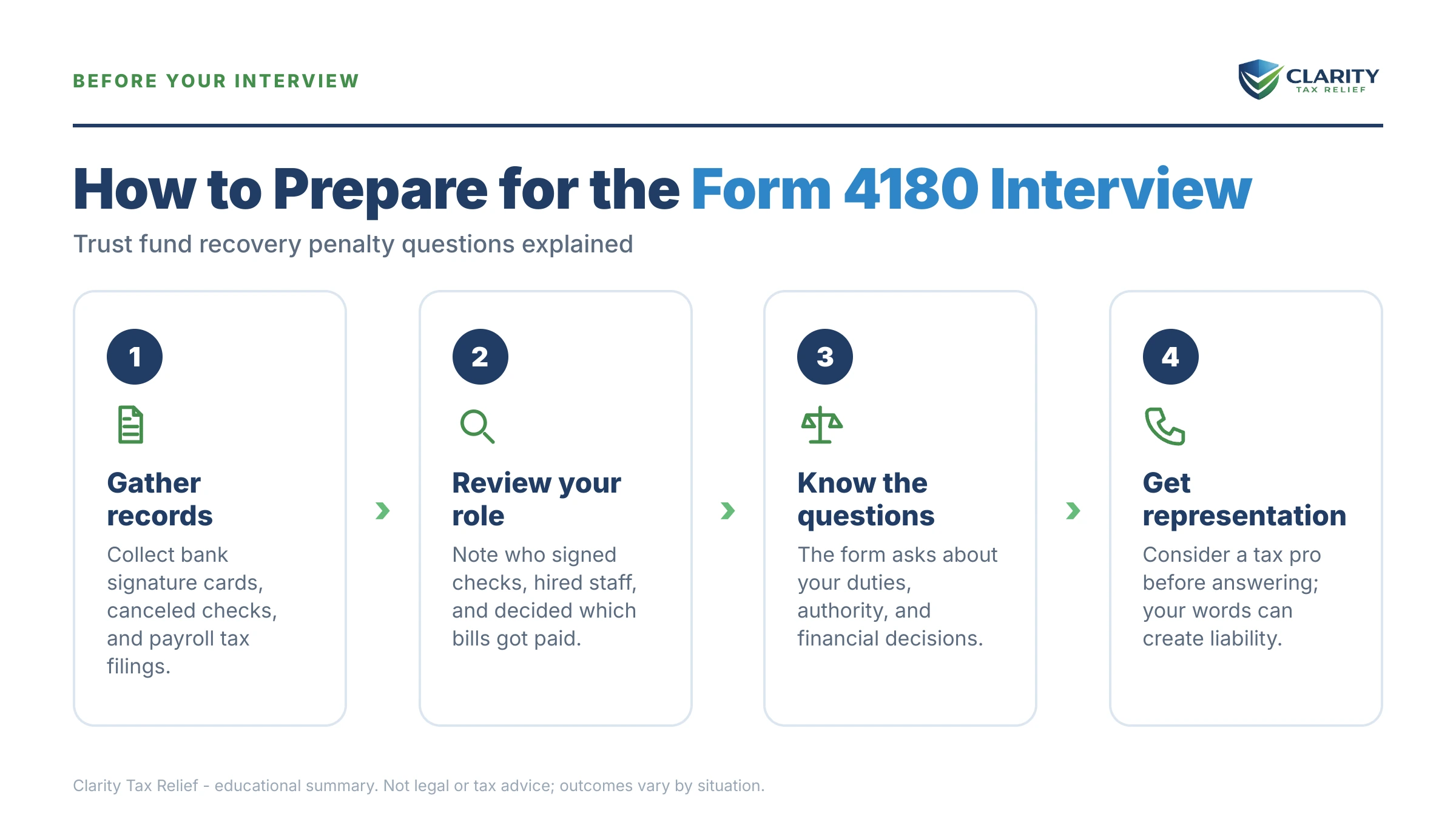
The 4180 interview questions, decoded
Every question on Form 4180 exists to prove or disprove one of two legal elements: responsibility or willfulness. The form walks through your role chronologically and functionally — what you could do, what you actually did, and what you knew. Here is what each part of the form is really establishing:
| Part of the form | What it asks | What the IRS is establishing |
|---|---|---|
| Background | Your name, title, dates with the business, ownership share | Whether you fit the profile of a responsible person at all |
| Duties & authority | Check-signing, hiring and firing, authorizing payroll, signing or filing Form 941, deciding which bills got paid | The responsibility test — status, duty, and authority over the money |
| Knowledge | When you learned the taxes were unpaid, what you did about it, which creditors were paid afterward | The willfulness test — choosing to pay anyone else once you knew |
| The business & other people | Who else performed each of these duties, banking details, corporate structure | Who else to interview and assess. Your answers shape their exposure too |
| Excise taxes | Asked only when collected excise tax, not payroll tax, is at issue | The same two tests applied to excise liabilities — rare |
Notice what's not on the form: nothing about intent to cheat, and nothing about whether keeping the business alive felt necessary at the time. "We used the withholding to make payroll so employees wouldn't quit" reads, to the IRS, as a direct admission of willfulness. The questions are designed so that ordinary, sympathetic explanations become the government's proof.
The two tests: responsible and willful
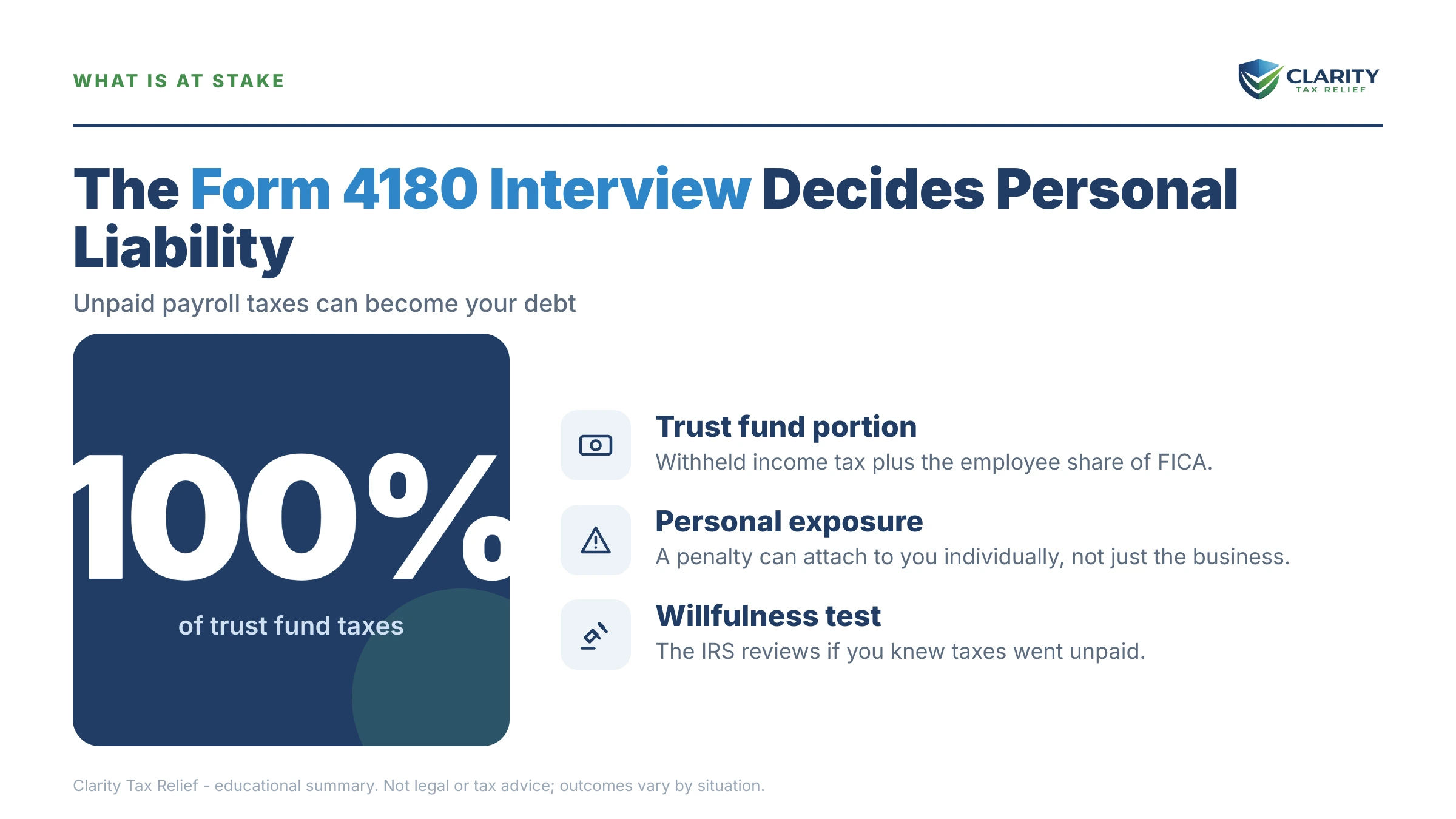
The IRS can only assess the Trust Fund Recovery Penalty against someone who was both responsible for paying the taxes and willful in not paying them. Responsibility is about power — could you direct which bills got paid? Titles matter less than function: a minority owner who controlled the checkbook can be responsible while a figurehead president is not. Willfulness doesn't require bad intent. It means you knew (or recklessly ignored) that the taxes were unpaid and let other creditors — rent, vendors, net payroll — get paid anyway. Our trust fund recovery penalty guide covers the case law in depth, and if your role was clerical, see whether a bookkeeper can be personally liable, often the answer is no.
What's actually at stake: a worked example
Say the landscaping company you co-ran with your ex-husband closed during the divorce owing $48,300 across four quarters of Form 941. The IRS's transcripts break that down: $27,600 in federal income tax withheld from the crews' paychecks, $9,200 in the employees' share of Social Security and Medicare, $9,200 in the employer's matching share, and $2,300 in penalties and interest. The trust fund portion, the only part that can follow you personally, is $27,600 + $9,200 = $36,800.
If the 4180 interview establishes that you were responsible and willful, you and your ex can each be assessed $36,800. The IRS collects the total only once. But it pursues whoever is easiest to reach — the person with wages to levy and equity in a house, not the ex who moved and works for cash. The remaining $11,500 (employer share plus penalties) stays with the defunct business and generally dies with it. And if your divorce decree assigned all business debts to your ex, understand now that the IRS ignores the divorce decree. Your remedy against your ex is in state court, not with the revenue officer.
What happens if you ignore a Form 4180 interview request
Declining or ignoring a Form 4180 interview does not stop the trust fund investigation — the revenue officer simply decides your fate from documents and other people's answers instead. The sequence runs like this:
- The paper file gets built without you. Bank signature cards, canceled checks, corporate filings, the signatures on the 941s, and payroll records all speak for themselves, and none of them explain context in your favor.
- Everyone else gets interviewed. Co-owners, the bookkeeper, your ex-spouse. People facing the same penalty have every incentive to describe your authority generously. Their signed 4180s go in your file.
- A summons can compel you. The interview is voluntary. But the IRS holds administrative summons power to force testimony and records if the revenue officer decides it's worth the effort.
- Letter 1153 proposes the penalty against you. It arrives with Form 2751 and starts a 60-day clock to file a written protest with IRS Appeals. Your best pre-assessment defense.
- The TFRP is assessed personally. Miss the 60 days and the penalty posts to your account, with its own 10-year collection statute. Liens, levy notices, and Collection Due Process rights now run against you as an individual, exactly as if you'd filed a return owing $36,800.
| Stage | Your window | The right at stake |
|---|---|---|
| Letter 3164 / first revenue officer contact | No fixed deadline — the investigation is open | Representation from day one: file Form 2848 before any questions |
| Form 4180 interview appointment | The date on the appointment letter; usually reschedulable by agreement | Attend, decline, or appear through a representative; review before signing |
| Letter 1153 (proposed TFRP) | 60 days to file a written protest | An independent Appeals hearing before the penalty is ever assessed |
| TFRP assessed against you | Collection notices begin; final levy notice carries a 30-day clock | A CDP hearing via Form 12153 CDP hearing rights before levy |
| After assessment | The IRS generally has 10 years to collect | Payment options, hardship status, or a refund-claim challenge in court |
Have a 4180 interview on the calendar?
Don't walk in cold. An experienced tax professional will review your role, your records. The revenue officer's letter, free, so you know your real exposure before your appointment date, not after.
Your options at every stage of the trust fund interview process
You have more choices than "show up and answer everything," and each one carries a different cost and clock:
| Option | What it costs | Typical timeline |
|---|---|---|
| Attend with a representative | Professional fees for prep and attendance | The interview itself is a single session; prep takes days, not months |
| Decline; respond through records and your representative | Your time gathering documents; a summons remains possible | The revenue officer decides on the paper file, on the IRS's schedule |
| Protest Letter 1153 to Appeals | Free to file the written protest within 60 days | Appeals review commonly runs months before a decision |
| Pay a divisible portion and sue for refund | The trust fund tax for one employee for one quarter, plus litigation costs | The longest route, typically pursued only after Appeals fails |
| Resolve an assessed TFRP (payment plan, OIC, CNC) | Plan setup fees vary; an OIC carries a $205 application fee, waived with low-income certification | Payment plans start quickly; OIC decisions take months and roughly 1 in 5 offers were accepted in FY2024 |
A few notes the table can't hold. First, appearing through a representative is genuinely common — once Form 2848 instructions are followed and the power of attorney is on file, the revenue officer must deal with your representative, which alone prevents the most damaging kind of interview answer: the unprepared guess. Second, if the penalty is proposed anyway, a well-built trust fund recovery penalty defense at Appeals wins cases the interview seemed to lose, because Appeals weighs hazards of litigation and the responsibility case law is fact-intensive.
Third, if the TFRP is ultimately assessed, it behaves like any personal IRS debt: the revenue officer will want a financial statement — usually the Form 433-A instructions walk you through it — and you can pursue an installment agreement, hardship status, or an Offer in Compromise on the assessed amount. The assessment also starts its own 10-year collection clock; you can estimate when yours would expire with our CSED Calculator.
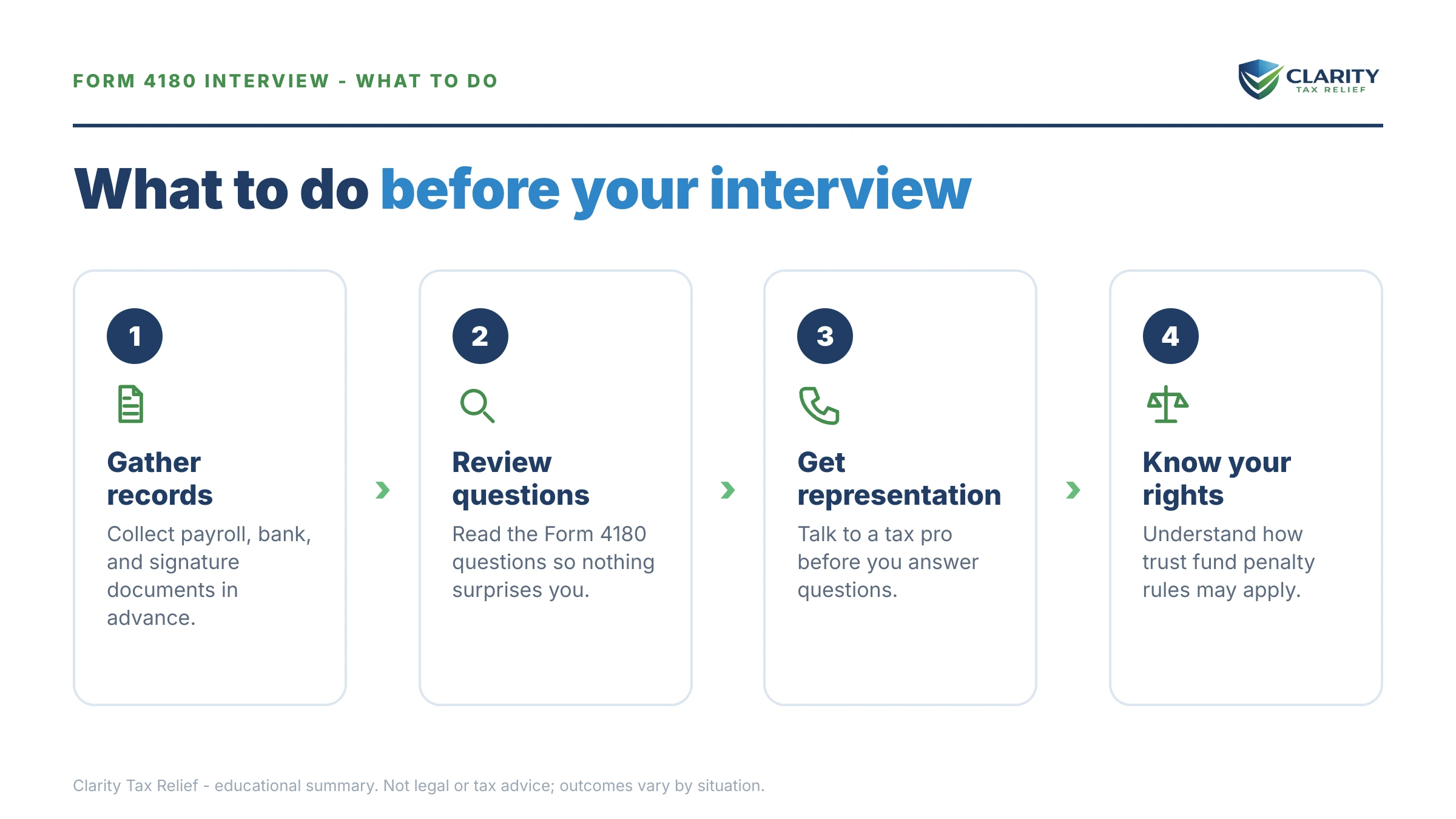
How to respond to a Form 4180 interview request, step by step
- Read the appointment letter closely. Confirm which business, which quarters of Form 941, and the interview date. Everything the IRS can assess flows from the periods listed there.
- File Form 2848 before the interview. A power of attorney lets an experienced tax professional speak with the revenue officer, attend with you, or in many cases handle the interview questions on your behalf.
- Gather proof of your actual role. Bank signature cards, payroll reports, corporate minutes, your job description, and emails showing who decided which bills got paid. Documents beat memory.
- Answer only what is asked. Short, factual answers. Never guess at dates or duties — "I don't recall" is an honest answer; a wrong guess becomes evidence.
- Review the completed form before signing anything. Read every recorded answer on Form 4180, correct inaccuracies, and do not sign Form 2751 or a statute waiver at the table without advice.
That last step deserves emphasis. Revenue officers sometimes present two other forms at or after the interview: Form 2751, which consents to the proposed assessment and waives your Appeals rights, and Form 2750, which extends the IRS's deadline to assess the penalty at all. Neither should ever be signed reflexively. The assessment deadline is one of your few structural advantages — the IRS's window to assess the TFRP is limited, which is part of why revenue officers push interviews on a schedule.
When you can handle the interview yourself, and when you shouldn't
If you clearly fail the responsibility test and can prove it, a short, truthful interview may end your involvement entirely. That's the person who was never on the bank account, never signed a 941, held no officer title, and processed payroll data someone else approved. Bring the documents that show it, answer precisely, and the 4180 in your file becomes your defense.
Get experienced help before the interview when any of these is true: you signed checks or 941s during the unpaid quarters, even occasionally. The business was your ex-spouse's but you held partial authority and the divorce makes the timeline messy. The debt spans many quarters (repeat non-payment, called pyramiding, is where civil cases pick up criminal undertones). The revenue officer is asking you to sign a statute extension. Or others involved are already pointing at you. In those situations, the difference between a prepared record and an improvised one is frequently the difference between owing nothing and owing the full trust fund amount personally. If you're weighing your overall exposure first, our guide to being personally liable for payroll taxes maps liability by role.
Terms in the trust fund interview, decoded
- Trust fund taxes: the money withheld from employees' paychecks — federal income tax plus their share of Social Security and Medicare — held "in trust" for the government.
- Responsible person: anyone with the status, duty, and authority to decide which of the business's bills got paid — function controls, not job title.
- Willfulness: knowing the taxes were unpaid and paying any other creditor anyway; no bad intent required.
- TFRP: the Trust Fund Recovery Penalty — a personal assessment equal to 100% of the trust fund portion, assessable against multiple people at once.
- Letter 1153: the IRS's formal proposal to assess the TFRP against you, opening a 60-day window to protest to Appeals.
- Divisible tax: the rule that lets you challenge an assessed TFRP in court after paying only one employee's portion for one quarter, rather than the whole balance.
For the IRS's own overview, see Employment Taxes and the Trust Fund Recovery Penalty (TFRP) on IRS.gov. If the investigation or later collection is creating serious hardship, the independent Taxpayer Advocate Service can step in on your behalf.
Form 4180 interview questions, answered
Do I have to attend a Form 4180 interview?
No — the interview is voluntary, and you can decline or appear through a representative holding a power of attorney. Declining doesn't stop the investigation: the revenue officer will decide responsibility from bank signature cards, canceled checks, corporate records, and other people's interviews, and can issue an administrative summons to compel testimony. For many people, a prepared interview (or a representative-managed one) produces a better record than silence.
Can I bring a lawyer or tax professional to a 4180 interview?
Yes. Once you file Form 2848, an experienced tax professional can attend the interview with you, and in many cases the revenue officer will work through your representative rather than requiring you to sit alone. If a question raises potential criminal exposure — repeated non-payment across many quarters, for example — a tax attorney's involvement matters, because attorney-client privilege is broader than any accountant privilege.
What questions does the IRS ask in a Form 4180 interview?
The questions map to two legal tests. Responsibility questions ask whether you could sign checks, hire and fire, authorize payroll, sign or file Form 941, and decide which creditors got paid. Willfulness questions ask when you learned the payroll taxes were unpaid and whether other bills were paid afterward. Expect specifics: dates, dollar figures, and names of everyone else who shared those duties.
Is a Form 4180 interview a criminal investigation?
No — it's a civil investigation to decide who owes the Trust Fund Recovery Penalty. But your recorded answers are evidence, and patterns like pyramiding (accruing new payroll tax debt quarter after quarter while paying other creditors) can be referred for criminal review. If IRS Criminal Investigation special agents are involved, that's a different process — stop answering and get counsel before saying anything more.
Can the IRS assess the trust fund penalty against more than one person?
Yes. The TFRP can be assessed against every responsible person at the same time — owner, officer, bookkeeper, and check-signer alike — each for 100% of the trust fund amount. The IRS only collects the total once, but it can pursue whoever is easiest to collect from first. That's why the interview asks so many questions about other people's roles.
Does my divorce decree protect me from the trust fund recovery penalty?
No. A divorce decree binds you and your ex-spouse, not the IRS. If the decree assigned the business debts to your ex, the IRS can still assess and collect the TFRP from you if you were a responsible person. Your remedy is to seek reimbursement from your ex in state court. Your actual duties at the business, not the decree, decide your exposure.
How much of the business's payroll debt can the IRS put on me personally?
Only the trust fund portion: federal income tax withheld from paychecks plus the employees' share of Social Security and Medicare. The employer's matching share, FUTA, and the penalties and interest on the business account are not part of the TFRP. On a typical 941 balance, the trust fund portion runs roughly two-thirds to three-quarters of the total — the exact split is in the IRS's own transcripts.
Should I sign Form 4180 at the end of the interview?
Read every recorded answer first — the revenue officer writes down your responses, and the signed form becomes the government's key evidence. You may correct anything inaccurate before signing, and you can decline to sign. Never sign Form 2751 (agreeing to the proposed assessment) or Form 2750 (extending the assessment deadline) at the table without professional advice.
Your next 24 hours
- Find the appointment date and the quarters listed on the revenue officer's letter — the periods named there define exactly what can be assessed against you.
- Gather your role evidence: bank signature cards or statements, payroll reports, anything with your signature (or its absence) on checks and 941s. Your divorce decree if the business was your ex's.
- Get a free case review before the interview date — use the 2-minute form or call (888) 825-7779. Once your answers are recorded on Form 4180, they can't be unrecorded; the time to know your exposure is before you sit down.
This guide is general information, not tax or legal advice for your specific situation. Eligibility for IRS programs depends on individual facts and circumstances; no outcome is guaranteed.