
IRS Forms
1040 Schedules Explained: Every Form 1040 Schedule, Who Files It, and Where It Flows
The short answer: Form 1040 is the two-page annual income tax return, and the 1040 schedules are the attachments that carry anything the two pages do not have room for. Numbered Schedules 1, 1-A, 2 and 3 collect extra income, deductions, taxes and credits and send one total each to the 1040. Lettered schedules (A, B, C, D, E, EIC, F, H, J, R, SE and 8812) each work out one specific thing, such as a business profit or a capital gain, and feed either a numbered schedule or the 1040 directly. You attach only the ones your situation triggers.
This guide covers every Form 1040 schedule, who attaches it and which 1040 line it lands on, how the 1040 differs from its variants, and what to do when the years you owe are already behind you.
Maybe this is your first return: a W-2 from the day job, a side gig that paid through an app, and a form everyone just calls "the 1040." Or maybe it is the opposite problem, three or four unfiled years staring back at you. Either way the form is a map, and you can read it one schedule at a time.
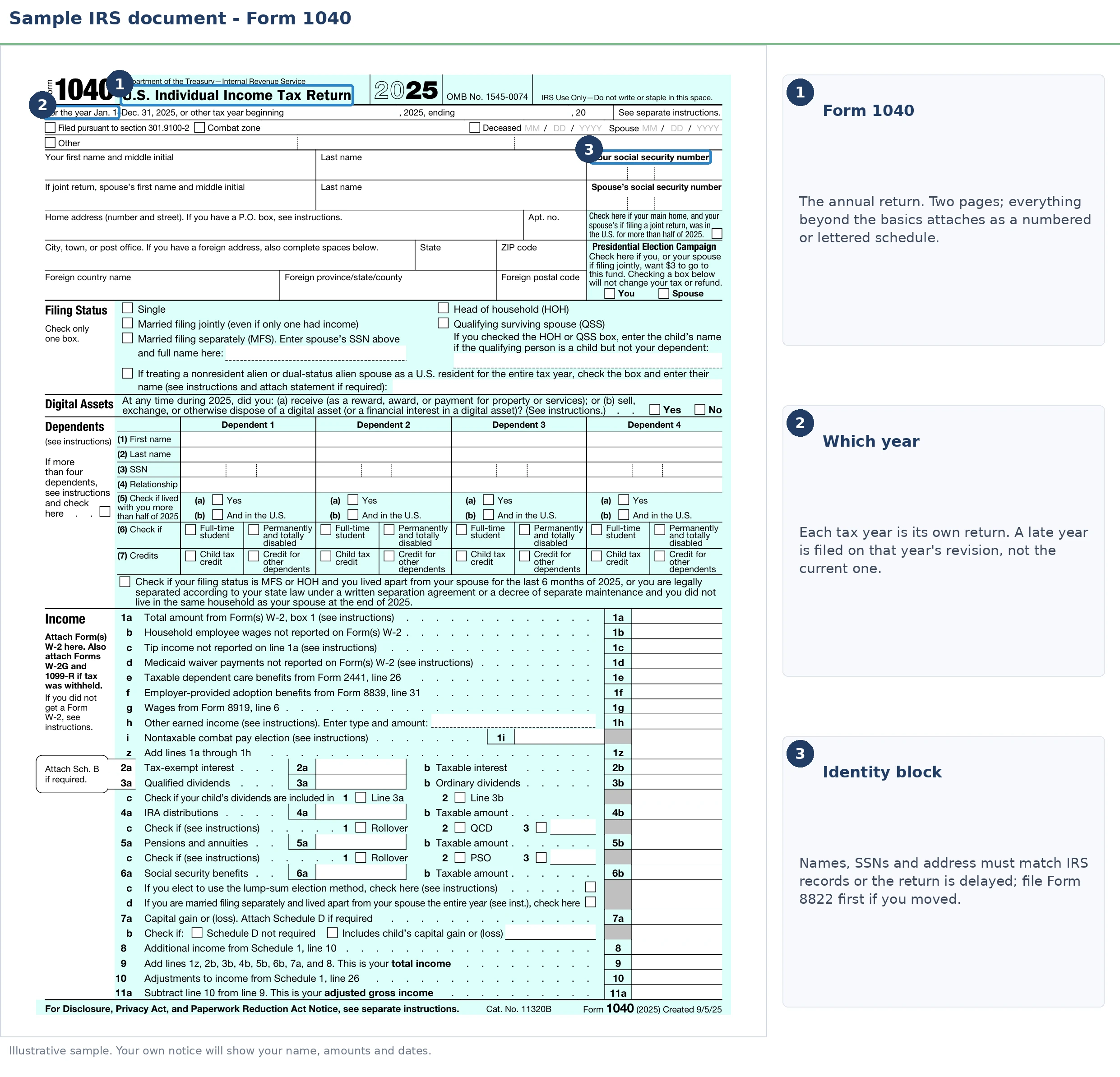
If you have never held one, the image below shows what the two-page Form 1040 looks like and where your income, your withholding, and the number that decides refund-or-bill all land.
⏱ The real clock if you are behind: the failure-to-file penalty accrues at 5% of the unpaid tax per month, up to 25%, and for a return more than 60 days late the minimum is $525 or 100% of the unpaid tax, whichever is less (returns due after December 31, 2025). Filing the return, even with no payment attached, stops that penalty and leaves the much smaller failure-to-pay rate. Interest runs on top of both, at 7% per year compounded daily for the quarter beginning October 1, 2026.
What is Form 1040, and why is it only two pages?
Form 1040 is the two-page return every U.S. individual taxpayer uses to file an annual income tax return. Page one identifies you, sets your filing status and dependents, lists your income lines, and subtracts your deduction. Page two computes the tax, applies credits, counts your withholding and payments, and lands on the only number most people care about: refund or amount owed.
The design is modular on purpose. The core form stays short, and complexity bolts on only when you have it. A filer with one W-2 and the standard deduction may attach nothing at all. A freelancer attaches four schedules. Both are filing the same two-page Form 1040.
Two housekeeping notes for anyone filing in late 2026. First, the current revision of the form is the 2025 Form 1040, and the IRS posted updates to it in March, April and May 2026. Always work from the current instructions for the year you are filing, never a cached PDF. Second, the IRS has said that claiming the new deduction for qualified tips may require an amended return for some occupations that customarily receive tips. If that is you, the fix runs through Form 1040-X, never a second original return.
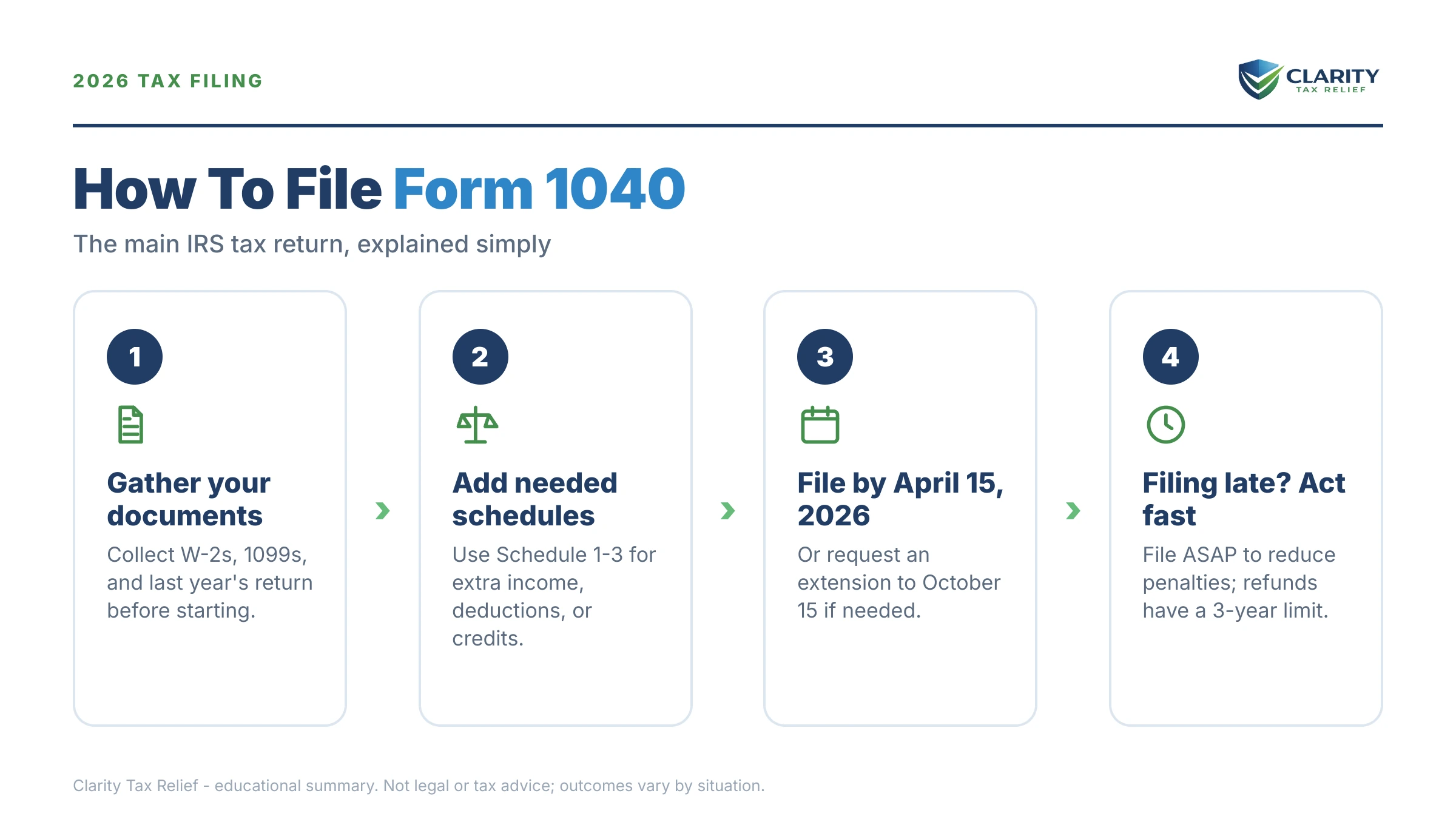
What are the 1040 schedules? The complete list
There are sixteen schedules to Form 1040 in current use. Four are numbered and act as collection sheets: Schedule 1 (extra income and adjustments), Schedule 1-A (the new deductions for tips, overtime, car loan interest and seniors), Schedule 2 (extra taxes) and Schedule 3 (extra credits and payments). Each sends one total to a specific 1040 line. The twelve lettered schedules each compute one thing and hand the result either to a numbered schedule or straight to the 1040. The table below gives every schedule, what it is for, who has to attach it, and exactly where the number goes, taken from the 2025 forms on irs.gov.
| Schedule | What it is for | Who attaches it | Where it flows |
|---|---|---|---|
| Schedule 1, Additional Income and Adjustments to Income | Income the 1040 has no line for (unemployment, prizes, gambling, business, rental, farm) and above-the-line deductions (student loan interest, half of self-employment tax, educator expenses) | Anyone with income or adjustments not on the 1040 itself; every Schedule C, E or F filer | Line 10 to Form 1040 line 8 (income); line 26 to Form 1040 line 10 (adjustments) |
| Schedule 1-A, Additional Deductions | The deductions for qualified cash tips, qualified overtime, qualified vehicle loan interest, and the enhanced deduction for seniors | Anyone claiming one of those four deductions (new for tax year 2025) | Line 38 to Form 1040 line 13b |
| Schedule 2, Additional Taxes | Taxes beyond regular income tax: self-employment tax, household employment taxes, additional tax on IRAs and other tax-favored accounts, AMT, excess advance premium tax credit repayment | Anyone who owes one of those taxes; every Schedule SE or Schedule H filer | Line 3 to Form 1040 line 17 (AMT and premium credit repayment); line 21 to Form 1040 line 23 (other taxes) |
| Schedule 3, Additional Credits and Payments | Credits not on the 1040 itself (foreign tax credit, education credits, general business credit, credit for the elderly or disabled) and other payments (amount paid with an extension, excess Social Security tax withheld) | Anyone claiming one of those credits or payments | Line 8 to Form 1040 line 20 (nonrefundable credits); line 15 to Form 1040 line 31 (payments and refundable credits) |
| Schedule A, Itemized Deductions | Figures itemized deductions: medical, state and local taxes, mortgage interest, charitable gifts | Filers whose itemized total beats their standard deduction | Form 1040 line 12e (in place of the standard deduction) |
| Schedule B, Interest and Ordinary Dividends | Lists each payer of interest and dividends; reports foreign accounts and trusts | Required if you had over $1,500 of taxable interest or ordinary dividends, or have certain foreign accounts, seller-financed mortgage interest, or nominee income | Form 1040 lines 2b (taxable interest) and 3b (ordinary dividends) |
| Schedule C, Profit or Loss From Business (Sole Proprietorship) | Income and expenses of a business you run yourself: freelancing, driving, selling, consulting | Anyone with self-employment or side-gig income; expenses count only if they are on this schedule | Schedule 1 line 3, then Form 1040 line 8; the profit also goes to Schedule SE |
| Schedule D, Capital Gains and Losses | Sales of stocks, crypto, real estate and other capital assets not reported elsewhere, plus capital gain distributions | Anyone who sold a capital asset during the year (usually with Form 8949 behind it) | Form 1040 line 7a |
| Schedule E, Supplemental Income and Loss | Rental real estate, royalties, partnerships, S corporations, estates, trusts and REMIC residual interests | Landlords, K-1 recipients, royalty earners | Schedule 1 line 5, then Form 1040 line 8 |
| Schedule EIC, Earned Income Credit | Gives the IRS information about your qualifying child or children after you have figured the credit | Anyone claiming the earned income credit with a qualifying child | Supports Form 1040 line 27a |
| Schedule F, Profit or Loss From Farming | Farm income and expenses | Anyone operating a farm as an individual | Schedule 1 line 6, then Form 1040 line 8; profit also goes to Schedule SE |
| Schedule H, Household Employment Taxes | Social Security, Medicare, FUTA and withheld income tax on a household employee (nanny, caregiver, housekeeper) | Anyone who paid a household employee cash wages subject to those taxes ($2,800 or more to one employee for 2025, or $1,000 or more to all in a calendar quarter for FUTA) | Schedule 2 line 9, then Form 1040 line 23 |
| Schedule J, Income Averaging for Individuals With Income From Farming or Fishing | Elects to figure tax by averaging farm or fishing income over the three prior years | Farmers and fishers with a high-income year | Replaces the regular tax computation on Form 1040 page two |
| Schedule R, Credit for the Elderly or the Disabled | Figures that credit | Qualifying taxpayers age 65 or older, or permanently and totally disabled | Schedule 3 line 6d, then Form 1040 line 20 |
| Schedule SE, Self-Employment Tax | Figures the tax on net earnings from self-employment; the Social Security Administration uses it to credit your benefits | Required when net earnings from self-employment (Schedule SE line 4c) are $400 or more | Schedule 2 line 4, then Form 1040 line 23; the deductible half goes to Schedule 1 line 15 |
| Schedule 8812, Credits for Qualifying Children and Other Dependents | Figures the child tax credit, the credit for other dependents, and the refundable additional child tax credit | Anyone claiming a child or dependent credit | Form 1040 line 19 (nonrefundable part) and line 28 (additional child tax credit) |
Schedule 1-A is the newest piece of the map. It exists only for the tips, overtime, vehicle-loan-interest and enhanced-senior deductions that began with tax year 2025. It is also the clearest proof that the form changes year to year, which matters when you are filing back years: a 2021 return cannot be prepared from 2025 instructions.
Which 1040 schedules do I need?
Only the ones your facts trigger, and most filers need none or a handful. A single W-2 job with the standard deduction attaches nothing. Add a side gig and you attach Schedules C, SE, 1 and 2. Itemize and you attach Schedule A. Sell stock and you attach Schedule D. Claim the child tax credit and you attach Schedule 8812. Here is how the common situations map:
- One W-2, standard deduction, no kids: no schedules.
- Children at home: Schedule 8812, and Schedule EIC if you claim the earned income credit.
- Side gig or freelance work: Schedules C, SE, 1 and 2 (four schedules from one 1099).
- Rental property or a K-1 from a partnership or S corporation: Schedule E and Schedule 1.
- Sold stock, crypto or a second home: Schedule D (usually with Form 8949).
- More than $1,500 of interest or dividends: Schedule B.
- Mortgage, big state taxes and charitable giving that beat the standard deduction: Schedule A.
- Tips, overtime, a car loan, or age 65 and over: Schedule 1-A for the new deductions.
- Education credits, the foreign tax credit, or an extension payment to claim: Schedule 3.
1040 vs. 1040-SR vs. 1040-NR vs. 1040-X: which one do you file, and what happened to the 1040-EZ?
There is only one main individual return, Form 1040. Every other "1040" is a presentation option, a different taxpayer's form, a correction tool, or retired. Form 1040-SR is an optional alternative for taxpayers age 65 or older and uses the same schedules and instructions as the 1040. Form 1040-NR is the return for nonresident aliens engaged in a U.S. trade or business. Form 1040-X corrects a 1040, 1040-SR or 1040-NR you already filed, and can now be e-filed for the current and two prior tax periods.
| Form | Who files it | Schedules | Status in 2026 |
|---|---|---|---|
| Form 1040 | The standard annual return for U.S. taxpayers, the default for almost everyone | All sixteen above, as triggered | Current (2025 revision) |
| Form 1040-SR | Optional alternative for taxpayers age 65 or older; larger print, same math | Same schedules and instructions as the 1040 | Current, never required |
| Form 1040-NR | Nonresident aliens engaged in a U.S. trade or business, and representatives of deceased persons, estates or trusts that had to file it | Uses Schedules 1, 2 and 3 plus its own Schedules A, NEC and OI | Current, a different return rather than a variant you choose |
| Form 1040-X | Anyone amending a 1040, 1040-SR or 1040-NR already filed, or an old 1040-A or 1040-EZ | Attach any schedule that changed | Current; e-file available for the current and two prior years. See our Form 1040-X guide |
| Form 1040-EZ | The old short form for simple returns | None | Retired after tax year 2017 |
| Form 1040-A | The old mid-length form | Limited | Retired, replaced by the redesigned 1040 |
Two traps here for the reader filing back years. If you are catching up on a very old year, 2017 or earlier, the retired forms may still be the correct ones for that year; our Form 1040-EZ guide covers when the old short form still applies. And if you filed a year wrong (missed income, missed a deduction, wrong status), the fix is 1040-X. Never send a second original 1040 for the same year; it only confuses processing.
What are the 2026 filing basics: due date, standard deduction, thresholds?
The 2025 return was due April 15, 2026. The IRS rule is that individual returns are due April 15 each year, moved to the next business day when that date falls on a weekend or holiday, so the tax year 2026 return comes due April 15, 2027 unless the IRS announces otherwise. An extension on Form 4868 moves the filing date six months and does nothing for the payment date. The figures below are from the 2025 instructions on irs.gov; the 2026 figures will post with the 2026 instructions.
| Item | Figure |
|---|---|
| Due date, 2025 return | April 15, 2026 (extension to October 15, 2026 with Form 4868; payment still due April 15) |
| Standard deduction, 2025 | $15,750 single or married filing separately; $31,500 married filing jointly or qualifying surviving spouse; $23,625 head of household |
| Must file if gross income is at least (under 65) | $15,750 single; $31,500 married filing jointly; $23,625 head of household; $5 married filing separately |
| Must file if gross income is at least (65 or older, single) | $17,750 |
| Schedule SE required when | Net earnings from self-employment are $400 or more |
| Schedule B required when | Taxable interest or ordinary dividends over $1,500 |
| Child tax credit, 2025 | Up to $2,200 per qualifying child (Schedule 8812) |
| State and local tax deduction cap, 2025 | $40,000 (Schedule A) |
| Failure-to-file penalty | 5% of unpaid tax per month or part of a month, up to 25%; minimum $525 if more than 60 days late (returns due after December 31, 2025) |
| IRS interest rate, individuals | 7% per year, compounded daily, for the quarter beginning October 1, 2026 |
Worked example: what does a W-2 job plus a $7,300 side gig need?
A $7,300 side-gig profit turns a schedule-free return into a four-schedule return and adds roughly $1,031 of self-employment tax before any income tax. Here is the flow, with the math shown. (This is a hypothetical example, not a client case.)
Say your day job issued a W-2 with tax withheld all year, and your side gig, deliveries or design work or whatever it was, netted $7,300 after expenses. Here is what your Form 1040 now needs:
- Schedule C: report the gross side-gig income, subtract your expenses (mileage, supplies, platform fees), and land on the $7,300 net profit. Expenses only count if they are on this schedule. Skip it and you are taxed on the gross.
- Schedule SE: self-employment tax runs at roughly 15.3% on 92.35% of net profit. $7,300 × 0.9235 ≈ $6,742; $6,742 × 15.3% ≈ $1,031.
- Schedule 1: the $7,300 profit flows in on line 3 as additional income, and half the self-employment tax, about $516, goes on line 15 as a deduction that lowers your AGI.
- Schedule 2: the $1,031 of self-employment tax itself sits on line 4 and carries to Form 1040 line 23, added on top of your regular income tax.
Income tax applies to the profit too. How much depends on your W-2 wages, filing status and the standard deduction for the year. The part that surprises first-time filers: your employer withheld tax on your wages only. Nothing was withheld on the side gig, so the roughly $1,031 plus income tax on the profit comes out of pocket at filing. If that is you every year, our guide to how much to save for side hustle taxes shows how to stop the April surprise.
What happens if you never file a Form 1040?
The IRS already knows about most of your income before you file. Every W-2 and most 1099s are reported to it directly, so an unfiled 1040 does not hide; it waits. The sequence that follows is automated and moves in stages:
- Penalties start at the due date. If you owe, the failure-to-file penalty accrues at 5% of the unpaid tax per month until it reaches 25%, with interest compounding on top the entire time.
- The IRS asks for the return. Delinquency notices, starting with letters like the CP59 notice, tell you a required return has not been received and demand you file it.
- The IRS files for you. Ignore the demands and the IRS can prepare a substitute for return from the income documents alone: worst-case filing status, no dependents, no itemized deductions, and, critically for side-gig income, zero Schedule C expenses. An SFR balance is almost always far higher than what a properly filed return would show.
- The SFR balance is assessed and goes to collections. Now you are in the regular collection machine: a first bill such as the CP14 notice, then escalating notices with growing enforcement power, ending in liens and levies if nothing intervenes. Your account transcript codes show each step as it posts.
- Refund years quietly expire. If a year would have produced a refund, there is no late-filing penalty, but the refund is generally forfeited about three years after the return's original due date. Unfiled refund years are the only stage where doing nothing costs you money the IRS never asks for.
To see what has already accrued on an unfiled year you know you owe on, our IRS penalty and interest calculator can give you a working estimate before the IRS does.
Behind on one 1040, or five?
Get a free case review before the IRS files a substitute return with none of your deductions. An experienced tax professional will pull what the IRS has on file, tell you exactly which years need to go in, and map the cheapest path to caught up. Penalties and interest accrue monthly until each return is filed.
How do you file a prior-year Form 1040, and what about the balance?
A late original Form 1040 is accepted, and it is usually the single move that shrinks a back-tax problem the most. Four things change when the return is old:
- Use that year's form and that year's schedules. Every tax year has its own Form 1040 version and instructions. Schedule 1-A did not exist before 2025, and old years had different line numbers. Prior-year returns generally must be filed on paper, mailed to the address in that year's instructions.
- Rebuild the income picture from the IRS's own records. Lost your old W-2s and 1099s? The IRS wage and income transcript lists everything reported under your Social Security number for each year. Request it through your online account or with Form 4506-T. If your records beyond that are gone, you can still file back taxes without records by reconstructing them defensibly.
- You may not need every year. The IRS practice is to bring non-filers current for a limited span of recent years rather than a lifetime. How many years of back taxes you have to file depends on your facts, and filing extra years you did not need can create balances you did not need to create. If it has been three years or more, start with our guide for people who haven't filed taxes in 3 years.
- An SFR is not final. If the IRS already filed a substitute return for a year, submitting your own accurate return generally gets the balance adjusted to your real figures, with your filing status, dependents and expenses back in the math.
And if the returns will show tax you cannot pay: file even if you can't pay. Filing stops the 5%-per-month penalty and leaves only the failure-to-pay rate; the failure-to-file vs. failure-to-pay penalty gap is the strongest argument in tax. Then handle the balance. A short-term plan gives up to 180 days with a $0 setup fee, and an individual balance of $50,000 or less in combined tax, penalties and interest can usually go on a long-term monthly plan set up online. Our guide to setting up an IRS payment plan online walks the process, and the IRS payment plan calculator shows what a monthly payment on your balance would look like. Hardship cases can pursue collection pauses or, where the financials support it, an offer under the IRS Fresh Start program. Those are means-tested programs, never defaults, and no outcome is guaranteed.
How to file Form 1040, step by step
- Gather your income records. Collect every W-2 and 1099 for the year, plus bank and payment-app records for side-gig income. For older years, request your wage and income transcript so you know exactly what the IRS has on file.
- Pick the correct form and year. Use the Form 1040 version and instructions for the specific tax year you are filing. Prior years require that year's form, never the current one.
- Identify your schedules. Run your situation against the schedule table above: side-gig income means Schedules C, SE, 1 and 2; extra credits mean Schedule 3; itemizing means Schedule A; kids mean Schedule 8812.
- Complete the schedules first, then the 1040. Work each schedule to its total, carry the totals to the 1040 lines shown in the table, and compare your total tax against withholding and payments to see whether you owe or are owed.
- File the return. E-file the current year; mail prior-year returns on paper to the address in that year's instructions and keep proof of mailing.
- Pay what you can and arrange the rest. Pay at IRS.gov/payments if possible; if not, set up a payment plan the same day you file so the balance does not roll into collection notices.
When can you handle this yourself?
Most Form 1040 filings need no professional at all, including plenty of late ones. You can do it yourself when:
- It is a current-year return with a W-2, maybe some interest, and the standard deduction. Filing software handles this in an afternoon.
- You are filing one late year, you have the records, and the balance (if any) is one you can pay or put on a simple plan.
- Your side gig is small and your records are clean. The $7,300 example above is well within DIY territory if you keep your expense receipts.
Experienced help changes the picture in a narrower set of situations. These are the red flags:
- Multiple unfiled years with self-employment income and missing records, where reconstructing expenses is the whole ballgame.
- A substitute-for-return balance that has already been assessed.
- A combined balance across years you cannot pay.
- Collection notices already arriving while returns are still missing.
In those cases the order you fix things (returns first, then penalties, then the balance) often changes the final number more than any single form does.
What do the terms on the form mean?
- AGI (adjusted gross income): your total income minus the adjustments from Schedule 1, the number many credits and phase-outs key off.
- Taxable income: AGI minus your standard or itemized deduction (and any Schedule 1-A deductions); the number your tax is computed on.
- Withholding: tax your employer already sent the IRS out of each paycheck, a prepayment credited on page two rather than the final bill.
- Refundable credit: a credit the IRS pays out even when it exceeds your tax, the reason some filers get refunds larger than their withholding.
- Schedule: an attachment that only files when a rule triggers it; its total carries back to the 1040 or another schedule.
- Substitute for return (SFR): the return the IRS constructs for a non-filer from income documents alone, with none of the deductions, dependents or expenses that would be on your side of the ledger.
Bottom line
Form 1040 is two pages, and the schedules carry everything else. Attach only the ones your situation triggers, and work each one to its total before you fill in the 1040. If you are behind, file even when you can't pay, because filing stops the 5%-per-month penalty. Use that year's form for every old year.
Your next 24 hours
- Find what the IRS already has. Round up your W-2s and 1099s for every open year, or request your wage and income transcript so you are working from the same numbers the IRS is.
- Map your schedules. Run each year against the table above and write down which schedules it needs. That list is the difference between a filed return and an SFR built without your expenses.
- Get a free case review. If you are behind on multiple years or the balances will be more than you can pay, call (888) 825-7779 or use the 2-minute form at the top of this page. Every month a return stays unfiled, penalties and interest keep compounding.
Official references: the IRS About Form 1040 page hosts the current form, schedules and instructions, the Form 1040 instructions carry the standard deduction and filing thresholds, and IRS.gov/payments covers every way to pay a balance.
1040 schedules: common questions
What are the 1040 schedules?
The 1040 schedules are the attachments to Form 1040 that carry anything the two-page form has no line for. Numbered Schedules 1, 1-A, 2 and 3 collect additional income and adjustments, the new deductions for tips and overtime, additional taxes, and additional credits and payments. Lettered Schedules A, B, C, D, E, EIC, F, H, J, R, SE and 8812 each compute one specific item, such as itemized deductions, business profit or the child tax credit, and feed a numbered schedule or the 1040 directly.
Which 1040 schedules do I need to file?
Only the ones your situation triggers. A single W-2 job with the standard deduction usually needs no schedules at all. Side-gig income adds Schedules C, SE, 1 and 2; itemizing adds Schedule A; selling investments adds Schedule D; claiming the child tax credit adds Schedule 8812; more than $1,500 of interest or dividends adds Schedule B. The table on this page lists the trigger for every schedule.
Can I still file a Form 1040 for a prior year?
Yes. The IRS accepts late original returns, and filing is almost always better than leaving the year open. You must use that specific year's version of the form and its schedules, and prior-year returns generally go in on paper. One real deadline does apply: a refund is generally lost about three years after the return's original due date.
This guide is general information, not tax or legal advice for your specific situation. Eligibility for IRS programs depends on individual facts and circumstances; no outcome is guaranteed.