
IRS Forms
Form 4506-T in 2026: Which IRS Transcript to Request — and When You Don't Need the Form at All
The short answer: Form 4506-T is the free IRS form for requesting any of five transcript types — tax return, tax account, record of account, wage and income, and verification of non-filing. For recent years, your IRS Individual Online Account is faster; you need Form 4506-T mainly for older years, oversized wage files, or letters you can't view online.
Your loan officer just sent the underwriting checklist: IRS transcripts for the last three years before closing can move forward — and you know one of those years carries an open balance. Two problems, one document trail. The good news: the transcripts are free, most are available today, and showing up with them (plus a plan for the balance) reads far better to an underwriter than stalling does.
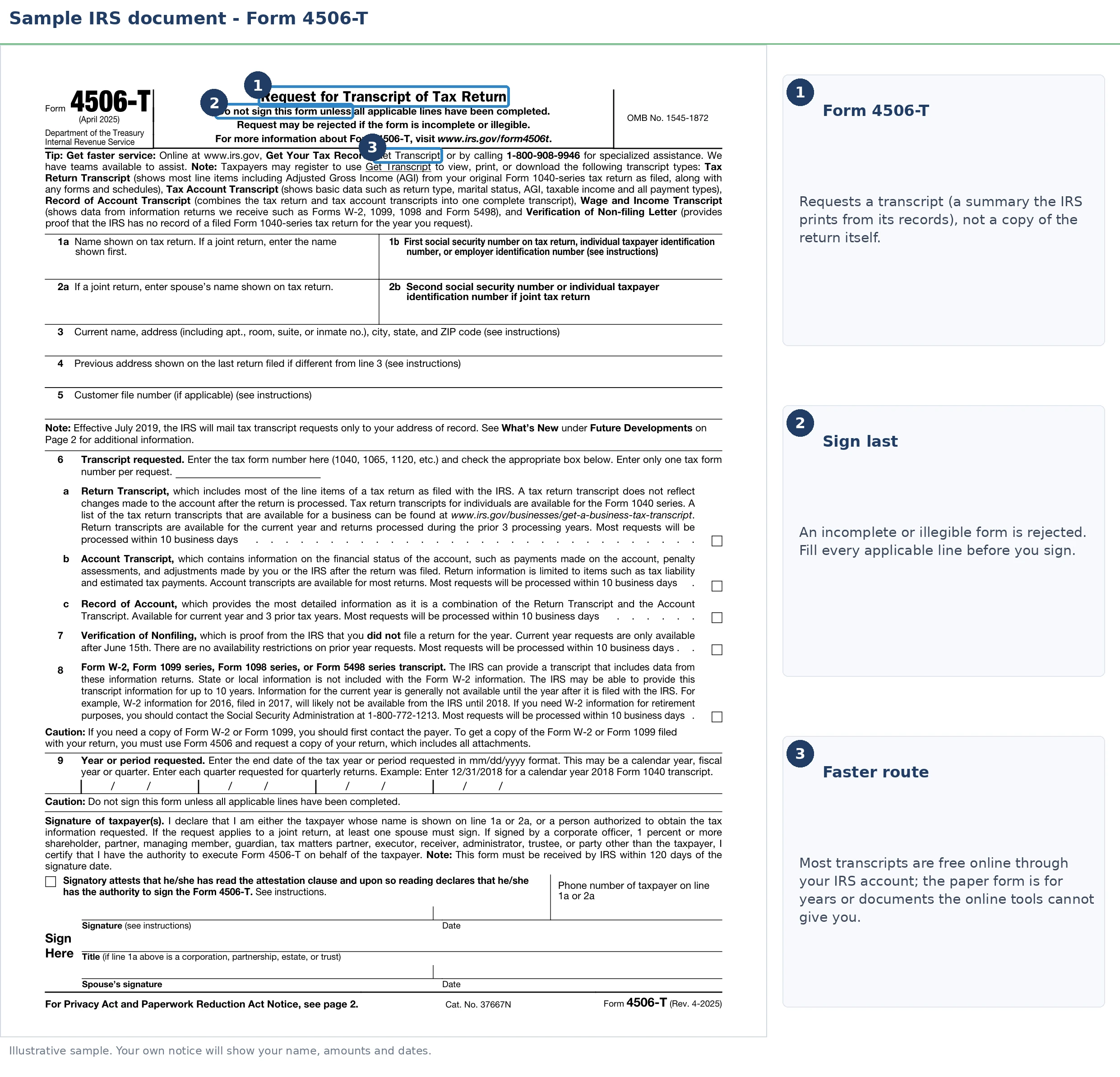
The image below shows exactly what Form 4506-T looks like and where to look — the transcript-type checkboxes and the Customer File Number field are where most requests go wrong, so glance at it before you fill anything in.
⏱ The clocks that actually matter: Get Transcript by Mail takes 5 to 10 calendar days; a mailed Form 4506-T takes longer (its instructions list current timeframes). And if your address changed since your last return, a Form 8822 address update generally takes four to six weeks to process — a transcript will never be forwarded from an old address. If you're on a lender's closing timeline, the route you pick this week decides whether the paperwork makes it.
What Form 4506-T actually gets you — and what it doesn't
Form 4506-T requests IRS transcripts — computer-generated summaries of your tax records — never photocopies of your actual returns. Every transcript type available on Form 4506-T is free. If someone insists on a photocopy of the return itself, that's a different form entirely: Form 4506, which carries a per-return fee listed in its instructions.
Five transcript types live on this one form: tax return, tax account, record of account, wage and income, and verification of non-filing. Each answers a different question, and ordering the wrong one is the single most common way people lose weeks.
One design feature matters for anyone handing a transcript to a third party. Transcripts partially mask personally identifiable information — including your taxpayer identification number — while leaving every financial figure fully visible for tax preparation, representation, or income verification. Because the ID is masked, the form includes a Customer File Number field; whatever you enter there (a loan number, a case number) prints on the transcript so the recipient can match it to your file.
Here's the part most guides bury: for recent years, you usually don't need the paper form at all. Your IRS Individual Online Account lets you view, print, and download every transcript type instantly — see how to get your IRS transcript online and, if you've never logged in, IRS online account setup. Form 4506-T is the route for what the faster channels can't reach.
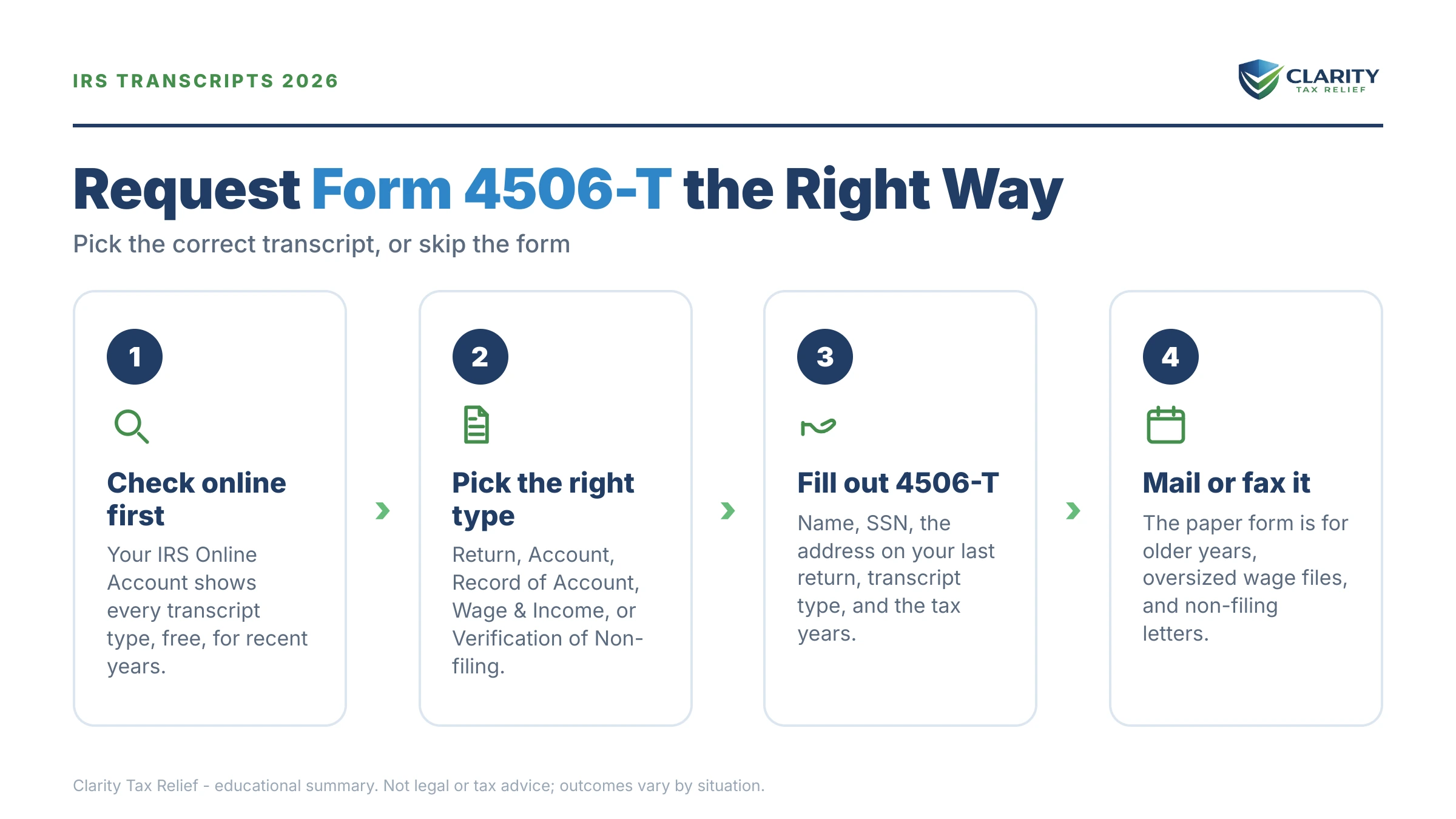
The five IRS transcript types: what each shows and how far back it goes
Through your IRS Individual Online Account, tax return and record of account transcripts cover the current tax year plus three prior years, while tax account transcripts generally reach back nine prior years. Get Transcript by Mail and the automated phone line (800-908-9946) are limited to the current and prior three years — and to tax return and tax account transcripts only. For anything older, Form 4506-T is the only door.
| Transcript type | What it shows | Availability limits | Fastest route |
|---|---|---|---|
| Tax return transcript | Most line items from your original 1040-series return as filed, with forms and schedules — no changes made after filing | Online, mail, and phone: current year + 3 prior years | Online account (instant); mail/phone (5–10 days); older years need Form 4506-T |
| Tax account transcript | The IRS ledger: assessments, penalties, interest, payments, and post-filing changes | Online: generally current year + 9 prior; mail/phone: current + 3 prior | Online account; Form 4506-T for years past the online window |
| Record of account | The return transcript and account transcript combined into one document | Online: current year + 3 prior years | Online account; Form 4506-T for anything older |
| Wage and income transcript | Every W-2, 1099, and other income document reported to the IRS under your number | Online copy won't generate past roughly 85 income documents | Online account; Form 4506-T when the file is too big to generate |
| Verification of non-filing letter | Official proof the IRS has no record of a processed return for the year | Current-year letter not available until June 15 | Online account; Form 4506-T if you can't view it online |
Tax return transcript is the mortgage staple — but it shows the original return only, never an amendment or IRS adjustment. If you filed a Form 1040-X, this transcript will contradict your loan file. That's not a clerical footnote; it's the top cause of underwriting kickbacks on transcript requests.
Tax account transcript is where a tax debt lives on paper: the assessment, every penalty and interest charge, and every payment, in date order. If you're verifying or disputing a balance, this is the document — our guide on how to read an IRS account transcript walks through it line by line, code 150 on an IRS transcript explains the return-posting entry, and the "as of" date on an IRS transcript explains the balance-calculation date people misread most.
Record of account is the two documents above stitched together. When a lender needs both the return as filed and what happened afterward — an amendment, an adjustment, payments on a balance — one record of account replaces two separate requests.
Wage and income transcript is how you rebuild years you never filed: it lists every income document employers and payers reported under your number, so you can reconstruct a return without a single record of your own. See the deep dive on the IRS wage and income transcript, the playbook to file back taxes without records, and how to get an old W-2 for back taxes. One trap: the online version won't generate past roughly 85 income documents — heavy 1099 years (gig work, brokerage accounts) often exceed that, and the IRS's answer is Form 4506-T.
Verification of non-filing letter proves a negative — that no processed return exists for the year. Financial-aid offices ask for it constantly. If a year you actually filed comes back empty instead, see IRS transcript shows no record of return before you panic.
Which transcript answers which problem
Four situations drive nearly every Form 4506-T request: mortgage underwriting, an IRS balance question, unfiled years, and proof of non-filing. Match the situation to the type before you touch the form — the wrong checkbox costs a full mailing cycle.
| Your situation | Transcript to request | Why that one |
|---|---|---|
| Mortgage or refinance underwriting | Tax return transcript — or record of account if you amended | Shows the return as filed; the record of account adds post-filing changes an underwriter must see after a 1040-X |
| Verifying or disputing an IRS balance | Tax account transcript | The IRS's running ledger: assessment date, penalties, interest, and every payment posted |
| Reconstructing unfiled years | Wage and income transcript | Lists every W-2 and 1099 reported under your number — the raw material for the missing return |
| Financial aid or proving you didn't file | Verification of non-filing letter | Official IRS proof of no processed return for the year (current year not available until June 15) |
Why your lender wants transcripts — and what happens when they surface your balance
Mortgage underwriters pull IRS transcripts to confirm the returns in your loan file match what the IRS actually has on record — a fraud check on income, not a courtesy. You'll typically be asked to sign a consent so the lender can request them through its own IRS-authorized channel, or to supply them yourself from your online account.
If you owe the IRS, the transcripts don't hide it. A tax account transcript for the debt year shows the balance, the penalties, and — critically — whether you're doing anything about it. An open balance with a documented, current payment arrangement is a workable underwriting fact; a surprise the underwriter discovers on their own is not. Our guide to whether you can buy a house if you owe the IRS covers how lenders treat balances, plans, and liens differently.
Timing note: transcripts aren't live data. They typically refresh on a weekly cycle — see which day IRS transcripts update — so a payment you made yesterday may not appear on the copy you pull today.
What goes wrong: the wrong-transcript spiral
The most expensive Form 4506-T mistake is ordering a tax return transcript after your return has changed — it shows the original filing only, and the mismatch triggers a chain that eats weeks:
- The wrong type goes out. You order a tax return transcript; your file includes an amendment or an IRS adjustment. The underwriter sees numbers that don't match the loan application and kicks the file back, asking for a record of account.
- The re-request hits an address mismatch. You moved since your last return, so the mailed transcript can't reach you — the IRS will not forward one from an old address. Fixing it means Form 8822 first, which generally takes four to six weeks to process.
- The lender's clock keeps running while the paper loops. Rate locks and closing dates don't wait for a second mailing cycle, and every resubmission restarts the wait.
- The balance keeps growing the whole time. An unpaid IRS balance accrues a 0.5%-per-month failure-to-pay penalty plus compounding interest — so the payoff figure in your loan file goes stale while you wait. And if the debt itself goes unaddressed, the IRS notice sequence keeps moving toward a recorded federal tax lien, which is a far harder underwriting problem than a balance with a payment plan.
Every step of that spiral is avoidable by choosing the right transcript type and the right delivery route on day one.
Lender wants transcripts while you owe the IRS?
Send us the underwriting request and your latest IRS notice. An experienced tax professional will map which transcripts you need, pull the fastest route, and structure the open balance so it doesn't sink the loan — free, confidential, no pressure. Penalties and interest accrue monthly on an open balance, so the sooner it's structured, the less it costs.
Form 4506-T vs Form 4506 vs 4506-T-EZ vs your online account
Form 4506-T is one of four ways to get your IRS records, and among the free routes it's the slowest — its real job is covering what the fast channels can't. Here's the whole family in one view:
| Route | What you get | Cost | How long |
|---|---|---|---|
| IRS Individual Online Account | View, print, or download all five transcript types for the years within each type's online window | Free | Immediate |
| Get Transcript by Mail / 800-908-9946 | Tax return and tax account transcripts only, current year + 3 prior | Free | 5 to 10 calendar days |
| Form 4506-T | Any of the five transcript types, including older years and wage files too large to generate online | Free | Paper processing — the current form instructions list timeframes; slower than the mail service |
| Form 4506-T-EZ | Short-form paper request for an individual tax return transcript only | Free | Paper processing — see its instructions |
| Form 4506 | A full photocopy of your actual return as filed — a copy, not a transcript | Per-return fee (listed in the Form 4506 instructions) | Check the form's instructions — order a transcript instead unless a copy is specifically demanded |
The practical rule: transcripts satisfy almost every income-verification and tax-resolution need, and they're free. Order the paid Form 4506 photocopy only when a court, agency, or counterparty explicitly refuses a transcript.
A worked example: $31,000 owed, three years of transcripts due
Say you owe the IRS $31,000 from your 2023 return, and your lender wants transcripts for 2023, 2024, and 2025. This is a hypothetical, but the math is the math:
The transcripts cost you nothing and can be in hand today. All three years sit inside the online account's current-plus-three-prior window, so you can download record of account transcripts for each — the record of account is the right pick for 2023, because it shows both the return and the account activity on the balance. No Form 4506-T needed, no 5-to-10-day wait, no address risk.
The balance is the real cost center. At the failure-to-pay rate of 0.5% per month, $31,000 accrues roughly $155 in penalty every month ($31,000 × 0.005), plus interest compounding on top. You can estimate your own accrual with our IRS penalty and interest calculator.
Because $31,000 is under the $50,000 ceiling for an online long-term IRS installment agreement, you can set up a plan of up to 72 months without a full financial disclosure. Straight-line, $31,000 ÷ 72 ≈ $431 a month before accruing interest and penalties — the actual payoff runs higher because both keep accruing inside a plan. But a documented agreement is exactly the artifact an underwriter wants to see next to that 2023 tax account transcript: balance acknowledged, payments posting, no lien filed.
Compare the alternative: ignore the balance until underwriting finds it, and you're negotiating with the IRS and a rate-lock deadline at the same time — with $155-plus in fresh charges landing every month you wait.
How to fill out and submit Form 4506-T, step by step
If the online routes genuinely can't serve you — an older year, an oversized wage file, a non-filing letter you can't view — here's the clean path through the paper form:
- Check your IRS online account first. Tax return and record of account transcripts for the current year and three prior years appear there instantly — if every year you need is available, you can skip the form entirely.
- Download the current Form 4506-T from IRS.gov. Use the mailing or fax address printed in the form's own instructions — submission addresses change, so never reuse an old copy from a folder.
- Fix your address before you submit, if you moved. If your address no longer matches IRS records, file Form 8822 first and allow four to six weeks — a transcript will not be forwarded from an old address.
- Complete the form with the end reader in mind. Enter your name and taxpayer identification number exactly as they appear on your last return, check the transcript type and tax years you need, and add a Customer File Number — such as a loan number — so it prints on the transcript for easy matching.
- Sign, date, and send — then calendar a follow-up. On a joint return, either spouse can sign to request their own transcripts; submit per the instructions and note a date to check whether the transcript arrived in time for your lender's deadline.
The current form, its instructions, and the correct submission addresses all live on the official page: About Form 4506-T at IRS.gov. The IRS's overview of every transcript route is at Get Transcript.
When you can handle Form 4506-T yourself — and when help changes the outcome
Requesting transcripts is a records task, not a negotiation — nearly everyone can handle Form 4506-T (or better, the online account) without paying anyone. If you know which type and years you need and your address matches IRS records, this article plus the form's instructions is the whole job.
Experienced help changes outcomes in the situations around the transcripts, not the request itself:
- The transcripts surface a balance mid-underwriting. Structuring a payment arrangement that both the IRS and a lender will accept — before a lien gets filed — is where sequencing matters.
- Multiple unfiled years. Reconstructing returns from wage and income data across several years, in the right order, decides how much you ultimately owe.
- The account transcript doesn't match what you believe you owe. Disputed assessments, misapplied payments, and penalty stacks take practiced reading and a documented response.
- You want someone else working the IRS directly. That authority runs through Form 2848 instructions (power of attorney) or Form 8821 instructions (information authorization) — never by handing a stranger your Form 4506-T. The IRS's transcript services are for taxpayers retrieving their own records; use by other entities is prohibited.
If your transcripts just revealed a balance — or years — you didn't expect, a free case review can map your options before the IRS notice sequence maps them for you.
Terms on Form 4506-T, decoded
- Transcript vs. copy: a transcript is a free computer summary of your tax data; a copy is a paid photocopy of the actual return, ordered on Form 4506.
- Customer File Number: an identifier you choose (like a loan number) that prints on the transcript so a lender can match it to your file, since your taxpayer ID is masked.
- Record of account: the tax return transcript and tax account transcript merged into one document — the return as filed plus everything that happened after.
- Verification of non-filing letter: official IRS confirmation that no processed return exists for the year you name; the current-year letter isn't available until June 15.
- Assessment: the formal recording of tax you owe on the IRS's books — the entry that appears, with its date, on your tax account transcript.
- Masking: the partial redaction of personally identifiable information on every transcript; financial figures remain fully visible.
Form 4506-T questions, answered
How long does Form 4506-T take to process?
Paper requests are the slowest route, and the form's own instructions list current processing timeframes. For comparison, transcripts in your IRS Individual Online Account appear immediately, and Get Transcript by Mail delivers tax return and tax account transcripts in 5 to 10 calendar days. Reserve Form 4506-T for what those routes can't do — an older year, a wage and income file too large to generate online, or a non-filing letter you can't view.
Is there a fee for Form 4506-T?
No — every transcript type you can request on Form 4506-T is free, as are transcripts through your online account and the automated phone line at 800-908-9946. The only paid document in this family is Form 4506, which orders a full photocopy of your return as filed; its per-return fee is listed in that form's instructions. Anyone charging you simply to pull your own transcripts is selling convenience, not access.
What is the difference between a tax return transcript and a record of account?
A tax return transcript shows most line items from your original return exactly as you filed it — it never reflects changes made afterward. A record of account combines the return transcript with the account transcript, so amendments, penalty assessments, and payments all appear on one document. If you filed a Form 1040-X or the IRS adjusted your return, request the record of account; a lender reading only the return transcript will see numbers that no longer match.
Can my spouse request transcripts from our joint return?
Yes. A secondary taxpayer on a jointly filed return may request any transcript type that's available, without the primary filer's signature or permission. The IRS treats this as you retrieving your own records, which matters in separations and divorces where one spouse needs the joint-year history and the other isn't cooperating. The request covers the years you filed jointly, not your ex's separate returns.
Can my lender file Form 4506-T for me?
No — the IRS says its transcript services are for taxpayers retrieving their own records, and use by other entities is prohibited. Lenders that need transcripts directly use their own IRS-authorized consent process, so ask your loan officer which route they want before you mail anything. If you want a tax professional to access your account instead, that authority runs through Form 2848 or Form 8821, not Form 4506-T.
Why is part of my transcript blacked out?
Transcripts partially mask personally identifiable information, including your taxpayer identification number, to reduce identity-theft risk. Every financial figure stays fully visible, so the masking never interferes with tax preparation, representation, or income verification. Because the ID number is hidden, Form 4506-T includes a Customer File Number field — enter your loan number or another identifier there and it prints on the transcript so your lender can match it to your file.
What if I moved since my last tax return?
File Form 8822, Change of Address, before you submit Form 4506-T. A transcript will not be forwarded from an old address, and an address that doesn't match IRS records can sink the request entirely. The address change generally takes four to six weeks to process — so if you're on a lender's timeline, first check whether the years you need are viewable instantly in your online account, where no mailing is involved.
Which transcript proves I did not file a return?
The verification of non-filing letter — an official IRS statement that it has no record of a processed return for the year you specify. Schools, aid programs, and some lenders require it. One timing rule catches people every year: the current-year letter is not available until June 15. If you can't view it through your online account, request it with Form 4506-T.
What does it mean if my transcript shows no record of a return?
It means the IRS has not processed a return for that year under your number — either the return is still working through the pipeline or it was never filed. Your wage and income transcript will usually still exist for the year, because employers and payers report those documents independently of your filing. If the year is genuinely unfiled, that wage and income data is the raw material for reconstructing and filing the return.
Your next 24 hours
- Pin down the exact request. Re-read your lender's (or school's, or agency's) transcript request and write down the transcript type and tax years it names — that one detail decides your route through the tables above.
- Gather your access and your records. Log into (or set up) your IRS online account, pull the years that are viewable now, and set your last filed return and any IRS notices about the open balance next to them.
- Get the balance reviewed free. If the transcripts show an amount you owe — or a year you never filed — call (888) 825-7779 or use the 2-minute form at claritytaxrelief.com/#consult. Penalties and interest accrue monthly on an open balance; structuring it now, before underwriting or the IRS notice sequence forces the issue, is the cheap version of this problem.
This guide is general information, not tax or legal advice for your specific situation. Eligibility for IRS programs depends on individual facts and circumstances; no outcome is guaranteed.