
IRS Forms
IRS Form 56: What It Is, Who Files It, and When (2026)
The short answer: Form 56 — Notice Concerning Fiduciary Relationship — tells the IRS that you now legally act for another taxpayer, such as a deceased parent's estate, under section 6903. Once it's on file, IRS notices about that taxpayer come to you. Until then, letters keep going to the old address, and every deadline runs anyway.
You found them while sorting your father's mail — envelopes from the Department of the Treasury, addressed to him, some unopened for months. You're his executor now, but the IRS doesn't know that yet. Form 56 is the form that closes that gap, and it's one of the simplest pieces of paperwork in the entire estate process.
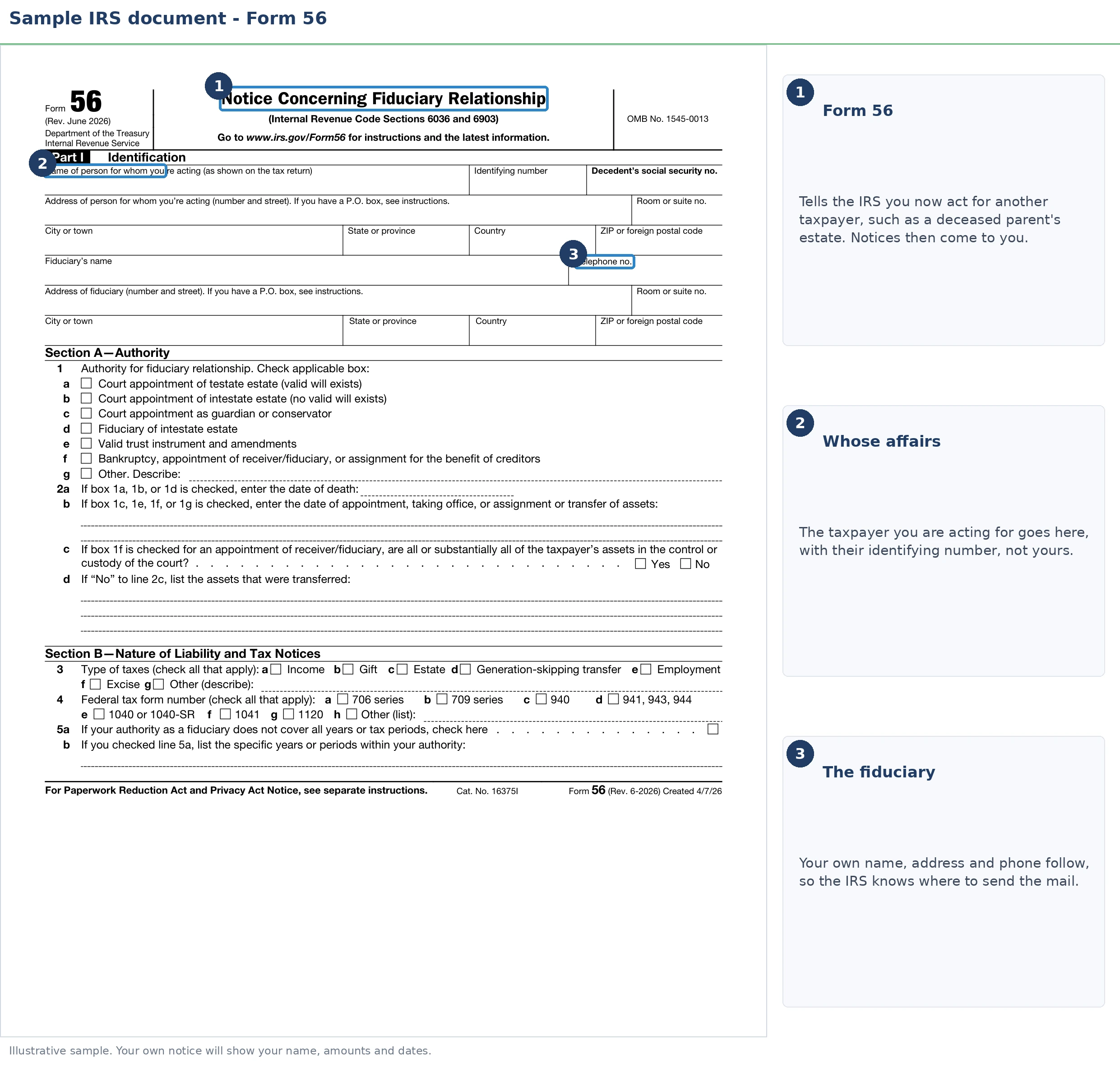
It's also one of the most misunderstood. People confuse it with a power of attorney, skip it because "the IRS will figure it out," or file it years too late — after notices they never saw have already escalated. The image below shows exactly what Form 56 looks like and where the key entries sit, so you can orient yourself before touching your own copy.
⏱ Your real clock: Form 56 has no printed deadline — but the IRS's clocks don't wait for it. Notices mailed to the taxpayer's last known address are legally effective, response windows run whether anyone reads the mail or not, and penalties and interest on any unpaid balance accrue monthly. File Form 56 as soon as your authority is official.
What Form 56 actually does — and what it doesn't
Form 56 notifies the IRS, under section 6903 of the tax code, that a fiduciary relationship has been created or terminated — that someone now legally stands in a taxpayer's shoes. A fiduciary, in IRS terms, is a person who takes on both the taxpayer's duties (filing, responding, paying from their assets) and their rights (receiving notices, contesting bills, claiming refunds). The same form also serves a second purpose: giving notice of qualification under section 6036, which applies to certain court-appointed roles like receivers.
Just as important is what Form 56 does not do. It doesn't create your authority — the probate court, the trust document, or the guardianship order does that. Form 56 simply tells the IRS the authority exists, so the agency's automated systems route the taxpayer's mail and account matters to you. It also doesn't move the debt onto your personal account, and it isn't a power of attorney (more on that distinction below).
The form itself is short — identification lines and checkboxes, not calculations. There's a separate version, Form 56-F, used only when a fiduciary such as a receiver takes over a financial institution. If you're handling a parent's estate, a trust, or a ward's affairs, the standard Form 56 is your form. And if the account you're taking over already has a balance, start with our guide to what happens when an estate owes IRS back taxes — this article covers the notice piece; that one covers resolving the debt.
Who files Form 56 — and when
Five kinds of fiduciaries commonly file Form 56, and each files it twice: once when the relationship begins, and again when it ends. The most common by far is the executor or administrator of a deceased person's estate — the person who will also handle the decedent's final return and any balance due on it. Trustees of a trust that owes back taxes are the second most common.
| Fiduciary | Event that starts it (file Form 56) | Event that ends it (file a termination Form 56) |
|---|---|---|
| Executor or administrator of an estate | Court appointment — letters testamentary or letters of administration — or otherwise taking on the duties of personal representative | The estate is closed and the fiduciary is discharged |
| Trustee | The trust takes effect, or you succeed a prior trustee | The trust terminates, or a successor trustee takes over |
| Guardian or conservator | A court appoints you over a person or their property | The guardianship or conservatorship ends by court order |
| Receiver | A court appoints a receiver (this is also a section 6036 qualification event — the instructions explain the notice requirement) | The receivership is dissolved |
| Assignee for the benefit of creditors | The assignment of the debtor's assets is executed | The assignment concludes and assets are distributed |
The termination filing matters more than people expect. Until the IRS receives notice that your role ended, its systems can keep treating you as the responsible party for that taxpayer's account — which means the mail, and the obligations that come with it, keep landing on you after your job is done.
What happens if you don't file Form 56
Until the IRS receives Form 56, every notice about the taxpayer's account is still legally effective when mailed to their last known address — even when the taxpayer has died. The collection machine doesn't pause for probate, and it doesn't know the mailbox is empty. For an estate with an unpaid balance, silence plays out in a predictable sequence:
- Balance-due bills go to the decedent. First notices land at your father's old address. Whether anyone opens them changes nothing about their legal effect.
- Reminders follow, and the balance grows. The failure-to-pay penalty adds 0.5% of the unpaid tax each month, plus interest, while the automated notice sequence advances.
- Intent-to-levy notices arrive unread. A CP504-stage notice lets the IRS take a state tax refund; the final notice of intent to levy starts a 30-day clock toward levy action against estate assets — with appeal rights nobody exercises because nobody saw the letter.
- A lien can attach to estate property. A federal tax lien after death can complicate selling the house or distributing anything to heirs.
- You distribute assets and inherit the risk. An executor who pays out the estate while known federal tax debts go unpaid can face executor personal liability to the IRS, up to the value of what was distributed.
One more thing silence doesn't change: the debt itself doesn't vanish. IRS debt after death becomes a claim against the estate, and the 10-year collection statute keeps running against it. If you're sorting through this for the first time, our guide for when a parent died owing taxes walks through the whole picture beyond the notice problem.
What silence costs: a worked example
Say your father died owing the IRS $11,200 — $10,400 in tax plus $800 in penalties and interest already assessed. The failure-to-pay penalty runs 0.5% of the unpaid tax per month: 0.005 × $10,400 = about $52 a month, with interest compounding on top. Nine months of mail piling up at his old address adds roughly $468 in penalties alone (9 × $52), and by then the automated sequence has moved from a first bill toward intent-to-levy territory — against an estate that could have set up a payment arrangement in month one.
Filing Form 56 in that first month wouldn't have stopped the accrual by itself. But it would have put every notice in your hands while the options — paying from estate funds, a payment plan, penalty relief — were all still cheap and open. You can estimate how fast a balance like this grows with our IRS Penalty & Interest Calculator.
Found IRS letters addressed to someone who's gone?
The balance behind those envelopes is growing monthly, and the collection sequence doesn't pause for probate. Send us what you found — an experienced tax professional will decode where the estate's account stands and what to do first. Free and confidential: the 2-minute form or (888) 825-7779.
Form 56 vs Form 2848 vs Form 8822: which one you actually need
Form 56 makes you the taxpayer in the IRS's eyes; Form 2848 hires someone to speak for a taxpayer; Form 8822 just changes where mail goes. People mix these up constantly, and the mix-up has a real consequence: a Form 2848 signed by the wrong person does nothing, because only the fiduciary can sign a power of attorney for a deceased taxpayer — and the IRS learns who the fiduciary is from Form 56.
| Form | What it tells the IRS | Effect on IRS notices | Who acts for the taxpayer |
|---|---|---|---|
| Form 56 — Notice Concerning Fiduciary Relationship | A fiduciary now legally stands in the taxpayer's place under section 6903 | Notices about the taxpayer's account go to the fiduciary | The fiduciary — they take on the taxpayer's duties and rights |
| Form 2848 — Power of Attorney | A representative has been appointed for specific tax matters | The representative gets copies; the taxpayer (or fiduciary) still gets the originals | The representative, within the authority granted — signed by a living taxpayer or by the fiduciary |
| Form 8822 — Change of Address | The taxpayer's mailing address changed | Mail goes to a new address — but to the same person | No one new; it changes where mail goes, not who acts |
In practice, an executor often ends up filing two of these. First Form 56, so the IRS recognizes her as the estate's fiduciary. Then, if she wants an experienced tax professional handling the IRS calls and correspondence, she signs a power of attorney for the estate — our Form 2848 instructions guide covers that step. If the professional only needs to see the account rather than represent it, a Form 8821 information authorization is the lighter option. Form 8822 rarely enters the picture for a decedent, because Form 56 already redirects the mail to the fiduciary.
How to file Form 56, step by step
Filing Form 56 is a one-sitting task once your appointment paperwork is in hand. The official form and its instructions live on the IRS's About Form 56 page — always work from the current version, because the details below the form's face (including where to send it) come from the instructions, not printed on the form itself.
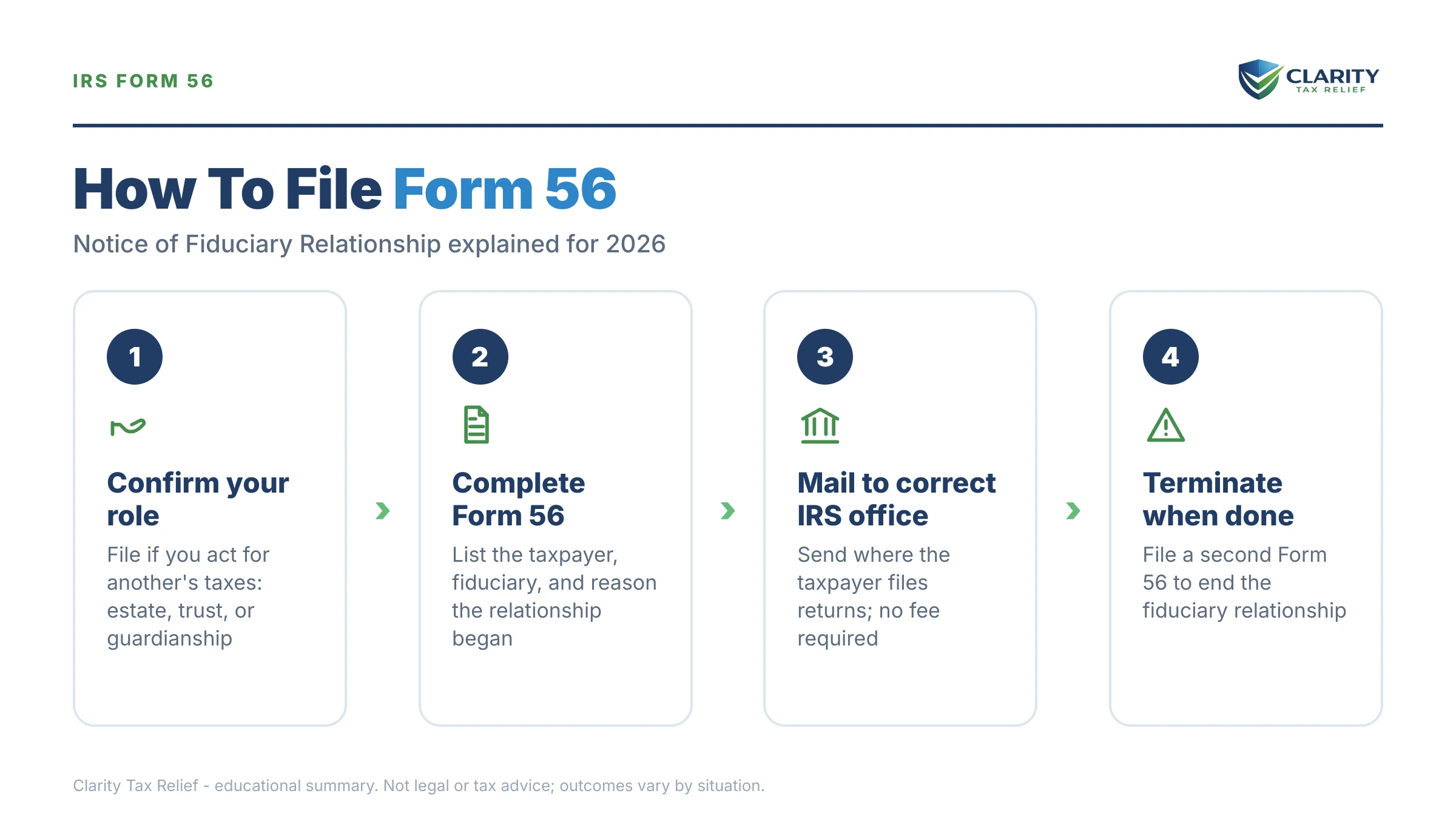
- Confirm your legal authority. Gather the document that makes you the fiduciary — letters testamentary or a court appointment for an estate, the trust instrument for a trust, or the court order for a guardianship or receivership.
- Download the current Form 56 and its instructions. Get both from IRS.gov. The instructions carry the filing address and the checkbox details the form itself doesn't explain — never work from an old copy.
- Complete the identification sections. Enter the taxpayer's name and identification number exactly as the IRS has them, then your own name and address, and mark the type of fiduciary relationship and the event that created it as the instructions direct.
- Send the form where the instructions specify. The filing address is not printed on the form — use the one in the current instructions, include whatever evidence of your authority the instructions call for, and keep copies plus proof of mailing.
- File a termination Form 56 when your duties end. When the estate closes or the relationship otherwise ends, file a new Form 56 noting the termination so IRS mail for that taxpayer stops coming to you.
Two practical notes. Filing Form 56 does not by itself answer any notice — if a bill or intent-to-levy letter is already sitting in that stack of mail, it still needs its own response on its own clock. And if the estate's IRS matter involves a lien, Publication 4235 lists the IRS Collection Advisory Group offices that handle lien and estate collection questions.
When you can handle Form 56 yourself — and when to get help
Form 56 itself is a do-it-yourself form for almost everyone. It's a notice, not a negotiation: if you have your appointment papers and the taxpayer's identification number, you can complete and send it without help. The same is true if the account behind it is clean — no balance due, returns all filed, maybe a refund coming to the estate.
Experienced help changes the outcome when the account is not clean. That looks like: an estate balance the assets can't easily cover, several unfiled years for the decedent that have to be reconstructed, an intent-to-levy or lien notice already in the stack, or an estate-tax bill the estate can't pay — see our guide to Form 706 when the estate can't pay.
In those cases, the sequence you fix things in (filings first, then penalties, then the balance) changes what the estate ultimately pays — and it changes your exposure before you distribute anything to heirs. If the estate is small and money is tight, the Taxpayer Advocate Service is also a legitimate free resource when the IRS process itself breaks down.
Terms on the form, decoded
- Fiduciary — a person who legally acts for another taxpayer, taking on both their IRS duties and their rights.
- Section 6903 — the tax-code provision under which Form 56 gives the IRS notice that a fiduciary relationship was created or terminated.
- Section 6036 — the provision requiring notice of qualification for certain court-appointed roles, such as receivers; Form 56 serves this notice too.
- Letters testamentary — the probate court document appointing an executor and proving their authority over an estate.
- Last known address — the address in IRS records; mail sent there is treated as legally delivered, which is exactly why Form 56 matters.
- Publication 4235 — the IRS directory of Collection Advisory Group offices, the unit that handles lien and estate collection questions.
Form 56 questions, answered
Do I have to file Form 56 when a parent dies?
File it as soon as you are formally appointed to act for the estate. Form 56 is how the IRS learns, under section 6903, that you now stand in your parent's place — without it, the IRS keeps mailing notices to your parent's last known address, and those notices are legally effective even though no one is acting on them. If the estate has any IRS balance, refund, or unfiled return, filing Form 56 first protects you.
What is the difference between Form 56 and Form 2848?
Form 56 tells the IRS you are the taxpayer's fiduciary — you legally stand in their shoes, receive their notices, and sign for them. Form 2848 is a power of attorney that appoints a representative, such as an enrolled agent or attorney, to deal with the IRS on a taxpayer's behalf. For a deceased person, the fiduciary named on Form 56 is the one who can sign a Form 2848 to hire that representative.
Where do I mail Form 56?
The filing address is not printed on the face of the form — it is listed in the current Form 56 instructions on IRS.gov, and it depends on your situation. Always download the latest instructions before sending, because IRS filing addresses change. Keep a copy of the completed form and proof of mailing with the estate's records.
Is there a deadline for filing Form 56?
There is no fixed statutory deadline printed on Form 56, but the practical deadline is immediately after your authority begins. Every IRS notice mailed to the taxpayer's last known address before you file is still legally valid, so response windows on bills, levies, and audits run whether or not anyone reads the mail. Penalties and interest on any unpaid balance also keep accruing monthly.
Does filing Form 56 make me personally liable for the tax debt?
No — Form 56 only gives the IRS notice that you act as fiduciary; it does not transfer the debt to you. Personal liability is a separate risk: an executor who distributes estate assets while known federal tax debts go unpaid can be held personally responsible up to the value of what was distributed. Filing Form 56 actually reduces that risk, because you will see the notices before you distribute anything.
How do I terminate a fiduciary relationship with the IRS?
You file another Form 56 indicating the relationship has ended — for example, when the estate closes and you are discharged, when a trust terminates, or when a guardianship ends. Section 6903 covers both the creation and the termination of a fiduciary relationship. Until the IRS receives the termination notice, it may keep treating you as the person responsible for that taxpayer's mail and filings.
What is Form 56-F?
Form 56-F is the financial-institution version: Notice Concerning Fiduciary Relationship of Financial Institution. It is used when a fiduciary — typically a receiver such as the FDIC — takes over a bank or similar institution. Individuals acting for an estate, trust, or ward use the standard Form 56, not the 56-F.
Your next 24 hours
- Sort the IRS letters by date. On the most recent one, find the notice date, the tax year, and the amount due — those three items tell you how far along the sequence the account already is.
- Gather your paperwork. Your letters testamentary or court appointment, the death certificate, your father's last filed return, and every IRS envelope — opened or not.
- Get the estate's account reviewed free. Use the 2-minute form or call (888) 825-7779. Penalties and interest are accruing monthly on any balance while those notices sit unanswered — the review tells you what to file first and what each option would cost the estate.
This guide is general information, not tax or legal advice for your specific situation. Eligibility for IRS programs depends on individual facts and circumstances; no outcome is guaranteed.