
IRS Forms
IRS Form 5695: Residential Energy Credits Explained for 2026 Filing
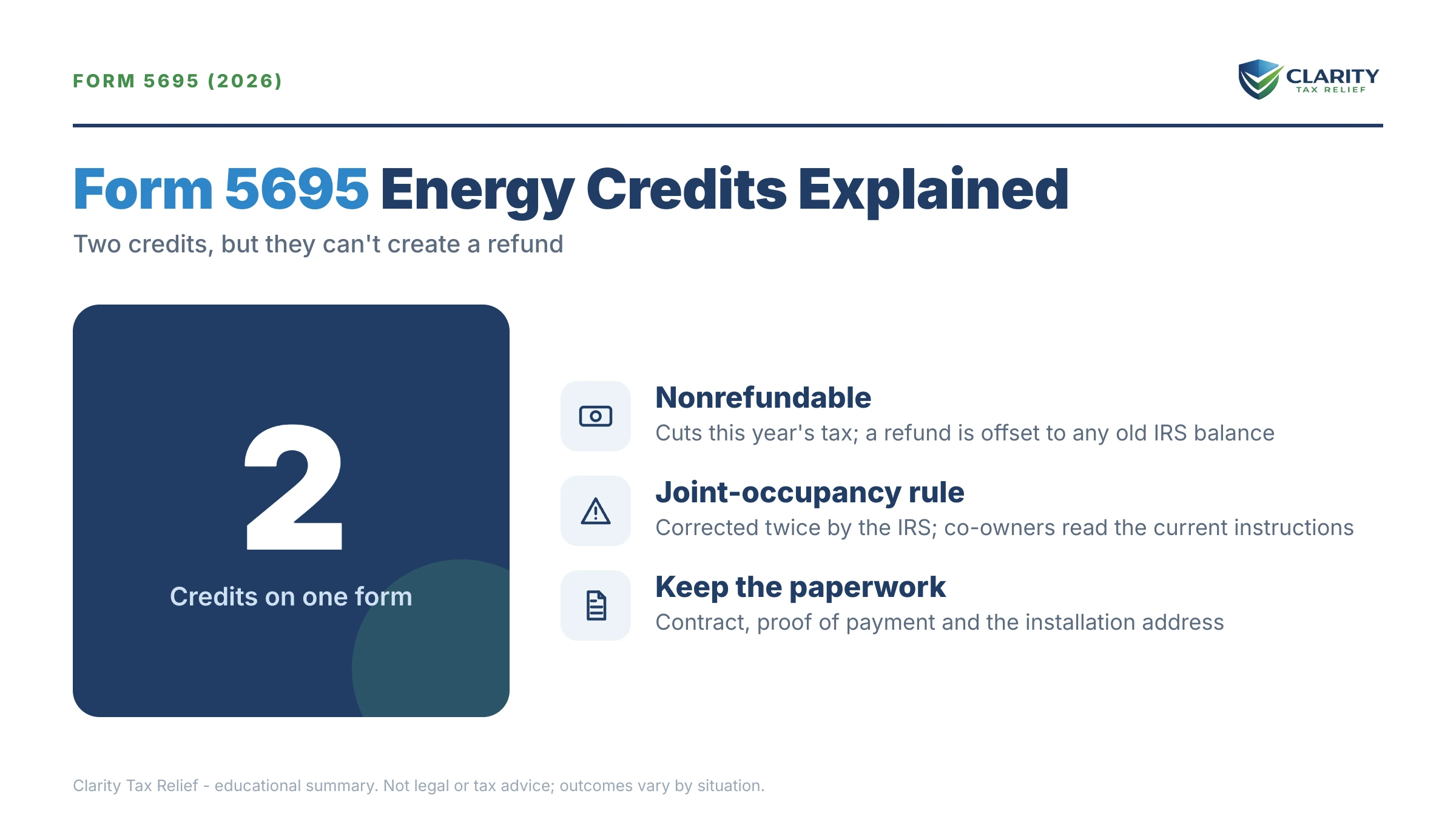
The short answer: IRS Form 5695 figures and claims the two residential energy credits. Part I is the Residential Clean Energy Credit (solar, geothermal, wind, battery storage, fuel cells) at 30% of cost with no dollar cap except for fuel cells. Part II is the Energy Efficient Home Improvement Credit (insulation, windows, doors, heat pumps, audits) at 30% of cost, capped at $3,200 a year. Under the 2025 instructions, neither credit is available for expenditures or property after December 31, 2025, so the 2025 return you file in 2026 is the last one most people will put this form on. Both credits are nonrefundable, and if you owe the IRS from a prior year, any refund they unlock is offset to that balance first.
This guide covers the whole path: which credit your project falls under, the current percentages and caps, which tax years still qualify after the 2025 law change, how to fill out each part of the form, the carryforward rules, and what the IRS does with the refund your credit creates.
You signed for $24,000 of rooftop solar because the installer said a big federal credit would come back at tax time, and somewhere in a drawer sits an IRS notice for a year you still owe. Both things are real, and they meet on the same return.
Every rate, cap and date below was checked against the IRS pages for the two credits and the 2025 Instructions for Form 5695 on irs.gov on October 5, 2026. Where the IRS has not published a figure, this guide says so instead of guessing.
⏱ The real clock here: Form 5695 has no deadline of its own; it files with your return. The date that matters is December 31, 2025. Per the 2025 instructions, Residential Clean Energy Credit expenditures made after that date and Energy Efficient Home Improvement property placed in service after that date do not qualify. And if you carry an old IRS balance, it grows every month: the failure-to-pay penalty accrues at 0.5% per month, plus interest. No energy credit pauses that.
What is IRS Form 5695?
Form 5695 is the IRS form you attach to Form 1040 to figure and take your residential energy credits. It has two parts, and each part is a different credit with different qualifying property, different math, and different treatment of any unused amount.
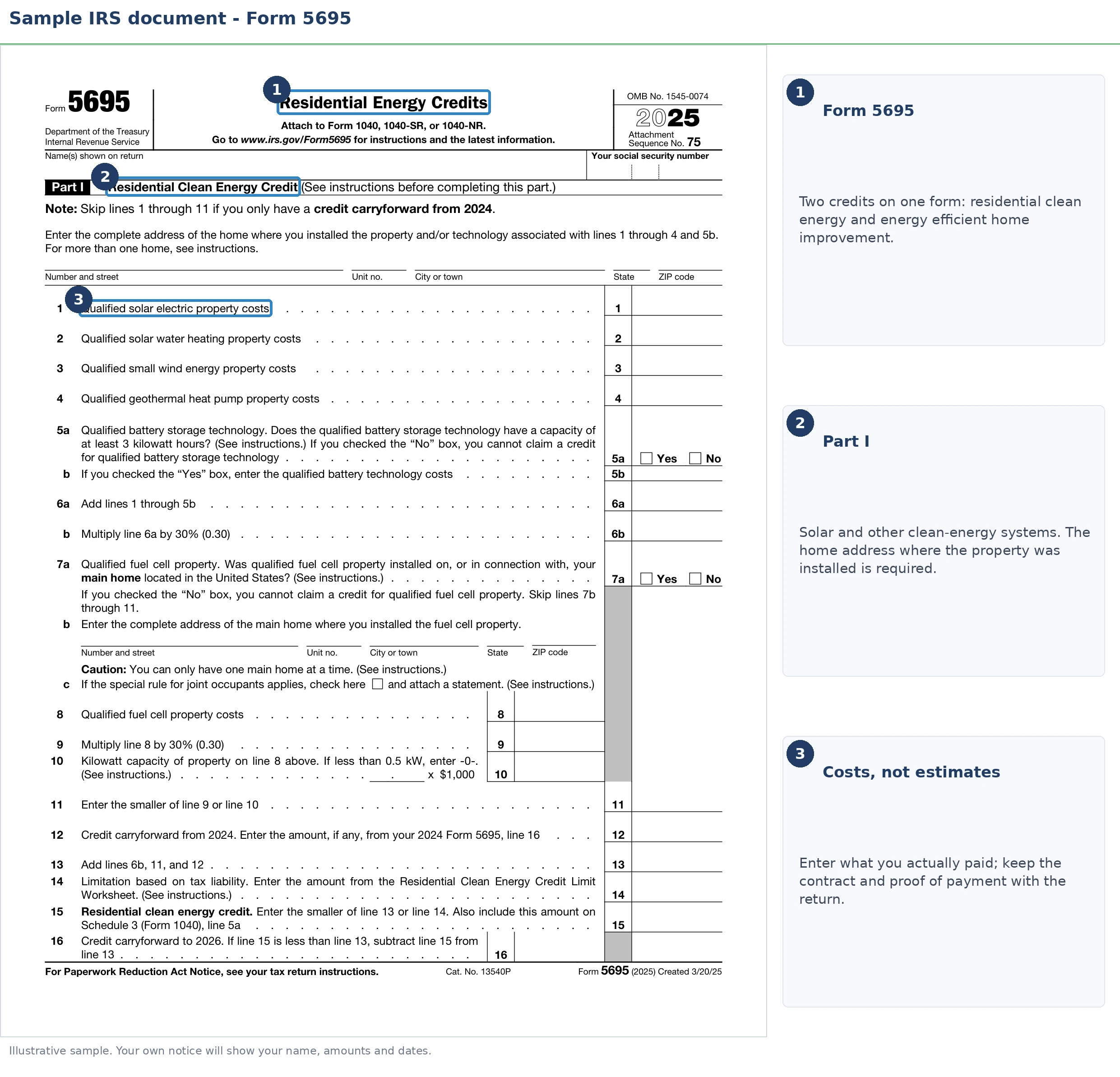
Part I is the Residential Clean Energy Credit. It covers systems that generate or store clean energy: solar electric panels, solar water heating, small wind turbines, geothermal heat pumps, battery storage of at least 3 kilowatt hours, and fuel cells. Part II is the Energy Efficient Home Improvement Credit. It covers upgrades that make an existing home use less energy: insulation and air sealing, exterior doors, windows and skylights, certain heat pumps, water heaters, furnaces, boilers and central air, electrical panel upgrades, and home energy audits.
A $24,000 rooftop solar system belongs in Part I. That matters beyond bookkeeping, because unused Part I credit carries forward to the next year while unused Part II credit is lost.
| Feature | Residential Clean Energy Credit (Part I) | Energy Efficient Home Improvement Credit (Part II) |
|---|---|---|
| Credit rate | 30% of qualified costs | 30% of qualified costs |
| Annual dollar limit | None, except fuel cells: $500 per half kilowatt of capacity ($1,667 per half kilowatt combined if more than one person lives in the home) | $3,200 total per year: up to $1,200 for building envelope items, other energy property and audits, plus up to $2,000 for heat pumps, heat pump water heaters, biomass stoves and boilers |
| Tax years covered | Property installed 2022 through December 31, 2025. No credit for expenditures made after December 31, 2025 | Property placed in service January 1, 2023 through December 31, 2025. No credit for property placed in service after December 31, 2025 |
| Unused credit carries forward? | Yes. The 2025 instructions carry the unused portion (line 16) to 2026 | No. Anything above your tax for the year is lost |
| Refundable? | No. Reduces tax to zero at most | No. Reduces tax to zero at most |
| Whose home | Homeowners and renters in a main home; limited use for a second home you do not rent out; landlords cannot claim it | An existing home you improve, used as your main residence; not new construction; landlords cannot claim it |
| Ownership | You must own the system. Leases and power purchase agreements generally do not qualify | Starting with property placed in service in 2025, each item must come from a qualified manufacturer and its QMID goes on the form |
Which tax years does IRS Form 5695 still apply to?
The short version: 2025 is the last year for both credits. The "What's New" section of the 2025 Instructions for Form 5695 states that you cannot claim residential clean energy credits for expenditures made after December 31, 2025, and cannot claim energy efficient home improvement credits for expenditures or property placed in service after December 31, 2025. The instructions cite Public Law 119-21 for the change. The IRS credit pages say the same thing: the Residential Clean Energy Credit is not available for property placed in service after December 31, 2025, and the Energy Efficient Home Improvement Credit applies to property placed in service from January 1, 2023 through December 31, 2025.
Before that law, the clean energy credit was scheduled to run at 30% through 2032 and phase down to 26% in 2033 and 22% in 2034. Older IRS FAQ pages and a lot of installer material still show that schedule. It no longer controls. If your system was installed in 2026, the 2025 instructions say there is no federal credit for it, and this guide will not pretend otherwise.
What that means in practice for the return you file in 2026:
- Solar, geothermal, wind, battery or fuel cell costs from 2025 go on Part I of the 2025 Form 5695.
- Insulation, windows, doors, heat pumps, water heaters and audits placed in service in 2025 go on Part II of the 2025 form, each with its qualified manufacturer code.
- A project from 2022, 2023 or 2024 you never claimed is still claimable by amending that year's return with that year's form, subject to the refund statute covered below.
- Unused Part I credit from 2025 is carried to 2026 per line 16 of the 2025 form. Whether the IRS publishes a 2026 form that continues the carryforward beyond that is not something irs.gov states as of October 5, 2026; check the 2026 instructions when they are released.
What qualifies for the Residential Clean Energy Credit in Part I?
Part I is 30% of what you paid for qualified property, including labor for on-site preparation, assembly and installation, and the wiring or piping that connects it to the home. Per the IRS credit page, there is no annual or lifetime dollar limit except for fuel cells. Qualifying property for the 2025 form:
- Line 1: qualified solar electric property (panels and related equipment).
- Line 2: qualified solar water heating property.
- Line 3: qualified small wind energy property.
- Line 4: qualified geothermal heat pump property.
- Line 5: qualified battery storage technology, which must have a capacity of at least 3 kilowatt hours.
- Line 8: qualified fuel cell property, limited to $500 for each half kilowatt of capacity.
The form adds those costs, multiplies by 30%, adds any carryforward from the prior year, and then runs the total against your tax liability limit on line 14. Whatever the limit cuts off becomes the line 16 carryforward.
Two eligibility points trip people up. First, you must own the system; a lease or power purchase agreement leaves ownership with the solar company. Second, the home has to be one you live in. The IRS page says homeowners and renters in their main residence can claim it, that there is limited eligibility for a second home you do not rent to others, and that landlords cannot claim it for a home they do not live in.
What qualifies for the Energy Efficient Home Improvement Credit in Part II, and what are the caps?
Part II is also 30% of cost, but every category has its own cap and the whole thing is capped at $3,200 for the year. The $3,200 is really two buckets: a $1,200 bucket for building envelope components, residential energy property and home energy audits, and a separate $2,000 bucket for heat pumps, heat pump water heaters, and biomass stoves or boilers. You can use both buckets in the same year.
| Item | Form 5695 section | Annual cap | Counts toward |
|---|---|---|---|
| Insulation and air sealing materials | Part II, Section A | Shares the $1,200 bucket; no separate item cap listed | $1,200 bucket |
| Exterior doors | Part II, Section A | $250 per door, $500 for all doors | $1,200 bucket |
| Exterior windows and skylights | Part II, Section A | $600 for all windows and skylights | $1,200 bucket |
| Central air conditioners, water heaters, furnaces and boilers (non heat pump), electrical panel upgrades | Part II, Section B | $600 per item | $1,200 bucket |
| Home energy audit | Part II, Section B | $150 | $1,200 bucket |
| Heat pumps and heat pump water heaters | Part II, Section B | $2,000 per year, combined with biomass | $2,000 bucket |
| Biomass stoves and boilers | Part II, Section B | $2,000 per year, combined with heat pumps | $2,000 bucket |
| Everything combined | Part II total | $3,200 per year | Both buckets |
Three rules that apply across Part II. The home must be an existing home you improve or add onto, used as your main residence; new construction does not qualify, and neither does a home you rent out and do not live in. For property placed in service in 2025, no credit is allowed unless the item was produced by a qualified manufacturer, and you must enter the four-character qualified manufacturer identification number (QMID) for each item on the form; keep the manufacturer's certification with your records rather than attaching it. And a home energy audit only counts if it is conducted by, or supervised by, a Qualified Home Energy Auditor certified by a Qualified Certification Program, with a written report that includes the auditor's name and taxpayer identification number and the name of the certification program.
How to fill out IRS Form 5695, step by step
- Sort your receipts into Part I and Part II. Solar, solar water heating, wind, geothermal, battery storage and fuel cells go in Part I. Insulation, doors, windows, skylights, HVAC, water heaters, panel upgrades and audits go in Part II. Putting an item in the wrong part is the most common mistake on this form.
- Confirm the date. Part I expenditures must have been made by December 31, 2025. Part II property must have been placed in service by December 31, 2025. The contract date and the payment date are not the test.
- Part I, lines 1 through 8: enter the cost of each category on its line, including installation labor. Enter fuel cell capacity so the form can apply the $500 per half kilowatt limit. Add any carryforward from your prior-year Form 5695.
- Part I, line 14: figure your tax liability limit using the worksheet in the instructions. Line 15 is the credit you can use this year; line 16 is what carries to next year.
- Part II, Section A: enter building envelope costs (insulation, doors, windows, skylights) with the QMID for each door, window and skylight placed in service in 2025. Apply the per-door, all-doors and all-windows caps.
- Part II, Section B: enter residential energy property (heat pumps, water heaters, furnaces, boilers, central air, panel upgrades) and the audit, each with its QMID where required. The form applies the $600 per item, $150 audit and $2,000 heat pump and biomass limits, then the $3,200 overall cap.
- Carry both results to Schedule 3 of Form 1040 and attach Form 5695. If you share the home with someone other than a spouse filing jointly, complete the joint occupancy section and keep a written record of how costs were split.
Missed the credit in a year you already filed? You can generally amend with Form 1040-X using that year's version of Form 5695. Refund claims generally must be filed within three years of the original return, or two years of paying the tax, whichever is later.
What does a nonrefundable credit mean when you owe the IRS?
A nonrefundable credit can take your tax for the year down to zero, but it never pays out beyond the tax you owe for that year. That one word is where most of the confusion about Form 5695 and back taxes lives, so here is the money's actual path.
First, the credit reduces your current-year tax. Then your payments for the year, withholding and estimated payments, are compared against that reduced tax. If you paid in more than you now owe, the difference is an overpayment, and overpayments are refundable.
If you have an unpaid balance from a prior year, the IRS intercepts that refund before it reaches you and applies it to the old debt. You get a CP49 notice showing which year the money went to. This happens automatically and it repeats every year you carry a balance. If the balance started with a CP14 notice you set aside, that balance is what the offset will hit.
Three things the credit does not do for someone with an old balance:
- It does not post against the old year directly. The credit lives entirely on the current return; only the resulting refund touches the old debt, via offset.
- It does not stop penalties and interest. The failure-to-pay penalty (0.5% per month) and interest keep accruing until the offset posts. You can estimate how fast your old balance is growing with our penalty and interest calculator.
- It does not replace a payment plan. If the offset will not clear the balance, collection notices continue on whatever remains. The credit bought you a dent, not a resolution.
What happens when a $24,000 solar system meets a $3,100 IRS balance?
Here is the whole interaction in one hypothetical scenario, with the arithmetic shown. Say you financed a $24,000 rooftop solar system and it was installed and paid for in 2025. At 30%, Part I produces a $7,200 Residential Clean Energy Credit. You also owe the IRS $3,100 (tax, penalties and interest) from an old year.
Suppose your 2025 tax before the credit is $6,500 and your paychecks withheld $6,800 during the year. Because the credit is nonrefundable, only $6,500 of it is usable this year, enough to zero out your tax. The remaining $700 carries to line 16 and onto next year's Form 5695. Your $6,800 of withholding is now a $6,800 overpayment. The IRS takes $3,100 of it for the old balance and releases $3,700 to you.
| Step in the math | Amount | What it means |
|---|---|---|
| 2025 tax before the credit | $6,500 | The ceiling on how much credit you can use this year |
| Form 5695 Part I credit (30% of $24,000) | $7,200 | No dollar cap on solar |
| Credit usable in 2025 | $6,500 | Nonrefundable, limited to the tax it can erase |
| Credit carried forward to 2026 | $700 | Part I only; a Part II credit would be lost |
| Tax after the credit | $0 | The credit did its full job for this year |
| Withholding paid in during 2025 | $6,800 | Now an overpayment, since tax is $0 |
| Offset to the old IRS balance | −$3,100 | Taken automatically; a CP49 notice confirms it |
| Refund that actually reaches you | $3,700 | $6,800 − $3,100 |
Notice what did the paying here: your own withholding, unlocked by the credit. And notice what the credit did not touch, the penalties and interest that accrued on the $3,100 before the offset posted. Those were baked into the balance already. Removing penalties themselves is a separate request, covered below.
Can you carry forward unused Form 5695 credit?
The two parts treat leftover credit in opposite ways. For Part I, the 2025 instructions say that if you cannot use all of the credit because of the tax liability limit (line 14 is less than line 13), you carry the unused portion to 2026. The IRS credit page says the same: excess unused credit can be carried forward and applied against tax in future years. The carryforward goes on next year's Form 5695, so you need to file the form again even if you bought nothing new.
For Part II there is no carryforward. The IRS page is direct: you cannot apply any excess credit to future tax years. If your tax for the year is $900 and your Part II credit is $1,200, the extra $300 is gone.
One open question. The 2025 form carries Part I credit to 2026. Whether that carryforward keeps rolling into 2027 and beyond under the new law is not addressed on the IRS pages checked for this guide, and the 2026 instructions had not been published on irs.gov as of October 5, 2026. If you have a large carryforward, plan around using it on the 2026 return and watch for the 2026 instructions.
What happens if you claim Form 5695 wrong?
The IRS can adjust a Form 5695 credit during return processing without ever opening an audit, and a disallowed credit becomes a new balance stacked on top of your old one. The stages run in this order:
- Math-error adjustment. If the form's own arithmetic or limits do not hold up, the IRS recalculates during processing and sends a CP12 or CP11 notice with a changed refund, or a balance due.
- Documentation request. The IRS can ask you to substantiate the credit: invoices, ownership, placed-in-service date, manufacturer certifications and QMIDs. No records, no credit.
- Disallowance. An unsupported credit is removed, the tax it erased comes back, and an accuracy-related penalty is possible on top.
- Collection. The new balance merges with your old one and rides the same automated notice sequence every unpaid balance does, with interest compounding throughout. You can follow it on your account transcript; our IRS transcript codes guide decodes what you see there.
The three most common ways people land in stage one: claiming a leased solar system they do not own, claiming 2026 property that no longer qualifies, and splitting the credit wrong between unmarried co-owners, the joint-occupancy trap covered next.
Claiming a solar credit on a return that carries an old IRS balance?
Have both reviewed together, free, before you file. An experienced tax professional can tell you what the offset will take, what will actually land in your account, and whether penalty relief can shrink the old balance first. Interest on that balance accrues monthly either way.
How do co-owners split the credit?
If you share or co-own the home with someone other than a spouse you file jointly with, the split calculation is the most error-prone part of Form 5695. The IRS itself has had to fix the published rules twice. It issued a clarification to the 2023 instructions for joint occupants on May 3, 2024, and then a correction to the 2025 instructions' joint occupancy calculation on January 23, 2026. Both notices sit on the About Form 5695 page.
The rule in the 2025 instructions: each occupant completes their own Form 5695, and each occupant's share is based on what they paid relative to the total paid. For fuel cells, the combined qualifying cost for all occupants is capped at $1,667 per half kilowatt. For Part II, occupants check a box and attach a statement explaining the split.
The practical consequence: any article, tax-software prompt, worksheet or installer handout written before those correction dates may describe a superseded method. This applies to unmarried couples who co-own, siblings sharing an inherited house, parents and adult children on the same deed, and married couples filing separately. Read the joint-occupancy section of the current instructions before splitting a dollar, and keep a written record of how you divided the cost.
What are your options when the credit meets an old IRS balance?
The smartest move is to sequence the credit and the old debt deliberately instead of letting the offset surprise you. Your realistic options:
- Let the offset work for you. If the refund your credit unlocks covers the old balance, as in the example above, filing accurately may resolve the debt in one pass. Verify your true payoff first, because the balance on an old notice has grown since it printed.
- Set up a payment plan for what the offset will not cover. Balances up to $50,000 can generally go on a plan of up to 72 months set up online; short-term plans give up to 180 days with no setup fee. Run the numbers first with our IRS payment plan calculator to see what a monthly payment on the remaining balance looks like. Know going in that the IRS keeps your refunds while you are on an installment agreement, your energy-credit refund included.
- Shrink the old balance with penalty relief first. If your prior three years were clean, first-time penalty abatement can remove failure-to-pay penalties. A smaller balance means the offset takes less of your refund. The IRS Fresh Start program page explains how penalty relief, payment plans and offers fit together.
- Hardship cases: an offset bypass. If losing the refund would create real economic hardship, an offset bypass refund is sometimes possible for federal tax offsets, but only if requested before the refund posts, which means acting before you file.
What documentation should you keep, and for how long?
Keep every Form 5695 record for at least as long as the credit affects any return, which with a carryforward can be years. For a financed $24,000 system, that file should hold:
- The signed installation contract showing you own the system. This is the single document that separates a valid claim from a disallowed one on leased panels.
- Itemized invoices separating qualifying equipment and installation from anything that does not qualify.
- Your financing agreement. Financing generally does not disqualify you, since you own the system and are paying over time, but keep the paperwork proving the structure is not a lease or power purchase agreement.
- Proof of the placed-in-service or completion date: the commissioning report, utility interconnection approval, or permission-to-operate letter. For 2025 property, this is what proves you made the December 31, 2025 cutoff.
- Manufacturer certification statements and the QMID for each Part II item placed in service in 2025. The instructions say not to attach the certification; keep it for your records.
- For a home energy audit, the written report with the auditor's name, taxpayer identification number and certification program.
- If you split the credit with a co-owner: a written record of the division and which instruction year's method you used.
Red flags to check before you file
Most Form 5695 problems trace back to one of these:
- The solar system is leased or under a power purchase agreement, so the solar company owns it.
- The property was placed in service in 2026, after the December 31, 2025 cutoff.
- A Part II item has no QMID entered on the form.
- An item sits in the wrong part of the form.
- You co-own the home with someone other than a spouse filing jointly and used a split method from before the IRS corrections.
- You owe the IRS for a prior year and have not priced in the refund offset.
Can you handle Form 5695 yourself?
Most people with a straightforward claim do not need professional help for the form itself. Handle it yourself if you solely own the system, you are the only taxpayer claiming it, your software walks you through the 2025 form, and you either owe the IRS nothing or the offset outcome is one you have already priced in.
Experienced help changes the outcome in fewer cases: an old balance large enough that the offset will not clear it (sequencing penalty relief and a payment plan matters), unmarried co-owners splitting the credit after two rounds of IRS corrections, a credit already disallowed by a math-error notice you disagree with, or unfiled prior years that will freeze this refund anyway. In those cases the order you fix things in changes what you pay. That is judgment, not data entry. If you are trying to sort it out by phone, our study of 188 IRS calls shows what the hold times look like before you dial.
What do the terms on Form 5695 mean?
- Nonrefundable credit: a credit that can reduce your tax for the year to zero but never pays out beyond that.
- Carryforward: unused Residential Clean Energy Credit that rolls to next year's Form 5695 (line 16) instead of vanishing.
- Placed in service: the date your property is installed and ready for use; it controls which year's rules apply and whether you made the December 31, 2025 cutoff.
- QMID: the four-character qualified manufacturer identification number required on Part II for items placed in service in 2025.
- Refund offset: the IRS applying your refund to an unpaid tax balance before sending you the remainder (confirmed by a CP49 notice).
- Joint occupancy: the rules for dividing the credit when unmarried co-owners or co-occupants share the qualifying costs; corrected twice by the IRS, so use only the current instructions.
Note the neighbors, so you do not file the wrong form: a clean vehicle credit goes on Form 8936, not Form 5695, and the mortgage interest credit goes on Form 8396. Publication 530 (Tax Information for Homeowners) and Publication 17 cover the surrounding homeowner tax rules.
Common questions
Is the Form 5695 credit refundable?
No. Both credits on Form 5695 are nonrefundable, meaning they can reduce your income tax for the year to zero but never pay out beyond that. Unused Residential Clean Energy Credit carries forward to the next year, and unused Energy Efficient Home Improvement Credit does not. If your withholding exceeds your tax after the credit, that overpayment is refundable, and if you owe the IRS for a prior year, it is offset to that balance first.
Do I qualify if I financed my solar system instead of paying cash?
Financing generally does not disqualify you, because you own the system and are paying for it over time. The key distinction is ownership: with a lease or a power purchase agreement, the solar company owns the panels, and the homeowner typically cannot claim the credit. Check your contract's ownership language and the 2025 Form 5695 instructions before assuming either way.
What if I forgot to claim Form 5695 in a prior year?
You can generally file Form 1040-X to amend that year's return and add the credit, using the Form 5695 version for the year the property was placed in service, not the current year's form. Refund claims generally must be filed within three years of the original return (or two years of paying the tax, if later). If you owe the IRS, any refund the amendment produces will be offset to that balance.
Bottom line
For most people, the 2025 return filed in 2026 is the last one with Form 5695 on it. Put each item in the right part, check the December 31, 2025 date, and keep the records that prove ownership and the QMIDs. If you owe for an old year, expect the refund your credit unlocks to go there first.
Your next 24 hours
d your installation paperwork. Pull the signed contract, the financing agreement, and the document showing the date the system was completed or placed in service. That date decides whether your $24,000 system made the December 31, 2025 cutoff.Primary sources for this guide, all checked October 5, 2026: the IRS's official About Form 5695 page (where the 2025 form, the 2025 instructions and both joint-occupancy correction notices live), the 2025 Instructions for Form 5695, the IRS Residential Clean Energy Credit and Energy Efficient Home Improvement Credit pages, Publication 530, Tax Information for Homeowners, and IRS.gov/payments for paying any balance the offset does not cover.
This guide is general information, not tax or legal advice for your specific situation. Eligibility for IRS programs depends on individual facts and circumstances; no outcome is guaranteed.