
IRS Accounts & Transcripts
How to Check Your IRS Balance Online in 2026 (Every Way to See What You Owe)
The short answer: to check your IRS balance online, sign in to your free IRS Online Account at IRS.gov. After a one-time ID.me identity check, it shows your total balance and a breakdown by tax year, usually within minutes. No account? Pull an account transcript, call 800-829-1040, or have a tax pro look it up.
You have a hunch you owe — maybe a notice showed up, maybe a refund never came — and you want a real number, not a guess. The good news is that the exact figure the IRS is working from is sitting behind one free login, and you can pull it up on your phone right now.
The catch is that the number you see is not frozen. It moves. The image below shows exactly what the IRS Online Account balance screen looks like and where the numbers you actually need appear, because "your balance" is really several numbers wearing one label.
⏱ There's no deadline to check your balance, but the balance itself grows while you wait. Interest compounds daily and the failure-to-pay penalty adds 0.5% every month the tax goes unpaid. The number you see today is the smallest it will ever be.
Why check your IRS balance online (and what it actually shows)
Your IRS Online Account is the only place that shows a live, current balance — every other method gives you a snapshot or a delay. A printed notice is frozen on the day it was mailed; a phone rep reads you a figure that may already be stale. The online account reflects the IRS's own master file, the same data collections works from.
Checking online answers four questions a notice usually can't: how much you owe in total, how that splits across each tax year, how much of it is tax versus penalties versus interest, and whether a payment you made actually posted. If you got a letter and aren't sure it's genuine, verifying the balance yourself is also the safest move — read how to tell if an IRS letter is real before you act on any letter.
One thing viewing your account does not do: it doesn't flag you, start an audit, or trigger collection. It's read-only. Collection runs on its own automated timeline regardless — checking early is purely defensive.
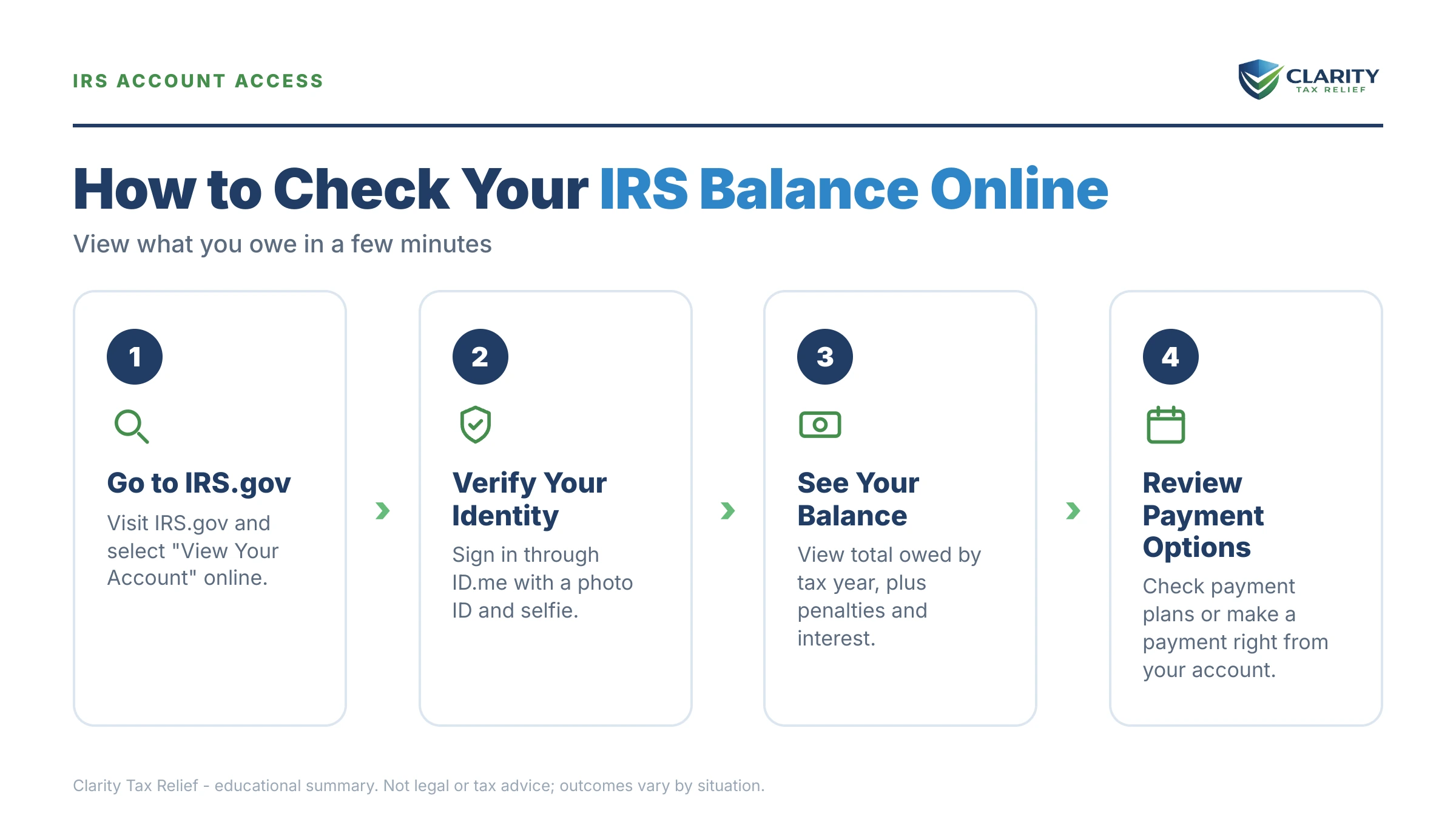
The fastest way: your IRS Online Account
The IRS Online Account for Individuals is the front door, and it's free. Once you're in, the home screen shows your total balance owed; open "View Balance Details" and it separates every tax year. If you've never set one up, our IRS online account setup walkthrough covers the whole flow, and the identity step is handled by ID.me — the same partner used across many federal sites.
Identity verification trips up more people than anything else. You'll upload a photo ID and either take a selfie the system matches to your ID or join a short video call with an agent. If the selfie won't match or the site keeps kicking you out, our guide to ID.me / idverify.irs.gov problems, solved walks through the fixes — the video-call path clears most people the self-service option can't.
Inside the account you can do far more than look. You can view or download your transcripts online, see pending payments, and, if the balance is real, set up a plan in a few clicks (see how to set up an IRS payment plan online).
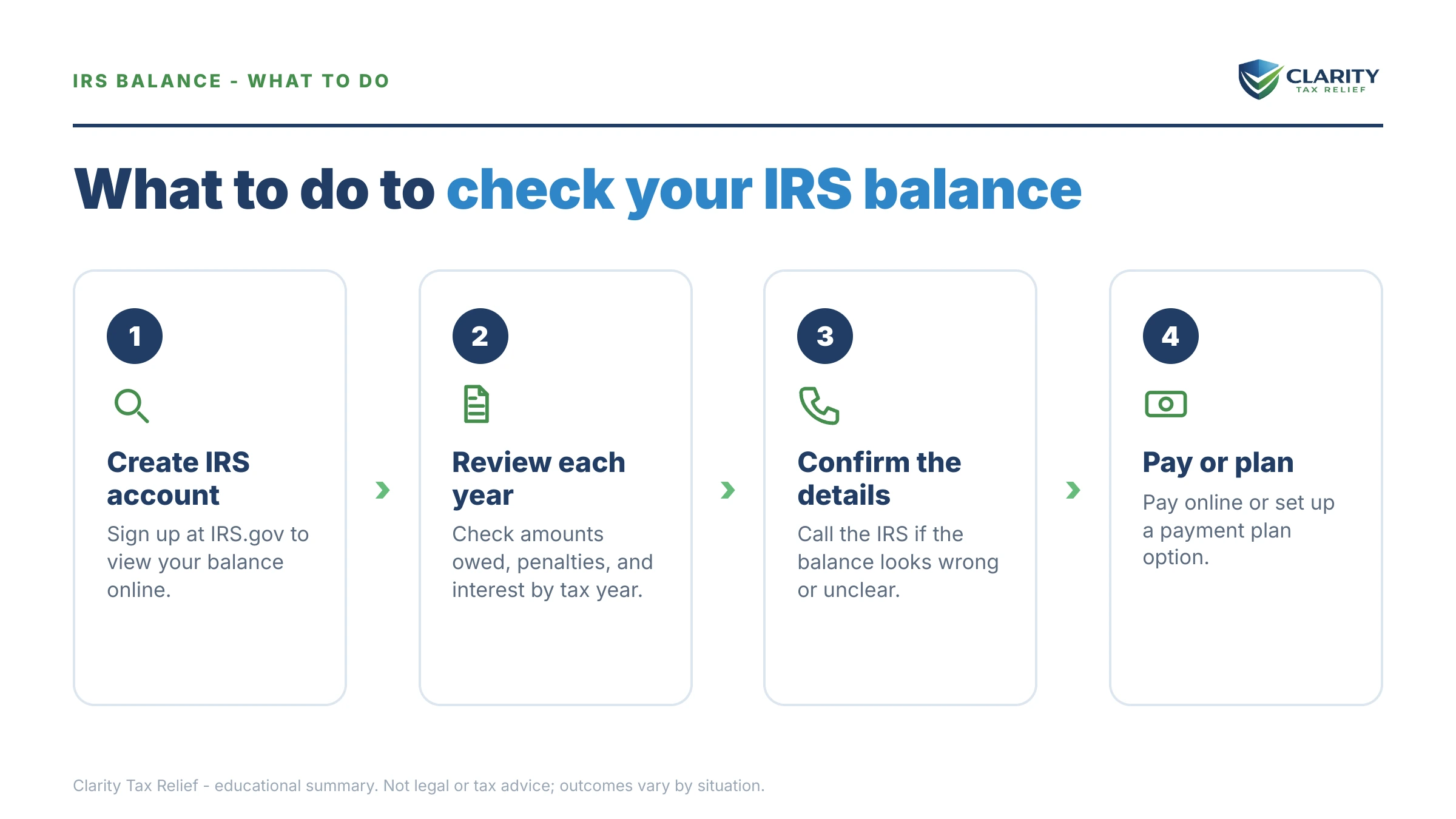
What your balance is actually made of
Your total IRS balance is three things stacked together: tax, penalties, and interest. That distinction matters because two of the three can sometimes be reduced or removed, while the tax itself generally can't.
The tax is what you reported or what the IRS assessed. The penalties are usually failure-to-file (5% per month, capped) and failure-to-pay (0.5% per month), and the failure-to-file penalty is ten times larger, which is why filing on time matters even when you can't pay. Interest compounds daily on the whole unpaid amount, penalties included.
If you want to see how much of your balance is penalties and interest versus original tax, and roughly how fast it's growing. You can estimate it with our IRS penalty & interest calculator. For a year-by-year history of exactly when each piece posted, the account transcript is the source of truth; here's how to read an IRS account transcript line by line.
| Method | What it shows | How fast | Cost |
|---|---|---|---|
| IRS Online Account | Live total + balance by year, pending payments | Minutes (after ID.me setup) | Free |
| Account transcript (online) | Full history: assessment, payments, penalties, interest | Minutes | Free |
| Account transcript (by mail) | Same history, printed | 5–10 calendar days | Free |
| Phone (800-829-1040) | Rep reads your balance aloud | Long hold times in 2026 | Free |
| Tax pro via Form 2848 / 8821 | Full account, all years, professional read | Same day once authorized | Varies by firm |
How to check your IRS balance without an online account
If ID.me won't verify you, three offline routes still reach the same number. None is as fast as the online account, but each is legitimate and free (except a paid pro's time).
First, request an account transcript by mail through the Get Transcript tool or Form 4506-T. It arrives in about 5 to 10 calendar days and shows the same postings the online account does. Second, call the IRS at 800-829-1040; be ready for a wait, because the 2026 workforce is down roughly 27%, so plan around the best time to call the IRS and know what to say when you get through.
Third, authorize a tax professional. With a signed Form 2848 power of attorney or a Form 8821 tax information authorization, a pro can pull your complete account — every year, every posting — often the same day, and tell you what it means rather than just reading a figure.
What happens if the balance is real and you ignore it
If the balance you find is genuine, doing nothing sets off an automated collection sequence, and each stage carries more enforcement power than the last. The letters arrive in order, roughly five weeks apart, and the automated system escalates whether or not a human ever touches your file:
- CP14 — the first bill. See the CP14 notice guide. No enforcement yet.
- CP501 / CP503 — reminder notices. Still bills, but penalties and interest keep stacking.
- CP504 — Notice of Intent to Levy. The IRS can seize your state tax refund and a federal lien becomes likely. See the CP504 notice guide.
- LT11 / Letter 1058 — the Final Notice. After 30 days the IRS can garnish wages and levy bank accounts, and your Collection Due Process appeal window opens. See the LT11 notice guide.
The whole point of checking your balance online is to intervene before you reach the bottom of that list. Every option is cheaper and easier at the top.
Saw a balance you weren't expecting?
Send us a screenshot of your Online Account or a photo of your notice. An experienced tax professional will read exactly what you owe, why it's that number, and which options fit — free, confidential, no pressure. Interest is compounding daily, so the sooner you know your real number, the smaller it stays.
You checked and you owe: your realistic options
What you can do next depends mostly on the size of the balance you just found. The IRS treats amounts differently at $10,000, $25,000, and $50,000 thresholds, and whether you have to hand over detailed financials changes at each step.
| Balance shown | What you can usually do | Financial disclosure? |
|---|---|---|
| Under $10,000 | Guaranteed installment agreement or pay within 180 days | No |
| $10,000–$25,000 | Streamlined installment agreement online, up to 72 months | No (with direct debit) |
| $25,000–$50,000 | Streamlined plan with direct debit required | Usually no |
| Over $50,000 | Full financials; plan, hardship, or offer | Yes (Form 433) |
| Can't pay anything | Currently Not Collectible or an offer in compromise | Yes |
A short-term payment plan (up to 180 days) has no setup fee. A long-term installment agreement under $50,000 can be set up right inside your online account, spread over up to 72 months. If paying anything would create genuine hardship, Currently Not Collectible pauses collection — the debt stays and interest keeps running, but garnishments and levies stop. An Offer in Compromise settles for less than the full balance only when your assets and income genuinely can't cover it. The IRS accepted roughly 1 in 5 offers in FY2024, so it's real but never automatic.
A worked example: what an $8,400 balance really looks like
Say you log in and the screen reads $8,400 owed for a single tax year. Open the details and it might break down like this: $7,000 in tax you reported but didn't pay, about $700 in accumulated failure-to-pay penalty, and roughly $700 in interest.
Because it's under $10,000, you'd likely qualify for a guaranteed installment agreement. On a 72-month plan, $8,400 is about $117 a month before ongoing charges. But the failure-to-pay penalty keeps adding roughly $35 a month (0.5% of the $7,000 tax) and interest compounds daily until the tax is cleared, so the true monthly cost to actually retire the debt runs higher. Pay it off faster and you starve those accruals. This is exactly the math the online balance is quietly running against you every day it sits, and why the failure-to-file vs. failure-to-pay penalty difference matters even when cash is tight.
How to respond, step by step
- Go to IRS.gov and open your Online Account — the only official place to see your live balance. Never follow a balance link from an email or text.
- Verify your identity through ID.me — a photo ID plus a selfie match or a short video call. First-time setup takes 10 to 20 minutes.
- Read the total balance and the year-by-year breakdown — open "View Balance Details" to see each year and how much is tax, penalty, and interest.
- Pull your account transcript for the full history — under "Records and Status," open the account transcript for any year to see every posting with dates.
- Compare the online balance to any notice you received — the online figure is usually more current, since recent payments cross in the mail.
- Pick your next move from the same screen — pay it, set up a plan, or, if it looks wrong, gather your proof of payment before contacting the IRS.
When you can handle this yourself, and when to get help
Most people can check their balance and act on it alone. If you log in, the number matches what you expected, and it's small enough to pay off or cover with a straightforward payment plan, you don't need anyone — the online account does the whole job, from viewing to setting up the agreement.
Where experienced help changes the outcome is when the number is confusing or the stakes are higher: the balance is wrong and you can't get it corrected, there are multiple years or unfiled returns behind it, the total is large enough to require full financial disclosure, a levy or garnishment is already in motion, or an Offer in Compromise is on the table and the math has to be built correctly the first time. In those cases the order you fix things in — returns, then penalties, then the balance — changes what you ultimately pay. Never trust anyone who quotes a settlement figure before they have seen your numbers. That's the pitch that got a competitor permanently banned by the FTC in 2026.
Terms on your account, decoded
Balance due: the total the IRS says you owe across all years — tax plus penalties plus interest combined.
Account transcript: the year-by-year ledger of your account, showing each assessment, payment, penalty, and interest posting with dates.
ID.me: the third-party identity partner that verifies you before the IRS lets you see your account.
Failure-to-pay penalty: 0.5% of the unpaid tax per month, part of why your balance grows between logins.
CSED: the Collection Statute Expiration Date — the IRS generally has 10 years from assessment to collect, though appeals, offers, and bankruptcy can pause the clock. See how long the IRS can collect back taxes.
Check your IRS balance online: your questions, answered
Can I check my IRS balance online for free?
Yes. Your IRS Online Account at IRS.gov is completely free and shows your total balance plus a breakdown by tax year, usually within minutes of signing in. There is no fee to view it, pull a transcript, or set up most payment plans from the same screen. The only cost is the time it takes to verify your identity through ID.me the first time.
How do I check my IRS balance without an online account?
You have three offline paths: request an account transcript by mail using the Get Transcript tool or Form 4506-T, call the IRS at 800-829-1040, or authorize a tax professional to pull your account with Form 2848 or Form 8821. Mailed transcripts take 5 to 10 calendar days, and phone waits can be long given 2026 staffing cuts, so the online account is almost always faster.
Why does my IRS online account show $0 but I got a notice?
This usually means timing or a posting mismatch, not that the notice was fake. A payment may have posted after the notice printed, the balance may sit under a different tax year, or a joint balance may show on your spouse's account instead of yours. Open the account transcript for the exact year on the notice before assuming the debt is gone.
How current is the balance shown in my IRS online account?
The online balance is the most current figure the IRS publishes, but it is not updated to the penny in real time. Payments can take one to three weeks to post, and interest compounds daily while the failure-to-pay penalty adds 0.5% a month, so the true payoff amount usually rises slightly between logins. For an exact payoff, use the account transcript and add accruals to date.
Can I see how much I owe the IRS for a specific year?
Yes. Inside your Online Account, the "View Balance Details" screen breaks the total into separate amounts for each tax year. For a full history of that year — the original assessment, every payment, and each penalty and interest posting — open the account transcript for that specific year under Records and Status.
Why can't I log into my IRS account?
Almost all login failures happen at the ID.me identity step, not the IRS itself — a blurry document photo, a selfie that won't match, or a name that doesn't match your credit file. Try the live video-call verification option instead of the self-service selfie, and make sure your legal name and address match your last tax return. Persistent failures can be resolved through the in-person verification path.
Does checking my IRS balance online flag me or start collection?
No. Viewing your own account is a read-only action. It does not trigger an audit, start collection, or put you on a list. Collection runs on its own automated schedule based on assessed balances and notice dates, whether or not you ever log in. Checking early only helps: it lets you fix problems before the next notice escalates.
Can I check my spouse's or business IRS balance online?
Not from your own personal account. Each individual has a separate Online Account tied to their own identity, and a business balance lives in a separate business tax account. To see someone else's balance legally, you need their authorization on Form 2848 or Form 8821, or they must sign in themselves. A joint tax debt shows on both spouses' accounts.
Your next 24 hours
- Find the number. Sign in to your IRS Online Account and write down the total balance and the amount for each tax year. That single screen replaces every guess.
- Gather your proof. Pull your last filed return and any payment confirmations, so you can spot instantly whether the balance is right or a payment simply hasn't posted.
- Get a free case review. If the number is bigger than expected, wrong, or spans multiple years, use the 2-minute form or call (888) 825-7779. Interest compounds daily, so knowing your real number today keeps it as small as it will ever be.
This guide is general information, not tax or legal advice for your specific situation. Eligibility for IRS programs depends on individual facts and circumstances; no outcome is guaranteed.
Official sources: IRS — Online Account for Individuals · IRS — Get Transcript · IRS — Payments.