
Dealing With the IRS
Best Time to Call the IRS in 2026 (and How to Skip the Hold)
The short answer: the best time to call the IRS is right at 7 a.m. your local time, on a Wednesday, Thursday, or Friday, outside of filing season. That's when the individual account line (800-829-1040) has the shortest hold. Avoid Mondays, the day after a holiday, and lunch hour.
You've decided you need a human at the IRS — over a notice, a balance, a frozen refund — and you already suspect you're about to lose a morning to hold music. The good news: the day and hour you dial genuinely changes your odds, and the number printed on your letter may get you to a shorter line than the main one.
The bad news, and the reason timing matters more in 2026 than it used to: the IRS cut roughly 27% of its workforce in 2025, so the same volume of callers is hitting fewer phones. The tables below show you exactly when the lines are emptiest, and where you can skip the call entirely.
⏱ The hours that control your call: the individual line answers 7 a.m. to 7 p.m. your local time, Monday through Friday — closed weekends and federal holidays. Call in the first 30 minutes after open for the shortest wait. Meanwhile, any penalties and interest on a balance keep accruing every day you don't resolve it, so an unanswered call still costs you.
Why you're calling in the first place
Most people dial the IRS for one of a handful of reasons, and knowing which one you have tells you whether the phone is even the right tool. The line is genuinely useful for disputing a specific figure, confirming a payment posted, arranging a payment plan the online system won't handle, or asking a levy to be released. It's the wrong tool for things the automated systems do faster.
If your reason is "I want to see my balance" or "did my payment go through," you almost never need a live agent — your IRS online account setup shows both in seconds. Match your reason to the right channel before you spend a morning on hold.
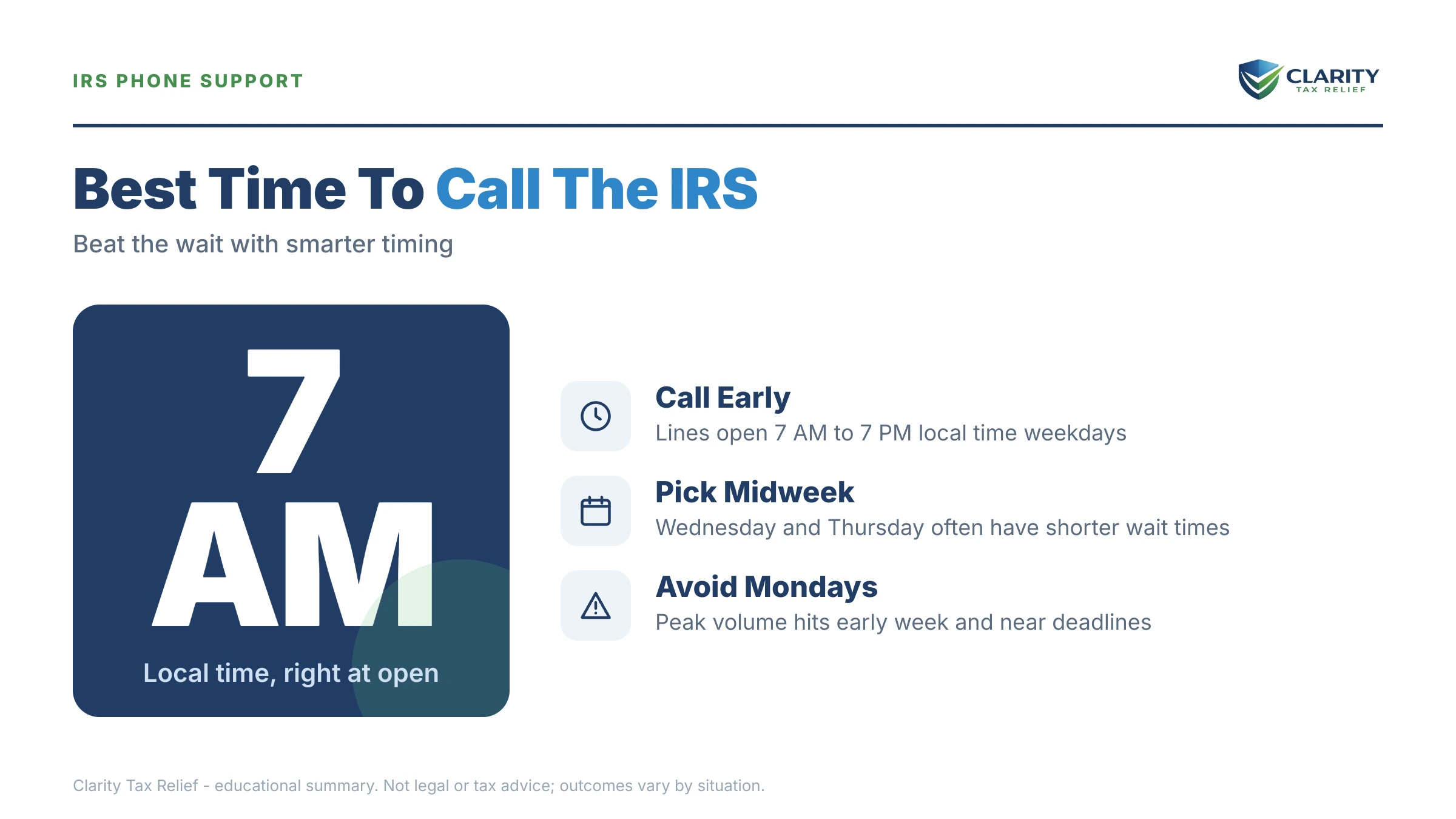
Best time to call the IRS: day and hour
Call volume follows a predictable weekly and daily rhythm, and you can use it to your advantage. The single most reliable window is the first half hour after the lines open.
| When you call | What to expect |
|---|---|
| 7:00–7:30 a.m. local time | Shortest hold of the day — the queue hasn't stacked up yet. Your best shot at a live agent. |
| Wednesday–Friday mornings | Lightest days of the week. Fewer callers than early-week. |
| Late afternoon (after 4 p.m.) | Volume eases again, but you risk not reaching an agent before 7 p.m. closing. |
| Mondays & Tuesdays | Busiest days of the week — the weekend's backlog floods in. Expect long waits. |
| Day after any federal holiday | Worst single day of the month. Two days of demand hit at once. |
| Lunch hour (11 a.m.–2 p.m.) | Spikes hard — that's when working callers dial in. Avoid it. |
| Filing season (late Jan–April 15) | Peak of the year across the board. Holds routinely run an hour-plus. |
Two quirks worth knowing. First, "local time" means your time zone, not Washington's, so a 7 a.m. call from the East Coast beats the West Coast to the same national queue. Second, Presidents Day week in February is the busiest stretch outside of the April crunch, because early filers with refund questions all call at once.
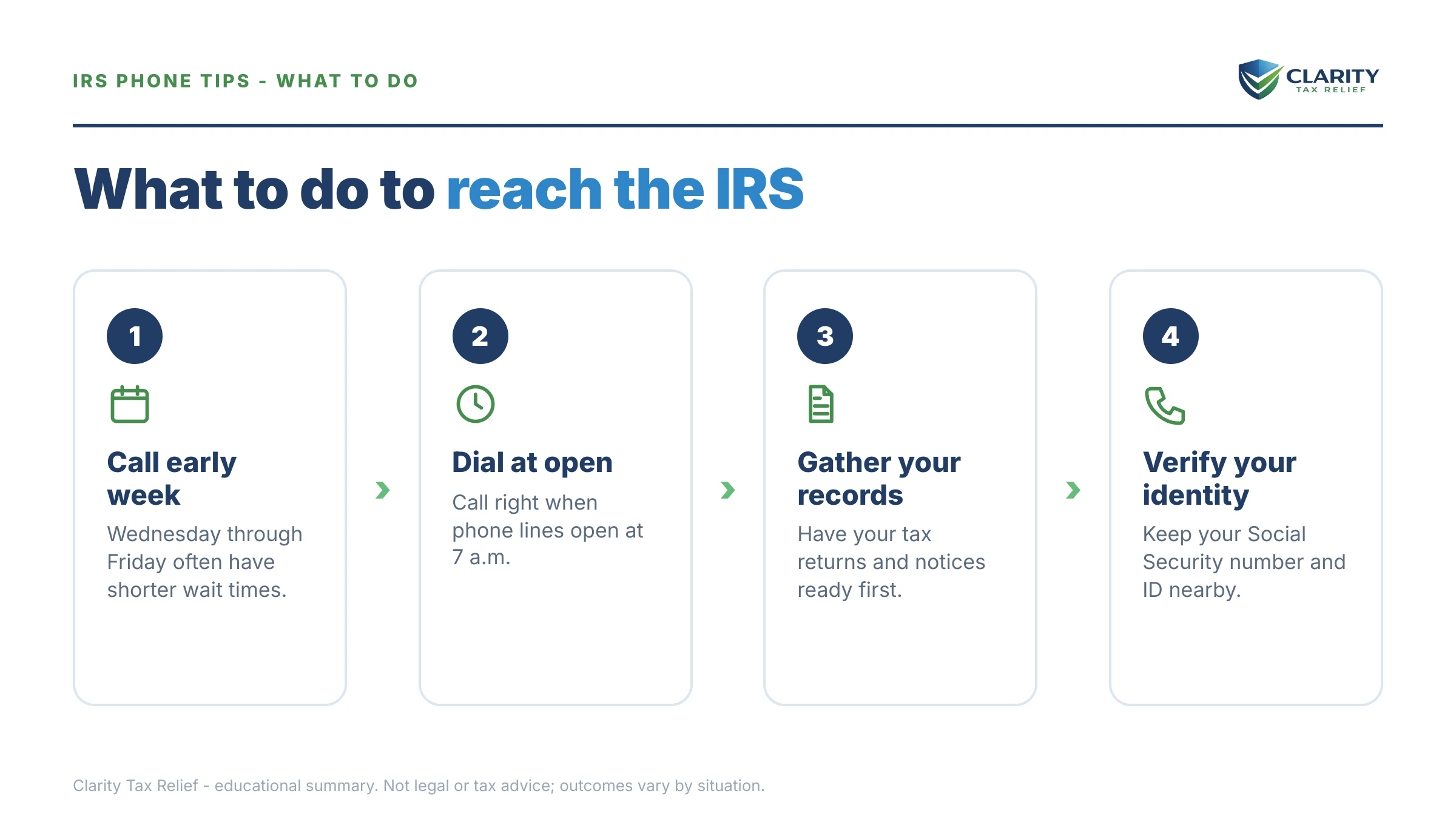
What happens if you keep hitting a busy signal
An unanswered call doesn't pause anything — the clock on your underlying problem keeps running. If you're calling because you owe, or because a notice arrived, every week you can't get through is a week of accrual and automated escalation. Here's the sequence that continues in the background whether or not a human ever picks up:
- Interest and penalties keep growing. The late-payment penalty and daily-compounding interest don't wait for you to reach an agent.
- The next notice generates automatically. The IRS's collection notices — CP501, CP503, then CP504 — are issued by automated systems, not by the people you're trying to call.
- A courtesy disconnect wastes the window. When the queue is full, the system hangs up on you ("we're unable to take your call") — burning the morning without moving your case.
- Enforcement rights advance. If a Final Notice (LT11 / Letter 1058) is already out, its 30-day clock runs even while you can't get anyone on the line, after which levies become possible.
In short, the phone system going down doesn't stop the collection machine. That's exactly why matching your call to the right time, or bypassing the call entirely, is worth the effort. For a deeper playbook when the line simply won't connect, see can't reach the IRS on the phone, and if you're wondering whether cuts mean your debt just disappears, read IRS understaffed — do I still owe (the automated levies never stopped).
Owe a balance and can't get the IRS to pick up?
Interest and penalties keep compounding every day the call doesn't connect. A licensed professional can call on your behalf, with a power of attorney on file, and set up your resolution without you sitting on hold. Free, confidential case review.
Which IRS number to call: by reason
The number printed in the top-right corner of any notice you received routes you straight to the unit handling your case, and is almost always faster than the general line. Use the specific number when you have one.
| Reason for calling | Number | Hours (local time) |
|---|---|---|
| Individual tax accounts | 800-829-1040 | Mon–Fri, 7 a.m.–7 p.m. |
| Business & specialty tax | 800-829-4933 | Mon–Fri, 7 a.m.–7 p.m. |
| You got a notice or letter | The number on the notice | As stated on the notice |
| Identity-verification letter (e.g., 5071C) | The number on that letter | As stated on the letter |
| Automated refund status | 800-829-1954 | 24/7 automated |
| Taxpayer Advocate Service | 877-777-4778 | Mon–Fri, business hours |
A word on scams while you're dialing: the IRS initiates contact by mail, not by phone, and never demands gift cards, wire transfers, or crypto. If someone called you claiming to be the IRS, read does the IRS call you before you say a word. You may be talking to a criminal, not the agency.
Before you dial: what to have in front of you
The agent verifies your identity before discussing anything, so a missing document can end the call before it starts. Lay these out first:
- Your Social Security number or ITIN (and your spouse's, for a joint return).
- Your filing status for the year in question.
- A copy of the tax return you're calling about.
- Any notice or letter you received, with its number visible.
- A pen and paper — write down the date, the agent's ID number, and exactly what was agreed.
Calling about someone else's account — a parent, a spouse's separate liability, a business you don't personally control? You generally need authorization on file first. See Form 2848 instructions to grant a representative the right to speak for you, which also lets a tax pro handle the call entirely. Walking in with a script helps too — what to say when calling the IRS about back taxes shows you the exact phrasing that gets results.
When you can skip the call entirely
The fastest "call" is often no call at all — most account tasks are self-service and available 24/7, including weekends when the phone lines are closed. Before you queue up, check whether the job is one a screen can do faster than an agent.
| What you need | Faster online? |
|---|---|
| Check your balance owed | Yes — online account, instantly |
| Set up a payment plan (under $50,000) | Yes — streamlined, in minutes |
| Get a transcript | Yes — download it online |
| Check refund status | Yes — Where's My Refund / automated line |
| Confirm a payment posted | Yes — payment history in your account |
| Dispute a specific notice error | No — usually needs a call or written response |
| Request a levy release for hardship | No — needs a live agent or a pro |
| Arrange non-standard relief (CNC, OIC) | No — phone, mail, or professional help |
If your reason falls in the "yes" column, the best time to call the IRS is never — do it online. You can set up an IRS payment plan online in about the time you'd spend on hold.
A worked example: the call vs. the click
Say you owe $9,400 for one tax year and you want a monthly payment plan. It's late March — peak filing season. You call 800-829-1040 at 10 a.m. on a Monday, wait 70 minutes, get a courtesy disconnect, and try again the next morning.
Or: you open your online account, choose a 72-month streamlined installment agreement (available because your balance is under $50,000), and finish in about 15 minutes. Your payment works out to roughly $9,400 ÷ 72 ≈ $131/month, before interest.
Either way, interest keeps compounding daily and the late-payment penalty continues at a reduced 0.25% per month while the plan is active, so the day you lock in the agreement is the day the escalation stops. The click gets you there the same day; the March phone call might take a week of attempts to accomplish the identical result. When the online path exists, it's simply faster.
When a call, or a pro, actually changes the outcome
You don't need anyone's help for the simple stuff: checking a balance, confirming a payment, or setting up a routine plan under $50,000. Handle those yourself online and skip the hold.
The phone — and often an experienced tax professional making the call for you — earns its keep when the situation is contested or urgent: a levy already in motion, a balance the IRS has wrong, multiple unfiled years, business or payroll debt, or a hardship release that needs financial disclosure. In those cases the timing of the call matters less than who makes it and how it's framed. A pro with a Form 2848 on file waits on hold so you don't, and knows the sequence to fix things in so you don't overpay. And when the IRS itself is the bottleneck — you can't get through and something time-sensitive is at stake — the Taxpayer Advocate Service exists precisely to break the logjam.
Terms on the phone tree, decoded
- Courtesy disconnect: the automated message that hangs up on you when the queue is full — "due to high call volume, we're unable to take your call." Not a rejection of your case. Just a full line.
- Callback option: when offered, the system holds your place in line and phones you back instead of making you wait on hold. Always accept it.
- Identity verification: the security check at the start of every call, using your SSN, filing status, and prior-return details — required before an agent discusses anything.
- Practitioner Priority Service: a separate IRS line only tax professionals with authorization can use — one reason a pro often gets through faster than you can.
- Power of attorney (Form 2848): the document that lets a representative speak to the IRS on your behalf, so you don't have to make the call at all.
Best time to call the IRS: your questions, answered
What is the best time of day to call the IRS?
Call right when the lines open at 7 a.m. your local time. The individual account line runs 7 a.m. to 7 p.m. local time, Monday through Friday, and the queue is emptiest in the first 30 minutes before the morning rush stacks up. If you can't call at open, mid-to-late morning on a Wednesday, Thursday, or Friday is the next-best window.
What is the worst time to call the IRS?
Mondays, Tuesdays, the day after any federal holiday, and Presidents Day week are the busiest, along with the whole filing season from late January through April 15. Lunch hour (roughly 11 a.m. to 2 p.m.) also spikes because that's when working callers dial in. During those windows you may wait an hour or more, or get a courtesy disconnect when the queue is full.
What number do I call for the IRS?
For individual tax questions call 800-829-1040; for business accounts call 800-829-4933. If you received a notice or letter, the phone number printed in its top-right corner routes you to the specific unit handling your case, which is usually faster than the main line. For identity-verification letters like a 5071C, use the number on that letter, not the general line.
How long does it take to reach a live person at the IRS?
It ranges from a few minutes at 7 a.m. on a Thursday to well over an hour during filing season. IRS staffing was cut roughly 27% in 2025, so hold times are longer and unpredictable in 2026. Ask for the automated callback option if it's offered. It holds your place in line so you don't have to sit on hold.
What information do I need before I call the IRS?
Have your Social Security number or ITIN, your filing status, a copy of the tax return you're calling about, and any notice you received. The agent verifies your identity before discussing your account, so missing any of these can end the call before it starts. If you're calling about someone else's account, you generally need a Form 2848 power of attorney on file first.
Can I avoid calling the IRS altogether?
Often, yes. Your IRS online account shows your balance, payment history, notices, and transcripts, and you can set up most payment plans there without ever calling. For balances under $50,000 you can arrange a streamlined installment agreement online in minutes. The phone is only truly necessary for disputing a specific error, arranging non-standard relief, or getting a levy released.
Is the IRS open on weekends?
No. The main IRS telephone lines operate Monday through Friday only, and are closed on federal holidays. Automated tools — your online account, transcript access. The refund status checker — are available 24/7, so weekends are the best time to handle anything that doesn't require a live agent.
Your next 24 hours
- Find your reason and your number. Pull out any notice you received and locate the phone number in its top-right corner — that's your fastest route. No notice? Use 800-829-1040 for individuals.
- Gather your call kit. Set out your SSN or ITIN, filing status, the relevant return. The notice, then decide whether the task is one your online account can finish faster than a live agent.
- If a balance or levy is driving the call, get help before the clock runs. Interest and penalties compound daily. A free case review at (888) 825-7779 or the 2-minute form puts a professional on the phone so you don't lose a morning on hold.
This guide is general information, not tax or legal advice for your specific situation. Eligibility for IRS programs depends on individual facts and circumstances; no outcome is guaranteed. Phone numbers and hours are current as of 2026; confirm details on official IRS pages before relying on them.
Official sources: IRS Telephone Assistance, IRS Online Account, and the Taxpayer Advocate Service.