
IRS Forms
Form 8283 in 2026: When You Need It and the Proof the IRS Requires
The short answer: Form 8283 is the form you must attach to your tax return when your deduction for all noncash charitable gifts — clothing, furniture, vehicles, stock — is more than $500. The form reports the donations; it doesn't prove them. Receipts, written acknowledgments, and (over $5,000) a qualified appraisal do that.
Months ago you loaded the old sedan and a houseful of furniture off to charity, claimed roughly $9,800 on your return, and moved on. Now an IRS letter is asking you to prove every dollar of it — and the drop-off receipt in your file folder is mostly blank. That gap between what you claimed and what you can document is exactly what this page fixes.
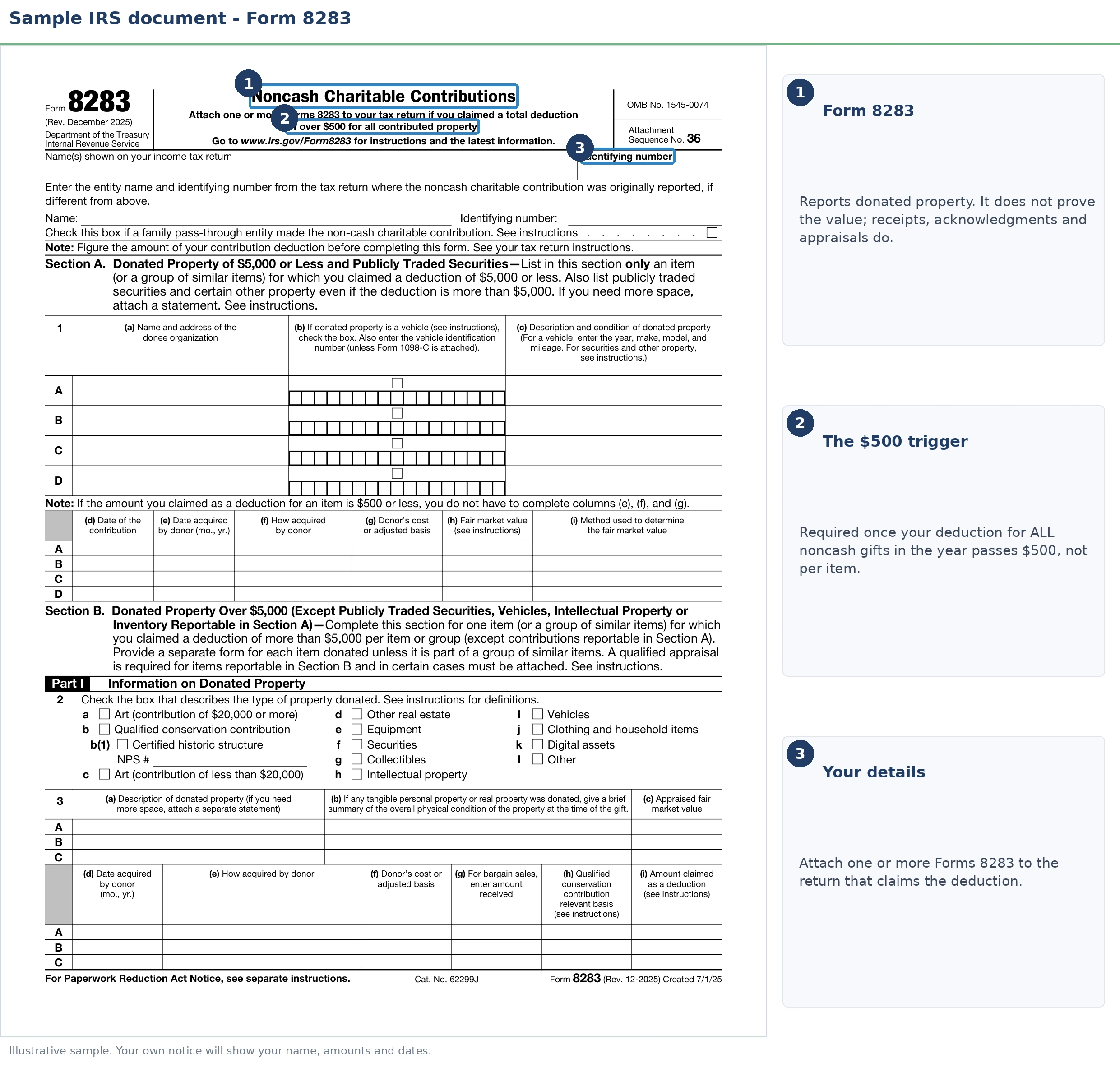
Here's the part most people miss: Form 8283 reports your donation — it does not, by itself, entitle you to the deduction. The deduction survives IRS scrutiny only if the paperwork behind the form holds up. The image below shows exactly what Form 8283 looks like and where each part of a donation belongs, so keep reading before you answer anything.
⏱ Your deadline: Form 8283 itself is filed with your return, so there's no separate due date — but if the IRS has sent you a letter questioning a noncash deduction, the response date printed on that letter controls. Miss it and the proposed changes move toward assessment while interest accrues monthly on whatever the IRS says you owe.
What Form 8283 is for — and the $500 trigger
Form 8283 is required whenever your deduction for all noncash charitable gifts in a year is more than $500. That's the whole trigger. Individuals, partnerships, and corporations all use it, and the $500 test is cumulative — three $200 donation runs to the thrift store across the year add up to $600 and require the form, even though no single trip did.
Two boundaries matter. First, cash and check gifts never go on Form 8283 — they have their own substantiation rules under Publication 526. Second, the form is informational: it tells the IRS what you gave, to whom, when, and how you valued it. If the IRS questions the deduction later, the form is the map, and your receipts, acknowledgment letters, appraisal, and photos are the territory.
One more rule that catches furniture donors specifically: clothing and household items generally must be in "good used condition or better" to be deductible at all, per Publication 526. A charity's blank receipt says nothing about condition — photos taken at donation time do.
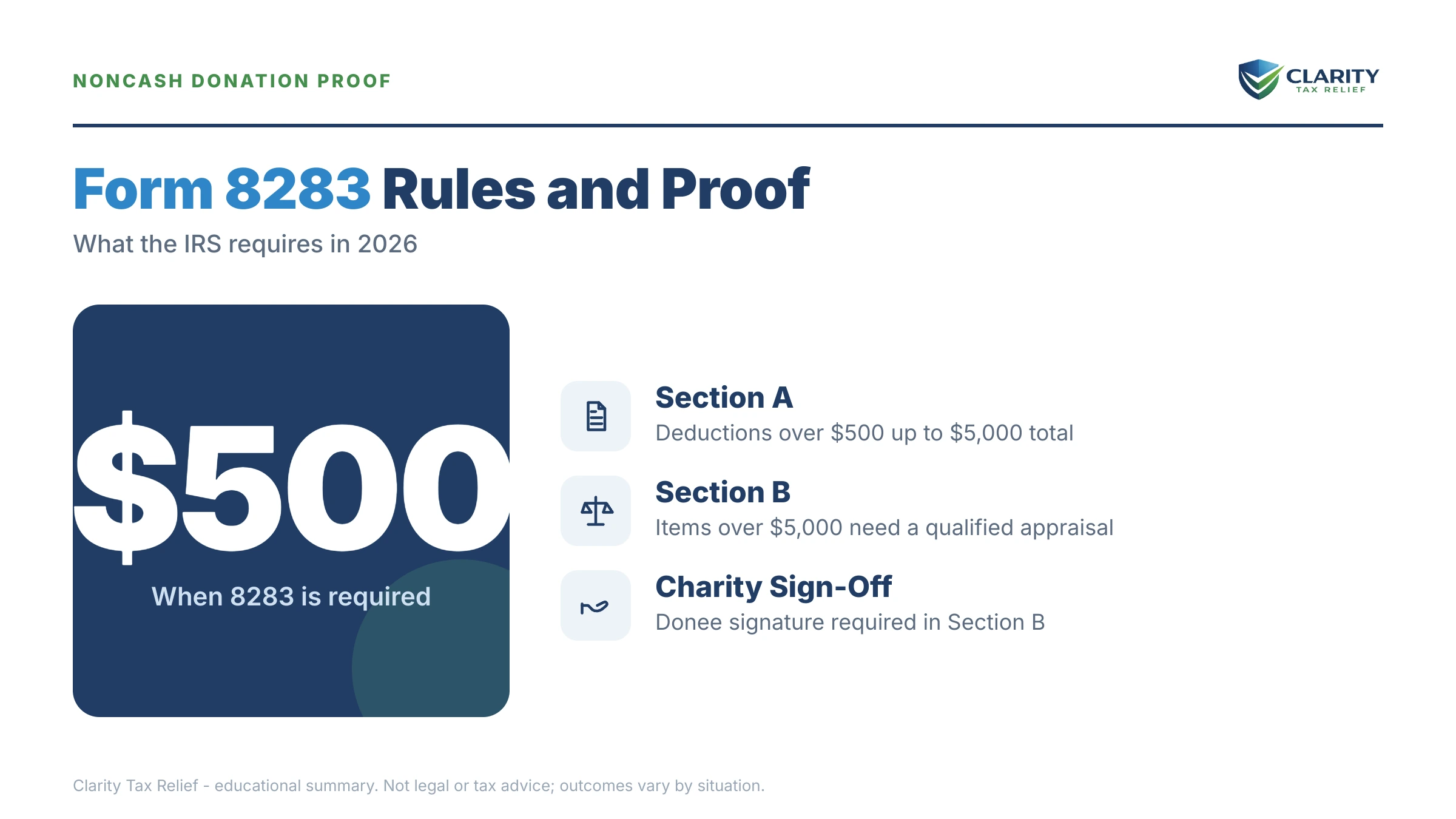
Form 8283 value tiers: Section A, Section B, and vehicles
The proof the IRS expects scales with the value you claim, and the Form 8283 instructions split the form into two sections at the $5,000 line. Here's the full ladder:
| Value of the gift | What goes on your return | Proof you must have |
|---|---|---|
| Any single gift of $250+ | No form yet (unless yearly noncash total tops $500) | Contemporaneous written acknowledgment from the charity, per Publication 526 |
| All noncash gifts total over $500 | Form 8283, Section A | Acknowledgment(s), itemized list, how you determined fair market value, condition evidence |
| One item or group of similar items over $5,000 | Form 8283, Section B | Qualified appraisal plus the charity's signed acknowledgment on the form itself (per the Form 8283 instructions; publicly traded securities are the main exception) |
| Vehicle, boat, or airplane claimed over $500 | Form 8283 plus Form 1098-C attached | Form 1098-C from the charity — if it sold the vehicle, the gross sale proceeds generally cap your deduction |
The trap in the middle row is the "group of similar items" rule: the $5,000 test applies to similar items combined, not one at a time. A dining set, two bedroom sets, and a sofa valued at $1,500 each are a $6,000 furniture group — Section B territory with an appraisal requirement — even though no single piece comes close to $5,000. For how to value used property in the first place, Publication 561 is the IRS's own methodology, and Publication 544 covers the sale-and-basis side when property changes hands.
Donated a car, boat, or plane? Form 1098-C sets your number
When a charity sells your donated vehicle, your deduction is generally limited to the gross sale proceeds shown on Form 1098-C — not the pricing-guide value. This surprises almost everyone. The guide might say your sedan was worth $6,200; if the charity auctioned it for $2,750, that $2,750 is generally your deduction.
There are exceptions — the charity keeps the vehicle for significant use in its work, materially improves it, or transfers it to a needy person, in which case fair market value can apply. The charity marks which situation applies on the 1098-C it sends you (and files with the IRS, which is how mismatches get flagged). For any vehicle claimed over $500, the 1098-C must be attached to your return along with Form 8283.
If you never received a 1098-C, contact the charity before you respond to any IRS letter. Claiming a vehicle deduction the charity's own filing contradicts is the single fastest way this deduction gets disallowed.
The substantiation checklist: what the IRS disallows without
Charitable substantiation rules are strict — several of them disallow the deduction entirely if the document is missing, no matter how real the donation was. The acknowledgment rule is the harshest: it must be "contemporaneous," meaning in hand by the time you file the return (or its due date, if earlier). A letter the charity writes for you two years later, after the IRS asks, generally does not cure it.
| Document | What it must show | If it's missing |
|---|---|---|
| Contemporaneous written acknowledgment (gifts of $250+) | Charity's name, description of the property, whether you received anything in return — dated before you filed | Deduction for that gift can be disallowed outright, even if the donation clearly happened |
| Itemized list + valuation records | Each item, its condition, and how you set fair market value (Publication 561 methods, thrift pricing) | IRS substitutes its own — usually much lower — number, or zero |
| Qualified appraisal (item/group over $5,000) | Prepared by a qualified appraiser, dated no earlier than 60 days before the gift, per the Form 8283 instructions | Deduction over the threshold is generally disallowed — good-faith value estimates don't substitute |
| Donee signature on Section B | The charity's authorized signature acknowledging receipt of the property | The form is incomplete; expect an IRS letter or disallowance |
| Form 1098-C (vehicles over $500) | Gross sale proceeds, or the exception that lets you use fair market value | Vehicle deduction over $500 is disallowed until the form is supplied |
| Photos / condition evidence | That clothing and household items were in good used condition or better | Not technically required — but often the difference between winning and losing a value dispute |
Say you claimed $9,800: a worked example
Say you and your spouse donated a used car you valued at $6,200 and furniture you valued at $3,600 — $9,800 total — and the IRS letter proposes to disallow all of it. You're in the 22% bracket. Here's the math both ways.
If you can't document anything: $9,800 disallowed × 22% = $2,156 in additional tax, plus a potential 20% accuracy-related penalty of about $431, plus interest running from the return's original due date. Call it roughly $2,700 and climbing.
If you respond with what you actually have: the charity's Form 1098-C shows it sold the car for $2,750, so the car deduction corrects from $6,200 down to $2,750. The furniture is a $3,600 group — under $5,000, so no appraisal was ever required — and your acknowledgment letter, itemized list, and photos support it. Corrected deduction: $6,350. Disallowed amount: $3,450 × 22% = $759 in tax, and with documented good-faith valuation, the accuracy penalty is very much contestable. Same donation, roughly $1,900 difference — decided entirely by paperwork. You can estimate how a proposed balance grows with our IRS penalty and interest calculator.
What happens if you ignore the IRS letter about your deduction
An unanswered letter about a noncash deduction ends in a legally assessed balance — the extra tax, an accuracy-related penalty of up to 20% (40% for gross valuation misstatements), and compounding interest. The sequence is automated and it does not need your agreement to finish:
- The inquiry — a CP2000 notice or a correspondence audit letter proposing changes and asking for your documents. This is where you have the most leverage.
- Proposed disallowance stands — no response means the IRS treats its numbers as correct and adds the accuracy-related penalty to the proposal.
- Statutory Notice of Deficiency (CP3219A) — your last pre-assessment stop, with a 90-day window to petition Tax Court. After that, the balance becomes legally owed.
- Assessment and billing — a CP14 notice arrives demanding payment, typically within about 21 days, and the collection notice sequence begins behind it.
Every stage before assessment is a document fight you can still win. Every stage after it is a collection problem — a materially worse position over the exact same furniture.
Got a letter questioning your donation deduction?
Send us a photo of the letter and your Form 8283 before your response date passes. An experienced tax professional will tell you which items are defensible, which aren't, and what the realistic number is — free, confidential, no pressure.
Your options when the IRS questions a Form 8283 deduction
You have four distinct paths, and choosing the right one depends on what your paperwork can actually support.
- Substantiate and defend. If you hold the acknowledgment, the 1098-C, and valuation records, respond with copies and a per-item explanation. Well-documented Section A donations get sustained regularly. If you disagree with the IRS's proposed figures, see how to disagree with a CP2000 in writing.
- Reconstruct what you can. Missing receipts aren't always fatal — charities can reissue records they already gave you, bank records can prove the drop-off date, and photos establish condition. The playbook in handling an IRS audit with no receipts applies directly, with one hard limit: a missing contemporaneous acknowledgment or missing appraisal generally can't be created after the fact.
- Correct the return yourself. If you realize the car should have been $2,750 and not $6,200, filing Form 1040-X to fix it — or agreeing to a corrected figure in your response — stops the meter and strengthens your penalty position.
- Reopen a closed disallowance. If the deduction was already disallowed because you never responded, audit reconsideration lets you submit the evidence late and ask the IRS to revisit the assessment. Note that first-time penalty abatement generally doesn't apply to accuracy-related penalties — reasonable cause and good-faith valuation is the argument there.
What is never an option: inflating values to make the math work. The valuation-misstatement penalties exist precisely for that, and they scale with the overstatement. This page is about documenting real gifts correctly — the deduction you can prove is worth more than the one you can't.
How to respond to an IRS letter about Form 8283, step by step
- Find the response deadline. It's printed near the top of the letter, and that date controls everything else you do. Missing it lets the IRS finalize the proposed disallowance without hearing your side.
- Pull the tax-year records. The return, the Form 8283 you filed (or should have filed), every acknowledgment letter, receipts, Form 1098-C if a vehicle was involved, your item list, and any photos of the donated property.
- Rebuild each value on paper. Match every claimed dollar to a document — the 1098-C proceeds for the car, thrift-store pricing and Publication 561 methods for household goods. Anything you can't tie to evidence, flag now rather than let the IRS find it.
- Respond in writing before the deadline. Send copies, never originals, with a short cover letter keyed to each donated item and each proposed change, and keep proof of mailing.
- Concede what you can't prove — and contest the penalty separately. Agreeing to a corrected number stops interest from compounding on a fight you'd lose, while reasonable cause and good-faith valuation can still remove the accuracy-related penalty on top of it.
When you can handle this yourself
Most Section A situations are self-service. If your total noncash deduction is a few thousand dollars, you have the acknowledgment letters and an itemized list, and the IRS letter just asks for documents — organize them, respond by the date, and you'll likely be fine. Same if the only issue is a vehicle where the 1098-C simply shows a lower sale price than you claimed: agree to the corrected number and move on.
Experienced help changes outcomes in four situations: a Section B gift claimed without a qualified appraisal (the strict-compliance fight is technical), a Notice of Deficiency already running its 90-day clock, multiple years of the same deduction under review at once, or a proposed accuracy-related penalty large enough that the reasonable-cause argument is worth building properly. Before hiring anyone, know what representation actually runs — our guide to IRS audit representation cost gives you the honest ranges.
Terms on the form, decoded
- Fair market value (FMV): what a willing buyer would actually pay a willing seller — thrift-store price for used goods, not what you paid new.
- Contemporaneous written acknowledgment: the charity's letter describing your gift and stating whether you got anything in return, received before you filed the return.
- Qualified appraisal: a written valuation by a qualified appraiser meeting the timing and content rules in the Form 8283 instructions — required for items or similar-item groups over $5,000.
- Donee: the charity receiving the gift; on Section B, an authorized person there signs the form acknowledging receipt.
- Gross proceeds: what the charity actually sold your vehicle for, reported on Form 1098-C — usually the ceiling on a vehicle deduction.
- Group of similar items: items of the same general category (all furniture, all clothing) counted together against the $5,000 appraisal threshold — the aggregation rule detailed in Publication 526 and the form's instructions.
Form 8283 questions, answered
Do I need Form 8283 if my donations were under $500?
No — Form 8283 is required only when your deduction for all noncash gifts for the year is more than $500. You still need records for every gift, and any single donation worth $250 or more still requires a written acknowledgment from the charity under Publication 526. Cash and check donations don't count toward the $500 trigger; they follow their own substantiation rules.
What is the difference between Section A and Section B of Form 8283?
Under the Form 8283 instructions, Section A covers items (or groups of similar items) valued at $5,000 or less, plus publicly traded securities. Section B covers any item or group of similar items valued over $5,000 — and it requires a qualified appraisal and the charity's signature on the form itself. The similar-items rule matters: ten pieces of furniture worth $600 each are one $6,000 group, which lands in Section B even though no single piece tops $5,000.
Do I need an appraisal to donate furniture or a car?
Only when the item or group of similar items is valued over $5,000, per the Form 8283 instructions. A $3,600 furniture donation needs good records and photos, not an appraisal. A donated vehicle is different: if the charity sells it, Form 1098-C's gross sale proceeds generally set your deduction, so no appraisal is needed — but if you claim a vehicle over $5,000 because the charity kept it for its own use, the appraisal rule applies.
What happens if I forgot to attach Form 8283 to my return?
The IRS will usually write to you and either request the form or propose to disallow the noncash deduction. Responding promptly with a completed Form 8283 and your substantiation often resolves it; you can also file Form 1040-X to amend the return and attach it. Don't ignore the letter — an unanswered request generally becomes a proposed disallowance, and then an assessed balance with penalties and interest.
How does the IRS verify noncash charitable donations?
Three main ways: Form 1098-C matching for vehicles (the charity files a copy with the IRS), statistical scoring that flags donation deductions that are large relative to your income, and correspondence audits that simply ask you to mail in your proof. The IRS never sees your drop-off receipt unless you send it — the burden of proving both the donation and its value is entirely on you.
What penalty applies if my donation deduction is disallowed?
You owe the extra tax plus interest, and the IRS can add a 20% accuracy-related penalty for a substantial understatement or valuation misstatement — rising to 40% for gross valuation misstatements. First-time penalty abatement generally does not cover accuracy-related penalties; the main defense is showing reasonable cause and good faith, such as relying on Publication 561 methods or a professional appraisal when you valued the property.
How much can I deduct for a car I donated to charity?
If the charity sold the vehicle — the most common outcome — your deduction is generally limited to the gross sale proceeds reported on Form 1098-C, not the pricing-guide value. Exceptions exist when the charity makes significant use of the vehicle, materially improves it, or gives it to a needy person; the Form 1098-C instructions cover those. For any vehicle claimed over $500, you must attach Form 1098-C to your return.
Who decides the value of donated clothing and furniture?
You do — the charity does not assign values, and a blank drop-off receipt is not a valuation. The standard is fair market value: what a willing thrift-store buyer would actually pay, using the methods in Publication 561. Clothing and household items generally must also be in good used condition or better to be deductible at all, so photos taken at donation time are some of the strongest evidence you can keep.
Your next 24 hours
- Find the response date on the IRS letter — it's printed near the top of the first page — and note the tax year and each proposed change so you know exactly what's being questioned.
- Gather the file: that year's return, the Form 8283, every acknowledgment letter from the charities, the Form 1098-C if a vehicle was involved, your item list, and any photos of what you donated.
- Get a free case review before you respond. Send us the letter and your documents through the 2-minute form or call (888) 825-7779 — an experienced tax professional will tell you what's defensible before your response window closes.
This guide is general information, not tax or legal advice for your specific situation. Eligibility for IRS programs depends on individual facts and circumstances; no outcome is guaranteed.