
IRS Forms
Form 8889 Explained: Reporting HSA Contributions and Distributions in 2026
The short answer: Form 8889 is the IRS form that reports all Health Savings Account activity for the year — contributions (yours and your employer's), your HSA deduction, and every distribution. You must file it with your Form 1040 any year money moved into or out of your HSA, even if your employer made the only contribution.
You got a Form 1099-SA in the mail from your HSA custodian, the withdrawal on it wasn't for a doctor's bill, and now your tax software is asking questions you don't have clean answers to. Here's the good news: Form 8889 is exactly the place where this gets sorted out — and handled correctly, it usually costs far less than handled late.
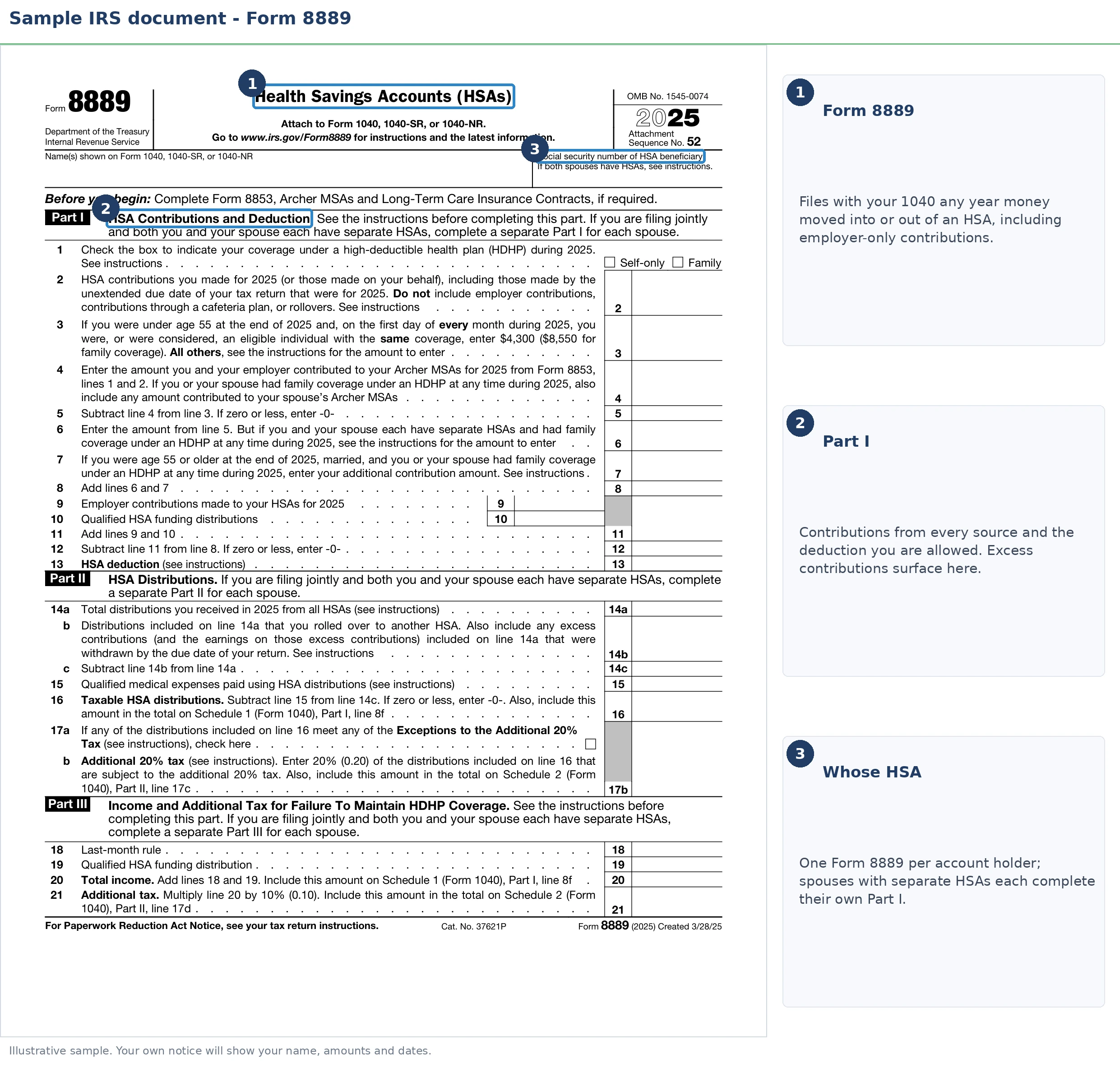
This guide covers who must file, what feeds each of the form's three parts, how a non-medical withdrawal becomes taxable, and how to fix an over-contribution before it starts compounding. The image below shows exactly what Form 8889 looks like and which of its three parts your situation lands in.
⏱ The clock that matters: Form 8889 has no deadline of its own — it files with your tax return. But an excess HSA contribution generally must come out of the account, along with its earnings, by your return's due date, including extensions. Miss that window and Form 5329's excise tax generally applies for every year the excess stays in the account.
Who must file Form 8889 — even if your employer made every contribution
You must file Form 8889 for any year money moved into or out of your HSA — including years when your employer made every contribution. The IRS's own filing triggers are broad: file it to report HSA contributions (including those made on your behalf and employer contributions), to figure your HSA deduction, to report distributions, and to figure income and additional tax if you failed to remain an eligible individual.
That surprises a lot of W-2 employees. If box 12 of your W-2 shows code W, your employer or payroll system put money into an HSA for you, and Form 8889 is what certifies you were eligible to receive those dollars tax-free. No form, and the IRS can treat that money as taxable wages.
For a 1099 contractor, the trigger is usually the other two: you made contributions directly (which become your deduction in Part I) or you took money out (which the custodian reported to the IRS on Form 1099-SA). Either one means the form is required. Form 8889 attaches to Form 1040 or 1040-NR — it's a schedule, not a standalone filing.
The three parts of Form 8889 and where each number comes from
Form 8889 has three parts: Part I for contributions and your deduction, Part II for distributions, and Part III for income and additional tax when you fail to remain an eligible individual. Almost every figure comes from one of three documents already in your mail pile — the form image on this page shows how the parts stack so you can see where each document feeds in.
| Part | What it asks for | Where the figure comes from |
|---|---|---|
| Part I — Contributions & deduction | Every contribution for the year: yours, anyone's made on your behalf, and your employer's — then your allowed deduction based on your coverage type and months of eligibility | Your own deposit records; Form 5498-SA from the custodian; W-2 box 12, code W for employer and payroll contributions; Publication 969 for the current-year limit |
| Part II — Distributions | Total money taken out, how much went to unreimbursed qualified medical expenses, and the taxable remainder plus any additional tax | Form 1099-SA, box 1 (gross distribution); your medical receipts; Publication 502 for what counts as a qualified expense |
| Part III — Failure to stay eligible | Income and additional tax you owe if you used the last-month rule and then lost eligibility during the testing period | Your own coverage dates (when HDHP coverage started or ended, when Medicare began); the Form 8889 instructions walk the calculation |
Two details trip people up in Part I. First, employer contributions are not your deduction — they were already excluded from your wages through payroll, so deducting them again double-dips and the IRS's matching systems will flag it. Second, your limit depends on coverage type (self-only vs. family) and how many months you were eligible; the current dollar limits are in Publication 969, and they change with inflation, so don't rely on last year's number.
In Part II, the taxable amount is simply total distributions minus unreimbursed qualified medical expenses. One rule works strongly in your favor here: qualified expenses generally count even if they happened in an earlier year, as long as they came after the HSA was established and were never reimbursed or deducted elsewhere. Old receipts can shrink this year's taxable number.
What happens if you don't file Form 8889
Your HSA custodian sends Form 1099-SA and Form 5498-SA to the IRS whether or not you file Form 8889 — so a missing form is a mismatch the IRS's computers catch on their own. The sequence that follows is automated, and it defaults to the worst-case reading of your account:
- The mismatch sits in the system. Your return goes in without Form 8889 while the custodian's copies of your 1099-SA and 5498-SA are already in IRS records.
- Automated matching flags the gap. With no form showing qualified expenses, the underreporter program treats your entire distribution as taxable — it has no way to know any of it was medical.
- A CP2000 notice arrives, proposing income tax on the full distribution, the additional tax on top, interest, and potentially an accuracy-related penalty. If employer contributions were involved, those can be added back as wages too.
- Ignore the CP2000 and the IRS can issue a statutory notice of deficiency — after that window closes, the proposed amount gets assessed as a legal debt.
- Assessment starts the collection sequence: balance-due notices, then escalating collection letters, with interest and the late-payment penalty accruing monthly the whole way.
The frustrating part is that most of a proposed CP2000 balance on an HSA distribution is often wrong — the IRS assumed zero medical expenses because you never told it otherwise. A late-filed Form 8889, or an amended return on Form 1040-X with the form attached, frequently cuts the proposed amount dramatically. If a balance does stand, you can estimate how fast it grows with our IRS Penalty & Interest Calculator.
Over-contributed or took a non-medical HSA withdrawal?
Get your Form 8889 numbers reviewed free before you file — an excess contribution left in the account keeps generating excise tax year after year, and an unreported 1099-SA is a matching notice waiting to happen. An experienced tax professional will map exactly what's taxable, what isn't, and what to fix first.
The four HSA outcomes and how each one is taxed
Only one HSA outcome is fully tax-free: a distribution matched dollar-for-dollar by unreimbursed qualified medical expenses. Every other path — non-medical spending, over-contributing, losing eligibility — creates a tax consequence, and each lands on a different part of a different form:
| Situation | Taxable? | Extra charge? | Reported on |
|---|---|---|---|
| Distribution spent on qualified medical expenses | No | No | Form 8889, Part II — distributions offset by qualified expenses |
| Non-qualified (non-medical) distribution | Yes — added to your income | Yes — an additional tax figured in Part II (current rate in the form's instructions); generally waived after age 65, on disability, or at death | Form 8889, Part II → flows to Form 1040 |
| Excess contribution left in the account | The excess isn't deductible (and payroll excess can become wages) | Yes — an excise tax for each year the excess remains, figured on Form 5329 | Form 8889, Part I caps the deduction; Form 5329 figures the excise |
| Lost eligibility mid-year (Medicare, non-HDHP coverage) | Contributions above your prorated limit become excess; a failed last-month-rule testing period becomes income | Yes — additional tax on the Part III income amount; excise on any excess left in | Form 8889, Part III (plus Form 5329 for the excess) |
Note what's not on this table: an HSA levy. If your worry is the IRS taking the account itself over existing back taxes, that's a collection question, not a filing question — see can the IRS take your HSA. This page covers how the account gets reported and taxed on your return.
What happens if you lose HSA eligibility mid-year
HSA eligibility is measured month by month, and enrolling in Medicare or switching to non-HDHP coverage ends it — but only the contribution side. You can keep spending the balance tax-free on qualified medical expenses forever; you just can't add new money for ineligible months.
When eligibility ends mid-year, your contribution limit is generally prorated for the months you were eligible. Keep contributing at the full-year pace after the switch and the overage becomes an excess contribution — the same Form 5329 problem as any other over-funding. Two traps to check:
- Retroactive Medicare. When you start Social Security benefits, Medicare Part A enrollment can take effect earlier than the date you signed up. Confirm your actual entitlement date before funding the HSA in that year — contributions made for months you were retroactively covered are excess.
- A spouse's health FSA. If your spouse has a general-purpose health FSA that can reimburse your expenses, it can make you ineligible even while you're enrolled in a qualifying HDHP. Publication 969 covers the coverage rules in detail.
Part III exists for a narrower situation: you used the last-month rule to contribute a full-year amount based on December coverage, then failed to stay eligible through the testing period. The shortfall becomes income plus an additional tax, both figured in Part III using the worksheet in the form's instructions — don't estimate this one by hand.
A worked example: $4,150 out of the HSA for a non-medical expense
Say you're a self-employed drywall contractor with self-only HDHP coverage. In a cash crunch mid-year, you pulled $4,150 out of your HSA to replace a transmission — no medical bills involved. You also discover, doing your return, that you deposited $700 more than your Publication 969 limit allowed. In January, the custodian's Form 1099-SA arrives showing $4,150 in box 1. Here's the math (this is a hypothetical, not a client case):
- Part II — the withdrawal. Total distributions: $4,150. Qualified medical expenses: $0. Taxable amount: $4,150, added to your income. If your marginal federal rate is 22%, that's roughly $4,150 × 22% = $913 in income tax — plus the additional tax Part II figures on the same $4,150 (the current percentage is printed in the Form 8889 instructions), plus state income tax if your state taxes HSA distributions.
- The receipt rescue. Before accepting that number, dig for unreimbursed medical receipts from any time after the HSA was opened — the dentist visit you paid out of pocket, prescriptions, the urgent-care copay. Say you find $1,400 of them: the taxable amount drops from $4,150 to $2,750, and both the income tax and the additional tax shrink with it.
- Part I — the $700 excess. Your deduction is capped at your limit, so the extra $700 deducts nothing. Withdraw the $700 plus its earnings before your filing deadline (including extensions), processed by the custodian specifically as a return of excess contribution, and there's generally no excise tax — you just pay income tax on the small earnings amount. Leave it in, and Form 5329 generally charges an excise tax this year and every year the $700 remains.
- One thing that doesn't work: the $4,150 you already pulled for the truck generally can't be re-labeled after the fact as your excess removal. A return of excess is a specific custodian transaction with its own coding on next year's 1099-SA — call the custodian and request it by name.
If the combined bill lands bigger than you can pay with the return, that's a payment problem with its own solutions — start with filed taxes and owe more than expected. Filing the accurate Form 8889 on time is still the right move; the failure-to-file penalty is far worse than the failure-to-pay penalty.
How to fill out Form 8889, step by step
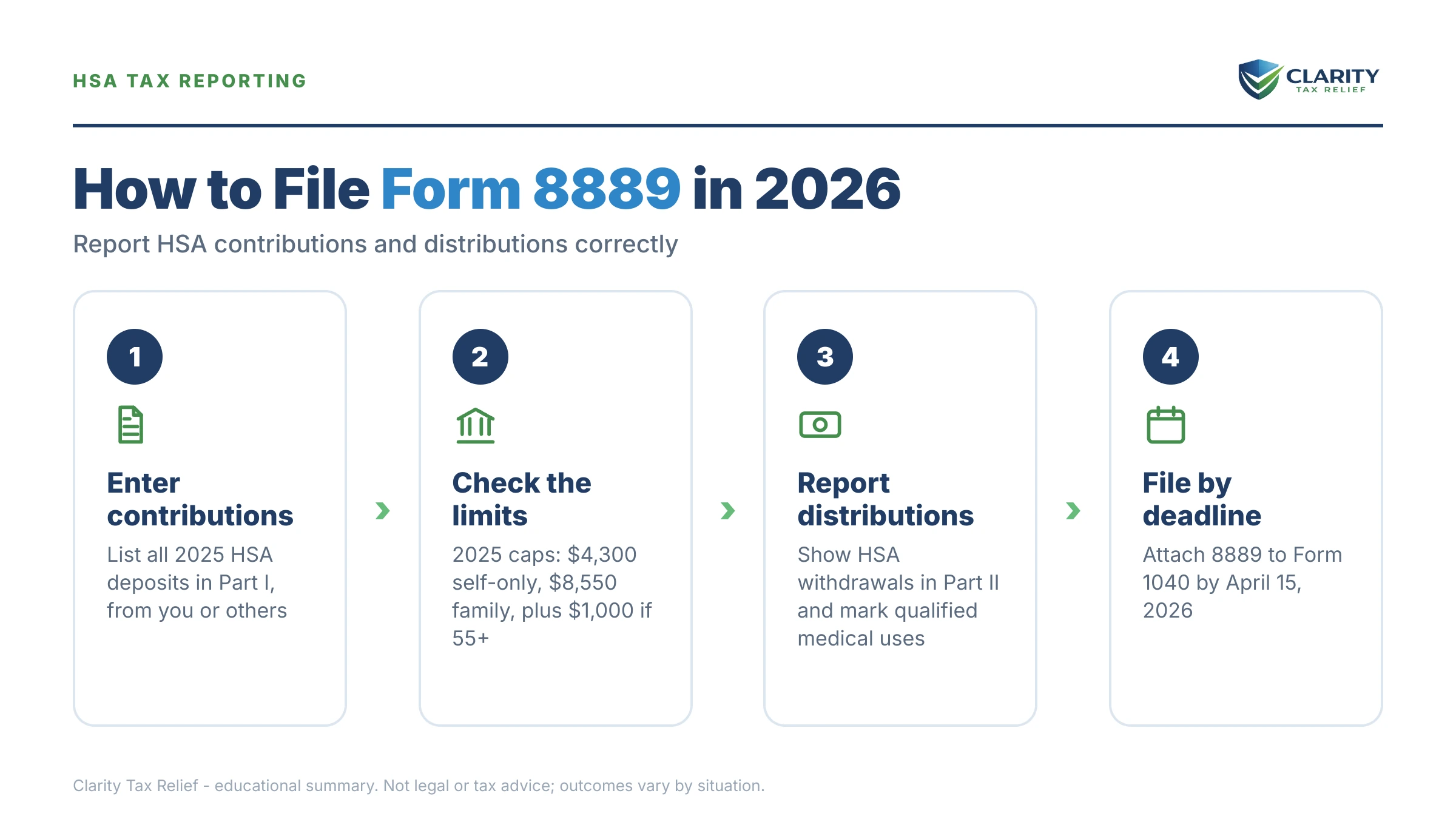
- Gather the three source documents: your W-2 (box 12, code W), Form 5498-SA from your custodian, and Form 1099-SA if you took any money out.
- Complete Part I: report every contribution — yours, anyone's made on your behalf, and your employer's — and figure your deduction against the Publication 969 limit for your coverage type.
- Complete Part II: enter your total distributions from Form 1099-SA, then your unreimbursed qualified medical expenses; any difference is taxable income and may carry the additional tax.
- Complete Part III only if you lost eligibility: if you used the last-month rule and then failed the testing period, figure the income and additional tax here using the form's instructions.
- Attach Form 8889 to your Form 1040 and file — then, if you over-contributed, arrange the excess withdrawal with your custodian before your filing deadline, including extensions.
When you can handle Form 8889 yourself — and when to get help
Most people with routine HSA activity can complete Form 8889 themselves in under an hour. If your contributions all ran through payroll, every withdrawal went to medical bills you have receipts for, and your coverage didn't change mid-year, tax software fills the form correctly from your W-2 and 1099-SA — file it and move on.
Experienced help changes the outcome in a handful of situations: a non-medical withdrawal and an excess contribution in the same year (where the order and coding of fixes determines what you owe), a CP2000 that has already proposed tax on the full distribution, multiple years of unfiled Form 8889s stacking up, or a retroactive-Medicare mess where the eligible-month count itself is in dispute. In those cases, the fee for an hour of review is routinely smaller than the excise tax a missed correction window locks in.
Terms on Form 8889, decoded
- Eligible individual — someone covered by a qualifying HDHP with no disqualifying other coverage (including Medicare); only eligible individuals can contribute.
- High deductible health plan (HDHP) — a health plan meeting the IRS's minimum-deductible and maximum out-of-pocket tests in Publication 969; HDHP coverage is what unlocks the HSA.
- Qualified medical expenses — the costs defined in Publication 502 (care, prescriptions, dental, vision, and more) that make a distribution tax-free when unreimbursed.
- Excess contribution — money put in above your annual limit; not deductible, and subject to a recurring excise tax on Form 5329 until removed.
- Last-month rule & testing period — the rule letting December-covered taxpayers contribute a full-year amount, conditioned on staying eligible through a testing period; failing it triggers Part III.
- Distribution code (Form 1099-SA, box 3) — the custodian's one-character label for why money left the account (normal distribution, excess removal, disability, death); it tells the IRS how to read box 1.
The authoritative references are the IRS's own pages: About Form 8889 for the current form and instructions — including the year's contribution limits, the additional-tax percentage, and the excise rate — and Publication 969 for the eligibility and coverage rules. If a completed form leaves you with a balance due, payment options are at IRS.gov/payments.
Form 8889 FAQs
Do I have to file Form 8889 if only my employer contributed to my HSA?
Yes. Employer contributions show up in box 12 of your W-2 with code W, and reporting them on Form 8889 Part I is what certifies you were eligible to receive them tax-free. If you skip the form, the IRS can treat those employer dollars as taxable wages. You must file it even if you personally deposited nothing and took nothing out.
What happens if I forget to file Form 8889?
The IRS usually catches it through document matching, because your custodian sends copies of Form 1099-SA and Form 5498-SA directly to the IRS. With no Form 8889 showing qualified expenses, the automated system can treat your entire distribution as taxable and propose tax, additional tax, and interest on a CP2000 notice. The fix is filing an amended return (Form 1040-X) with a completed Form 8889 — before the notice arrives, or in response to it.
Do I owe tax on HSA withdrawals I spent on medical bills?
No — distributions spent on qualified medical expenses are tax-free, but you still must report them. Form 8889 Part II lists your total distributions from Form 1099-SA and subtracts your unreimbursed qualified expenses; if they match, nothing is taxable. Keep receipts, because the IRS can ask you to prove the expenses were qualified. Publication 502 defines what counts.
How do I fix an excess HSA contribution?
Withdraw the excess amount plus any earnings on it before your tax filing deadline, including extensions, and ask the custodian to process it specifically as a return of excess contribution. Do that and there is generally no excise tax — you only pay income tax on the earnings. Leave the excess in the account and Form 5329 generally applies an excise tax for every year it stays there.
Is Form 8889 the same as Form 5329?
No — they work together. Form 8889 reports your HSA contributions, deduction, and distributions, and computes the additional tax on non-qualified withdrawals. Form 5329 handles a different charge: the recurring excise tax on excess contributions you leave in the account. Someone who over-contributed and also took a non-medical withdrawal may need both forms in the same year.
Can I still contribute to my HSA after enrolling in Medicare?
No. Enrolling in Medicare ends your eligibility to contribute, and your contribution limit for that final year is generally prorated for the months before your Medicare coverage began. Contributions above the prorated amount become excess contributions. You can still spend the money already in the HSA tax-free on qualified medical expenses — spending is never cut off, only contributing.
Does the IRS know about my HSA withdrawals?
Yes. Your HSA custodian files Form 1099-SA for distributions and Form 5498-SA for contributions with the IRS every year, so the IRS sees the money moving whether or not you report it. What the IRS cannot see is what you spent it on — that is exactly what Form 8889 Part II tells them. Silence gets read as none of it being medical.
Your next 24 hours
- Find the two numbers that drive the form: box 1 on your Form 1099-SA (total distributions) and box 12, code W on your W-2 (employer contributions). Those feed Part II and Part I respectively.
- Gather your offsets: Form 5498-SA plus every unreimbursed medical receipt dated after the HSA was opened — copays, prescriptions, dental work. Each receipt directly reduces the taxable amount in Part II.
- Get a free case review if you took a non-medical withdrawal, over-contributed, or already have a CP2000 in hand — use the 2-minute form or call (888) 825-7779. An excess left in the account keeps generating excise tax each year it sits, and interest runs on any balance the return gets wrong.
This guide is general information, not tax or legal advice for your specific situation. Eligibility for IRS programs depends on individual facts and circumstances; no outcome is guaranteed.