
IRS Collections
Can the IRS Take My HSA? How an HSA Levy Actually Works in 2026
The short answer: yes — the IRS can take my HSA is the right worry, because health savings accounts are not levy-exempt property under IRC §6334 and have none of the ERISA protection that shields many 401(k)s. But a levy comes only after a required notice sequence, and every notice is a chance to stop it.
You built that HSA for the medical bills retirement was always going to bring, and now, with the IRS saying you owe $7,400, you're wondering whether the government can reach in and empty it. That worry is legitimate. But an HSA levy sits at the end of a long, letter-by-letter process, and you are almost certainly earlier in it than you fear.
This guide covers what makes an HSA legally reachable, the exact notices that must arrive first, the surprising tax bill a levied or drained HSA creates, and the resolution options — several built for balances under $10,000 — that take your account off the table entirely.
⏱ Your real clock: if a Letter LT11, Letter 1058, or CP90 has already arrived, you have 30 days from the date printed on it to request a Collection Due Process hearing before the IRS can levy accounts. Before that stage, the clock is monthly: the late-payment penalty and interest compound on your balance every month you wait.
Why can the IRS take my HSA when my 401(k) has more protection?
The IRS can levy an HSA because health savings accounts are not on the list of levy-exempt property in IRC §6334. That exemption list is short and specific — items like unemployment benefits, workers' compensation, certain pension payments, and basic personal effects. HSAs are not on it, and neither Congress nor the IRS has carved out a special shield for them.
The comparison that surprises most readers: your HSA is easier for the IRS to reach than your 401(k). Employer retirement plans carry ERISA anti-alienation clauses. The IRS's own internal manual reserves retirement-account levies for taxpayers whose conduct has been flagrant, with extra managerial sign-off. An HSA is just a custodial account, usually held at a bank or trust company, with no equivalent clause and no equivalent internal hurdle. When a levy is served under IRC §6332, your HSA custodian must comply the same way a bank does. (For how retirement accounts differ, see can the IRS take my 401(k) and can the IRS take my IRA.)
Two more points specific to HSAs. First, a levy on an HSA is a one-time grab: it attaches to the funds in the account on the day it's served, not to future contributions — reaching new deposits would require a new levy. Second, once a balance is assessed, billed, and unpaid, the federal tax lien already attaches silently to everything you own, HSA included. The lien is the claim; the levy is the taking.
| Account | Can the IRS levy it? | Key difference |
|---|---|---|
| HSA | Yes | Not §6334-exempt; no ERISA shield; treated like a bank account. Levied funds are taxable income, and can trigger a 20% additional tax before age 65. |
| 401(k) / pension | Yes, but rarely | IRS internal procedures reserve retirement levies for flagrant conduct, with manager approval. |
| IRA | Yes, but rarely | Same retirement-levy hurdles, and the tax code waives the 10% early-withdrawal penalty on levied retirement funds. The HSA rules have no matching waiver. |
| Bank account | Yes | One-time levy with a 21-day hold before the bank sends the money. |
| Social Security | Yes, up to 15% | Automated, continuous levy through the Federal Payment Levy Program until the debt is resolved. |
“An IRS levy permits the legal seizure of your property to satisfy a tax debt. It can garnish wages, take money in your bank or other financial account, seize and sell your vehicle(s), real estate and other personal property.”
— Levy (IRS.gov)
What has to happen before an HSA levy: the notice sequence
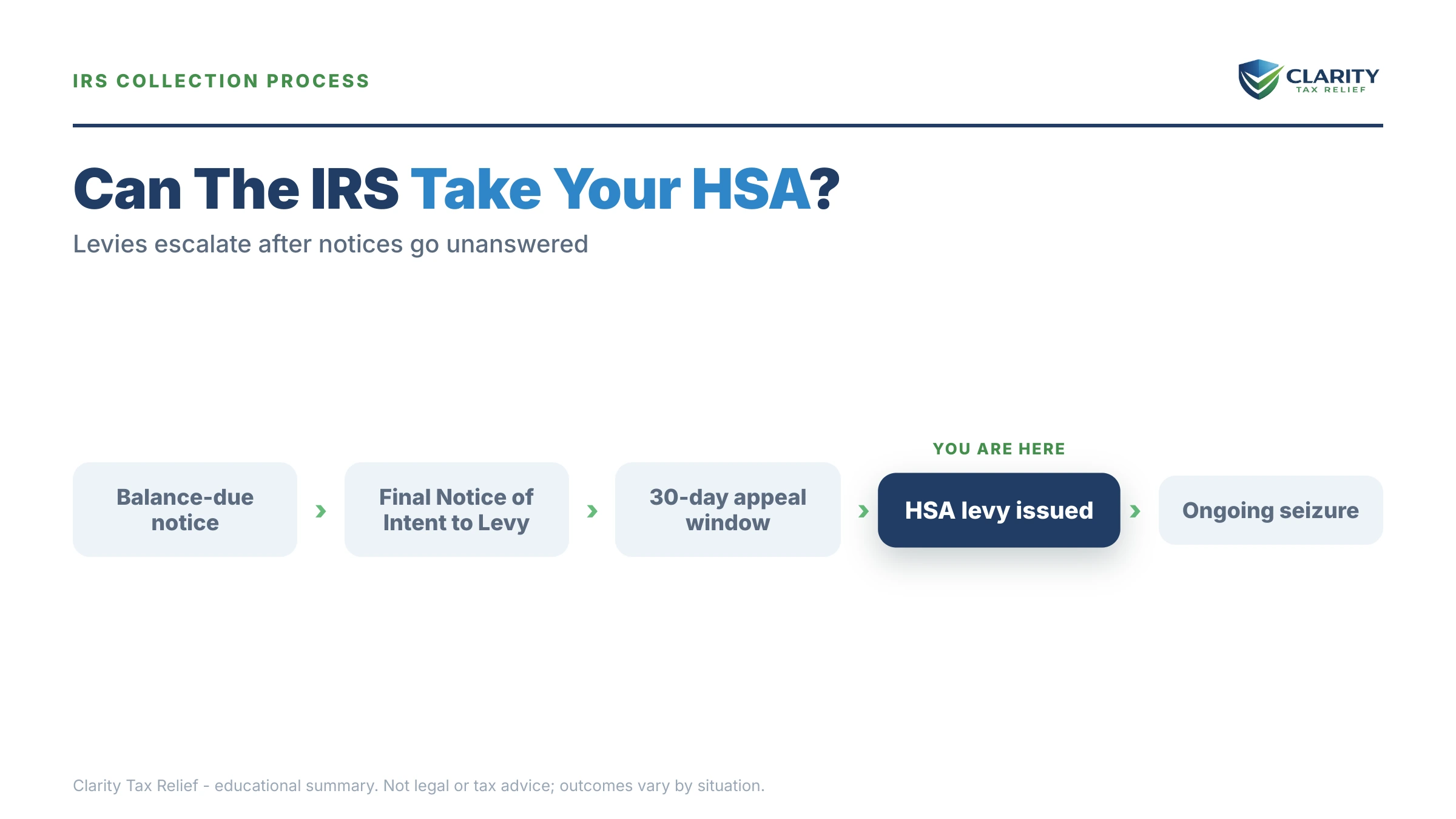
The IRS cannot levy an HSA until it has assessed the tax, sent a bill, and issued a final notice of intent to levy that goes unanswered for 30 days. The sequence is automated, and in 2026 — with the IRS workforce down roughly 27%, per TIGTA reports — it runs with almost no human review. The machine that mails the letters is the same machine that eventually issues the levy. Ignore each stage and the next arrives with more interest attached:
- CP14 — the first bill. You typically have about 21 days from the notice date before escalation begins. No levy power exists yet; this is the cheapest moment to act.
- CP501 / CP503 — reminders. Still just bills, but the balance compounds monthly and the federal tax lien has already attached to your property.
- CP504 — intent to levy your state refund. The IRS can now seize any state tax refund. A public lien filing becomes more likely. This is not yet the final notice, though it reads like one.
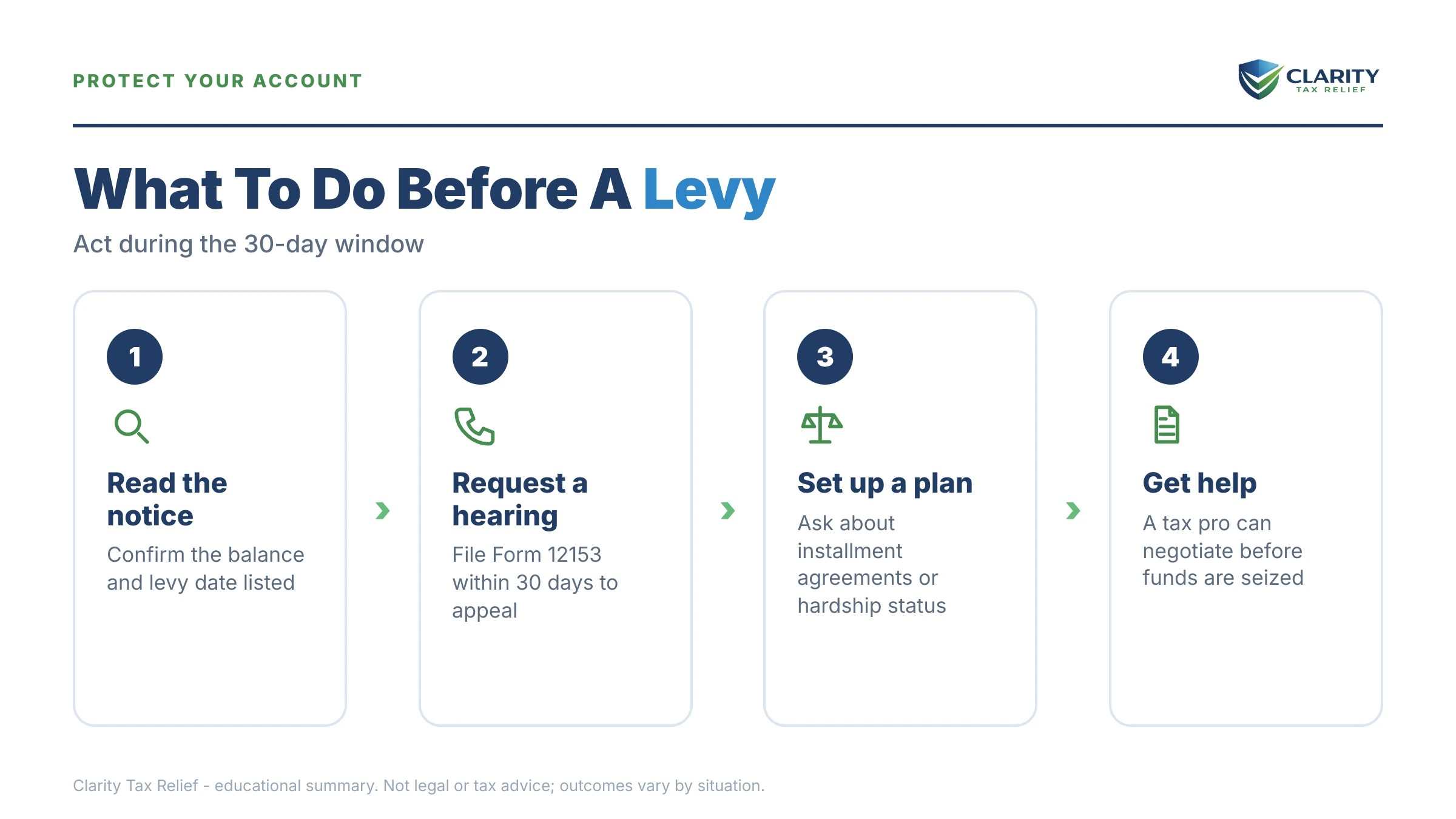
- LT11 / Letter 1058 / CP90 — the final notice. This starts the 30-day clock and your Collection Due Process rights. Filing Form 12153 for a CDP hearing within 30 days holds levy action on that debt while your case is heard.
- Levy. After day 30 with no response, the IRS can levy bank accounts, serve your HSA custodian, and, for retirees, take up to 15% of Social Security through the automated Federal Payment Levy Program.
Two details specific to this stage. If your HSA custodian is a bank, levied funds sit under a 21-day hold before they're transmitted — a last, narrow window to negotiate a release. And a levy that creates genuine economic hardship (for a retiree, that often means money needed for medications or medical care) can be released under IRC §6343 even after it's served. Long before any of this touches your HSA, though, the IRS will simply keep taking your tax refund every year — the quietest levy there is.
The table below maps each notice to your response window and the right you lose if it passes. The image on this page shows exactly how this escalation ladder fits together, so you can place your own letter on it.
| Notice | Your window | What's at stake if it passes |
|---|---|---|
| CP14 | Typically 21 days from the notice date | The cheapest fix; after this, penalties and interest compound and reminders begin |
| CP501 / CP503 | The pay-by date printed on each notice | Still no levy power, but escalation to CP504 is queued automatically |
| CP504 | The date printed on the notice | Your state tax refund can be seized; lien filing becomes more likely |
| LT11 / Letter 1058 / CP90 | 30 days from the notice date | Your Collection Due Process hearing rights (Form 12153) — the strongest lever you get |
| Levy served on custodian | 21-day hold on bank-held funds | The final chance to negotiate a release before the money is transmitted |
Worried a levy is next?
Tell us which notice you're holding. An experienced tax professional will place you on the exact timeline above, tell you whether your HSA or Social Security is actually at risk, and map the fix — free and confidential. If a final notice has arrived, the 30-day CDP window is the one deadline that matters most.
Should you drain your HSA to pay the IRS? Run this math first
The tax cost of draining an HSA
A non-medical HSA withdrawal is taxable income, plus a 20% additional tax if you're under 65, so paying the IRS from your HSA can create a brand-new tax bill while erasing your medical cushion. This is the trap most people miss: the money feels like savings. But the tax code treats any dollar not spent on qualified medical expenses as a penalized distribution. The exceptions to the 20% additional tax are narrow — age 65, disability, and death. Full rules are in IRS Publication 969.
Here's a clearly hypothetical example. Say you're 67, retired on Social Security, and owe the IRS $7,400 from taxes on a retirement-account withdrawal two years ago. You have $11,000 in an HSA. Your three realistic paths:
- Pay from the HSA at 67. Because you're over 65, no 20% additional tax applies, but the $7,400 counts as ordinary income on next year's return. That extra income can pull more of your Social Security into the taxable column and hand you a new balance next April. The debt dies; the medical cushion dies with it.
- Same move at 63 (for comparison). In a 12% bracket, a $7,400 withdrawal costs about $888 in income tax plus $1,480 in additional tax — $2,368 in new tax, meaning only about $5,032 actually reaches the debt. To clear the full $7,400 you'd need to withdraw roughly $10,900, nearly the whole account.
- A guaranteed installment agreement instead. Because $7,400 is under $10,000, the IRS must accept a guaranteed installment agreement if you meet its conditions: it's available to individuals only, on an income-tax balance of $10,000 or less (excluding penalties and interest), with all your returns filed, timely filing and payment for the past 5 years with no installment agreement during that period, and full payment within 3 years — $7,400 ÷ 36 ≈ $206 a month. Interest still accrues. But the late-payment penalty rate is cut in half while the plan is active, no levy can proceed. Your HSA never moves.
- Hardship status, if the numbers are tighter. If Social Security barely covers rent, food, and medications, collection can be paused entirely — see IRS hardship while on Social Security. The debt remains and interest accrues, but levies stop and the 10-year collection statute keeps running.
The takeaway: at $7,400, the payment plan almost always beats the withdrawal, and under 65, the withdrawal is close to self-sabotage.
Options that protect your HSA (and your Social Security)
Any active resolution — a payment plan, hardship status, or a pending offer — takes levy action off the table while it's in place. Which one fits depends on your balance and your monthly numbers. The shared mechanics of each program are covered in our guide to how to settle tax debt yourself, so here's just the eligibility map:
| Option | Basic eligibility | Effect on your HSA |
|---|---|---|
| Short-term payment plan | Can pay in full within 180 days; $0 setup fee | Levy action stops while the plan is active; interest and penalties continue |
| Guaranteed installment agreement | Individuals only; income-tax balance of $10,000 or less (excluding penalties and interest); all returns filed; timely filing and payment for the past 5 years with no installment agreement in that period; full pay within 3 years | The IRS must accept it; no levy while you're current |
| Streamlined installment agreement | Up to $25,000 (or $50,000 with direct debit), up to 72 months | No detailed financial disclosure; levy risk ends while current |
| Currently Not Collectible | Income covers only allowable living expenses — common on fixed Social Security income | Collection paused; HSA and benefits left alone, though a lien may still be filed |
| Offer in Compromise | Assets and future income genuinely can't cover the debt; $205 fee, waived with low-income certification | Collection is generally held while the offer is reviewed; per IRS data, the IRS accepted roughly 1 in 5 offers in FY2024 |
| Penalty relief (FTA / AEP) | Clean compliance for the prior 3 years; the new Automatic Exemption from Penalty begins summer 2026, no request needed | Shrinks the balance itself, which shrinks everything downstream |
One retiree-specific note: an HSA is means-tested against you in an Offer in Compromise. The IRS counts the account as an asset when it calculates what it could collect, so a five-figure HSA can raise your required offer — one more reason to have the math run before filing anything.
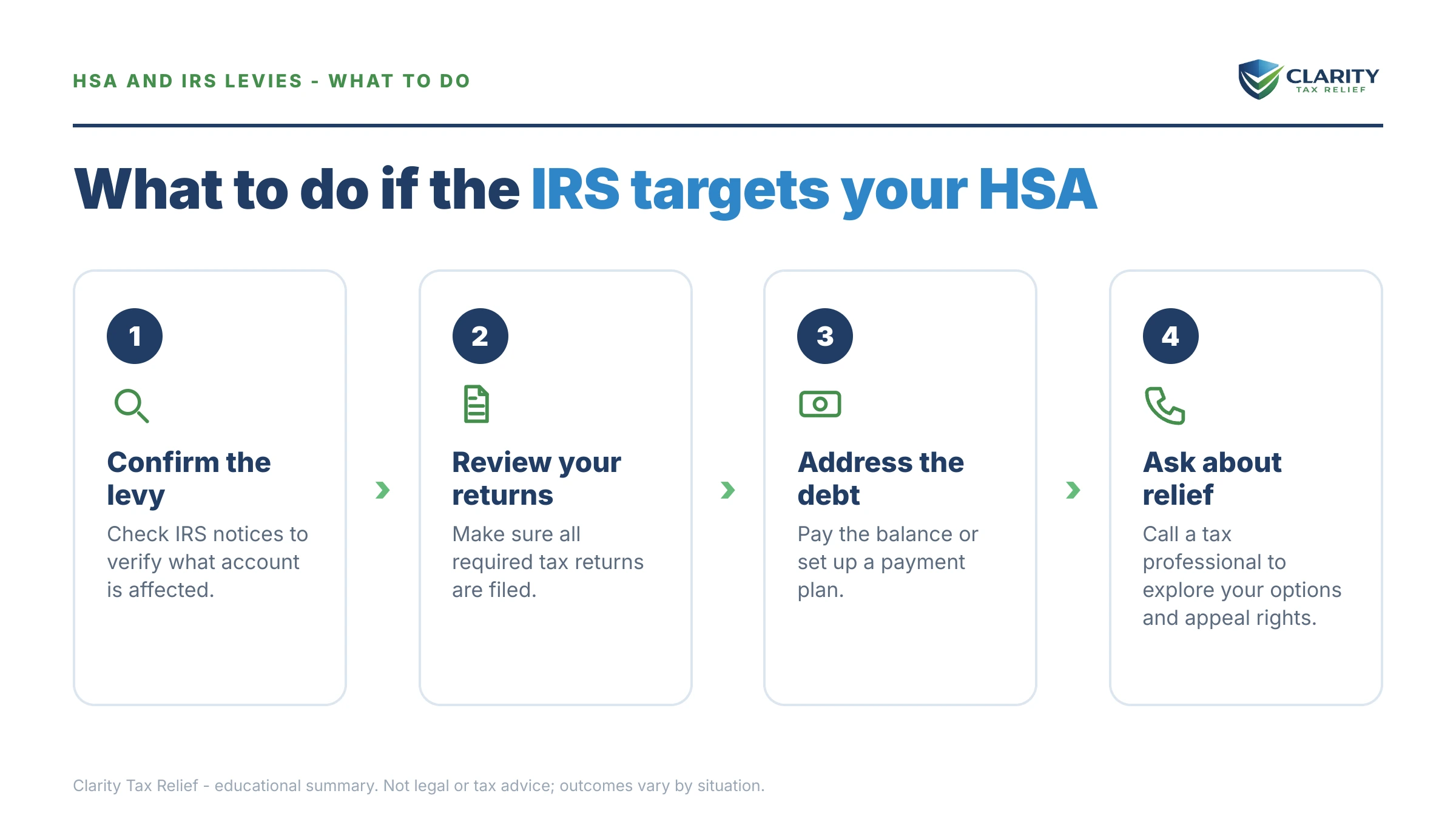
How to respond and protect your HSA, step by step
- Find your place in the notice sequence. Pull your most recent IRS letter and note its code — CP14, CP504, LT11, or CP90 — then log into your IRS online account to confirm the balance and years involved.
- Calendar the 30-day deadline if a final notice arrived. If you're holding an LT11, Letter 1058, or CP90, count 30 days from its date and file Form 12153 for a Collection Due Process hearing before that window closes — the hearing request holds levy action on the debt while your case is heard.
- Set up a resolution that fits your numbers. Choose from the options table — a 180-day short-term plan, a guaranteed installment agreement if you qualify, or hardship status — and put it in place before the final-notice window closes.
- Run the tax math before touching the HSA. Before voluntarily withdrawing HSA money to pay the IRS, calculate the income tax — plus the 20% additional tax if you're under 65 — that the withdrawal itself creates.
- Ask for penalty relief. If your prior three years are clean, request first-time penalty abatement, and note that the IRS's Automatic Exemption from Penalty begins rolling out in summer 2026, which can remove qualifying penalties without a request.
Payment plans can be set up online at the IRS payment plans page, and any direct payment goes through IRS.gov/payments — never to anyone asking for gift cards or wire transfers.
When you can handle this yourself, and when experienced help changes the outcome
Most people worried about an HSA levy can fix the problem themselves, because the fix is usually a simple payment arrangement. You likely don't need help if you agree with the balance, it's under $10,000, all your returns are filed. You can either pay within 180 days or afford the guaranteed-agreement monthly amount. Set the plan up online, keep current, and your HSA never enters the conversation. If money is the obstacle, the Taxpayer Advocate Service and Low Income Taxpayer Clinics offer free help — start at taxpayeradvocate.irs.gov.
Experienced help earns its cost in narrower situations: a final notice already past its 30-day mark, a levy already served on a custodian (the release arguments are technical and time-boxed by the 21-day hold), a disputed balance, multiple unfiled years, or fixed-income cases where the choice between hardship status and an Offer in Compromise turns on asset math the IRS runs its own way. In those cases the order of moves — returns first, penalties second, resolution third — often changes the final number.
Terms on your notices, decoded
- Levy: the actual seizure of money or property — the IRS taking, not just claiming.
- Lien: the government's legal claim against everything you own, which attaches automatically once a tax is assessed, billed, and unpaid.
- Exempt property (IRC §6334): the short federal list of things a levy can't touch — HSAs are not on it.
- CDP rights: your right to a Collection Due Process hearing, triggered by the final notice and requested on Form 12153 within 30 days.
- Custodian: the bank or trust company holding your HSA — the party legally required to hand over funds when served a levy.
- Nonqualified distribution: any HSA dollar not spent on qualified medical expenses — taxable income, plus a 20% additional tax before age 65.
HSA levy questions, answered
Can the IRS take money out of my HSA?
Yes. Health savings accounts are not on the list of levy-exempt property in IRC §6334, so once the IRS finishes its required notice sequence it can serve a levy on your HSA custodian and take the balance. In practice an HSA levy usually happens late in a case, after bills and final notices have gone unanswered — which means you almost always have time to stop it if you act on the letters.
Is my HSA protected like my 401(k) or pension?
No — an HSA has weaker protection. Workplace retirement plans get extra procedural hurdles inside the IRS: its own manual reserves retirement levies for taxpayers whose conduct has been flagrant. An HSA is a custodial account with no ERISA anti-alienation clause, so the IRS treats it closer to a bank account than a pension.
Do I owe the 20% penalty if the IRS levies my HSA?
Possibly, if you're under 65. Levied HSA money wasn't spent on qualified medical expenses, so it counts as taxable income. The HSA statute's exceptions to the 20% additional tax cover only age 65, disability, and death — there's no levy exception like the one retirement accounts get. Have an experienced tax professional review how a levy would land on your return before assuming the worst.
Should I use my HSA to pay off the IRS myself?
Usually not before running the math. A voluntary non-medical withdrawal is taxable income, plus a 20% additional tax if you're under 65, so pulling $7,400 before 65 can cost roughly $1,480 in extra tax on top of ordinary income tax. A payment plan on a balance under $10,000 often costs far less than gutting your medical fund.
Can the IRS take my HSA without warning?
Not legally, outside rare jeopardy situations. Before levying any account the IRS must assess the tax, send a bill, and issue a final notice of intent to levy — LT11, Letter 1058, or CP90 — that starts a 30-day window to request a Collection Due Process hearing. If those letters went to an old address, the levy can still land, which is why updating your address with the IRS matters.
Can the IRS take my HSA for my spouse's tax debt?
Generally not if the debt is your spouse's alone. HSAs are individually owned, and a levy reaches property belonging to the person who owes the tax. But if the balance comes from a jointly filed return, you are both fully liable, and either spouse's HSA is fair game. Innocent-spouse rules can sometimes separate that liability.
Will the IRS take my Social Security before my HSA?
Usually, yes. The Federal Payment Levy Program can take up to 15% of Social Security benefits through an automated, continuous levy, and automation reaches benefits long before a levy notice reaches an HSA custodian. An HSA levy typically requires a person working the case, so on fixed income the 15% benefit levy is the more common first strike.
Your next 24 hours
- Find the notice code and date on the most recent IRS letter you've received. It's printed in the top corner. That code tells you exactly how far the automated sequence has run and whether a 30-day CDP window is open.
- Gather three things: your last filed tax return, that IRS letter. Your income picture. Your Social Security award letter and your latest HSA statement. That's everything needed to know which option in the table above fits.
- Get the free case review. Call (888) 825-7779 or use the 2-minute form and an experienced tax professional will tell you whether your HSA is genuinely exposed and which resolution protects it, before interest and penalties add another month to the bill.
This guide is general information, not tax or legal advice for your specific situation. Eligibility for IRS programs depends on individual facts and circumstances; no outcome is guaranteed.