
IRS Forms
Form 941 2026: Due Dates, Deposit Rules, Rates, and Penalties
The short answer: Form 941 is the Employer's Quarterly Federal Tax Return. For 2026 it reports federal income tax withheld from employee paychecks plus both shares of Social Security (6.2% each, on wages up to $184,500) and Medicare (1.45% each). The 2026 returns are due February 2, April 30, July 31, and November 2, and the tax itself is deposited earlier on a monthly or semiweekly schedule.
You run payroll, the paychecks clear, and then a dense quarterly form stands between you and staying square with the IRS. Maybe this is your first quarter with employees. Maybe, like a lot of restaurant and shop owners, you know exactly which quarters you skipped.
Either way, the form is more mechanical than it looks, and catching up is a known process. This guide covers the 2026 version of Form 941: every due date, the deposit-schedule test and lookback period, the 2026 Social Security wage base and rates, the penalties for filing or depositing late, how to e-file, and what happens when 941 taxes fall behind. Every figure below was checked against the March 2026 Form 941 instructions, Publication 15 (2026), and the IRS penalty pages in October 2026.
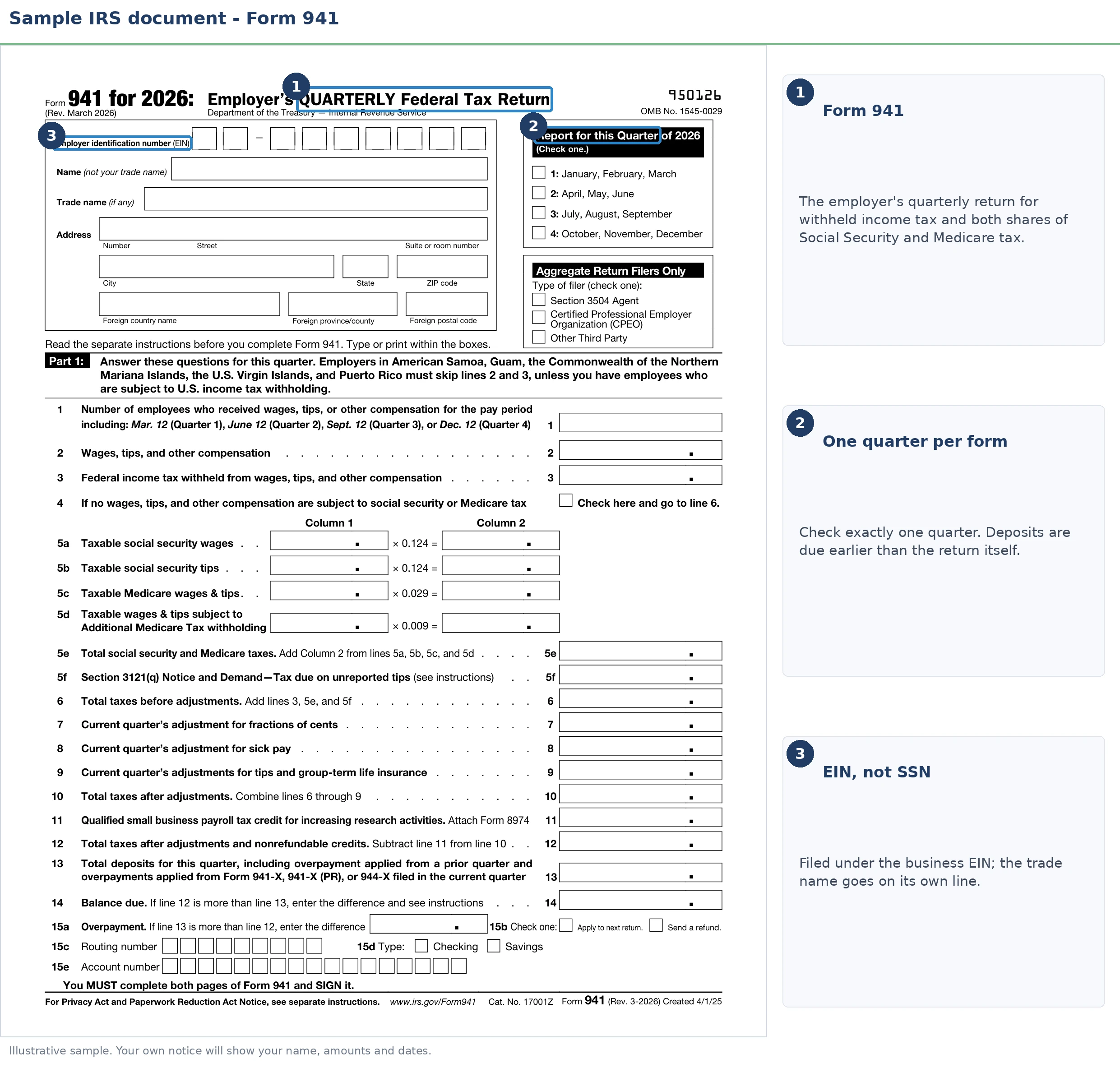
The image below shows what Form 941 looks like and where to focus. The numbers that decide everything are the total tax for the quarter, the total deposits made, and the balance line where those two meet.
⏱ The next deadline: Form 941 for the third quarter of 2026 (July through September wages) is due October 31, a Saturday this year, so the deadline moves to Monday, November 2, 2026. Your payroll tax deposits are due far sooner than the return itself, on your monthly or semiweekly schedule.
What does Form 941 report, and who has to file it in 2026?
Form 941 reports three things every quarter: federal income tax withheld from employees' paychecks, the employees' share of Social Security and Medicare tax, and the employer's matching share. The return reconciles what you owed for the quarter against what you actually deposited. Any gap becomes a balance due.
If you pay wages subject to withholding or Social Security and Medicare taxes, you file every quarter, even a quarter with zero payroll, until you check the final-return box or qualify as a seasonal employer. A quarter of silence looks to the IRS like a missing return, not a quiet one.
The current form is the March 2026 revision (the IRS labels the form and instructions "03/2026"), and it is the one to use for every 2026 quarter. Searchers looking for "f941 form 2026" are looking for that same document: the IRS file name for the form PDF is f941, and there is no separate 2026-only version beyond the current revision.
What Form 941 does not cover: federal unemployment (FUTA) tax, which is reported once a year on Form 940, and only the employer pays it. The two returns create very different debt problems when unpaid. Our guide to 941 vs 940 back taxes breaks down why.
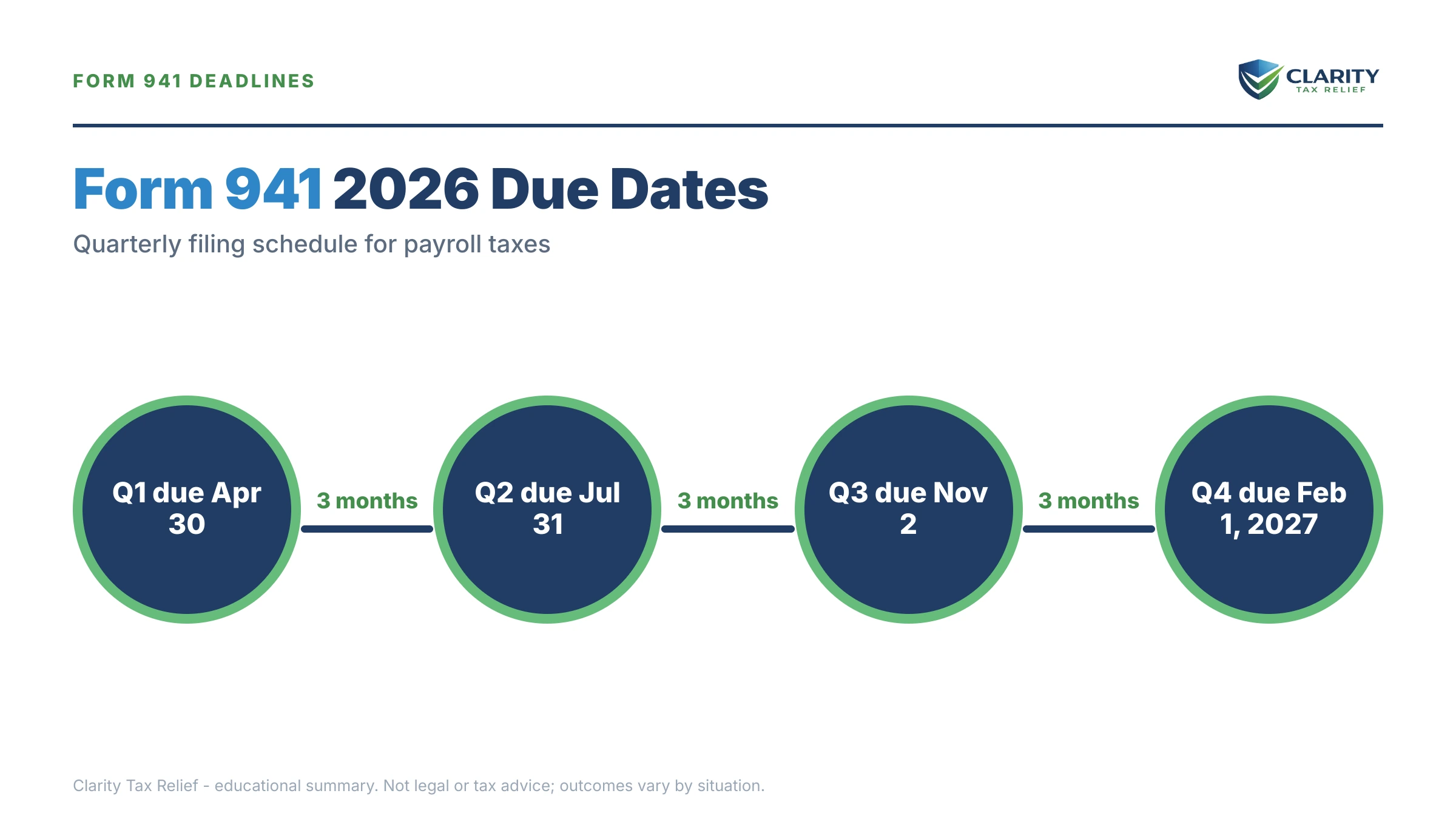
When is Form 941 due in 2026?
Form 941 is due four times a year, on the last day of the month after each quarter ends. That rule never changes; only the weekend and holiday adjustments do. The Form 941 instructions say that when a due date falls on a Saturday, Sunday, or legal holiday, you may file on the next business day. Two of the deadlines on the 2026 calendar move for that reason.
| Quarter | Wages paid in | Form 941 due |
|---|---|---|
| Q4 2025 | October through December 2025 | January 31, 2026 (a Saturday, so Monday, February 2, 2026) |
| Q1 2026 | January through March | April 30, 2026 |
| Q2 2026 | April through June | July 31, 2026 |
| Q3 2026 | July through September | October 31, 2026 (a Saturday, so Monday, November 2, 2026) |
| Q4 2026 | October through December | January 31, 2027 (a Sunday, so Monday, February 1, 2027) |
Each quarter is its own return, its own deadline, and its own penalty clock. Filing Q3 on time does nothing for a Q1 you never filed. The IRS tracks every quarter as a separate account module.
What are the 2026 Social Security wage base and tax rates on Form 941?
The rates on the 2026 form are the same as 2025 and the wage base moved up. Per the March 2026 Form 941 instructions and Publication 15 (2026), the Social Security tax rate is 6.2% each for the employee and employer, and the Social Security wage base limit is $184,500. Medicare is 1.45% each for the employee and employer with no wage base limit. Additional Medicare Tax of 0.9% is withheld from the employee only, starting in the pay period in which you pay an employee more than $200,000 for the year, and there is no employer match on it.
| Tax | Employee share | Employer share | 2026 wage limit |
|---|---|---|---|
| Social Security | 6.2% | 6.2% | $184,500 per employee |
| Medicare | 1.45% | 1.45% | None |
| Additional Medicare Tax | 0.9% | No employer share | Withheld on wages above $200,000 paid to an employee in the year |
| Federal income tax withholding | Per Form W-4 and the withholding tables | None | None |
On the form itself, the combined 12.4% Social Security rate and 2.9% Medicare rate are applied to the quarter's taxable wages, then added to the income tax you withheld. That total, minus any adjustments and credits, is the quarter's liability on line 12.
Monthly or semiweekly: when is the money itself due?
Your Form 941 deadline is not the deadline for the money. Payroll taxes are deposited during the quarter, on either a monthly or a semiweekly schedule. This is the single most misunderstood part of the form, and it is where most payroll tax debt starts.
The test is mechanical and it runs on a lookback period. For 2026 the lookback period is July 1, 2024 through June 30, 2025, which the instructions describe as July 1 of the second preceding calendar year through June 30 of the preceding calendar year. Add up the total tax you reported on the four Forms 941 for those quarters. If it is $50,000 or less, you are a monthly schedule depositor for all of 2026. If it is more than $50,000, you are a semiweekly schedule depositor. Separately, if you accumulate a $100,000 tax liability on any day during a deposit period, that amount must be deposited by the next business day, and a monthly depositor who hits it becomes a semiweekly depositor the following day.
| Deposit schedule | You are on it if | When the deposit is due |
|---|---|---|
| Monthly | $50,000 or less of employment tax reported in the lookback period (July 1, 2024 through June 30, 2025) | Each calendar month's accumulated liability is deposited by the 15th day of the following month |
| Semiweekly | More than $50,000 of employment tax reported in the lookback period | Wages paid Wednesday, Thursday, or Friday are deposited by the following Wednesday; wages paid Saturday through Tuesday are deposited by the following Friday. Schedule B goes with the return |
| Next-day rule | Either schedule, once accumulated liability reaches $100,000 on any day in a deposit period | By the next business day, and a monthly depositor becomes semiweekly from the following day |
| No deposit required | Line 12 for the quarter, or the prior quarter, is under $2,500 and you did not trigger the $100,000 rule | Pay the balance with the return instead of depositing |
All deposits go through electronic funds transfer, usually EFTPS. Two practical consequences follow from the schedule. First, by the time the quarterly return is due, nearly all of the quarter's tax should already be paid in, and the 941 mostly confirms it. Second, if cash gets tight mid-quarter, the deposit is the payment that gets skipped, and that is where the deepest holes form.
Who has to file Schedule B, D, or R with Form 941?
Form 941 has three lettered schedules, B, D, and R, and most employers will only ever file one of them, if any. Each attaches to the return and answers a question the IRS cannot get from the main form.
| Schedule | What it reports | Who must file it |
|---|---|---|
| Schedule B | Report of Tax Liability for Semiweekly Schedule Depositors: your tax liability day by day across the quarter, so the IRS can check each deposit's timeliness | Semiweekly schedule depositors (more than $50,000 of employment tax in the lookback period, or anyone who triggered the $100,000 next-day rule) |
| Schedule D | Explains certain discrepancies between Forms W-2 and Forms 941 in totals of Social Security wages, Medicare wages and tips, Social Security tips, and federal income tax withheld | Employers whose W-2 and 941 totals stopped matching because of an acquisition, statutory merger, or consolidation |
| Schedule R | Allocates the aggregate information reported on one Form 941 to each individual client business | Aggregate filers such as PEOs and payroll agents; more than 15 clients requires continuation sheets |
Schedule B is the one that trips up small employers. If you crossed into semiweekly status and keep filing without it, the IRS may average your liability across the quarter, which can generate deposit penalties on paydays you actually covered on time. Schedule D and Schedule R almost never apply to a typical small business: D only after a merger or acquisition, R only if you file one 941 on behalf of many clients.
How to e-file Form 941 in 2026
The IRS encourages electronic filing of Form 941 and lists three benefits: it saves time, it is secure and accurate, and you receive an acknowledgement within 24 hours. There are two ways to do it.
- File it yourself with IRS-approved software. The IRS keeps a list of approved providers. You sign the return one of two ways: with a 94x Online Signature PIN, which you apply for through the IRS and should allow at least 45 days to receive, or by scanning and attaching Form 8453-EMP, the Employment Tax Declaration for an IRS e-file Return, which works immediately.
- Have a professional file it. An authorized IRS e-file provider, including most payroll services and tax professionals, can submit the return for you. The IRS's Authorized IRS e-file Provider Locator Service lists them by location.
If you prefer paper, the mailing address depends on your state and on whether a payment is enclosed, and the correct address is printed in the Form 941 instructions. Paper returns get no acknowledgement, so keep proof of mailing. For paying any balance, the instructions point to EFTPS, IRS Direct Pay, or your business tax account, and e-filed returns can also carry an electronic funds withdrawal.
How to correct a Form 941 you already filed (Form 941-X)
You correct a filed Form 941 with Form 941-X, never by filing a second 941 for the same quarter, and never by folding the fix into the next quarter's return. Form 941-X is the Adjusted Employer's Quarterly Federal Tax Return or Claim for Refund, and you file a separate 941-X for each quarter you are correcting.
The form works in two directions: reporting additional tax you underreported, or claiming back tax you overreported. The deadlines and mechanics differ between the two paths, so match your situation to the Form 941-X instructions before filing. If your correction increases the tax, expect penalties and interest on the difference, and consider whether 941 penalty abatement applies before you simply pay them.
What are the Form 941 penalties for 2026?
Three different penalties can attach to one late quarter, and they are calculated differently. The failure-to-file penalty is 5% of the unpaid tax for each month or part of a month the return is late, up to a maximum of 25%. When the failure-to-pay penalty also runs in the same month, the failure-to-file penalty is reduced by that month's failure-to-pay amount (0.5%), so the two together total 5% for the month. For a return more than 60 days late, the IRS charges a minimum failure-to-file penalty of $525 for returns due after December 31, 2025. The failure-to-deposit penalty is separate and is tiered by how late each deposit was.
| Penalty | Rate | How it is measured |
|---|---|---|
| Failure to file | 5% per month or part of a month, maximum 25% | On the unpaid tax shown on the return, reduced by the failure-to-pay penalty in any month both apply; $525 minimum when more than 60 days late (returns due after December 31, 2025) |
| Failure to pay | 0.5% per month or part of a month | On the unpaid balance after the due date, until paid |
| Failure to deposit, 1 to 5 days late | 2% of the unpaid deposit | Each late deposit is measured on its own |
| Failure to deposit, 6 to 15 days late | 5% of the unpaid deposit | Replaces the 2% tier; the tiers do not stack |
| Failure to deposit, more than 15 days late | 10% of the unpaid deposit | Replaces the earlier tiers; this is the rate for most deposits that were simply never made |
| Failure to deposit, more than 10 days after the first IRS notice | 15% of the unpaid deposit | Also applies once the IRS issues a notice and demand for immediate payment |
| Interest | Set quarterly by the IRS | Charged on the tax and on the penalties until the balance is paid in full |
The practical rule that falls out of this table: file the return on time even if you cannot send a dollar with it. The late-filing penalty is ten times the late-payment rate, and it is the one you can avoid at no cost. You can estimate your own accruals with our IRS penalty and interest calculator.
What falling behind actually costs: a hypothetical worked example
This is a hypothetical example, not a client's case. Say your restaurant has four employees and you are $13,500 behind across two quarters: $6,800 for Q1, filed two months late with nothing deposited, and $6,700 for Q2, filed one month late. The late-filing penalty alone is 5% times 2 months times $6,800, or $680, plus 5% times 1 month times $6,700, or $335. That is about $1,015 before anything else.
Now layer on the monthly failure-to-pay penalty running on both quarters, a 10% or 15% failure-to-deposit penalty on every skipped deposit, and interest compounding daily. The $13,500 tax bill is realistically past $15,000 before a revenue officer ever calls, and most of that $13,500 is trust fund money the IRS can pursue from you personally.
What happens when 941 taxes fall behind?
The IRS treats unpaid Form 941 tax more seriously than almost any income tax debt, because most of the balance is money withheld from your employees' paychecks. The IRS calls these trust fund taxes because, in its words, you hold the employee's money in trust until you make a federal tax deposit. Payroll cases get human collection attention faster, and the withheld portion can be assessed against you personally. The sequence usually runs in stages:
- Penalties stack immediately. Failure-to-file at 5% per month capped at 25%, failure-to-pay at 0.5% per month, and a failure-to-deposit penalty of 2% to 15% on each deposit made late or missed, with interest on all of it.
- Balance-due notices arrive. A CP161 business balance due notice bills the quarter, followed by reminders while interest compounds daily. Once a notice has gone out, late deposits still outstanding more than 10 days later move to the 15% tier.
- The case gets a human. Payroll debt is prioritized for field collection. A revenue officer can be assigned, visit the business, and demand current-quarter compliance before discussing anything else.
- The trust fund investigation begins. Owners, officers, and check-signers are interviewed, then Letter 1153 proposes assessing the withheld portion against individuals personally.
- Enforcement follows. Federal tax lien, levies on the business bank account and receivables, and a personal trust fund assessment that survives even if the business shuts down.
The Trust Fund Recovery Penalty, in plain terms
The Trust Fund Recovery Penalty is how the IRS moves the withheld portion of a 941 debt from the business onto a person. Per the IRS, the amount of the penalty equals the unpaid balance of the trust fund tax: the income tax withheld plus the employees' share of Social Security and Medicare. The employer's matching share is not part of it.
Two things have to be true for the IRS to assess it. First, you must be a responsible person, which the IRS defines as someone with the authority and control over funds to direct their disbursement. Its own examples include officers and employees of a corporation, members and employees of a partnership, directors, shareholders, nonprofit board members, and even payroll service providers. Second, you must have acted willfully, which the IRS says means you were, or should have been, aware of the outstanding taxes and either intentionally disregarded the law or were plainly indifferent to it. No bad motive is required. Paying other bills while the deposits went unmade is the usual fact pattern.
Before the assessment, the IRS sends a letter stating that it plans to assess the TFRP against you, and you have 60 days from the date of that letter to appeal (75 days if it is addressed to you outside the United States). That window is the best point to contest responsibility or willfulness, and it is the point at which most people first call us.
Behind on 941s or payroll deposits?
Every unfiled quarter adds a fresh 5%-per-month late-filing clock, and every payday you fall further behind pushes the withheld money closer to a personal Trust Fund Recovery Penalty assessment. Clarity handles payroll tax cases for businesses: missing quarters, deposit penalties, revenue officer contact, and Letter 1153 appeals. Get your quarters reviewed free before the November 2 deadline stacks another return on the pile.
What are your options when you are behind on 941s?
Every path out of 941 debt starts the same way: file every missing quarter and get current on this quarter's deposits, because the IRS will not negotiate anything while the hole is still getting deeper. From there:
- File the missing returns first. If quarters were never filed at all, start with our unfiled tax returns service. The IRS can create its own version of a missing business return, and its numbers will not favor you.
- Set up a business payment plan. An IRS payment plan spreads the balance monthly while stopping enforcement; interest and penalties continue until paid. Run the numbers first with our IRS payment plan calculator.
- Attack the penalties. Late-filing and deposit penalties on a first slip are often removable. See 941 penalty abatement for the reasonable-cause and first-time paths.
- Work the full playbook. For how liens, the trust fund investigation, and settlement options such as the Offer in Compromise fit together, the complete guide is 941 back taxes for your business.
How to file Form 941 for 2026, step by step
For a routine quarter, filing takes less time than reading about it. The steps:
- Gather the quarter's payroll totals. Pull gross wages, federal income tax withheld, and both the employee and employer shares of Social Security and Medicare tax from your payroll records for the three months covered.
- Confirm your deposit schedule. Check whether you were a monthly or semiweekly depositor for the quarter. Semiweekly depositors must attach Schedule B showing day-by-day liability.
- Complete the March 2026 revision for the correct quarter. Download the form and instructions from the IRS's About Form 941 page and check the box for the quarter you are filing. The IRS processes each quarter as its own separate account module.
- File by the quarterly deadline. E-file through your payroll software or an authorized IRS e-file provider, or mail the return to the address listed in the instructions for your state.
- Reconcile deposits and pay any balance. Compare the total tax on the return against what you actually deposited through EFTPS, and pay any remaining difference using the options at IRS.gov/payments.
Common Form 941 mistakes and red flags
- Skipping a zero-payroll quarter. Until you check the final-return box or qualify as a seasonal employer, every quarter needs a return.
- Treating the return deadline as the payment deadline. Deposits are due during the quarter on your monthly or semiweekly schedule.
- Crossing into semiweekly status without Schedule B. The IRS may average your liability across the quarter and penalize paydays you covered on time.
- Fixing an error with a second 941. Corrections go on Form 941-X, one per quarter.
- Not filing because you cannot pay. The 5%-per-month late-filing penalty is the one you can avoid for free.
- Letting the Letter 1153 window pass. You have 60 days from the date of that letter to appeal a proposed Trust Fund Recovery Penalty.
Can you handle Form 941 yourself, or does help change the outcome?
Most employers with payroll software never need help filing a routine Form 941. The software calculates the numbers, schedules the deposits, and e-files the return. You also do not need help for a single late quarter you can file and pay today, or a small error fixable with one Form 941-X.
Experienced help changes the order of operations in a narrower set of situations: two or more unfiled quarters; falling behind on deposits while payroll continues, the pattern the IRS calls pyramiding and treats as its most serious collection issue; a revenue officer already assigned or a Letter 1153 in hand; or deciding whether to close a business that owes payroll tax. In those cases, the sequence you fix things in (current compliance, then filings, then penalties, then the balance) shapes what you personally end up owing.
Terms on Form 941, decoded
- Trust fund taxes: the money withheld from employees' paychecks, income tax plus their share of Social Security and Medicare, which you hold in trust for the government until deposited.
- Lookback period: the four quarters the IRS uses to set your deposit schedule: July 1 of the second preceding year through June 30 of the preceding year. For 2026, that is July 1, 2024 through June 30, 2025.
- Deposit schedule: the monthly or semiweekly calendar that determines when your payroll taxes must actually be paid in, separate from when the return is due.
- EFTPS: the Electronic Federal Tax Payment System, the free Treasury system employers use to make federal tax deposits.
- Schedule B: the day-by-day liability report semiweekly depositors attach so the IRS can verify each deposit was on time.
- 94x Online Signature PIN: the IRS-issued PIN that lets a business sign its own e-filed 941; allow at least 45 days to receive it.
- Aggregate filer: a payroll agent or PEO that files one Form 941 covering many client businesses, allocating each client's share on Schedule R.
Form 941 2026 questions, answered
What is Form 941 for 2026?
Form 941 is the Employer's Quarterly Federal Tax Return. For 2026 it reports federal income tax withheld from employee paychecks plus both the employee and employer shares of Social Security and Medicare tax, and it reconciles that liability against the deposits you made during the quarter. The current revision is dated March 2026, and the IRS asks you to use the current form for every 2026 quarter.
When is Form 941 due in 2026?
Form 941 is due the last day of the month after each quarter ends. The 2026 calendar is February 2 (for Q4 2025), April 30, July 31, and November 2 (October 31 is a Saturday). The Q4 2026 return is due February 1, 2027, because January 31 is a Sunday. The deposits themselves are due much earlier, on your monthly or semiweekly schedule.
What are the 2026 Social Security and Medicare rates on Form 941?
For 2026 the Social Security tax rate is 6.2% each for the employee and employer, on wages up to the $184,500 wage base. Medicare is 1.45% each with no wage limit, and Additional Medicare Tax of 0.9% is withheld from the employee only once wages paid exceed $200,000 in the year. These figures come from the March 2026 Form 941 instructions.
Am I a monthly or semiweekly depositor in 2026?
Look at your lookback period, which for 2026 is July 1, 2024 through June 30, 2025. If you reported $50,000 or less of employment tax on your 941s for those four quarters, you deposit monthly, by the 15th of the following month. If you reported more than $50,000, you deposit semiweekly. Either way, a $100,000 liability on any single day must be deposited by the next business day.
What is the penalty for filing Form 941 late in 2026?
The failure-to-file penalty is 5% of the unpaid tax for each month or part of a month the return is late, up to 25%. Late deposits draw a separate failure-to-deposit penalty of 2%, 5%, 10% or 15% of the deposit depending on how late it is. Interest runs on top of both. Filing on time even when you cannot pay in full avoids the largest of these.
Can I e-file Form 941?
Yes, and the IRS encourages it. You can file through IRS-approved software, signing with a 94x Online Signature PIN (allow at least 45 days to receive one) or by attaching Form 8453-EMP, or you can have an authorized IRS e-file provider or payroll service file for you. E-filed returns are acknowledged within 24 hours.
Can I be personally liable for unpaid Form 941 taxes?
Yes, for the withheld portion. Through the Trust Fund Recovery Penalty the IRS can assess the unpaid withheld income tax and employee share of Social Security and Medicare against any responsible person who willfully failed to pay it over, including officers, partners, and anyone with authority over the money. The business being an LLC or corporation does not shield you. You get a letter first and have 60 days to appeal.
Do I have to file Form 941 if I had no payroll this quarter?
Generally, yes. Once you have filed a Form 941, the IRS expects one every quarter, even a quarter with zero wages, until you check the final-return box when you close or stop paying wages. Seasonal employers who check that box on the form are the exception and skip quarters with no payroll. Going silent without either flag usually triggers a notice asking where the return is.
The bottom line on Form 941 for 2026
Form 941 reconciles the quarter's withheld income tax and both shares of Social Security and Medicare against what you deposited. The 2026 returns are due February 2, April 30, July 31, and November 2; the money is due earlier, on the schedule your lookback period sets. File every quarter on time even when you cannot pay, keep deposits current, and fix errors on Form 941-X. If quarters are already behind, the withheld portion can follow you personally, so the order you fix things in matters.
Your next 24 hours
- Take inventory of your quarters. List every quarter from your first payroll forward and mark each one: filed on time, filed late, or never filed. The IRS added online business payment and transcript options in 2025, so you can check your filing and deposit history without waiting on the phone. If you are checking a transcript, our IRS transcript codes guide decodes what you will see.
- Gather the records. Pull payroll reports for each open quarter, your EFTPS deposit confirmations, and copies of any 941s you have filed, plus any IRS notices that have arrived. If a CP14 notice came for your personal account at the same time, keep it in the same pile; business and personal balances often get worked together.
- Get the quarters reviewed free. If anything on that list is late, unfiled, or under-deposited, penalties are compounding monthly and the trust fund exposure is growing. Call (888) 825-7779 or use the 2-minute form. An experienced tax professional will map exactly where you stand before the November 2 deadline adds another return to the pile. The IRS Fresh Start program page explains the relief options a business can be reviewed for, and our pricing page spells out what the review costs: nothing for the consultation, and a flat investigation fee of $695 for a business if you choose to go further.
This guide is general information, not tax or legal advice for your specific situation. Eligibility for IRS programs depends on individual facts and circumstances; no outcome is guaranteed.