
Business & Payroll Tax Debt
941 vs 940 Back Taxes: What's the Difference and Which Is Worse? (2026)
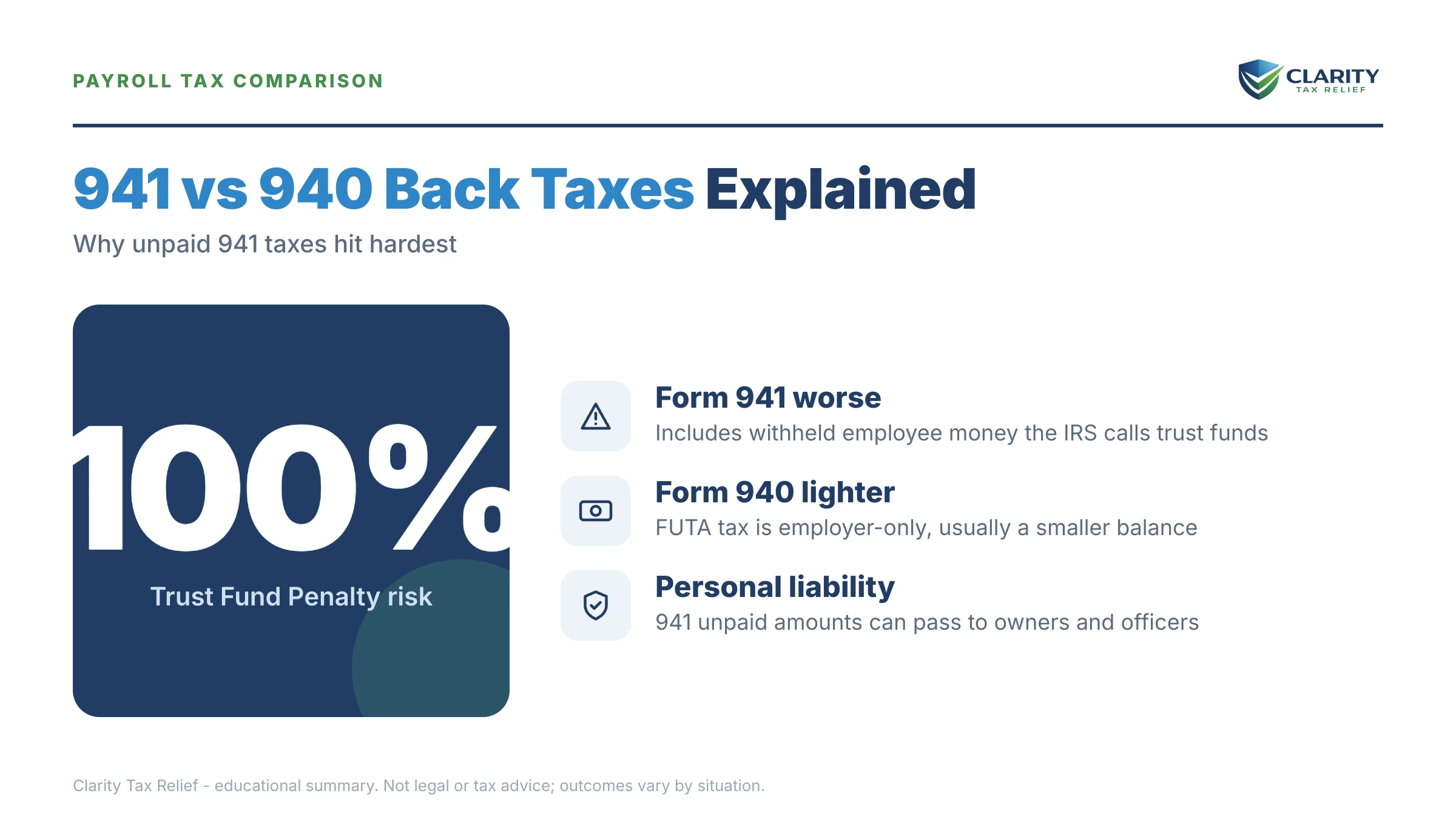
The short answer: 941 back taxes are unpaid quarterly payroll taxes — employee withholding plus Social Security and Medicare — and they include trust-fund money the IRS can collect from you personally. 940 back taxes are unpaid federal unemployment (FUTA) tax: employer-only, annual, and usually far smaller. If you owe both, the 941 debt is the emergency.
If you're comparing 941 vs 940 back taxes, it's probably because IRS notices arrived naming two forms you filed once, or never filed at all. Maybe your side business grew, you hired a helper, ran payroll as best you could, and the paperwork got away from you. Now the balances are stacking and you can't tell which letter is the fire and which is the smoke.
Here's the map: the two forms tax completely different things, escalate on completely different tracks, and only one of them can chase you into your personal bank account. The image below shows you exactly what each form looks like and how to tell at a glance which one your notice is about.
⏱ Two real clocks are running: every unfiled 941 or 940 accrues a failure-to-file penalty of 5% per month, up to 25%, plus 0.5% per month for failure to pay, and if a Letter 1153 has arrived, you have exactly 60 days to protest before the trust-fund portion is assessed against you personally.
What Form 941 and Form 940 actually cover
Form 941 reports the taxes tied to every paycheck; Form 940 reports one small employer-only tax that funds unemployment benefits. Specifically:
- Form 941 (Employer's Quarterly Federal Tax Return) reports the federal income tax you withheld from employee paychecks, plus Social Security and Medicare (FICA) — 7.65% withheld from the employee and a matching 7.65% from you. It's filed four times a year, due the last day of the month after each quarter ends.
- Form 940 (Employer's Annual Federal Unemployment Tax Return) reports FUTA tax: 6.0% on only the first $7,000 each employee earns per year, reduced to as low as 0.6% when you paid your state unemployment taxes in full and on time. It's filed once a year, due January 31. No part of it comes out of any employee's check.
That structural difference — money held back from workers' pay versus a tax that's purely yours — drives everything about how the IRS collects each debt.
| Feature | Form 941 back taxes | Form 940 back taxes |
|---|---|---|
| What it taxes | Withheld income tax + Social Security/Medicare (15.3% of all wages, split with employee) | Federal unemployment (FUTA): 6.0% of first $7,000 per employee, often 0.6% net |
| Filing schedule | Quarterly (Apr 30, Jul 31, Oct 31, Jan 31) | Annual (Jan 31) |
| Who funds it | Partly employee money you withheld, partly your match | Employer only — nothing from employee pay |
| Trust-fund money? | Yes — withheld income tax + employee FICA | No |
| Personal liability risk | High — Trust Fund Recovery Penalty reaches owners, officers, even bookkeepers | No TFRP; personal only for sole proprietors and disregarded single-member LLCs |
| Typical debt size | Large — often 20–40× the 940 balance for the same wages | Small — capped at $420 per employee per year at the full rate |
| IRS urgency | Highest priority; repeat non-payment can draw a revenue officer | Collected, but rarely the driver of enforcement |
Why you owe on a 941, a 940, or both
Most 941 and 940 debt comes from cash-flow triage, not fraud, but the IRS's systems can't tell the difference. The common paths here:
- You withheld but never deposited. The money came out of paychecks and went to rent or fuel instead. This is the single most dangerous version, because it's spent trust-fund money.
- You filed but couldn't pay. Better, filing caps the worst penalty, but the balance still compounds and escalates.
- You never filed at all. Three years behind means up to 12 missing 941s and 3 missing 940s. Leave them unfiled long enough and the IRS can file substitute returns for you, at numbers that are never in your favor.
- A worker got reclassified. If you paid a helper on a 1099 who legally should have been W-2, an audit or SS-8 ruling creates retroactive 941 and 940 debt at once.
- You lost the FUTA credit. Skip or pay your state unemployment taxes late and your 940 bill can jump from 0.6% to as much as the full 6.0% of the wage base — a 10× surprise on a tax most owners think is trivial.
941 vs 940 back taxes: why the 941 side is far more dangerous
The withheld income tax and employee FICA inside a 941 balance are legally the government's money the moment you hold back a paycheck. The IRS treats spending it as taking, not borrowing. That slice is called the trust fund, and under IRC §6672 the IRS can assess 100% of it against any "responsible person" as the trust fund recovery penalty (TFRP).
The TFRP survives closing the business, follows you personally, and cannot be discharged in a typical bankruptcy. Owners, officers, partners, bookkeepers, and anyone with check-signing authority can be assessed — the IRS decides who was "responsible" and "willful" partly through a Form 4180 interview, then proposes the assessment with Letter 1153.
The 940 has no trust fund, because no employee money ever passes through it. A corporation's or multi-member LLC's FUTA debt generally stays with the entity. One honest caveat: if you're a sole proprietor or a disregarded single-member LLC — which describes most gig workers who hire help — all of your payroll debt is personally yours regardless, because you and the business are the same taxpayer. How that plays out by entity type is covered in our guide to personal liability for payroll taxes.
Size compounds the danger. A 941 balance grows with every dollar of payroll all year long; a 940 balance stops accruing once each employee crosses $7,000 in wages. For the same workforce, the 941 debt is routinely 20 to 40 times larger.
A worked example: three years of unfiled payroll returns on one helper
Say you drive delivery full-time, the business took off, and you hired a part-time helper at about $7,000 a year in wages. You withheld taxes from their checks like you were supposed to, but never filed a 941 or a 940, for three years. This is a hypothetical, but the math is real:
- Employee FICA withheld: 7.65% × $7,000 = $535.50 per year
- Your employer FICA match: another $535.50 per year
- Federal income tax withheld: roughly $529 per year
- 941 liability: about $1,600 per year → $4,800 over three years
Of that $4,800, the trust-fund portion, withheld income tax plus employee FICA, is about $1,065 per year, or roughly $3,200 total that the IRS can assess against you personally even if the business folds tomorrow.
Now the 940 side, same wages. If you had paid state unemployment on time, FUTA would be 0.6% × $7,000 = $42 a year — $126 over three years. If you never registered with your state at all, the credit is gone and the bill runs at up to 6.0%: $420 a year, or $1,260. Either way, it's a rounding error next to the 941 debt.
Then penalties stack on the $4,800: failure-to-file can add up to 25% ($1,200), the federal tax deposit penalty can add up to 15% ($720) on undeposited amounts, failure-to-pay accrues at 0.5% per month toward its own 25% cap, and interest compounds daily on all of it. Before interest, that $4,800 can push past $7,500. You can estimate your own buildup with our Penalty & Interest Calculator.
What happens if you ignore payroll back taxes
Business payroll debt escalates on an automated track, and repeat non-payment is the fastest route in the entire tax system to a human collector at your door. The sequence runs in this order:
- CP161 — the business balance-due bill, one per unpaid period. No enforcement yet; the cheapest moment to act.
- Reminder notices — the balance regrows monthly while the system queues the next step.
- CP504B notice — intent to levy. The IRS can start reaching state payments, and a federal tax lien against business assets becomes likely.
- LT11 / Letter 1058 — final notice of intent to levy. A 30-day clock starts on your Collection Due Process rights (requested with Form 12153). After it runs, the IRS can levy bank accounts and even your accounts receivable.
- The parallel TFRP track — for 941 debt only: a Form 4180 interview, then Letter 1153 proposing the trust fund recovery penalty against you personally, with a 60-day protest window. Miss it and the assessment lands on your own account, where individual collection begins all over again.
Two aggravators to know. First, continuing to run payroll without depositing, quarter after quarter, is called pyramiding payroll taxes, and it's the pattern that turns a civil problem into potential criminal exposure. Second, 2026's IRS staffing cuts mean it's harder than ever to reach a human to fix this. But the notices, liens, and levies are generated by automated systems that never stopped running.
Behind on 941s, 940s, or both?
Get your payroll balances reviewed free before the trust-fund portion becomes a personal assessment, and if you've received a Letter 1153, before the 60-day protest window closes. An experienced tax professional will map exactly which debt threatens you personally and the fastest way to contain it.
Your options to resolve 941 and 940 back taxes
One resolution can cover both debts — the IRS looks at your total business balance, not form by form. The general playbook for resolving any tax debt on your own is in our guide to how to settle tax debt yourself. Here's how each option applies specifically to payroll debt:
| Option | Best for | Key eligibility | Watch out for |
|---|---|---|---|
| Pay in full (up to 180 days) | Small balances, especially 940-only debt | Any taxpayer; $0 setup | Interest and penalties accrue until paid |
| Business payroll tax payment plan (IBTF-Express) | Operating businesses owing $25,000 or less | Full pay within 24 months; current on deposits and filings | Miss a new deposit and the agreement defaults |
| Regular business installment agreement | Larger balances | Financial disclosure (Form 433-B) usually required | IRS may still file a lien; setup fee applies |
| 941 penalty abatement | First slip-up or genuine reasonable cause | Clean prior compliance (FTA) or documented cause; the new AEP begins automating first-time relief in summer 2026 | Removes penalties, not the underlying tax |
| Offer in Compromise | Rare for payroll debt | Must show the balance genuinely exceeds what the IRS could ever collect; $205 fee, 20% down on lump-sum offers (waived with low-income certification) | IRS accepted roughly 1 in 5 offers in FY2024; trust-fund money is compromised reluctantly |
| Hardship / Currently Not Collectible | Closed businesses or post-TFRP individuals with no ability to pay | Financial disclosure proving hardship | Debt remains and interest accrues; rarely granted to an operating business still running payroll |
Strategy matters more here than on ordinary tax debt. Because only the trust-fund slice of a 941 follows you personally, voluntary payments should be designated in writing to the trust-fund portion of specific quarters — undesignated payments get applied to the oldest, employer-side amounts first, which helps the IRS and not you. And if the business is already closed or bankruptcy is on the table, know that the trust-fund portion survives. How payroll debt behaves inside a repayment plan is covered in our guide to Chapter 13 and back taxes.
Deadlines and rights on payroll tax notices
Each document in the payroll collection sequence carries its own clock, and each expired clock costs you a specific right. The response windows below are the ones that decide cases:
| Document | Response window | What you lose if it passes |
|---|---|---|
| CP161 (business bill) | Pay-by date printed on the notice | The cheapest resolution point — penalties keep compounding |
| CP504B (intent to levy) | Date printed on the notice | Protection of state payments; lien filing becomes likely |
| LT11 / Letter 1058 (final notice) | 30 days | Your Collection Due Process hearing (Form 12153) — the strongest pre-levy right you have |
| Letter 1153 (TFRP proposal) | 60 days | Your chance to contest personal liability before it's assessed |
| Form 4180 interview request | Scheduled by the revenue officer | Nothing expires, but your answers establish "responsibility" and "willfulness," so prepare before you speak |
How to respond, step by step
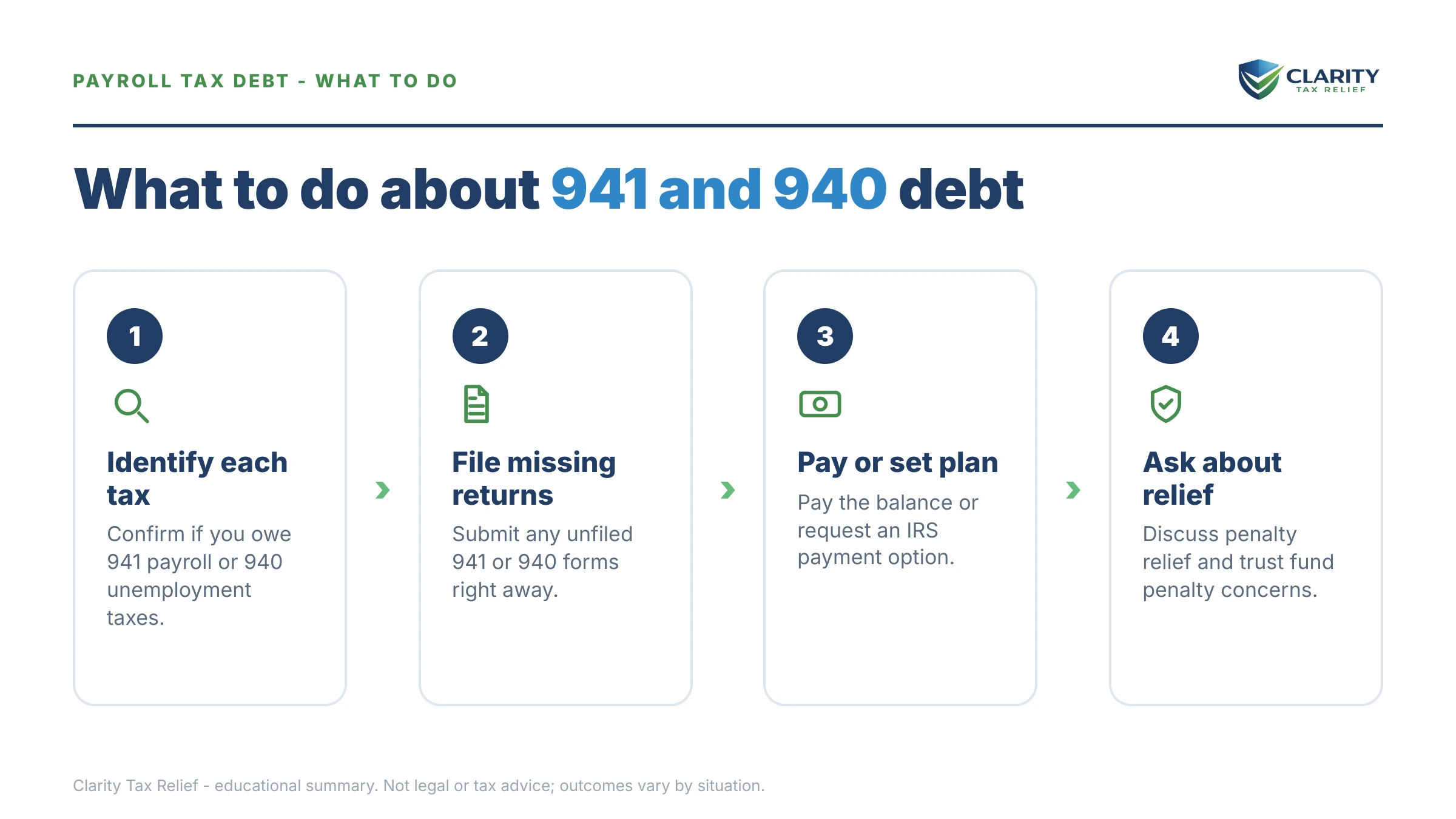
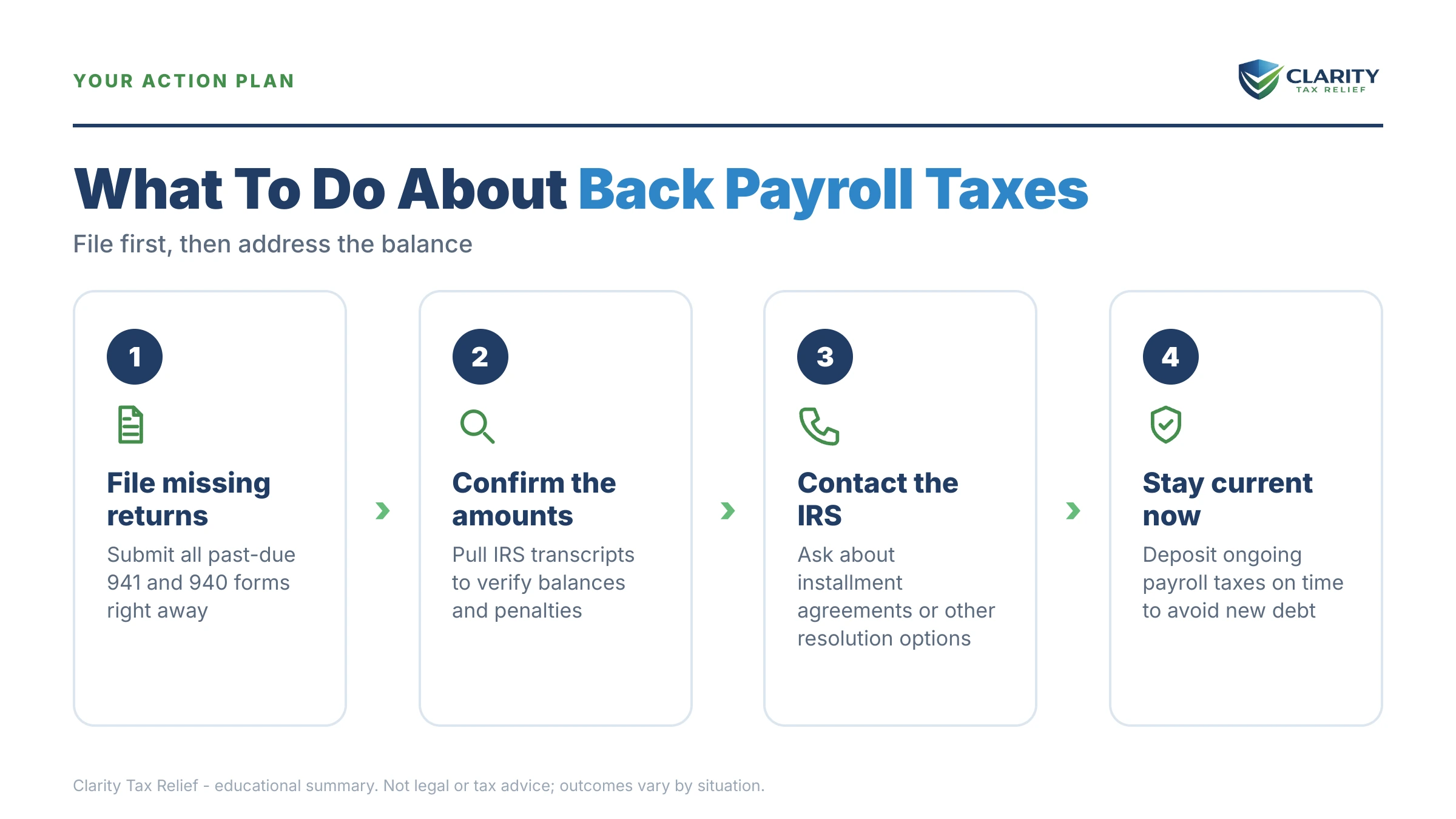
- Pull your business account transcripts. Confirm exactly which quarters and years the IRS shows as unfiled or unpaid, and how each balance splits between tax, penalties, and interest, before you send anything.
- File every missing 941 and 940. Returns come first. The IRS will not approve any payment plan, abatement, or offer while returns are missing. Your own numbers almost always beat a substitute assessment.
- Get current on this quarter's payroll deposits. Every resolution program requires current compliance. Making this quarter's deposits on time proves the bleeding has stopped and unlocks every option on the table.
- Designate voluntary payments to the trust-fund portion. Send payments with written instructions naming the specific 941 quarter and the trust-fund portion. Undesignated payments are applied the way that protects you least.
- Set up your resolution before the notice clock runs. Request an IBTF-Express or business installment agreement, penalty abatement, or hardship review, and if a Letter 1153 has arrived, file your protest within its 60-day window.
When you can handle this yourself
Plenty of payroll back-tax situations don't need professional help. You can likely handle it alone if:
- Your debt is 940-only, a few hundred dollars of FUTA you agree with. You can pay it within 180 days at IRS.gov/payments.
- You missed one 941 quarter, agree with the balance, and can pay or set up a small plan now.
- Your only issue is a penalty on an otherwise clean history — a first-time abatement request is a phone call or letter, and starting in summer 2026 the new Automatic Exemption from Penalty applies some first-time relief with no request at all.
Experienced help genuinely changes outcomes when: multiple quarters or years are unfiled. A revenue officer has been assigned or requested a Form 4180 interview. A Letter 1153 has arrived. The business has closed with balances still open. Or more than one person could be tagged as a responsible person and the IRS is deciding whom to assess. Those are the moments where what you say, and what order you fix things in — moves real dollars.
If any of those describe you, it costs nothing to have an experienced tax professional look at your notices before you talk to the IRS — start a free payroll tax case review here.
Terms on your notices, decoded
- Trust fund taxes: the withheld income tax and employee share of Social Security/Medicare inside a 941 — employee money you held in trust for the government.
- Trust Fund Recovery Penalty (TFRP): the IRS's power under IRC §6672 to assess 100% of the trust-fund portion against individuals, not just the business.
- Responsible person: anyone with the duty and authority to collect and pay over payroll taxes — ownership isn't required; check-signing power can be enough.
- Willfulness: knowing the taxes were due and paying anyone else instead. It doesn't require bad intent — paying rent before the IRS counts.
- FUTA: the Federal Unemployment Tax Act tax reported on Form 940 — employer-only, 6.0% on the first $7,000 of each employee's wages, often 0.6% after the state credit.
- Failure-to-deposit penalty: the tiered 2%/5%/10%/15% penalty for late or missing payroll tax deposits — separate from, and stacked on top of, filing and payment penalties.
- §6020(b) substitute return: a return the IRS prepares for a non-filing business from wage data it already holds — almost always worse than filing your own.
Official IRS references: About Form 941 and About Form 940.
941 vs 940 back taxes: your questions, answered
What is the difference between 941 back taxes and 940 back taxes?
Form 941 back taxes are unpaid quarterly payroll taxes — federal income tax you withheld from employee paychecks plus Social Security and Medicare. Form 940 back taxes are unpaid federal unemployment tax (FUTA), an annual, employer-only tax of 6.0% on the first $7,000 each employee earns, usually reduced to 0.6%. The 941 side is almost always the larger and more dangerous debt because it contains trust-fund money.
Can the IRS collect 941 back taxes from me personally?
Yes. Through the Trust Fund Recovery Penalty, the IRS can assess the withheld income tax and the employee share of Social Security and Medicare against any 'responsible person' — owner, officer, bookkeeper, or check-signer — who willfully failed to pay it over. The assessment survives closing the business, and if you operate as a sole proprietor, the entire 941 balance is your personal debt from day one.
Does the Trust Fund Recovery Penalty apply to Form 940 taxes?
No. FUTA is an employer-only tax — nothing is withheld from employee paychecks, so there is no trust-fund money for the IRS to trace to a responsible person. A corporation or multi-member LLC's unpaid 940 balance generally stays with the entity. The exception is sole proprietors and single-member LLC owners, who are personally liable for 940 debt just like any other business tax.
Which should I pay first if I owe both 941 and 940 back taxes?
Pay the 941 trust-fund portion first — the withheld income tax and the employee share of FICA. That is the slice the IRS can assess against you personally, so every dollar aimed there reduces your personal exposure. Send voluntary payments with a written designation to the trust-fund portion of specific quarters. Undesignated payments get applied in the order the IRS prefers, which usually protects you least.
Can I get one payment plan that covers both 941 and 940 back taxes?
Yes — a business installment agreement can cover all of a business's federal tax debts, including 941, 940, and civil penalties. An operating business owing $25,000 or less in payroll taxes may qualify for an IBTF-Express agreement paid within 24 months without full financial disclosure. You must be current on this quarter's deposits and all filings first, or the IRS will not approve any plan.
What happens if I never filed my 941 or 940 returns at all?
The IRS can prepare substitute returns for a business under IRC §6020(b) using wage data it already has, then assess the tax plus a failure-to-file penalty of 5% per month, up to 25%. Substitute assessments are usually worse than what you'd owe by filing, and no resolution — payment plan, abatement, or offer — is available while returns are missing. Filing the real returns first is always step one.
Can 941 or 940 back taxes be discharged in bankruptcy?
The trust-fund portion of 941 debt is never dischargeable. It survives both Chapter 7 and Chapter 13 as a priority claim. The employer-side pieces (your FICA match and FUTA) can sometimes be treated more favorably depending on their age, and Chapter 13 can force the IRS into a structured repayment. Bankruptcy for payroll debt is a specialist question; get advice before filing anything.
Why is my 940 balance bigger than 0.6% of wages?
The 5.4% FUTA credit that drops the rate from 6.0% to 0.6% only applies if you paid your state unemployment taxes in full and on time. Employers who never registered with their state or who paid late lose some or all of the credit, and employers in credit-reduction states lose a slice automatically. If you skipped state unemployment entirely, expect the IRS to bill FUTA at or near the full 6.0%.
Can I settle 941 back taxes with an Offer in Compromise?
It's possible but rare and strictly reviewed. The IRS is reluctant to compromise trust-fund money, and it accepted roughly 1 in 5 offers of all types in FY2024. An operating business must usually show it can stay compliant going forward. The IRS often insists the trust-fund portion be addressed through the TFRP first. For most small employers, a payment plan plus penalty abatement resolves more debt for less cost.
Your next 24 hours
- Sort your notices by form and period. The top-right corner of each notice names the form (941 or 940) and the tax period. Stack the 941 notices first, that's where personal exposure lives, and flag any Letter 1153 immediately.
- Gather your payroll records. Wage totals per employee per year, whatever was withheld, proof of any deposits made, and any state unemployment filings. These decide both the real balance and your FUTA credit.
- Get a free case review. Send us your notices at the 2-minute form or call (888) 825-7779. An experienced tax professional will separate the trust-fund debt that threatens you personally from the balance that doesn't, and map the order to fix it in while penalties and interest are still accruing.
This guide is general information, not tax or legal advice for your specific situation. Eligibility for IRS programs depends on individual facts and circumstances; no outcome is guaranteed.