
IRS Forms
How Many Allowances Should I Claim in 2026? None — Here's What Replaced Them
The short answer: if you're asking how many allowances should I claim, the answer is zero — the redesigned Form W-4 (2020 and later) eliminated allowances entirely. You now set withholding through four direct steps: filing status, multiple jobs, dependents, and other adjustments. The IRS Tax Withholding Estimator tells you exactly what to enter.
You're sitting at a new-hire packet, or comparing the W-4 your payroll portal just served up against the one you filled out years ago — and the question you remember answering isn't there anymore. Last time, you wrote "Married, 4." Now there's no box for a number at all. That's not an error, and the replacement steps do the same job better once you know where each old allowance went.
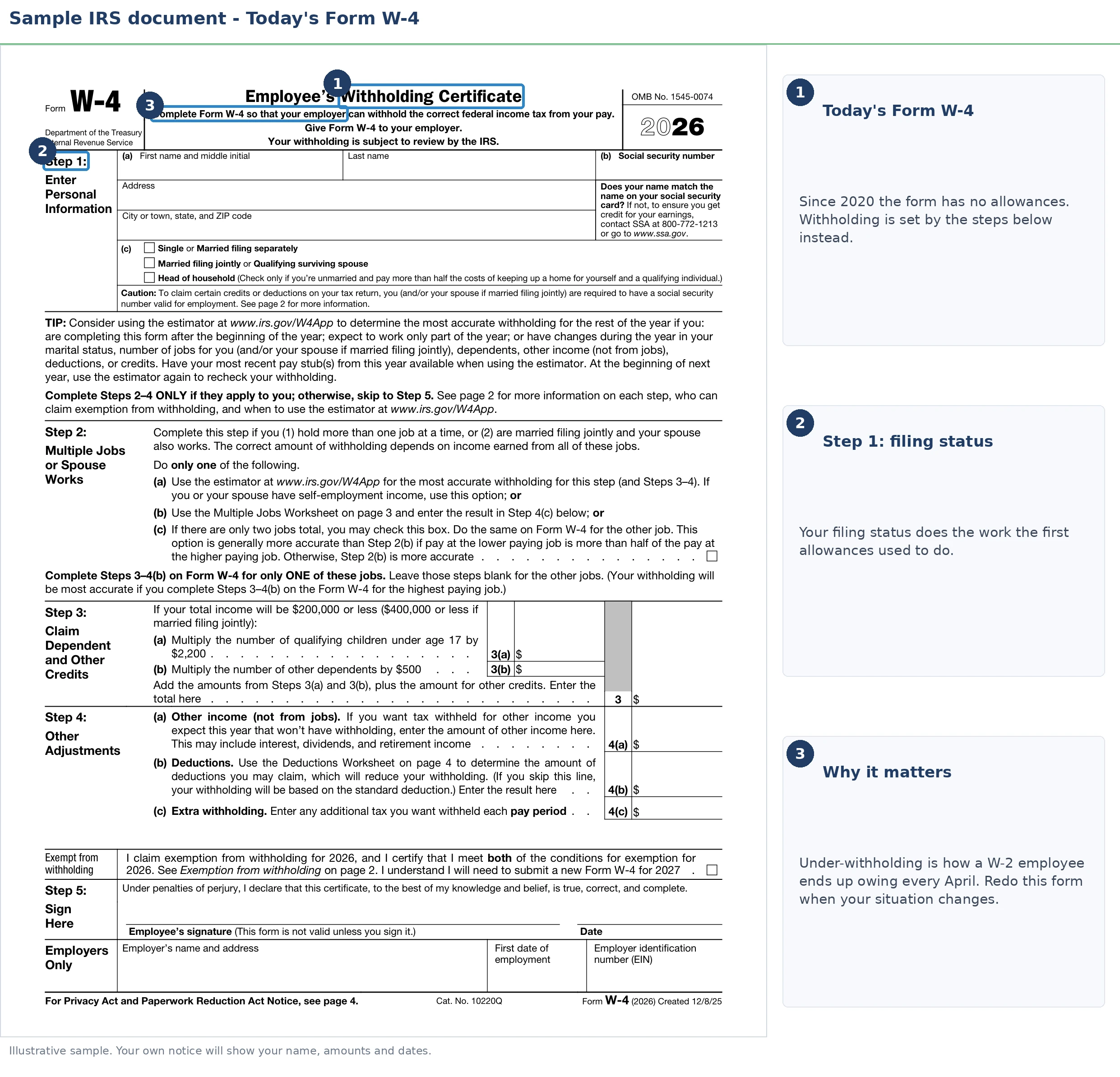
The image below shows exactly what the current W-4 looks like and where each of the old allowance jobs moved on the form — worth a glance before you fill in a single line, because the biggest mistakes happen in the first thirty seconds.
⏱ The real clock: there is no IRS deadline for updating a W-4 — the clock is your pay cycle. Every paycheck that runs on the wrong setting adds to (or subtracts from) next April's bill, and a fix made late in the year has fewer remaining paychecks to spread the correction across.
Why allowances disappeared from Form W-4
Withholding allowances were removed from Form W-4 in 2020 because the personal exemption they were built on no longer exists in the tax law. Each allowance you claimed on the old form told your employer to shelter roughly one personal exemption's worth of pay from withholding. When current law eliminated personal and dependency exemptions, the allowance number lost its anchor — so the IRS redesigned the form around direct questions instead.
Here's the part most articles get wrong: the redesign didn't change what the IRS needs to know. Per the IRS's own FAQs on the 2020 form, the new W-4 uses the same underlying information as the old one — filing status, household jobs, dependents, other income, deductions. It just asks for those facts in plain English instead of making you convert them into a coded number through a worksheet.
That's genuinely good news. The old allowance system failed silently: claim "Married, 4" while your spouse also worked, and both employers withheld as if each salary were the household's only income. The new form asks about the second income directly — the single most common cause of W-2 households owing every April.
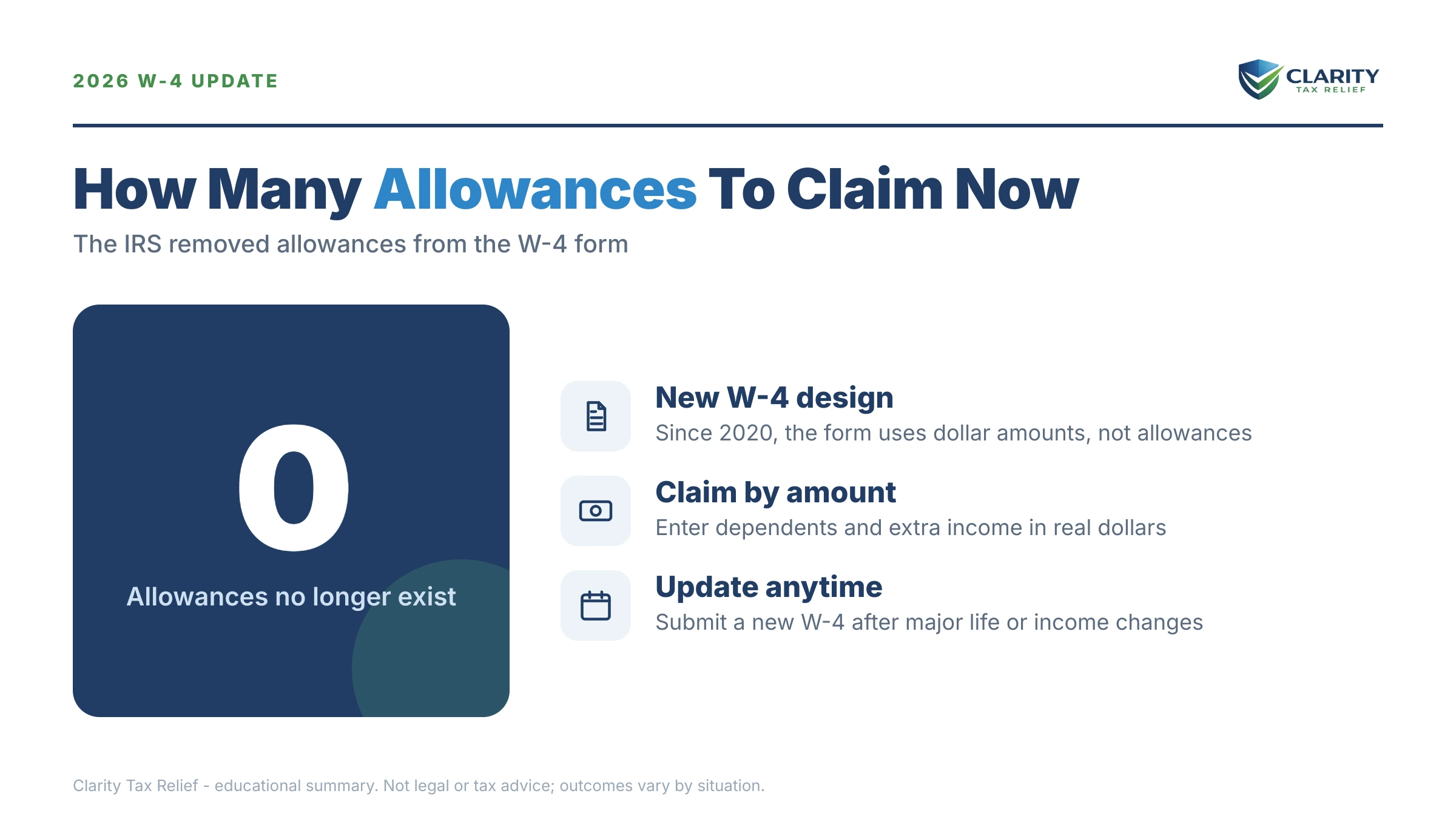
How many allowances should I claim? Translating the old numbers into the new W-4
Every job the old allowance number did now lives in one of the four steps on the 2020-and-later W-4. If you knew what you used to claim, this table converts it. Note the direction column carefully — on the old form, more allowances meant less withholding, and each new step pushes your paycheck one way or the other.
| What the old allowance did | Where it lives on the 2020+ W-4 | Effect on each paycheck |
|---|---|---|
| Allowance for yourself / your spouse (and the "Married" rate box) | Step 1(c): filing status checkbox | Married filing jointly withholds at a lower per-check rate than single or married filing separately |
| Two-Earners/Multiple Jobs Worksheet (subtracting allowances for a working spouse or second job) | Step 2: check box 2(c), use the Estimator, or use the form's worksheet | Increases withholding so two incomes aren't each taxed as if they were the household's only income |
| Allowances for children and dependents | Step 3: dependent credit amounts (per-child figure printed in the form's instructions) | Decreases withholding — claim it on only one W-4 per household |
| Allowances for itemized deductions and adjustments (Deductions Worksheet) | Step 4(b): deductions beyond the standard deduction | Decreases withholding |
| Nothing — side income had no clean home on the old form | Step 4(a): other income not from jobs (interest, 1099 gigs, dividends) | Increases withholding to cover income no employer withholds on |
| "Claiming 0" to force a bigger refund; the old extra-withholding line | Step 4(c): a flat extra dollar amount per paycheck | Increases withholding by exactly the amount you enter |
The step that catches the most households is Step 2. Skipping it when both spouses work — or when you hold two jobs and owe taxes every year because of it — recreates the exact under-withholding failure the old allowance system was notorious for.
Step 3 has its own trap: the dependent amounts reduce withholding for credits you'll claim once at filing (the child tax credit runs through Schedule 8812 on your return). If both spouses enter the kids on their own W-4s, payroll subtracts the credit twice, the IRS allows it once, and the difference shows up as a balance due.
Still have a pre-2020 W-4 on file? Here's when to replace it
A W-4 filed before 2020 is still valid, and your employer is still withholding based on the allowances you claimed on it. You are not required to submit a new W-4 just because the form changed — the IRS grandfathered every pre-2020 form, and payroll systems keep honoring the old allowance math.
But "still valid" and "still right" are different questions. Replace the old form if any of these is true:
- Your spouse started (or stopped) working since you filed it — the old two-earner worksheet math is now wrong for your household.
- You've had children since — or your kids have aged past the credit thresholds the old allowances assumed.
- You've added 1099 or side income that no employer withholds on.
- You owed at filing last year. An outdated allowance-based W-4 is the first suspect when a W-2 employee suddenly files taxes and owes more than expected.
The IRS's standing advice applies either way: consider completing a new W-4 each year and whenever your personal or financial situation changes. A form you filed in 2018 is running your 2026 paychecks on 2018 facts.
What happens when your withholding comes up short
Under-withholding on a W-4 is the most common way W-2 employees end up in the IRS collection pipeline without ever missing a filing deadline. Nothing looks wrong all year — every paycheck arrives, every return gets filed on time — and then the shortfall surfaces in April and starts compounding. The sequence from there is automated:
- April: you file Form 1040 and the shortfall appears as a balance due. If withholding fell far enough below your total tax, an underpayment penalty gets added before you've missed a single payment.
- The first bill: a CP14 notice arrives showing the balance, with roughly 21 days to pay before the sequence escalates. The failure-to-pay penalty runs at 0.5% per month, plus interest, from the filing deadline forward.
- Reminders: CP501 and CP503 follow if the CP14 goes unanswered — still just bills, but each one arrives with a larger balance attached.
- CP504: the IRS states its intent to levy your state tax refund. This is where the same under-withholding mistake starts costing you money you were counting on.
- LT11 / Letter 1058: the final notice of intent to levy. A 30-day clock starts on your Collection Due Process rights; after it runs, wage garnishment and bank levies become legally available.
There's a parallel track most people never see coming: when a W-4 severely under-withholds year after year — or someone claims exempt without qualifying — the IRS can step in and dictate your withholding directly through a withholding lock-in letter. At that point you no longer control your own W-4 until the IRS releases the lock.
One 2026 reality worth naming: the IRS workforce shrank roughly 27% in 2025, which makes a human hard to reach — but every notice in the sequence above is generated by automated systems that never stopped running. Waiting for the IRS to notice you can't call back is not a strategy.
Did an old W-4 already turn into an IRS bill?
If under-withholding left you with a balance-due notice, penalties and interest are accruing on it every month while the W-4 stays wrong. Get the notice and your withholding reviewed together — free, confidential, and specific to your household.
Married, $64,000, two kids, two incomes: the new W-4, worked through
A married two-earner household is exactly the situation the old allowance system handled worst — so let's walk one through the new form. Say you earn $64,000, your spouse earns $38,000, and you have two kids. Years ago you each wrote "Married, 4 allowances," counting yourselves and the children. Each payroll system then withheld as if its own salary were the household's entire income — both applied the full married-rate benefit, both sheltered pay for the same four allowances, and the household came up short every April.
On the current form, the same household is three decisions:
- Step 1: both of you check married filing jointly.
- Step 2: both of you check box 2(c) — on both W-4s. This tells each employer a second income exists, so neither withholds as if it's covering the whole household alone.
- Step 3: only one spouse claims the children — on the W-4 for the higher-paying job, per the form's instructions. Here, that's your $64,000 job. Your spouse leaves Step 3 blank. The per-child dollar amount is printed in the form's Step 3 instructions; don't guess it from memory, because it's the piece that changes with the law.
Now the arithmetic on getting it wrong. Say the old allowance-based forms left you $2,600 short at filing. The failure-to-pay penalty accrues at 0.5% per month — $13 a month on that balance — plus interest, on top of the tax itself. And catching up through withholding gets harder as the year goes on: fix the W-4 in September with roughly 8 biweekly checks left, and covering a $2,600 gap through Step 4(c) means about $325 per check. Make the same fix in January and 26 checks spread it to $100 per check. Same mistake, triple the per-paycheck pain — which is why the review belongs at the start of the year, not after the damage.
| How the household fills out the W-4s | Likely direction at filing |
|---|---|
| Both spouses check Step 2(c); kids claimed in Step 3 on the higher-paying job only | Withholding tracks the household's real combined income — this is the setup the form is designed around, and the closest to break-even |
| Neither checks Step 2(c); each W-4 filled as if it were the household's only job | Each employer under-withholds for a two-income household; a balance due in April is the likely result |
| Both spouses claim the kids in Step 3 | The dependent credit reduces withholding twice but is allowed once at filing; pushes further toward a balance due |
| Step 2(c) on both, kids on one W-4, plus an extra dollar amount in Step 4(c) | Withholds more than the projected tax; pushes toward a refund — an interest-free loan to the Treasury, but some households prefer the forced savings |
One more edge case for this household: if either spouse picks up 1099 side income — deliveries, freelance work, a booth rental — Step 4(a) can cover it through the W-2 paycheck instead of quarterly payments. For anything more than incidental side income, though, learn how quarterly estimated taxes work, because a W-4 alone often can't stretch far enough to cover a real second business.
And if you're married filing separately — because of student loans, a spouse's debt, or anything else — check the single/MFS box in Step 1. It withholds at a higher per-check rate than the joint box, which is correct for the separate-return math you'll actually face in April.
Your options if the old W-4 already left you with a balance
Fixing the W-4 stops the bleeding for next year — it does nothing for a balance that already exists. Those are two separate repairs, and the second one has real programs behind it, each with its own cost and eligibility line:
| Option | Fits when | Cost and terms |
|---|---|---|
| Pay in full | You can cover the balance now | Stops further penalty and interest accrual immediately; no fees |
| Short-term payment plan | You can clear the balance within 180 days | $0 setup fee; interest and the 0.5%/month penalty continue until paid |
| Long-term installment agreement | Balance is $50,000 or less | Set up online, spread over up to 72 months; interest and penalties keep accruing on the declining balance |
| Penalty relief | Clean compliance history in the prior 3 years | First-Time Abatement can remove qualifying penalties on request; starting summer 2026, the Automatic Exemption from Penalty applies without a request |
| Underpayment penalty waiver | The shortfall traces to uneven income, disaster, or other specific circumstances | Removes the estimated-tax underpayment penalty where the criteria are met; the tax itself remains |
Start with the plan: our guide to setting up an IRS payment plan online walks through the whole process, and you can estimate what the balance is accruing in the meantime with our IRS Penalty & Interest Calculator. Then stack the relief: first-time penalty abatement if your prior three years are clean — or, from summer 2026, the automatic penalty exemption (AEP), which applies without you asking — and an estimated tax penalty waiver where the underpayment penalty's specific relief criteria fit. The order matters: relief that shrinks the balance first makes any payment plan on the remainder cheaper.
How to fix your W-4, step by step
The whole correction takes about twenty minutes, and the official IRS Tax Withholding Estimator does the hard math — including the 2025 tax-law changes the IRS updated it for. Do it with both spouses' pay information in hand:
- Pull your numbers. Grab your most recent pay stub, your spouse's most recent pay stub if you're married and both work, and last year's federal tax return. You need the year-to-date federal income tax withheld figures and last year's total tax.
- Run the IRS Tax Withholding Estimator. Enter every job in the household, your dependents, and any side income. The Estimator projects your full-year tax against your projected withholding and tells you exactly what to enter on each step of each W-4.
- Fill out one W-4 per job. Choose your filing status in Step 1. If both spouses work (or you hold two jobs), check the Step 2(c) box on every W-4 in the household. Claim your children in Step 3 on the highest-paying job's W-4 only. Use Step 4 for side income, extra deductions, or additional withholding.
- Submit the form to your employer. Give the completed W-4 to HR or enter it in your payroll portal. The W-4 never goes to the IRS — your employer applies it to upcoming paychecks.
- Check the first corrected paycheck. Confirm the federal income tax withheld line moved in the direction you expected. If it didn't move enough, adjust the dollar amount in Step 4(c) rather than starting over.
- Recheck after any life change. Marriage, divorce, a new child, a raise, a second job, or new 1099 income all change the math. The IRS recommends reviewing your W-4 every year and whenever your situation changes.
One thing a new federal W-4 does not do: update your state withholding. Many states use their own withholding certificates with their own rules — some quite different from the federal form — so ask payroll whether a separate state form needs updating too.
When you can set your withholding yourself — and when to get help
Most W-4 corrections need no professional help at all. If your situation is W-2 wages, a working spouse, and kids — even with the two-earner wrinkle — the Estimator plus the six steps above will land you close to break-even, for free. Don't pay anyone to fill out a one-page form the IRS built a free calculator for.
Experienced help changes the outcome in a narrower set of situations: a balance already moving through the notice sequence (a CP504 or LT11 means enforcement clocks are running, not just accrual), multiple years unfiled alongside the withholding problem, a lock-in letter already dictating your withholding, or self-employment income large enough that the real question is quarterly estimates and entity structure, not a W-4. In those cases the sequencing — returns first, penalty relief second, resolution of the balance third — is where a professional earns their fee.
If your situation is in that second group — a balance in the notice stream, unfiled years, or 1099 income stacking on top of the W-2 problem — a free case review at (888) 825-7779 or the 2-minute form will map the order to fix things in before penalties do the mapping for you.
Terms on your W-4, decoded
- Withholding allowance: the number on pre-2020 W-4s that told your employer how much pay to shelter from withholding — each allowance was tied to one personal exemption. Gone from the current form.
- Personal exemption: the per-person deduction that allowances were built on; current law set it to zero, which is why allowances were removed.
- Step 2(c) checkbox: the box that tells your employer a second household income exists, so withholding is computed at the two-earner rate. Both spouses check it on their own W-4s.
- Extra withholding (line 4(c)): a flat dollar amount taken from every paycheck on top of the computed withholding — the modern replacement for "claiming 0."
- Lock-in letter: the IRS's tool for chronic under-withholders — it instructs your employer to withhold at an IRS-set rate, overriding your W-4 until released.
- Tax Withholding Estimator: the IRS's free online calculator that projects your full-year tax against your withholding and prescribes exact W-4 entries for every job in the household.
For the full technical treatment — including every withholding method and worksheet — the primary sources are the IRS's About Form W-4 page and Publication 505, Tax Withholding and Estimated Tax.
W-4 allowance questions, answered
Is it better to claim 0 or 1 on your W-4 in 2026?
Neither — the current W-4 has no place to claim 0, 1, or any other allowance number. The equivalent of the old "claim 0" (maximum withholding, likely refund) is leaving Step 3 blank and adding a dollar amount in Step 4(c). The equivalent of claiming more allowances (more take-home pay) is claiming your dependents in Step 3 and any deductions in Step 4(b).
What replaced allowances on Form W-4?
Four direct steps replaced the allowance number: Step 1 sets your filing status, Step 2 corrects for multiple jobs or a working spouse, Step 3 claims your dependents, and Step 4 handles other income, deductions, and extra withholding. The IRS says the redesign uses the same underlying information as the old form — it just asks for it in plain questions instead of a worksheet-generated number.
Do I have to fill out a new W-4 every year?
No — a W-4 stays in effect until you replace it. The IRS does recommend reviewing your withholding each year and any time your personal or financial situation changes: marriage, divorce, a new child, a second job, a spouse starting work, or new side income. A ten-minute check with the Tax Withholding Estimator each January is the cheapest tax planning most households will ever do.
My employer still has my old W-4 with allowances — is that a problem?
Not automatically — employees who submitted a W-4 before 2020 aren't required to file a new one, and employers keep withholding based on those allowances. It becomes a problem when your life no longer matches that old form: a spouse who started working, kids who aged into or out of credits, or new side income. If you owed at filing last year, the old form is the first suspect.
We're married with two kids and both work — who claims the kids on the W-4?
Only one of you should claim the children in Step 3, and the form's instructions say to do it on the W-4 for the highest-paying job. Both spouses should check the Step 2(c) box on their own W-4 so each employer withholds at the two-earner rate. If both of you claim the kids, the credit gets subtracted from withholding twice but only allowed once at filing — a common recipe for a balance due.
How do I get a bigger refund now that allowances are gone?
Add a flat dollar amount on line 4(c), the extra-withholding line — that's the modern version of "claiming 0." Every dollar you enter there comes out of each paycheck and back to you at filing. Just know a big refund is an interest-free loan to the Treasury; the same money could sit in your own savings account instead.
How do I get more take-home pay without owing in April?
Claim everything you're actually entitled to: your correct filing status in Step 1, your dependents in Step 3, and expected above-standard deductions in Step 4(b). Then verify the result with the IRS Tax Withholding Estimator rather than guessing — it projects your full-year tax against your withholding. Skipping Step 2 when your household has two incomes is how extra take-home pay turns into an April balance.
Can I still claim exempt from withholding?
Yes, but the bar is high: per the form's instructions, exempt status applies only if you had no federal income tax liability last year and expect none this year. A $64,000 household with two working spouses will not qualify. Claiming exempt when you don't qualify leads to a year of zero withholding, a large April balance, and potentially the IRS dictating your withholding through a lock-in letter.
What if my W-4 mistake already left me with an IRS balance?
Fix both problems separately: submit a corrected W-4 so next year doesn't repeat, and deal with the existing balance now, because the failure-to-pay penalty (0.5% per month) and interest accrue until it's resolved. Balances up to $50,000 can go on an IRS payment plan online for up to 72 months; a short-term plan gives up to 180 days with no setup fee.
Your next 24 hours
- Find your current setting. Pull your most recent pay stub and locate the federal income tax withheld line, then ask HR (or check your payroll portal) whether the W-4 on file is a pre-2020 allowance form or the current version.
- Gather the household's numbers. Last year's tax return, your spouse's most recent pay stub, and a rough figure for any side income — everything the Estimator will ask for in one sitting.
- Fix the year — and the balance, if one exists. Run the Estimator and submit corrected W-4s. If a past year's under-withholding already became an IRS balance, get a free case review at the 2-minute form or (888) 825-7779 — penalties and interest accrue on it every month it waits, and the review costs nothing.
This guide is general information, not tax or legal advice for your specific situation. Eligibility for IRS programs depends on individual facts and circumstances; no outcome is guaranteed.