
IRS Forms & Templates
Innocent Spouse Statement Example: A Fill-in-the-Blank Sample for Form 8857 (2026)
The short answer: the innocent spouse statement example below is a fill-in-the-blank narrative you attach to Form 8857, organized by the Rev. Proc. 2013-34 factors: knowledge, marital status, economic hardship, benefit received, legal obligation, compliance since, and health. Give each factor its own heading, use specific dates and dollar amounts, and attach proof for every claim.
The divorce is final, and now an IRS letter says you owe tens of thousands of dollars traced to income you never saw — earnings your ex kept off a return you trusted enough to sign. You are not automatically stuck with that bill. Federal law lets you ask the IRS to separate your liability from your ex's, and the request rises or falls on one document: the written statement you attach to Form 8857.
Form 8857 itself gives you only a handful of lines per question — the image below shows you exactly what the form looks like and where your attached statement takes over. This page gives you the statement itself: a complete, editable template, the factor checklist behind it, and the documents to staple to it. For how the program works overall, start with how to qualify for innocent spouse relief and the Form 8857 instructions; this article covers only what to write.
⏱ Your deadline: for traditional innocent spouse relief and separation of liability, Form 8857 is generally due within 2 years of the IRS's first collection activity against you — a levy, a refund offset, or a court claim. Equitable relief has a longer window: generally as long as the 10-year collection statute is open. Interest keeps accruing on the joint balance until relief is granted or the debt is resolved.

Why your written statement decides your Form 8857 request
The IRS scores innocent spouse requests against the factors in Rev. Proc. 2013-34, and the form's short answer boxes cannot carry that weight alone. The examiner reviewing your file has never met you. Everything they know about who controlled the money, what you saw before signing, and what paying would do to you comes from the pages you attach.
A strong statement does three things a bare Form 8857 cannot. It tells one coherent story instead of scattered checkbox answers. It maps that story onto the exact factors the examiner must score. And it ties every claim to an attached document, so nothing rests on your word alone.
To be clear about what this template is: it organizes the factors you must address. It does not, and cannot — promise relief. The IRS weighs your specific facts, and requests with weak facts get denied no matter how well they read.
What happens if you don't request relief
A joint return makes each spouse individually responsible for 100% of the tax — the IRS can collect the entire balance from whichever spouse is easier to reach. A W-2 employee with steady wages is usually easier to reach than a self-employed ex. If you never file Form 8857, the collection machine treats the debt as fully yours:
- Refund offsets — every refund you claim on your own returns gets swallowed by the joint balance, year after year.
- Balance-due and reminder notices — annual reminders and escalating demand letters arrive at your address, with interest and the late-payment penalty compounding monthly.
- CP504 notice — the IRS states its intent to levy your state tax refund. A federal tax lien against your property becomes a live possibility.
- LT11 / Letter 1058 — the final notice of intent to levy starts a 30-day clock. After it runs, the IRS can garnish your teacher's paycheck and levy your bank accounts even though the income behind the debt was never yours.
- Levy — a wage levy runs continuously until released, and a bank levy freezes funds for 21 days before they're sent to the IRS. If the growing balance passes $66,000, passport certification enters the picture too.
Filing Form 8857 changes this picture: the IRS generally pauses most collection against you while your request is reviewed (the 10-year collection clock also pauses during the review). That's one more reason the statement is worth writing now, not after a levy lands.
Drafting your innocent spouse statement right now?
Before you mail Form 8857, let an experienced tax professional review your statement free — the strongest facts are easy to bury and the weak ones need handling, and for two of the three relief types the clock runs just 2 years from the IRS's first collection action against you.
The Rev. Proc. 2013-34 factors your statement must address
Rev. Proc. 2013-34 lists the factors the IRS weighs for equitable relief. The same facts drive traditional innocent spouse relief and separation of liability relief. No single factor controls; the examiner weighs them together. Use this table as your outline — one statement section per row:
| Factor | What the IRS looks for | What to put in your statement |
|---|---|---|
| Marital status | Divorced, legally separated, widowed, or living apart for the 12 months before filing | The date of your divorce or separation; attach the decree or agreement. |
| Economic hardship | Whether paying would leave you unable to meet reasonable basic living expenses | Your monthly take-home pay and an itemized monthly budget, backed by pay stubs and bills. |
| Knowledge or reason to know | Whether you knew, or should have known, about the unreported income or bad deduction when you signed | Who controlled the money and records, exactly what you saw before signing, and the date you first learned the truth. |
| Legal obligation | Whether your divorce decree assigns this tax debt to your ex-spouse | Cite the decree paragraph that assigns the debt and attach the page. It doesn't bind the IRS alone, but it weighs for you. |
| Significant benefit | Whether you enjoyed more than normal support from the unpaid tax | Where the money actually went — whose accounts, whose purchases — and what your own lifestyle looked like. |
| Compliance since | Whether you've filed and paid your own taxes in the years since | Each year you've filed on time as single or head of household and paid the tax shown. |
| Mental or physical health | Whether illness impaired you when you signed, or affects your ability to pay now | Conditions and dates, with medical records if you're willing to share them. Omit if not applicable. |
| Abuse or financial control | Not a standalone factor — when present, it can outweigh others, including knowledge | Specific incidents with dates; attach police reports, protective orders, counseling records, or messages showing control. |
One state-law wrinkle before you draft: if you lived in Arizona, California, Texas, Washington, or another community property state during the marriage, income attribution rules change the knowledge analysis — see community property innocent spouse. And Form 8857 covers only the IRS; California runs a separate program covered in our FTB innocent spouse guide.
Innocent spouse statement example: the fill-in-the-blank template
Copy this template, replace every bracket with your own facts, and delete any section that doesn't apply. Every bracketed blank should become a specific date, name, or dollar amount — "he handled the money" is an adjective; "only he could sign on the [Bank] business account ending [1234]" is evidence.
[Your full name]
[Your current mailing address]
[Daytime phone number]
[Date]
Re: Statement in support of Form 8857, Request for Innocent Spouse Relief
Requesting spouse: [your name], SSN [your Social Security number]
Non-requesting spouse: [ex-spouse's full name]
Tax year(s): [year(s)] | Amount at issue: [$ amount from the IRS notice]
To the IRS Innocent Spouse Unit:
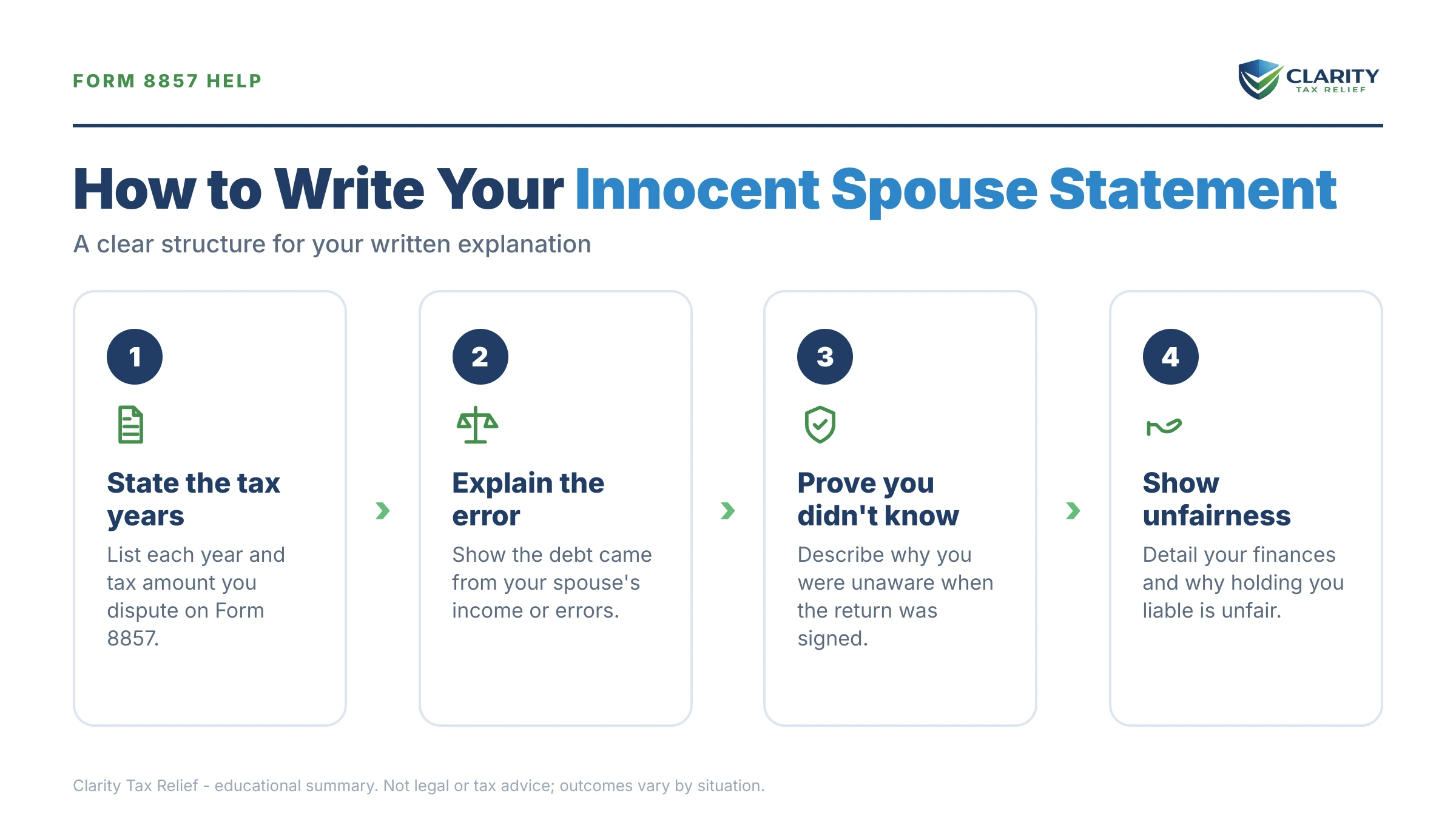
I am requesting relief from joint and several liability under Internal Revenue Code Section 6015 for the tax year(s) listed above. This statement supplements my answers on Form 8857 and is organized by the factors in Rev. Proc. 2013-34.
1. How the liability arose, and why I did not know about it.
The balance results from [describe the item: unreported income from / an erroneous deduction claimed for] [source], which belonged entirely to [ex-spouse's name]. I first learned of it on [date], when [how you learned: I received IRS Notice [number] / it surfaced in divorce discovery]. During our marriage, [ex-spouse's name] controlled [the business / its bank accounts / the mail / our tax preparation]. I never saw [the 1099s / the business records / the account statements] because [specific reason: the account was in his name only / the preparer corresponded only with him]. My own income was [W-2 wages of $____ from ____, with tax fully withheld]. Before signing the return, I reviewed [what you actually saw]. [If you asked about the return and were reassured, state exactly what was said, by whom, and when.]
2. Marital status.
[Ex-spouse's name] and I [were divorced on [date] — the decree is attached / have been legally separated since [date] / have not shared a household since [date]].
3. Economic hardship.
My monthly take-home income is [$____] from my work as [occupation]. My basic monthly living expenses total [$____]: [rent/mortgage $____, utilities $____, food $____, transportation $____, insurance $____, dependent costs $____]. Paying this liability would [leave me unable to meet these basic expenses / require $____ per month that my budget does not contain]. Pay stubs and bills supporting these figures are attached.
4. Significant benefit.
I received no significant benefit from the unpaid tax beyond ordinary support. [Describe: we took no vacations or major purchases funded by this money. The funds went to [ex-spouse's separate account / business equipment titled in his name / his personal spending], as shown in the attached statements.]
5. Abuse or financial control (include only if true).
[Describe specific incidents of physical, emotional, or financial abuse, or the ways your spouse controlled money and information: restricted account access, intercepted mail, threats or intimidation when you asked about finances, with dates. Reference attached police reports, protective orders, counseling or medical records, or messages, where they exist.]
6. Legal obligation.
Our divorce decree, entered [date] in [court], assigns responsibility for this tax debt to [ex-spouse's name] at paragraph [__]. The relevant page is attached. [Add, if true: When I signed the decree, I had no knowledge or reason to believe he would not pay it.]
7. Compliance with tax laws since.
I have filed my own returns on time for [years], filing as [single / head of household], and have paid the tax shown on each. My current withholding is [accurate / adjusted to cover my liability].
[8. Mental or physical health (include only if applicable).]
[Condition, dates, and how it affected your understanding at signing or affects your ability to pay now. Attach records if you are willing to share them.]
All facts stated above are true, correct, and complete to the best of my knowledge and belief.
Signature: ______________________ Date: ____________
[Your printed name]
Reminder as you edit: this template shows the factors to address, not a script that produces approval. Whether relief is granted depends entirely on your individual facts — no statement, however well written, guarantees an outcome.
Five rules that make your sample innocent spouse letter credible
The statement is signed under the same penalties of perjury as Form 8857 itself, so accuracy is not optional. As you fill in the template:
- Specifics beat adjectives. Dates, account names, and dollar amounts are checkable; "controlling" and "secretive" are not.
- Match the form. Your statement and your Form 8857 checkbox answers must agree — contradictions are the fastest route to a denial.
- Address bad facts head-on. If you saw a deposit or signed a bank card, explain the context yourself rather than letting your ex's version define it.
- Never exaggerate. One provably false claim taints every true one, and it's perjury.
- Anchor every claim to an attachment. If a sentence has no document behind it, either find one or soften the sentence.
Worked example: building a statement around a $41,000 assessment
Say you're a recently divorced teacher and the IRS assessed $41,000 against your joint 2023 return after a CP2000 notice matched $92,000 of contracting income your ex-husband never reported — the exact situation covered in spouse hid income from the IRS. The math: roughly $29,100 in additional tax, a $5,820 accuracy-related penalty (20% of the tax), and about $6,080 of accrued interest.
Here's how that hypothetical maps onto the template, factor by factor:
- Knowledge: the flooring business ran through an LLC checking account only he could sign on. The preparer emailed drafts only to him. Your $56,000 teaching salary was fully withheld on a W-2. You first learned of the income when the CP2000 arrived in March 2026.
- Marital status: divorce final February 2026 — decree attached.
- Economic hardship, with the arithmetic shown: take-home pay $3,480/month. Rent $1,550 + car and insurance $520 + utilities $310 + food $600 + health and other basics $420 = $3,400/month, leaving an $80 surplus. Spreading $41,000 over a 72-month plan would run roughly $570/month before ongoing interest — about seven times that surplus. That gap, documented with pay stubs and bills, is the hardship section.
- Benefit: the unreported money bought a work truck and equipment titled to him; your household lived on the two paychecks you knew about.
- Compliance: your 2025 return, filed single and on time, showed a $940 refund — which the IRS offset to the joint balance, an event worth naming because it may have started your 2-year clock.
Notice what the example never does: it never claims innocence in the abstract. Every factor gets a number or a date the examiner can verify.
What to attach to Form 8857
Attachments turn your statement from a story into a record. Build your package from this checklist:
| Document | What it proves | Practical note |
|---|---|---|
| Divorce decree or separation agreement | Marital status and the legal-obligation factor | Flag the page that assigns the tax debt. |
| The IRS notice showing the assessment | The exact years and amounts at issue | Cite the notice number and date in your statement heading. |
| Copy of the joint return(s) | What was reported and what you signed | Pull a transcript from your IRS online account if you don't have the original. |
| Three months of pay stubs | Your income, for the hardship factor | Include all current household income. |
| Lease or mortgage statement plus monthly bills | Your basic living expenses | Utilities, insurance, food receipts, transportation, dependents' costs. |
| Bank statements from the marriage | Who controlled the money and where it went | Mark the accounts you had no access to. |
| Police reports, protective orders, counseling records | Abuse or financial control | Only what genuinely exists — never manufacture or embellish. |
| Your recent single or head-of-household returns | The compliance-since factor | The first two pages of each filed year are enough. |
How to respond, step by step
- Confirm you're eligible to file — you filed a joint return, the tax traces to your spouse's income or deduction. Your filing window is still open.
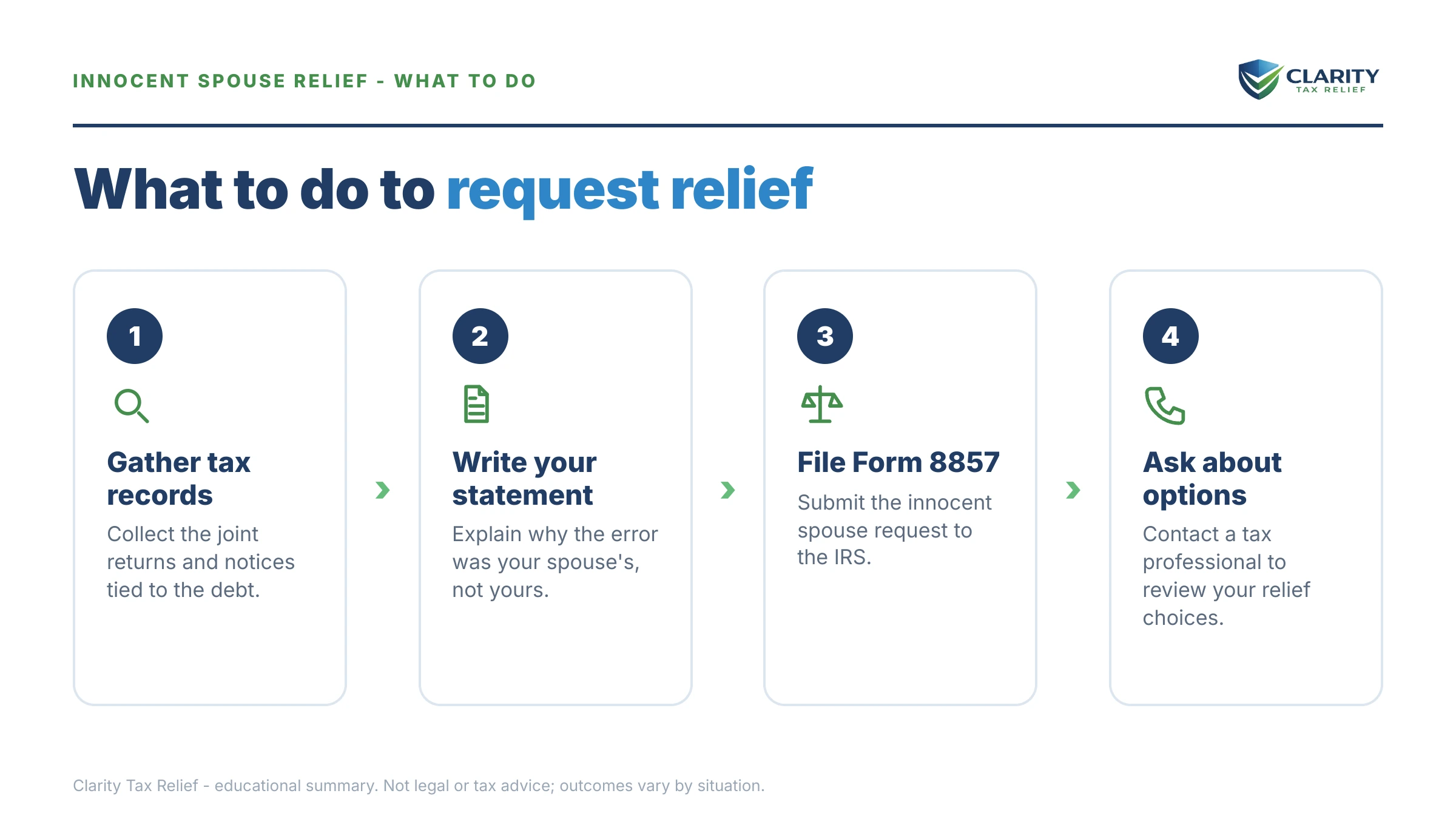
- Draft your statement factor by factor — copy the template above and replace every bracket with your own dates, names, and dollar amounts.
- Gather your evidence — pull the divorce decree, three months of pay stubs and bills. The account statements that show who controlled the money.
- Complete Form 8857 — answer every question on the form itself, and write "see attached statement" wherever the form's lines can't hold your full answer.
- Mail everything together by certified mail — send the form, statement, and attachments to the address in the Form 8857 instructions, and keep a complete copy.
- Respond quickly to IRS follow-ups — questionnaires and preliminary determinations carry short reply windows, and silence can sink a strong claim.
If the IRS ultimately says no, the fight isn't over — a preliminary denial can be appealed inside the IRS. A final determination can go to Tax Court. Our guide to an innocent spouse denial and appeal covers that stage.
When you can handle this yourself, and when to get help
Plenty of innocent spouse requests are winnable without professional help when the facts are clean. If your divorce is final, the income was unmistakably your ex's, you had no access to the accounts. Your own filing record since is spotless, this template plus a careful weekend of document-gathering may be all you need.
Experienced help changes outcomes in the harder cases: you saw some of the money or signed on the account, so the knowledge factor needs careful framing. You lived in a community property state. A levy or refund offset already started your 2-year clock and you're not sure when. Abuse is part of the story and presenting it safely matters. The balance is large enough that a denial means years of collection. Or you already filed once and were denied. In those situations, how the facts are presented, and which relief type is argued — genuinely moves the result.
Terms on your Form 8857, decoded
- Joint and several liability — the rule that makes each spouse on a joint return responsible for the entire tax, not half.
- Requesting spouse / non-requesting spouse — you are the requesting spouse; your ex is the non-requesting spouse the IRS must notify.
- Understatement vs. underpayment — an understatement means the return showed too little tax (hidden income). An underpayment means the return was right but the tax went unpaid. Equitable relief is the only type that covers underpayments.
- Rev. Proc. 2013-34 — the IRS revenue procedure listing the factors examiners weigh for equitable relief; it's the skeleton of the template above.
- Preliminary vs. final determination — the IRS's first answer, which you can protest (Form 12509), versus the final letter that starts your 90-day Tax Court window.
- CSED — the Collection Statute Expiration Date, generally 10 years from assessment; it pauses while your request is reviewed. Note this is different from injured spouse relief, which is about recovering a seized refund, not removing liability.
Innocent spouse statement questions, answered
What should I write in an innocent spouse statement?
Address each Rev. Proc. 2013-34 factor under its own heading: how the tax arose and why you didn't know about it, your marital status now, the economic hardship paying would cause, whether you significantly benefited, any abuse or financial control. Your tax compliance since. Specific dates, account names, and dollar amounts carry far more weight than adjectives, and every factual claim should point to an attached document.
How long should a Form 8857 statement be?
Most effective statements run two to four pages. That's long enough for one focused paragraph per factor with real dates and dollar figures, and short enough that the reviewer can follow your story in one sitting. There is no official page limit. But a long emotional narrative buries the facts the examiner actually scores — use headings that match the factors so nothing gets missed.
Will the IRS contact my ex-spouse if I file Form 8857?
Yes — the law requires the IRS to notify the other person on the joint return and give them a chance to participate in the review. The IRS will not disclose your current address, phone number, employer, or other new personal information to them. If you fear retaliation, say so in your statement and answer the domestic-violence questions on Form 8857. That context also affects how the knowledge factor is weighed.
Is there a deadline to file Form 8857?
For traditional innocent spouse relief and separation of liability, you generally must file within 2 years of the IRS's first collection activity against you — a levy, a refund offset, or a court claim. Equitable relief has a longer window: generally any time the 10-year collection statute is still open, or within the refund-claim period if you're seeking money back. Collection against you continues until you file, so earlier is better.
Do I need to prove abuse to qualify for innocent spouse relief?
No — abuse is not a requirement. It's a factor that, when present, can outweigh others, including actual knowledge: if your spouse controlled the money or you feared the consequences of questioning the return, the IRS can grant relief even though you knew about the income. Document it with whatever exists — police reports, protective orders, counseling or medical records, or texts and emails showing financial control.
What's the difference between innocent spouse relief and injured spouse relief?
Innocent spouse relief (Form 8857) removes your liability for extra tax caused by your spouse's errors on a joint return. Injured spouse relief (Form 8379) recovers your share of a joint refund the IRS seized for your spouse's separate debt, like child support or their pre-marriage taxes. If the IRS says you owe money because of your spouse, you want Form 8857. If the IRS took your refund for their debt, you want Form 8379.
Can I get innocent spouse relief after a divorce?
Yes, and being divorced actually helps. Marital status is the first factor in Rev. Proc. 2013-34, and being divorced, legally separated, or living apart for the 12 months before filing weighs in your favor. Keep in mind a divorce decree assigning the debt to your ex does not bind the IRS by itself. But it does count in your favor under the legal-obligation factor, so attach it.
What happens after I mail Form 8857 and my statement?
The IRS acknowledges the request, generally pauses most collection against you, notifies your ex-spouse, and assigns an examiner who may send follow-up questionnaires. Reviews commonly take several months to more than a year. You'll receive a preliminary determination first; if relief is denied, you can appeal within the IRS and, after a final determination, petition the U.S. Tax Court within 90 days.
Your next 24 hours
- Find your trigger date. Pull the IRS notice (or check your online account) and note the date of the first collection action against you, a refund offset counts, because that may have started your 2-year window for two of the three relief types.
- Gather your core three documents. The divorce decree, a copy of the joint return at issue, and your last three pay stubs. Those alone let you draft most of the template above tonight.
- Get your draft reviewed free. Call (888) 825-7779 or use the 2-minute form and an experienced tax professional will look at your statement, your facts, and which relief type fits, before the joint balance grows further and while your filing window is open.
Primary sources: the IRS's overview of innocent spouse relief, the official Form 8857 page (form, instructions, and mailing addresses), and the Taxpayer Advocate Service if your request stalls or causes hardship.
This guide is general information, not tax or legal advice for your specific situation. Eligibility for IRS programs depends on individual facts and circumstances; no outcome is guaranteed.