
IRS Data & Studies
Average Tax Refund in 2026: What the Latest IRS Data Shows
What this episode covers
- What was the average IRS tax refund in 2025?
- Will the IRS take my refund if I owe back taxes from an earlier year?
- What is the difference between IRS transcript code 826 and code 898?
- How many years do I have to file a tax return to claim an IRS refund?
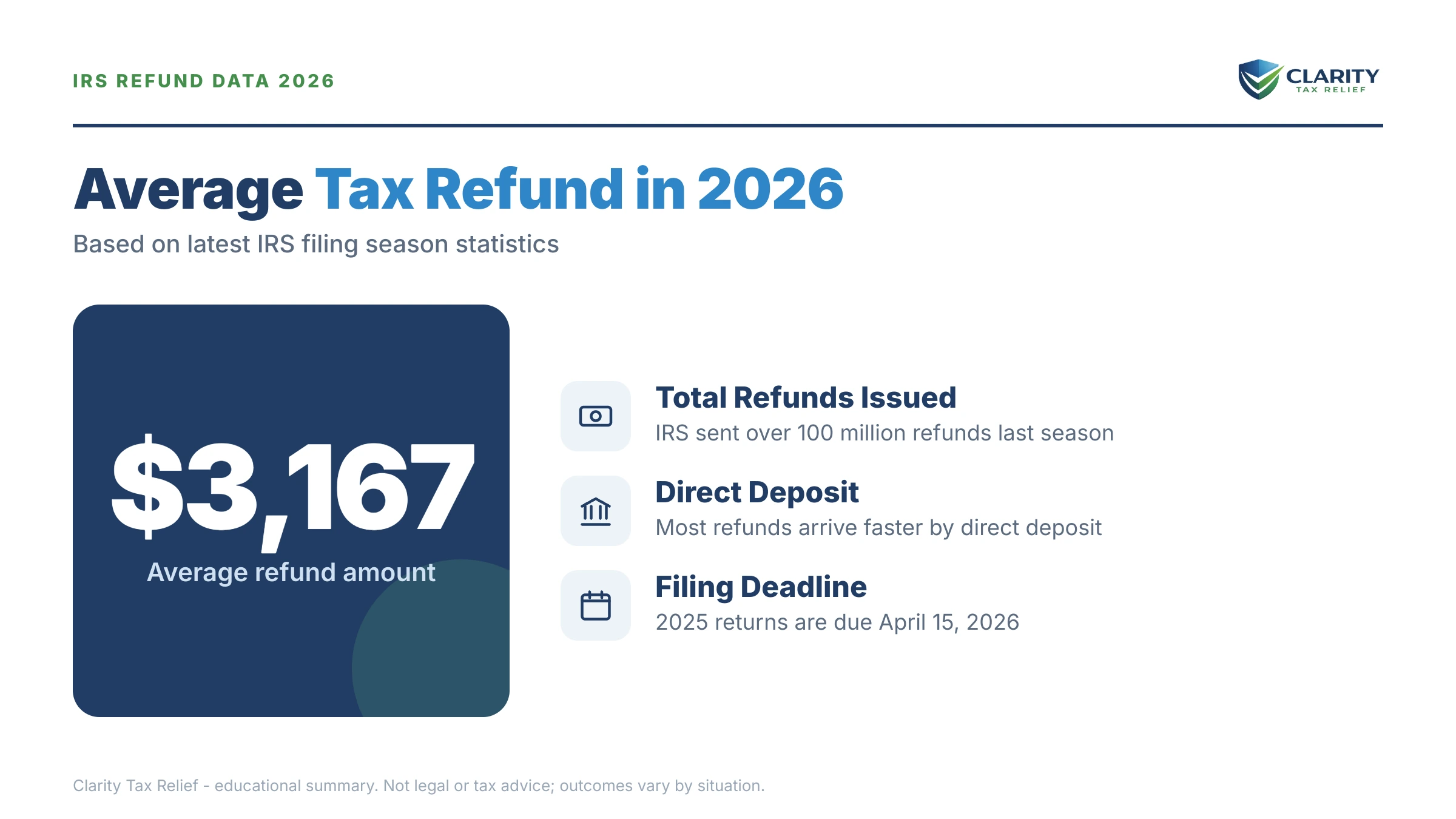
The short answer: the average tax refund was $3,167 in 2025, up 0.9% from $3,138 in 2024. The IRS sent back $328.9 billion to 103.8 million taxpayers, and direct-deposit refunds averaged $3,230. Whether YOU see that money depends on withholding, credits, and whether you owe the government anything.
You just filed, or you're about to, and you want to know if your number is normal. Maybe you also have an IRS balance hanging over you and a levy notice in a drawer. The real question isn't "what's the average tax refund" — it's "will I actually get mine?" This page answers both, with the IRS's own verified filing-season data.
⏱ The clock that matters here: you generally have 3 years from the original filing deadline to claim a refund. Miss that window on an unfiled year and the money is forfeited permanently — the IRS keeps your overpayment even though you earned it back.

The average tax refund in 2025: every verified number
The average IRS tax refund hit $3,167 in 2025, with the agency sending back $328.9 billion to 103.8 million taxpayers. Those figures come straight from the IRS's own year-end filing season statistics, and the full breakdown looks like this:
| Metric | 2025 figure | Year-over-year change |
|---|---|---|
| Average refund | $3,167 | Up 0.9% (from $3,138 in 2024) |
| Total refunds issued | 103,846,000 | Down 1.0% (from 104,866,000 in 2024) |
| Total dollars refunded | $328.878 billion | — |
| Average direct-deposit refund | $3,230 | — |
| Refunds paid by direct deposit | 94,335,000 (about 91%) | — |
| Individual returns processed | 165,469,000 | Up 1.2% |
Read those two trend lines together and something interesting appears: the IRS processed 165,469,000 individual returns in 2025, up 1.2%, while the number of refunds fell 1.0% to 103,846,000. More people filed; slightly fewer got money back. Roughly six in ten processed returns produced a refund. The other four in ten either broke even or wrote a check.
The direct-deposit gap is worth noticing too. Refunds paid by direct deposit averaged $3,230 — above the overall $3,167 average — and 94,335,000 refunds, about 91%, went out that way. Direct-deposit filers skew toward early e-filers claiming refundable credits, which pulls their average up. Paper checks capture more adjusted refunds, amended returns, and filers without bank accounts, which run smaller.
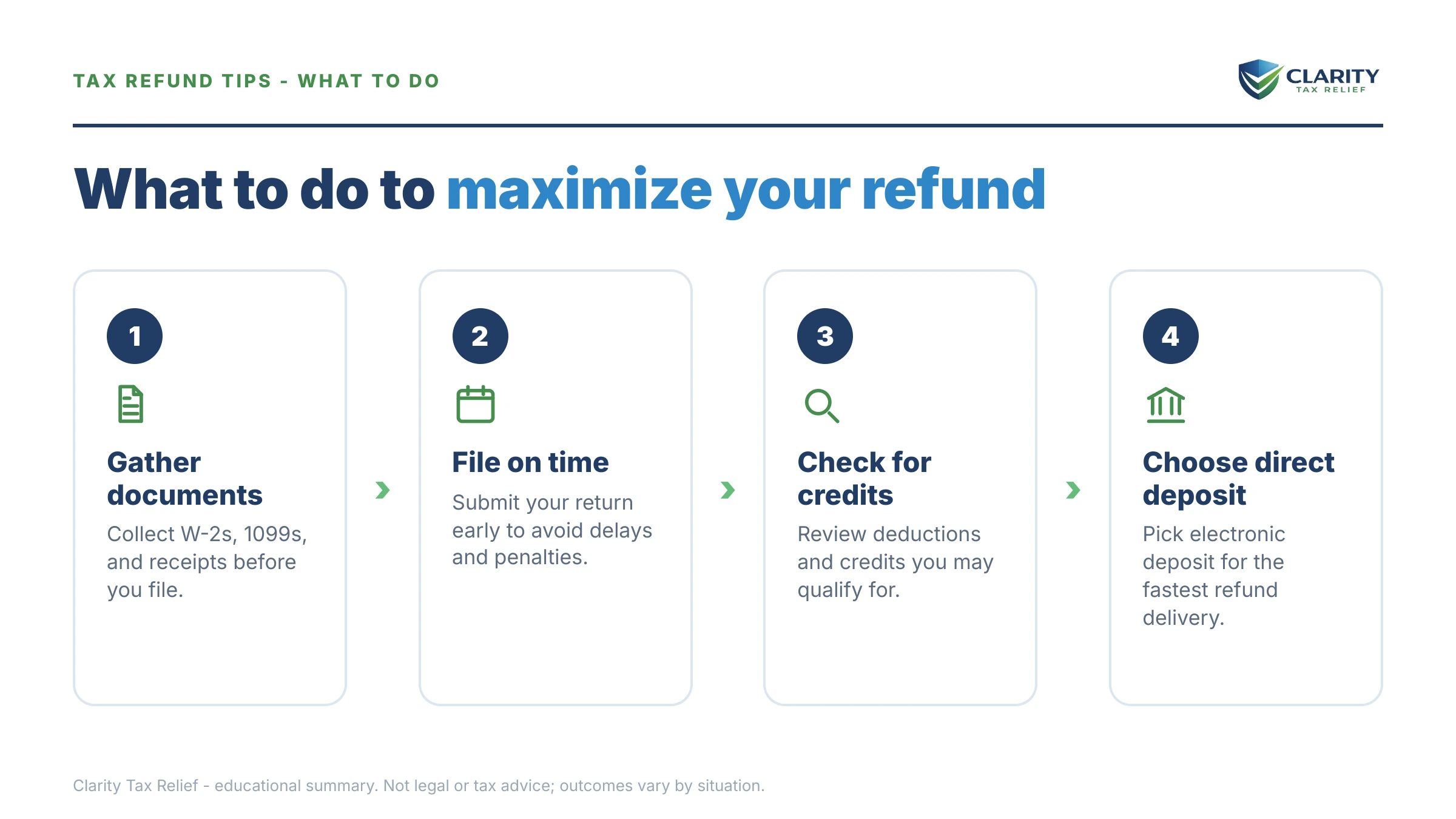
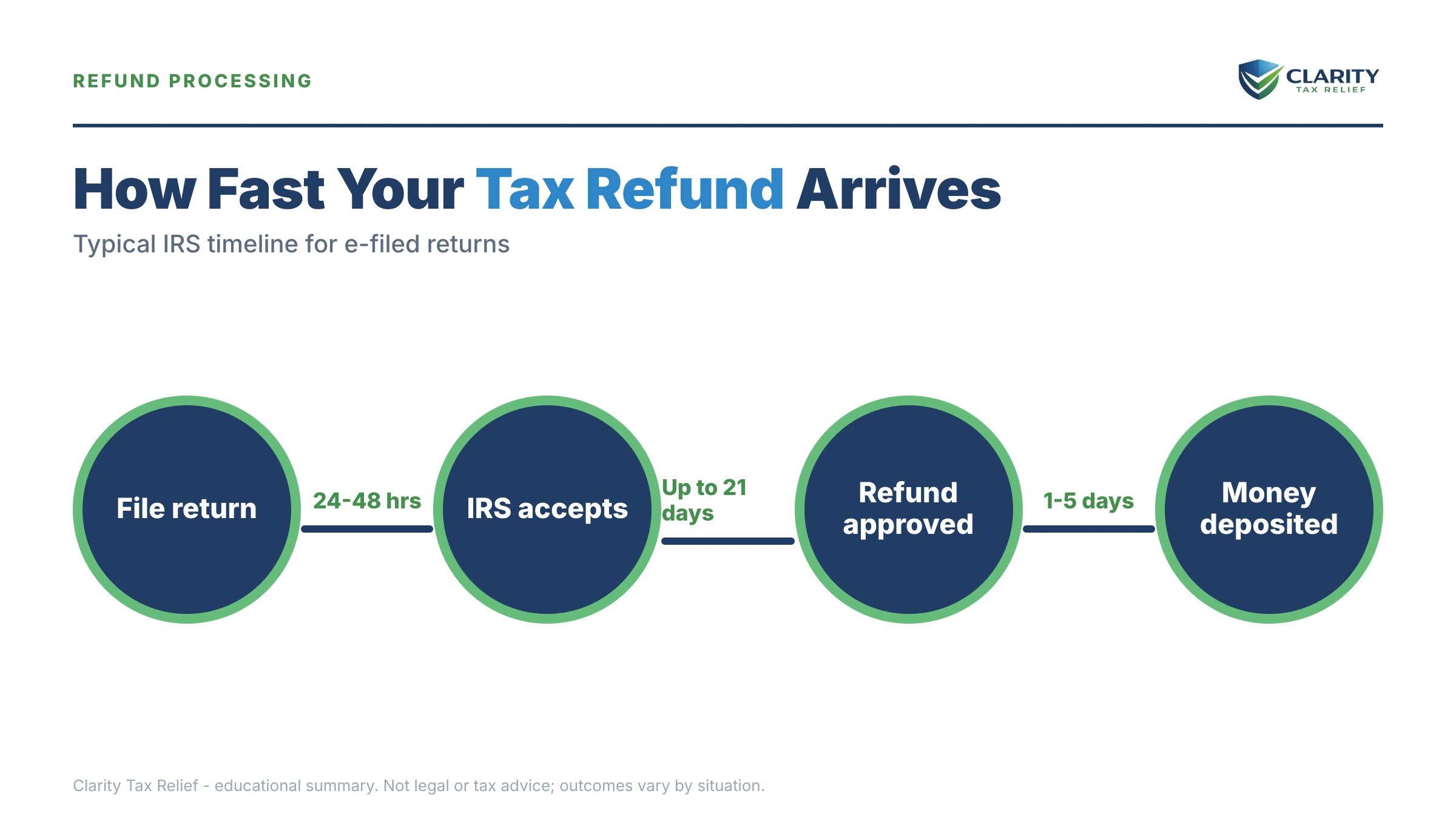
“The typical time to receive your refund depends on how you filed your taxes: E-filed return - 3 weeks from the date you e-filed Mailed return - 6 or more weeks from the date we received your mailed return”
— Refunds (IRS.gov)
Why the average tax refund landed at $3,167
A refund isn't a bonus — it's the difference between what you paid in during the year and what you actually owed. The $3,167 average means the typical refund recipient overpaid by roughly $264 a month all year, then got it back in a lump.
Three forces set your personal number, and none of them care about the national average:
- Withholding accuracy. A W-4 that hasn't been updated since a raise, a second job, or a marriage is the single most common reason a refund swings far from average — in either direction.
- Refundable credits. The Earned Income Tax Credit and Additional Child Tax Credit can push refunds well past what was withheld. They also pull the national mean upward, which is why a single filer with no kids often sees far less than $3,167 and shouldn't worry about it. These credits also trigger the early-season hold covered in our eitc refund hold path act data study.
- Offsets. If you owe federal taxes, state taxes, child support, or federal student loans in default, part or all of your refund can be redirected before it ever reaches you. This is the piece most "average refund" articles skip, and for anyone with a balance due, it's the only piece that matters.
One statistical caveat worth keeping: $3,167 is a mean, not a median. A minority of very large credit-driven refunds pulls the average up, so the "typical" refund most wage earners see is smaller. If yours is below average, that alone signals nothing wrong.
If your refund is late rather than small, that's a different problem with its own data — see our companion studies on irs refund delay statistics and irs refund delays statistics for how often returns get suspended and for how long.
What happens to your refund when you owe the IRS
If you have an unpaid IRS balance, your refund is applied to it automatically — no separate warning, no opt-out. The average filer expecting $3,167 sees $0 arrive, and the sequence around it runs like this:
- The offset happens first. Your refund posts to your oldest unpaid year (transcript code 826). The IRS mails a cp49 refund applied notice afterward showing where the money went.
- Collection on any remaining balance continues. The offset doesn't pause the notice stream — CP501 and CP503 reminders keep coming on whatever the refund didn't cover.
- CP504 arrives. The IRS gains the right to seize your state refund too, under IRC §6331(d).
- LT11 or Letter 1058 — the final notice. A 30-day clock starts, along with your Collection Due Process appeal rights (Form 12153). After it runs, wage and bank levies become legal.
- It repeats every year. The offset recurs each filing season until the debt is resolved — our guide on whether the will irs take refund every year question walks through exactly when that cycle ends.
Two things surprise people here. First, the offset happens even while you're on an approved payment plan in most cases. Your monthly payments and your refund both go to the debt. Second, an offset does not stop a levy already in motion; it just shrinks the balance the levy is chasing.
If the refund was taken for a debt that isn't yours, a spouse's back taxes or defaulted loans, that's not an IRS collection issue at all. It runs through the treasury offset program tax refund system, and form 8379 injured spouse can recover your share.
A worked example: the average refund against a real balance
Say you're a renter who owes $9,400 from a 2023 return, an LT11 just arrived, and you're expecting the average $3,167 refund this spring. Here's the honest math:
- The IRS applies the full $3,167 to the balance automatically: $9,400 − $3,167 = $6,233 remaining.
- The failure-to-pay penalty keeps running at 0.5% per month on that remainder, about $31 a month, plus interest on top.
- On a 72-month streamlined installment agreement, $6,233 works out to roughly $87 a month minimum before accruals, but setting it up before the LT11's 30-day window closes is what stops the levy, not the offset.
This is hypothetical, but the mechanics are exact: the refund shrinks the debt, and only a resolution stops the enforcement. You can estimate how fast penalties and interest grow on your own balance with our Penalty & Interest Calculator.
Refund taken, or about to be, while you still owe?
If the IRS applied your refund and the balance is still growing, penalties and interest are accruing every month you wait. An experienced tax professional will review where your refund went and what stops the collection cycle — free, confidential, no pressure.
Your options when the IRS keeps your refund and you still owe
An offset pays down the debt, but it never resolves it — one of the programs below does. The full walkthrough of each lives in our guide to how to settle tax debt yourself. Here's how they map to a refund-offset situation:
| Option | Who it typically fits | What it does to future refunds |
|---|---|---|
| Pay in full / short-term plan | Balance you can clear within 180 days; $0 setup fee | Ends offsets once the balance hits zero |
| Streamlined installment agreement | Balances up to $50,000; up to 72 months online | Stops levies, but refunds are still applied to the debt each year |
| Currently Not Collectible | Paying anything would prevent basic living expenses | Pauses levies; refunds are generally still kept |
| Offer in Compromise | Assets and income genuinely can't cover the debt; $205 fee (waived with low-income certification) | Resolves the balance for less when accepted — the IRS accepted roughly 1 in 5 offers in FY2024 |
| Injured spouse claim (Form 8379) | Joint refund taken for a debt that is only your spouse's | Recovers your share of the offset refund |
| Offset Bypass Refund | Documented severe financial hardship (eviction, utility shutoff) | Can release a refund that would otherwise be offset — see offset bypass refund hardship |
Note the honest limitation in that middle column: a payment plan stops levies, but it does not protect your refund. If your plan was built assuming the refund would arrive, rebuild the budget — the IRS keeps it.
How to check your refund, and spot an offset, step by step
- Pull your IRS account transcript. Log into your IRS online account and look for code 846. That is the refund actually being issued, with the real date.
- Check Where's My Refund. Use the IRS tracker about 24 hours after e-filing. It shows received, approved, and sent. But the transcript shows why something is stuck.
- Match the deposit to your return. Compare what arrived against line 35a of your Form 1040 — any shortfall means an offset or an IRS adjustment, not a bank error.
- Identify who took the difference. Code 826 means the IRS applied it to your own back taxes. Code 898 means the Treasury Offset Program sent it to another agency, like student loans or child support.
- Resolve the underlying debt before next filing season. Set up a payment plan, request hardship status, or explore settlement now — otherwise next year's refund is taken the same way.
Refund codes on your transcript: what each one means
Your account transcript tells you more about your refund than any IRS phone line, and in 2026, with the IRS workforce down roughly 27% from 2025 cuts per TIGTA reporting, the transcript is often the only answer you'll get quickly. The codes that matter for refunds:
| Code | What it means | What to do |
|---|---|---|
| 846 | Refund issued — the date shown is when money moves | Nothing; see 846 refund issued date for timing by deposit method |
| 570 | Refund on hold pending review | Wait for the matching notice; our code 570 on irs transcript guide covers causes |
| 810 | Refund frozen — often identity verification or a credit review | Act, don't wait — see code 810 refund freeze |
| 826 | Refund applied to your own IRS balance | Expect a CP49; resolve the underlying debt |
| 898 | Refund sent to another agency via Treasury offset | Contact that agency, not the IRS; file Form 8379 if the debt is your spouse's alone |
When you can handle this yourself
Most refund questions never need professional help. If your refund simply hasn't arrived yet, the transcript and the IRS tracker will resolve it. If it was offset to a small balance you agree with, and the offset cleared the debt — you're done; nothing else is coming. And if you just want a bigger paycheck instead of a lump-sum refund, updating your W-4 is a ten-minute fix.
Experienced help changes the outcome in a narrower set of situations: a levy is in motion and the offset didn't clear the balance. Multiple years are unfiled (some with refunds expiring, some with debts growing). A joint refund keeps disappearing to a spouse's debt. Or you're weighing an Offer in Compromise, where the eligibility math decides everything before you spend a dollar applying. In those cases, the order you fix things — returns first, penalties second, balance last — changes what you ultimately pay.
Terms in refund data, decoded
- Refund offset — the government applying your refund to a debt before you ever see it.
- Treasury Offset Program (TOP) — the Treasury system that redirects refunds to non-IRS debts like defaulted student loans and child support.
- Code 846 — the transcript entry meaning your refund was actually issued, with the real payment date.
- Refund freeze (810) — a hold that stops a refund entirely until the IRS resolves an identity or credit question.
- Injured spouse — a filer whose share of a joint refund was taken for the other spouse's separate debt; recoverable with Form 8379.
- Refund statute — the 3-year window to claim a refund by filing; after it closes, the overpayment is forfeited.
Average tax refund questions, answered
What is the average tax refund in 2025?
The average IRS tax refund was $3,167 in 2025, up 0.9% from $3,138 in 2024. Refunds paid by direct deposit averaged slightly more, at $3,230. Keep in mind this is a mean, not a median — large refundable credits like the EITC pull the average up, so a typical wage earner's refund is often smaller.
Why is my refund smaller than the average tax refund?
Your refund is just the difference between what you paid in and what you owed. It has nothing to do with anyone else's. Accurate withholding, fewer credits, or self-employment income with no withholding all produce smaller refunds. If your refund came in smaller than your return showed, look for an offset: code 826 or 898 on your transcript means part of it was applied to a debt.
Will the IRS take my refund if I owe back taxes?
Yes — automatically, with no separate warning before it happens. The IRS applies your refund to your oldest balance first and mails a CP49 notice afterward showing where the money went. This repeats every year until the debt is paid or resolved. It happens even while you are on a payment plan in most cases.
Why do direct-deposit refunds average more than the overall average?
Direct-deposit refunds averaged $3,230 in 2025 versus $3,167 overall. Filers who e-file with direct deposit skew toward those claiming refundable credits and filing early, which pulls their average up. Paper-check refunds include more amended returns, adjusted refunds, and filers without bank accounts, which tend to run smaller.
How many people got tax refunds in 2025?
The IRS issued 103,846,000 refunds in 2025, down 1.0% from 104,866,000 in 2024, out of 165,469,000 individual returns processed. Of those refunds, 94,335,000, about 91%, were paid by direct deposit. So roughly six in ten processed returns produced a refund; the rest broke even or owed.
Can I still claim a refund from an old tax year?
Generally yes, but only within 3 years of the original filing deadline. File after that window closes and the refund is forfeited permanently — the IRS keeps the money even though you overpaid. If you have unfiled years with refunds waiting, filing the oldest ones first protects the money closest to expiring.
Is getting a big tax refund a good thing?
A big refund means you gave the government an interest-free loan all year — money that could have covered rent or bills as you earned it. But if you owe back taxes, over-withholding backfires twice: you go without the cash during the year. The IRS keeps the refund at filing time anyway. Adjusting your W-4 puts that money in your paycheck instead.
Your next 24 hours
- Pull your account transcript and find the code next to your refund: 846 means it's coming, 826 or 898 means it was applied to a debt, and 570 or 810 means it's held.
- Gather three things: your most recent tax return, any IRS notice you've received (especially a CP49 or levy notice). A rough picture of your monthly income.
- If your refund went to a balance you still owe, get a free case review — the form takes 2 minutes at claritytaxrelief.com/#consult, or call (888) 825-7779. Penalties and interest accrue on that remaining balance every month, and each filing season the cycle repeats until the debt itself is resolved.
Source and methodology: all refund figures on this page come from the IRS's official filing season statistics for the week ending December 26, 2025. You can track your own refund at IRS.gov/refunds, and if a held refund is causing financial hardship, the Taxpayer Advocate Service can intervene independently of IRS collections.
This guide is general information, not tax or legal advice for your specific situation. Eligibility for IRS programs depends on individual facts and circumstances; no outcome is guaranteed.