
IRS Data & Studies
EITC Refund Hold and the PATH Act: 2026 Statistics, Dates, and What to Do
What this episode covers
- Does the PATH Act hold my entire tax refund, including my own withholding?
- When can early filers with EITC expect their refund after the PATH Act hold lifts?
- What do IRS codes 570 and 971 on my tax transcript mean?
- What happens if I don't respond to an IRS CP75 letter about my EITC claim?
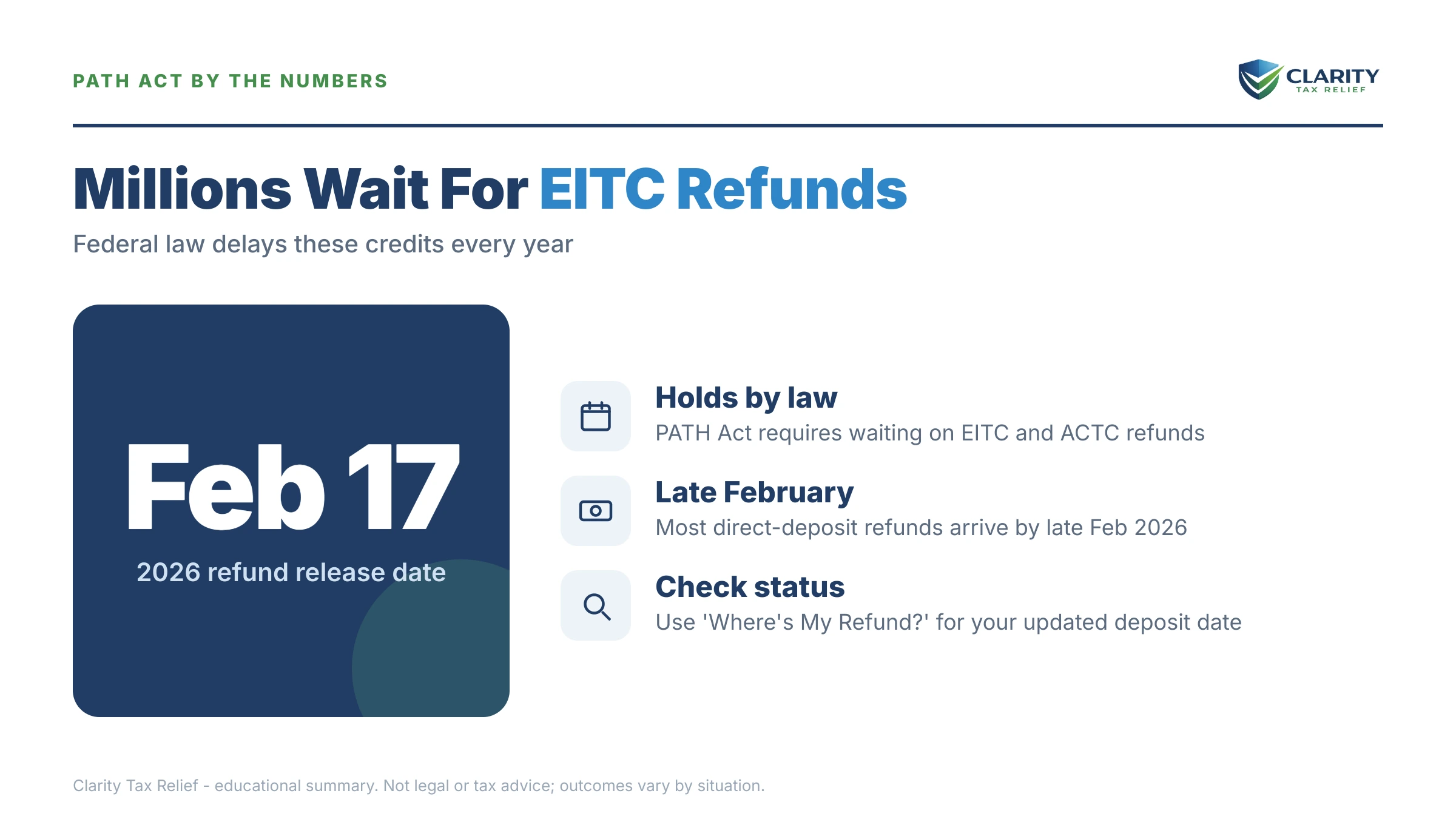
The short answer: the EITC refund hold under the PATH Act is a federal law, not a mistake. By law the IRS cannot release any EITC or ACTC refund before mid-February — freezing refunds for the roughly 24 million workers who claimed about $70 billion in Earned Income Tax Credit. Most see money by around early March.
You filed in the third week of January, a coworker already spent their refund, and Where's My Refund has shown the same screen for weeks. If your return claims the Earned Income Tax Credit, that wait is not a glitch and not a flag on your account. It is a statute working exactly as Congress wrote it.
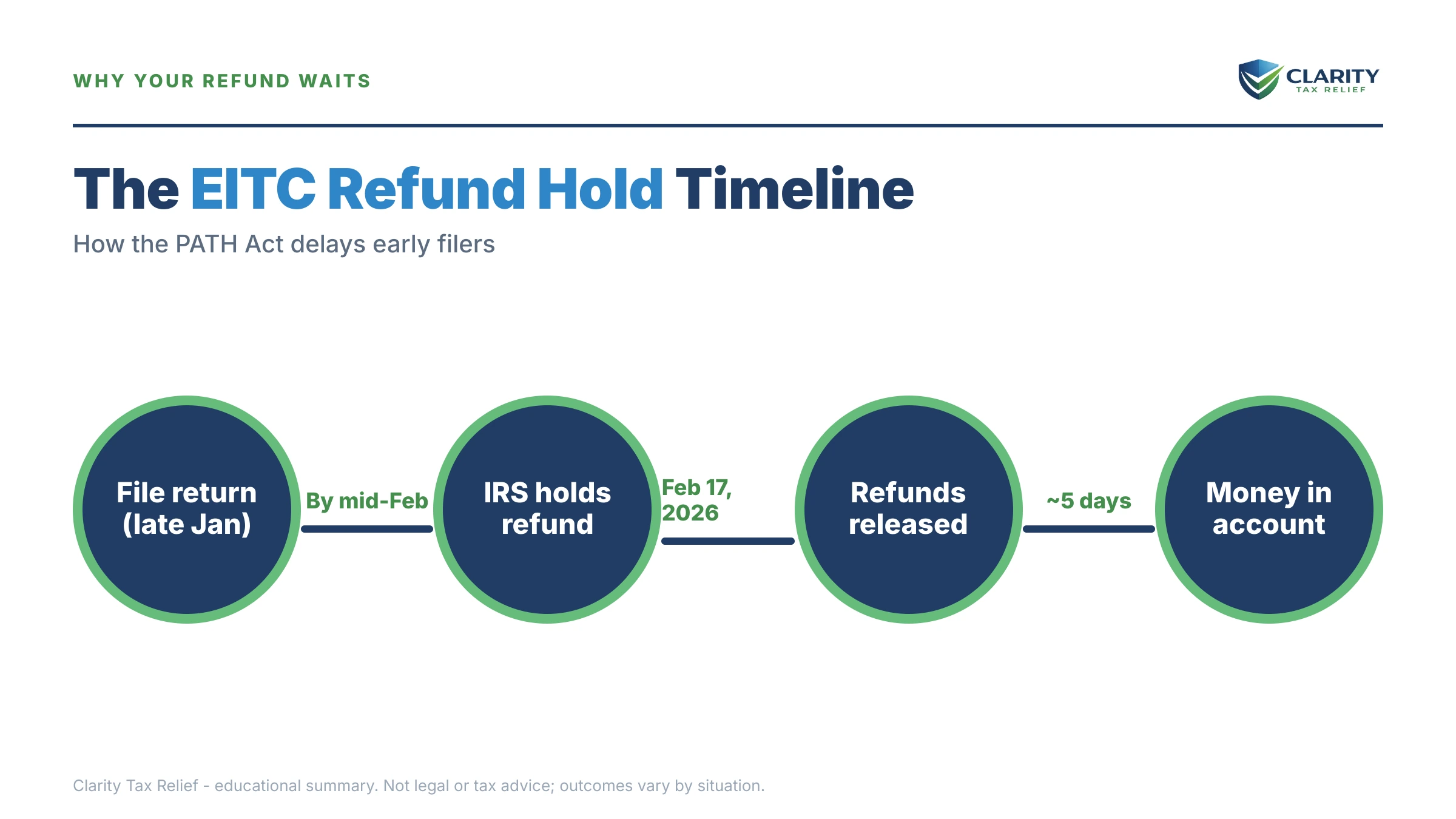
This data study covers the numbers behind the hold, the real 2026 calendar, and, most important, the exact moment a normal PATH Act wait turns into an actual problem you need to act on. The image below shows how the hold plays out across the filing-season calendar, so you can see where your refund likely sits today.
⏱ The real clock: The PATH Act bars the IRS from issuing any refund that includes EITC or the Additional Child Tax Credit before mid-February. Early EITC/ACTC filers who e-file with direct deposit and no issues can expect refunds by around early March. No preparer, no phone call, and no IRS employee can legally release it sooner.

The EITC refund hold in numbers
About 24 million eligible workers and families received about $70 billion in EITC for tax year 2024, as of December 2025, and every one of those refunds passed through the same mid-February freeze. The average EITC was about $2,894, which for many working families is the single largest check they receive all year.
That scale is exactly why the hold exists. When Congress passed the Protecting Americans from Tax Hikes (PATH) Act of 2015, refundable credits like the EITC and the Additional Child Tax Credit were paying out billions before employers' W-2 and 1099 data even reached the IRS. The hold gives the IRS a window to match the income on your return against what employers and payers actually reported, before the money leaves the Treasury.
“By law, we must wait until mid-February to issue refunds to taxpayers who claim the Earned Income Tax Credit.”
— Earned Income Tax Credit (EITC) (IRS.gov)
Why the PATH Act holds your EITC refund until mid-February
The PATH Act bars the IRS from issuing any refund that includes EITC or the Additional Child Tax Credit before mid-February. Three details in that sentence matter more than most articles admit:
The hold applies to your entire refund, not just the credit portion. If your refund is part withholding and part EITC, the IRS cannot split it and send the withholding early. One dollar of EITC or ACTC on the return holds every dollar of the refund.
Second, the hold is universal. It hits every EITC and ACTC claim, filed by anyone, no matter how early or how clean the return. It says nothing about you, your preparer, or your risk of audit.
Third, mid-February is a release date, not a delivery date. The IRS can begin issuing held refunds in mid-February; the money still has to move through processing and your bank. That is why the practical answer for planning purposes is early March, not Valentine's Day.
The 2026 EITC refund timeline: what happens when
For 2026, mid-February is the earliest legal release date, and clean e-filed returns with direct deposit typically see deposits in the weeks right after. Here is the full sequence and what you should see at each stage:
| When | What happens | What you'll see |
|---|---|---|
| Late January | The IRS accepts e-filed returns and processes them, but EITC/ACTC refunds are frozen by law even when processing finishes. | Where's My Refund shows "Return Received," often with a PATH Act message. |
| Mid-February | The earliest date the law allows the IRS to release any refund that includes EITC or ACTC. Refunds release in processing order. | The tool begins updating with personalized deposit dates for clean returns. |
| Around early March | Direct deposits land for early filers who e-filed with no issues. Paper checks and paper-filed returns run later. | Your transcript shows code 846 with a deposit date. |
| Mid-March and later | A refund still missing is being delayed by something other than the PATH Act — a review, an identity check, or an offset. | Codes 570, 810, or 898 on the transcript; letters such as a CP75 by mail. |
Now put dollars on that calendar. Say you're a self-employed sole proprietor whose Schedule C shows $48,300 in net profit, filing with two qualifying children. Your EITC comes out near the tax-year-2024 average of about $2,894. You also overpaid your quarterly estimates by $1,100 — a total refund of $2,894 + $1,100 = $3,994.
You e-file on January 26 with direct deposit. Without the PATH Act, a clean refund would typically arrive within about 21 days — mid-February. With the hold, the earliest legal release is mid-February and your realistic deposit is around early March: roughly five weeks after filing, with all $3,994 held together. The $1,100 of your own overpaid tax waits in line with the credit; the law doesn't distinguish.
When the delay stops being the PATH Act
The PATH Act hold ends by mid-February every year, so a refund missing well past early March means something else has attached to your account. If a real issue exists and you do nothing, it unfolds in a predictable sequence:
- Mid-February passes with no update. Where's My Refund never moves past "still processing." This is the first sign the delay is no longer statutory.
- Codes 570 and 971 post to your transcript. Your account is on hold pending review and a notice is on its way. The letter, not the code, tells you what the IRS wants.
- A CP75 notice or a refund freeze arrives. The IRS is auditing the credit — asking for proof of income, or proof your children lived with you — or has frozen the refund pending identity verification.
- No response → the credit is disallowed. The IRS recalculates your refund without the EITC. Worse, a disallowance can force you to file Form 8862 to claim the credit in future years. A reckless claim can trigger a two-year ban — ten years for fraud.
- Code 898 → the refund is offset. The hold lifts, the refund releases, and some or all of it is redirected to back taxes, child support, or defaulted federal student loans before it ever reaches your bank.
Each stage narrows your options. A CP75 answered on time is a paperwork exercise; a CP75 ignored is a lost credit plus a barrier to claiming it again.
Refund frozen past early March, or a 570 or 810 on your transcript?
Don't guess at what's holding your money. An experienced tax professional will read your transcript, identify the exact freeze, and tell you what to send and where — free, confidential, no pressure.
Transcript codes during the EITC refund hold: what each means
Your IRS account transcript tells you more than Where's My Refund ever will. During a PATH hold, most of the codes you'll see are routine, and two or three are not:
| Code | What it means | What to do |
|---|---|---|
| 150 | Your return was filed and processed. Routine. | Nothing — this is normal. |
| 806 | Your withholding was credited to your account. | Nothing — confirm the amount matches your W-2s/1099s. |
| 766 | A credit (including EITC-related credits) posted to your account. | Nothing — this confirms the credit was accepted into processing. |
| 570 | A hold beyond the PATH Act — your refund is paused for review. See code 570 on IRS transcript. | Wait for the paired 971 notice, then answer it by its deadline. |
| 971 | A notice was issued explaining the hold. | Read the letter carefully and respond with documents, not a phone argument. |
| 810 | A refund freeze, often identity or credit verification. See code 810 refund freeze. | Complete any identity verification the IRS requests as soon as the letter arrives. |
| 898 | Part or all of your refund was applied to a non-IRS debt through the Treasury Offset Program. | Identify the debt; if it's your spouse's alone, file Form 8379 injured spouse. |
| 846 | Refund issued. Your money is on the way. See 846 refund issued date. | Note the date; direct deposits usually arrive within days of it. |
How to track your EITC refund through the PATH Act hold, step by step
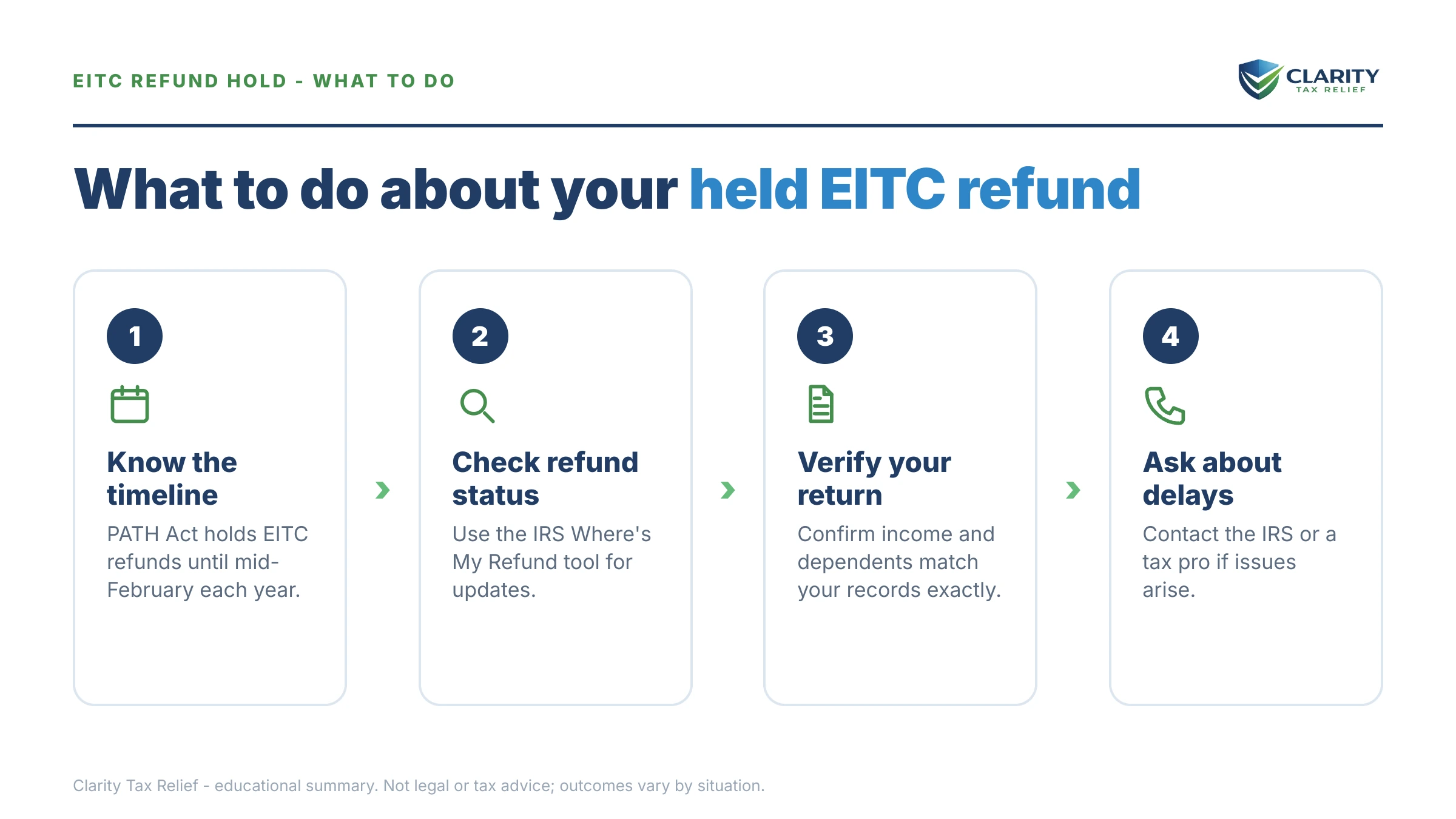
- File early anyway. E-file with direct deposit as soon as you have all your income documents. Held refunds release in processing order, so early filers are first out the door when mid-February arrives.
- Check Where's My Refund after mid-February. Most EITC filers see an updated status with a personalized deposit date once the hold lifts. Before then, a PATH Act message is normal and means nothing is wrong.
- Pull your IRS account transcript. Look for code 846 with a date. That is your refund on the way. Codes 150, 806, and 766 are routine processing entries, not problems. (Here's how to get your IRS transcript online.)
- Watch for freeze codes. A 570, 810, or 898 on your transcript means something beyond the PATH Act is holding your money — a review, identity verification, or an offset to another debt.
- Respond to any IRS letter by its printed deadline. A CP75 audit letter or identity-verification letter left unanswered can turn a delayed credit into a disallowed one. Answer with documents, and keep copies of everything you send.
Self-employed and claiming the EITC: why your hold can run longer
Net earnings from self-employment count as earned income for the EITC. But they are also the hardest income for the IRS to verify. That changes your risk profile during the hold. A W-2 employee's wages are matched against employer filings automatically. A sole proprietor's $48,300 of Schedule C profit is matched against… whatever records the taxpayer kept.
That's why Schedule C returns claiming the EITC are disproportionately the ones pulled for review after the hold lifts — the IRS EITC audit rate data shows how heavily these credits are examined relative to their dollar size. The review usually arrives as a CP75 asking for two kinds of proof: that your business income is real (invoices, 1099-Ks, bank deposits, mileage and expense logs) and that your qualifying children actually lived with you (school, medical, or lease records).
If you're self-employed, your records are your refund. A shoebox of receipts answered promptly keeps a review at two or three weeks. No records at all is how a $2,894 credit becomes zero plus a Form 8862 requirement next year.
Owe back taxes? The hold ends, then the offset begins
The PATH Act delays your refund; a debt can take it. Once the hold lifts, the IRS applies your refund to any federal tax balance you owe. The Treasury Offset Program can intercept it for state tax debt, past-due child support, or defaulted federal student loans — the scale of those intercepts is documented in our Treasury Offset Program refund seizure statistics study.
Three situations change the answer here. If the debt is your spouse's alone and you filed jointly, Form 8379 can recover your share. If the offset would create a genuine hardship, an eviction or utility shutoff, the Taxpayer Advocate Service can sometimes intervene before the money is taken. And if the debt is your own back-tax balance, the offset will repeat every year until the balance is resolved — see will the IRS take my refund every year, and our hub on how to settle tax debt yourself for the resolution options that stop the cycle.
The statistical quirk: where EITC refunds vanish from IRS data
EITC refunds are excluded from the IRS's mid-February weekly filing-season statistics because of the hold, then appear the following week. This is why headlines every February claim "refunds are down sharply this year" — the week the IRS publishes its first post-hold numbers, tens of millions of the largest refunds in the system simply aren't in the count yet.
One week later, the held refunds flood in and the averages snap back. If you're comparing your refund to news reports in February, you're comparing against a dataset that deliberately omits people like you. Our IRS refund delay statistics study breaks down how much of each season's "delay" is this statutory hold versus genuine processing problems.
When you can handle this yourself, and when help changes the outcome
Most people reading this need no help at all. If your only issue is that it's February and your refund hasn't arrived, the correct move is nothing: the hold lifts by law, and no service, preparer, or phone call can accelerate it. A single CP75 with clean records is also very manageable on your own — copy the documents, respond by the deadline, keep proof of mailing.
Experienced help changes outcomes in a narrower set of cases: an 810 freeze that persists after you've completed identity verification, an EITC disallowed in a prior year that now blocks every refund, a Schedule C review where your records are thin and the credit plus your business deductions are both on the line, or a refund being offset year after year to a back-tax balance you can't pay. In those situations the question isn't "where's my refund" — it's how to resolve the underlying account. The order you fix things in matters.
Terms on your transcript, decoded
- PATH Act — the Protecting Americans from Tax Hikes Act of 2015, the law that created the mid-February refund hold for EITC and ACTC claims.
- ACTC — the Additional Child Tax Credit, the refundable portion of the Child Tax Credit; it triggers the same hold as the EITC.
- Refund hold vs. refund freeze — a hold (PATH) is statutory and lifts automatically. A freeze (570/810) is account-specific and lifts only when the underlying issue is resolved.
- Code 846 — the transcript entry meaning your refund was issued, with the date it was sent.
- Offset — the government applying your refund to another debt (federal or state tax, child support, federal student loans) before you receive it.
- Form 8862 — the form the IRS requires you to file to claim the EITC again after a prior-year disallowance.
EITC refund hold questions, answered
Why is the IRS holding my EITC refund?
Because of the PATH Act — a federal law, not a problem with your return. The PATH Act bars the IRS from issuing any refund that includes EITC or the Additional Child Tax Credit before mid-February, no matter how early you file. The hold applies to every EITC and ACTC claim automatically; you don't need to do anything to release it.
When will I get my EITC refund in 2026?
Early EITC/ACTC filers who e-file with direct deposit and no issues can expect refunds by around early March. The IRS can begin releasing held refunds in mid-February, and direct deposits typically land in the weeks that follow. Paper returns and paper checks take longer, and any error, identity-verification letter, or offset adds time beyond that.
Does the PATH Act hold my whole refund or just the EITC part?
The entire refund is held, not just the credit portion. If your refund is $3,994 — say $2,894 of EITC plus $1,100 of overpaid tax — all $3,994 waits until mid-February. The law bars the IRS from issuing any refund that includes the credits, so it cannot split the payment and send the non-credit portion early.
What is the average EITC refund amount?
The average EITC was about $2,894 for tax year 2024. About 24 million eligible workers and families received about $70 billion in EITC for that year, as of December 2025. Your own credit depends on your earned income, filing status, and number of qualifying children, so it can run from a few hundred dollars to several thousand.
What if my EITC refund still hasn't arrived by mid-March?
At that point the delay is probably no longer the PATH Act. Pull your IRS account transcript and look for code 846 (refund issued). If you instead see 570, 810, or 898, your refund is frozen for review, identity verification, or an offset. Respond to any IRS letter, such as a CP75 audit request, by its stated deadline, because ignoring it can turn a delay into a disallowed credit.
Can the IRS keep my EITC refund for back taxes or other debts?
Yes. Once the PATH hold lifts, the Treasury Offset Program can take some or all of your refund for federal tax debt, state tax debt, child support, or defaulted federal student loans. A transcript code 898 signals an offset. If the debt belongs only to your spouse, filing Form 8379 (injured spouse) can recover your share of a joint refund.
Does self-employment income count for the EITC?
Yes — net earnings from self-employment count as earned income for the EITC, so a sole proprietor with Schedule C profit can qualify. The trade-off is scrutiny: self-employment income isn't verified by a W-2, so Schedule C EITC claims are more likely to be flagged for review or audit. Keep books, invoices, and bank records that support both your income and your expenses.
Why doesn't Where's My Refund update during the PATH hold?
The tool typically shows a PATH Act message or "still processing" until the hold lifts; that's normal, not a red flag. Most EITC filers see a personalized deposit date appear after mid-February. Checking daily won't speed anything up — the tool generally updates once a day, and no one at the IRS can legally release the refund before mid-February.
Your next 24 hours
- Pin down your dates. Confirm when you filed, how you filed (e-file or paper), and how you're being paid (direct deposit or check). Those three facts set your realistic arrival window against the mid-February release and early-March deposit timeline above.
- Pull your account transcript. Set up your IRS online account if you haven't, open the current-year account transcript, and note any code that isn't 150, 806, or 766.
- If you see 570, 810, or 898, or a letter you're not sure how to answer — get a free case review. Use the 2-minute form or call (888) 825-7779. A frozen credit left unanswered can become a disallowed one, and a disallowed EITC follows you into future filing seasons.
Source: figures in this study come from the IRS's EITC reports and statistics page (tax year 2024 data, as of December 2025). You can check your own refund status any time at the IRS's Where's My Refund page.
This guide is general information, not tax or legal advice for your specific situation. Eligibility for IRS programs depends on individual facts and circumstances; no outcome is guaranteed.