
IRS Data Studies
IRS Failure to File Penalty Statistics: What the Data Shows in 2026
What this episode covers
- Does the IRS failure-to-file penalty stop growing after five months?
- What happens when IRS failure-to-file and failure-to-pay penalties apply at the same time?
- Does the IRS 10-year collection statute run on an unfiled tax return?
- How many years of back tax returns does the IRS generally require for compliance?
The short answer: the IRS assessed about 3 million failure-to-file penalties on individual, estate, and trust income tax returns in fiscal year 2023 — roughly $6 billion, about $2,000 per penalty (IRS Data Book, Table 26). Roughly one-third of those penalty dollars were later abated. The penalty itself runs 5% per month, capped at 25%.
If you searched for IRS failure to file penalty statistics, you're probably not writing a term paper. You're a freelancer two returns behind, doing the math in your head before you face the real math on paper — how many people get hit, how big the hit usually is, and how often it gets undone. Those numbers exist, and two of them should genuinely change how you feel: the average penalty is about $2,000, and roughly a third of penalty dollars get removed after the fact.
The image below shows how the 5%-a-month math builds toward its cap and where this study's headline numbers sit, so you can see the whole picture before we get into the tables.
⏱ The real clock: the failure-to-file penalty maxes out at 25% of the unpaid tax after just five months late. But staying unfiled keeps the failure-to-pay penalty and daily-compounding interest growing every month, and any year the IRS owes you a refund expires for good three years after its original due date.

IRS failure to file penalty statistics: the headline numbers
The IRS assessed about 3 million failure-to-file penalties worth roughly $6 billion against individual, estate, and trust income tax returns in fiscal year 2023, according to Data Book Table 26. In the Data Book, this line is labeled the "delinquency" penalty — the official name for the failure-to-file charge under IRC §6651(a)(1). All figures here are rounded; the exact numbers and our derivations are in the methodology note at the end.
Two derived numbers matter most for a reader deciding what to do:
- Average penalty per assessment: roughly $2,000. Divide about $6 billion by about 3 million assessments. That average is dollar-weighted — a small number of very large penalties pulls it upward — but it tells you the delinquency line produces the biggest individual bills of any common penalty.
- Share of penalty dollars later abated: roughly one in three. About $2 billion of the roughly $6 billion assessed came back off through abatement. Relief on this penalty is a normal outcome of the system, not a longshot.
| Measure | Approximate figure | What it tells you |
|---|---|---|
| Failure-to-file penalties assessed | About 3 million | Millions of filers are in your position every single year |
| Dollars assessed | Roughly $6 billion | The delinquency line carries some of the largest dollar totals of any individual penalty |
| Average per penalty (derived) | Roughly $2,000 | Dollar-weighted; big balances pull the average up |
| Dollars abated | About $2 billion | Billions come back off through relief every year |
| Share of dollars abated (derived) | Roughly 1 in 3 | Abatement on this penalty is routine, not exceptional |
For context: the average failure-to-file penalty runs many times larger than the average failure-to-pay penalty, which typically lands in the hundreds of dollars — see our companion failure-to-pay penalty statistics study for that line's numbers. The estimated tax penalty statistics and IRS accuracy-related penalty statistics pages cover the other individual penalty lines, and the IRS individual penalty mix by type shows how all of them compare side by side. This page stays on the delinquency line only.
One scope note: these figures cover individual, estate, and trust income tax returns. Business late-filing penalties — including the per-partner, per-month charge behind a CP162 partnership late-filing penalty — sit on separate Data Book lines and are not counted here.
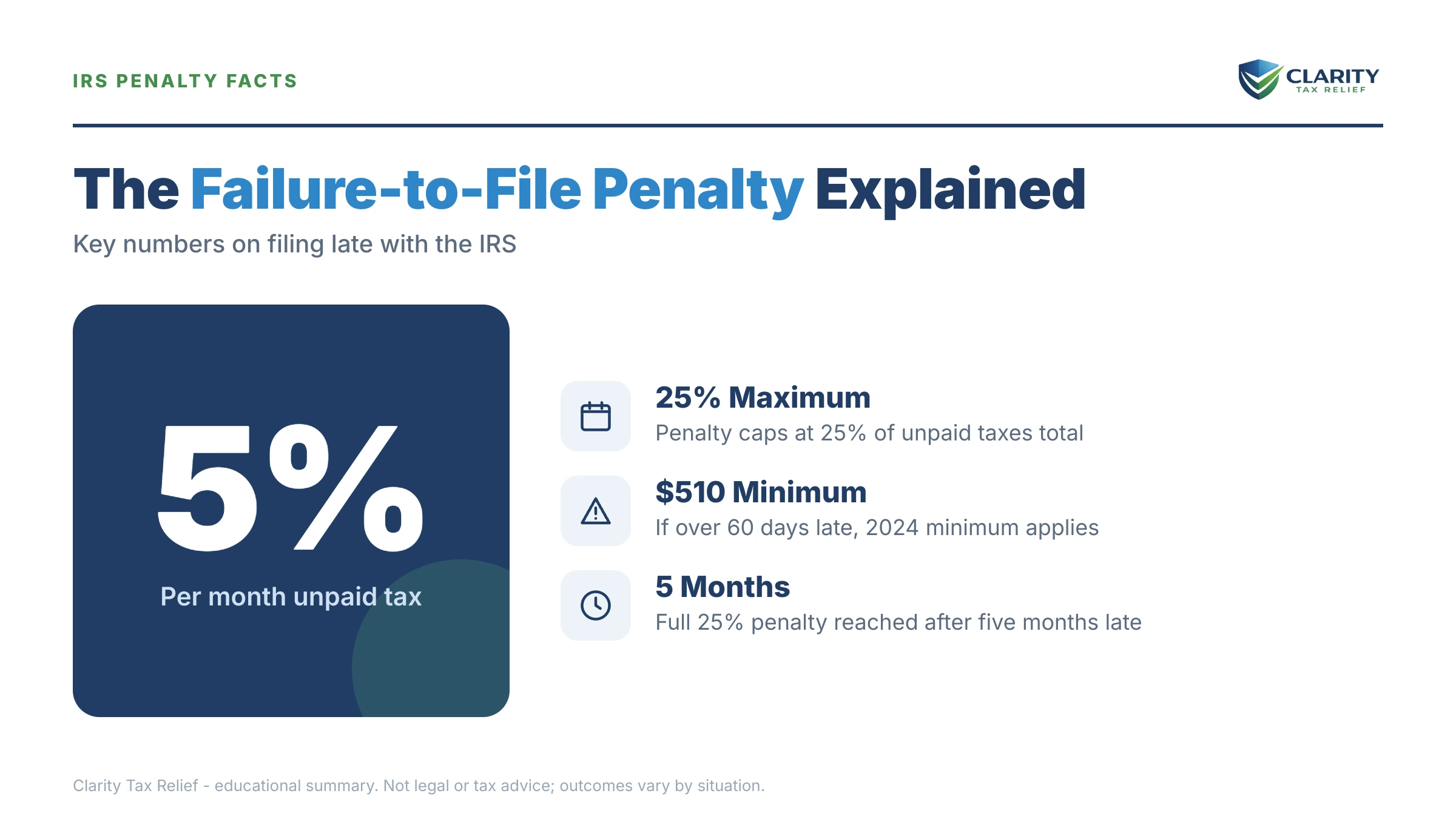
“The penalty is 5% of the tax due (less any tax paid on time and available credits) for each month or partial month the return is late. The penalty accrues up to a maximum of 25%.”
— Failure to file penalty (IRS.gov)
Why the failure-to-file penalty produces the biggest bills in the data
The failure-to-file penalty charges 5% of the unpaid tax for each month or part of a month a return is late — ten times the 0.5% monthly failure-to-pay rate. That single design choice explains why the average delinquency penalty is roughly $2,000 while the average late-payment penalty is a fraction of that.
Four rules drive the numbers you see in Table 26:
- Any part of a month counts as a full month. File one day past the deadline with a balance due and the first 5% has already attached.
- The cap arrives fast. Five months late and the penalty hits its 25% ceiling. Most people who search this query are already at the cap — which, oddly, is useful news: your failure-to-file damage is likely already done and now fixed in size.
- A minimum penalty applies past 60 days. Returns more than 60 days late owe at least the smaller of 100% of the unpaid tax or a flat amount adjusted for inflation each year — roughly $485–$525 depending on when the return was due — $485 for returns due in 2024, $510 for returns due in 2025, and $525 for returns due after December 31, 2025. Small balances still generate real penalties.
- Fraudulent failure to file triples the rate. Where the IRS proves fraudulent intent, the rate becomes 15% per month, capped at 75%. This is rare in the data but it's the ceiling of the statute.
And underneath every one of these charges, interest compounds daily on both the tax and the penalties — the penalty numbers in the Data Book don't include interest at all.
How failure-to-file and failure-to-pay stack when both apply
When the failure-to-file and failure-to-pay penalties run in the same month, the combined charge is 5% per month — the failure-to-file portion drops to 4.5% and failure-to-pay adds its 0.5%. That offset is why the practical failure-to-file cap for someone who also hasn't paid is 22.5%, not 25%, and why the two penalties together can eventually reach 47.5% of the unpaid tax.
| Time late | Failure-to-file | Failure-to-pay | Combined charge |
|---|---|---|---|
| Months 1–5 (both penalties running) | 4.5% per month | 0.5% per month | 5% per month |
| Month 6 onward | Capped (22.5% total) | 0.5% per month continues | 0.5% per month |
| More than 60 days late | Minimum penalty floor applies (lesser of 100% of tax or the inflation-adjusted flat amount) | — | |
| Lifetime maximum | 22.5% (25% if no overlap) | 25% | 47.5% of the unpaid tax |
Rates shown are for months when BOTH penalties apply. If only the failure-to-file penalty applies (you filed late but paid on time), it runs at the full 5% per month, up to 25%.
The full rules-level comparison — including what happens on an installment agreement — lives in our guide to IRS failure to file vs failure to pay penalties. Here, the takeaway is statistical: the reason the delinquency line dwarfs the late-payment line per assessment isn't that non-filers owe more tax — it's that the same balance generates a penalty ten times as fast.
What the numbers look like on a real balance: $9,400, two years late
A $9,400 balance that goes unfiled and unpaid for two years generates about $3,243 in combined penalties before interest. Here's the arithmetic, using a clearly hypothetical case: say you're a freelancer who skipped filing two years ago and would have owed $9,400 on that return.
| Charge | Rate applied | Amount |
|---|---|---|
| Unpaid tax | — | $9,400 |
| Failure-to-file penalty | 4.5% × 5 months = 22.5% (capped) | $2,115 |
| Failure-to-pay penalty so far | 0.5% × 24 months = 12% | $1,128 |
| Balance before interest | — | $12,643 |
| Failure-to-pay if left unpaid long enough | Continues to the 25% cap | Up to $2,350 total |
Interest then compounds daily on the tax and the penalties at the federal underpayment rate — several hundred dollars a year on a balance this size at recent rates. And if the second unfiled year also has a balance, its own failure-to-file clock runs independently: two years like this one means two separate 22.5% penalties. You can estimate your own penalty and interest with our calculator before you file anything.
Notice what the example implies about timing. The failure-to-file penalty on this return capped out 19 months ago — filing today doesn't add a dollar to it. What filing today does is stop the problem from getting a third year, start the abatement paths that remove penalties, and put you in control of the numbers instead of the IRS's estimates.
What happens if you stay unfiled: the escalation sequence
Unfiled returns never start the IRS's 10-year collection clock — the statute of limitations on collection runs from assessment. An unfiled year has no assessment to run from. Waiting doesn't age the problem toward expiration; it preserves it indefinitely while the automated non-filer pipeline works through its stages:
- CP59 — the first non-filer notice, telling you the IRS has no return on file for a year where its records show income. See our CP59 notice guide if this is the letter in your hand.
- CP516 / CP518 — the reminder and final-reminder notices. Still requests, but the file is moving toward the IRS doing your return for you.
- Substitute for Return (SFR) — the IRS prepares a return from your 1099s and W-2s: single filing status, no dependents, no business expenses, no deductions beyond the standard. For a freelancer, an SFR taxes gross 1099 income as if you had zero costs. Details in what to do when the IRS filed a substitute return.
- CP3219N — the statutory notice of deficiency on the SFR numbers, opening a 90-day window to petition Tax Court before the inflated amount is assessed.
- Assessment and collections — once assessed, the failure-to-file and failure-to-pay penalties post to your account and the balance enters the normal collection notice stream, which ends in lien and levy authority. Debts assessed above $66,000 (the 2026 threshold) can also trigger passport certification.
One more stage runs silently in the background: any unfiled year where you were owed a refund expires three years after its due date. Our guide to whether you can still get a refund from 3 years ago covers exactly where that line falls for your years.
Two years behind and watching the math compound?
Get a free review of your unfiled years before the failure-to-pay penalty and daily interest add another month to the bill — an experienced tax professional will map which years to file first, what the penalties actually total, and which relief you may qualify for.
Your options: how a third of these penalty dollars get removed
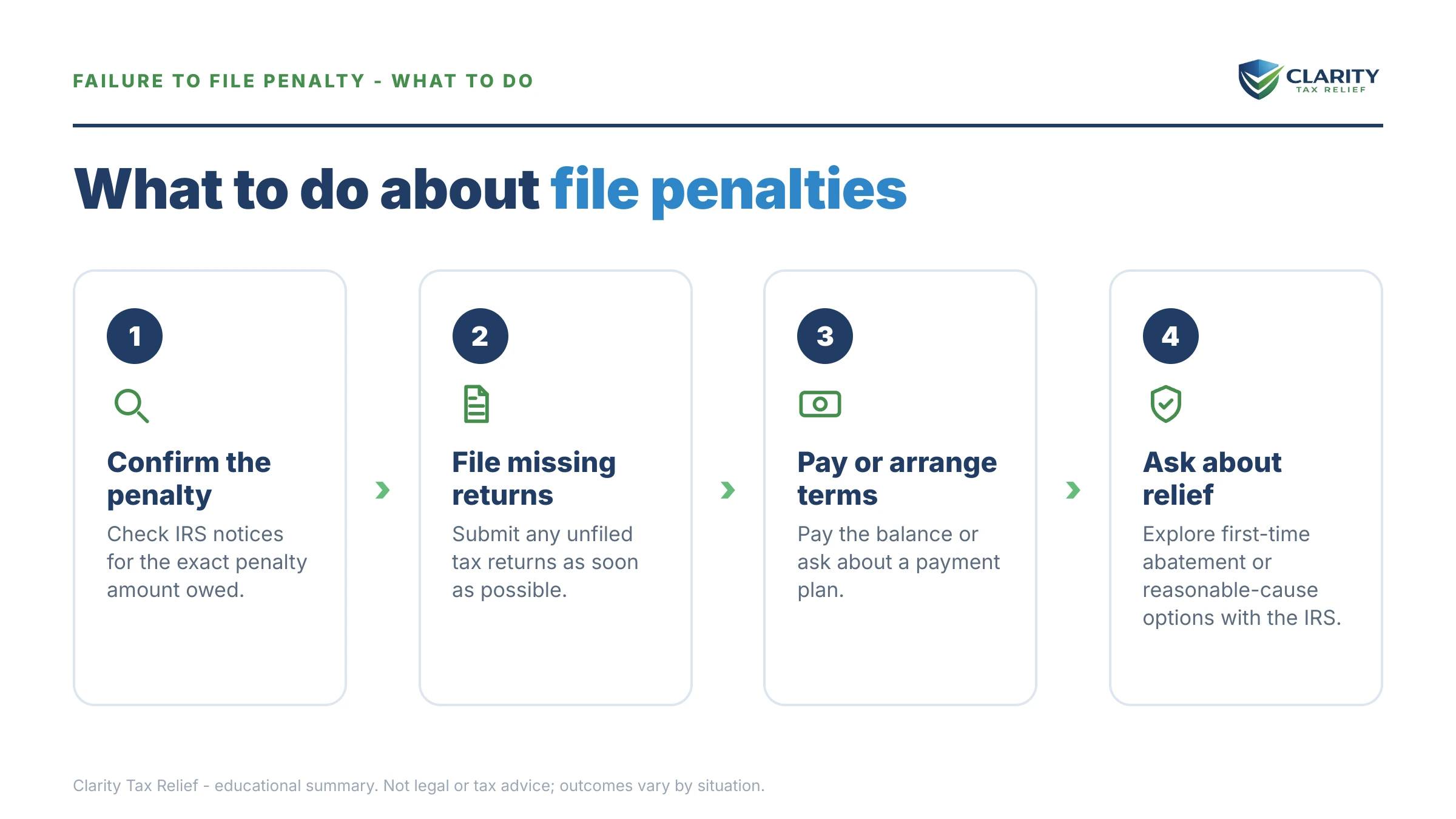
Roughly one in three failure-to-file penalty dollars assessed is later abated, and the relief flows through a handful of well-worn channels, not luck. Here's each path, what it costs, and who qualifies:
- File the return. Free, and the single most powerful move. Filing stops the failure-to-file clock the day the return is in, replaces any inflated SFR assessment with your real numbers (often shrinking the penalty base itself), and is a prerequisite for every relief program below. If you're multiple years back, our guide to being three years behind on taxes walks the catch-up order.
- First-time penalty abatement. Free, requested by phone or letter, and available if your prior three years were filed and penalty-free. On a capped penalty like our $2,115 example, a granted FTA removes the whole thing. It generally applies to one year, so multi-year cases need a strategy for the rest.
- Automatic Exemption from Penalty (AEP). Starting summer 2026, AEP begins replacing first-time abate — qualifying relief applies automatically, with no request needed. If you're filing catch-up returns in late 2026 or after, check whether AEP already covered a year before you spend effort requesting anything.
- Reasonable cause penalty abatement. Free. But it must be earned with facts: serious illness, disaster, death in the family, records destroyed, reliance on bad professional advice. Documentation decides these — dates, medical records, insurance claims. There's no year limit, which makes it the workhorse for multi-year non-filers with a genuine story.
- SFR reconsideration. If the IRS already assessed a substitute return, filing your actual return typically reduces the tax, and because the penalty is a percentage of that tax, the penalty shrinks with it. For a freelancer whose SFR ignored every business expense, this is often the biggest dollar swing available.
- Payment programs for what's left. A short-term plan gives up to 180 days with $0 setup. Balances of $50,000 or less fit an online installment agreement of up to 72 months. Genuine hardship can qualify for currently-not-collectible status. None of these remove penalties, but an approved plan does keep enforcement off while you resolve them, and interest continues under all of them.
Note that these are federal numbers and federal remedies. States assess their own late-filing penalties on their own schedules and rates, if you skipped a state return too, that's a separate balance with its own relief process through your state agency.
For how the delinquency line's abatement rate compares to every other penalty type, see the site-wide study of IRS civil penalties assessed vs abated — the short version is that failure-to-file relief runs among the more generous, precisely because FTA, reasonable cause, and SFR corrections all funnel into it.
How to respond if you're years behind, step by step
- Pull your IRS transcripts. Order wage and income transcripts and account transcripts for every unfiled year so you know what the IRS already has on file and whether any substitute returns or penalties have posted.
- File refund years before the three-year window closes. Any year the IRS owes you money carries no failure-to-file penalty. But the refund is forfeited three years after the original due date — file those first.
- File the balance-due years. IRS policy generally requires the last six years of returns to get back into compliance. Filing stops the failure-to-file clock immediately and replaces any inflated substitute-for-return assessment.
- Request penalty relief once the returns post. Ask for first-time abate if your prior three years were clean, or submit a reasonable-cause request with documentation. From summer 2026, the automatic exemption from penalty (AEP) applies qualifying relief without a request.
- Set up payment on what remains. A short-term plan gives up to 180 days with no setup fee. Balances of $50,000 or less can go on an online installment agreement of up to 72 months. Interest and the failure-to-pay penalty continue until paid.
- Get a professional review if the numbers are big or messy. Multiple years, substitute returns, or self-employment records that need reconstructing are where an experienced tax professional changes the outcome — a free case review shows where you stand.
When you can handle this yourself, and when help changes the outcome
One late return with a balance you can pay within 180 days is usually a do-it-yourself fix. If you're a single year behind, agree with the numbers. Your prior three years were clean, the whole sequence — file, request first-time abate, set up a short-term plan — takes a few phone calls and costs nothing but the tax and interest. You don't need to hire anyone for that, and anyone who tells you otherwise is selling.
The data points to where help genuinely pays for itself. Remember that roughly a third of penalty dollars get abated while the count of abated penalties runs lower — the removals concentrate in cases someone actively worked. That's typically:
- Multiple unfiled years, where the filing order, which year gets FTA, and how reasonable cause is framed across years materially change the total.
- SFR assessments already on your transcript, where reconsideration with a properly built return can shrink both the tax and the penalty base.
- Self-employment years with thin records, where reconstructing expenses from bank statements determines whether the return shows $9,400 due or twice that.
- Balances too large for streamlined plans, or collection already in motion — notices past the reminder stage, or a levy warning in the mail.
Be honest with yourself about which column you're in. The system forgives billions in these penalties every year, but almost none of it goes to people who don't ask, or who ask badly.
Terms in the data, decoded
- Delinquency penalty — the Data Book's name for the failure-to-file penalty under IRC §6651(a)(1); "delinquent return" simply means a late one.
- Assessment — the moment a tax or penalty is formally recorded on your IRS account. The counts and dollars in Table 26 are assessments, not collections.
- Abatement — the removal of a penalty after assessment, whether through first-time abate, reasonable cause, or a corrected return.
- Substitute for Return (SFR) — a return the IRS builds for a non-filer from third-party income reports, with no deductions or business expenses in your favor.
- Minimum penalty — the floor charged on returns more than 60 days late: the lesser of 100% of the unpaid tax or a flat, inflation-adjusted dollar amount.
- FTA / AEP — first-time abate, the clean-history relief program, and the automatic exemption from penalty that begins replacing it in summer 2026.
If your transcript already shows delinquency penalties stacked across more than one year, a free case review can map the cheapest order to unwind them before another month of failure-to-pay and interest posts.
Failure-to-file penalty statistics: your questions answered
How many failure-to-file penalties does the IRS assess each year?
Based on the FY2023 IRS Data Book (Table 26), the IRS assessed about 3 million failure-to-file penalties on individual, estate, and trust income tax returns in a single year, totaling roughly $6 billion. That works out to about $2,000 per penalty. Business late-filing penalties — like the per-partner penalty behind a CP162 notice — are counted on separate lines and would push the totals higher.
What is the average IRS failure-to-file penalty?
Roughly $2,000, derived by dividing about $6 billion in delinquency-penalty dollars by about 3 million assessments in the FY2023 IRS Data Book (Table 26). That average is dollar-weighted, so a few very large penalties pull it up; many penalties are smaller. It is still roughly ten times the typical failure-to-pay penalty, because the failure-to-file rate is ten times higher per month.
What percentage of failure-to-file penalties get abated?
Roughly one-third of failure-to-file penalty dollars are later abated — about $2 billion of the roughly $6 billion assessed, per Data Book Table 26. The share abated by count is lower, because larger penalties are more likely to be professionally contested. Abatement usually comes through first-time abate, reasonable cause, or corrected assessments after real returns replace substitute returns.
How is the failure-to-file penalty calculated in 2026?
The penalty is 5% of the unpaid tax for each month or part of a month the return is late, capped at 25% after five months. When the failure-to-pay penalty runs in the same month, failure-to-file drops to 4.5% so the combined monthly charge is 5%. Returns more than 60 days late face a minimum penalty, and fraudulent failure to file runs 15% per month up to 75%.
Which is worse: failure-to-file or failure-to-pay?
Failure-to-file is far worse — 5% per month versus 0.5% per month for failure-to-pay, a tenfold difference. Filing on time with no payment at all costs you one-tenth the penalty of not filing. That is why the first move for anyone behind is always to file, even with no money attached. The failure-to-file clock stops the day the return is in.
What is the minimum failure-to-file penalty for filing more than 60 days late?
If your return is more than 60 days late, the minimum penalty is the smaller of 100% of the unpaid tax or a flat dollar amount that is adjusted for inflation each year — roughly $485–$525 depending on when the return was due — $485 for returns due in 2024, $510 for returns due in 2025, and $525 for returns due after December 31, 2025. This floor exists so tiny balances still generate a meaningful penalty. If you owe nothing, there is no failure-to-file penalty at all.
Do I owe a failure-to-file penalty if the IRS owes me a refund?
No — the failure-to-file penalty is a percentage of unpaid tax, so if the IRS owes you money, the penalty is zero. But there is a different cost: you forfeit the refund entirely if you don't file within three years of the original due date. Non-filers lose real refunds this way every year, so file refund years first.
Can the IRS remove a failure-to-file penalty?
Yes — abatement is routine, not rare: roughly a third of delinquency-penalty dollars assessed are later removed. The main paths are first-time abate (clean compliance for the prior three years), reasonable cause (illness, disaster, records destroyed), and correcting inflated substitute-for-return assessments by filing real returns. Starting in summer 2026, the automatic exemption from penalty (AEP) begins replacing first-time abate, applying qualifying relief without a request.
Can you go to jail for not filing taxes?
Willful failure to file is a misdemeanor, but criminal prosecution is rare and reserved for deliberate, usually high-dollar or repeat cases — the IRS resolves the overwhelming majority of non-filing civilly, through penalties and substitute returns. Coming forward voluntarily and filing before the IRS contacts you is the strongest protection. If you're simply behind and scared, the realistic risks are financial, not criminal.
Your next 24 hours
- Check your IRS account. Log into your IRS online account or pull your account transcript for each unfiled year, and look for two entries: any substitute-for-return activity and any penalty already assessed. That tells you which stage of the sequence you're actually in.
- Gather the raw material. Your last filed return, every 1099 and W-2 for the missing years, and twelve months of bank statements per year if you're self-employed — enough to reconstruct income and expenses.
- Get the free case review. Use the 2-minute form or call (888) 825-7779. There's no notice-printed deadline on unfiled returns. But the failure-to-pay penalty and daily interest post every month you wait, and refund years expire for good at the three-year mark.
Methodology note
This study uses the civil-penalties table (Table 26, "Civil Penalties Assessed and Abated") of the fiscal year 2023 IRS Data Book, delinquency-penalty line for individual, estate, and trust income tax returns. All figures are rounded and presented as approximations. The average penalty per assessment and the share of dollars abated are our derivations (dollars divided by counts, and dollars abated divided by dollars assessed, respectively). Dollar-weighted averages overstate the typical penalty. Abatement dollars in a fiscal year can relate to penalties assessed in earlier years, so the abatement share is an approximation of flow, not a case-level success rate. Statutory penalty rates are drawn from IRC §6651 as described on the IRS's failure-to-file penalty page. Payment-program terms reflect the options listed at IRS.gov/payments as of July 2026. Consult the current Data Book edition for exact, unrounded figures.
This guide is general information, not tax or legal advice for your specific situation. Eligibility for IRS programs depends on individual facts and circumstances; no outcome is guaranteed.