
IRS Data & Studies
IRS Accuracy-Related Penalty Statistics: What the FY2023–FY2025 Data Shows (2026)
What this episode covers
- What triggers the IRS accuracy-related penalty under IRC 6662?
- How can I dispute an IRS accuracy-related penalty before it is assessed?
- Does IRS First-Time Abate apply to the accuracy-related penalty?
- What happens if I miss the response deadline on an IRS accuracy-related penalty notice?
The short answer: the IRS assessed 564,913 accuracy-related penalties on individuals worth $1.39 billion in FY2023 — the 20% penalty for understating your tax. About 32% of assessed dollars were later abated. But when taxpayers fight this penalty in court, the IRS prevails in full in about 78% of cases.
You found the line on your exam report or CP2000 that says "accuracy-related penalty" — a 20% surcharge stacked on top of the tax the IRS says you already underpaid. Before deciding whether to pay it or push back, it helps to see how the IRS accuracy-related penalty statistics actually break down: how often this penalty is charged, how often it comes off, and who wins when it's contested.
This data study walks through the IRS's own numbers from Data Book Table 28 and Table 4-2, then translates them into a practical playbook. The image below shows the assessment-and-abatement picture at a glance, so you can see where your situation fits before reading the detail.
⏱ The clock that matters: the response date printed on the notice that proposed your penalty — miss it. The penalty is formally assessed and billed. Once assessed, interest generally accrues on an accuracy-related penalty from the return's original due date, so every month of delay adds real cost even while you decide what to do.

IRS accuracy-related penalty statistics: the headline numbers
The IRS assessed 564,913 accuracy-related penalties on individual, estate, and trust returns in FY2023, worth $1.39 billion. Table 28 of the IRS Data Book reports that dollar figure as $1,390,420 thousand, and in the same year, the IRS abated 65,576 of those penalties worth $450,051 thousand ($450 million).
Two years later, the pattern shifted. The FY2025 Data Book (Table 4-2) shows 440,718 individual accuracy-related penalties assessed, worth $1.50 billion, with $592 million abated. Fewer taxpayers got hit, but the average penalty grew.
| Measure | FY2023 | FY2025 |
|---|---|---|
| Penalties assessed (individuals) | 564,913 | 440,718 |
| Dollars assessed | $1.39 billion ($1,390,420 thousand) | $1.50 billion |
| Dollars abated | $450,051 thousand ($450 million) | $592 million |
| Share of assessed dollars abated | About 32% | Roughly 39% |
| Average penalty assessed | Roughly $2,460 | Roughly $3,400 |
Read those two columns together and three things jump out. The count dropped by more than 120,000 penalties, the average assessment climbed roughly 38%, and the share of dollars removed on request went up. In plain terms: the IRS is charging this penalty less often but for bigger amounts, and taxpayers who contest it properly are getting more back.
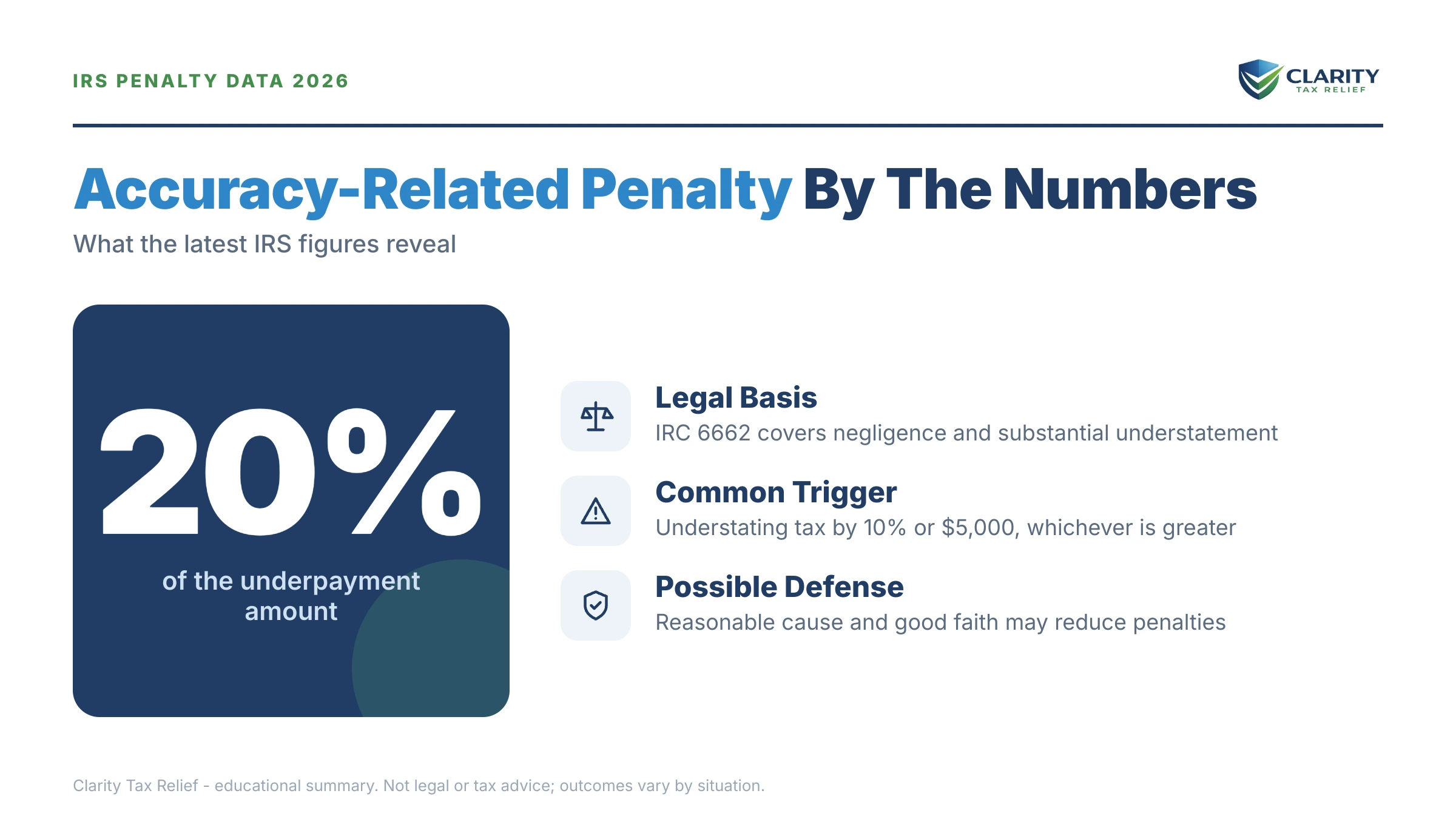
“The accuracy-related penalty is 20% of the portion of the underpayment of tax that is attributable to negligence or disregard of rules or regulations.”
— Accuracy-related penalty (IRS.gov)
Why the IRS assesses half a million accuracy-related penalties a year
The accuracy-related penalty is 20% of the underpayment under IRC 6662, charged for negligence or a substantial understatement of income tax. It is not an accusation of cheating — most of these penalties are generated by automated systems that compare your return against 1099s and W-2s, or by exams that disallow deductions.
The "substantial understatement" trigger is mechanical: a substantial understatement exists when you understate tax by the greater of 10% of the correct tax or $5,000. There is no judgment call in that math. If a CP2000 notice or exam moves your correct tax up by enough to cross that line, the 20% penalty attaches by formula.
The negligence prong is the other common route: no reasonable attempt to comply, or inadequate records. That's why sole proprietors are heavily represented in these numbers — a Schedule C audit that disallows unsupported deductions produces both an underpayment and, in the examiner's view, evidence of careless recordkeeping. The IRS's automated underreporter program alone generates a large share of these proposals. Our IRS CP2000 underreporter statistics study covers that pipeline in detail.
What the abatement data reveals: roughly a third of the dollars come off
In FY2023, the IRS removed about 32% of the accuracy-related penalty dollars it assessed — $450 million abated against $1.39 billion charged. By count, though, only 65,576 of the 564,913 penalties were abated, roughly 12%.
That gap between the dollar rate and the count rate is the most useful signal in the whole dataset. It means the taxpayers winning abatements tend to be the ones with larger penalties and documented cases — people who responded formally, argued reasonable cause or a legal defense, and often had representation. Small penalties mostly go unchallenged and get paid.
The FY2025 numbers reinforce it: $592 million abated against $1.50 billion assessed, a higher share than two years earlier. Compare that with the litigation data, and the strategy writes itself. In litigated accuracy-related penalty cases studied by the National Taxpayer Advocate, the IRS prevailed in full in about 78% of cases. The administrative route — response letters, Appeals, reconsideration — is where taxpayers win. Court is where they usually don't. Our broader IRS penalty abatement statistics study shows the same pattern across every penalty type.
What happens if you ignore an accuracy-related penalty
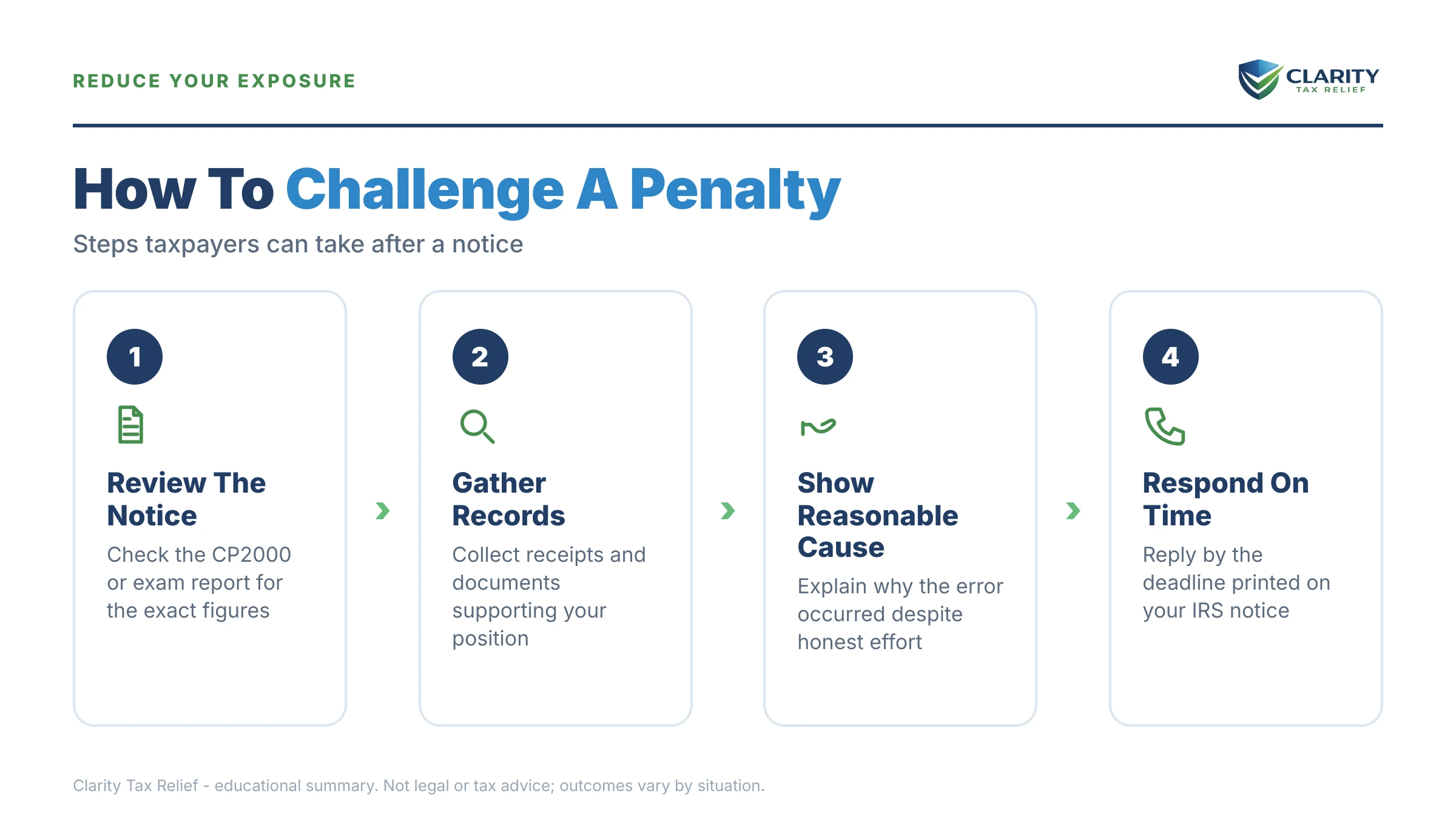
An unanswered accuracy-related penalty moves from a proposal you can still argue into a debt the IRS collects like any other. The sequence is automated and runs in stages:
- Proposed — the penalty appears on a CP2000, exam report, or 30-day letter. This is your cheapest exit: you can dispute it before it ever becomes a debt, including through the IRS Independent Office of Appeals.
- Notice of deficiency, if you don't respond, a statutory notice arrives giving you 90 days to petition Tax Court. Miss it and the assessment becomes final; see our guide to the 90 day letter tax court petition.
- Assessed and billed — the penalty posts to your account with the tax, and a balance-due bill arrives. Interest is now compounding on the penalty itself.
- Collection notices — reminder notices escalate to a CP504 (intent to levy your state refund) and eventually an LT11 final notice, which starts a 30-day clock before wage and bank levies become legal.
Notice what ignoring it costs you at each stage: first your pre-assessment appeal rights, then your Tax Court option, then your leverage. A penalty the data says has roughly a one-in-three chance (by dollars) of being removed becomes just another balance the collection machine pursues.
Staring at a 20% penalty on your notice?
The IRS removed $450 million of these penalties in FY2023, but only for taxpayers who made a documented case. Get your penalty notice reviewed free before the response date printed on it passes: an experienced tax professional will tell you whether reasonable cause, Appeals, or reconsideration fits your facts.
Your options to remove an accuracy-related penalty, and who qualifies
Every accuracy-related penalty has at least one contest path, but the right one depends entirely on the stage and your facts. One critical exclusion first: first time penalty abatement does not apply here. It covers failure-to-file, failure-to-pay, and deposit penalties, not IRC 6662 penalties. Your paths are these:
| Option | Who it fits | Stage and cost |
|---|---|---|
| Reasonable cause + good faith | You relied on a competent preparer, had records destroyed or unavailable for reasons beyond your control, or made an honest mistake on a genuinely unclear issue | Any stage; free to request in writing with documentation |
| Substantial authority / adequate disclosure | Your position had real legal support, or you disclosed it on Form 8275 with the return | Raised in your written response or Appeals protest; free |
| Appeals protest (pre-assessment) | Anyone who responds to the proposing notice by its printed deadline | Before assessment; free, and most disputes resolve here without court |
| Audit reconsideration | The penalty was assessed but you have new information, or never got the chance to respond | After assessment; free to request, though processing takes months |
| Form 843 / refund claim | The penalty is assessed or paid and you have a reasonable-cause or legal argument | After assessment; free to file |
| Tax Court litigation | Large dollars and strong documentation only | After a notice of deficiency; costly — the IRS prevails in full in about 78% of litigated cases |
Two of these deserve their own reading before you act: reasonable cause penalty abatement (the standard the IRS actually applies, with the documentation that persuades) and Form 843 instructions (the post-assessment request form). If your penalty came out of an exam you never meaningfully participated in, start with IRS audit reconsideration instead.
What a 20% penalty looks like in real dollars
Say you're a self-employed sole proprietor and an exam disallows enough Schedule C deductions that your correct tax comes out $27,500 higher than what you reported. Here's the penalty math:
- Substantial understatement test: $27,500 is well above $5,000, and above 10% of the correct tax in almost any realistic scenario, so the penalty attaches by formula.
- Penalty: 20% × $27,500 = $5,500, added on top of the $27,500 in tax.
- Interest: accrues on both the tax and the penalty, generally running from the return's original due date, so the real bill is higher than $33,000 by the time it's assessed.
Now apply the abatement data. If reasonable cause removes the penalty, you save $5,500 plus the interest that would have compounded on it — for the cost of a well-documented written request. That trade is why roughly a third of assessed dollars come off: the taxpayers with penalties this size ask, and ask correctly. You can estimate your own penalty-and-interest exposure with our IRS penalty & interest calculator. And if the underlying $27,500 in tax stands, our hub on how much are IRS penalties on back taxes covers the payment-plan and relief options for the balance itself.
How to respond to an accuracy-related penalty, step by step
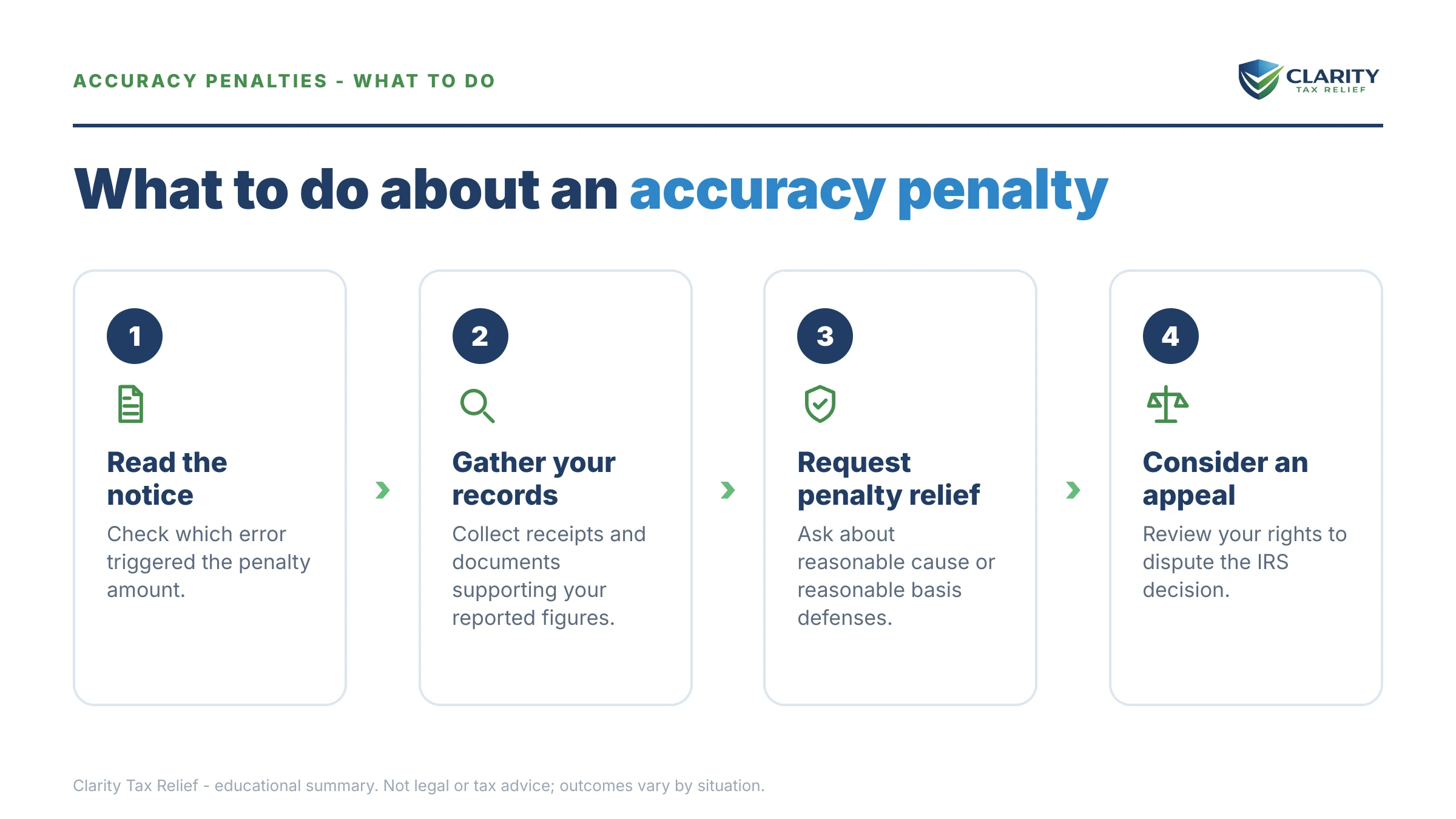
- Identify the stage — check whether the penalty is proposed (a CP2000 or exam report asks you to agree) or already assessed (it appears on a bill or your account transcript).
- Verify the math — confirm the penalty is 20% of the underpayment, and check whether the understatement actually exceeds the greater of 10% of the correct tax or $5,000.
- Build your defense — gather records showing reasonable cause and good faith, or authority supporting the position the IRS adjusted.
- Respond in writing before the notice deadline — dispute a proposed penalty with the unit that sent the notice and request Appeals if denied. For an assessed penalty, file Form 843 or request audit reconsideration.
- Get experienced review before you litigate — the IRS prevails in full in about 78% of litigated accuracy-related penalty cases, so exhaust the administrative options first.
When you can handle this yourself, and when help changes the outcome
A small accuracy-related penalty with a clear-cut cause is a genuinely DIY project. If the penalty is a few hundred dollars, you agree the underlying tax is right. Your reasonable-cause story is simple — a documented hospitalization, a preparer who made the error on complete information you gave them — write the request yourself and attach the proof. You don't need to pay anyone for that.
Experienced help earns its cost in different situations: the penalty is thousands of dollars (like the $5,500 example above), the IRS is also hinting at negligence across multiple years, the exam disallowed business deductions you believe were legitimate, or you're weighing a Tax Court petition. That last one especially — a 78% full-win rate for the IRS in litigation means the decision to go to court needs a hard-eyed review of your evidence first, not optimism. If the notice also proposes the 75% fraud penalty instead, that's a different and more serious animal. See our guide to the IRS civil fraud penalty and get representation before responding at all.
Terms in the penalty data, decoded
- IRC 6662 — the Internal Revenue Code section that authorizes the 20% accuracy-related penalty.
- Substantial understatement — understating your tax by the greater of 10% of the correct tax or $5,000; crossing it triggers the penalty automatically.
- Negligence — failing to make a reasonable attempt to comply with the tax law or to keep adequate records; the other main trigger.
- Assessment — the IRS formally recording the penalty as a debt on your account, which is when collection can begin.
- Abatement — the IRS removing an assessed penalty, in whole or in part, after you establish a defense.
- Reasonable cause — the legal standard that you exercised ordinary business care and acted in good faith but still got it wrong.
Accuracy-related penalty statistics: your questions, answered
How many accuracy-related penalties does the IRS assess each year?
In FY2023 the IRS assessed 564,913 accuracy-related penalties on individuals, estates, and trusts worth $1.39 billion. By FY2025 the count fell to 440,718 but the dollars rose to $1.50 billion. Fewer taxpayers are being penalized, but for larger amounts — the average assessment climbed roughly 38% in two years. Most of these penalties come out of automated underreporter matching and exams, not a human deciding you were careless.
What percentage of accuracy-related penalties get abated?
About 32% of assessed accuracy-related penalty dollars were abated in FY2023, $450 million out of $1.39 billion, and in FY2025 the IRS abated $592 million. By count, only 65,576 of the 564,913 FY2023 penalties came off, roughly 12%, which tells you the wins go to taxpayers who build a documented case rather than send a one-line request. Abatement is never automatic; you must raise reasonable cause or a legal defense.
What triggers the IRS accuracy-related penalty?
The penalty is 20% of the underpayment under IRC 6662, most commonly for negligence or a substantial understatement of income tax. A substantial understatement is triggered when you understate tax by the greater of 10% of the correct tax or $5,000. Self-employed filers hit these thresholds fast, because a few disallowed Schedule C deductions or one unreported 1099 can move the tax number by thousands.
What are my chances if I fight an accuracy-related penalty in court?
Not good without preparation: in litigated accuracy-related penalty cases studied by the National Taxpayer Advocate, the IRS prevailed in full in about 78% of cases. Your odds are meaningfully better earlier — through Appeals, audit reconsideration, or a reasonable-cause request — where roughly a third of assessed dollars get removed. Court should be the last stop, taken only when the dollars justify it and your documentation is strong.
Does first-time penalty abatement apply to accuracy-related penalties?
No. First-Time Abate covers failure-to-file, failure-to-pay, and failure-to-deposit penalties, not the accuracy-related penalty. To remove a 20% accuracy penalty you need reasonable cause and good faith, a legal defense like substantial authority or adequate disclosure, or a win at Appeals or in court. A clean compliance history helps your credibility, but it is not itself a legal basis here.
Is the accuracy-related penalty the same as the fraud penalty?
No. The accuracy-related penalty is 20% of the underpayment and requires only negligence or a substantial understatement — no bad intent. The civil fraud penalty is far harsher, at 75% of the underpayment, and requires the IRS to prove intentional wrongdoing. The IRS cannot stack both penalties on the same portion of an underpayment.
How do I get an accuracy-related penalty removed?
It depends on the stage. Before assessment, respond to the notice proposing it, often a CP2000 or exam report, with your defense, and request an Appeals conference if you are denied. After assessment, file Form 843 or request audit reconsideration with documentation showing reasonable cause and good faith. In FY2025 alone the IRS abated $592 million of these penalties, but only for taxpayers who asked with evidence.
Your next 24 hours
- Find the penalty line on your notice or account transcript — confirm it says "accuracy-related penalty" and check that the amount is 20% of the underpayment shown, then note the response date printed on the notice.
- Gather three things: the tax return for that year, the notice proposing or assessing the penalty, and any records supporting the position the IRS adjusted (receipts, 1099s, preparer correspondence).
- Get a free case review — use the 2-minute form or call (888) 825-7779. The data shows roughly a third of these penalty dollars come off, but only when the request is built correctly, and interest keeps accruing on the penalty until it's resolved.
Sources: IRS Data Book Table 28, Civil Penalties Assessed and Abated by Type of Tax and Type of Penalty; National Taxpayer Advocate litigated-issue analysis via the Taxpayer Advocate Service. If you decide to pay the underlying balance, use the official channels at IRS.gov/payments.
This guide is general information, not tax or legal advice for your specific situation. Eligibility for IRS programs depends on individual facts and circumstances; no outcome is guaranteed.