
IRS Audits
IRS Audit Document Checklist for 2026: Every Record to Gather, by Audit Type and Issue
The short answer: an IRS audit document checklist starts with four items — the audit letter itself, a complete copy of the return under exam, every income record for that year (W-2s, 1099s, bank statements), and proof for each questioned deduction: receipts, logs, and acknowledgment letters. Send copies only, and only for the items requested.
The letter says your return has been selected for examination, names a tax year, and lists the items the IRS wants proof of, with a response date that suddenly feels very close. That knot in your stomach is normal. But an audit is not an accusation; it's a paperwork exercise, and the taxpayers who do well are simply the ones who send an organized, complete package on time. This page is the package list.
Before you gather anything, read the request itself carefully — the image below shows exactly what an audit request letter looks like and where the list of requested documents appears. Every item on that list needs a matching document in your response.
⏱ Your deadline: the response date printed on your audit letter — typically 30 days from the letter date for a mail audit. If you need more time to gather records, call the number on the letter before that date and ask for an extension. Once questioned items are disallowed, getting them back takes appeals, not a phone call.

Why the IRS is asking you for documents
An IRS audit is a documentation test: the examiner's job is to match every questioned line on your return to a record that proves it. Under the tax code, the burden of proving a deduction falls on you, not the IRS — income the IRS can see through W-2s and 1099s, but deductions exist only if you can document them.
The request arrives in one of a few wrappers: Letter 566 for most mail audits, a CP75 when an Earned Income Credit or dependent claim is under review, or Letter 2205-A scheduling an in-person exam. Attached to most of them is Form 886-A or an information document request — the itemized list your response must answer point by point.
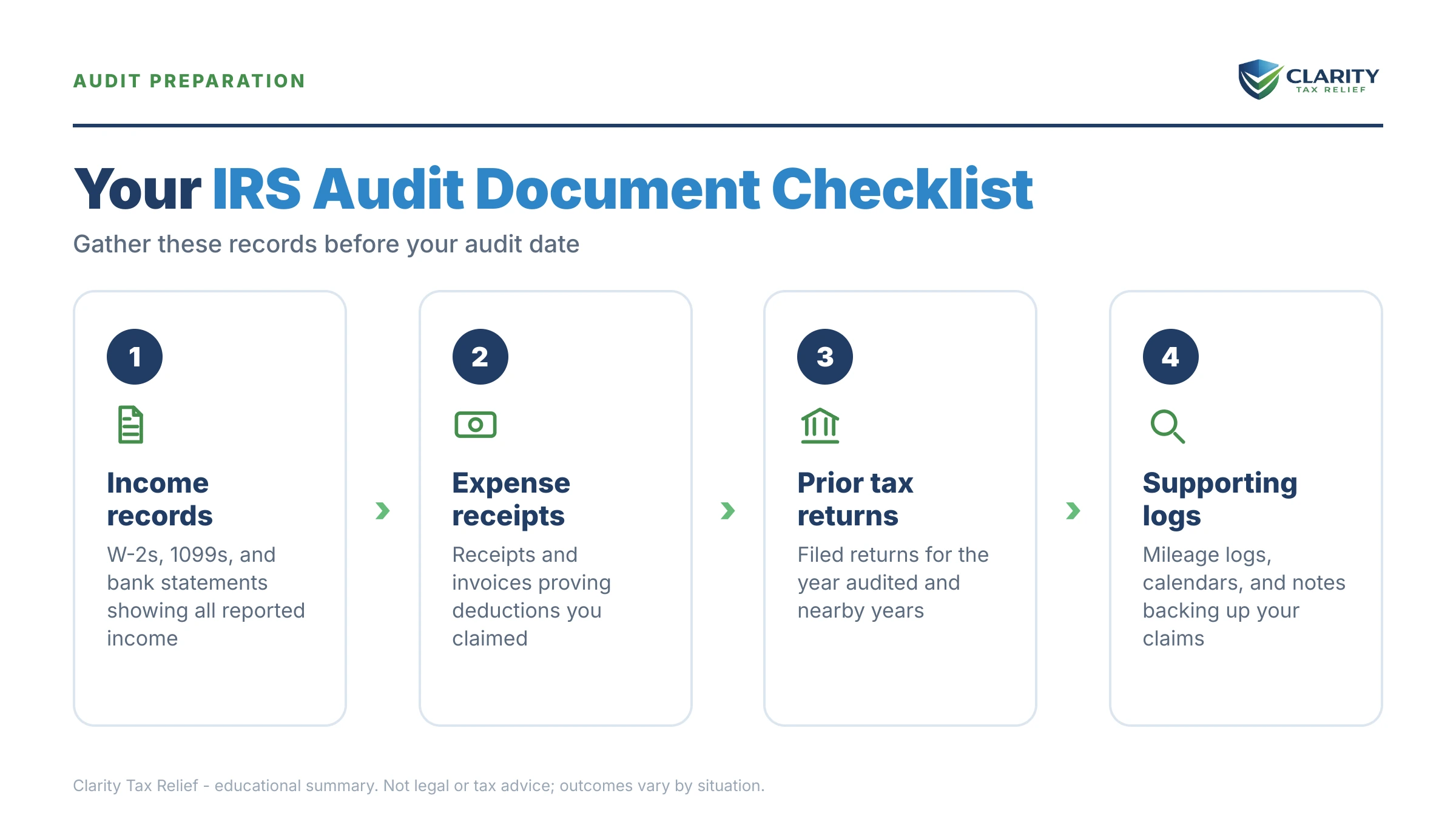
Whatever the wrapper, four core documents anchor every response:
- The audit letter and all its enclosures. It defines the year, the items, and the deadline.
- A complete copy of the return under exam, with every schedule and attachment as filed.
- All income documents for that year: W-2s, 1099-NEC, 1099-K, brokerage statements, and platform annual summaries.
- Proof for each questioned item — the issue-by-issue table below tells you exactly what qualifies.
“The IRS will provide you with a written request for the specific documents we want to see. Here's a listing of records the IRS may request. The IRS accepts some electronic records in lieu of or in addition to other types of records.”
— IRS audits (IRS.gov)
What happens if you don't respond to the document request
If you don't answer an audit letter, the IRS doesn't drop the audit. It disallows every questioned item and bills you for the difference. The sequence runs on autopilot, and each stage narrows your options:
- The response date passes. Your file moves forward with only the IRS's side of the story in it.
- Examination report (Form 4549). The IRS proposes the changes — questioned deductions removed, tax recalculated, often with a 20% accuracy-related penalty added. A 30-day letter gives you a window to send documents or request appeals; your IRS audit appeal rights live here.
- CP3219A Notice of Deficiency. The formal 90-day letter. Your last pre-assessment stop, with the right to petition Tax Court before the changes become final.
- Assessment and collection. The proposed amount becomes a legal debt, interest compounds daily, and the balance enters the normal collection notice stream.
- Audit reconsideration. Even after assessment, audit reconsideration lets you submit the same documents you could have sent today, but now you're unwinding an assessed debt instead of preventing one.
The document checklist below is identical at every stage. The only thing that changes is how much leverage you have when you use it, and today is the most you will ever have.
Staring at an audit letter and a list of documents you're not sure you have?
Get your audit letter reviewed free before the response date on it passes. An experienced tax professional will map each requested item to what you actually have, and show you how to fill the gaps.
IRS audit document checklist by issue: what counts as proof
The IRS accepts different proof for different line items — a receipt substantiates a supply purchase, but only a per-trip log substantiates mileage. Find the row for each item your letter questions and gather everything in it:
| Issue under exam | Documents to gather | The proof standard |
|---|---|---|
| Gross income / receipts | All 1099-K and 1099-NEC forms, platform annual summaries, bank statements for every account, bookkeeping ledger or app export | Every deposit must be explained as taxable income, a transfer, or a nontaxable source — examiners run a bank deposit analysis |
| Vehicle / mileage | Per-trip mileage log (date, miles, destination, business purpose), platform mileage summaries, repair and oil-change receipts showing odometer readings, registration | IRC §274(d): contemporaneous records made at or near the time of each trip — estimates are not accepted |
| Home office | Floor plan with square footage of the office and the whole home, rent or mortgage records, utility bills, photos of the space | Exclusive and regular business use of the specific area claimed |
| Travel and meals | Receipts plus a record of the date, place, business purpose, and who attended | IRC §274(d) again — a receipt alone is not enough without the business context |
| Supplies, equipment, other Schedule C expenses | Receipts, invoices, canceled checks, credit-card statements; purchase records and an asset list for anything depreciated | Ordinary and necessary for the business, and actually paid in the year claimed |
| Charitable contributions | Bank records or receipts for every gift; a written acknowledgment letter for any single gift of $250 or more; a qualified appraisal for noncash gifts over $5,000 | The $250+ acknowledgment must already exist when you file — the charity cannot backdate one |
| Dependents / EITC / head of household | Birth certificates, school and medical records showing the child's address, custody orders, lease or landlord letter showing who lived in the household | Relationship plus residency with you for more than half the year — see EIC audit proof of residency |
| Medical expenses | Provider bills, proof of payment, insurance explanation-of-benefits statements, mileage records for medical travel | Paid, not merely billed, during the year, and only the portion above the AGI floor is deductible |
Two rows trip up more taxpayers than all the others combined. Charitable gifts of $250 or more die without the acknowledgment letter even when the canceled check exists. And vehicle expenses die without a per-trip log even when the car, the gas receipts. The work were all real, if that's your situation, our guide to what to do when the IRS asks for a mileage log covers reconstruction in detail.
Correspondence, office, and field audits: how you submit the documents
Most individual audits are correspondence audits, handled entirely by mail with no examiner meeting at all. The audit type changes the scope, the setting, and how your checklist gets delivered:
| Audit type | Scope and setting | How documents are submitted |
|---|---|---|
| Correspondence audit (Letter 566, CP75) | One to three specific items on one return; conducted entirely by mail through an IRS campus | Mail or fax copies to the address on the letter, or use the Documentation Upload Tool if your letter offers it — always with tracking, never originals |
| Office audit (Letter 2205-A) | Several issues on one or two returns; an appointment at a local IRS office with a tax compliance officer | Bring organized copies to the appointment; the examiner reviews them with you and may request follow-up items in writing |
| Field audit | The whole return, sometimes multiple years; a revenue agent works at your business, home, or your representative's office | The agent issues Form 4564 information document requests; documents are produced in stages against each request |
The audit type also signals stakes. A correspondence audit questioning one deduction is a contained problem; a field audit of a business return is not. Match your response effort, and whether you bring in representation — to the row you're in.
A worked example: the $73,000 rideshare return and the missing mileage log
Say you drove rideshare full-time, reported $73,000 in gross fares on Schedule C for 2025, and claimed 30,000 business miles — a $21,000 deduction at the 2025 standard mileage rate of 70 cents. A correspondence audit now asks for your mileage log. You never kept one. This example is hypothetical, but the math is how examiners actually score it.
If you send nothing: the full $21,000 is disallowed. In a 22% bracket, that's roughly $4,620 in extra income tax, plus about $2,970 in additional self-employment tax ($21,000 × 92.35% × 15.3%) — call it $7,600 in tax, plus a 20% accuracy-related penalty of roughly $1,520, plus interest. Total exposure: north of $9,100 on one line item.
If you reconstruct: your platform's annual tax summary shows 22,400 miles logged while you were on the app. Submitting that summary, a third-party record the examiner can verify, substantiates 22,400 miles × $0.70 = $15,680 of the deduction. Only the unproven 7,600 miles ($5,320) get disallowed: about $1,170 in income tax and $750 in self-employment tax, roughly $1,900 instead of $9,100.
Platform summaries typically count only app-on miles, so a carefully labeled reconstruction of additional business miles — built from calendar entries, GPS history, and odometer readings on repair receipts — can sometimes close more of the gap. It draws scrutiny, and it must be presented honestly as a reconstruction. Drivers with no records at all should start with surviving an IRS audit with no receipts.
What NOT to send the IRS in an audit
Never send the IRS original documents, and never send records for years or items it didn't request. What you leave out of the envelope matters almost as much as what goes in:
- No originals — ever. Correspondence audit mail is scanned at a campus and not returned. If your only copy of a $2,000 acknowledgment letter is lost in processing, the deduction is lost with it.
- No extra years. The letter names one tax year. Sending other years' returns or records invites the examiner to open them — audits can and do expand.
- No unrequested bank statements or schedules. Every page you volunteer is a page that can raise a new question. Answer the list; stop there.
- No shoebox. An unlabeled pile of receipts forces the examiner to do your organizing, and examiners resolve ambiguity against you. Group, subtotal, and label everything to the item it proves.
- No essays or admissions. A cover letter should list what's enclosed, not narrate your year. Volunteered explanations create inconsistencies that documents then have to overcome.
- No mid-audit amended return without professional advice. It rarely stops the exam and can complicate the numbers the examiner is working from.
How to respond to an IRS audit document request, step by step
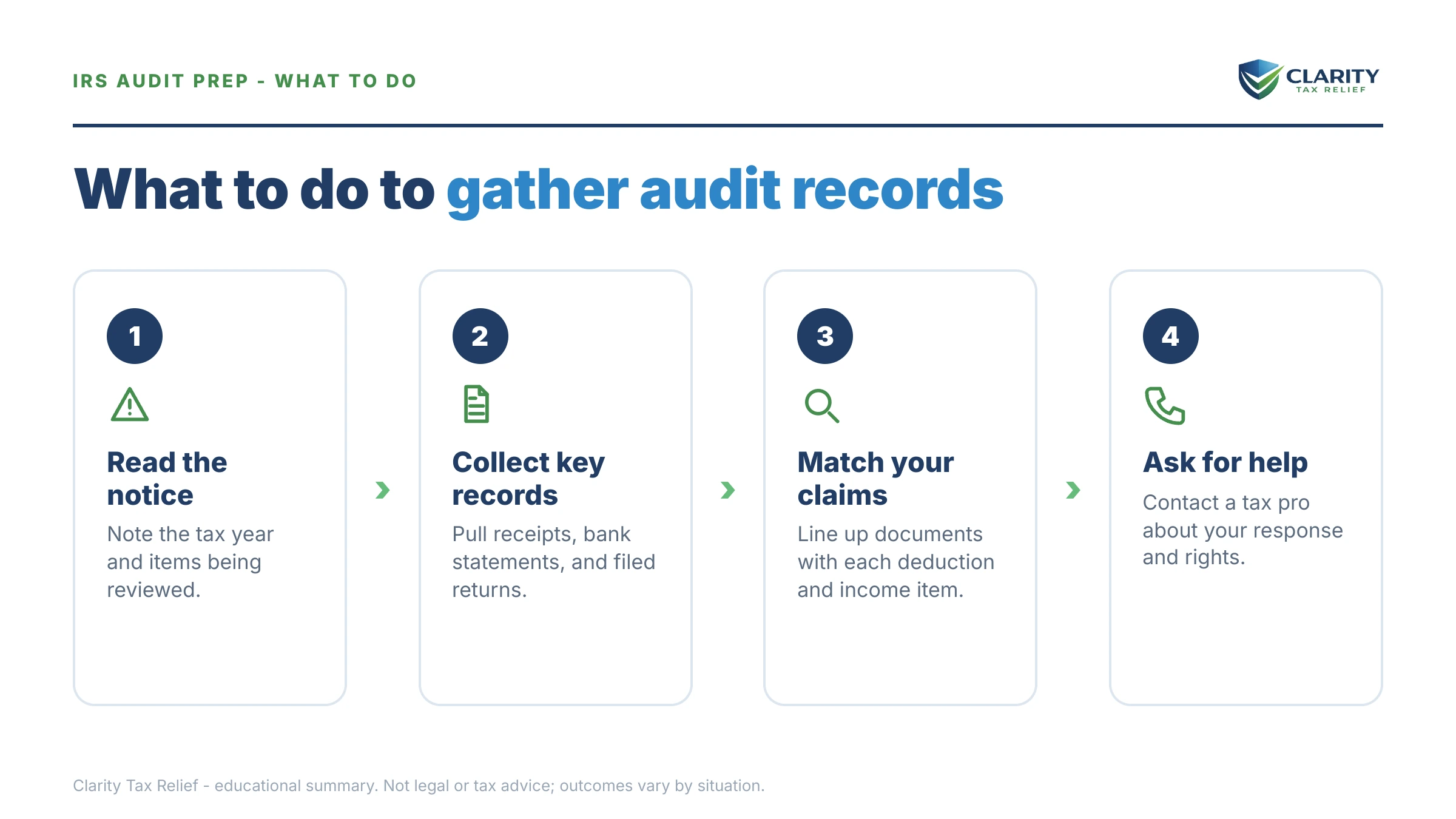
- Read the letter line by line. Write out every item requested, the tax year under exam, and the response date. The enclosed Form 886-A or document request is your table of contents — respond to it item by item.
- Gather the matching records. Use the checklist table above to pull what the IRS accepts as proof for each questioned item — receipts and bank records for expenses, a per-trip log for mileage, acknowledgment letters for charitable gifts.
- Reconstruct any gaps. Order missing bank and card statements, download platform annual summaries, and pull calendar or GPS history. Label anything rebuilt after the fact as a reconstruction — never pass it off as an original record.
- Copy and organize everything. Send copies only. Group the pages in the same order as the IRS's list, label each group with the item it proves, and add a one-page cover letter listing what is enclosed.
- Send it with proof of delivery. Use the address, fax number, or upload option printed on your letter, add tracking, and keep a complete duplicate set of everything you sent.
When you can handle the audit yourself, and when help changes the outcome
A single-issue correspondence audit where you actually have the records is a do-it-yourself job. If the IRS questions one deduction and your folder holds the receipts, the acknowledgment letter, or the log, an organized response by the deadline usually closes the exam, sometimes with a no-change letter and nothing owed.
Experienced help earns its cost in specific situations: when you have no records for a large deduction and the reconstruction has to survive scrutiny. When the IRS is questioning your income rather than a deduction. When the audit covers a cash-heavy or self-employed return where one answer can open new issues (our Schedule C audit defense guide explains why). When multiple years or a business return are on the table. Or in any field audit, where a representative can meet the agent so you never have to. What that costs, and what it typically saves — is covered in our guide to IRS audit representation cost.
One honest rule of thumb: if your worst-case number from the exam is a few hundred dollars, handle it yourself. If it's thousands — like the $9,100 mileage example above — a professional review before you respond is cheap insurance.
Terms on your audit letter, decoded
- Substantiation — the records that prove a return item; the legal reason the audit exists.
- Contemporaneous — created at or near the time of the event, not rebuilt later; the standard mileage, travel, and meal records must meet.
- Form 886-A — the "Explanation of Items" attachment listing exactly what the IRS is questioning and what it wants from you.
- Form 4564 (IDR) — an Information Document Request; how a revenue agent formally asks for records in a field audit.
- Form 4549 — the examination report proposing the changes and the new balance; signing it accepts the result.
- No-change letter — the audit's best outcome: your documents held up and the return stands as filed.
IRS audit document questions, answered
What documents do I need for an IRS audit?
Start with the audit letter, a complete copy of the return under exam, and every income record for that year — W-2s, 1099s, and bank statements. Then add proof for each item the letter questions: receipts and invoices for expenses, a mileage log for vehicle claims, acknowledgment letters for charitable gifts, and residency records for dependents. Send only what the letter asks for.
Can I send the IRS copies of my documents instead of originals?
Yes — the IRS expects copies, and you should never mail originals. Documents sent to an IRS campus in a correspondence audit are scanned and are not returned, so an original receipt, birth certificate, or acknowledgment letter can be lost for good. Copy everything, keep the originals in one folder at home, and send a duplicate set you can afford to lose.
What if I don't have receipts for the items being audited?
Reconstruct them before your response date. Banks and card issuers can reissue statements, vendors can reprint invoices, and rideshare or delivery platforms publish annual summaries with recorded miles. Courts have allowed reasonable estimates for some expenses under the Cohan rule, but that rule does not apply to vehicle, travel, or meal expenses. Those need records. Our guide to surviving an IRS audit with no receipts walks through the reconstruction process.
Will the IRS accept a mileage log I create after the fact?
Sometimes, if it is clearly labeled a reconstruction and built from credible third-party sources, not memory. IRC §274(d) requires records made at or near the time of each trip, so a reconstructed log gets more scrutiny and often a haircut. Anchor it to platform mileage summaries, GPS history, and maintenance receipts showing odometer readings, and never present it as an original log.
How do I submit documents for a correspondence audit?
Use the method printed on your letter: mail or fax copies to the address or number shown, and use the IRS Documentation Upload Tool if your letter includes an access code for it. Mail with tracking so you can prove the response arrived by the deadline. Never send documents to a different IRS address you found online — correspondence audits are handled by one campus unit. A misdirected response can be treated as no response.
Should I send extra documents the IRS didn't ask for?
No. Send exactly what the letter requests for the year it names — nothing more. Extra years, extra schedules, or unrequested bank statements invite the examiner to expand the audit into items that were never questioned. If a document is genuinely needed to explain a requested item, include it with a one-line label saying which requested item it supports.
How long do I have to respond to an IRS audit letter?
Your deadline is the response date printed on the letter, typically 30 days from the letter date for a correspondence audit. If you need more time to gather records, call the number on the letter before the date passes and request an extension. Examiners can grant them. Missing the date entirely usually means the questioned items are disallowed in a proposed examination report.
What happens if I already missed my audit response deadline?
Respond anyway — fast. Before the audit closes, a late but complete document package can still be considered. After the IRS issues an examination report or a CP3219A Notice of Deficiency, you still have appeal and Tax Court windows, and even after assessment you can submit your documents through audit reconsideration. Every stage you let pass makes the same checklist harder and more expensive to use.
Your next 24 hours
- Find two things on your audit letter: the response date. The itemized list of requested documents (page one plus the enclosed Form 886-A or document request). Those two things define your entire job.
- Gather your starting set: a complete copy of the audited return, that year's bank statements, and every record you already have for each questioned item, then mark the gaps the checklist above says you need to fill.
- Get the letter reviewed free before the response date passes. Call (888) 825-7779 or use the 2-minute form — an experienced tax professional will tell you which gaps matter, which reconstructions will hold up, and whether this is a respond-yourself audit or one worth representing.
For the IRS's own overview of the examination process, see IRS audits at IRS.gov. If your audit is stalled or you can't get a response from the campus handling it, the Taxpayer Advocate Service is an independent unit inside the IRS that can intervene.
This guide is general information, not tax or legal advice for your specific situation. Eligibility for IRS programs depends on individual facts and circumstances; no outcome is guaranteed.