
IRS Data & Statistics
How Many Taxpayers Are in Currently Not Collectible Status? What the 2026 Data Shows
Read the transcript
Host: So you've lost your income, the balance-due notices keep showing up, and somebody told you about "currently not collectible", and you're not sure whether that's a real IRS thing or something a relief company invented. That's who this is for.
Tax specialist: Yeah, and the data settles that pretty fast. Shelving accounts it can't collect is one of the most routine things the IRS does. It's not an exception, it's not a favor.
Host: Okay, so give me the count. How many people are in it?
Tax specialist: There isn't one.
Host: Wait. There isn't a count?
Tax specialist: No official headcount. Anybody quoting you "X million taxpayers in CNC" is estimating. What the sources do report is scale. The IRS delinquent-account inventory has topped 10 million accounts in recent Data Books, and hardship shelvings run in the hundreds of thousands of accounts a year in the TIGTA audits and the Taxpayer Advocate reports.
Host: 10 million. And hundreds of thousands a year shelved for hardship.
Tax specialist: Right. But there's a counting quirk. The Data Book counts modules, not people. One taxpayer with three unpaid years shows up as three taxpayer delinquent accounts.
Host: Hm. So the 10 million isn't 10 million humans.
Tax specialist: Correct. And CNC shows up as a disposition, what happened to accounts during that year, not as a running population. So the standing total is plausibly in the millions, because accounts sit there for years, but nobody prints that line.
Host: Why is there no roster? That seems like something they'd track.
Tax specialist: Because it's not a program you enroll in. It's a flag. When the IRS decides it can't collect, it posts transaction code 530 to the account plus a two-digit closing code for the reason. That's it. Nothing to enroll in, so nothing to count.
Host: Code 530. And the closing code is the reason.
Tax specialist: The reason. And hardship is only one of them. There's unable-to-locate, defunct business, deceased taxpayer, expired statute. All of those post as code 530, which is why total CNC numbers always run above hardship numbers.
Host: Okay. Compare that to the settlement thing everybody advertises.
Tax specialist: Offer in Compromise. In fiscal 2024, roughly one in five offers were accepted — out of a much smaller pool of applicants to begin with. So the IRS shelves far more accounts than it settles. That gap is the single most useful thing in this data.
Host: And the reason CNC is more common is what — it's easier?
Tax specialist: It's a different kind of test. The Internal Revenue Manual directs employees to code an account uncollectible when income is at or below the IRS allowable living expense standards. It's a math test, not a negotiation. Which cuts both ways. You don't argue your way in, and you do have to document the numbers.
Host: Say more about the hard part.
Tax specialist: The hard part is documentation and the fact that your math has to actually fail their standards. Your county, your family size, their tables. If you're self-employed, the business income and expense analysis gets genuinely contestable and the IRS often pushes back. If you've got unfiled years, they typically want filing compliance first, and the order you fix things in changes what you owe.
Host: Let's do the thing where doing nothing is also a choice. What happens if I just... don't call?
Tax specialist: You don't drift into CNC. You get the automated escalation track instead. CP14 is the first bill — you've typically got about 21 days from the notice date. Then CP501 and CP503, the reminders, while penalties and interest compound. Then CP504, which is notice of intent to levy your state tax refund. Then LT11 or Letter 1058 — that's the final notice of intent to levy, starts a 30-day clock and your Collection Due Process rights, requested on Form 12153.
Host: Hold on — CP504 is the state refund one, and LT11 is the real levy notice?
Tax specialist: That's the order. And after those 30 days: bank levies with a 21-day hold before funds leave, wage levies that continue paycheck after paycheck until released, and up to 15% of Social Security through the Federal Payment Levy Program.
Host: None of that requires a person to look at my hardship.
Tax specialist: That's the whole point. Especially now — the collection workforce was cut roughly 27% in 2025, but the automated systems weren't touched. The notice stream, the refund offsets, the systemic levies. A taxpayer whose numbers would support hardship can still get levied by a computer, because the designation only protects you once it's coded on the account.
Host: Okay, so if it does get coded. What stops and what doesn't?
Tax specialist: Stops: wage garnishments and bank levies — existing levies generally get released. New enforced collection from the automated system. The Federal Payment Levy Program deductions including that Social Security piece. And hardship-CNC debt is excluded from passport certification, which otherwise kicks in at $66,000 of seriously delinquent debt in 2026.
Host: And the keeps-going list.
Tax specialist: Interest, compounding daily on the full balance. The failure-to-pay penalty at 0.5% a month until it caps at 25%. Refund offsets. They keep any refund you're owed and apply it. An annual CP71 notice restating the balance. And they can still file a Notice of Federal Tax Lien.
Host: Wait, a lien while collection is paused?
Tax specialist: Yes. Levies stop; liens don't. A lien isn't a seizure — it's a public claim attaching to property you own, and it can complicate selling or refinancing a home.
Host: That's the surprise, then.
Tax specialist: That and the clock. The 10-year collection statute keeps running while you're in CNC, and it runs in your favor. Compare that to an Offer in Compromise, where the clock is paused while the offer's under review. If your debt is already several years old, that asymmetry can decide which path costs less over a lifetime.
Host: Run me the article's example, quickly.
Tax specialist: Hypothetical. $28,000 across two years, laid off in March, two kids, $2,600 a month in unemployment. Allowable expenses under the IRS standards come to about $4,100. So $2,600 minus $4,100 is negative $1,500 a month — ability to pay is zero. Meanwhile a 72-month installment agreement on $28,000 is roughly $389 a month before interest, realistically $430 to $470 with accrual.
Host: Money that doesn't exist.
Tax specialist: And agreeing to it anyway just sets up a default a few months later. The cost of CNC in that example is the meter — the failure-to-pay penalty alone starts around $140 a month, plus daily interest. In exchange, no levy, nothing due monthly, and if those years were assessed in 2024 and 2025, they'd expire around 2034 to 2035.
Host: And what ends it?
Tax specialist: Income. Land a $70,000 job in 2027 and your next return likely trips the income threshold coded on the account, and it goes back to active collections.
Host: So what does someone actually do this week?
Tax specialist: Pull your IRS account transcript. Confirm the balance, the tax years, the assessment date for each one, those set your 10-year clocks, and check whether code 530 already appears anywhere. Then run the hardship math against the allowable living expense standards for your county and family size. Then gather proof: unemployment statements or final pay stub, rent or mortgage, utilities, medical, last filed return.
Host: And a lot of people can do this call themselves, right?
Tax specialist: Honestly, yes. One or two years of W-2 or unemployment income, simple records, budget that clearly fails the standards. You call the number on your latest notice with your Form 433-F figures ready and the agent walks them line by line. Patience is the main fee. Where experienced help changes things is narrower: a levy already in motion that needs a release negotiated now, self-employment income, unfiled years, a balance climbing toward that $66,000 passport line, or a real CNC-versus-settlement decision.
Host: And afterward — verify it landed.
Tax specialist: Check that code 530 posts to your transcript, keep filing every future return on time, and write down the collection statute expiration date for each year. Filing compliance is the thing you control.
Host: If you want someone to check the math before you dial, Clarity's Enrolled Agents do a free, confidential review — the two-minute form on the page, or 888-825-7779. And pull that transcript today either way, because the interest and the penalty accrue every month the account sits there.
The short answer: how many taxpayers are in currently not collectible status? No single official count exists, but IRS data shows it's common: the delinquent-account inventory tops 10 million accounts, hardship shelvings run in the hundreds of thousands of accounts a year, and because accounts sit in CNC for years, the standing total plausibly reaches into the millions.
You're not reading IRS statistics for fun. You lost your income, the balance-due notices keep coming, and you want to know whether "currently not collectible" is something the IRS actually grants to ordinary people, or a phrase relief companies made up. The data answers that question decisively: shelving accounts it can't collect is one of the most routine things the IRS does.
This page is a data study. It pulls together what the IRS Data Book, TIGTA (the Treasury Inspector General for Tax Administration), and the National Taxpayer Advocate actually report about CNC, with the source named for every figure and honest "about" rounding where the government doesn't publish a clean number. For eligibility rules and the request process itself, see our guides to IRS currently not collectible status and how to qualify for currently not collectible. This page owns the numbers.
⏱ The real clock: CNC has no application deadline, but doing nothing has a running meter. Interest compounds daily, the failure-to-pay penalty adds 0.5% per month until it caps at 25%, and the IRS's automated levy programs keep escalating regardless of staffing. The sooner hardship status is coded onto your account, the sooner enforcement stops.

How many taxpayers are in currently not collectible status?
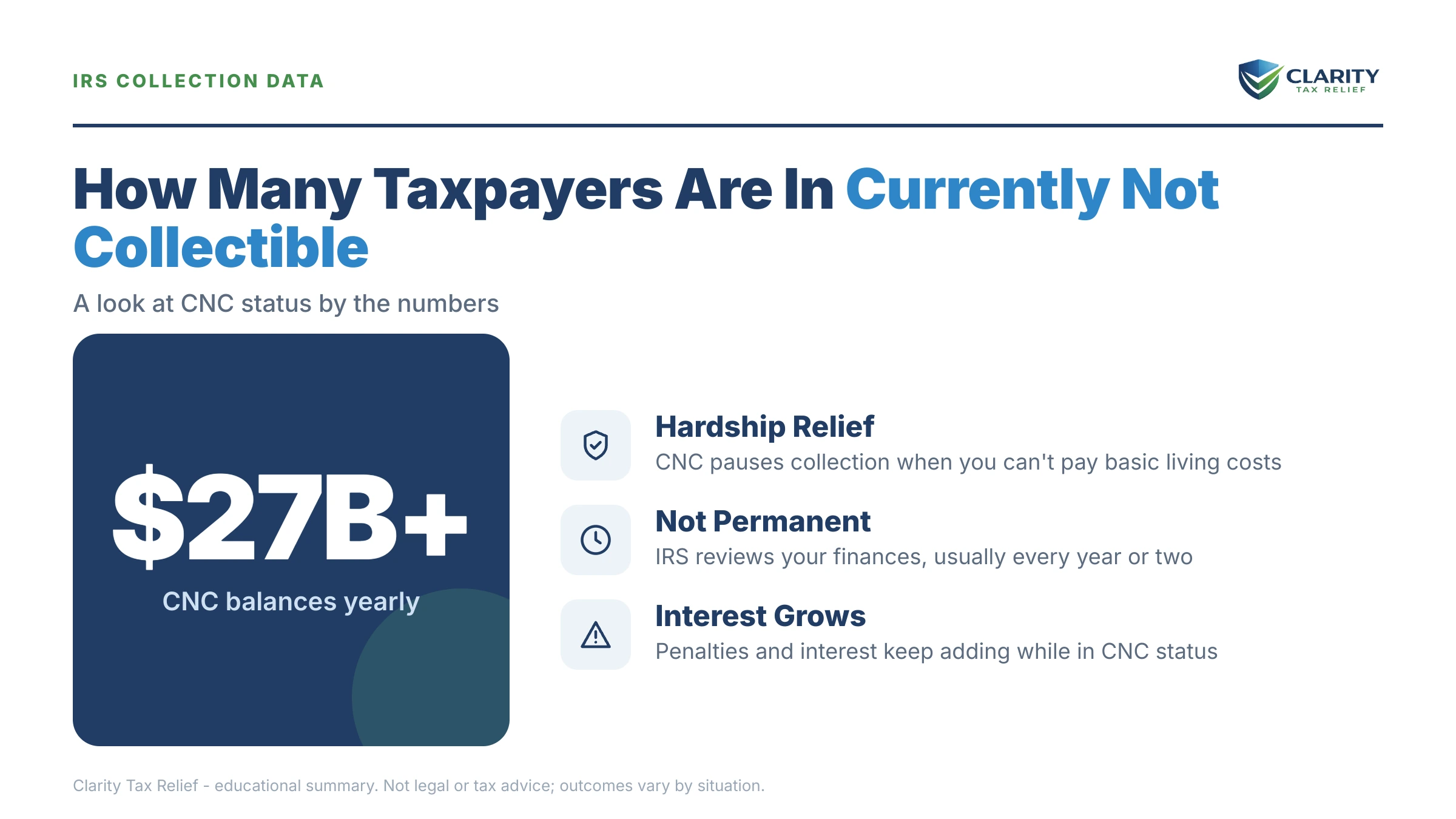
No IRS publication reports a headcount of taxpayers in currently not collectible status — every precise "X million people in CNC" figure you see quoted elsewhere is an estimate. What the official sources do report, consistently, is scale: a collection inventory above 10 million delinquent accounts, and hardship shelvings that run in the hundreds of thousands of accounts each year.
Here is what each source actually says, with the caveats attached:
| What it measures | Latest reported picture | Source |
|---|---|---|
| IRS delinquent-account inventory (all unpaid balances in collection) | More than 10 million taxpayer delinquent accounts at fiscal year-end, counted as "modules" — one unpaid tax year each | IRS Data Book, Table 25 (recent editions) |
| Accounts shelved as CNC for economic hardship | Hundreds of thousands of accounts per year, across recent fiscal years | TIGTA audits of CNC determinations; National Taxpayer Advocate reports |
| All CNC closures combined (hardship, can't-locate, defunct business, deceased, expired statute) | Well above the hardship count alone — hardship is only one of the closing codes the IRS uses | IRS Internal Revenue Manual closing-code structure |
| Offer in Compromise acceptances (the "settlement" alternative) | Roughly 1 in 5 offers accepted, FY2024 | IRS |
| IRS collection workforce | Cut roughly 27% in 2025; automated collection systems unaffected | Federal workforce reporting |
Stack those rows and the shape of the answer emerges. Annual hardship shelvings number in the hundreds of thousands. Accounts typically stay in CNC for years, often until income recovers or the 10-year collection statute runs out. So the standing population of taxpayers sitting in CNC at any moment is far larger than any one year's placements: plausibly millions, even though no agency prints that exact line.
Where these numbers come from, and why there's no official count
CNC is a status flag, not a program with an enrollment roster — which is exactly why no clean count exists. When the IRS decides an account can't be collected, it posts transaction code 530 plus a two-digit closing code to the account. Nothing "enrolls"; the account is simply shelved. Our guide to code 530 currently not collectible shows what that looks like on a transcript.
Three sourcing quirks matter when you read CNC figures anywhere:
- The Data Book counts modules, not people. One taxpayer with three unpaid years is three "taxpayer delinquent accounts" in Table 25. Any page converting modules straight into "taxpayers" is overstating.
- CNC appears as a disposition, not a population. The Data Book reports what happened to accounts during the year. It doesn't publish a running total of accounts currently sitting in CNC.
- TIGTA and the Taxpayer Advocate sample and analyze — TIGTA audits whether CNC determinations were made correctly; the Advocate studies hardship outcomes. Both confirm the magnitude; neither publishes an annual headcount.
Our rule on this page: name the source, round with "about," and where no reliable figure exists, say so — instead of inventing precision the government never published.
What the data says about IRS hardship relief
Shelved accounts versus settled accounts in the data
The single most important finding in the CNC data is this: the IRS shelves far more accounts than it settles. Hardship shelvings run in the hundreds of thousands of accounts per year, while the Offer in Compromise — the option most heavily advertised to struggling taxpayers — produced acceptances for roughly 1 in 5 of a much smaller pool of applicants in FY2024.
Four more conclusions fall out of the official numbers:
- CNC is rules-based, not a favor. The Internal Revenue Manual directs employees to code an account uncollectible when income is at or below the IRS allowable living expenses standards. It's a math test, not a negotiation.
- A meaningful share of CNC debt is never collected. Taxpayer Advocate analyses have long noted that hardship-CNC debt frequently rides out the 10-year collection statute and expires unpaid.
- Hardship CNC changes your legal posture. Debt in hardship-CNC is excluded from passport certification — which otherwise kicks in at $66,000 of seriously delinquent debt in 2026.
- The 2025–26 staffing cuts cut people, not machines. The workforce fell roughly 27% in 2025 — see our IRS workforce statistics — but the notice stream, refund offsets, and systemic levies are automated. Getting hardship status coded is how a human decision overrides the machine.
For context on how big the overall unpaid-tax pool is that CNC accounts sit inside, our IRS back tax debt statistics study covers the full inventory in hundreds of billions of dollars.
Why the IRS shelves accounts as not collectible
Economic hardship is only one of the reasons the IRS codes an account uncollectible — which is why "CNC statistics" always exceed hardship statistics. The main closing categories:
- Economic hardship — collection would leave the taxpayer unable to pay basic living expenses. This is the category individuals apply for. The account carries an income threshold: if a later return reports income above it, collection can restart. See CNC removed back to collections for how that reversal works.
- Unable to locate or contact — the IRS can't find the taxpayer or any levy source.
- Defunct business — a corporation or LLC with no remaining assets.
- Deceased taxpayer — no collectible estate.
- Expired statute — the CSED passed and the balance is closed out.
Every one of these posts as transaction code 530 on the account transcript. For the reader this matters practically: when you request hardship status, you're asking the IRS to apply a designation it already applies at industrial scale — hundreds of thousands of times a year — not pleading for an exception.
What happens if you can't pay and do nothing
Doing nothing does not put you in CNC — it puts you on the automated escalation track. CNC is a coded decision on your account; silence gets you the default sequence instead:
- CP14 — the first bill. You typically have about 21 days from the notice date before the sequence moves on.
- CP501 / CP503 — automated reminders while penalties and interest compound monthly.
- CP504 — notice of intent to levy your state tax refund under IRC §6331(d).
- LT11 / Letter 1058 — the final notice of intent to levy. It starts a 30-day clock and your Collection Due Process rights (requested on Form 12153).
- Levy — after the 30 days: bank levies (a 21-day hold before funds leave), wage levies that continue paycheck after paycheck until released, and up to 15% of Social Security through the Federal Payment Levy Program.
Here's the part the statistics add: none of those steps requires a human to review your hardship. Our IRS levy statistics study shows how heavily the IRS leans on automated levies. A qualifying taxpayer who never asks for CNC can be levied by a computer for a debt a human would have shelved — the designation only protects you once it's on the account.
Out of work and worried a levy is next?
The data says hardship shelving is routine, but only for accounts where it's actually coded. Get a free, confidential review of your income, expenses, and balances with an experienced tax professional and find out whether your numbers support currently-not-collectible status before the automated sequence reaches your paycheck or bank account.
CNC vs. installment agreement vs. Offer in Compromise: your real options
CNC is one of three main paths when you can't pay in full, and the data favors different paths for different budgets. The comparison below shows what each one pauses, requires, and costs — the deeper head-to-heads live in installment agreement vs CNC and CNC vs offer in compromise.
| Feature | Currently not collectible | Installment agreement | Offer in Compromise |
|---|---|---|---|
| What it does | Pauses collection while hardship lasts | Pays the debt monthly over time | Settles for less than owed, if accepted |
| Upfront cost | $0 | $0 for short-term (180-day) plans; a setup fee for most monthly plans | $205 fee plus 20% down on lump-sum offers (both waived with low-income certification) |
| Financial disclosure | Income/expense figures, often via Form 433-F or a phone interview | Often none for streamlined plans ≤ $50,000 | Full disclosure on Form 433-A (OIC) |
| Monthly payment | $0 | Balance spread over up to 72 months (≤ $50,000 online) | Lump sum or short-term payment schedule |
| Interest & penalties | Keep accruing | Keep accruing until paid off | End once an accepted offer is paid |
| Levies | Stop; existing levies generally released | Stop while the plan stays current | Stop while the offer is pending |
| 10-year collection clock (CSED) | Keeps running in your favor | Keeps running | Paused while the offer is under review |
| Ends the debt? | Only if the statute expires first | Yes, when fully paid | Yes, if accepted — roughly 1 in 5 offers were in FY2024 |
Note the CSED asymmetry in that table — it's the most overlooked strategic fact in the data. CNC lets the 10-year clock keep running while you pay nothing; an Offer in Compromise stops it while under review. For a taxpayer whose debt is already several years old, that difference can decide which path costs less over a lifetime.
What CNC pauses, and what keeps running
CNC stops enforcement, not accrual — the two lists below are what the status actually changes. This is the reference data most "hardship program" pages skip:
| Stops while you're in CNC | Keeps going while you're in CNC |
|---|---|
| Wage garnishments and bank levies (existing levies generally released) | Interest, compounding daily on the full balance |
| New enforced collection by the automated collection system | The failure-to-pay penalty — 0.5% per month until it caps at 25% |
| Federal Payment Levy Program deductions, including the 15% Social Security levy | Refund offsets — the IRS keeps any refund you're owed and applies it to the debt |
| Passport certification — hardship-CNC debt is excluded from the $66,000 seriously-delinquent threshold | The 10-year collection statute — the CSED clock runs in your favor |
| Collection calls and demand letters, except one annual reminder | An annual CP71 notice restating the balance, and possible filing of a Notice of Federal Tax Lien |
That last right-hand row deserves emphasis: the lien question and the expiration question are where CNC taxpayers get surprised. The IRS can file a lien even while collection is paused — a claim on property, not a seizure. And because the statute keeps running, long CNC stretches genuinely can end with the debt expiring. You can estimate when each of your tax years drops off with our CSED Calculator, and how long does CNC last covers the review cycle that decides whether you stay in.
Say you owe $28,000 and you're out of work: the math
A hypothetical laid-off household budget, step by step
Here's a clearly hypothetical example built on the numbers above. Say you owe $28,000 across two tax years, you were laid off in March, and you're supporting two kids on $2,600 a month in unemployment while you job hunt — watching the mailbox and worried a levy will hit the checking account your rent comes out of.
The hardship math. Suppose your allowable expenses under the IRS standards — rent and utilities, the food/clothing standard for a household of three, transportation, health care — total about $4,100 a month. Income of $2,600 minus $4,100 leaves −$1,500 a month. Under the IRS's own formula, your ability to pay is $0. That negative number is a CNC case, not a payment-plan case.
Versus a payment plan. A 72-month installment agreement on $28,000 runs roughly $389 a month before interest ($28,000 ÷ 72), realistically $430–$470 once accrual is folded in. That money does not exist in this budget. Agreeing to it anyway just sets up a default a few months later.
What CNC costs. The meter doesn't stop. The failure-to-pay penalty alone starts at about $140 a month (0.5% of $28,000), plus daily-compounding interest — call it a few thousand dollars a year added to the balance. In exchange: no levy, no garnishment, $0 due monthly, and the collection statute ticking down. If these balances were assessed in 2024 and 2025, they expire around 2034–2035; every year in CNC is a year off those clocks.
What ends it. Land a $70,000 job in 2027 and your next return will likely trip the income threshold coded on the account, sending it back to active collections — at which point an installment agreement on your new budget, or an Offer in Compromise if the numbers support one, becomes the move. One more real cost while you wait: any refund you'd otherwise get, including refundable credits, is kept and applied to the debt. Our guide to what to do when you've lost your job and can't pay the IRS walks this exact scenario end to end.
How to request currently not collectible status, step by step
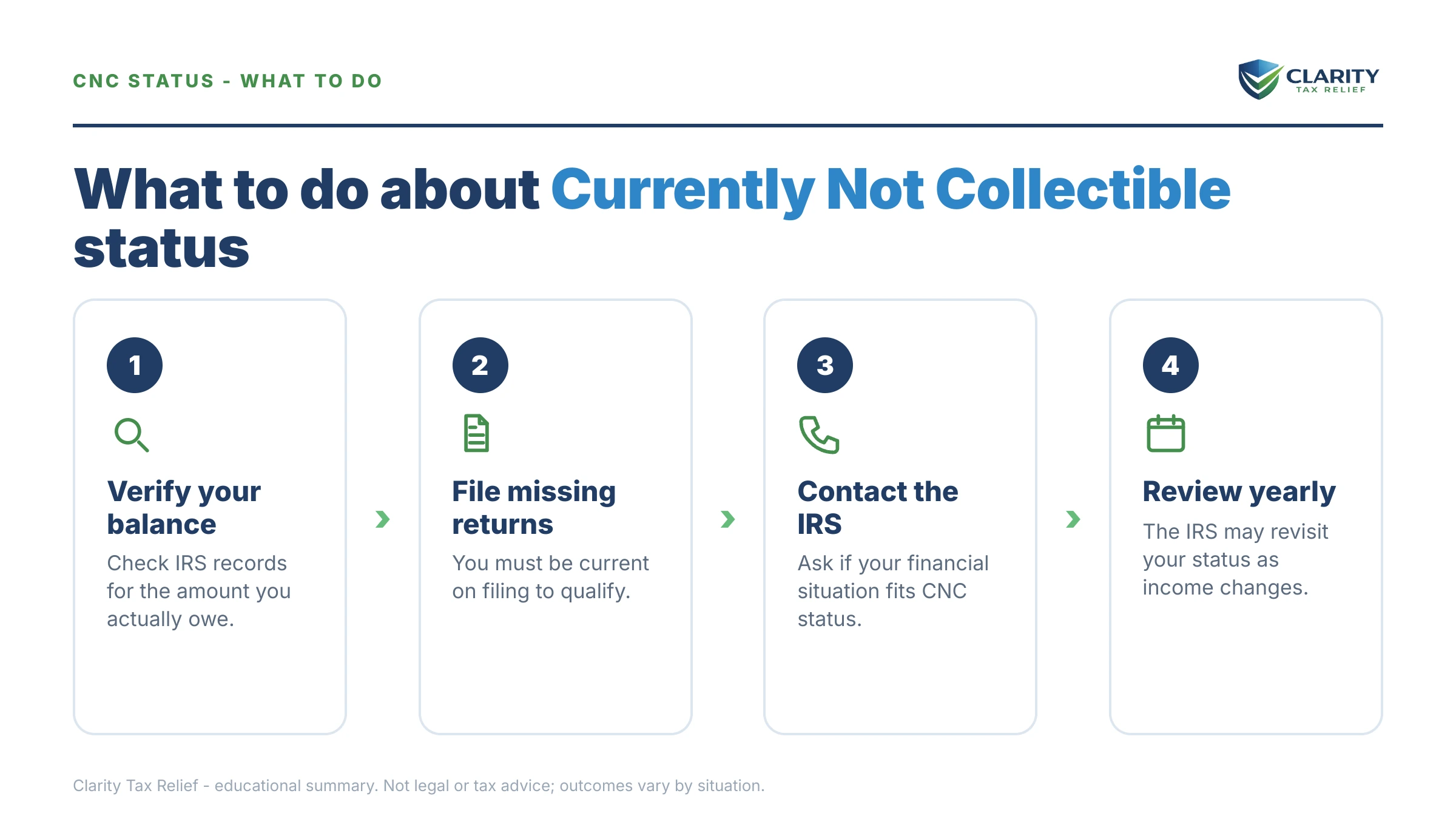
- Pull your IRS account transcript. Confirm what you owe, when each year was assessed, and whether transaction code 530 already appears on any year.
- Run the hardship math. Compare your monthly income against the IRS allowable living expense standards for your county and family size — hardship means income at or below those standards.
- Gather your proof. Unemployment statements or pay stubs, rent or mortgage, utilities, medical costs, and your most recent filed return.
- Call the IRS and request currently not collectible status. Use the number on your latest notice and have your Form 433-F figures ready before you dial — the agent will walk through them line by line.
- Verify and calendar. Check that code 530 posts to your transcript, keep filing every future return on time, and note the collection statute expiration date for each year you owe.
When you can handle this yourself, and when help changes the outcome
Plenty of CNC requests are genuinely do-it-yourself. If you owe one or two years of W-2 or unemployment income, your budget clearly fails the IRS standards. Your records are simple, you can call the number on your latest notice with completed Form 433-F figures and often get coded CNC in a single (long) phone call — at zero cost. With 2026 hold times what they are, patience is the main fee.
Experienced help changes outcomes in specific situations, not all of them:
- A levy is already in motion — a garnishment or bank levy needs a release negotiated now, not just future protection.
- You're self-employed — business income and expense analysis makes the hardship math genuinely contestable, and the IRS often pushes back.
- You have unfiled years — the IRS typically wants filing compliance before granting relief. The order you fix things in changes what you owe.
- The balance is large or climbing toward $66,000 — passport exposure and lien strategy enter the picture.
- CNC vs. settlement is a real question — deciding between riding out the statute and making an offer requires running both sets of numbers correctly.
If you're weighing hardship status against a settlement on a $28,000-plus balance, a free case review with an experienced tax professional can run both calculations before you commit to either — start with the 2-minute form or call (888) 825-7779.
Terms in the data, decoded
- CNC / status 53: the IRS's internal designation for an account it has stopped actively collecting; "53" comes from the transaction code.
- Transaction code 530: the transcript entry showing your account was placed in CNC, always paired with a closing code giving the reason.
- Closing code: the two-digit reason attached to TC 530 — hardship codes carry the income threshold that can pull you back into collections.
- CSED: Collection Statute Expiration Date — the day, 10 years after assessment (plus any pauses), when the IRS can no longer collect a tax year.
- ALE standards: the IRS's published allowable living expense tables for food, housing, transportation, and health care — the yardstick for hardship.
- TDA (taxpayer delinquent account): the Data Book's counting unit — one unpaid tax year, so one taxpayer can be several TDAs.
Currently not collectible statistics: your questions answered
How many taxpayers are in currently not collectible status?
There is no single official count, but the numbers are large. The IRS's delinquent-account inventory has exceeded 10 million accounts in recent Data Books, and hardship shelvings alone have run in the hundreds of thousands of accounts per year in TIGTA and Taxpayer Advocate analyses. Because accounts stay in CNC for years at a time, the standing total is plausibly in the millions.
Does currently not collectible mean the IRS forgave my debt?
No. CNC pauses active collection; it does not erase the balance. Interest and the late-payment penalty keep accruing, and the IRS keeps any refunds you're owed. The debt only goes away if you pay it, settle it, or the 10-year collection statute expires. That clock does keep running while you sit in CNC.
How hard is it to qualify for CNC status?
Far easier than settling. You generally qualify when your monthly income is at or below your allowable living expenses under the IRS's published standards — meaning any payment would create hardship. Compare that with the Offer in Compromise, where the IRS accepted roughly 1 in 5 offers in FY2024. CNC is a math test, not a negotiation, but you must document your income and expenses.
How long does currently not collectible status last?
As long as your financial hardship does. There is no fixed term: the IRS reviews your later tax returns, and if reported income rises above the threshold coded on your account, collection can restart. Some taxpayers stay in CNC for years and ride out the collection statute; others are pulled back after one good year of income.
Does interest still accrue in currently not collectible status?
Yes. Interest compounds daily at the federal underpayment rate, and the 0.5%-per-month failure-to-pay penalty continues until it hits its 25% cap. On a five-figure balance that can add thousands of dollars a year. CNC buys protection from levies, not a pause on the meter — which is why it fits best when the debt may outlive the 10-year statute.
Can the IRS levy my wages or bank account while I'm in CNC?
No — active enforced collection stops while the hardship designation is in place, and existing wage levies and Federal Payment Levy Program deductions are generally released when the account is coded CNC. What continues: refund offsets, meaning the IRS keeps any refund you're owed, and in many cases a federal tax lien filing, which is a claim on property rather than a seizure.
Does CNC status stop the IRS from filing a tax lien?
No. The IRS can, and above $10,000 often does — file a Notice of Federal Tax Lien even while your account sits in CNC. A lien doesn't take anything; it's a public claim that attaches to property you own and can complicate selling or refinancing a home. Levies stop in CNC; liens don't.
Will my tax debt expire while I'm in currently not collectible status?
It can. The 10-year collection statute keeps running during CNC, so debt that stays uncollectible long enough expires at the CSED. Taxpayer Advocate analyses have noted that a substantial share of hardship-CNC debt is never collected. Watch for actions that pause the clock — a pending Offer in Compromise, bankruptcy, or certain appeals extend the deadline.
Is CNC better than an installment agreement?
It depends on what your budget actually shows. If IRS-standard expenses leave you nothing each month, CNC is the honest answer and costs $0 per month. If you can genuinely afford a payment, an installment agreement resolves the debt and avoids years of accrual. Some taxpayers whose hardship is long-term are better served by an Offer in Compromise, which ends the debt entirely if accepted.
Your next 24 hours
- Pull your numbers. Log into your IRS online account or your latest notice and write down the total balance, the tax years involved. The assessment date for each. Those dates set your 10-year clocks.
- Gather your hardship proof. Your most recent unemployment statement or final pay stub, rent or mortgage amount, utility bills. Your last filed return — everything the hardship math runs on.
- Get the math checked free. The data on this page says shelving is routine when the numbers support it, but only for accounts where it's coded. Send your figures through the 2-minute form or call (888) 825-7779, and remember interest and penalties accrue every month the account sits unresolved.
Sources: figures on this page are drawn from the IRS Data Book (delinquent collection activity, Table 25), audit reports from the Treasury Inspector General for Tax Administration, annual reports from the National Taxpayer Advocate, and IRS payment-option guidance at IRS.gov/payments.
This guide is general information, not tax or legal advice for your specific situation. Eligibility for IRS programs depends on individual facts and circumstances; no outcome is guaranteed.