
IRS Data & Studies
IRS ERC Claims Disallowed Statistics: 84,000 Denied Claims by the Numbers (2026)
What this episode covers
- Is an IRS ERC disallowance letter an accusation of fraud?
- What is the difference between IRS Letter 105-C and Letter 106-C?
- What happens if the response deadline on an ERC disallowance letter passes?
- Can the IRS levy Social Security benefits over a recaptured ERC refund?
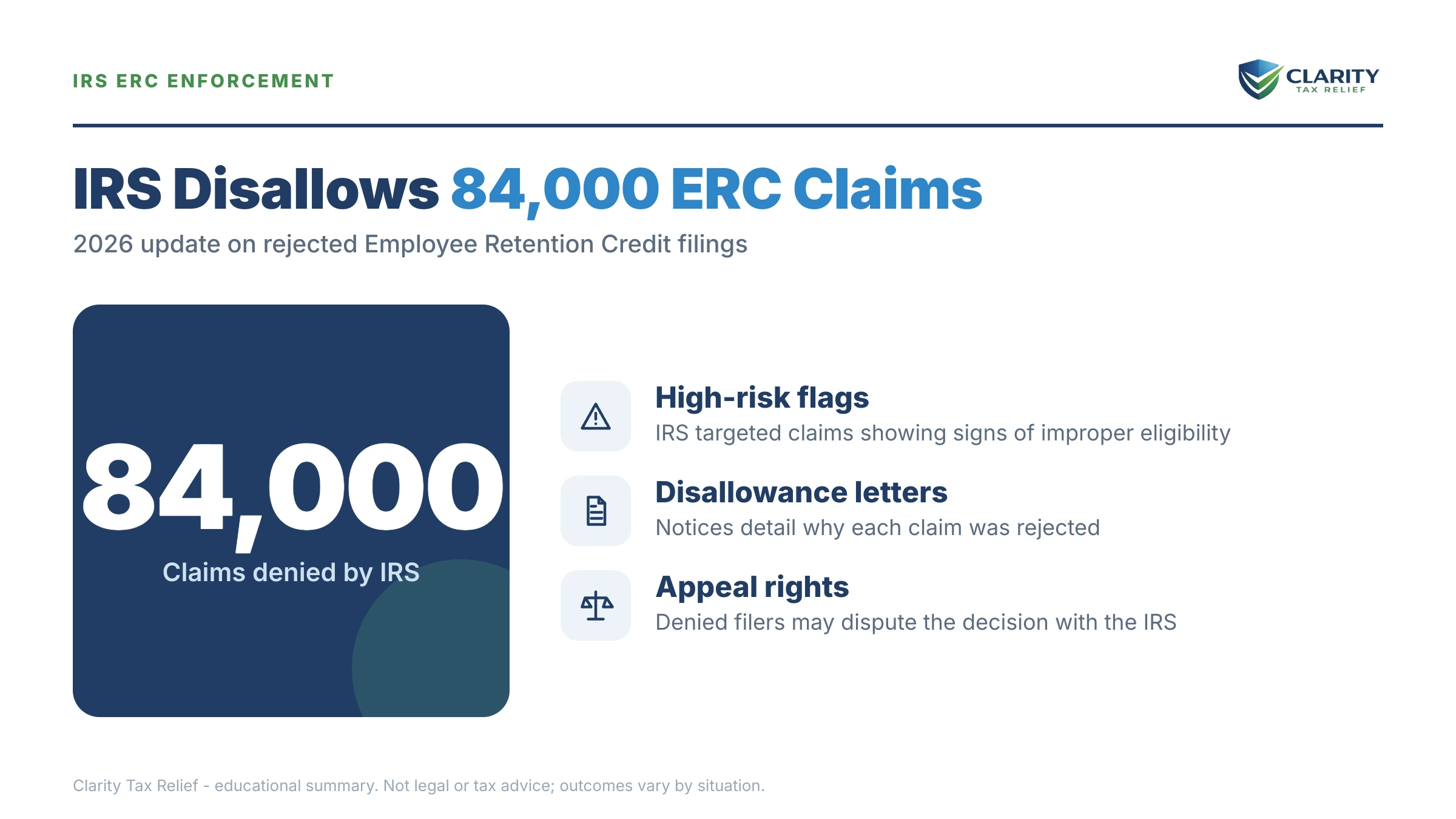
The short answer: The IRS has moved to deny all or part of roughly 84,000 Employee Retention Credit claims, and disallowed about 21,000 claims from businesses that did not even exist. Another approximately 28,000 disallowance notices went out in summer 2024 based on risk filters alone, before any examination of records.
The IRS ERC claims disallowed statistics on this page are the verified numbers behind those headlines — every figure sourced to the National Taxpayer Advocate or sworn Commissioner testimony. Maybe a marketer talked your now-closed business into an ERC claim, and a denial letter just landed next to your Social Security check. Take a breath: a disallowance is a civil determination with a built-in appeal path. The data below shows exactly how the IRS got here, and what people in your position do next.
If a denial letter is what brought you here, the image below shows exactly what ERC disallowance paperwork looks like and where to look for the details that control your response. First, the numbers.
⏱ The clock that matters: this study has no single deadline, but if your own claim was denied, the response deadline printed on your Letter 105-C or 106-C controls your appeal rights, and interest keeps accruing on any recaptured credit until it is repaid.

IRS ERC claims disallowed statistics: the five numbers that matter
The IRS has moved to deny all or part of roughly 84,000 Employee Retention Credit claims, and disallowed about 21,000 claims from businesses that did not even exist.
The largest figure comes from the National Taxpayer Advocate. In a May 2025 blog post marking the close of the ERC claim window, the NTA reported the IRS had acted on "approximately 84,000 returns claiming the ERC, partially or fully disallowing the claims." That count blends full denials, partial denials, and claims flagged after refunds were already paid.
The most striking sub-figures come from then-Commissioner Danny Werfel's January 2024 briefing to the Senate Finance Committee. He testified the IRS had disallowed "around 21,000 pending claims from businesses that did not exist during the time for which the credit was being claimed or did not pay W-2 wages" — claims that fail before eligibility analysis even begins, because a payroll-based credit cannot flow to an employer with no payroll.
Werfel also identified "20,000 claims where the IRS has identified the employer received an erroneous or excessive credit" — money already out the door that the IRS intends to get back — and announced "more than 3,000 new compliance-related letters to companies with both processed and unprocessed claims."
Then came the biggest single wave: in summer 2024, the IRS issued approximately 28,000 ERC disallowance notices to businesses whose claims showed a high risk of being incorrect. Those denials were generated by risk-filter analyses — data screens run against every claim in inventory — rather than prior examination. That detail matters enormously if you received one: nobody looked at your records before denying your claim, which is exactly why the appeal path exists.
| Figure | What it counts | Source & date |
|---|---|---|
| Approximately 84,000 | Returns claiming the ERC that the IRS partially or fully disallowed | National Taxpayer Advocate, May 2025 |
| Around 21,000 | Pending claims from businesses that did not exist during the credit period or paid no W-2 wages | Commissioner Werfel, Senate Finance briefing, January 2024 |
| 20,000 | Claims where the employer received an erroneous or excessive credit the IRS intends to recover | Commissioner Werfel, Senate Finance briefing, January 2024 |
| Approximately 28,000 | Disallowance notices issued to high-risk claims based on risk-filter analyses, without prior examination | IRS / Werfel, August 2024 |
| More than 3,000 | New compliance-related letters to companies with both processed and unprocessed claims | Commissioner Werfel, Senate Finance briefing, January 2024 |
Disallowance is only one lane of the ERC enforcement push. For the size of the pile still waiting on decisions, see our ERC claims backlog and IRS inventory statistics. For clawbacks of refunds already paid, see the IRS ERC recapture letters statistics. And for the promoter prosecutions running on a separate track, see the IRS ERC fraud criminal investigation statistics.
Why the IRS denied these claims, and possibly yours
Most ERC disallowances trace back to aggressive third-party promoters who filed claims for businesses that never met the credit's two eligibility tests. The ERC was real relief for 2020 and 2021 payrolls, but only for employers with a significant decline in gross receipts or operations fully or partially suspended by a government order. It was claimed by amending payroll returns on Form 941-X, which is why the whole fight runs through the payroll side of the IRS.
The ERC mill business model — radio ads, contingency fees, "everyone qualifies" pitches — pushed claims from businesses that were never eligible, and in the 21,000 most extreme cases, from businesses that didn't exist or never paid a W-2 wage during the credit period. That flood is why the IRS froze new-claim processing in September 2023 and began sorting its entire inventory into risk bands.
The summer 2024 batch of approximately 28,000 notices came from the highest-risk band. Because those denials were driven by data screens rather than audits, they cut both ways: they caught genuinely bad claims at scale. They inevitably swept in some eligible businesses whose data merely looked suspicious. A denial letter is the IRS's opening position, not the final word.
What happens if you ignore an ERC disallowance
An uncontested ERC disallowance becomes final, and a recaptured credit becomes ordinary tax debt that moves through the standard IRS collection sequence. Here is the order of events, whichever side of the refund line you're on:
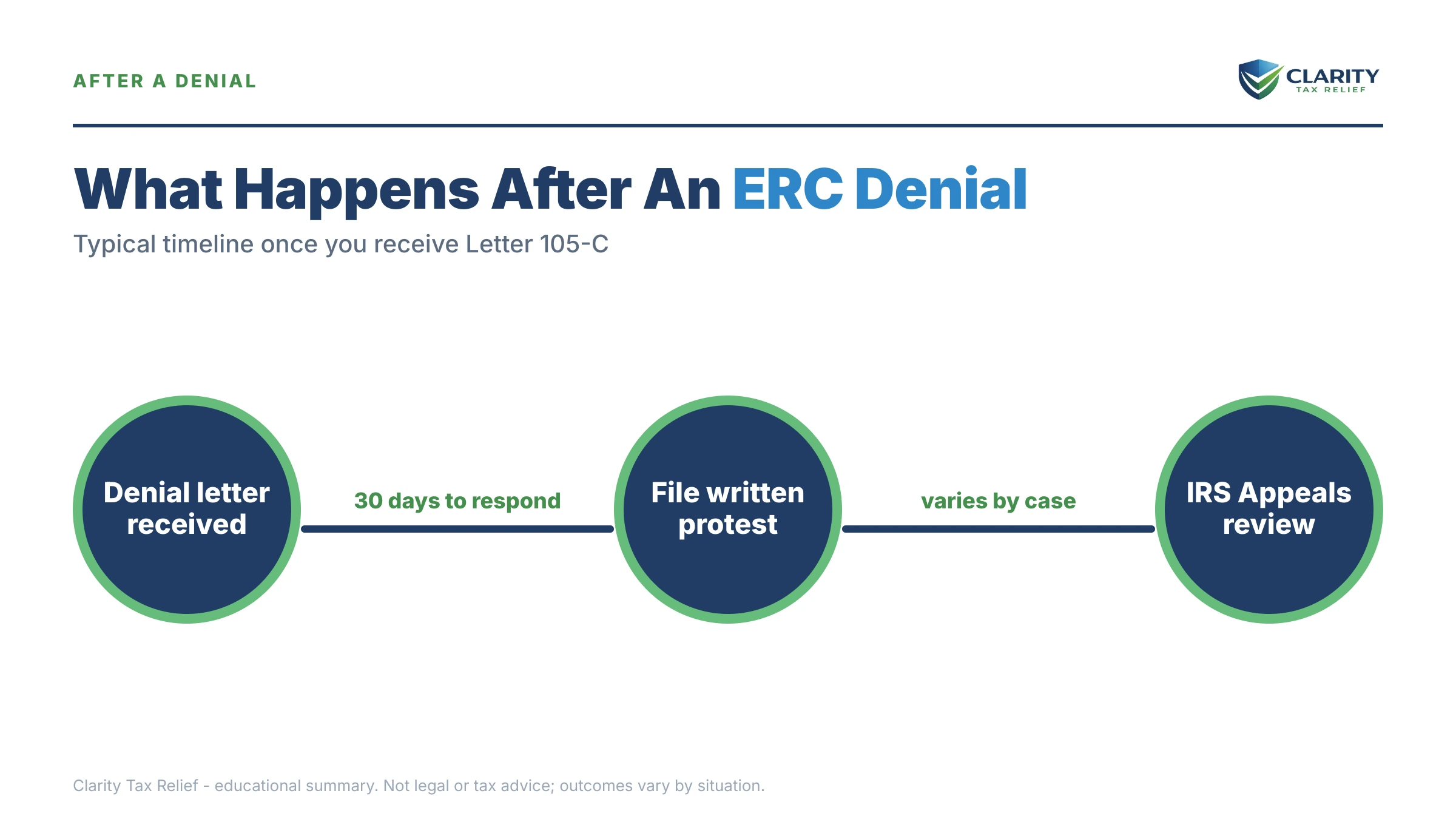
- The disallowance letter arrives — Letter 105-C (full denial) or Letter 106-C (partial). If your refund was never paid, nothing is being collected; the letter simply withholds the money and opens your appeal window.
- The response deadline on the letter passes. Your administrative appeal path closes. Contesting the denial after that generally means suing for the refund in federal court: slower, costlier, and harder without representation.
- Recapture, if you were already paid — for claims the IRS identifies as erroneous or excessive, it assesses the credit back as a balance due, with interest running from the refund date and penalties on the table.
- Balance-due notices begin — a first bill, then escalating reminders, each adding interest and a monthly late-payment penalty.
- Intent-to-levy notices — a CP504-class notice lets the IRS take your state tax refund. The final notice (LT11 or Letter 1058) starts a 30-day clock, after which the IRS can levy bank accounts and income. For a retired owner, that includes up to 15% of your Social Security through the Federal Payment Levy Program.
One 2026 reality check: the IRS workforce shrank roughly 27% in 2025, so reaching a human about your ERC file is harder than ever. But the disallowance, recapture, and levy notices are generated by automated systems that never slowed down. Silence on your end doesn't buy time; it buys interest.
Holding an ERC disallowance letter?
The deadline printed on your Letter 105-C or 106-C controls your appeal rights — don't let it pass unread. An experienced tax professional will review your denial free, tell you whether your claim is defensible, and map the exit if it isn't.
Your options after an ERC claim is disallowed
A disallowed ERC claim leaves you with three main paths: appeal the denial, accept it, or, if the money was already paid out, resolve the recapture balance. Which one fits depends on two questions: did you actually qualify, and did you already receive the refund?
| Your situation | What you're looking at | Your best move |
|---|---|---|
| Claim fully denied, refund never paid | Letter 105-C | Appeal in writing by the deadline on the letter if you can document eligibility; let it stand if you can't — nothing to repay |
| Claim partly denied | Letter 106-C | Contest only the disallowed quarters; the allowed portion is unaffected |
| Refund paid, IRS says it was erroneous | Recapture letter, then balance-due notices | Verify the math, restore any wage deductions you gave up, then pay or arrange a payment plan |
| Refund paid, and you now know the claim was bad | No IRS contact yet | Repay proactively before a recapture letter arrives; document that a promoter prepared the claim |
| Recaptured balance you can't pay | Escalating collection notices | Installment agreement, hardship status, or other resolution before levy notices start |
If you're appealing: the strongest ERC appeals are built quarter by quarter — gross-receipts comparisons against 2019, or the specific government order that suspended your operations, matched to the exact quarters claimed. Our guide to the ERC disallowance appeal walks through the written protest itself.
If you're repaying: the IRS's formal ERC voluntary disclosure program windows have closed, but proactive repayment still puts you in a materially better position than waiting for recapture. It stops interest from compounding and demonstrates good faith. If you can't repay in full, see can't repay ERC for the realistic paths.
If it becomes ordinary tax debt: an assessed ERC recapture behaves like any other federal balance — payment plans, hardship status, and settlement all follow the same rules, covered in our hub on how to settle tax debt yourself.
A worked example: recapture math for a retired owner
Say you're 68, retired on Social Security. The shop you closed in 2022 received a $60,000 ERC refund in 2023 from a claim a promoter filed for a contingency fee. In 2026 the IRS determines the claim was erroneous and recaptures it.
The math: $60,000 in principal, plus potentially a penalty of up to 20% (about $12,000 in this example) - whether and which penalty applies to ERC recapture depends on the facts and is an area professionals actively contest — $72,000 before interest, with interest running back to the refund date. And here's the part that stings: if the promoter kept a 20% fee ($12,000), you only ever received $48,000. But the IRS recaptures the full $60,000. You can estimate the penalty-and-interest side of a balance like this with our IRS penalty and interest calculator.
One real offset: if you reduced your business's wage deduction when the credit was claimed, the rules required it, you can generally amend the income tax return to restore that deduction once the credit is disallowed, recovering part of the hit. This is hypothetical math, not a prediction for your case, but the structure is what every recaptured claim faces.
How to respond to an ERC disallowance, step by step
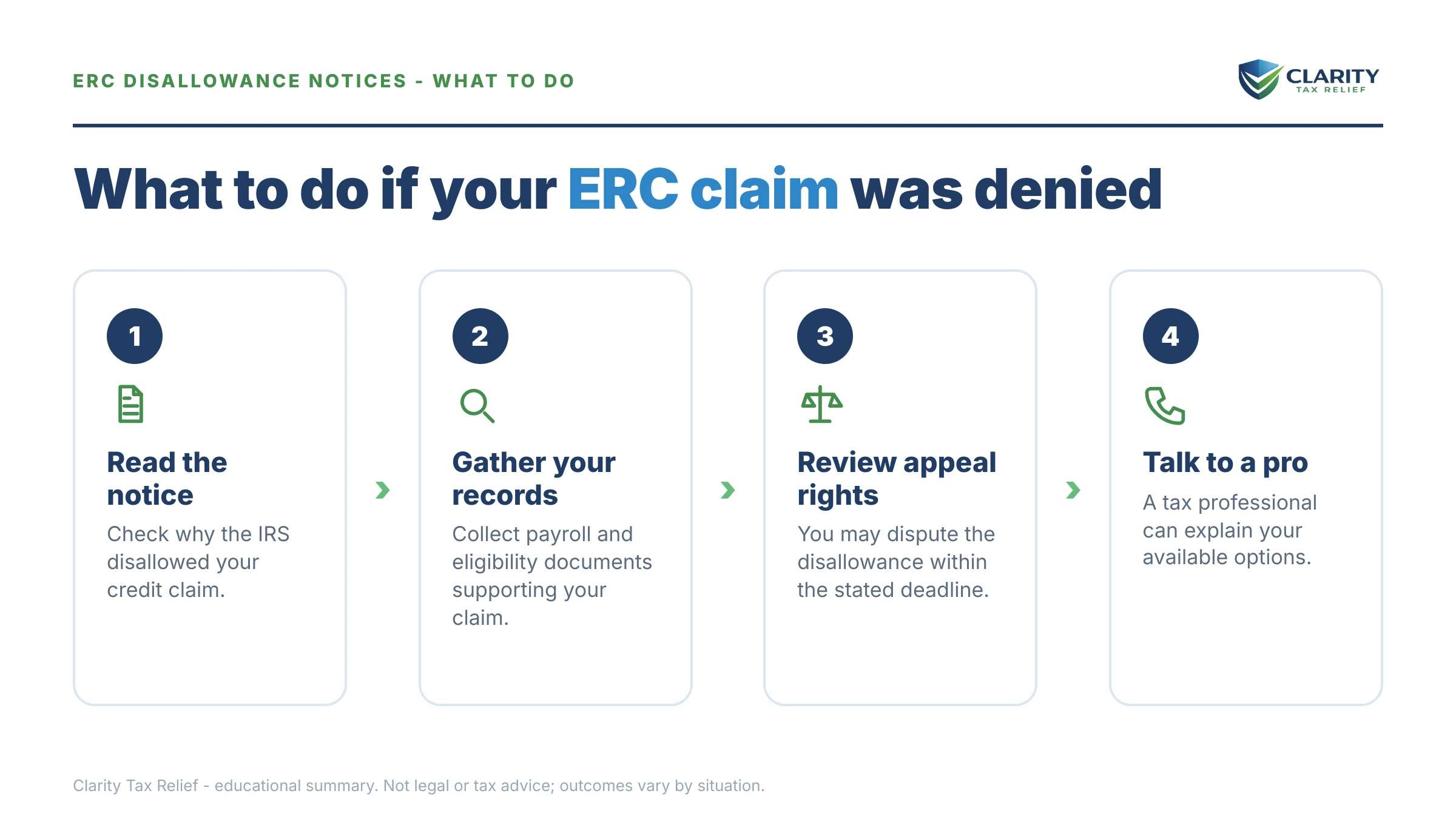
- Read your letter first. Confirm whether you received Letter 105-C (full disallowance) or Letter 106-C (partial disallowance), note the stated reason for the denial, and circle the response deadline printed on the letter. That date controls your appeal rights.
- Pull your eligibility proof. Gather quarterly gross-receipts figures for 2019 through 2021, payroll records showing W-2 wages. The specific government order, if any, that fully or partially suspended your operations.
- Match your proof to the stated denial reason. If the IRS says the business did not exist or paid no W-2 wages and that is wrong, your payroll records alone may resolve it. If the denial questions eligibility, build the case quarter by quarter.
- File a written appeal before the deadline. Send a written protest to the address on your letter explaining why the claim qualifies, with documents attached. Keep copies of everything and use tracked mail.
- Get ahead of recapture if you were already paid. If you received a refund you now know was erroneous, repaying proactively, before a recapture letter arrives, stops interest from compounding and puts you in a stronger posture.
- Get a professional review for large or paid claims. If real dollars were paid out, multiple quarters are involved, or a promoter filed the claim, have an experienced tax professional review the file before you respond.
When you can handle this yourself
Not every disallowance needs professional help, and some need none at all. You can likely handle it yourself if the refund was never paid and you agree the claim was bad: letting a Letter 105-C stand on an unpaid, promoter-filed claim costs you nothing and requires no response. You can also self-manage a straightforward appeal where you clearly pass the gross-receipts test and the numbers are on paper.
Experienced help tends to change the outcome when real money has already been paid out: recapture of a five- or six-figure refund, appeals that hinge on the murkier government-order suspension argument, promoter-filed claims where penalty exposure is in play, multiple quarters or entities, or a fixed-income household where collection would hit Social Security. In those cases, how the file is presented, and in what order the deduction, penalty, and balance pieces are fixed — moves the final number. For a walkthrough of the response itself, see ERC claim disallowed.
Terms on your disallowance letter, decoded
- Disallowance — the IRS's formal refusal to allow a claimed credit or refund, in whole or in part.
- Letter 105-C — the notice that your claim is fully disallowed; it states the reason and your appeal rights.
- Letter 106-C — the partial version: some quarters or amounts allowed, the rest denied.
- Recapture — the IRS taking back a credit it already paid, assessed as a balance due with interest.
- ERC mill — a promoter that mass-filed claims for contingency fees, often for ineligible businesses.
- Refund suit — the court route to contest a denial after (or instead of) the administrative appeal.
ERC disallowance statistics: your questions answered
How many ERC claims has the IRS disallowed?
The IRS has moved to deny all or part of roughly 84,000 Employee Retention Credit claims. The National Taxpayer Advocate reported in May 2025 that the IRS had acted on “approximately 84,000 returns claiming the ERC, partially or fully disallowing the claims.” That total covers both claims denied before any refund was paid and claims flagged afterward. It continues to grow as the IRS works through its remaining ERC inventory.
How many disallowed ERC claims came from businesses that didn't exist?
About 21,000. In January 2024, then-Commissioner Werfel told the Senate Finance Committee the IRS had disallowed “around 21,000 pending claims from businesses that did not exist during the time for which the credit was being claimed or did not pay W-2 wages.” These are the clearest denials in the program — a payroll-based credit cannot go to an employer with no payroll.
What letter does the IRS send when it disallows an ERC claim?
A full denial arrives as Letter 105-C; a partial denial arrives as Letter 106-C. Each states the reason for the disallowance and your appeal rights, including the response deadline printed on the letter itself. Neither letter means you were audited — the approximately 28,000 notices issued in summer 2024 were generated by risk-filter analyses, not examinations.
Can I appeal an ERC disallowance?
Yes. You can file a written protest with the IRS Independent Office of Appeals, and if that fails you generally keep the right to sue for the refund in federal court. The deadline that controls your administrative appeal is printed on your Letter 105-C or 106-C, so read it before anything else. Appeals succeed most often when you can document eligibility — a gross-receipts decline or a qualifying government order — quarter by quarter.
Do I have to pay back an ERC refund I already received?
If the IRS determines the credit was erroneous, yes. It can recapture the money with interest. Werfel identified “20,000 claims where the IRS has identified the employer received an erroneous or excessive credit,” and recapture converts those refunds into ordinary tax debt. If you cannot repay in full, standard resolution options such as an installment agreement apply, and repaying proactively generally beats waiting for the letter.
Does a disallowed ERC claim mean I'm being investigated for fraud?
No — a disallowance is a civil determination, not a criminal accusation. The summer 2024 batch of approximately 28,000 disallowance notices came from data screens, not fraud referrals, and criminal ERC cases run on a separate track that targets promoters and willfully false claims. If you filed in good faith and can document eligibility, your dispute is with Appeals, not a special agent.
What if the IRS disallowed my ERC claim by mistake?
Contest it — risk filters are blunt instruments, and because the summer 2024 notices went out without prior examination, some eligible businesses were swept in. Respond before the deadline printed on your letter with the documents the stated denial reason calls for: payroll records, gross-receipts comparisons, or the government order that suspended operations. A disallowance you never contest becomes final.
Your next 24 hours
- Find the controlling details on your letter: the letter number (105-C or 106-C), the stated reason for denial. The response deadline printed on it.
- Gather your file: the Form 941-X claims, quarterly payroll records, 2019–2021 gross-receipts figures, any government order, and every document the promoter gave you, if one filed the claim.
- Get the free case review: use the 2-minute form or call (888) 825-7779 before the deadline on your letter passes, and if a refund was already paid, before another month of interest accrues on money the IRS wants back.
Primary sources: the National Taxpayer Advocate's May 2025 analysis, The ERC Claim Period Has Closed. The IRS's official Employee Retention Credit page. And, for arranging payment on a recaptured balance, IRS payment plans.
This guide is general information, not tax or legal advice for your specific situation. Eligibility for IRS programs depends on individual facts and circumstances; no outcome is guaranteed.