
IRS Data Studies
IRS ERC Recapture Letters Statistics: 30,000 Letters, $1 Billion Clawed Back (2026)
What this episode covers
- What happens if I ignore an IRS ERC recapture letter?
- On what grounds can I dispute an IRS ERC recapture letter?
- What payment options exist for an ERC recapture balance owed to the IRS?
- Is an IRS ERC recapture letter the same as a Letter 105-C denial?
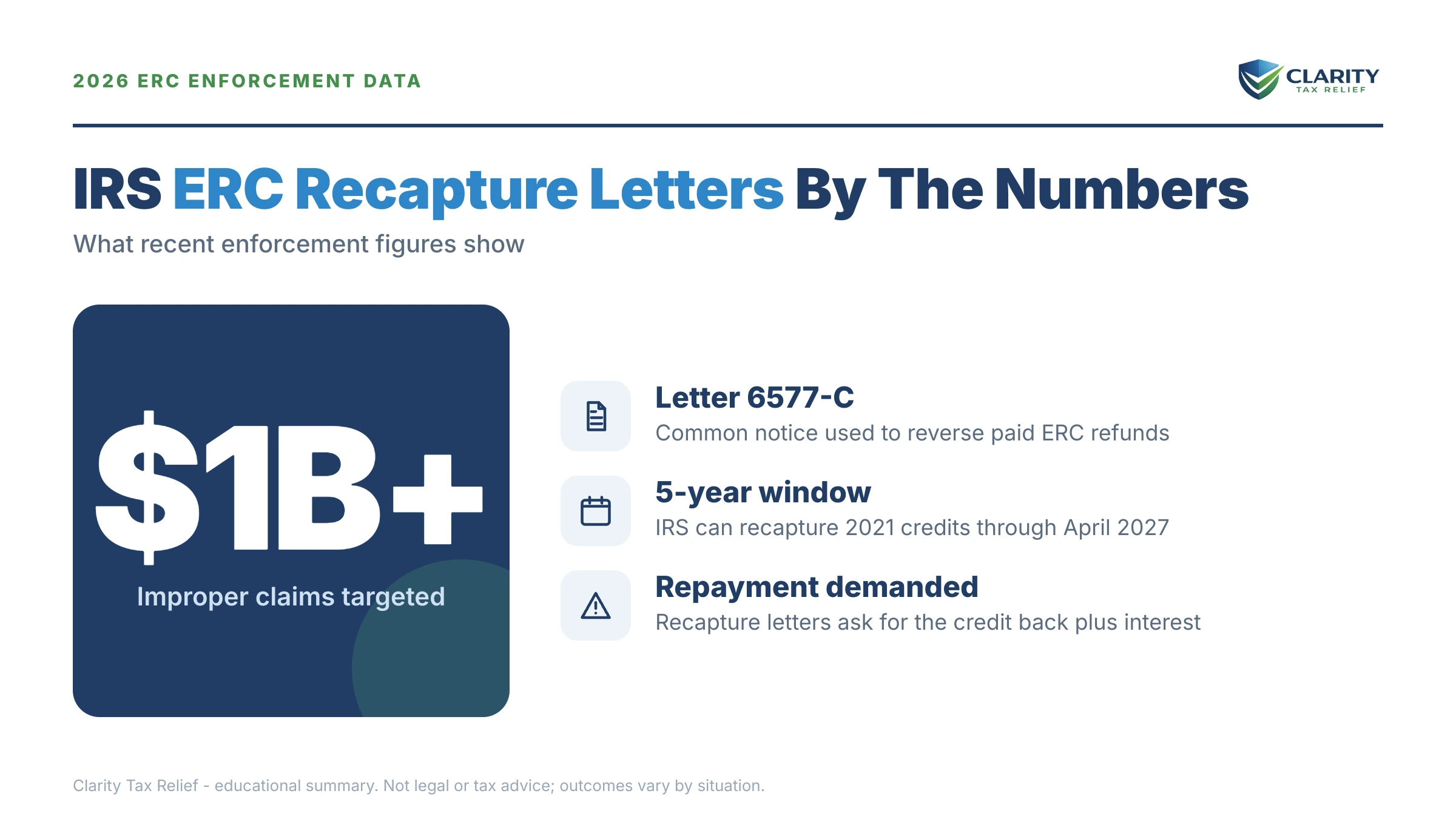
The IRS ERC recapture letters statistics: on August 15, 2024, the IRS said it would send up to 30,000 recapture letters representing more than $1 billion in claims, mostly for tax year 2021. An earlier round went to more than 12,000 entities for tax year 2020, producing $572 million in assessments.
Maybe you kept the business in the divorce. The ERC refund that arrived with it felt like the one clean win of a brutal year. Now a letter says the IRS wants that credit back, with penalties and interest possible on top. You're not alone. The numbers below show exactly how big this clawback wave is, and what the businesses caught in it can actually do.
A recapture letter is different from every other ERC letter because the money already moved. The IRS isn't denying a claim you're waiting on; it's reversing a payment that hit your account, sometimes years ago. The image below shows exactly what a recapture letter looks like and where the amount and response date sit on the page.
⏱ Your deadline: the response date printed on your recapture letter. There is no universal day count for these letters. Interest runs on a recaptured balance once it's assessed, and failure-to-pay penalties can follow, so the letter's own printed date is the only clock that matters. Find it before you read anything else.

IRS ERC recapture letters statistics: the key numbers
The IRS announced up to 30,000 ERC recapture letters covering more than $1 billion in claims on August 15, 2024, after an earlier round assessed $572 million against more than 12,000 entities. Together, the two announced rounds put the recapture campaign at more than $1.5 billion in ERC money the IRS has moved to claw back.
| Recapture round | Scope | Tax year covered | Dollar amount |
|---|---|---|---|
| First round | Letters to more than 12,000 entities | 2020 | $572 million in assessments |
| Second round (announced August 15, 2024) | Up to 30,000 letters | Mostly tax year 2021 | More than $1 billion in claims |
The rough per-letter math tells you these aren't small adjustments. The first round works out to roughly $48,000 per entity at most, on average - likely somewhat less, since more than 12,000 entities received letters ($572 million spread across 12,000-plus letters). The second round averages at least roughly $33,000 per letter ($1 billion-plus across up to 30,000 letters). Many of these letters land in the five-figure range — not an outlier.
Notice what the tax years imply. The 2020 round came first because 2020 claims were older and the IRS's window to act on them was shorter. The second round targets 2021 — the year with the largest credits per employee and the heaviest promoter activity. Recapture on 2021 claims is where the campaign's weight sits now, which is why most letters arriving today cite 2021 quarters.
These letters are one arm of a broader ERC enforcement push. The IRS has separately denied tens of thousands of unpaid claims outright — covered in our IRS ERC claims disallowed statistics study — and referred the worst cases to criminal investigation, tracked in our IRS ERC fraud criminal investigation statistics. Recapture is the arm reserved for money that already left the Treasury.
“As a reminder, anyone who incorrectly claims the credit has to pay it back and may owe penalties and interest.”
— Employee Retention Credit (IRS.gov)
What an ERC recapture letter actually does
A recapture letter reverses Employee Retention Credit money the IRS already paid, turning your past refund into a current balance due. The letter identifies the quarters involved, states the amount being reversed, and gives you a printed date to respond by if you disagree.
Two features make recapture harsher than an ordinary bill. First, the reversal can carry penalties and interest on top of the credit itself. You can owe back more than you received. Second, the assessment attaches to your employment tax account, the same account behind your Form 941 filings, so it lives in the business's collection stream, not a personal one (though entity type affects who ultimately answers for it).
Why do these letters go out? The recapture rounds have focused on claims the IRS believes were erroneous on their face — entities that didn't exist during the eligibility period, claims exceeding what the employer's reported payroll could support, and businesses that never met the government-order or gross-receipts tests. Many were prepared by promoters. If that's your situation, our guide to ERC mill claim problems covers the extra steps worth taking, including preserving everything the promoter sent you.
The 2026 backdrop: closed windows and a tightening statute
The ERC claim window for 2021 quarters closed April 15, 2025 under the three-year statute of limitations, so no new money is going out while recapture pulls old money back. Every ERC dollar in motion in 2026 is moving in one direction: toward the Treasury.
Congress reinforced that direction. The One, Big, Beautiful Bill (sec. 70605(d)) bars ERC refunds/credits after July 4, 2025 for Q3/Q4 2021 claims filed after Jan. 31, 2024, per IRS FS-2025-07. That provision kills late-filed claims still sitting in inventory rather than clawing back paid ones. But it tells you where enforcement policy stands. It explains why the IRS's remaining review effort is concentrating on payments already made.
Timing also cuts the other way, in your favor: the government's own window to assess and recapture is bounded by statute, and which deadline applies to which quarter is genuinely complicated. Our ERC statute of limitations guide walks through those dates. If your letter covers a quarter the IRS may be out of time on, that's a real defense, not a technicality. For how these letters relate to the claims still sitting unprocessed, see our ERC claims backlog IRS inventory statistics.
What happens if you ignore an ERC recapture letter
An ignored recapture letter becomes a finalized assessment, and a finalized assessment feeds the same automated collection machine as any unpaid tax bill. The stages run in sequence:
- Response date passes. Your window to dispute the recapture before assessment closes. The proposed reversal posts to your account as a balance due, with penalties and interest attaching.
- Balance-due billing — the IRS bills the assessed amount and sends reminder notices while the balance grows monthly.
- Intent-to-levy stage (CP504) — the IRS can seize your state tax refund, and a federal tax lien against the business becomes a live possibility.
- Final notice (LT11 / Letter 1058) — a 30-day clock starts, along with Collection Due Process rights you request via Form 12153. After it runs, the IRS can levy bank accounts and receivables. A bank levy carries a 21-day hold before funds leave.
Don't count on IRS staffing problems to save you. The workforce was cut roughly 27% in 2025, per TIGTA reporting, which makes a human harder to reach. But these notices and levies come from automated systems that never stopped running. You can estimate how fast an unpaid recapture balance compounds with our IRS penalty and interest calculator.
One more cost of silence: disputing gets harder at every stage. Answering the letter itself is the cheapest fight you will ever get. Once the assessment posts, you're contesting a recorded debt while collection runs in parallel.
Holding an ERC recapture letter right now?
The average letter in the latest round runs five figures, and the response date printed on yours is the only deadline that matters. Get it reviewed free before that date passes — an experienced tax professional will tell you whether you have grounds to dispute, and what it realistically costs to resolve if you don't.
Your options if the recapture stands
A recaptured ERC balance can be disputed, repaid over time, paused for hardship, or, in genuinely limited cases, settled for less than the full amount. Which path fits depends on whether you actually qualified for the credit and what the business can pay. (For the general playbook on resolving any federal balance on your own, see how to settle tax debt yourself — the notes below cover what's specific to recaptured ERC.)
| Option | Who it fits | Key threshold or condition |
|---|---|---|
| Dispute the recapture | Businesses that met a real eligibility test (government order or gross-receipts decline) | Written response with documentation by the date printed on the letter |
| Pay in full | Businesses with cash to clear the balance | Stops further penalty and interest accrual immediately |
| Short-term payment plan | Balances payable within 180 days | $0 setup fee; interest and penalties still accrue |
| Installment agreement | Balances needing monthly payments | Individual balances ≤ $50,000 can often be set up online for up to 72 months; business employment-tax balances usually require financial disclosure |
| Currently Not Collectible | Businesses/owners where any payment creates genuine hardship | Requires financial documentation; debt remains and interest accrues |
| Offer in Compromise | Cases where full collection is genuinely impossible | Means-tested; $205 application fee; the IRS accepted roughly 1 in 5 offers in FY2024 |
Two ERC-specific notes before you pick a lane. First, dispute comes before repayment — payment options are for balances you actually owe, and conceding a recapture you could have beaten is the most expensive mistake on this page. Our ERC disallowance appeal guide covers the dispute mechanics that carry over to recapture fights. Second, the IRS has periodically opened voluntary repayment paths for businesses that know their claim was bad. Whether one is open changes over time, so check the current state in our ERC voluntary disclosure program guide before repaying at full freight.
| Option | Upfront cost | Typical timeline |
|---|---|---|
| Dispute / appeal | No IRS filing fee | Often many months given current IRS staffing; collection generally pauses on the disputed amount while it's considered |
| Pay in full | The balance itself; no fee | Immediate — accrual stops when payment posts |
| Short-term plan | $0 setup | Up to 180 days to pay in full |
| Installment agreement | Setup fee varies by method; interest and penalties continue | Up to 72 months |
| Currently Not Collectible | $0 fee; financial disclosure required | Lasts while hardship persists; reviewed periodically |
| Offer in Compromise | $205 fee plus 20% down on lump-sum offers (waived with low-income certification, which is AGI-based and generally unavailable to operating businesses) | Months to review; auto-accepted if the IRS doesn't decide within 2 years |
A worked example: a $33,000 recapture on a payment plan
Say you're recently divorced, you kept the business in the settlement. A recapture letter reverses $33,000 of 2021 ERC — right at the second round's rough per-letter average. You review your records and conclude the promoter's eligibility theory doesn't hold up, so you're repaying rather than disputing.
On a 72-month installment agreement, $33,000 divides to about $458 per month before interest and penalties ($33,000 ÷ 72 = $458.33). Because both keep accruing on the unpaid balance, the real payoff runs meaningfully higher than $33,000 — which is why paying faster than the minimum, or clearing it within a 180-day short-term plan if cash allows, saves real money.
There's a partial offset most businesses miss: when you claimed the $33,000 credit, you were required to cut your wage deduction by $33,000, which raised your income tax that year. With the credit recaptured, amending that income tax return to restore the deduction can recover a slice of what you overpaid — the mechanics are in our ERC recapture income-tax guide. Mind the amendment deadline for the affected year; it doesn't wait for your dispute or payment plan to finish. And if the business is now solely yours post-divorce, the recapture debt likely is too — a divorce decree splitting old business obligations binds your ex-spouse, not the IRS.
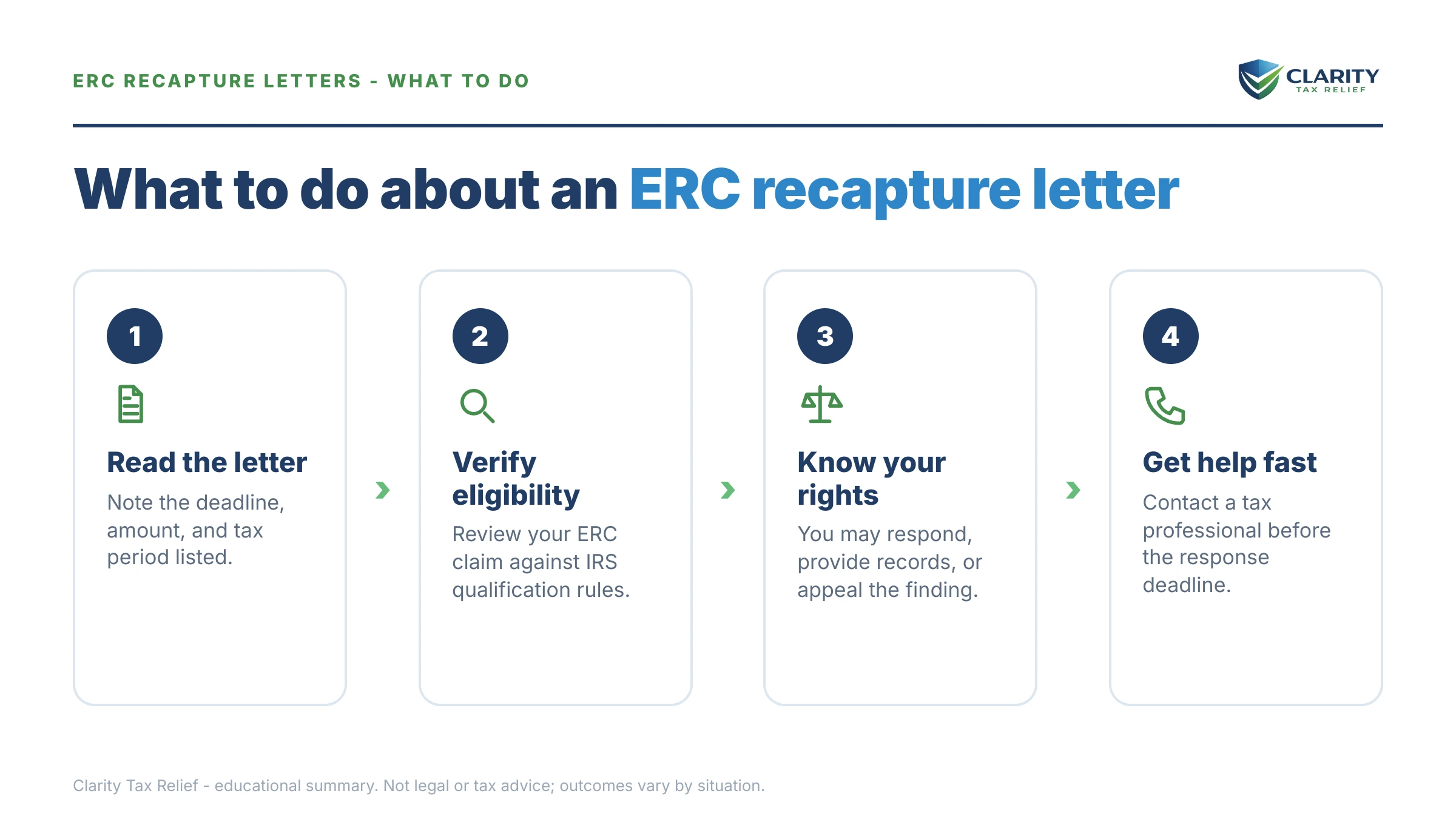
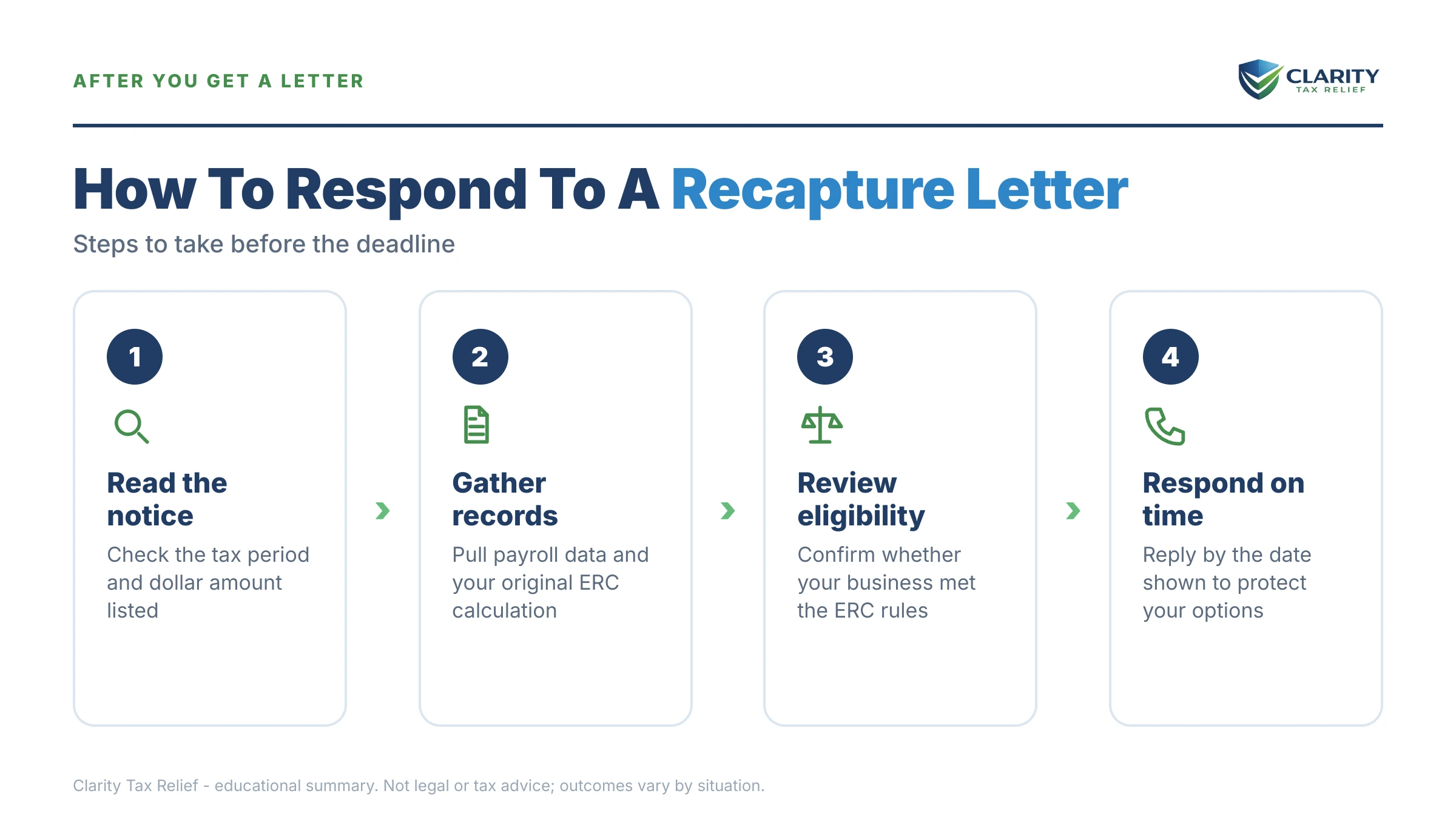
How to respond to an ERC recapture letter, step by step
- Find the response date. Locate the response date printed on your recapture letter. That date, not any general IRS timeline, controls your window to dispute before the assessment finalizes.
- Pull your eligibility file. Gather the Form 941-X claims, the government shutdown order or gross-receipts calculations that supported eligibility, and payroll records for the quarters listed on the letter.
- Decide whether to dispute or accept. Compare your documentation against the ERC rules for each quarter. Dispute in writing with evidence if you qualified, and plan repayment if you didn't.
- Respond in writing by the printed date. Send your dispute or your payment arrangement request before the letter's deadline, and keep copies of everything you mail.
- Get a professional review for large or promoter-filed claims. If the recapture is five figures or an ERC promoter filed the claim, have an experienced tax professional review it before you concede or pay — the promoter's file, penalty relief. Your income tax amendments all change the final number.
When you can handle this yourself, and when help changes the outcome
You can reasonably handle a recapture letter alone when the amount is small, you know the claim was wrong. You can pay within 180 days — a short-term plan costs nothing to set up and ends the matter. You can also self-manage a straightforward dispute if you hold clean, dated proof of a qualifying government order or gross-receipts decline for exactly the quarters cited.
Experienced help changes outcomes in four situations: the recapture is large enough that penalty relief and the income-tax amendment materially move the total. A promoter filed the claim and you never saw the eligibility workpapers. The letter covers quarters where the assessment statute may have run. Or collection has already escalated past billing into lien-and-levy territory. In those cases, the order you fix things in — dispute, penalties, amendment, then payment terms — determines what you ultimately pay. If you disagree with the recapture and the numbers are big, get the review before the printed date, not after.
Terms on your recapture letter, decoded
- Recapture — the IRS reversing a credit it already paid, converting your past refund into a present balance due.
- Erroneous refund — the IRS's label for money it paid out that it now says you weren't entitled to; recapture is how it's recovered.
- Assessment — the formal recording of a debt on your account; once assessed, the amount is collectible and interest runs on it.
- Form 941-X — the amended employment tax return most ERC claims were filed on; your recapture ties back to specific 941-X quarters.
- Statute of limitations — the legal time limit on both sides: your window to claim (closed April 15, 2025 for 2021 quarters) and the IRS's window to assess and recapture.
- Disallowance — denial of an unpaid claim (typically via Letter 105-C); the opposite side of the coin from recapture, which reverses a paid one.
ERC recapture letter questions, answered
How many ERC recapture letters has the IRS sent?
The IRS announced on August 15, 2024 that it would send up to 30,000 recapture letters representing more than $1 billion in claims, mostly for tax year 2021. An earlier round went to more than 12,000 entities for tax year 2020 and produced $572 million in assessments. Additional recapture work continues as the IRS processes its remaining ERC inventory, so these totals reflect announced rounds, not a final count.
What is an IRS ERC recapture letter?
It is a letter reversing Employee Retention Credit money the IRS already paid you, turning a refund you received into a balance you owe. Unlike a disallowance, which denies a claim before payment, recapture claws back funds after they hit your bank account. The assessment can add penalties and interest on top of the credit itself. The letter states the amount, the quarters involved, and your response date.
Do I owe penalties and interest on recaptured ERC?
Potentially yes — recapture letters reverse credits the IRS already paid and can add penalties and interest to the assessment. Interest generally runs on the balance once it is assessed, and failure-to-pay penalties can attach while it goes unpaid. If you had reasonable cause — for example, an ERC promoter assured you the claim was valid — penalty relief may be worth pursuing, though the underlying credit still has to be repaid or disputed.
Can I dispute or appeal an ERC recapture letter?
Yes. If your business genuinely qualified — a government shutdown order or the required gross-receipts decline — respond by the date printed on the letter with your eligibility documentation. Missing that date lets the assessment finalize, after which you are fighting a posted balance instead of a proposed one. Appeal paths exist beyond the first response, but each stage is slower and harder than answering the letter itself.
What if my business can't repay the recaptured ERC?
You have the same collection alternatives as any federal tax balance: a short-term plan of up to 180 days with no setup fee, a monthly installment agreement, currently-not-collectible status if paying would create hardship, or an Offer in Compromise if the IRS could never collect the full amount. Interest and penalties keep accruing on a payment plan, so dispute first if you have grounds — repayment options are for balances you actually owe.
Is an ERC recapture letter the same as a Letter 105-C disallowance?
No. A Letter 105-C denies an ERC claim the IRS never paid. You lose an expected refund but owe nothing back. A recapture letter reverses a credit the IRS already paid, creating a balance due with potential penalties and interest. The dispute deadlines and stakes differ, so identify which letter you are holding before you respond.
Does the One Big Beautiful Bill affect ERC recapture?
Indirectly. Section 70605(d) of the One, Big, Beautiful Bill bars ERC refunds or credits after July 4, 2025 for third- and fourth-quarter 2021 claims filed after January 31, 2024, per IRS FS-2025-07. That provision blocks unpaid claims rather than clawing back paid ones. But it signals the same enforcement direction: Congress and the IRS are unwinding late and questionable ERC claims, and recapture is the tool for money already out the door.
Do I have to fix my income tax return after ERC recapture?
Often, yes — in your favor. When you claimed the ERC, you were required to reduce your wage deduction by the credit amount, which raised your income tax. If the ERC is later recaptured, you may be able to amend that income tax return to restore the deduction and recover some of the tax you overpaid. Check the amendment deadline for the affected year before it lapses.
How to cite this data
Clarity Tax Relief, “IRS ERC Recapture Letters Statistics: 30,000 Letters, $1 Billion Clawed Back (2026),” updated July 10, 2026, https://claritytaxrelief.com/blog/irs-erc-recapture-letters-statistics/. Figures come from the IRS sources cited on this page; please link to this page when you use them.
Your next 24 hours
- Find the response date and the recapture amount on your letter. Both sit near the top of the first page — write the date somewhere you'll see it, because it controls everything else.
- Gather your ERC file: the Form 941-X claims for the quarters listed, whatever the preparer or promoter gave you about eligibility, payroll records. The income tax return where you reduced your wage deduction.
- Get a free case review before that printed date passes. Use the 2-minute form or call (888) 825-7779, with interest and potential penalties accruing on a recaptured balance, whether you dispute or repay, sooner is cheaper.
Sources: the Taxpayer Advocate Service's guidance on what to do if you receive an Employee Retention Credit recapture letter. The IRS's Employee Retention Credit page for program rules and updates. And IRS.gov/payments for payment and plan setup.
This guide is general information, not tax or legal advice for your specific situation. Eligibility for IRS programs depends on individual facts and circumstances; no outcome is guaranteed.