
IRS Data Studies
How Long Does the IRS Take to Resolve Identity Theft Cases? (2026 Data)
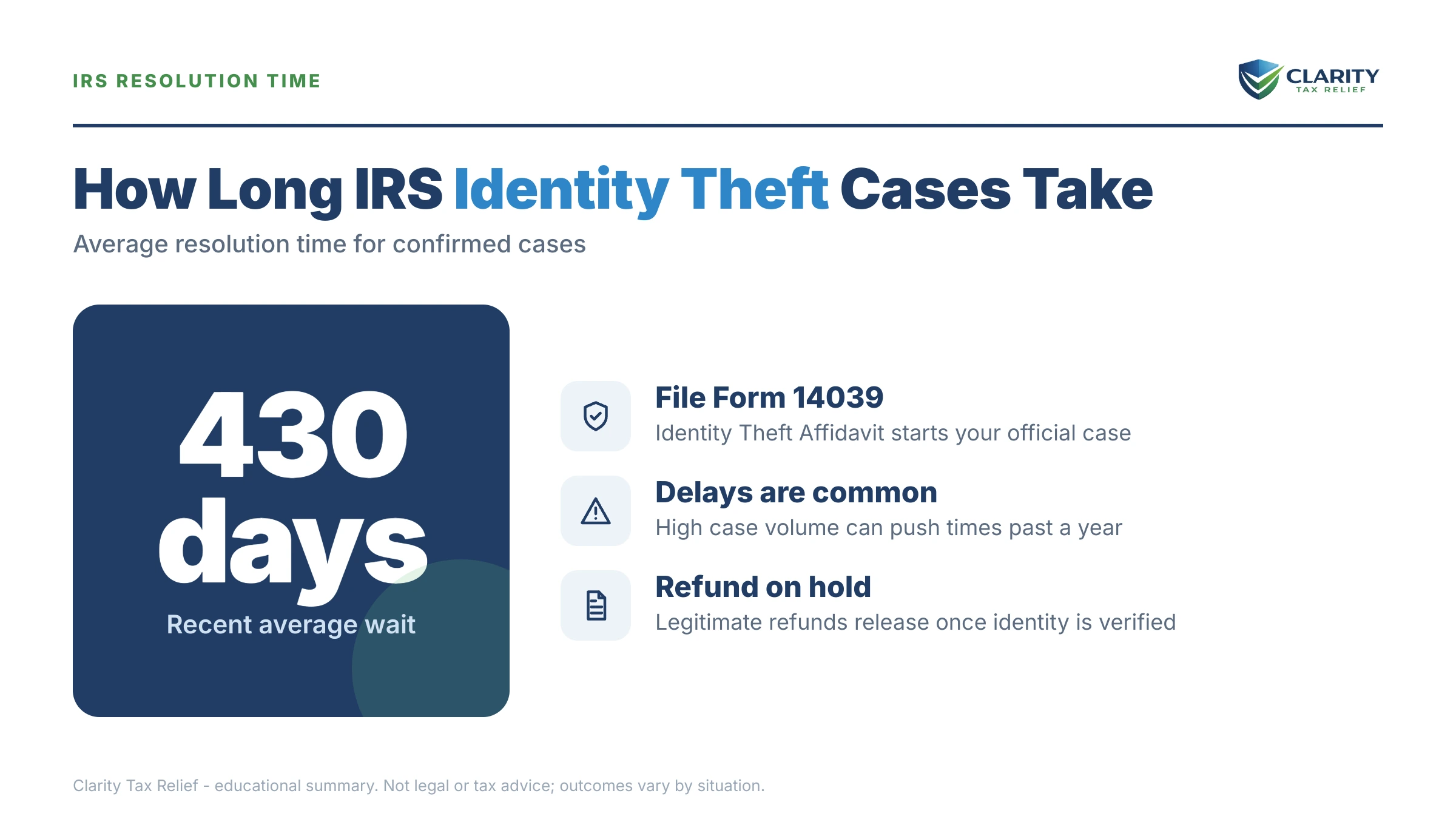
The short answer: how long does the IRS take to resolve identity theft cases? An average of more than 21 months, per the National Taxpayer Advocate's 2025 Annual Report to Congress — up from the nearly 19 months the Advocate had already called unconscionable. Roughly 316,000 victims were still in the queue at the end of FY2025.
Your e-file bounced back with "a return has already been filed under this SSN," you mailed a Form 14039, the IRS sent one acknowledgment letter, and then the mail went silent. That silence is not a sign your case was lost. It's a sign your case joined a very long line, and this page shows you exactly how long that line is and how to move through it faster.
The first table below shows exactly how far the official numbers have slipped since the Taxpayer Advocate first sounded the alarm, and what target the Advocate says the IRS should be hitting instead.
⏱ The clock that actually matters: your refund stays frozen the entire time your case is open, and the average case now runs more than 21 months. The clock doesn't start until the IRS logs your Form 14039 or fraud flag, so every week an unanswered verification letter sits on your counter adds a week to the far end.

How long does the IRS take to resolve identity theft cases? The 2026 numbers
The IRS took an average of more than 21 months to resolve Identity Theft Victim Assistance (IDTVA) cases during 2025 — roughly two years from the day a case opens to the day the account is corrected. That figure comes straight from the National Taxpayer Advocate's 2025 Annual Report to Congress. It moved in the wrong direction: at the end of FY2023, the Advocate flagged an average wait of almost 19 months and called the delays 'unconscionable.'
The backlog behind that average is just as stark. The IRS ended fiscal year 2025 with approximately 316,000 unresolved IDTVA cases — roughly 316,000 people whose refunds are frozen, whose accounts show returns they never filed, or both.
| What the data shows | Figure | Period / source |
|---|---|---|
| Average time to resolve an IDTVA case | More than 21 months | 2025 — National Taxpayer Advocate's 2025 Annual Report to Congress |
| Unresolved IDTVA cases in inventory | Approximately 316,000 | End of fiscal year 2025 |
| Average wait when the Advocate called delays "unconscionable" | Almost 19 months | End of FY2023 |
| The Advocate's recommended resolution target | 90 days | Erin Collins, reiterated in the 2025 report |
Two things the average hides. First, it's an average, not a promise: a clean single-year duplicate-return case can close well under it, while a case touching multiple years, a business EIN, or dependents claimed by a stranger can run past it. Second, the average measures only cases the IRS has actually opened — a Form 14039 that was never filed, or a verification letter that was never answered, isn't "taking 21 months." It's taking forever, because it hasn't started.
Why identity theft victims wait more than 21 months
The single biggest driver of the delay is staffing, not case complexity. The IRS has historically reassigned IDTVA employees to answer phones during filing season, which stops casework cold for months at a time. The agency's overall workforce shrank roughly 27% in 2025, leaving fewer people to work a queue that kept growing.
National Taxpayer Advocate Erin Collins reiterated her recommendation that the IRS keep IDTVA staff focused on identity-theft casework until average resolution time is reduced to 90 days. That's the yardstick to remember: the Advocate's target is 90 days. The current reality is more than 21 months — a gap of roughly seven-fold.
The frustrating part for victims: the automated side of the IRS never slowed down. Refund freezes post instantly, fraudulent-return balances generate collection notices automatically — only the human unit that untangles it all is understaffed.
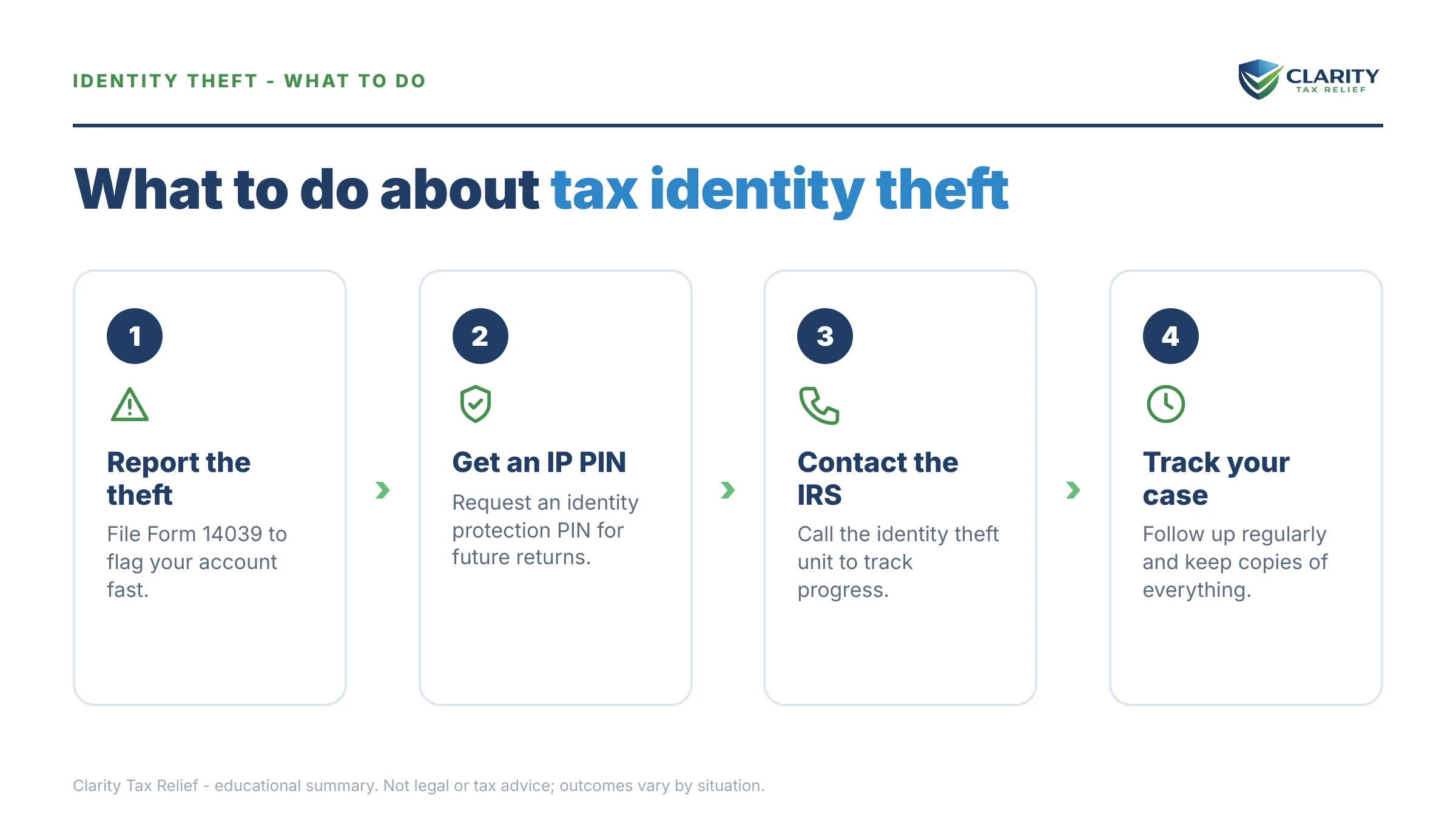
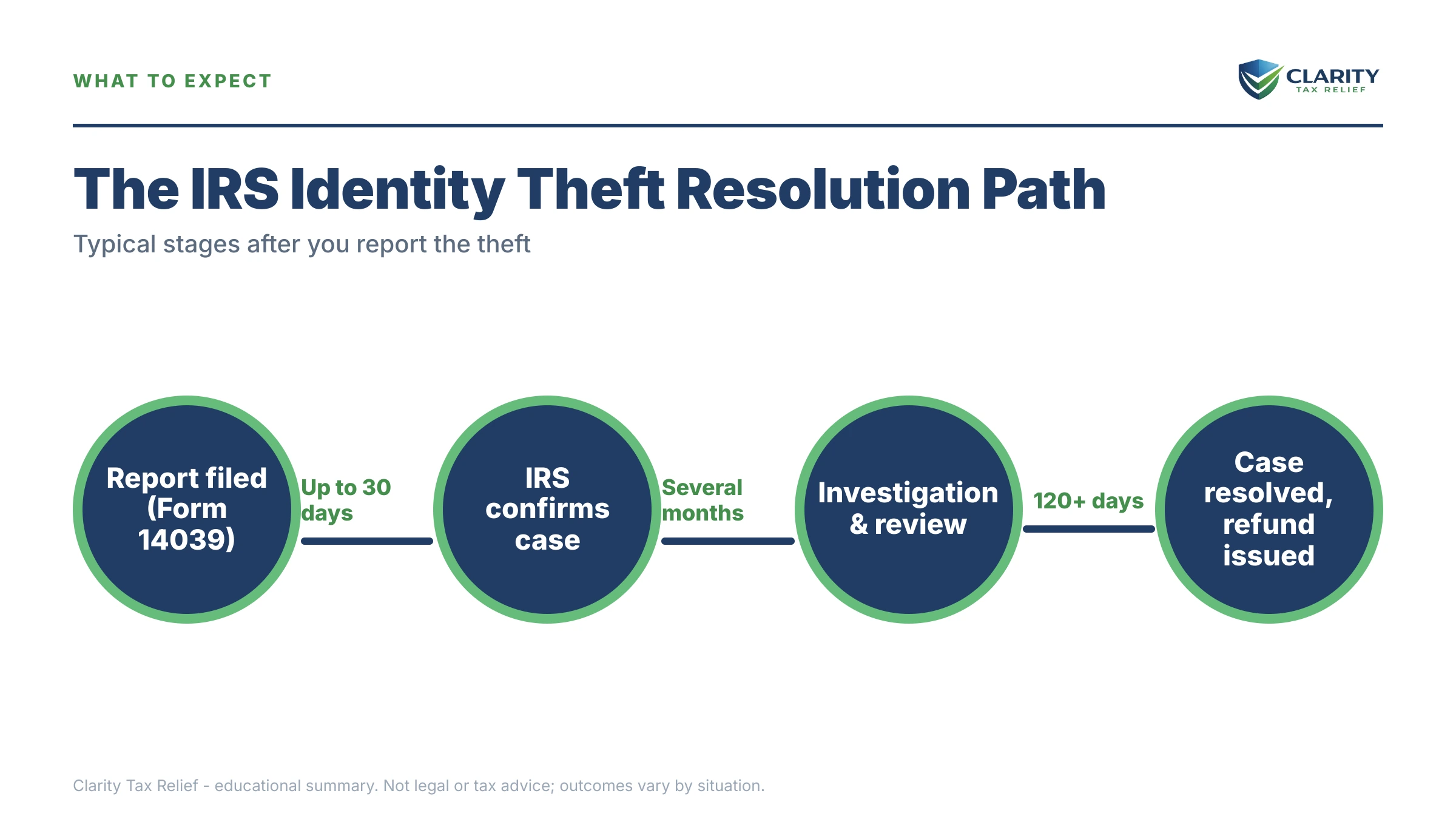
The stages of an IRS identity theft case, and where the time goes
An identity theft case moves through five stages, and almost all of the more-than-21-month average is spent sitting in stage four. Here's the sequence, and what stalls it:
- The fraud surfaces. Your e-file rejects because a return already exists under your SSN, or the IRS's filters flag a suspicious return before you ever file. If the IRS caught it first, you'll get a verification letter.
- The IRS freezes the account. A code 810 refund freeze typically appears on your transcript. A verification letter — 5071C, 4883C, or 5747C — may go out. Until you answer that letter, nothing else happens. This is the stage where victims accidentally add months to their own wait.
- The case opens. You verify your identity and file Form 14039, the Identity Theft Affidavit (or the IRS opens a case internally). You'll receive an acknowledgment letter — save it; the number on it is your lifeline for status checks.
- The IDTVA queue. This is the long middle: your file waits with approximately 316,000 others for a caseworker to verify the rightful taxpayer, back out the fraudulent return, and correct every affected year. Expect long stretches of total silence — silence here is normal, not a sign of a lost file.
- Resolution. The IRS removes the fraudulent return, corrects your account, releases the freeze (code 811 on your transcript), and issues your refund — generally with interest added when the refund comes more than 45 days after the filing deadline.
Doing nothing carries a specific cost at each stage. Ignore the verification letter and your case never enters the queue — the refund stays frozen indefinitely. Skip the Form 14039 and the IRS may treat the fraudulent return as yours, which means a fake balance can start generating real collection notices in your name. The wait is bad; an unopened case is worse.
Stuck in the identity theft queue?
The average case now takes more than 21 months, and your refund stays frozen the whole time. An experienced tax professional can find out where your case actually stands, confirm your Form 14039 was processed, and build the escalation path — free review, no pressure. Call (888) 825-7779 or use the 2-minute form.
Your options while the case sits in the queue
You cannot force a caseworker to pick up your file, but there are real escalation paths, and each one has its own eligibility gate. Here's the honest map:
| Escalation path | Who qualifies | What it can do |
|---|---|---|
| Taxpayer Advocate Service (Form 911) | Taxpayers facing economic hardship (eviction, shutoff, can't cover basics) or a stalled IRS process | Assigns a case advocate who can push for expedited handling — the strongest lever a hardship victim has |
| Status call to the IDTVA unit | Anyone with an open case and an acknowledgment letter | Confirms your case exists and is in queue; won't speed it up, but catches lost paperwork early |
| Identity Protection PIN (CP01A) | Any taxpayer who can verify their identity | Blocks future fraudulent e-filings under your SSN — protects the next filing season, not the open case |
| Congressional casework inquiry | Any constituent (contact your U.S. representative's or senator's office) | Congressional staff can query the IRS on your behalf; sometimes shakes loose a stalled file |
| Low Income Taxpayer Clinic | Income-qualified taxpayers, generally at or below 250% of the federal poverty guidelines | Free representation for the whole case, including TAS escalation |
One edge case deserves its own sentence: if the fraudulent return created a balance due in your name, the IRS's collection machine can start billing you for a debt that isn't yours while the identity case crawls. Flag the identity theft on every collection response, and if a genuine balance of your own is tangled in with it, the general playbook in our guide to how to settle tax debt yourself covers those options so this page doesn't have to.
What a 21-month wait actually costs: a worked example
Say you're a rideshare driver who filed in February 2026 expecting a $3,800 refund, and your e-file rejected because a thief filed first. You verify your identity and mail Form 14039 in March 2026. At the current average of more than 21 months, that case resolves around December 2027 — March 2026 plus 21 months.
In between, two more filing seasons come and go. Your 2026 return (due April 2027) should be filed on time with an IP PIN. That refund arrives on a normal schedule — the freeze applies to the disputed year, not to your life. When the $3,800 finally releases, the IRS generally adds interest at its quarterly overpayment rate for refunds issued more than 45 days after the deadline. Small consolation, and worth knowing: that interest is taxable income the year you receive it.
How to respond, step by step
- Confirm the fraud — Pull your IRS online account or account transcript to see the fraudulent return, the refund freeze, or a balance you don't recognize.
- File Form 14039 — Submit the Identity Theft Affidavit for every affected tax year if the IRS hasn't already flagged your account on its own.
- Answer verification letters immediately — Respond to any 5071C, 4883C, or 5747C letter the same week — your case can't enter the resolution queue until you do.
- Get an IP PIN — Opt in to the Identity Protection PIN program so no one can e-file under your SSN again while the case is open.
- Keep filing on time, File every current-year return on schedule, on paper if e-filing rejects, so new problems don't stack on top of the old one.
- Escalate if you're in hardship — Request Taxpayer Advocate Service help with Form 911 if the frozen refund is causing economic hardship you can document.
Which IRS letter did you get? Each one starts something different
Identity theft generates several different IRS letters, and each demands a different response. Matching the letter to the action is the fastest thing you control:
| Letter | What it means | Your move |
|---|---|---|
| 5071C | The IRS suspects a return filed under your SSN may not be yours | Verify your identity online or by phone right away |
| 4883C | Same suspicion, but verification must happen by phone | Call the number on the letter with your returns in hand |
| 5747C | Verification requires an in-person visit | Book a Taxpayer Assistance Center appointment; bring photo ID and your return |
| 4310C | The IRS is telling you it detected possible identity theft on your account | Read it carefully. It tells you whether the IRS already took action or needs a Form 14039 from you |
| CP01A | Your annual Identity Protection PIN for the coming filing season | Keep it — you'll need the six-digit PIN to e-file; a new one arrives each January |
When you can handle this yourself, and when help changes the outcome
Most single-year identity theft cases are genuinely DIY. If your situation is one verification letter you can answer online, a Form 14039 you've already filed, or simply opting in to an IP PIN, you don't need to pay anyone — the bottleneck is the IRS queue, not your paperwork, and no firm can lawfully promise to jump it.
Experienced help changes outcomes in four specific situations. First, a frozen refund plus documented hardship — building a Form 911 request that TAS actually accepts is a skill. Second, a fraudulent return that created a fake balance now generating collection notices, because you're fighting two IRS systems at once. Third, business or EIN identity theft, where payroll filings multiply the damage. Fourth, identity theft tangled with your own unfiled years — a gig worker with three seasons of unfiled returns and a thief's return in the middle of them has a genuinely hard "which filer is real" problem, because the IRS can't sort the rightful taxpayer from the fraud until the missing returns exist. If your identity case has stalled past the average with no transcript movement, a free review with an experienced tax professional can tell you which lever fits — start with the 2-minute form.
Terms in your identity theft case, decoded
- IDTVA — Identity Theft Victim Assistance, the IRS unit that works victim cases from Form 14039 through account correction.
- Form 14039 — the Identity Theft Affidavit, the sworn statement that formally opens (or supports) your case.
- IP PIN — a six-digit Identity Protection PIN, reissued each January, that blocks e-filed returns under your SSN without the code.
- 810 freeze — the transcript code showing your refund is held; code 811 means the hold was released.
- TAS — the Taxpayer Advocate Service, an independent unit inside the IRS that takes hardship and stalled-process cases via Form 911.
- Resolution — the IRS backing the fraudulent return out of your account, correcting every affected year, and releasing your refund.
Identity theft resolution time: your questions, answered
How long does the IRS take to resolve identity theft cases in 2026?
The average is now more than 21 months, according to the National Taxpayer Advocate's 2025 Annual Report to Congress. That is up from almost 19 months at the end of FY2023, when the Advocate first called the delays 'unconscionable.' Individual cases vary widely — a simple duplicate-return case can close faster, while a multi-year or business-related case can run longer than the average.
Will I still get my refund if someone filed a fraudulent return in my name?
Yes — a fraudulent filing does not erase your right to your refund. It delays the refund until the IRS confirms which return is really yours. Once the case resolves, the IRS releases your money. It generally adds interest when a refund is issued more than 45 days after the filing deadline. Note that any interest the IRS pays you is taxable income on the following year's return.
How do I check the status of my IRS identity theft case?
Call the number printed on the IRS letter that acknowledged your Form 14039. That routes you to the unit holding your file. Your IRS online account and account transcript can also show movement: a code 810 refund freeze means the hold is still active. A code 811 means it has been released. If months pass with no letters and no transcript changes, that is your signal to escalate.
Can the Taxpayer Advocate Service speed up my identity theft case?
Sometimes — TAS can take your case if the delay is causing economic hardship, such as an eviction risk, a utility shutoff, or an inability to cover basic living expenses. You request help with Form 911. TAS cannot jump every case in the queue, but National Taxpayer Advocate Erin Collins has made IDTVA delays a headline issue, and hardship cases are exactly what the service exists for.
What is IDTVA?
IDTVA stands for Identity Theft Victim Assistance — the IRS unit that works cases where a taxpayer's identity was used on a fraudulent return. Once your Form 14039 or an internal fraud flag opens a case, IDTVA verifies the rightful taxpayer, removes the fraudulent return from your account, corrects the record, and releases your refund. The IRS ended fiscal year 2025 with approximately 316,000 unresolved IDTVA cases.
Should I keep filing my taxes while my identity theft case is open?
Yes — file every return on time even while the older case sits in the queue. If e-filing rejects because a return already exists under your SSN, file on paper with a Form 14039 attached for that year. Falling behind on current filings can complicate your open case and creates separate late-filing penalties, which run 5% per month (capped at 25% of the unpaid tax) — a far worse cost than the wait itself.
Why is the IRS so slow at resolving identity theft cases?
Staffing is the biggest driver: the IRS routinely reassigns IDTVA employees to answer phones during filing season. The agency's workforce shrank roughly 27% in 2025. The National Taxpayer Advocate has recommended keeping IDTVA staff focused on identity-theft casework until average resolution time falls to 90 days. Until that happens, the queue moves at the speed of whoever is left working it.
Does an IP PIN stop tax identity theft?
An Identity Protection PIN blocks anyone from e-filing a return under your SSN without the six-digit code, which stops the most common form of refund fraud before it starts. It does not resolve an existing case or unfreeze a held refund. It protects future filings. The IRS issues a new PIN each January on a CP01A notice, and any taxpayer who can verify their identity can opt in.
How to cite this data
Clarity Tax Relief, “How Long Does the IRS Take to Resolve Identity Theft Cases? (2026 Data),” updated July 10, 2026, https://claritytaxrelief.com/blog/irs-identity-theft-resolution-time-statistics/. Figures come from the IRS sources cited on this page; please link to this page when you use them.
Your next 24 hours
- Find your acknowledgment letter, or the unanswered verification letter still sitting in the pile. The date on it tells you where your case clock actually stands against the 21-month average. The phone number on it is your status line.
- Gather three things: your last filed tax return, every IRS letter you've received about the identity theft, and, if the frozen refund is hurting you, proof of hardship (a shutoff notice, an eviction letter, past-due bills).
- Get a free case review. An experienced tax professional can confirm your case is actually open, check your transcript for the freeze, and map the fastest escalation path while your refund sits idle and interest quietly runs. Use the 2-minute form or call (888) 825-7779.
Where this data comes from: the resolution-time and backlog figures on this page are from the National Taxpayer Advocate's 2025 Annual Report to Congress. For the Advocate's ongoing work on victim delays, see the Taxpayer Advocate Service, and for the IRS's own victim resources, see IRS Identity Theft Central.
This guide is general information, not tax or legal advice for your specific situation. Eligibility for IRS programs depends on individual facts and circumstances; no outcome is guaranteed.
Read the transcript
Host: So the situation we're talking about today is this. You went to e-file, and it bounced. Message says a return's already been filed under your Social Security number. You mailed in a Form 14039, you got one letter back saying they got it, and then... nothing. Months of nothing.
Tax specialist: Yeah. And the thing I want to say first, because it's the thing people are most scared of - the silence doesn't mean your file got lost. It means you're in a line. A very long line.
Host: How long is the line?
Tax specialist: More than 21 months on average. That's from the National Taxpayer Advocate's 2025 Annual Report to Congress, for cases worked by the identity theft unit at the IRS - IDTVA.
Host: More than 21 months. Almost two years.
Tax specialist: Almost two years. And it got worse, not better. At the end of fiscal year 2023, the Advocate measured almost 19 months and called the delays unconscionable. That's her word. Then it slid to over 21.
Host: Hm. And how many people are sitting in that line right now?
Tax specialist: Roughly 316,000 unresolved cases at the end of fiscal year 2025.
Host: 316,000.
Tax specialist: Right. And for context on what it should be - the Advocate's recommended target is 90 days. So you've got 90 days as the goal and more than 21 months as the reality.
Host: Okay, before we go further. Why? Is it because these cases are complicated?
Tax specialist: Mostly no. It's staffing. The IRS has a history of pulling IDTVA employees off casework to answer phones during filing season, which just stops the queue cold for months. And the agency's workforce shrank roughly 27% in 2025. Fewer people, growing pile.
Host: So the humans slowed down but -
Tax specialist: The machines didn't. That's exactly the cruel part. Refund freezes post instantly. If a thief's return created a balance in your name, the collection notices generate automatically. The only slow piece is the human unit that untangles it.
Host: Okay. I want to get to what the listener actually controls, because 21 months is not something they control.
Tax specialist: No. But the start of the clock is. And that's the part people miss. The average only counts cases the IRS has actually opened. If there's a verification letter sitting unanswered on your kitchen counter, your case isn't taking 21 months. It's taking forever, because it hasn't started.
Host: Say more about that letter. Which letter?
Tax specialist: Could be a 5071C, a 4883C, or a 5747C. Different flavors of the same thing - the IRS suspecting a return filed under your Social Security number might not be yours, and wanting you to prove who you are.
Host: 5071C, 4883C, 5747C. And they're different how?
Tax specialist: 5071C you can generally verify online or by phone. 4883C, the verification has to happen by phone - so call the number on the letter with your returns in front of you. 5747C means in person. You book an appointment at a Taxpayer Assistance Center and bring photo ID and your return.
Host: And there's a fourth one, right? I saw a 4310C in the article.
Tax specialist: There is. 4310C is the IRS telling you it spotted possible identity theft on your account. Read that one closely, because it tells you whether the IRS already took action or whether it still needs a Form 14039 from you.
Host: Okay so the rule is - answer the verification letter -
Tax specialist: The same week. Not eventually. Your case cannot enter the resolution queue until you verify. Every week that letter sits there adds a week to the far end of a 21-month wait.
Host: Got it. What about Form 14039 - who needs to file that, and for what years?
Tax specialist: Every affected year. That's the piece people shortcut. If you skip it, the IRS may treat the fraudulent return as yours - and then a fake balance starts generating real collection notices in your name. Fighting that is much harder than filing the affidavit up front.
Host: So the wait is bad, but an unopened case is worse.
Tax specialist: Much worse.
Host: Let's talk about the transcript, because I think people stare at those and don't know what they're seeing.
Tax specialist: Two codes matter. Code 810 is the refund freeze - the hold is active. Code 811 means the hold was released. So when you pull your account transcript, you're basically looking for 810 flipping to 811.
Host: 810 held, 811 released.
Tax specialist: Right. And if months go by with no letters and no change on that transcript, that's your signal to escalate rather than keep waiting politely.
Host: Okay, escalate how? Because you can't call and demand a caseworker pick up your file.
Tax specialist: You can't. But there are a few real levers, and each one has its own gate. The strongest for someone in real trouble is the Taxpayer Advocate Service - you request help with Form 911. That's for economic hardship you can document. Eviction risk, a utility shutoff, not being able to cover basics.
Host: Documented being the operative word.
Tax specialist: Documented. A shutoff notice, an eviction letter, past-due bills. TAS can assign a case advocate who pushes for expedited handling. It can't take every case in the queue - I want to be straight about that.
Host: What else?
Tax specialist: A status call to the IDTVA unit. Use the number printed on the letter that acknowledged your Form 14039 - that letter is your lifeline, save it. That call won't speed anything up, but it confirms your case actually exists and catches lost paperwork early. There's also a congressional casework inquiry - your representative's or senator's office can query the IRS on your behalf. And Low Income Taxpayer Clinics, which are income-qualified, generally at or below 250% of the federal poverty guidelines, and they'll represent the whole case for free.
Host: What about the IP PIN? Where does that fit?
Tax specialist: Important, but understand what it does. An Identity Protection PIN blocks anyone from e-filing under your Social Security number without the six-digit code. It protects next filing season. It does not unfreeze your held refund or resolve the open case. New one arrives each January on a CP01A notice.
Host: CP01A. And meanwhile - do you keep filing?
Tax specialist: Yes. On time, every year, no exceptions. If e-file rejects because that return already exists, file on paper with a Form 14039 attached for that year. Falling behind stacks new problems on the old one, and the late-filing penalty runs 5% a month up to 25% of the unpaid tax. That's a far bigger cost than the wait.
Host: Wait - the freeze doesn't apply to the new year's refund?
Tax specialist: Correct. The freeze applies to the disputed year, not to your whole life. Your current-year return filed with an IP PIN can move on a normal schedule while the old year sits.
Host: That's genuinely useful. Okay, honest question - who actually needs to pay someone for this?
Tax specialist: A lot of people don't. If it's one verification letter you can answer online, a Form 14039 you've already mailed, or just opting into an IP PIN - that's DIY. The bottleneck is the IRS queue, not your paperwork, and nobody can jump that queue.
Host: And when does help actually change something?
Tax specialist: Four spots. Frozen refund plus documented hardship, because building a Form 911 request that TAS accepts is a skill. A fraudulent return that created a fake balance now sending collection notices, because you're fighting two IRS systems at once. Business or EIN identity theft, where payroll filings multiply it. And identity theft tangled up with your own unfiled years - if you've got three unfiled seasons with a thief's return in the middle, the IRS genuinely can't sort out which filer is real until your missing returns exist.
Host: So what do people do in the next day or so?
Tax specialist: Find the letter. Either the acknowledgment letter or the verification letter you haven't answered. The date tells you where your clock actually stands, and the phone number is your status line. Then gather three things - your last filed return, every IRS letter about the identity theft, and if the frozen money is hurting you, your hardship proof.
Host: And if you want someone to look at it with you, Clarity's Enrolled Agents will do a free case review - confirm the case is actually open, check the transcript for that 810, and map which escalation lever fits. That's 888-825-7779, or the two-minute form on the page.
Tax specialist: One last thing. This is general information, not advice for your specific facts, and eligibility for any IRS program depends on your circumstances. But the piece you control is real - answer the letter, file the affidavit for every year, keep filing current. Do that and your case is at least moving.