
IRS Notices
IRS Math Error Notices: What They Mean and Your 60-Day Deadline (2026)
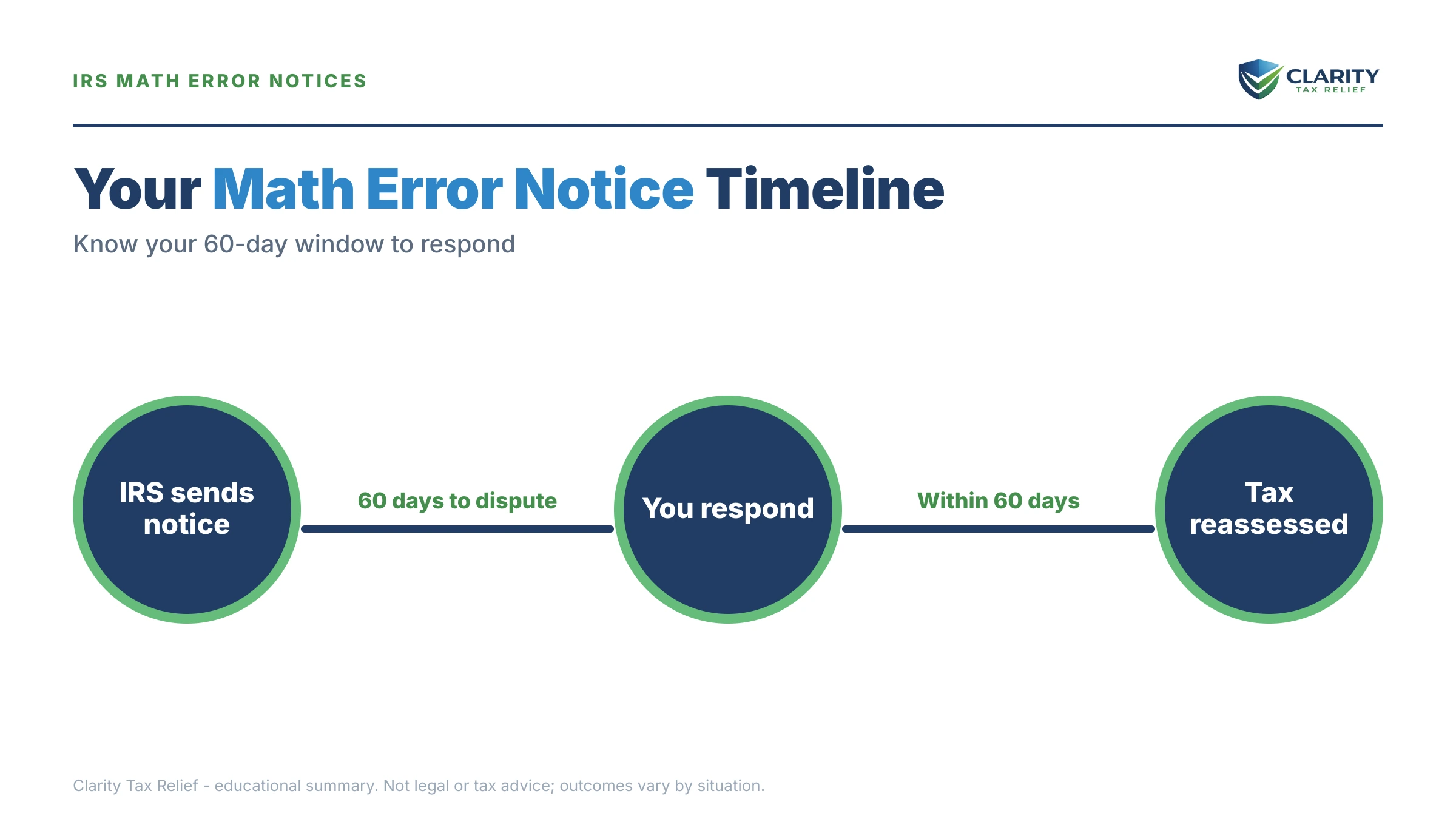
The short answer: IRS math error notices — most often a CP11 (balance due), CP12 (refund changed), or CP13 (no change in what you owe) — mean the IRS corrected your return during processing and assessed the change immediately, with no audit. You have 60 days from the notice date to dispute the correction before it becomes final.
You did your own return — Schedule C, Schedule SE, quarterly payments, all of it — and now a letter says the IRS "changed your return," with numbers that don't match anything you filed. Nobody asked you a question first. That's the unsettling part of a math error correction: it's already done. The good news is that one little-known deadline lets you undo it, if you move inside the window.
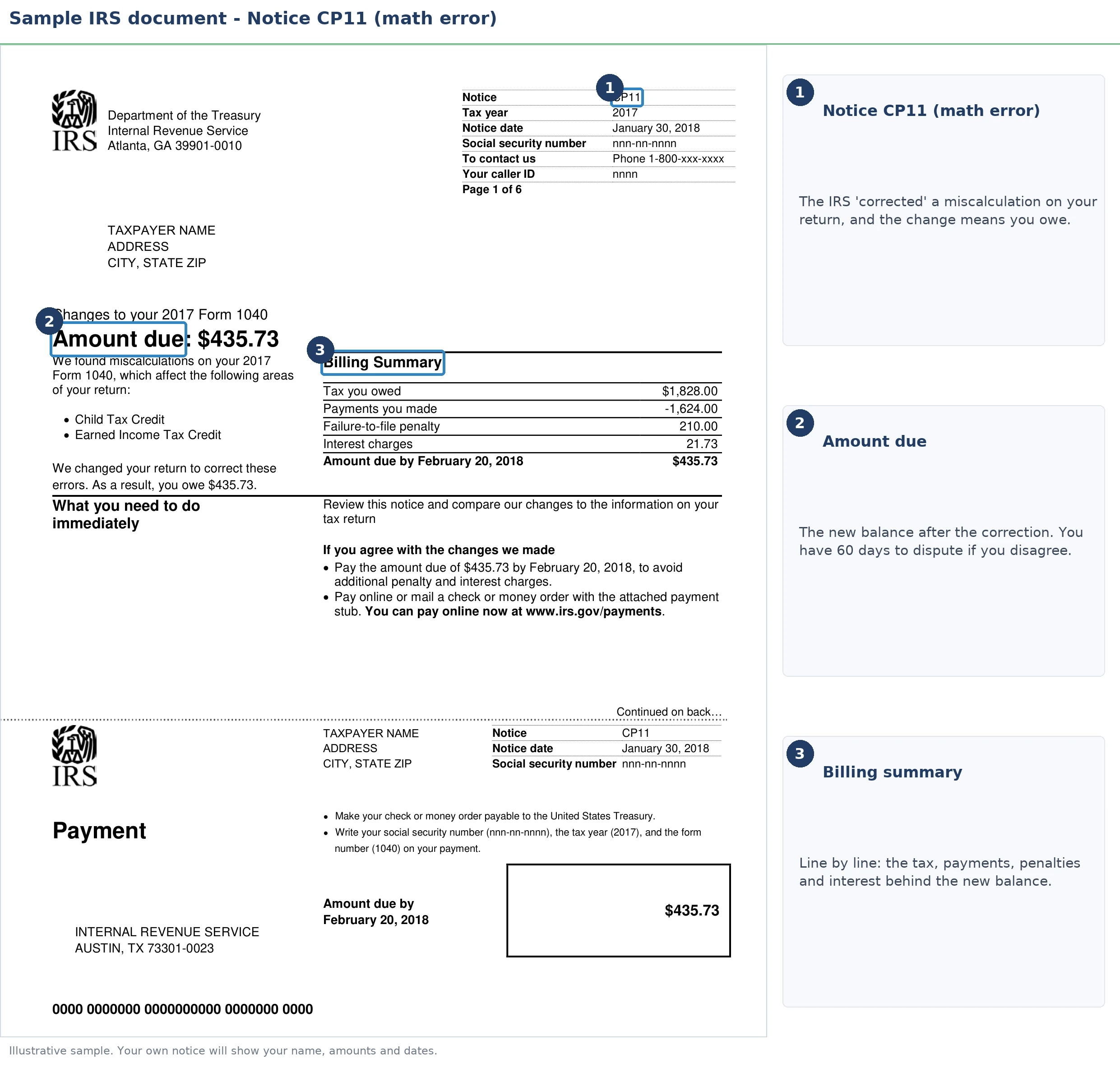
The image below shows exactly what a math error notice looks like and where the two facts that control everything, the notice date and the CP number, sit on the page.
⏱ Your deadline: you have 60 days from the date printed on a math error notice to request abatement of the change. Inside that window, the IRS must reverse the assessment on request. Miss it, and the change becomes final. You keep only slower, pay-first ways to fight it, while interest and penalties accrue on any balance.
Why you got an IRS math error notice
A math error notice means the IRS corrected your return during processing and assessed the change instantly under IRC §6213(b) — skipping the audit and 90-day letter most tax changes require. Congress calls this "math error authority," and it is the fastest assessment power the IRS has. The change is assessed the day the notice is issued — the IRS does not need your agreement first.
"Math error" covers more than bad arithmetic. The most common triggers:
- A straight arithmetic mistake — an addition error, or digits transposed while carrying a total from one schedule to another.
- Entries that contradict each other — a Schedule SE that doesn't match the Schedule C profit feeding it, common on self-prepared 1099 returns.
- A missing or mismatched Social Security number behind a dependent credit like the Child Tax Credit or EITC. (If someone else used the same SSN, see both parents claimed child IRS — that's a different fight with different rules.)
- A credit or deduction claimed above its statutory limit — the computer caps it at the legal maximum and recalculates.
- The wrong tax-table or rate amount for the income and filing status shown.
Don't confuse this with a CP2000 notice. A CP2000 comes months later, from matching your return against W-2s and 1099s, and it only proposes a change you can contest before assessment. A math error notice is the opposite: the change already happened, and your leverage runs backward from the notice date.
The IRS math error notices family: CP11, CP12, and CP13
Three notices deliver almost all individual math error corrections, and the CP number tells you which direction the money moved. The letter's generic explanation paragraphs rarely name the exact line changed, a long-running Taxpayer Advocate criticism, so the CP number and the "changes to your return" section are where to start.
| Notice | What it means | Your move |
|---|---|---|
| CP11 | Math error correction created a balance due | Verify the change; dispute within 60 days or arrange payment by the pay-by date — full guide: CP11 notice |
| CP12 | Correction changed your refund (usually smaller, sometimes larger) | Confirm the adjusted refund is right before cashing anything — full guide: CP12 notice |
| CP13 | Correction made, but no balance due and no refund change | Still verify it — the corrected figures carry into next year's return and your account records |
| CP23 (cousin) | Estimated payments claimed don't match IRS records; balance due | Match every payment on your transcript by date and amount — full guide: CP23 notice |
The 60-day rule: the right most people lose without knowing it
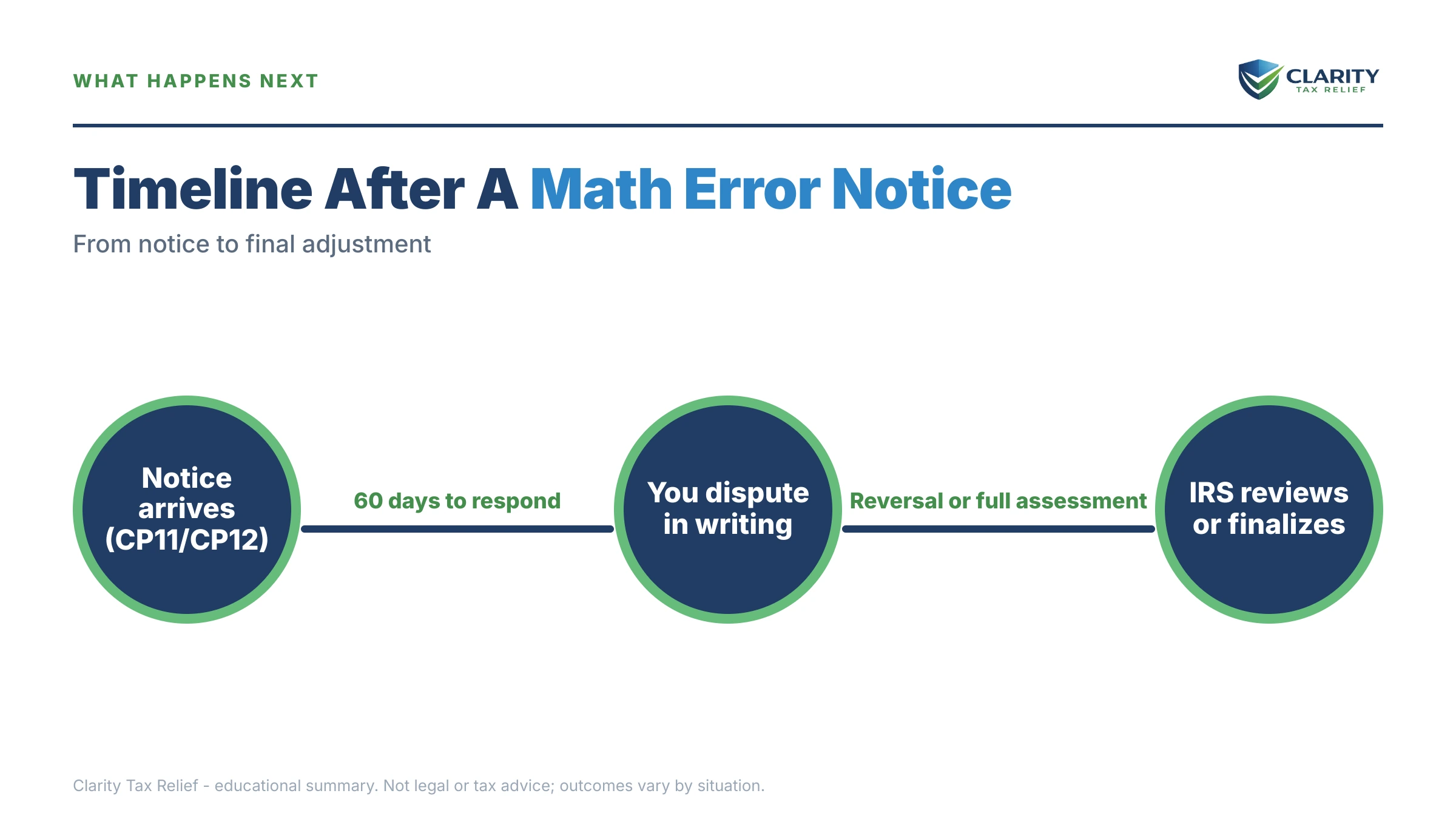
Requesting abatement within 60 days of the notice date forces the IRS to reverse a math error assessment. That is the trade Congress built into §6213(b): the IRS gets to assess instantly, and in exchange you get 60 days to say "no" and unwind it. If the IRS still believes it's right, it must then reassert the change through formal deficiency procedures — a statutory Notice of Deficiency that opens your right to contest the tax in court before paying a dollar (see how that works in our 90 day letter Tax Court petition guide).
Miss the window and none of that applies. The assessment stands, collection proceeds, and your remaining challenges all run through slower channels. The 60-day request is the only way to force reversal without proving anything first.
One honest caveat: if the IRS is clearly right, you really did transpose the digits, disputing only delays the bill while interest grows. Use the 60-day right when you genuinely disagree, not as a stall.
| When you act | What you can do | What you keep or lose |
|---|---|---|
| Within 60 days of the notice date | Request abatement by phone or in writing | IRS must reverse the assessment; to reassert it, it must issue a Notice of Deficiency — preserving pre-payment Tax Court rights |
| After 60 days, balance unpaid | Request audit reconsideration with documentation | Discretionary and slow; collection continues unless the IRS agrees to hold it or you arrange payment |
| After paying the balance | File a claim for refund (refund suit if denied) | You must pay first; the refund route can run months to years |
What happens if you ignore a math error notice
An unanswered CP11 balance flows straight into the automated collection stream — the same one every unpaid tax bill enters. The stages, in order:
- The 60-day window expires silently. No warning letter marks it. The assessment becomes final, and the failure-to-pay penalty (0.5% per month) plus daily-compounding interest keep building on the balance.
- Reminder bills arrive, CP501 and CP503, each restating a larger balance. Still no enforcement, but the file is moving.
- CP504 notice — Notice of Intent to Levy. The IRS can now take your state tax refund, and a federal tax lien becomes a live possibility.
- LT11 notice / Letter 1058 — final notice of intent to levy. A 30-day clock starts on your Collection Due Process rights (requested on Form 12153). After it runs, the IRS can levy bank accounts and, for a 1099 contractor, send levies straight to the businesses that pay you.
In 2026, don't count on understaffing to save you. The IRS workforce shrank roughly 27% in 2025, which makes disputing harder — longer holds, slower correspondence — but math error notices and the collection sequence behind them are generated by computers that never stopped running.
Holding a CP11 or CP12 you don't agree with?
Send us a photo of it. An experienced tax professional will trace exactly what the IRS changed and whether it's worth fighting — free, before your 60-day dispute window closes.
If the correction is right: your options for the balance
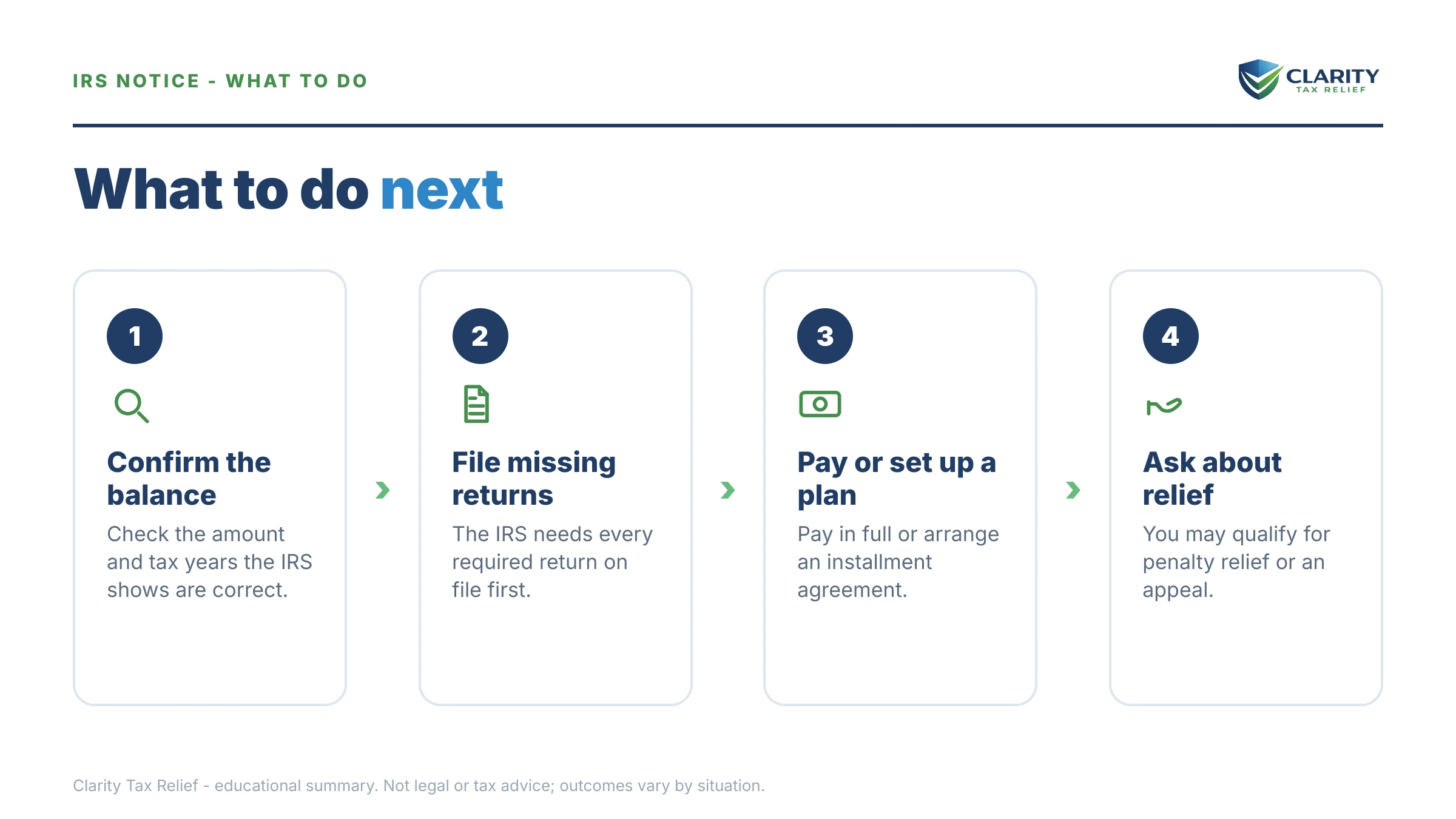
A math error balance is collected exactly like any other tax debt, so every standard resolution path is open. The notice stage is the cheapest moment to pick one.
A worked example (hypothetical). Say you're a 1099 contractor who transposed two digits carrying a Schedule C total onto your Form 1040. The income was reported correctly. But the tax computed on the smaller figure. A CP11 now shows $48,300 due: corrected tax, plus interest running from the return's original due date. Your realistic paths:
- Pay in full — stops the failure-to-pay penalty and interest immediately. On $48,300, the 0.5% monthly penalty alone is roughly $241 a month before interest, so every month of delay has a real price.
- Short-term plan (up to 180 days) — $0 setup fee, no financial disclosure. Interest and penalties continue, but enforcement stops.
- 72-month installment agreement — $48,300 sits under the $50,000 online threshold, so with direct debit you can set it up without filing financial statements: $48,300 ÷ 72 ≈ $671/month as the baseline, with actual payments a bit higher (or the plan running its full term) because interest and penalties keep accruing. You can also apply by mail on Form 9465. Compare every payment channel in best way to pay the IRS.
- Currently Not Collectible, if paying anything would leave you unable to cover basic living expenses, collection can be paused. The debt (and interest) remains, but levies stop.
- Offer in Compromise — settling for less than the full balance is real but strictly means-tested: $205 application fee and 20% down on lump-sum offers (both waived, along with payments during review, if your AGI is at or below 250% of the poverty level). The IRS accepted roughly 1 in 5 offers in FY2024. On $48,300, it's only realistic if your income and assets genuinely can't cover the debt before the collection statute runs.
- Penalty relief — first-time abatement can remove the failure-to-pay penalty if your prior three years are clean, and starting summer 2026 the new Automatic Exemption from Penalty (AEP) applies qualifying relief without a request. Interest itself is another story — see can IRS interest be waived. You can estimate what the penalties and interest add on your own balance with our Penalty & Interest Calculator.
| Option | Who it fits | Cost & terms |
|---|---|---|
| Short-term plan | Can pay in full within 180 days | $0 setup; interest + 0.5%/mo penalty continue |
| Long-term installment agreement | Balance ≤ $50,000 (online, up to 72 months; ≤ $25,000 without direct debit) | Setup fee applies (reduced for direct debit); interest + penalties accrue until paid |
| Currently Not Collectible | Paying would prevent covering basic living expenses | No payment; debt and interest remain; IRS reviews periodically |
| Offer in Compromise | Income and assets genuinely can't cover the debt | $205 fee + 20% down on lump-sum offers (low-income waiver available); ~1 in 5 accepted in FY2024 |
| Penalty abatement / AEP | Clean prior 3 years, or reasonable cause | Free to request; removes penalties, not the tax or most interest |
The full do-it-yourself sequence — verify the number, cut the penalties, then resolve the balance — is laid out in our guide to how to settle tax debt yourself.
How to respond to an IRS math error notice, step by step
- Identify your notice and its date. Find the CP number (CP11, CP12, or CP13) and the notice date in the top corner. Your 60-day dispute clock runs from that printed date, not the day you opened the envelope.
- Compare the change to your filed return. Put the notice next to your copy of the return and trace the exact line the IRS changed. The notice explains the reason in general terms, so you have to follow the math yourself.
- Check the source document behind the changed figure. Pull the schedule, 1099, W-2, or payment confirmation that supports your original number before deciding whether the IRS is right.
- Dispute within 60 days if you disagree. Call the number on the notice or send a written request for abatement of the math error assessment, with your supporting documents. Keep proof of the date you sent it.
- Set up payment before the pay-by date if you agree. Pay in full, or set up a short-term or monthly payment plan online so the balance never enters the collection notice stream.
- Watch for the IRS's response. Expect an adjusted notice, a corrected refund, or, if you disputed, either a reversal or a Notice of Deficiency that opens your Tax Court rights.
When you can handle a math error notice yourself
Most math error notices don't need professional help. Handle it yourself when the correction is obviously right and small, when a CP12's adjusted refund matches your own recheck, or when you agree with a CP11 and can pay in full or within 180 days — payment setup at IRS.gov/payments takes minutes. The IRS's own pages for understanding your CP11 notice and understanding your CP12 notice cover the mechanics.
Experienced help changes the outcome in a narrower set of situations: a disputed change worth thousands where the 60-day abatement request has to be framed and documented correctly. A correction that collides with other problems (unfiled years, an estimated-payment mess across multiple years, a denied refundable credit tied to a dependent dispute). Or a five-figure balance like the $48,300 example, where the order you fix things — dispute first, penalties second, payment plan third — directly changes what you pay. If the IRS ignores a timely, documented dispute, the Taxpayer Advocate Service exists for exactly that.
Terms on your notice, decoded
- Summary assessment — the IRS recording the tax as legally owed immediately, without the usual pre-assessment review.
- Abatement — reversing an assessment; the thing you're entitled to demand within 60 days of a math error notice.
- Deficiency procedures — the formal route (examination findings, then a Notice of Deficiency) the IRS must use for most tax increases, and must fall back to if you dispute a math error in time.
- Notice of Deficiency — the "90-day letter" giving you the right to petition Tax Court before paying.
- TIN — taxpayer identification number (SSN or ITIN); a missing or mismatched TIN behind a credit is a top math error trigger.
- Failure-to-pay penalty — 0.5% of the unpaid balance per month, stacking on top of interest until the balance is resolved.
Math error notice questions, answered
Is an IRS math error notice the same as an audit?
No. A math error notice is an automatic correction made when the IRS computer processes your return — no examiner reviewed your records. It does not flag you for a future audit. An audit questions your documentation; a math error notice recalculates figures already on your return. The correction is assessed immediately under IRC §6213(b), which is why the 60-day dispute window matters so much.
What happens if I don't respond to a math error notice within 60 days?
The assessment becomes final and the IRS can begin normal collection on any balance due. You lose the right to force the IRS into formal deficiency procedures, which means no Tax Court review before paying. You can still challenge the change afterward, but only through slower routes — paying and filing a refund claim, or requesting audit reconsideration with documentation.
Can I still dispute a math error notice after 60 days?
Yes, but on worse terms. After 60 days you can request audit reconsideration with proof the IRS's change was wrong, or pay the balance and file a claim for refund. Both routes work. But they can take months, and collection notices keep arriving in the meantime unless you set up a payment arrangement or the IRS agrees to hold collection.
Why did the IRS reduce my refund with a CP12 notice?
A CP12 means the IRS corrected something on your return and the correction changed your refund, often a credit claimed above the statutory limit, a dependent's missing or mismatched Social Security number, or an arithmetic error. The notice shows the adjusted refund amount. If you disagree, you have the same 60-day window to dispute it before the change becomes final.
What if the IRS made the math error, not me?
It happens — IRS systems misread entries, misapply estimated payments, and apply corrections to the wrong line. Call the number on the notice or write to the address shown, state that you request abatement of the math error assessment, and include the schedule or records that support your original figure. Requesting abatement within 60 days forces the IRS to reverse the change unless it formally reasserts it.
Do I have to pay interest and penalties on a math error balance?
Interest applies by law from the return's original due date on any tax the correction added, and the 0.5% monthly failure-to-pay penalty accrues on unpaid balances. Interest generally cannot be waived while the tax is owed, but penalties can sometimes be removed through first-time abatement or reasonable cause, and if the underlying change is reversed, the interest and penalties tied to it disappear with it.
Can a math error notice come from estimated tax payments not matching?
A mismatch between the estimated payments you claimed and what the IRS shows on your account produces a closely related notice — a CP23 if it creates a balance due. Before paying, pull your IRS account transcript and match every payment by date and amount. Payments applied to the wrong year or a spouse's account are common and fixable with proof.
Your next 24 hours
- Find the notice date and CP number in the top corner of the letter, count 60 days forward, and write that date somewhere you'll see it — that's the deadline that controls everything.
- Gather three things: the notice, your copy of the filed return, and the schedule or payment records behind the line the IRS changed.
- Get a free case review before the 60-day window runs — the 2-minute form or (888) 825-7779. An experienced tax professional can tell you in one call whether your correction is worth disputing or cheaper to resolve.
This guide is general information, not tax or legal advice for your specific situation. Eligibility for IRS programs depends on individual facts and circumstances; no outcome is guaranteed.