
Offer in Compromise
IRS Offer in Compromise Acceptance Rate: What It Really Is in 2026
What this episode covers
- What percentage of IRS offers in compromise are accepted?
- How does the IRS calculate Reasonable Collection Potential for an offer in compromise?
- What is the difference between a returned and a rejected IRS offer in compromise?
- How long do I have to appeal a rejected IRS offer in compromise?
The short answer: the IRS offer in compromise acceptance rate was roughly 1 in 5, about 20%, in FY2024. Acceptance isn't a lottery: the IRS compares your offer to a fixed formula called Reasonable Collection Potential (RCP). Offers at or above that number have strong odds; offers below it are near-certain rejections.
You're not asking out of curiosity. You've seen the settle-your-tax-debt ads, you owe a real balance, and before you commit $205 and months of waiting you want to know whether the IRS actually says yes. It does, about a fifth of the time, and unlike a lottery, you can calculate which side of that line you're on before you ever apply.
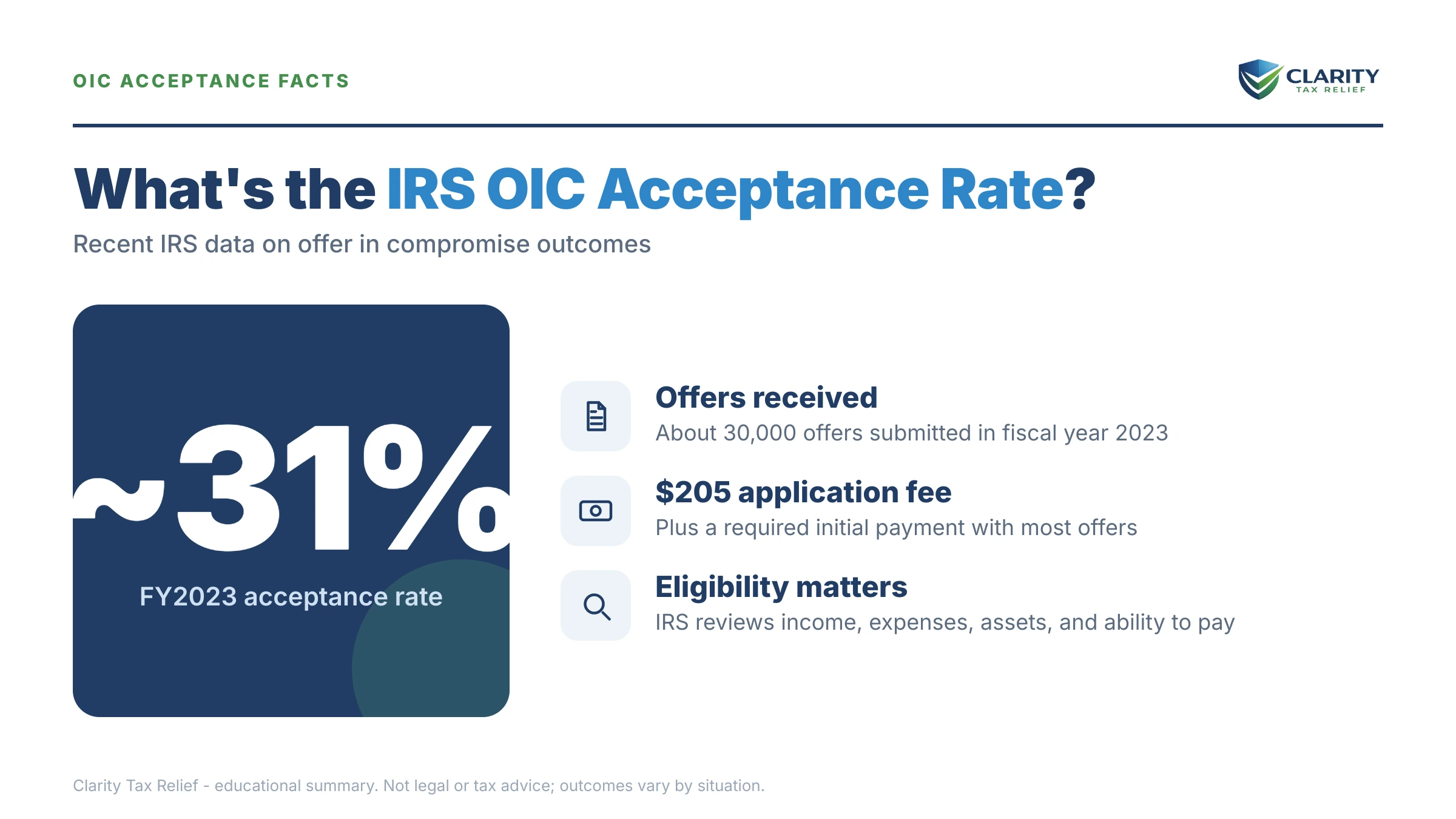
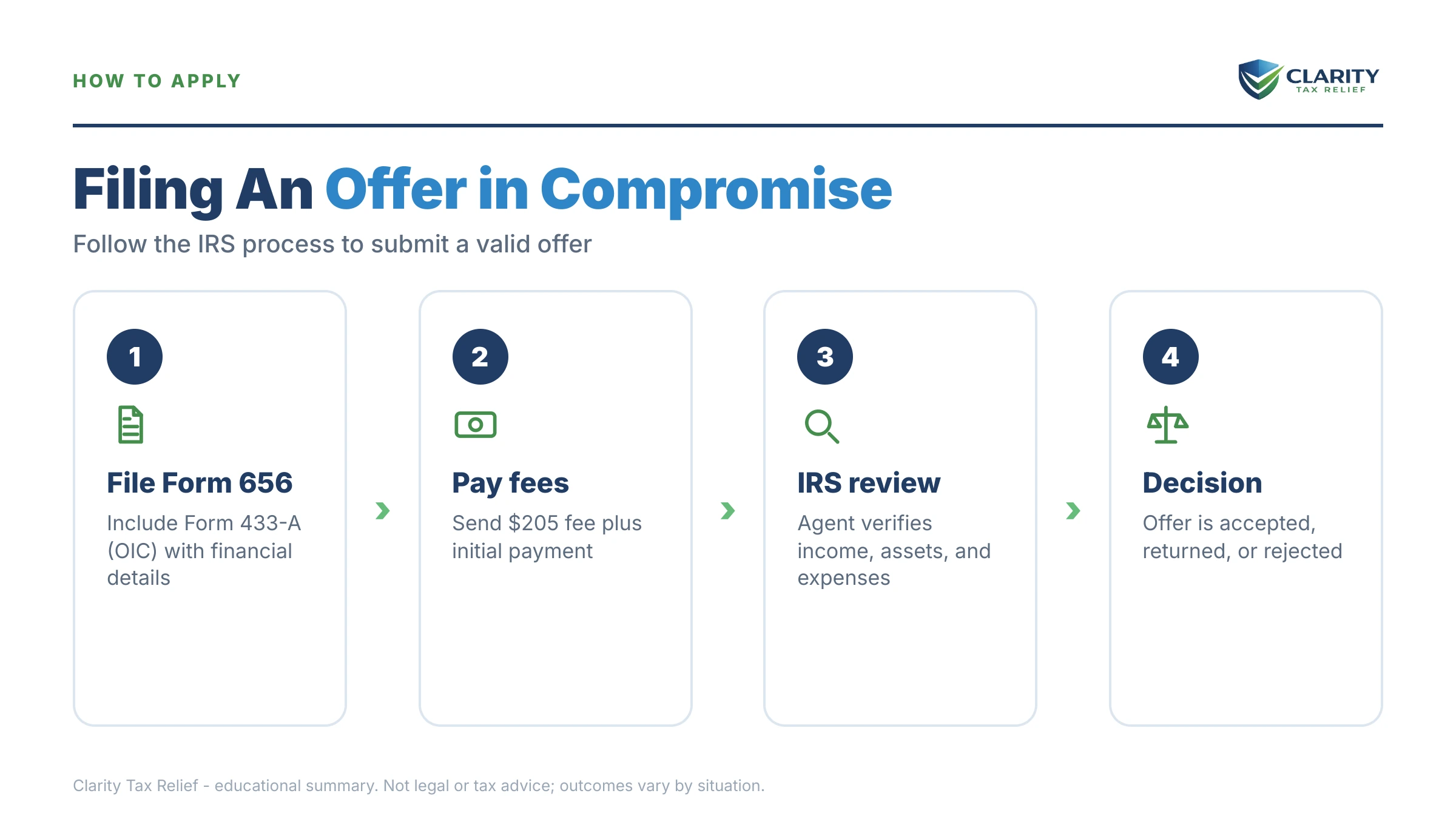
The image below maps the stages every offer travels from mailing to decision — including the two checkpoints where most offers fall out — so you'll know exactly which hurdle matters in your case.
⏱ The clocks that matter: there is no deadline to apply for an offer in compromise, but the 0.5% monthly late-payment penalty and daily interest keep growing on your balance while you decide. And if an offer is rejected, you generally have 30 days from the date on the rejection letter to appeal with Form 13711.
What the IRS offer in compromise acceptance rate really means
The IRS accepted roughly 1 in 5 offers in compromise in FY2024 — an acceptance rate of about 20%. That headline number is real, but it tells you almost nothing about your own odds until you understand what's inside it.
First, the rate only counts offers the IRS deemed "processable." Offers kicked back for unfiled returns, missing fees, or an open bankruptcy are "returned," not "rejected". They never enter the math. Counting those, the real-world success rate of everything mailed in is lower than 20%.
Second, the denominator is polluted. High-volume promoters mass-file offers for people whose finances could never support one, because the fee gets collected either way. Those doomed applications drag the average down for everyone. A well-screened offer — one filed only after the applicant's numbers actually clear the formula — succeeds far more often than the blended national figure suggests.
Third, there is no quota and no discretion budget. The IRS doesn't accept 20% because it decided to; 20% is simply how many offers cleared the math that year. Your case is effectively binary: the formula works for you or it doesn't. For the year-by-year IRS data behind the headline, see our breakdown of the offer in compromise acceptance rate, and for what's shifted this year specifically, the offer in compromise acceptance rate 2026 update.
One 2026 wrinkle worth knowing: with the IRS workforce cut roughly 27% in 2025, offer review times have stretched. That cuts both ways — decisions take longer, but by law an offer the IRS fails to decide within 2 years is automatically accepted. Few cases run that long, but the backlog makes the rule less theoretical than it used to be. If you're still learning what the program actually is, start with how an offer in compromise actually works. This page assumes the basics and focuses on the odds.
Why roughly 4 in 5 offers fail: the RCP formula behind the rate
The IRS rejects an offer whenever the amount offered falls below your Reasonable Collection Potential — the total it calculates it could collect from you through the end of the collection statute. Almost every rejection traces back to that one comparison, not to an examiner's mood or your story.
RCP has two parts. The first is net realizable equity in your assets: bank balances, vehicles above the IRS's allowance, and, critically for homeowners, your house, counted at roughly 80% of market value (the "quick-sale value") minus what you owe on it. Retirement accounts generally count too.
The second part is future income: your monthly income minus IRS-allowed living expenses, multiplied by 12 months for a lump-sum offer (24 for a periodic offer). Note the word allowed — the IRS caps most expense categories at national and local standards, not what you actually spend. A $3,000 mortgage payment in a county where the housing standard is $2,100 counts as $2,100, which quietly inflates your "disposable" income on paper.
Add the two parts together and you have the minimum the IRS will accept. The full mechanics, with the asset and expense worksheets, are in our guide to reasonable collection potential. The numbers come off Form 433-A (OIC). If you want a quick read on where your own numbers land, you can estimate your offer with our Offer in Compromise Calculator before spending anything.
| Factor | Effect on your offer |
|---|---|
| Offer at or above your RCP | The single biggest driver of acceptance — the math simply works |
| Significant home equity | Raises RCP dollar for dollar; the most common reason homeowner offers fail |
| Unfiled tax returns | Offer returned unreviewed; the $205 fee is kept |
| Expenses you can't document | Disallowed by the examiner, inflating your disposable income and RCP |
| Assets recently sold, gifted, or spent down | Can be added back into RCP as dissipated assets |
| Low-income certification (AGI at or below 250% of poverty) | Waives the fee, the down payment, and payments during review |
| New balance accrued while the offer is pending | Offer returned or rejected regardless of the underlying math |
Say you owe $23,800 and plan to refinance: the math that decides your odds
Home equity decides more homeowner offers than any other single number. Here's a clearly hypothetical example that shows why — built around a reader who owes $23,800 and is planning to refinance.
Say your house would sell for $340,000. The IRS values it at 80% quick-sale value: $272,000. Your mortgage payoff is $256,000, so your countable equity is $272,000 − $256,000 = $16,000. Add $2,000 in the bank and no vehicle equity above the allowance. On the income side, say you bring in $6,100 a month against $5,850 in IRS-allowed expenses — $250 of monthly disposable income, × 12 for a lump-sum offer = $3,000.
Your RCP: $16,000 + $2,000 + $3,000 = $21,000. Against a $23,800 balance, the minimum viable offer saves you about $2,800, and costs you the $205 fee, a $4,200 down payment (20% of $21,000), months of review. A paused collection statute. Worse for a refinancer: a federal tax lien can still be filed while the offer is pending. A recorded lien complicates underwriting — see does OIC remove a tax lien and can I refinance with an IRS lien before you file anything.
For this profile, a streamlined installment agreement is usually the smarter tool: $23,800 over 72 months is roughly $331 a month, interest and penalties still accrue so faster is cheaper. Your refinance timeline stays in your own hands — a cash-out at closing could clear the balance entirely. The side-by-side decision is mapped in IRS payment plan vs offer in compromise.
Now flip the facts: same $23,800 balance, but a renter with $2,000 in the bank and $50 of monthly disposable income. RCP = $2,000 + ($50 × 12) = $2,600. An offer near $2,600 is a genuine candidate. Same debt, opposite answer. That binary split is the entire story behind the 1-in-5 acceptance rate.
What a doomed offer actually costs you
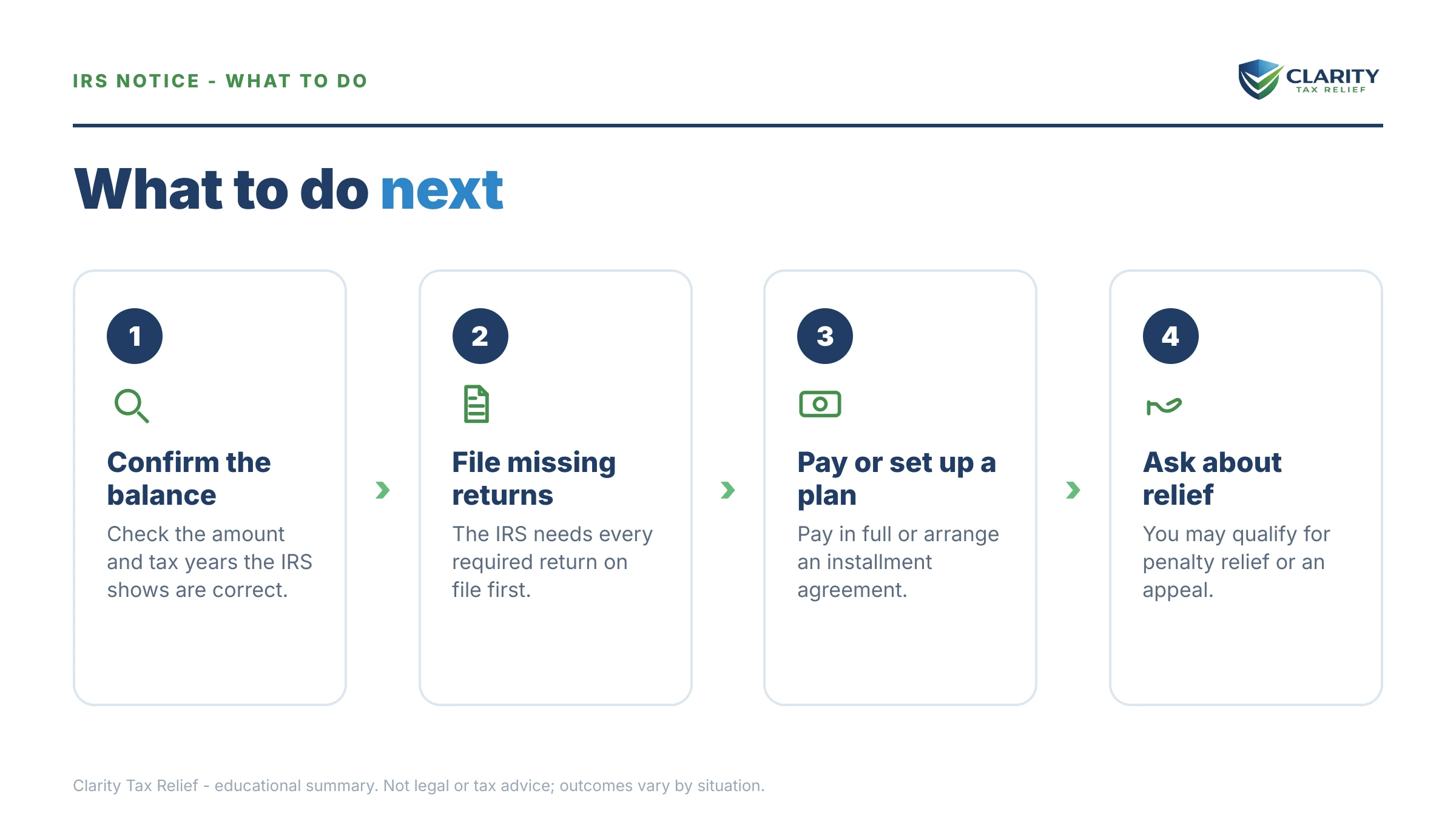
A rejected offer isn't a free spin. It costs money, months, and collection time, in a predictable sequence:
- You wait in line. The offer sits in review for months, and the 10-year collection statute is paused the entire time it's pending, giving the IRS extra runway to collect later.
- The processability screen. An unfiled return, missing fee, or open bankruptcy gets the package returned unreviewed. The $205 is kept, and returns can't be appealed.
- Examiner review. Undocumented expenses are disallowed and asset values recalculated — often pushing the IRS's RCP figure above your offer even when your own worksheet looked fine.
- The rejection letter. Your 20% down payment isn't refunded — it's applied to the balance. What happens to each dollar you sent is covered in OIC down payment refundable.
- The 30-day fork. You can appeal the rejection with Form 13711, or the case flows back to collections, with a larger balance and a longer collection window than when you started.
| Stage | Window | The right or risk at stake |
|---|---|---|
| Applying | No deadline, but interest and the 0.5% monthly penalty accrue while you wait | Once the offer is pending, the 10-year collection statute pauses |
| Processability screen | The first checkpoint after the IRS receives Form 656 | Returned offers can't be appealed — only corrected and refiled |
| Review and decision | Commonly months; automatic acceptance if the IRS doesn't decide within 2 years | Levies are generally suspended while the offer is pending |
| Rejection | Generally 30 days from the date on the rejection letter | Appeal on Form 13711 keeps your original offer alive |
| After acceptance | 5 years of on-time filing and payment | Default reinstates the original balance, less payments made |
Not sure which side of the 1-in-5 line you're on?
Before you commit $205, a 20% down payment, and months of paused collection statute to guesswork — get your RCP math run free. An experienced tax professional will tell you honestly whether your numbers point to an offer, a payment plan, or penalty relief, while interest and penalties are still small.
Your options when the acceptance math doesn't work
An offer in compromise is one of five real tools, and for most people whose RCP sits at or above their balance, one of the other four is cheaper and faster. Here's the field, with what each costs and how long it takes:
| Option | Upfront cost | Typical timeline | Best fit |
|---|---|---|---|
| OIC — lump sum | $205 fee + 20% of the offer down (both waived with low-income certification) | Months to a year+ in review; balance settled on acceptance | RCP clearly below your total balance |
| OIC — periodic payment | $205 fee + first monthly offer payment; payments continue during review | Same review window; offer paid in monthly installments | Low RCP but no cash for a 20% down payment |
| Short-term payment plan | $0 setup | Up to 180 days to pay in full | Balances you can clear within six months |
| Streamlined installment agreement | Setup fee applies (reduced with direct debit) | Up to 72 months on balances of $50,000 or less | RCP at or above your balance — most homeowners |
| Currently Not Collectible | $0 | Collection paused while hardship lasts; reviewed periodically | Nothing left after basic living costs |
| Penalty abatement (FTA, or automatic AEP from summer 2026) | $0 | One request; often the fastest relief on the list | Clean compliance history in the prior 3 years |
Two notes on that last row. First-time abatement isn't the only path anymore — starting summer 2026, the Automatic Exemption from Penalty (AEP) applies qualifying relief without a request. And penalty relief stacks with everything else on the table: shrinking the balance first changes the math on every other option, including the offer itself.
Situations that change your OIC acceptance odds
The same balance produces different acceptance odds depending on who owes it and how. These are the fact patterns that move the formula most:
Married couples and joint balances
A jointly assessed debt means a joint offer — both incomes and both spouses' assets enter RCP. When only one spouse owes, the IRS still looks at household income to prorate shared expenses. But the non-liable spouse's separate assets stay out of the calculation. Community-property states shift that analysis, so run the numbers both ways before choosing how to file.
Self-employed and business owners
Business bank accounts, receivables, and equipment all land on the asset side, and irregular income makes the future-income figure a negotiation rather than a lookup. Documentation standards are higher and examiner pushback more common — the specifics are in OIC self employed.
Multiple tax years
One Form 656 covers every assessed balance you owe. It must list all of them — you can't settle 2021 while leaving 2023 out. Any unfiled year blocks processability entirely, so the filing cleanup comes first, always.
You think the balance is wrong
If your real argument is that you don't owe the money, you want the doubt-as-to-liability track (Form 656-L), which argues the debt itself rather than your ability to pay — no RCP math involved. See offer in compromise doubt as to liability.
Low income
If your AGI is at or below 250% of the federal poverty level, low-income certification waives the $205 fee, the 20% down payment, and payments during review — an offer costs you nothing to try. Details and the income table are in OIC low income certification.
State tax debt
An IRS acceptance means nothing to your state. States run separate settlement programs with their own criteria and their own math — California's Franchise Tax Board, for example, has its own FTB offer in compromise process. Never assume a federal result carries over.
How to raise your OIC acceptance odds, step by step
- File every required return first. The IRS returns offers from non-filers without reviewing them and keeps the $205 fee. Confirm every year shows as filed on your account transcript before you mail anything.
- Run your Reasonable Collection Potential math. Add your net asset equity to 12 months of disposable income (24 for a periodic offer). If the result meets or beats your balance, stop — the offer will fail.
- Document every expense you claim. Examiners disallow anything unproven on Form 433-A (OIC), which inflates your disposable income. Attach statements for housing, insurance, medical costs, and court-ordered payments.
- Offer at or slightly above your RCP. The examiner compares your number to theirs. An offer your own worksheet can't support invites rejection; one that matches the math gives them no reason to say no.
- Stay compliant while the offer is pending. A missed estimated payment or a new unpaid balance during review gets an otherwise sound offer kicked back.
- Appeal a rejection instead of starting over. You generally have 30 days from the date on your rejection letter to file Form 13711, which keeps your original offer alive and puts fresh eyes on the math.
The most common preventable rejection reasons, and how to fix each before mailing — are collected in how to get an OIC accepted.
When you can handle an offer yourself, and when help changes the outcome
Plenty of accepted offers are filed without professional help, and honesty requires saying so. You're a reasonable DIY candidate if you have W-2 income only, few assets, an RCP that's obviously far below your balance. The patience to assemble Form 433-A (OIC) with full documentation. If you qualify for low-income certification, applying costs you nothing — the fee, down payment, and interim payments are all waived, so even a miss is cheap. The IRS's own program page at IRS.gov: Offer in Compromise includes a pre-qualifier screening tool worth running first.
Experienced help changes outcomes in a narrower set of cases: home equity that sits near the accept/reject line (where quick-sale valuation and payoff timing are arguable), self-employment income the examiner will contest, recently moved money that risks a dissipated-asset add-back, a prior rejection headed to appeal, or a refinance timeline a lien filing could wreck. Those aren't paperwork problems — they're judgment calls where the difference between positions is measured in thousands of dollars. And if a pending offer stalls or gets mishandled inside the IRS, the Taxpayer Advocate Service exists precisely for that. If the answer is a payment plan instead, the mechanics live at IRS.gov: payment plans.
Terms on the OIC paperwork, decoded
- Reasonable Collection Potential (RCP): the IRS's calculation of the most it could collect from you — net asset equity plus a multiple of your monthly disposable income — and the number your offer is judged against.
- Quick-sale value: roughly 80% of an asset's market value, the discount the IRS applies before counting your equity.
- Doubt as to collectibility: the main offer track. You owe the money, but your finances can't produce it before the collection statute ends.
- Doubt as to liability: the alternate track (Form 656-L) arguing the assessed debt itself is wrong.
- Processable vs. returned: a processable offer enters review; a returned one was rejected at the door — no review, no appeal rights, fee kept.
- Offer default: breaking the post-acceptance terms, five years of on-time filing and payment, which reinstates the original balance minus what you paid.
If your worksheet lands within a few thousand dollars of your balance and you can't tell which way it tips, one free call with an experienced tax professional at (888) 825-7779, or the 2-minute form — will settle whether an offer or a payment plan is your cheaper path.
OIC acceptance rate questions, answered
What is the IRS offer in compromise acceptance rate right now?
The IRS accepted roughly 1 in 5 offers in compromise in FY2024 — about a 20% acceptance rate. That figure only counts offers the IRS actually reviewed; offers returned as unprocessable for unfiled returns or missing fees never enter the count. Your personal odds depend almost entirely on how your offer compares to your Reasonable Collection Potential, not on the national average.
Why does the IRS reject most offers in compromise?
Most rejections happen because the offer is lower than the IRS's Reasonable Collection Potential. Your net asset equity plus 12 or 24 months of disposable income. The formula is mechanical, so an offer below that number fails no matter how sympathetic your circumstances are. The second most common killer is documentation: expenses you can't prove get disallowed, which raises your calculated disposable income and your RCP.
How long does the IRS take to decide an offer in compromise?
Expect months, and complex offers can run a year or longer — 2026 staffing cuts have stretched review times further. By law, an offer the IRS fails to decide within 2 years is automatically accepted, though very few cases reach that point. The 10-year collection statute is paused the entire time your offer is pending, so a failed offer leaves the IRS extra time to collect.
Do I lose my money if my offer in compromise is rejected?
You lose the $205 application fee, but the 20% down payment on a lump-sum offer is applied to your tax balance rather than refunded, so it reduces what you owe either way. Taxpayers who qualify for low-income certification — adjusted gross income at or below 250% of the federal poverty level — pay no fee, no down payment, and nothing during review, which removes most of the financial risk of applying.
Can I appeal a rejected offer in compromise?
Yes. You generally have 30 days from the date on your rejection letter to request an appeal on Form 13711. Appeals go to the IRS Independent Office of Appeals, which regularly revisits examiner math — disputed expense allowances and asset valuations are the items most often adjusted. A returned offer, by contrast, carries no appeal rights; you fix the defect and refile.
Does home equity hurt my chances of OIC acceptance?
Usually, yes. The IRS counts your home at roughly 80% of market value, the quick-sale value, minus what you owe on it. That net equity goes straight into your Reasonable Collection Potential. For many homeowners, equity alone pushes RCP above the tax balance, which makes an acceptable offer mathematically impossible and a payment plan the better tool.
Can I apply for an offer in compromise while I'm on a payment plan?
Yes — an existing installment agreement doesn't disqualify you, and your monthly plan payments are generally suspended while the offer is under review. If the offer is rejected or returned, the agreement picks back up. Remember that the pending offer pauses the 10-year collection statute either way, so weigh that trade before filing an offer that's unlikely to clear your RCP.
What's the difference between a returned offer and a rejected offer?
A returned offer never got reviewed — the IRS sent it back as unprocessable, usually over unfiled returns, a missing fee, or an open bankruptcy. It carries no appeal rights. A rejected offer was fully reviewed and denied on the numbers, and it comes with roughly 30 days to appeal. Returned offers also don't count in the published acceptance rate, which quietly makes real-world odds worse than the headline number.
Does a pending offer in compromise stop IRS collection?
Generally the IRS won't levy while a processable offer is pending, which is why some promoters push doomed offers as a stall tactic. But interest and the 0.5% monthly late-payment penalty keep accruing, a federal tax lien can still be filed. The collection statute is paused, so a bad-faith offer buys quiet time at the price of a bigger balance and a longer collection window.
Your next 24 hours
- Pull your exact balance. Log in to your IRS online account and write down the total across every year you owe — an offer has to cover all of them. The acceptance math starts from that number.
- Gather the RCP inputs. Your last filed return, a current mortgage statement with a realistic home-value estimate, two months of pay stubs. Your core monthly bills — that's everything the formula needs.
- Get the math checked free. Call (888) 825-7779 or use the 2-minute form. An experienced tax professional will run your acceptance odds before another month of penalties and interest is added to the balance the formula runs against.
This guide is general information, not tax or legal advice for your specific situation. Eligibility for IRS programs depends on individual facts and circumstances; no outcome is guaranteed.