
Offer in Compromise
OIC Low-Income Certification: Who Qualifies and What It Waives in 2026
The short answer: the OIC low income certification waives the $205 application fee, the 20% down payment on lump-sum offers, and all monthly payments while the IRS reviews your offer. You qualify if your adjusted gross income, or your current household income annualized — is at or below 250% of the federal poverty guidelines for your family size.
You've run the numbers, decided an offer in compromise is your way out, and then hit the wall: the IRS wants $205 plus 20% of your offer just to consider it — money it keeps even if the answer is no. The certification is the built-in exit from that wall, and claiming it takes one checkbox on one form.
That checkbox lives in Section 1 of Form 656, right next to a table of income thresholds by family size. The image below shows you exactly what that section of the form looks like and where to look, so you can find it on your own copy in seconds.
⏱ The real clock: there's no deadline to claim the certification. You claim it the day you file Form 656. But penalties and interest keep accruing on your full balance every month until an offer is accepted or the debt is paid, so every month you wait to file, the debt underneath the offer grows.
What the OIC low-income certification actually is
The OIC low-income certification waives every upfront cost of filing an offer in compromise: the $205 application fee, the 20% down payment on lump-sum offers. The monthly payments periodic offers normally require during review. It's a self-certification. You check the box, attest your income qualifies, and file with $0 attached.
Congress built this into the program on purpose. An offer in compromise exists for people the IRS realistically can't collect from in full, and many of those same people can't spare thousands of dollars for a nonrefundable application. The certification removes that contradiction. (New to offers entirely? Start with how an offer in compromise actually works, then come back. This page covers only the certification itself.)
One boundary up front: the certification is for individuals. A corporation or partnership filing its own offer pays the fee and payments no matter its finances — more on that below.
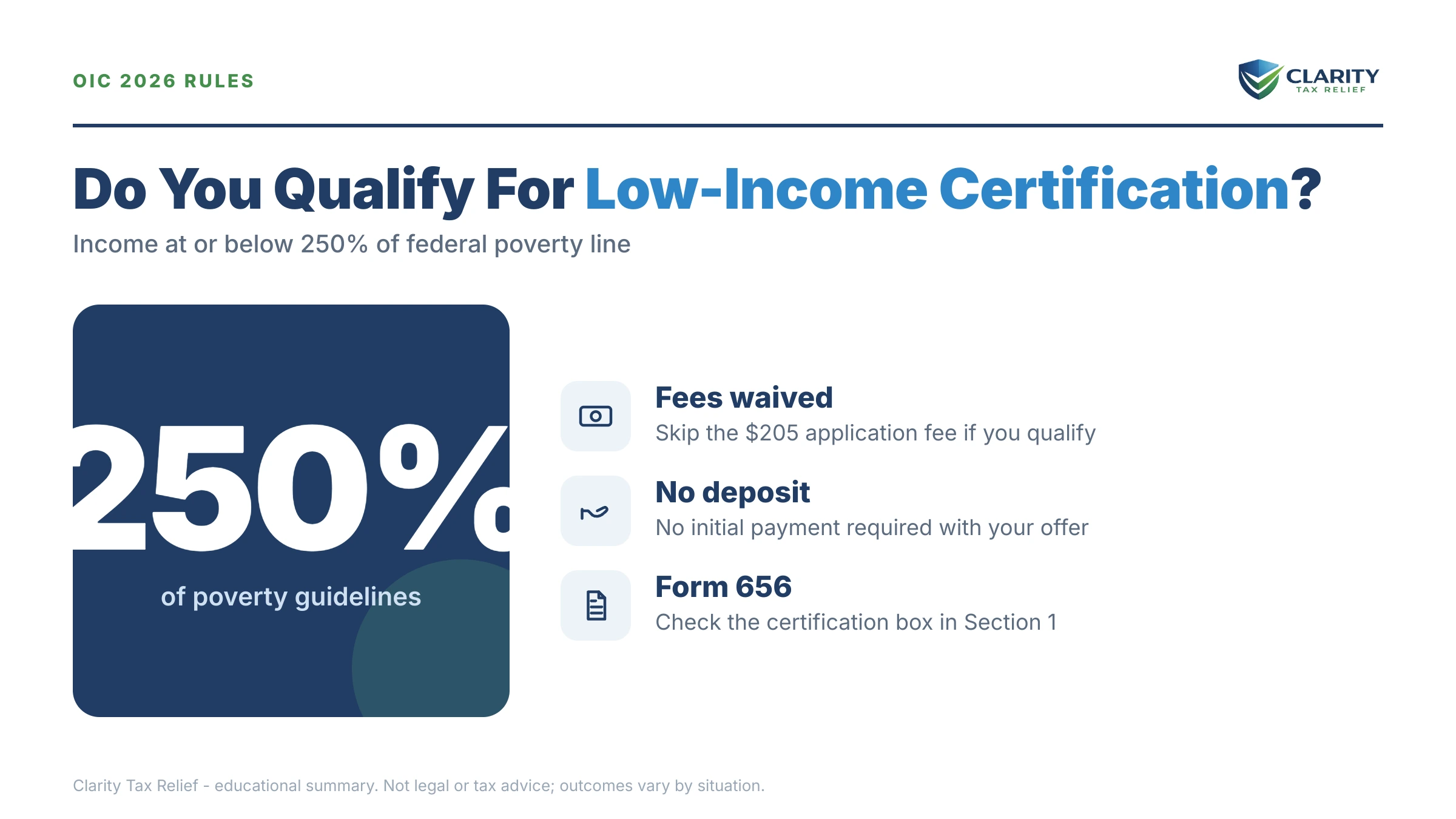
“If you meet the low income certification guidelines You don't have to: Send the application fee or the initial payment. Make monthly installments while we review your offer.”
— Offer in compromise (IRS.gov)
Do you qualify for the OIC low-income certification? The two income tests
You qualify for the OIC low-income certification if either your adjusted gross income or your annualized current household income is at or below 250% of the federal poverty guidelines for your family size. You only need to pass one test, and you get to pick whichever one favors you.
The exact dollar thresholds are printed in a table inside Section 1 of Form 656, broken out by family size, with separate, higher tables for Alaska and Hawaii. Because HHS updates the poverty guidelines every year, always use the table on the current revision of the form rather than a number you found online.
| Test | What's measured | Where the number comes from | When it's the better test |
|---|---|---|---|
| Test 1: AGI | Adjusted gross income for your most recent tax year | The AGI line of your last filed Form 1040 | Your income was already low last year |
| Test 2: Household income | Current gross monthly household income × 12 | Recent pay stubs, benefit statements, business records for everyone in the household | Your income dropped recently — job loss, retirement, illness, a closed business |
Test 2 is the one most people overlook. If you earned well last year but got laid off in March, your AGI may fail while your current household income passes easily. The reverse also happens: a new job can push current income over the line while last year's AGI still qualifies. Run both tests before deciding you don't qualify.
Note the word household: Test 2 counts gross income for everyone living in your home, including a spouse who has nothing to do with the tax debt. That's the same household the family-size column counts, so a bigger household raises your threshold too.
| Filer type | Can claim the certification? |
|---|---|
| Individual (Form 1040 debt) | Yes — if either income test passes |
| Sole proprietor (Schedule C) | Yes — tested on household income, same as any individual |
| Married couple filing a joint offer | Yes — tested on combined household income and full family size |
| Corporation, partnership, or multi-member LLC filing as an entity | No — the entity pays the $205 fee and required payments regardless of income |
What it costs to skip, or misclaim, the certification
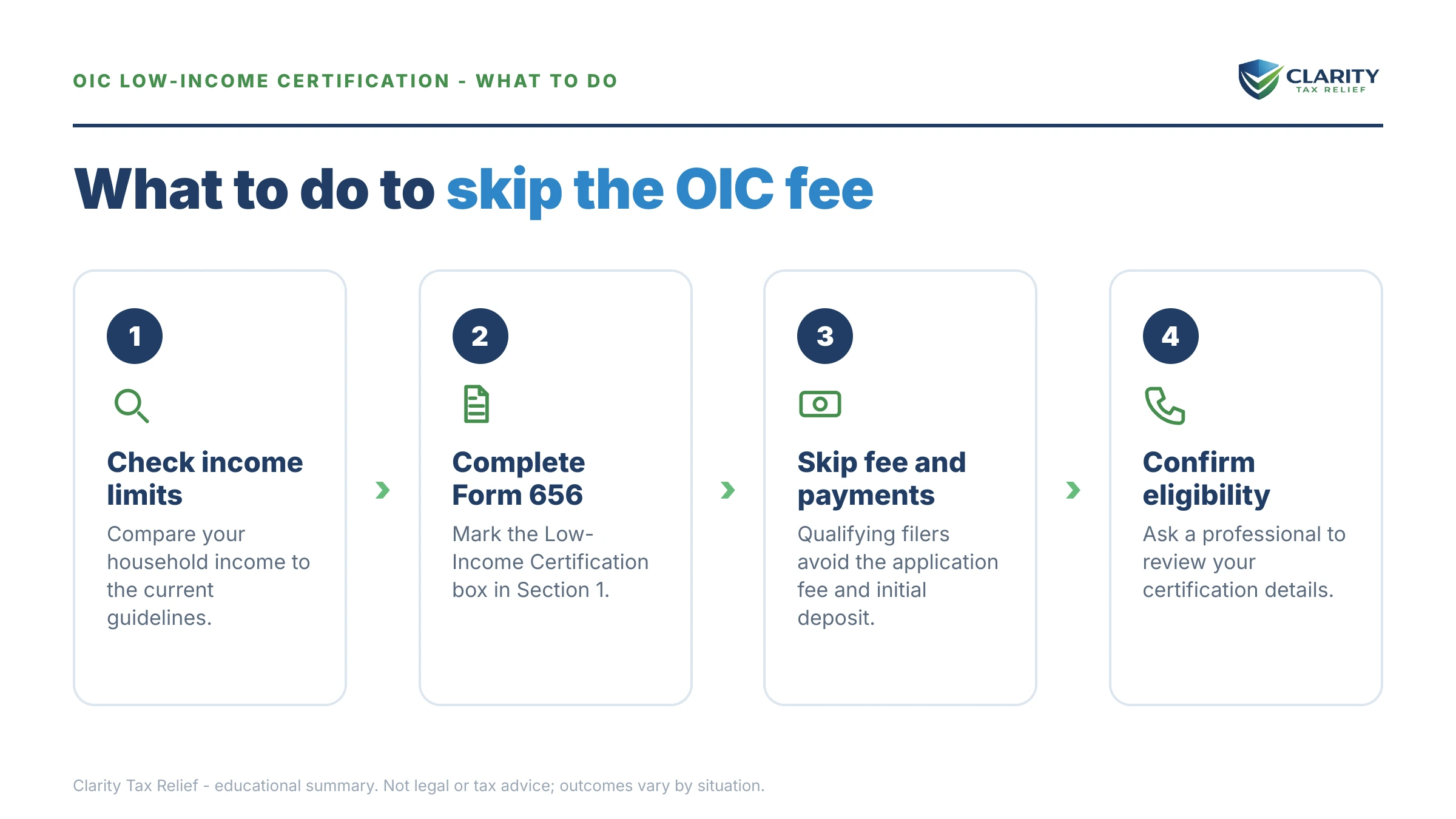
Filing an offer without the certification puts $205 plus 20% of your offer amount at risk the moment you mail the package. Getting the checkbox wrong in either direction has a predictable sequence of consequences:
- You qualify but leave the box unchecked. You send the $205 fee plus a 20% down payment you never owed. The fee is never refunded, and the down payment is applied to your tax debt, not returned, even if the offer is rejected. (Full detail: is your OIC down payment refundable? Almost never.)
- You check the box but don't actually qualify — the IRS catches the mismatch against your return and Form 433-A (OIC), then contacts you demanding the fee and any required payments before processing continues.
- You don't respond to that demand — the offer is returned as not processable. A return is not a rejection: there are no appeal rights, and collection activity on the full balance resumes.
- On every path, the meter runs — interest accrues on the entire debt throughout review. A returned or rejected offer means you owe more than when you started.
One quieter stake worth knowing: at a balance like $83,100 you're above the $66,000 passport-certification threshold for 2026. A properly pending offer generally keeps your debt off the State Department referral list. An offer returned over a botched certification loses that protection along with everything else.
Filing an offer and not sure the certification box applies to you?
Send us your income numbers before you mail Form 656. An experienced tax professional will run both certification tests and sanity-check your offer amount — free, confidential, and before a nonrefundable dollar leaves your account.
What the certification waives, and what it doesn't change
The low-income certification changes what you pay to apply. It does not change the offer amount the IRS will accept. Here is the full ledger:
| Cost item | Without certification | With certification |
|---|---|---|
| $205 application fee | Due with Form 656; nonrefundable | Waived — $0 |
| 20% down payment (lump-sum offers) | Due with the application; applied to your debt even if rejected | Waived — $0 |
| Monthly payments during review (periodic offers) | Required every month while the offer is pending | Waived — $0 during review |
| The offer amount itself, if accepted | Full offer, on the schedule you proposed | Same — the certification never reduces what you must pay |
What it doesn't change matters just as much. The IRS still evaluates your offer on Reasonable Collection Potential. Your countable asset equity plus a multiple of your future monthly income. A certified offer gets no easier grading. The offer in compromise acceptance rate 2026 data shows the IRS accepted roughly 1 in 5 offers in FY2024, certified or not. You can estimate your own numbers with our Offer in Compromise Calculator before you file.
It also doesn't stop interest, and it doesn't speed up review. What it does do, beyond the money, is remove the review-period cash squeeze: a non-certified periodic filer keeps writing monthly checks the whole time the IRS deliberates, while a certified filer pays nothing until there's an answer. And under the law, if the IRS doesn't decide within 2 years, the offer is deemed accepted automatically, with narrow exceptions - a returned or rejected offer stops the clock, and time during court disputes does not count.
Worked example: an $83,100 debt, a homeowner, and $8,565 you don't have to send
Say you owe the IRS $83,100 across two tax years. You own a home worth about $312,500 with a $210,000 mortgage, you're hoping to refinance. A layoff has cut household income to $3,400 a month for a family of four — comfortably under the 250% threshold printed in the Form 656 table, so Test 2 qualifies you even if last year's AGI wouldn't.
The offer math, step by step:
- Home equity: the IRS typically values assets at quick-sale value, around 80% of market value. $312,500 × 80% = $250,000, minus the $210,000 mortgage = $40,000 in countable equity.
- Future income: $3,400 income minus $3,250 in allowable living expenses leaves $150 a month. A lump-sum offer multiplies that by 12: $1,800. (The multiplier and the expense caps are where offers live or die — see how the IRS calculates your future income.)
- Reasonable Collection Potential: $40,000 + $1,800 = $41,800 — realistically the minimum offer the IRS would accept, even though it's only about half the $83,100 debt.
Now the certification's dollar impact. Without it, filing that $41,800 lump-sum offer costs $8,565 on day one — the $205 fee plus a 20% down payment of $8,360 — and none of it comes back if the offer fails. With the certification: $0 at filing. If the IRS accepts, you fund the $41,800 within five months of acceptance, which is exactly where a cash-out refinance can come in.
Two cautions for the refinance plan. First, timing: pulling cash out before you file converts home equity into countable cash and can raise your required offer. Second, if a federal tax lien has already been filed, underwriting gets complicated — read can I refinance with an IRS lien before you apply, because lien subordination is often the missing step.
How to claim the OIC low-income certification, step by step
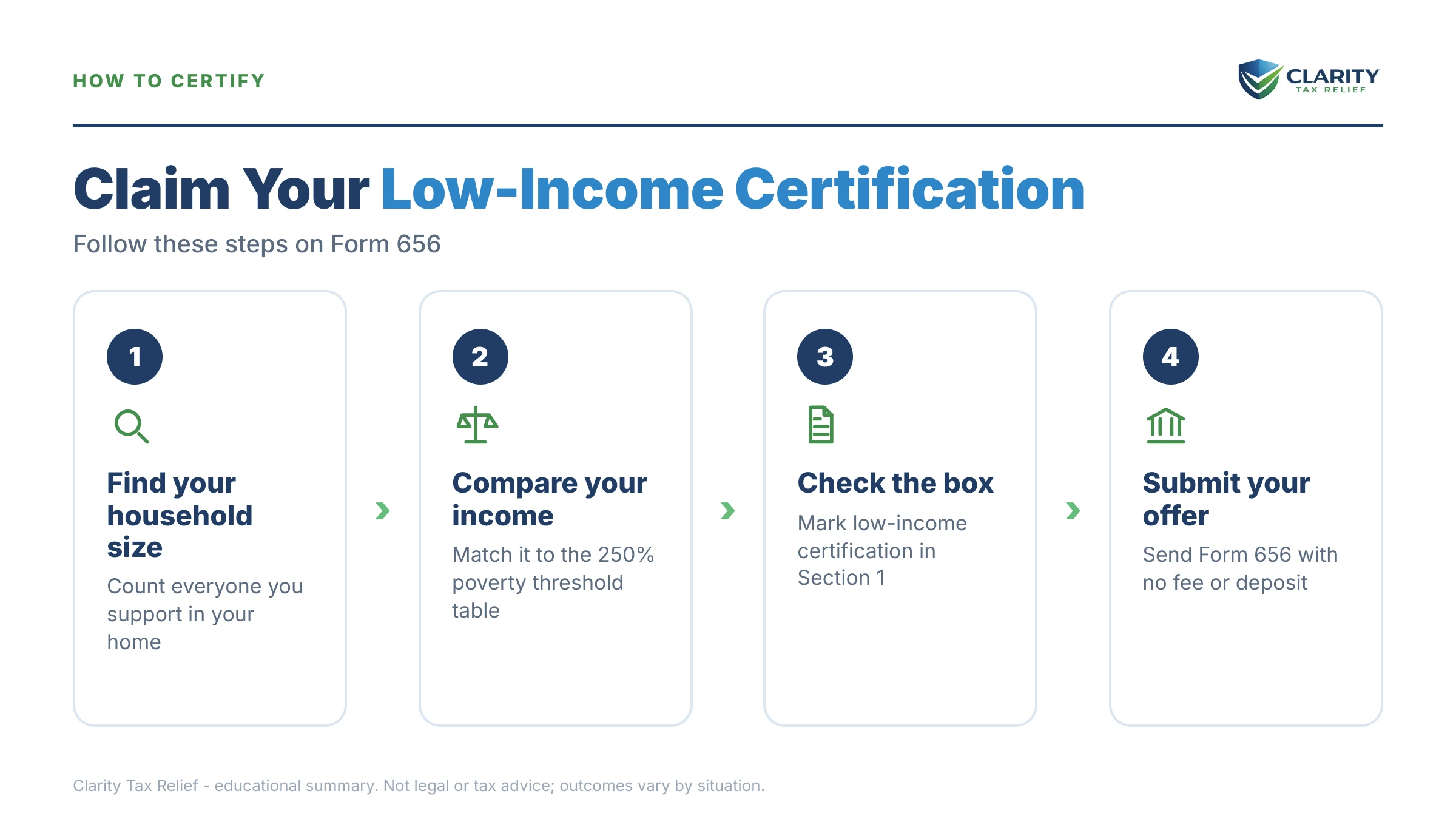
- Find your AGI. Pull your most recently filed Form 1040 and note the adjusted gross income line — this is your Test 1 number.
- Total your household income. Add every household member's gross monthly income and multiply by 12 — this is your Test 2 number.
- Compare against the Form 656 table. Check both numbers against the 250%-of-poverty table printed in Section 1 of Form 656 for your family size and state.
- Check the Low-Income Certification box. If either number is at or below the threshold, mark the certification box in Section 1 of Form 656.
- File with nothing attached. Submit Form 656 with Form 433-A (OIC) and your documentation — send no application fee and no down payment.
- Keep your proof. Save the tax return and pay stubs you used to qualify in case the IRS asks to verify your certification.
The offer package itself — 433-A (OIC) attachments, payment terms, offer amount — is a bigger project than the checkbox. Our Form 656 walkthrough covers the rest of the form line by line, and lump-sum vs. periodic OIC payment options explains which structure the certification pairs best with.
When you can handle this yourself
Checking the low-income certification box is a do-it-yourself task when your income is clearly below the threshold. If your household income sits comfortably under the table figure for your family size on both tests, you don't need to pay anyone to confirm it — check the box, keep your proof, and put your energy into the offer itself. If you qualify for the certification, you likely also qualify for free representation through a Low Income Taxpayer Clinic, which is worth knowing before you sign any paid engagement.
Experienced help changes outcomes in the harder versions of this situation: income hovering right at the 250% line (which test, and when to file after an income drop, can decide it). Meaningful home equity or a planned refinance that reshapes the RCP math. Self-employment income the IRS will scrutinize. Or a prior offer that already came back. And if your offer is rejected rather than returned, the 30-day window for appealing an OIC rejection with Form 13711 is short enough that having someone who has done it before genuinely matters.
Terms on Form 656, decoded
Six terms you'll hit in Section 1 and the instructions, in plain English:
- AGI (adjusted gross income): your total income minus specific deductions — the single number printed on your Form 1040 that Test 1 uses.
- Federal poverty guidelines: income levels by family size that HHS updates every year. The certification threshold is 250% of them, with higher tables for Alaska and Hawaii.
- Lump-sum offer: an offer paid in five or fewer installments within five months of acceptance — the type that normally requires the 20% down payment.
- Periodic payment offer: an offer paid monthly over a longer schedule — the type that normally requires payments during review.
- Reasonable Collection Potential (RCP): the IRS's calculation of the most it could ever collect from you, asset equity plus future income. The floor your offer must meet.
- Returned vs. rejected: a returned offer was never evaluated and carries no appeal rights. A rejected offer was evaluated and denied, and can be appealed within 30 days.
OIC low-income certification questions, answered
What income counts for the OIC low-income certification?
Two numbers can qualify you. You only need one: the adjusted gross income on your most recently filed tax return, or your current gross monthly household income multiplied by 12. Either must be at or below 250% of the federal poverty guidelines for your family size. Household income includes everyone in your home, not just you, so a spouse's wages count even if the tax debt is yours alone.
Does the low-income certification improve my chances of getting an offer accepted?
No. The certification changes what you pay to apply, not how the IRS evaluates the offer — acceptance still comes down to the same Reasonable Collection Potential math everyone faces. The IRS accepted roughly 1 in 5 offers in FY2024. Where it helps is risk: a certified filer has no fee or down payment on the line if the answer is no.
Do businesses qualify for the OIC low-income certification?
Only individuals can claim it, and that includes sole proprietors who file a Schedule C. Corporations, partnerships, and LLCs submitting an offer as a business entity must pay the $205 application fee and the required payments no matter how little the business earns. If the debt is on your personal return — for example, pass-through income — you may still certify on your individual offer if your household income qualifies.
Is the low-income fee waiver automatic, or do I have to request it?
You have to claim it by checking the Low-Income Certification box in Section 1 of Form 656 when you file your offer — the IRS does not apply it for you. There is no separate application or approval letter. The IRS can check your figures against your return and the financial statement on Form 433-A (OIC), so make sure the box matches your real numbers.
What happens if the IRS decides I don't actually qualify as low-income?
The IRS will typically contact you and ask for the $205 fee and any required payments before processing continues. If you don't respond, the offer can be returned as not processable — a return is not a rejection, so there are no appeal rights, and collection activity resumes. Answer quickly with payment or documentation supporting your income figures to keep the offer alive.
Do I still make monthly payments while the IRS reviews my offer if I'm certified?
No. Certified taxpayers skip the monthly payments that periodic-payment offers normally require during review, and OIC reviews commonly stretch many months. Interest still accrues on the underlying debt while the offer is pending, though, and if the offer is accepted you must then pay the full offer amount on the schedule you proposed.
If my offer is rejected, do I get my fee and payments back?
For non-certified filers, no — the $205 fee is non-refundable, and any down payment or monthly payments are applied to your tax debt rather than returned. That is exactly what the certification protects you from: a certified filer whose offer is rejected has lost nothing but time. Either way, you generally have 30 days to appeal a rejection using Form 13711.
Can I claim the certification if I own a home?
Yes — the certification tests income only, so home equity has no effect on whether you qualify for the waiver. Equity absolutely affects the offer itself: the IRS counts available equity when setting the minimum it will accept, so low income plus substantial equity usually means a larger required offer, not a lost certification. Time any refinance carefully, because pulling out cash changes that math.
Your next 24 hours
- Find your AGI. Pull your last filed Form 1040, circle the adjusted gross income line, and set it next to the 250% table in Section 1 of the current Form 656.
- Gather the Test 2 evidence. Collect the last few pay stubs or benefit statements for everyone in your household, plus a rough list of what you own and owe — you'll need all of it for Form 433-A (OIC) anyway.
- Get the numbers checked before you file. Request a free case review at the 2-minute form or call (888) 825-7779 — interest is accruing on the full balance every month you wait. The certification decision is far cheaper to get right than to unwind.
Primary sources: the IRS's official Offer in Compromise page, the current Form 656 and its instructions (which contain the low-income certification table), and the Taxpayer Advocate Service for help when an offer stalls.
This guide is general information, not tax or legal advice for your specific situation. Eligibility for IRS programs depends on individual facts and circumstances; no outcome is guaranteed.