
Offer in Compromise
Does an OIC Remove a Tax Lien? What Really Happens Before, During, and After Your Offer (2026)
The short answer: no — an accepted Offer in Compromise doesn't remove a federal tax lien right away. The IRS releases the lien within 30 days after you pay your offer in full and satisfy its terms. Until that final payment posts, the lien stays filed, and the IRS can file a new one while your offer is pending.
You did the hard part — submitted the offer, maybe even got the acceptance letter — and then a title company, a lender, or a county records search told you the lien is still sitting there under your name. That's jarring, but it doesn't mean anything went wrong. If you're searching "does an OIC remove a tax lien," the honest answer is yes, eventually — on a specific clock that starts at your final offer payment, not at acceptance, and this guide maps every stage of it.
The image below shows exactly what a recorded Notice of Federal Tax Lien looks like and where to find the tax years, the amounts, and the refile deadline that controls the filing's lifespan — pull yours up alongside it as you read.
⏱ The clock that matters: the IRS must release a federal tax lien within 30 days after your offer amount is paid in full and every term is met (IRC §6325(a)). That 30-day release clock starts at your final offer payment, not at your acceptance letter. Until then, interest-free waiting doesn't exist: the underlying balance keeps accruing until the offer resolves it.
Why the tax lien exists, and why an accepted OIC doesn't erase it
A federal tax lien survives OIC acceptance because the lien is the government's collateral, and collateral isn't returned until the deal is fully paid. The lien itself arises automatically, by statute, the moment tax is assessed and goes unpaid. The Notice of Federal Tax Lien (NFTL) is the separate public document the IRS records at your county office, and with a balance like $54,600, well past the point where the IRS typically records one, most offer candidates already have a filing on record before Form 656 ever goes in the mail.
Your acceptance letter and the fine print of Form 656 say it plainly: the lien stays in place until the offered amount is paid and all terms are satisfied. Acceptance changes what you owe; only full payment of the offer changes the lien.
If you're still deciding whether an offer fits your situation at all, the mechanics of the program live in our guide to how an offer in compromise works. This page stays focused on what the offer does, and doesn't do, to the lien.
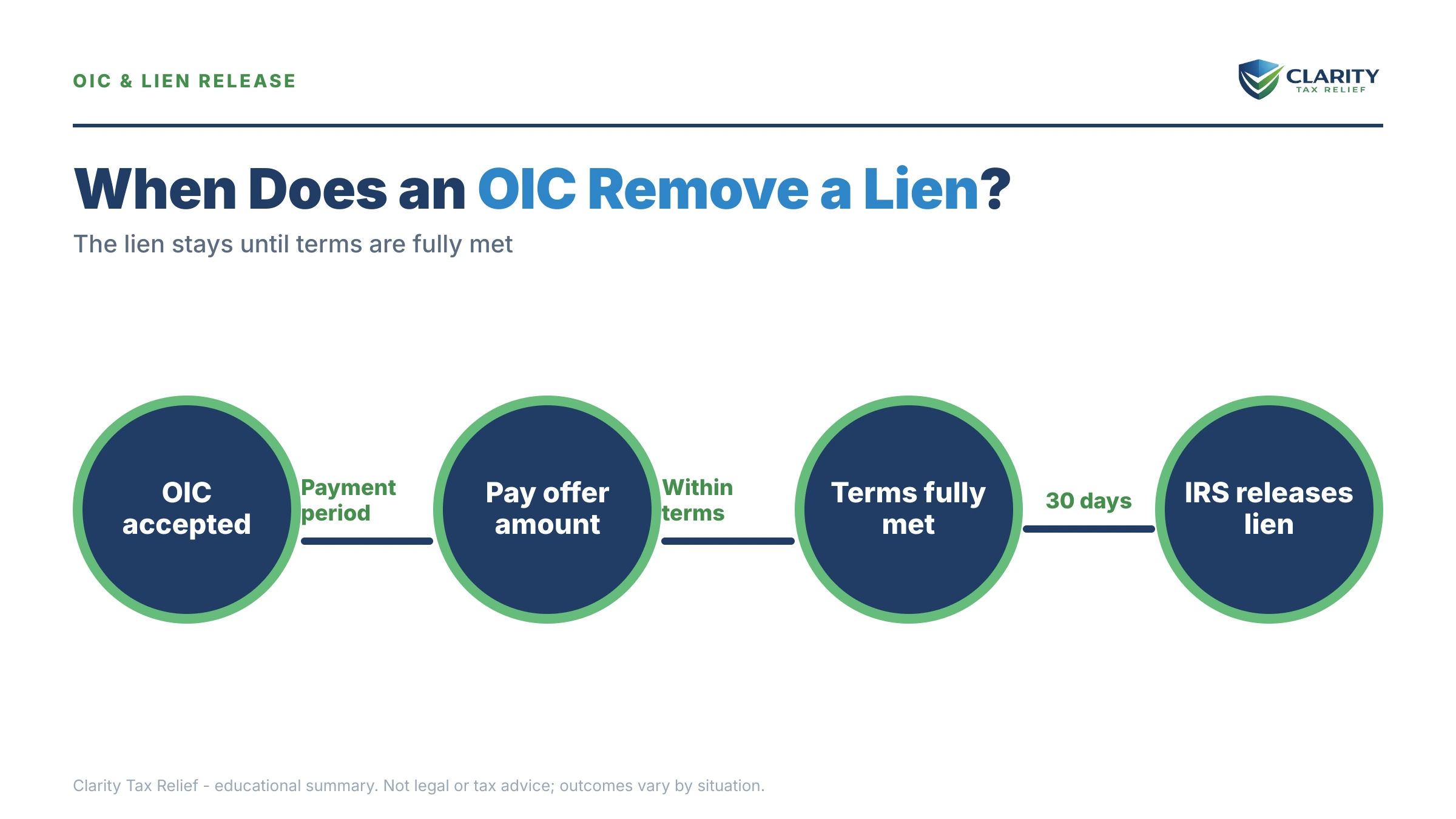
Does an OIC remove a tax lien while it's pending? No: here's what pauses instead
A pending offer in compromise pauses levies, not liens. Under IRC §6331(k), the IRS generally cannot levy your wages or bank account while your offer is under review, for 30 days after a rejection, or during a timely appeal. That protection is real, but it says nothing about lien filings.
While your offer sits in the queue, three things are true at once:
- The IRS can record a new Notice of Federal Tax Lien during the review. It commonly does, to protect its priority against your other creditors. If no lien has been filed yet, submitting an offer can be the event that triggers one. That's not a reason to skip the offer; it's a reason to know it going in.
- The 10-year collection statute pauses. The CSED stops running while your offer is pending, so a rejected offer hands the IRS back a longer collection runway than it had before.
- Your transcript posts code 480, the marker that your offer is officially pending — our code 480 transcript guide shows what a healthy pending-offer account looks like.
One quiet safeguard works in your favor: if the IRS doesn't decide your offer within two years of submission, it's deemed accepted by law, with narrow exceptions: a returned or rejected offer stops the clock, and time during court disputes does not count.
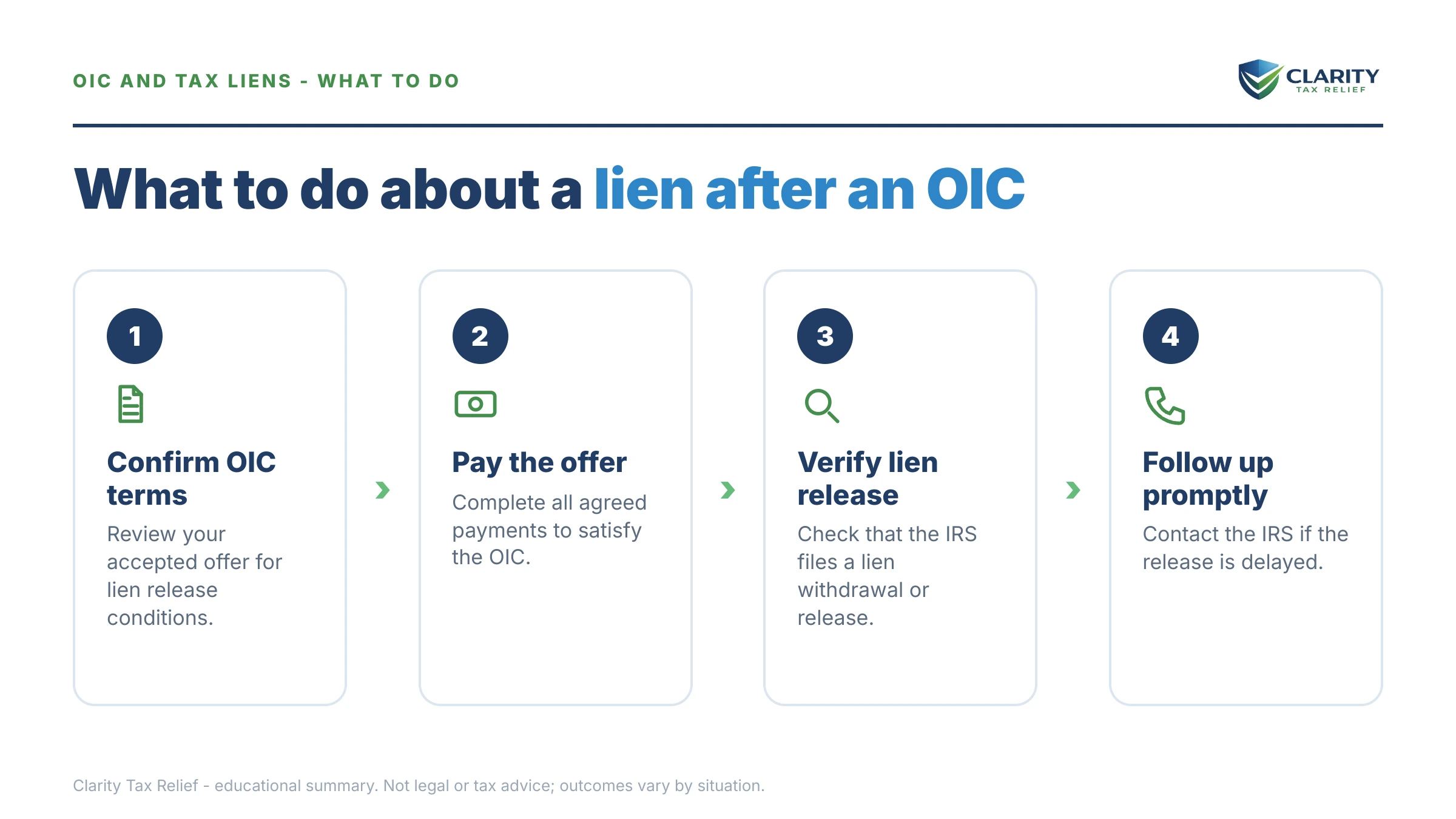
What happens if you ignore the lien, or default your offer
An unaddressed federal tax lien attaches to everything you own now and everything you acquire later. It outlives almost everything except full resolution or the collection statute. Here's the sequence, in order:
- The statutory lien arises silently at assessment — no filing needed. It already encumbers your property even before anything hits county records.
- The NFTL is recorded and Letter 3172 arrives, giving you a short window, check the date printed on yours, to request a Collection Due Process hearing.
- The lien attaches to after-acquired property. Buy a house next year, inherit a car, open a brokerage account — the lien reaches all of it automatically.
- The balance compounds monthly. On $54,600, failure-to-pay penalties and daily-compounding interest push the debt steadily toward the $66,000 passport-certification threshold for 2026 — cross it. The State Department can deny or revoke your passport.
- The levy track runs in parallel. The lien is a claim; levies are the seizure. Without a pending offer or agreement, the notice sequence marches toward wage and bank levies on its own automated schedule.
- Only the statute ends it passively. The recorded notice self-releases at its refile deadline unless the IRS refiles — the full mechanics are in our guide to whether an IRS tax lien expires — but "wait it out" means a decade of encumbered property. The clock pauses for offers, appeals, and bankruptcy.
And there's a second failure path unique to this topic: defaulting an accepted offer. Miss an offer payment, or break the five-year compliance clause. The IRS can reinstate the original balance (minus what you paid) and record a fresh lien to secure it. The offer isn't a finish line at acceptance — it's a finish line at full performance.
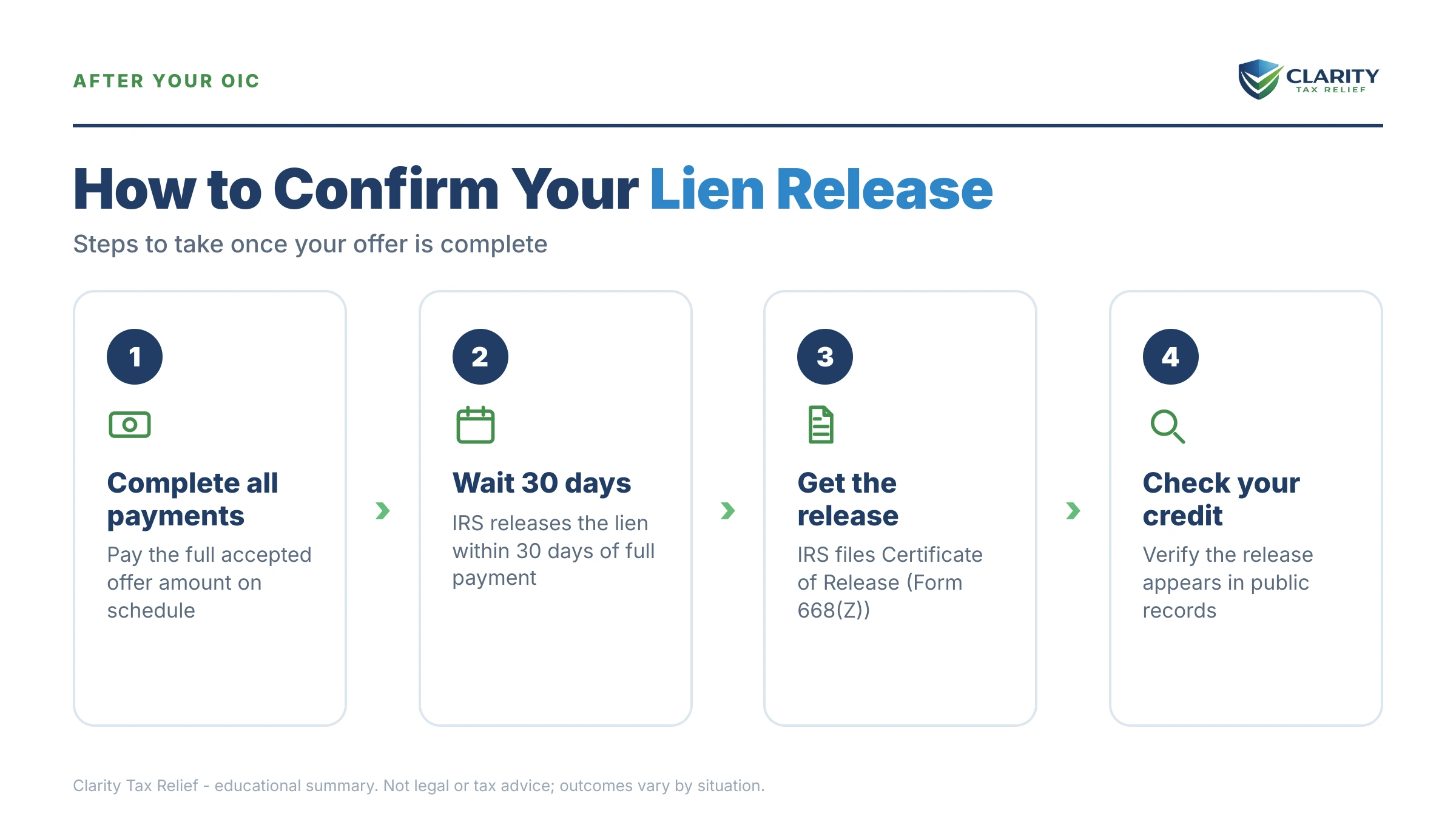
A lien on record and an offer in motion?
Send us your lien notice and your offer paperwork. An experienced tax professional will confirm exactly where your lien stands, whether your offer terms are on track. The fastest route to a released, or fully withdrawn — record. The underlying balance keeps accruing interest and penalties until the offer resolves it, so sequence matters. Free, confidential, no pressure.
Every path that removes a federal tax lien, and where an OIC ranks
An accepted and fully paid OIC is one of only a handful of events that end a federal tax lien, and each path has its own eligibility gate and its own timeline. Here's the full field:
| Resolution path | Typical eligibility | What happens to the lien |
|---|---|---|
| OIC accepted & fully paid | Your Reasonable Collection Potential is less than the balance; $205 fee (waived with low-income certification) | Released within 30 days of the final offer payment; withdrawal only by separate request |
| Pay in full | Any balance | Released within 30 days of payment posting |
| Direct-debit installment agreement | Individual balance of $25,000 or less | You may request lien withdrawal after a run of consecutive on-time direct-debit payments |
| Streamlined installment agreement | Up to $50,000, set up online, up to 72 months | Lien stays until the balance is satisfied; release follows full payment |
| Currently Not Collectible | Financials show payment would create hardship | Collection pauses, but the lien stays, and one is often filed when CNC is granted |
| CSED expiration | 10 years from assessment, pausable by offers, appeals, bankruptcy | The recorded notice self-releases at its refile deadline unless the IRS refiles |
| Bankruptcy discharge | Taxes meeting the discharge timing tests | Personal liability can end, but the lien survives against property you owned at filing |
Two rows deserve a flag. Hardship status is the most misunderstood — the lien question during CNC has its own rules, covered in does CNC stop a tax lien. And the direct-debit withdrawal row is the only route on this table where the public filing itself can be erased without a separate discretionary request, but at $54,600, you're more than double its $25,000 ceiling, which is exactly why the OIC-then-withdrawal sequence matters for larger balances.
Worked example: a $54,600 debt, a recorded lien, and what an offer actually changes
Say you owe $54,600 as a single W-2 employee — no business, no side income, one bad stretch of under-withholding across two tax years. At that balance you're already above the $50,000 online payment-plan ceiling, so even an installment agreement means financial disclosure. A Notice of Federal Tax Lien is very likely already on record. This example is hypothetical, but the math is the IRS's real formula.
The IRS decides offers using Reasonable Collection Potential (RCP): your net asset equity plus a multiple of your monthly disposable income. The full formula is broken down in our guide to reasonable collection potential. You can estimate your own figure with our Offer in Compromise Calculator. Suppose your numbers look like this:
- Asset equity: $4,500 in your car (quick-sale value minus the loan) plus $2,500 in savings = $7,000
- Monthly disposable income: $5,400 take-home minus $5,100 in IRS-allowable living expenses = $300/month
Now the two offer structures produce two very different lien timelines:
- Lump-sum offer: $7,000 + ($300 × 12) = $10,600. You'd send the $205 application fee plus a 20% down payment ($2,120) with Form 656, then pay the remaining $8,480 in five or fewer installments within five months of acceptance. Final payment posts → the 30-day release clock starts. If your income qualifies for low-income certification (AGI at or below 250% of the poverty level), the fee, the 20% down, and payments during review are all waived.
- Periodic offer: $7,000 + ($300 × 24) = $14,200, paid monthly over up to 24 months. You offer $3,600 more and the lien stays recorded the entire payment period, because release waits for the last dollar.
Compare the non-offer route: $54,600 spread over 72 months is roughly $758/month before interest and penalties, with the lien in place until the balance is satisfied. That contrast is the whole reason the lien question and the offer question are really one question, but be clear-eyed about odds: according to IRS data, the IRS accepted roughly 1 in 5 offers in FY2024. Offers succeed on math, not hope, which is why the RCP work up front matters more than anything else.
When the lien actually comes off after an OIC: release, then withdrawal
The IRS releases a federal tax lien within 30 days after the offer amount is paid in full and all terms are satisfied — release is automatic. Withdrawal is not. That single distinction explains most of the confusion around this topic.
The release. Once your final offer payment clears, the IRS issues Form 668(Z), the Certificate of Release, to the office where the lien was recorded. Our guide to the certificate of release of a tax lien shows what the document looks like and how to get a copy. The broader mechanics and what to do when the release runs late are in getting a lien released after payment. On your account transcript, the release posts as code 583 — see the code 583 transcript guide for what a cleanly closed lien looks like.
The withdrawal. A released lien still appears in county records, just marked satisfied. Title searches, mortgage underwriters, and background checks will still find it, even though the three credit bureaus stopped reporting tax liens back in 2018, as we explain in tax liens and your credit report. To erase the filing as though it never existed, you request withdrawal on Form 12277 — the process and the "best interest of the government and the taxpayer" argument are covered in our lien withdrawal (Form 12277) guide. After an OIC, withdrawal is discretionary, not automatic, but a completed offer plus clean compliance is a genuinely strong fact pattern to argue.
To confirm what the world currently sees under your name, run the lookup steps in our guide to tax lien public records before and after the release posts.
If you need to move property before the release — sell a house mid-offer, or refinance to fund the offer itself — two narrower certificates exist:
| Certificate | How you get it | What it does |
|---|---|---|
| Release — Form 668(Z) | Automatic within 30 days of full offer payment | Ends the lien; the filing stays in records marked released |
| Withdrawal | Request on Form 12277; discretionary | Removes the recorded notice as if it were never filed |
| Discharge | Apply on Form 14135 before a sale | Frees one specific property so the closing can fund |
| Subordination | Apply on Form 14134 before a refinance | Lets a lender move ahead of the IRS so the loan can close |
Discharge and subordination each interact with a pending offer, because equity pulled out of property changes your RCP. The property-by-property details are in tax lien discharge (Form 14135) and tax lien subordination (Form 14134).
How to handle the lien during and after your OIC, step by step
- Pull your account transcript. Confirm codes 480 (offer pending) and 582 (lien filed) are posted, and note which tax years the lien covers.
- Verify your offer's payment terms. Check whether your Form 656 elected lump-sum (paid within 5 months of acceptance) or periodic payments (up to 24 months). That choice sets when the release clock can start.
- Make every offer payment on time. One missed payment can default the offer, reinstate the full balance, and keep the lien alive.
- Calendar 30 days after your final payment. If the Certificate of Release (Form 668(Z)) hasn't reached the recording office by then, contact the IRS and request it.
- Request withdrawal if you need a clean record. File Form 12277 asking the IRS to withdraw the notice entirely, not just release it.
- Protect the deal for five years. File every return and pay every tax on time through the compliance period so the debt. The lien — can't come back.
Transcript codes that track your offer and your lien
Your IRS account transcript tells the whole offer-and-lien story in five codes, and checking it is free. Here's the decoder:
| Code | What it means | What to do |
|---|---|---|
| 480 | Offer in compromise pending | Confirm the date matches your Form 656 submission; levy protection runs from here |
| 481 | Offer rejected | Calendar 30 days to appeal on Form 13711 — the lien stays in force meanwhile |
| 482 | Offer withdrawn | Collection and the lien continue; rework the numbers before refiling |
| 582 | Lien indicator posted | A Notice of Federal Tax Lien has been recorded — verify the filing in county records |
| 583 | Lien released or withdrawn | Confirm the recording office shows it and keep the certificate with your permanent records |
When you can handle this yourself, and when help changes the outcome
Plenty of the lien-after-OIC workflow is genuinely do-it-yourself. If your offer is already accepted, your payments are on schedule. Your only question is whether the release recorded, you don't need to hire anyone: watch for code 583, confirm the county filing, and request a copy of Form 668(Z) if it's late. Filing Form 12277 for withdrawal is a one-page application you can complete alone. The IRS's own Offer in Compromise page covers the program terms in plain language. If the release simply never records and you can't get traction through normal channels, the Taxpayer Advocate Service exists for exactly that kind of stuck case.
Experienced help earns its cost in a different set of situations: when the RCP math involves home equity, dissipated assets, or income the IRS will dispute. When a lien is blocking a home sale or refinance mid-offer and the discharge or subordination has to be sequenced with the offer terms. When an offer has defaulted and the reinstated balance needs a rescue plan. When multiple years or business debt sit behind the lien. Or when a rejection needs a Form 13711 appeal built on better numbers than the first submission. In those cases, the professional's job isn't paperwork — it's making the government's own formula come out right. With 2026's reduced IRS staffing, offer files and lien releases move slower and errors surface later, which makes getting the submission right the first time worth more, not less.
Not sure which side of that line your case falls on? A free case review will tell you honestly — including when the answer is "you can do this part yourself."
Terms on your lien and offer paperwork, decoded
The IRS's plain-language overview lives at Understanding a Federal Tax Lien. Here are the six terms you're most likely staring at right now:
- Notice of Federal Tax Lien (NFTL): the public document recorded at your county office — the lien itself arose automatically when the tax was assessed and unpaid.
- Certificate of Release (Form 668(Z)): the document proving the lien has ended, sent for recording within 30 days of the debt being satisfied.
- Withdrawal: removal of the recorded notice as if it were never filed — requested on Form 12277, never automatic after an OIC.
- Reasonable Collection Potential (RCP): the IRS's calculation of the most it could ever collect from you — asset equity plus a multiple of monthly disposable income. Your offer must generally meet or beat it.
- Compliance period: the five years after acceptance in which you must file and pay every tax on time, or the compromised debt comes back.
- Self-releasing lien: language printed on the NFTL itself stating it releases automatically at the refile deadline unless the IRS refiles.
OIC and tax lien questions, answered
Does an accepted offer in compromise remove a federal tax lien?
No — acceptance alone does not remove the lien. The IRS releases the lien within 30 days after you pay the full offer amount and meet every term in your acceptance letter. With a lump-sum offer that can happen within about five months of acceptance. With a periodic offer, the lien can stay recorded for up to 24 months while you finish paying.
How long after my OIC is paid does the IRS release the lien?
Federal law requires release within 30 days after the liability is satisfied, which for an OIC means 30 days after your final offer payment clears and all terms are met. The IRS issues a Certificate of Release, Form 668(Z), to the recording office. If more than 30 days pass with no release on record, contact the IRS's Centralized Lien Operation and ask for the certificate directly.
Will the IRS file a tax lien while my offer in compromise is pending?
It can, and it often does. A pending offer legally stops levies under IRC §6331(k), but nothing stops the IRS from recording a Notice of Federal Tax Lien to protect its place in line while it reviews your offer. If no lien has been filed yet, that is worth weighing before you submit, because the filing becomes public record even if the offer is later accepted.
Is the lien withdrawn or just released after an OIC?
Released, not withdrawn. A release, Form 668(Z), says the debt is satisfied, but the original filing stays visible in county records marked as released. A withdrawal, requested on Form 12277, removes the notice as though it had never been filed, and after an OIC it is discretionary, granted only when the IRS agrees withdrawal serves the government's and your best interests.
Will the lien release after my OIC fix my credit report?
Your credit report is likely already clear — the three major bureaus stopped reporting tax liens entirely in 2018, so the lien does not appear in your credit score today. The real damage lives in public records: title searches, mortgage underwriting, and background checks still surface a recorded lien. The release fixes what those searches show; a withdrawal erases the entry more completely.
Can I sell or refinance my house while the lien and offer are pending?
Yes, but not by ignoring the lien. A Certificate of Discharge (Form 14135) removes the lien from one specific property so a sale can close. A subordination (Form 14134) lets a lender move ahead of the IRS so a refinance can fund. Coordinate either move with your offer, because home equity feeds directly into the offer amount the IRS expects.
What happens to the lien if my OIC is rejected?
The lien stays exactly where it is, and collection can resume. You have 30 days from the rejection letter to appeal using Form 13711, and levies stay paused during that window and any appeal. Remember that the 10-year collection statute was paused while your offer was under review, so rejection also means the IRS has more time on the clock than when you applied.
Can the lien come back after my offer is finished?
Yes, if you default the offer's five-year compliance clause. Every accepted OIC requires you to file every return and pay every tax on time for five years after acceptance. Miss one. The IRS can reinstate the original balance minus what you paid, and record a new Notice of Federal Tax Lien to secure it.
Does the IRS keep my tax refund after accepting my offer?
Generally not anymore for the year of acceptance. Under a policy change made in late 2021, the IRS stopped recouping refunds for the calendar year in which an offer is accepted. Refunds tied to earlier years that were already offset stay applied to the old debt. Your acceptance letter controls — read its refund paragraph before you count on any check.
Does an IRS offer in compromise release a state tax lien?
No. State tax agencies file and release their own liens under their own rules, and an accepted federal OIC has no effect on them. California's Franchise Tax Board, for example, runs a separate offer program and can collect for up to 20 years under state law. If you owe both, each lien needs its own resolution plan.
Your next 24 hours
- Find the lien details. Pull your Notice of Federal Tax Lien (or Letter 3172) and note the tax years and amounts listed, then check them against your IRS account transcript for codes 480 and 582.
- Gather your offer file. Form 656, your acceptance or rejection letter, and proof of every offer payment made so far. That stack answers the "when does my release clock start" question in minutes.
- Get a free case review. The balance behind the lien keeps accruing interest and penalties until the offer resolves it — use the 2-minute form or call (888) 825-7779 and an experienced tax professional will map your lien's exact path off the record.
This guide is general information, not tax or legal advice for your specific situation. Eligibility for IRS programs depends on individual facts and circumstances; no outcome is guaranteed.