
Offer in Compromise
Is the OIC Down Payment Refundable? What Happens to Your 20% in 2026
The short answer: no — the OIC down payment is not refundable. If the IRS rejects or returns your offer, or you withdraw it, the 20% payment is applied to your tax balance and the $205 application fee is kept. The only way to send $0 is the low-income certification, which waives both.
You've worked through Form 656, you know the number you want to offer, and one instruction is holding up the envelope: attach a check for 20% of your offer, plus a $205 fee. On a fixed Social Security income, mailing money you might never see again is not a small decision, so it's worth understanding exactly where every dollar goes before you seal it.
Here's the map: what the law says about that payment, what happens to it at every possible outcome, and the certification that lets many retirees and fixed-income filers submit an offer with nothing at risk. The image below shows you exactly what the payment and certification sections of Form 656 look like and where to look before you write anything.
⏱ The clock on this decision: there's no response deadline before you file, but penalties and interest keep accruing on your full balance every month while you weigh it. And if your offer is later rejected, you get only 30 days from the date on the rejection letter to appeal with Form 13711.
Why the OIC down payment isn't refundable: the 2006 law behind it
Since 2006, money sent with an Offer in Compromise has been a payment, not a deposit — federal law requires the IRS to keep it and apply it to your tax debt if the offer fails. The Tax Increase Prevention and Reconciliation Act (TIPRA) made that change to stop taxpayers from filing offers just to stall collection.
That's why so much advice online is dangerously out of date. Before TIPRA, offer funds sat in a deposit account and came back to you if the IRS said no. For any offer filed today, the required payments do not come back — they're absorbed into your balance the moment the offer dies.
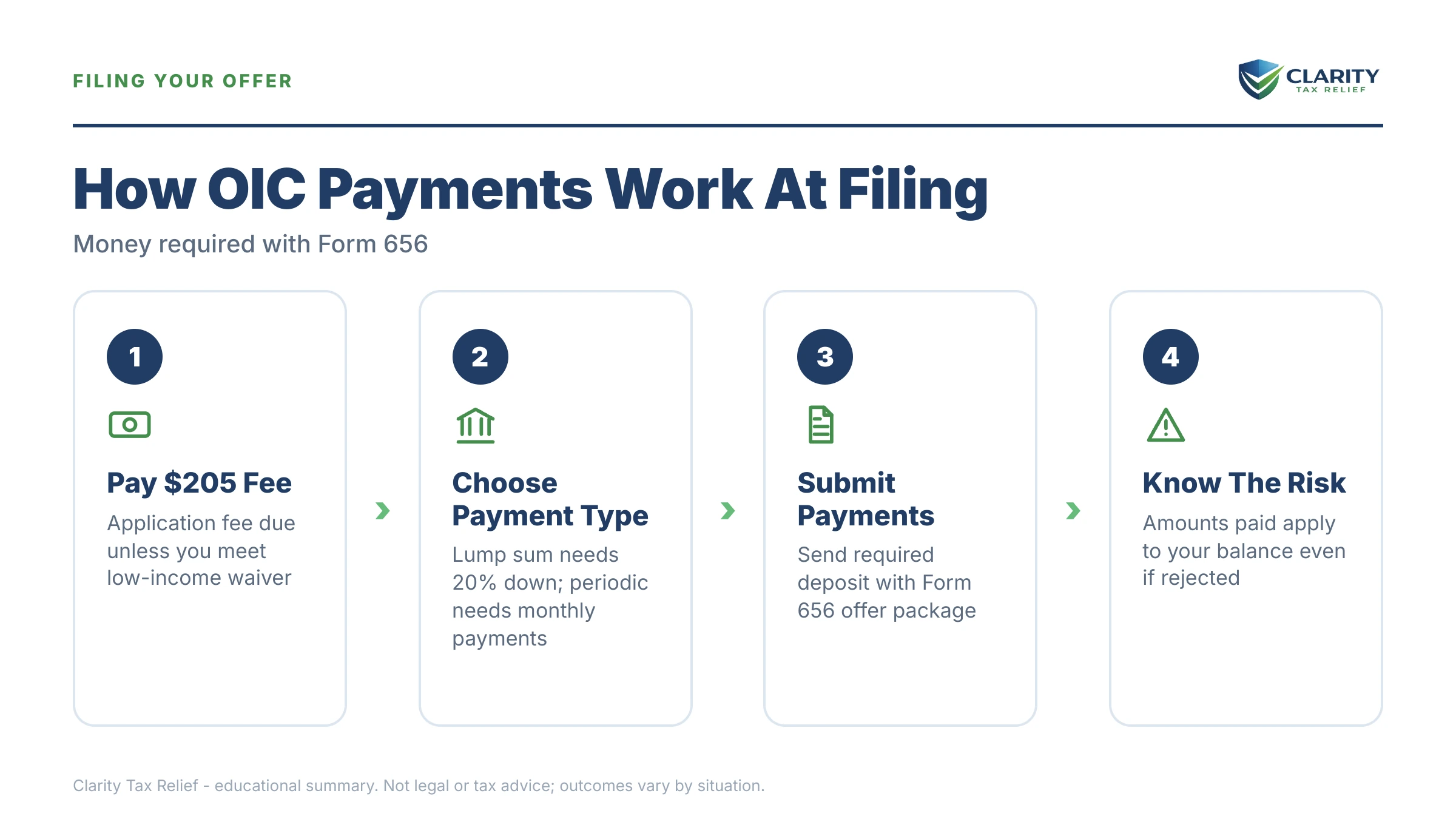
What you're required to send depends on which of the two OIC payment options you choose: a lump-sum offer requires 20% of the offer amount up front, while a periodic-payment offer requires the first monthly installment, and every installment after it while the IRS reviews. Both come with the $205 application fee. (For the full picture of the program itself, see how an offer in compromise works. This page stays focused on the money you send with it.)
One distinction matters more than anything else on this page: the 20% and the fee are treated differently. The 20% reduces your tax debt if the offer fails. The $205 fee is a processing charge. It reduces nothing.
“While IRS evaluates your offer: Your non-refundable payments and fees are applied to the tax liability. (You may designate payments to a specific tax year and tax debt.)”
— Offer in compromise (IRS.gov)
What happens to your money if the offer fails, or never gets reviewed
Roughly 1 in 5 offers was accepted in FY2024, which means most money sent with offers ends up applied to the balance rather than sealing a settlement. Here's the sequence your payment travels through when things go wrong, in order:
- Package arrives incomplete. If the required fee or 20% is missing and the low-income box isn't checked, the IRS treats the offer as non-processable and sends it back. It was never "pending," and you have no appeal right — just lost weeks while interest ran.
- Offer processed, then returned. Miss a required periodic payment, skip an information request, or fall behind on current-year taxes. The offer is returned, not rejected. The fee is kept, every payment is applied to your balance, and a return carries no appeal right.
- Offer reviewed and rejected. The 20% and any monthly payments are applied to your tax debt. You have 30 days to appeal; miss that window and the rejection is final.
- The collection clock stretches. A pending offer pauses the 10-year collection statute. A failed offer doesn't just cost the payment. It hands the IRS extra time to collect the rest.
- Collection resumes. The notices pick up where they left off, against a balance that shrank only by whatever you paid in, while penalties and interest kept compounding the whole time.
None of this means an offer is a bad idea. It means the down payment decision deserves the same rigor as the offer amount itself, because the money rides on the outcome.
About to mail a non-refundable check with your offer?
Get the offer reviewed free before you send it. An experienced tax professional will pressure-test your offer math, check whether you qualify to send $0, and flag anything that would get the package returned, while interest keeps accruing on the full balance.
What each OIC payment route costs up front
A lump-sum offer puts 20% at risk once. A periodic offer puts a smaller amount at risk every month for as long as the review runs. Here's the money side of each route:
| Payment option | Due with Form 656 | While the IRS reviews | Refundable? |
|---|---|---|---|
| Lump-sum offer (paid in 5 or fewer installments) | $205 fee + 20% of the offer amount | Nothing more required until a decision | No — 20% applied to your balance if not accepted; fee kept |
| Periodic-payment offer (monthly, 6–24 months) | $205 fee + first monthly payment | Every proposed monthly payment, on time | No — all payments applied to your balance if not accepted |
| Either option with low-income certification | $0 | $0 required | Nothing at risk — no fee, no down payment, no review payments |
Reviews commonly run many months, so the periodic route can mean a long string of non-refundable payments before you ever hear a decision. If you're already on an installment agreement, the interaction gets its own rules — see whether you can apply for an OIC while on a payment plan before you double up.
How to send $0: the low-income certification
The low-income certification in Section 1 of Form 656 waives the $205 fee, the 20% down payment, and every payment during review — for households at or below 250% of the federal poverty guidelines. Qualify, and the refundability question disappears: there's nothing to lose if the offer is rejected.
This matters enormously if you're retired on Social Security. The certification looks at your adjusted gross income from your most recent return, or your household's gross monthly income, against a chart printed right in the Form 656 booklet. Because Social Security is often only partly included in AGI, many retirees clear the threshold even when their monthly budget feels tight.
Checking the box costs nothing and requires no separate application, but check it honestly, because the IRS verifies it against your return. The full mechanics, including how household size is counted, are in our guide to the OIC low-income certification and the low-income OIC fee waiver.
Is the OIC down payment refundable at any outcome? Fee vs. 20%, compared
There is exactly one outcome where money comes back to you: a package the IRS never accepted for processing. Every other path either credits your payments toward a settlement or applies them to your debt:
| Outcome | Your $205 fee | Your 20% / monthly payments | Your right & window |
|---|---|---|---|
| Offer accepted | Kept (processing fee) | Credited toward your offer amount | Pay the remainder per your offer terms |
| Offer rejected | Kept | Applied to your tax balance | 30 days to appeal with Form 13711 |
| Offer returned after processing | Kept | Applied to your tax balance | No appeal — fix the issue and resubmit |
| Not processable (never reviewed) | Generally sent back with your package | Generally sent back with your package | Correct the package and refile |
| Offer withdrawn by you | Kept | Applied to your tax balance | You may submit a new offer later |
| No IRS decision within 2 years | Kept | Credited — the offer is deemed accepted by law | Automatic acceptance under TIPRA |
Two takeaways from that table. First, "applied to your balance" is not the same as "lost" — a rejected offer's payments still shrink what you owe. Second, the appeal window is short and real: our Form 13711 OIC appeal guide walks through it, and if the appeal succeeds, everything you already paid counts toward the accepted offer.
A worked example: $48,300 owed, a $7,500 offer, and $1,705 on the line
Say you owe $48,300 across two tax years and you're retired, living on Social Security plus a small pension. Your reasonable collection potential — asset equity plus what the IRS projects it could squeeze from future income — works out to $7,500, so that's your lump-sum offer. (You can estimate your own figure with our Offer in Compromise Calculator.)
The math at each fork, without the low-income certification:
- At filing: 20% of $7,500 = $1,500, plus the $205 fee. $1,705 leaves your account the day you mail the offer — none of it refundable.
- If accepted: the $1,500 is credited, leaving $6,000 to pay in five or fewer installments within five months of acceptance. A $48,300 debt resolves for $7,500 total (plus the fee).
- If rejected: the $1,500 is applied to the debt, dropping it to roughly $46,800, before the penalties and interest that accrued during the months of review. The $205 is simply gone. Net result: $1,705 spent to reduce the balance by $1,500, plus a paused collection statute.
Now run the same scenario with the low-income certification. If your AGI sits at or below 250% of the poverty guideline for your household size — plausible for a single filer whose Social Security is only partly taxable — you check the Section 1 box and mail the offer with $0 attached. Accepted, you pay the $7,500 on your offer terms. Rejected, you're out nothing but time, and you still have the 30-day appeal. For a fixed-income filer, that certification is the difference between a calculated risk and a free swing.
One caution before you trust the $7,500 figure: if you gave away or spent significant assets in the years before filing, the IRS can add them back into your offer math — see dissipated assets in an OIC — and an offer priced below the recalculated number is a rejection with your down payment attached.
How to protect your OIC down payment, step by step
- Check the low-income table first — Compare your AGI and household size against the 250%-of-poverty chart in Section 1 of Form 656 — qualifying means you send $0 with your offer.
- Verify your offer math before sending money — Run your reasonable collection potential honestly. An offer the numbers don't support is the most common way a down payment gets absorbed into the balance.
- Pick your payment option deliberately — A lump-sum offer risks 20% once. A periodic offer risks a smaller first payment but requires every monthly payment during a review that can run many months.
- Designate your payment in writing — Attach a statement telling the IRS which tax year and debt the payment applies to. Without it, the IRS applies the money wherever it chooses.
- Send exact amounts with every box checked — Match the fee and payment to the penny, sign every form, and include all schedules — incomplete packages get returned. A return still costs you time and money.
If you're assembling the package now, our Form 656 walkthrough covers every section, including where the payment and certification boxes live.
When you can handle this yourself, and when the stakes say otherwise
If you qualify for the low-income certification, DIY is genuinely low-risk: with no fee, no down payment, and no review payments, the worst case of a rejected offer is lost time, not lost money. A single tax year, simple finances, and income clearly below the threshold is a package many people file on their own.
Experienced help changes outcomes when real money rides on the math: when you're staking a four-figure non-refundable payment on a borderline offer amount, when the IRS could add back assets you sold or gifted, when self-employment or multiple years complicate the income calculation, or when a rejection has already landed and the 30-day appeal clock is running (see OIC rejected — now what). The current offer in compromise acceptance rate in 2026 makes the point on its own: most offers fail. The ones that succeed are usually the ones priced and packaged correctly the first time. And if an offer isn't realistic at all, a retiree on a fixed income may do better pursuing IRS hardship status on Social Security instead — no down payment required.
Not sure which side of that line you're on? A free case review with an experienced tax professional at (888) 825-7779 can tell you before any non-refundable check gets written.
Terms on Form 656, decoded
- TIPRA payment: the required, non-refundable money sent with an offer — the 20% on a lump-sum offer or the monthly installments on a periodic one.
- Application fee: the $205 processing charge; it's never applied to your tax balance and is kept once the offer is accepted for processing.
- Low-income certification: the Section 1 checkbox that waives the fee, the down payment, and review payments for households at or below 250% of the poverty guidelines.
- Reasonable Collection Potential (RCP): the IRS's calculation of the most it could ever collect from you — the floor your offer amount is measured against.
- Returned vs. rejected: a returned offer was closed without a decision (no appeal right); a rejected offer was evaluated and denied (30-day appeal right). Your money is applied to the balance either way.
- Deemed acceptance: the TIPRA rule that an offer is automatically accepted if the IRS fails to decide it within 2 years, with narrow exceptions: a returned or rejected offer stops the clock, and time during court disputes does not count.
While your offer sits under review, your account transcript will show code 480 — offer in compromise pending. That's how you confirm the IRS actually accepted the package for processing.
OIC down payment questions, answered
Do you get your OIC down payment back if the offer is rejected?
No. The 20% payment sent with a lump-sum offer, and any monthly payments made on a periodic offer — are applied to your tax balance, not returned, when an offer is rejected. The $205 application fee is kept as a processing fee. You do get 30 days from the rejection letter to appeal with Form 13711, and if the appeal succeeds, everything you paid counts toward the accepted offer.
Is the $205 OIC application fee refundable?
Not once the IRS accepts your offer for processing — the fee is kept whether the offer is accepted, rejected, returned, or withdrawn. If the package is deemed non-processable before review (for example, you're in an open bankruptcy), it's generally sent back with your forms. Taxpayers who qualify for the low-income certification never pay the fee at all.
Can the 20% down payment be waived?
Yes — the low-income certification in Section 1 of Form 656 waives the application fee, the 20% down payment, and all monthly payments while the IRS reviews the offer. You may qualify if your adjusted gross income or household income is at or below 250% of the federal poverty guidelines for your household size. Many retirees qualify because Social Security is often only partly included in AGI.
Does the 20% payment count toward my offer if it's accepted?
Yes. On an accepted lump-sum offer, the 20% is credited against your offer amount. You pay the remaining balance in five or fewer installments within five months of acceptance. Monthly payments made on a periodic offer are credited the same way. The $205 fee, however, is a processing fee and does not reduce your offer amount.
Can I choose which tax year my OIC payment applies to?
Yes, but only if you say so in writing when you submit the payment. Attach a statement designating the tax year and type of tax you want the payment applied to. Without one, the IRS applies it in the government's best interest, usually the oldest debt. The application fee cannot be designated — it never touches your balance.
Wasn't the OIC deposit refundable before?
It was — before the Tax Increase Prevention and Reconciliation Act of 2005 (TIPRA, enacted May 2006), money sent with an offer was treated as a refundable deposit. TIPRA converted it into a required, non-refundable payment applied to your liability if the offer fails. That change is why older forum posts and articles still claim you'll get the money back; for any offer filed today, you won't.
Do I have to keep paying during an OIC appeal?
It depends on your payment option. A lump-sum offer requires nothing beyond the original 20% while the offer, or an appeal of its rejection — is pending. A periodic-payment offer requires you to keep making the proposed monthly payments the entire time the offer is under consideration. Missing one can get the offer returned with no appeal right, though low-income-certified filers are exempt from these payments.
Your next 24 hours
- Find your AGI. Pull last year's Form 1040 and note line 11, then compare it against the low-income certification chart in Section 1 of the current Form 656 booklet. This one number may make the entire down payment question moot.
- Gather your package. Your last filed return, Social Security benefit statements, bank and pension statements. Your draft Form 433-A (OIC) — everything a reviewer needs to pressure-test your offer amount.
- Get the offer reviewed before you mail it. Use the 2-minute form or call (888) 825-7779 for a free case review. Interest and penalties accrue on the full $48,300-sized balance every month an offer sits unfiled. A non-refundable check deserves a second set of eyes first.
Primary sources: the IRS's official Offer in Compromise page covers payment requirements and the low-income certification, and the Taxpayer Advocate Service offers independent help if your offer or payments were mishandled.
This guide is general information, not tax or legal advice for your specific situation. Eligibility for IRS programs depends on individual facts and circumstances; no outcome is guaranteed.