
Offer in Compromise
Dissipated Assets OIC Rule: When the IRS Adds Back Money You Already Spent (2026)
The short answer: a dissipated asset is money or property you sold, transferred, or spent after your tax debt arose, without paying the IRS. In an Offer in Compromise, the IRS can add that value back into your minimum offer, generally looking at the three years before you apply, unless the funds went to necessary living expenses.
The dissipated assets OIC rule is the reason offers fail even when the taxpayer genuinely has nothing left. Your divorce is final, the 401(k) you cashed to survive it is gone, and now an IRS offer examiner is asking you to account for money you haven't had in a year. That question isn't an accusation — it's a math problem, and math problems can be answered. What you prove about where those dollars went can swing your minimum offer by tens of thousands.
This guide covers what counts as dissipation, the three-year lookback, the divorce-transfer trap, and exactly how to document your way out. The image below shows what the asset section of the offer paperwork looks like and where your explanation needs to live — worth seeing before you answer anything.
⏱ The clock that matters: there is no fixed statutory deadline on the dissipation inquiry itself, but the examiner's asset-verification letter carries its own printed response date, and if your offer is rejected over an add-back, you have 30 days from the date on the rejection letter to appeal with Form 13711. Penalties and interest accrue on the full balance the entire time.
What counts as a dissipated asset in an OIC
A dissipated asset is any asset converted to cash and spent — after the tax liability existed or was clearly coming — on something other than the tax or necessary living expenses. The classic examples: a cashed-out retirement account, home-sale proceeds that evaporated, a car signed over to a relative, or a lump sum used to clear credit cards while the IRS balance sat untouched.
The logic is blunt. The IRS evaluates a doubt as to collectibility offer by asking what it could ever collect from you. If you had an asset that could have paid the tax and chose to spend it elsewhere, the examiner can treat that value as if you still had it. The money being gone does not remove it from the offer math.
Not all spending is dissipation, though, and the line the IRS draws is more forgiving than most people fear:
| How the money was spent | Usually treated as dissipated? | Why |
|---|---|---|
| Rent, groceries, utilities, health care | No | Necessary living expenses aren't dissipation, but you must document them |
| Payments applied to the IRS balance | No | Money that went to the tax can't be added back |
| Paying off credit cards or personal loans | Usually yes | Unsecured creditors rank behind the IRS in offer math |
| Divorce attorney fees | Often challenged | Legal fees aren't a necessary living expense under IRS standards |
| Gifts or below-value transfers to family | Yes | Looks like moving assets out of the IRS's reach |
| Gambling, vacations, luxury purchases | Yes | Classic dissipation — discretionary spending with a known balance due |
| Court-ordered transfers in a divorce decree | Case by case | An order you couldn't refuse is a defense; voluntary settlement terms get scrutiny |
“We generally approve an offer in compromise when the amount you offer represents the most we can expect to collect within a reasonable period of time.”
— Offer in compromise (IRS.gov)
Why the IRS flagged the money you spent
Offer examiners don't guess. They cross-reference. Your Form 433-A(OIC) gets compared against the 1099-R your plan administrator filed when you cashed the retirement account, the 1099-S from any home sale, county property records. The bank statements you submitted yourself. A retirement cash-out or home sale is essentially impossible to hide — the question is never whether the examiner sees the money, only whether you explain it before they characterize it.
Divorce years are flag-heavy by nature. Houses get sold or transferred, retirement accounts get split or raided, and joint accounts get drained — all in a compressed window, all visible on paper. If you're offering on a debt built during the marriage, expect every one of those moves to draw a question. (How the underlying liability itself gets split is a separate problem — see our guide to an OIC when divorced or separated.)
If you're new to the offer program's overall mechanics — RCP, payment options, the two-year review — start with how an offer in compromise works. This page stays focused on the dissipation problem.
The three-year lookback: how far back the IRS goes
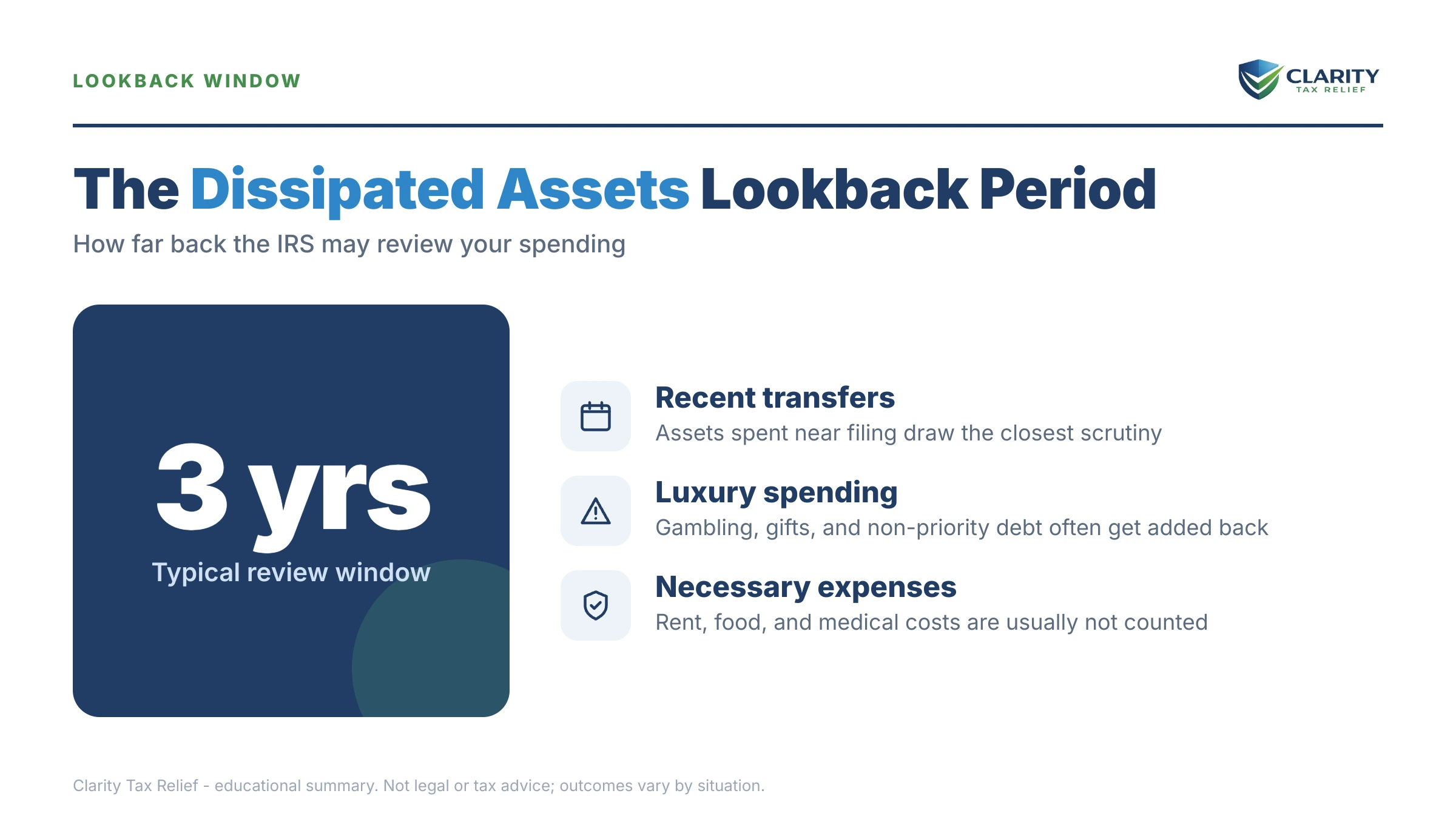
The IRS's internal manual generally directs examiners to asset moves within the three years before the year you submit your offer, plus the current year. Older spending is normally left alone, with one sharp exception: a transfer the examiner believes was made specifically to put an asset beyond the IRS's reach can be questioned regardless of age.
Two more limits work in your favor. First, dissipation is only relevant to money spent after the liability was assessed or after you knew, or reasonably should have known — one was coming. Spending that predates the debt isn't dissipation, no matter how large. Second, if the flagged funds went to necessary living expenses, examiners are instructed to exclude them.
The lookback also makes timing part of offer strategy. An asset converted almost four years ago sits very differently than one converted last spring — an experienced tax professional weighs that window before deciding when a Form 656 should go in, alongside the CSED math, since a pending offer pauses the 10-year collection clock.
How dissipated assets change your OIC offer math
An add-back raises your minimum offer dollar-for-dollar by the value you received from the dissipated asset. The IRS's acceptance floor is your Reasonable Collection Potential: the net equity in what you own now, plus a multiple of your monthly disposable income — 12 months for a lump-sum offer, 24 for periodic payments (our guide to the OIC future income component walks through that multiplier). A dissipated asset is stacked on top of both, as if you still held it. You can estimate your own offer with our Offer in Compromise Calculator, then see below how one add-back moves the number.
A worked example (hypothetical). Say you owe $83,100 from returns filed during your marriage, the divorce finalized last year, and during the separation you cashed a 401(k) and received $26,000. It went three places: $9,000 to a rental deposit and six months of living costs, $11,000 to your divorce attorney, and $6,000 to pay off a joint credit card. Today you have $3,200 of net equity in your car and $340/month of disposable income.
- Base RCP, lump-sum offer: $3,200 equity + ($340 × 12 = $4,080) = $7,280.
- Worst case — full add-back: $7,280 + $26,000 = $33,280 minimum offer.
- Documented case: you trace the $9,000 to rent and groceries with bank statements, so it's excluded. Add-back drops to $17,000 (attorney + credit card): $7,280 + $17,000 = $24,280.
Same debt, same spending — a $9,000 difference in the minimum offer, produced entirely by paperwork. And even $24,280 against an $83,100 balance can be a rational outcome if you can actually fund it. If you can't, the offer gets rejected no matter how sympathetic the story, which is why the options section below matters. Remember the cash mechanics too: a lump-sum offer requires a $205 application fee and 20% down with filing — both waived if your AGI is at or below 250% of the federal poverty guidelines under the low-income certification.
Divorce transfers: when a settlement looks like dissipation
Divorce is where honest people get hit hardest by this rule, because assets move fast and rarely toward the IRS. Three patterns come up constantly:
Signing the house over to your ex. If a court decree ordered the transfer, that's your strongest position. You had no legal choice, and the decree itself is your exhibit. If the transfer was a term you negotiated while both of you knew taxes were owed, the examiner can argue you voluntarily gave away equity the IRS could have reached. The line between "ordered" and "agreed" is the whole defense — keep the decree, the settlement agreement, and closing statements.
Retirement splits via QDRO sit on the safer side of that line, since the transfer runs on a court order. Raiding your own remaining share afterward does not — that's an ordinary cash-out, traced like any other.
Attorney fees and support catch-up. Divorce legal fees are not on the IRS's necessary-expense list, so expect them to be challenged. Court-ordered child support payments fare better because, again, a court compelled them. Present both with the orders and invoices attached rather than waiting to be asked.
What happens once an examiner flags dissipation
A flagged asset doesn't kill your offer by itself — it starts a sequence, and each stage still has an exit:
- Asset-verification letter. The examiner asks where specific funds went — the 1099-R distribution, the sale proceeds, the account that emptied. The letter carries its own printed response deadline.
- The add-back. Anything unexplained by that deadline is included in your RCP at the value you received. Your minimum acceptable offer is recalculated upward.
- Preliminary determination, then rejection. If your offer amount is now below the recalculated RCP and you don't raise it, the offer is rejected. Payments made with a lump-sum offer are applied to your balance, not returned — see whether the OIC down payment is refundable before assuming otherwise.
- The 30-day appeal window. The rejection letter starts a 30-day clock to request Appeals review. Miss it and the rejection is final.
- Offer closed, collection resumes. The levy protection you had while the offer was pending ends, active collection restarts on the full balance, and the 10-year collection clock, paused during review, starts running again. Our guide to an OIC rejected — now what covers this stage in full.
Through every stage, interest and the failure-to-pay penalty keep compounding on the entire debt. The cheapest point to win a dissipation fight is stage one, with documents, not stage four, with arguments.
Examiner asking where the money went?
Send us the letter and your offer file. An experienced tax professional will trace the flagged assets, tell you what's defensible and what isn't, and map your response before the printed deadline — free and confidential.
Your options when the IRS adds back spent money
An add-back forces a choice: prove it, fund it, fight it, or change strategy. Each path has a different cost and clock:
| Option | What it costs | Timeline |
|---|---|---|
| Document the spending as necessary living expenses | Your time — statements, leases, receipts | Resolved during offer review if sent by the examiner's deadline |
| Raise your offer to cover the add-back | The add-back amount, paid on your offer terms | Keeps the original offer alive; no restart |
| Appeal the rejection (Form 13711) | No IRS fee to appeal | Must file within 30 days of the rejection letter; Appeals review typically runs months |
| Withdraw and pursue an installment agreement | Setup fee plus monthly payments on the full balance | Can be arranged quickly; stops enforcement while you regroup |
| Partial-pay installment agreement or CNC hardship status | Full financial disclosure (Form 433 series) | Ongoing; reviewed periodically until the collection statute runs |
Two strategy notes. A partial payment installment agreement often beats an offer inflated by an add-back you can't fund. You pay what your budget allows and the balance dies at the CSED, without the dissipation fight. And moving to a payment plan doesn't burn your offer eligibility: you can apply for an OIC while on a payment plan later, once the flagged asset ages past the lookback window or your documentation is complete.
How to respond to a dissipated-asset inquiry, step by step
- Inventory three years of asset moves. List every sale, withdrawal, transfer, and unusually large payment going back three years before the year of your offer, before the IRS lists them for you.
- Trace every dollar. Pull bank statements, closing statements, 401(k) distribution records, and receipts showing where each asset's proceeds actually went.
- Separate necessary living expenses. Mark rent, food, utilities, health care, and transportation. Those amounts are defensible; everything else needs a stronger explanation.
- Attach a written explanation to Form 433-A(OIC). For each flagged asset: what it was, when it was converted, what you received, and where it went, with exhibits.
- Answer the examiner before the letter's deadline. An unanswered asset-verification request is treated as unexplained dissipation and added back in full.
- Appeal within 30 days if the add-back sticks. File Form 13711 before the deadline printed on the rejection letter and lay out your tracing, document by document.
Our Form 433-A instructions walk the asset section line by line. The guide to Form 13711 OIC appeal covers how Appeals re-runs the RCP math.
When you can handle this yourself
You likely don't need professional help if the flagged spending is small, recent, and cleanly documented — a few thousand dollars of traced rent and grocery payments answered by the examiner's deadline usually resolves without drama. The IRS's own program page at IRS.gov's Offer in Compromise overview plus your bank statements may be all you need.
Experienced help changes outcomes when the stakes and ambiguity rise: a five-figure retirement cash-out, assets that moved through a divorce settlement, multiple flagged items across several years, or an add-back that pushes your minimum offer past what you can fund. Those cases turn on how the tracing is framed against the IRS's own manual, and on knowing when to concede an item, when to appeal, and when a different resolution beats the offer entirely. With the IRS accepting roughly 1 in 5 offers, per the data in our offer in compromise acceptance rate 2026 breakdown, precision at the asset section is where offers are won or lost. If your file has any of those complications, a free case review before you respond costs you nothing but the two minutes.
Terms on your offer paperwork, decoded
- Dissipated asset — an asset sold, transferred, or spent after the tax debt arose, on something other than the tax or necessary living expenses.
- Reasonable Collection Potential (RCP) — the IRS's calculation of the most it could ever collect from you; your offer must meet or beat it.
- Net realizable equity — an asset's quick-sale value (usually 80% of market) minus any loans against it.
- Add-back — the examiner's inclusion of a dissipated asset's value in your RCP as if you still owned it.
- Form 433-A(OIC) — the financial disclosure filed with your offer; its asset section is where dissipation questions start and where your explanation belongs.
- Doubt as to collectibility — the offer basis arguing the debt exceeds what the IRS could collect; the only basis where dissipation math applies.
Dissipated-asset questions, answered
What counts as a dissipated asset in an offer in compromise?
Any asset you sold, transferred, gave away, or spent after your tax debt arose, or when you should have known one was coming, without paying the IRS or covering necessary living expenses. Common examples are cashed-out retirement accounts, home-sale proceeds that vanished, property gifted to family, and money used to pay off credit cards while the tax bill sat unpaid.
How far back does the IRS look for dissipated assets in an OIC?
The IRS's internal manual generally directs offer examiners to the three years before the year you submit your offer, plus the current year. Spending older than that window is usually left alone, unless the examiner believes an asset was moved specifically to keep it away from the IRS, which examiners can question regardless of age.
Can money I gave up in my divorce count as a dissipated asset?
Yes — voluntary settlement transfers made while you knew taxes were owed can be added back into your offer. Transfers you were ordered to make by a court decree are your strongest defense, because you had no choice in the matter. Keep the decree, closing statements, and QDRO paperwork so you can prove exactly what the court required versus what you agreed to.
Does a dissipated asset automatically get my OIC rejected?
No. The add-back raises your minimum acceptable offer. It doesn't disqualify the offer itself. If you can fund the higher number, or document that the spending went to necessary living expenses, the offer can still be accepted. Since the IRS accepted roughly 1 in 5 offers in FY2024, getting the asset section right before you file matters more than anything you argue afterward.
What if I spent the money on rent, food, or medical bills?
Money spent on necessary living expenses is not dissipation, and examiners are instructed to exclude it. The burden of proof is yours, though: bank statements, lease agreements, medical bills, and receipts that trace the specific dollars. Vague claims that the money 'went to living costs' without a paper trail are typically treated as unexplained, and unexplained usually means added back.
Is paying off credit cards instead of the IRS considered dissipation?
Usually, yes. Unsecured creditors like credit card companies rank behind the IRS in offer math, so using an asset to clear them while a tax balance sat unpaid is a classic add-back. A narrow exception can apply if the payment was genuinely necessary to keep basic living intact — for example, avoiding eviction — but you would need to document that necessity.
Can I appeal a dissipated-asset add-back?
Yes. If your offer is rejected because of the add-back, you have 30 days from the date on the rejection letter to request an appeal with Form 13711. Appeals reviews the Reasonable Collection Potential math independently of the examiner who rejected your offer. A dollar-for-dollar paper trail showing where the money went gives Appeals a concrete basis to remove the add-back.
Your next 24 hours
- Find the deadline on the examiner's letter (or the rejection letter's date — your 30-day appeal clock runs from it) and write it somewhere you'll see daily.
- Gather the money trail: bank statements covering the three years before your offer, any 1099-R or closing statement for the flagged asset, your divorce decree and settlement agreement. Your Form 433-A(OIC) as filed. If your response stalls inside the IRS itself, the Taxpayer Advocate Service exists for exactly that.
- Get the file reviewed free before you answer: the 2-minute form or (888) 825-7779. Every week of delay adds interest and penalties to the full balance. An answer sent without the tracing done is an add-back waiting to happen.
This guide is general information, not tax or legal advice for your specific situation. Eligibility for IRS programs depends on individual facts and circumstances; no outcome is guaranteed.