
IRS Collections & Financial Standards
IRS National Standards and Allowable Living Expenses: How the IRS Decides What You Can Pay in 2026
The short answer: the IRS allowable living expenses standards are preset national and local spending caps the IRS uses, instead of your actual bills, to decide how much you can pay toward tax debt. Food and clothing are allowed at the full national amount; housing and vehicles are capped at the lesser of your actual cost or the local standard.
You're sitting with a Form 433 worksheet, a rent payment that changed completely after your divorce, and a blank line asking what you spend each month, with no hint that the IRS may not accept your real answer. Here's the part nobody tells you up front: the IRS grades your budget against its own tables, not your bank statements.
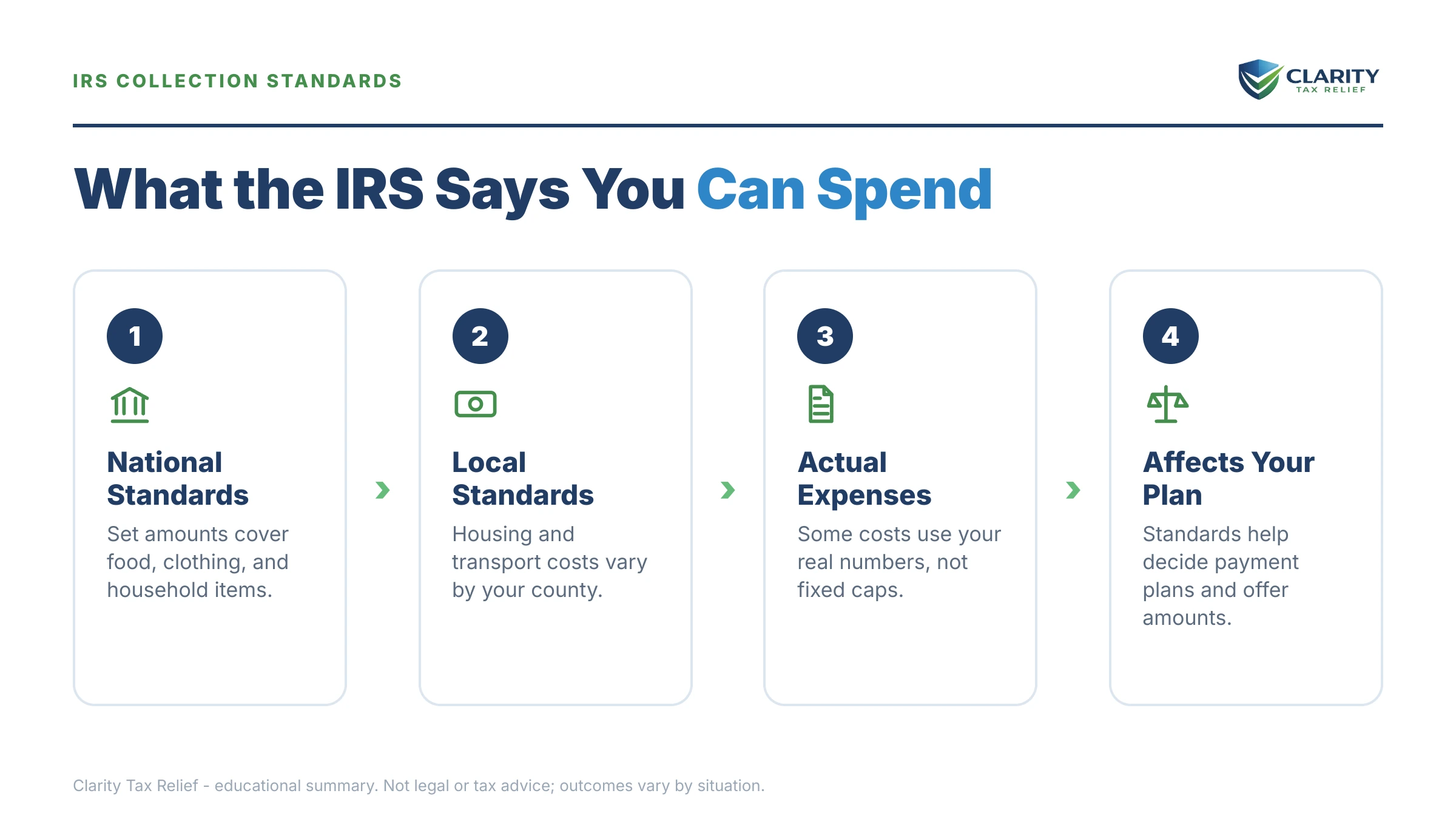
That's fixable once you know the rules, and the rules are surprisingly mechanical. The image below shows exactly what the expense section of an IRS collection statement looks like and where these standards come into play, so you can see which of your numbers the IRS will keep and which it will replace.
⏱ The real clock: the standards themselves carry no response deadline, but your balance grows every month you wait. The failure-to-pay penalty adds 0.5% per month plus daily-compounding interest while you build your numbers, and the IRS refreshes the standards roughly once a year, which can change your math mid-case.
What the IRS allowable living expenses standards are: the four categories
The IRS allowable living expenses standards (officially the Collection Financial Standards) are updated tables of "reasonable" living costs the IRS substitutes for your actual spending when it measures ability to pay. They control every case where the IRS reviews your finances: payment plans requiring disclosure, hardship status, and every Offer in Compromise.
The standards split into two families. National Standards cover food, clothing, and out-of-pocket health care and apply identically in every state; Local Standards cover housing, utilities, and transportation and vary by county or region. Everything else — child care, court-ordered payments, current taxes — is judged case by case under the "necessary expense" test.
| Expense category | How the standard is set | The cap rule |
|---|---|---|
| Food, clothing & miscellaneous (National Standards) | One national table, by family size | Allowed in full — no receipts needed up to the standard, even if you spend less |
| Out-of-pocket health care | National amount per person, split by age (under 65 / 65 and over) | Allowed without proof up to the standard; anything above needs documentation |
| Housing & utilities (Local Standards) | By county and household size | Lesser of your actual cost or the county standard |
| Vehicle ownership costs | National amount per vehicle, up to two vehicles | Lesser of your actual loan or lease payment or the standard |
| Vehicle operating costs | By Census region and metro area | Lesser of actual costs or the standard; a public-transit allowance applies if you have no car |
| Other necessary expenses (child care, court-ordered payments, current taxes) | Your actual cost | Must pass the necessary expense test, with documentation |
Notice the asymmetry. The national categories are a floor that works in your favor — you claim the full standard even if you spend less. The local categories are a ceiling that works against you — spend more than the table, and the IRS cuts your number down.
Why the IRS caps your actual bills: the necessary expense test
An expense is "allowable" only if it's necessary for your family's health and welfare or for producing income — that's the necessary expense test, and it's the filter behind every line of your Form 433. Your $1,950 rent isn't judged on whether you really pay it. It's judged on whether the IRS thinks you need to.
Three refinements matter more than anything else on the page:
- The lesser-of rule. For housing, utilities, and vehicles, you get the smaller of your actual cost or the standard. There's no averaging and no partial credit for a nice neighborhood.
- The six-year rule. On installment agreements, if your balance plus projected accruals can be fully paid within six years, and before the 10-year collection statute runs out — the IRS can accept your actual expenses even above the standards.
- The one-year rule. If you can't full-pay in six years, the IRS may allow an over-standard expense for up to one year while you restructure it — refinance the car, move to cheaper housing — before your payment resets to the standard-based number.
Then there are conditional expenses the IRS usually disallows outright: credit card minimums, private school tuition, voluntary retirement contributions, and, painfully relevant after a divorce, your attorney's fees. Court-ordered child support and alimony, by contrast, are allowed in full when you can show the order and proof of payment. If you're untangling who owes what from a joint year, see divorce and IRS debt: who pays.
What happens if you get the standards wrong
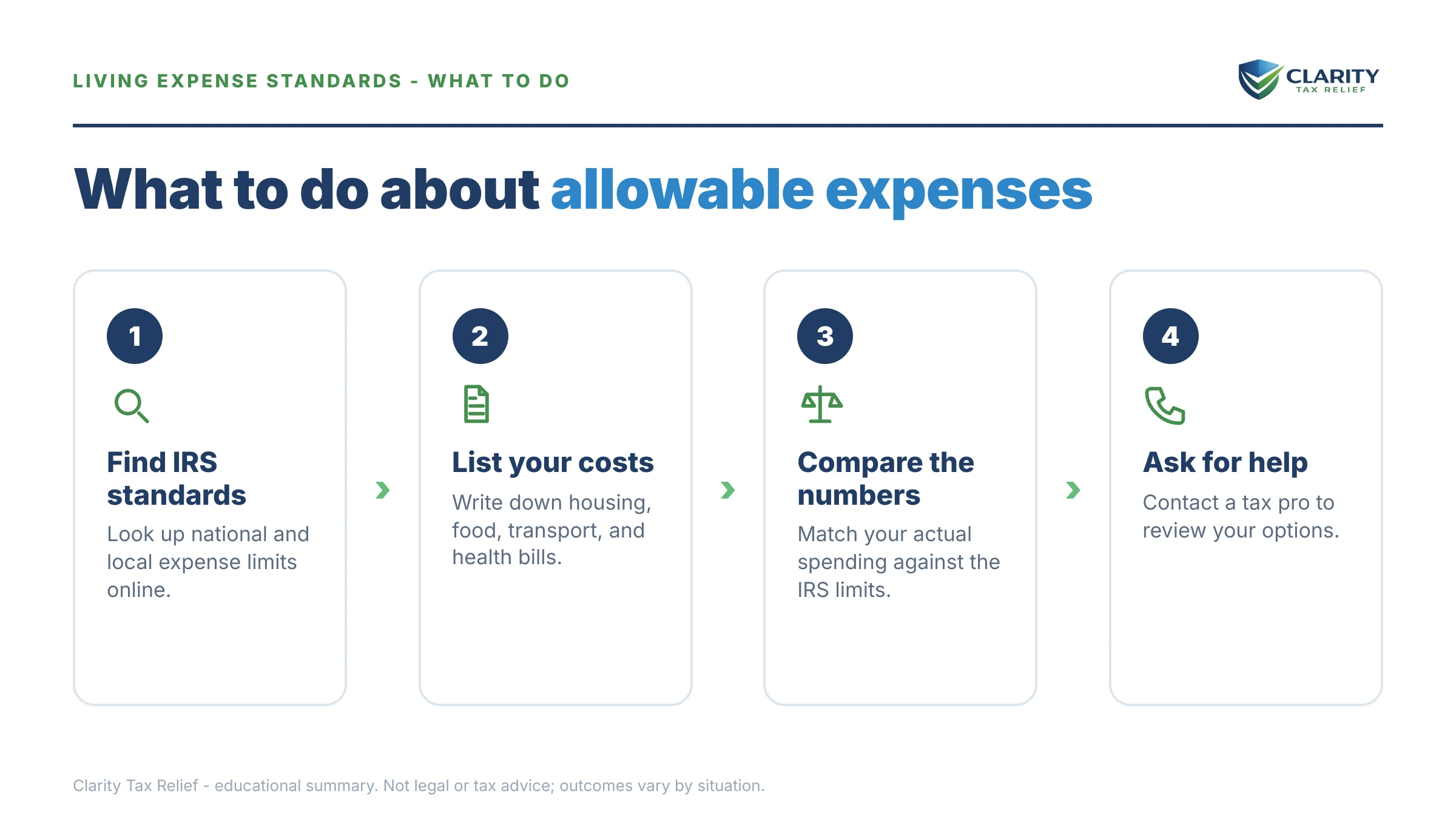
A Form 433 built on your actual budget, without checking the standards first, usually comes back with a payment demand you never saw coming. The sequence runs in stages:
- You submit your financial statement listing real expenses: the post-divorce rent, the car payment, the credit card minimums.
- The IRS recalculates using the standards. Over-standard housing gets capped, unsecured debt payments get deleted, and your "disposable income" jumps — on paper.
- The answer comes back higher than you can afford: a proposed monthly payment built on money you don't actually have, or a denial of hardship status or your offer.
- If you can't pay the demanded amount and don't respond, the case returns to active collection — the balance-due notice sequence resumes and marches toward levy authority, with your own financial statement now telling the IRS exactly where you bank and work.
That last point deserves a beat: a Form 433 is a map of your assets. Submitting one with the wrong numbers doesn't just cost you a better deal. It hands collections a directory of what to levy. Run the math before the IRS does.
About to send the IRS your financial statement?
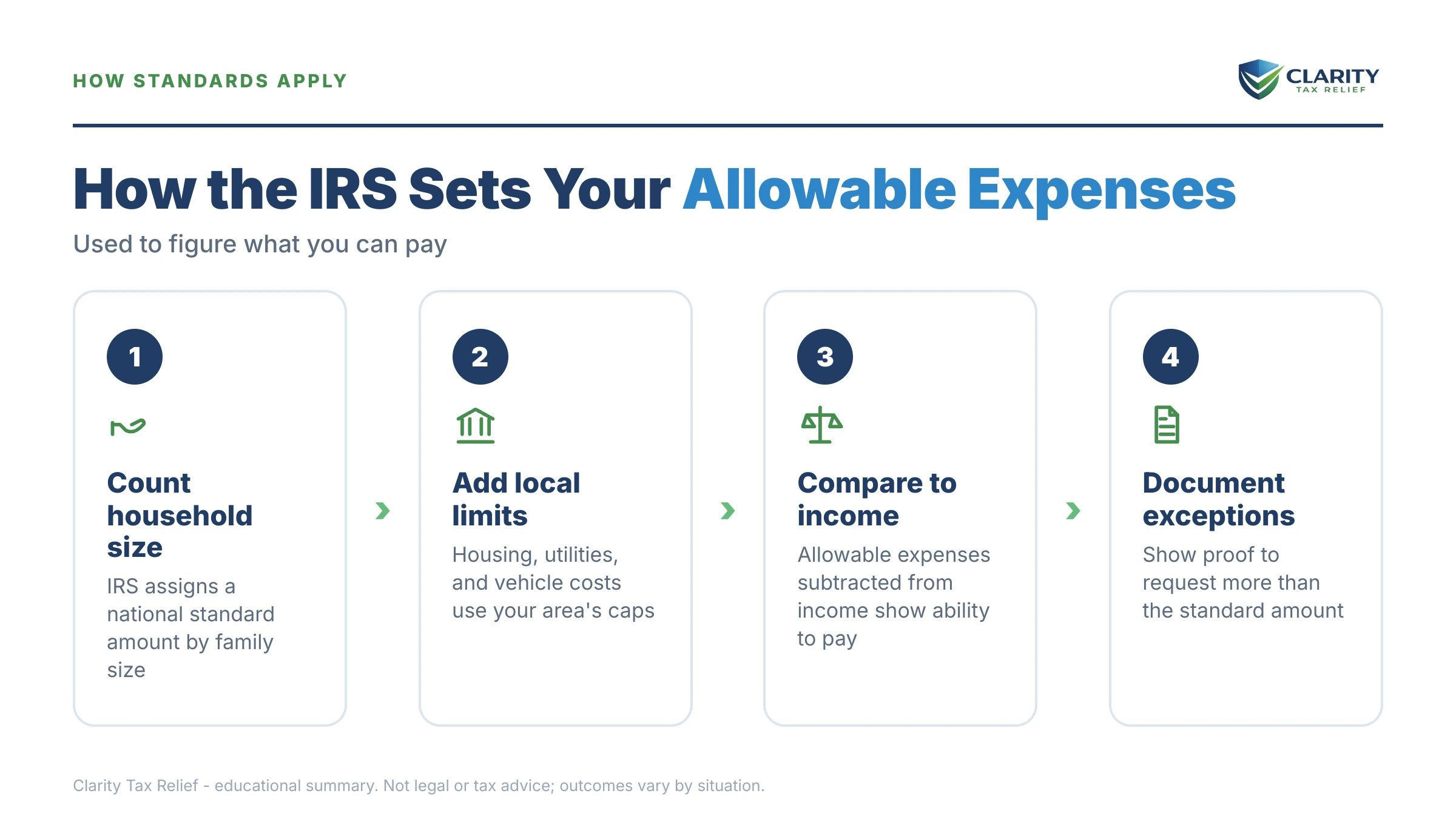
Get your Form 433 numbers reviewed free before you file them. An experienced tax professional will run the allowable-expense math the way the IRS will, and tell you whether a payment plan, hardship status, or an offer actually fits your figures.
Where the IRS living expense standards decide your outcome, and where they never apply
The standards only matter when the IRS reviews your finances, and many resolutions never trigger that review at all. That's the single most useful thing to know before you volunteer a financial statement:
| Option | Typical eligibility | Do the standards apply? |
|---|---|---|
| Short-term payment plan | Full payment within 180 days; $0 setup fee | No — no financial statement required |
| Streamlined installment agreement | Balance up to $50,000; up to 72 months | No — no Form 433, so the standards never enter |
| Non-streamlined installment agreement | Balance over $50,000, or a payment below the streamlined minimum | Yes — Form 433 required, standards applied |
| Partial-payment installment agreement | Can't full-pay before the collection statute expires | Yes — applied strictly, with periodic re-reviews |
| Currently Not Collectible status | Allowed expenses meet or exceed your income | Yes — the standards are the qualification test itself |
| Offer in Compromise | Reasonable Collection Potential below your balance | Yes — strictest application; the standards drive the offer amount |
For the offer route, the standards feed directly into Reasonable Collection Potential: your monthly disposable income times 12 for a lump-sum offer (24 for periodic payments), plus your net asset equity. That formula, not any promise about settling cheap, is how offers are decided. The deep math lives in our guide to Reasonable Collection Potential. You can estimate your own figure with our Offer in Compromise Calculator. For the broader step-by-step of resolving a balance on your own, the hub is how to settle tax debt yourself.
A worked example: $16,400 in tax debt after a divorce
Say you're recently divorced and owe $16,400 from a joint tax year, earning $6,000 gross per month. Here's how the standards would score a hypothetical budget (all standard amounts below are illustrative — pull the current tables for your county before relying on any figure):
- Tax withholding: $1,150 — allowed at actual
- Rent plus utilities: $1,950 actual; suppose your county standard for a household of one is $1,750 — allowed $1,750
- Car payment: $640 actual; suppose the ownership standard is $590 — allowed $590
- Gas, insurance, maintenance: $360 actual; suppose the regional operating standard is $310 — allowed $310
- Food, clothing, miscellaneous: allowed the full national amount, suppose $800, even though you actually spend $720
- Out-of-pocket health care: suppose $80 (under-65 standard)
- Court-ordered child support: $650 — allowed at actual, with the order attached
Allowed expenses total $5,330. Monthly disposable income: $6,000 − $5,330 = $670 — even though, by your real budget, only about $250 is left each month. The standards just erased roughly $420 of your actual spending.
What that number means: at $670 a month, the IRS projects full payment in roughly 25–26 months, so it would expect an installment agreement near that figure, and would likely deny hardship status. An offer is a long shot too: $670 × 12 = $8,040 of future income, and once your car and bank equity are added, Reasonable Collection Potential can climb past the $16,400 you owe.
The smarter play at this balance is usually to skip the financial review entirely. A streamlined 72-month plan on $16,400 needs roughly $228 a month minimum ($16,400 ÷ 72), plus accruing interest and penalties. If you can sustain $250–$300 a month, you can set that up online without ever handing the IRS a Form 433 — the standards never touch your case. Compare payment methods in best way to pay the IRS, and note that interest keeps running on any plan; can IRS interest be waived covers the narrow exceptions.
If even $228 is genuinely out of reach, then the standards become your battlefield: hardship status or a partial-payment agreement will cap that $1,950 rent at the county table unless you can prove the extra cost is necessary, or invoke the one-year rule while you bring housing costs down.
How to respond, step by step: run the numbers before the IRS does
- Pull the current standards. Look up the national standards and your county's housing and transportation figures on the IRS's Collection Financial Standards page — never build your worksheet on last year's tables.
- Build your real monthly budget. List what you actually spend next to each category, using three months of bank statements rather than memory.
- Flag every capped category. Mark where your actual cost exceeds the standard — rent, car payment, operating costs — because those are the numbers the IRS will cut first.
- Calculate your monthly disposable income. Subtract the allowed amounts, not your actual amounts, from gross monthly income. The result is what the IRS believes you can pay.
- Match the result to a resolution. Full-pay plan, partial-payment agreement, Currently Not Collectible, or an Offer in Compromise — the disposable-income figure tells you which is realistic.
- Submit the right Form 433 with proof attached. Include the court order behind any support payments and statements for every capped category, and keep a complete copy of the package.
Which form is "right" depends on who's asking: the shorter Form 433-F goes to the IRS's automated collection unit, while the longer Form 433-A goes to revenue officers and, in its OIC version, with offers.
When you can handle this yourself
You don't need professional help to use the standards when the standards never apply. If your balance is under $50,000 and your budget genuinely supports the streamlined monthly payment, set the plan up yourself at the IRS payment plans page and skip the financial statement entirely. The same goes for a 180-day short-term plan you can actually cover.
Experienced help changes the outcome when the standards do control your case: hardship claims where the IRS is capping over-standard housing, partial-payment agreements, offers where a few disputed expense lines swing the offer amount by thousands, or any case where a levy is already in motion and the financial statement has to be right the first time. The detailed qualification math for hardship cases is in our guide to CNC income limits. And if a Form 433 with the wrong numbers has already gone in, a professional can often get the analysis reopened before the payment demand hardens.
Terms on your Form 433, decoded
- Necessary expense test — the rule that an expense counts only if it's required for your family's health and welfare or to produce income.
- Conditional expense — spending the IRS considers optional (credit card minimums, tuition, extra retirement savings) and usually disallows unless you can full-pay quickly.
- Monthly disposable income (MDI) — gross income minus allowed expenses; the number the IRS treats as your payment capacity.
- Reasonable Collection Potential (RCP) — MDI times 12 or 24, plus net asset equity; the minimum the IRS will accept in an offer.
- Six-year rule — actual expenses can stand on an installment agreement if the balance full-pays within six years and inside the collection statute.
- One-year rule — a grace period of up to a year to reduce an over-standard expense before your payment is recalculated on the standard.
If your case stalls or the IRS's expense math produces a payment that leaves you unable to cover basics, the Taxpayer Advocate Service exists for exactly that kind of hardship dispute.
IRS allowable living expense standards: FAQs
What are the IRS allowable living expense standards?
They are preset national and local spending caps the IRS uses to decide how much of your income is available to pay tax debt. Food, clothing, and miscellaneous costs are allowed at the full national amount. Housing, utilities, and vehicles are capped at the lesser of your actual cost or the local standard. They apply whenever you submit a Form 433 for a payment plan, hardship status, or an Offer in Compromise.
Can I claim expenses higher than the IRS standards?
Sometimes. Amounts above a standard must pass the necessary expense test. You have to prove the extra cost is required for your family's health and welfare or to produce income, with documentation. On installment agreements, the IRS's six-year and one-year rules can also let actual expenses stand temporarily. On an Offer in Compromise, the standards are applied far more strictly.
Do I have to prove my food and clothing spending to the IRS?
No — the national standard for food, clothing, and miscellaneous items is allowed in full without receipts, even if you actually spend less. The same is true of the out-of-pocket health care standard. You only need documentation if you claim more than the standard amount, and then you must justify every dollar above it.
How often do the IRS Collection Financial Standards change?
The IRS updates the standards roughly once a year, typically in the spring, and posts the current tables on IRS.gov. Always pull the current figures before submitting a Form 433, because the IRS will apply the version in effect when it reviews your case — a worksheet built on last year's numbers can come back recalculated.
Is child support an allowable expense under the IRS standards?
Yes, if it is court-ordered and you are actually paying it. Attach the order and proof of payment, bank records or pay-stub deductions, to your Form 433. Voluntary support without a court order is harder: the IRS may allow it, but treats it as conditional, so expect pushback and document everything.
Are credit card minimum payments an allowable living expense?
Generally no. Payments on unsecured debt usually fail the necessary expense test, because the IRS considers itself ahead of your credit card company. There are narrow exceptions — for example, when the debt was incurred to produce income or pay for necessary medical care — but plan your disposable-income math assuming those payments won't count.
What is the IRS six-year rule for living expenses?
If you can fully pay your balance, including projected penalties and interest, within six years and before the collection statute expires, the IRS can allow your actual expenses on an installment agreement even where they exceed the standards. It does not apply to Offers in Compromise or Currently Not Collectible status, where the caps are enforced.
Do the IRS allowable expense standards apply to state tax debt?
No. State agencies run their own financial reviews with their own forms and allowances — California's Franchise Tax Board, for example, uses its own financial statement rather than Form 433. If you owe both, don't assume a budget the IRS accepted will pass a state review; check that state agency's rules separately.
Your next 24 hours
- Look up two numbers: your county's housing-and-utilities standard for your household size on the IRS Collection Financial Standards page. Your actual monthly housing cost. The gap between them is the heart of your case.
- Gather your proof: three months of bank statements, your last pay stub, your most recent tax return, and, if you pay support, the court order and payment records.
- Get the math checked before you file it: a free case review at the 2-minute form or (888) 825-7779 will tell you whether your disposable-income number supports a plan, hardship status, or an offer, while interest and the monthly late-payment penalty are still small.
This guide is general information, not tax or legal advice for your specific situation. Eligibility for IRS programs depends on individual facts and circumstances; no outcome is guaranteed.