
IRS Data Study
IRS Passport Revocation Tax Debt Threshold in 2026: More Than $66,000
The short answer: the IRS passport revocation tax debt threshold for 2026 is more than $66,000 in seriously delinquent tax debt. Cross it, and the IRS can certify your debt to the State Department via Notice CP508C under IRC Section 7345, and the State Department can then deny, revoke, or refuse to renew your passport.
This guide covers the dollar line at which IRS debt can reach your passport, every year's threshold since the program began, what counts toward it and what does not, how certification happens, every way to stop or reverse it, and the order to act in. You are planning a trip, or looking at a passport that expires soon, and you owe the IRS more than you can pay at once. Here is the fact that matters most: nothing touches your passport until your total balance crosses a specific dollar line, and in 2026 that line is more than $66,000.
If the IRS has already certified your debt, you were mailed a Notice CP508C. The image below shows what that notice looks like and where to find the certified balance and tax years on your copy.
⏱ The real clock: a CP508C carries no day-count deadline. Your balance grows every month, though. The failure-to-pay penalty adds 0.5% per month, plus interest, which can push a balance sitting below $66,000 over the certification line while you wait.

Why is the IRS passport revocation tax debt threshold $66,000 in 2026?
In 2026 the IRS can certify your tax debt to the State Department for passport revocation once you owe more than $66,000, a threshold that has climbed every year from $51,000 in 2018. The number is not arbitrary. IRC Section 7345 set the original figure and requires an annual inflation adjustment, which is why the line moves each January.
Two things make this threshold different from every other number in IRS collections. First, it is the only one that reaches outside the tax system. It does not take your money; it takes your ability to leave the country. Second, it is a total rather than a per-year figure. Three modest balances from three old tax years, each harmless on its own, can combine to cross $66,000 without any single year looking dangerous.
Certification is not the same as revocation. The IRS certifies; the State Department acts. Between those two steps there is real room to fix things, and the options section below maps all of it.
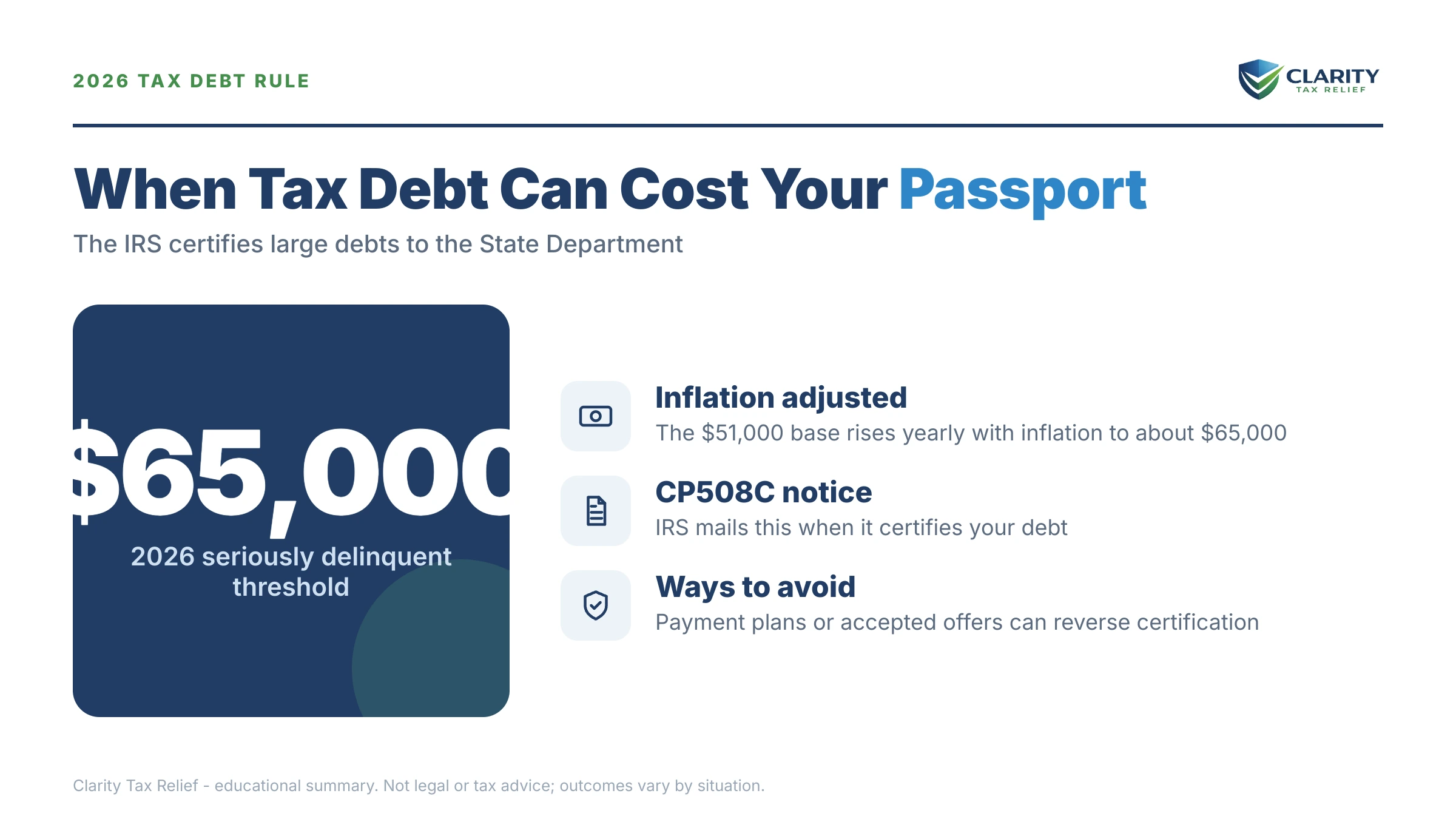
“Seriously delinquent tax debts are legally enforceable, unpaid federal tax debt (including assessed penalties and interest) totaling more than $66,000 (adjusted yearly for inflation).”
— Revocation or denial of passport in cases of certain unpaid taxes (IRS.gov)
How has the threshold changed by year, from $51,000 in 2018 to $66,000 in 2026?
The passport threshold has risen $15,000 since the program's first full year, from $51,000 in 2018 to more than $66,000 in 2026. The recent pattern has been steady $2,000-per-year increases, driven by the inflation adjustment. Here is the verified year-by-year data:
| Year | Seriously delinquent debt threshold | Change from prior listed year |
|---|---|---|
| 2018 | $51,000 | — (early program year) |
| 2023 | $59,000 | +$8,000 across five annual adjustments |
| 2024 | $62,000 | +$3,000 |
| 2025 | $64,000 | +$2,000 |
| 2026 | More than $66,000 | +$2,000 |
The threshold is adjusted yearly for inflation, so it will move again in 2027. Note what the rising line does not do: it does not decertify anyone. If you were certified at $59,000 in 2023, the threshold climbing past your balance in later years does not undo the certification. Only the reversal events covered below do that.
What counts toward the $66,000, and what doesn't?
"Seriously delinquent tax debt" is your total assessed balance: tax, penalties, and interest, across all years combined. That is the detail that surprises people. A $48,000 tax bill left alone for a few years can easily carry enough penalties and interest to top $66,000 today.
The debt also has to reach a specific enforcement stage before it can be certified. The IRS must have filed a Notice of Federal Tax Lien (with your Collection Due Process rights lapsed or exhausted) or issued a levy. A fresh balance that has not hit the lien or levy stage is not certifiable yet, which is exactly why acting early matters.
Several categories of debt are excluded even above the dollar line:
- Debt you're paying on time under an approved installment agreement or an accepted Offer in Compromise.
- Debt with a timely Collection Due Process hearing pending, requested with Form 12153 for a CDP hearing.
- Debt covered by a pending innocent spouse request.
- Under current IRS practice, debt in bankruptcy, accounts in currently-not-collectible hardship status, taxpayers in federally declared disaster areas, and accounts with a pending installment agreement or Offer in Compromise request are also not certified.
Two things never count toward the threshold at all. FBAR penalties and child support are not tax debt under IRC Section 7345, however large they are.
What happens if you ignore a balance heading toward $66,000?
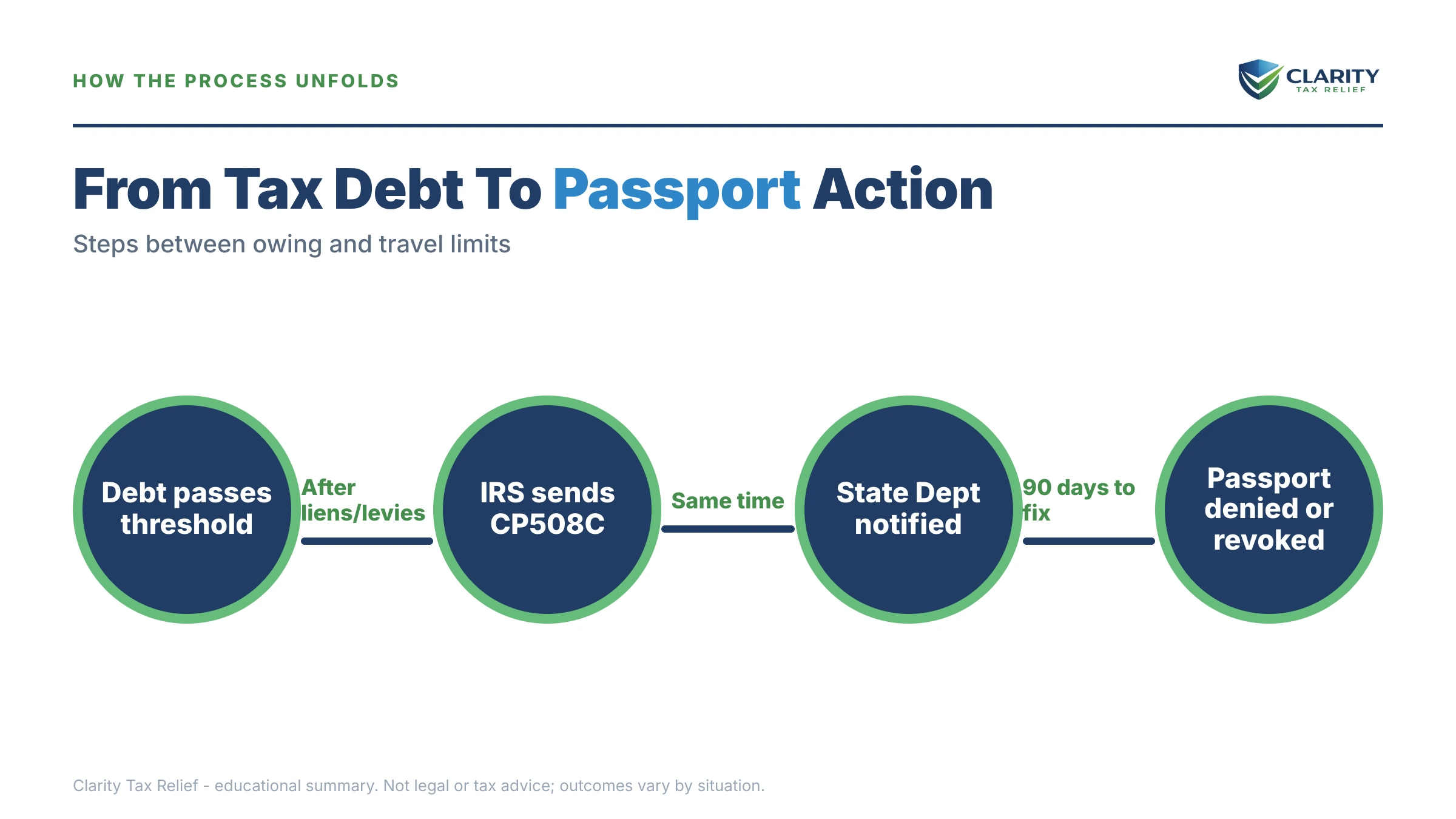
Passport certification sits at the end of the IRS collection sequence, after the lien or levy stage. The path there is automated, and each stage removes options you have today:
- CP14. The first bill. Pay or arrange by the due date printed on the notice, or the sequence moves.
- CP501 / CP503. Reminder notices. The balance grows monthly; no enforcement yet.
- CP504. Intent to levy your state refund under IRC §6331(d). A federal tax lien becomes a live possibility.
- LT11 notice / Letter 1058. The final notice of intent to levy. A 30-day clock starts, along with your Collection Due Process rights.
- Lien filed or levy issued. Once your CDP rights lapse or a levy goes out, a balance over $66,000 meets the legal definition of seriously delinquent.
- Notice CP508C. The IRS certifies the debt to the State Department. Our CP508C notice guide covers this letter line by line.
- State Department action. It can deny a new passport application, refuse to renew, or revoke the passport you hold.
One more 2026 reality. The IRS workforce was cut roughly 27% in 2025, per TIGTA reporting, and certifications run through automated systems that never stopped. As we cover in our analysis of the IRS budget cuts 2026, the humans got harder to reach while the machine kept escalating. That is the worst combination for anyone trying to fix a certification the week before a flight.
Balance near, or over, the $66,000 line?
Get a free review of exactly where your debt sits in the certification sequence and which arrangement takes your passport off the table. Penalties and interest are adding to the total every month. The earlier you act, the more options stay open.
How do you stop or reverse a passport certification?
Any arrangement that removes your debt from the "seriously delinquent" definition blocks certification, or reverses one that already happened. The general playbook for resolving a balance lives in our hub on how to settle tax debt yourself. Here is how each path interacts with the passport rule:
| Path | Effect on certification | Key eligibility / cost |
|---|---|---|
| Pay in full | Certification reversed; IRS issues Notice CP508R | Full balance including penalties and interest |
| Installment agreement (paid on time) | Debt no longer "seriously delinquent"; blocks or reverses certification | ≤ $50,000: online, up to 72 months; larger balances need financial disclosure |
| Accepted Offer in Compromise (paid on time) | Excluded from certification while terms are met | $205 fee; 20% down on lump-sum offers; both waived with low-income certification (AGI ≤ 250% of poverty) |
| Timely CDP hearing request (Form 12153) | Debt excluded while the hearing is pending | Must be filed within the 30-day window on your LT11/Letter 1058 |
| Innocent spouse request pending | Excluded while the request is pending | Must show the liability belongs to your spouse or ex-spouse |
| Currently Not Collectible (hardship) | Not certified under current IRS practice | Must show paying anything would prevent basic living expenses |
| Bankruptcy | Not certified while the case is open | Court filing; interest rules vary by chapter and debt type |
The one strategy that does not work: once you have been certified, paying the balance down just below the current threshold does not undo it. Reversal comes from full payment, the debt becoming legally unenforceable, or one of the qualifying arrangements above. If your application was already turned down, our guide to a passport denied for tax debt at the $66,000 threshold covers the application-in-limbo scenario, and passport revoked tax debt covers what to do after the State Department has acted.
A retiree's math: how a balance drifts over $66,000
A balance a few thousand dollars under $66,000 can cross the line on penalties and interest alone. Say you are 68, retired on Social Security, and you owe the IRS $61,800 spread across three old tax years, all filed, none paid. That is a hypothetical. The arithmetic is real:
- The failure-to-pay penalty runs 0.5% per month: $61,800 × 0.5% = about $309 added every month before interest.
- The gap to the certification line is $66,000 − $61,800 = $4,200. At $309 a month, penalties alone close that gap in roughly 13 to 14 months ($4,200 ÷ $309 ≈ 13.6). Interest compounds daily on top, so realistically it happens sooner.
- Meanwhile, on the same debt, the IRS can take up to 15% of Social Security benefits through the Federal Payment Levy Program. On a $1,900 monthly benefit, that is up to $285 a month. See our guide on the IRS taking 15 percent of Social Security.
Now the fix. At $61,800 the balance is over the $50,000 online-setup limit, so this retiree has two clean moves: pay the balance down below $50,000 and set up a 72-month plan online, or submit financial information for an agreement at the full amount. Either one takes the debt out of the "seriously delinquent" definition before certification ever happens. You can estimate how fast your own balance is growing with our IRS penalty and interest calculator, and if you are in this exact life stage, our guide for people who are retired and owe IRS back taxes goes deeper on protecting fixed income.
How to respond if you're near or over the $66,000 threshold, step by step
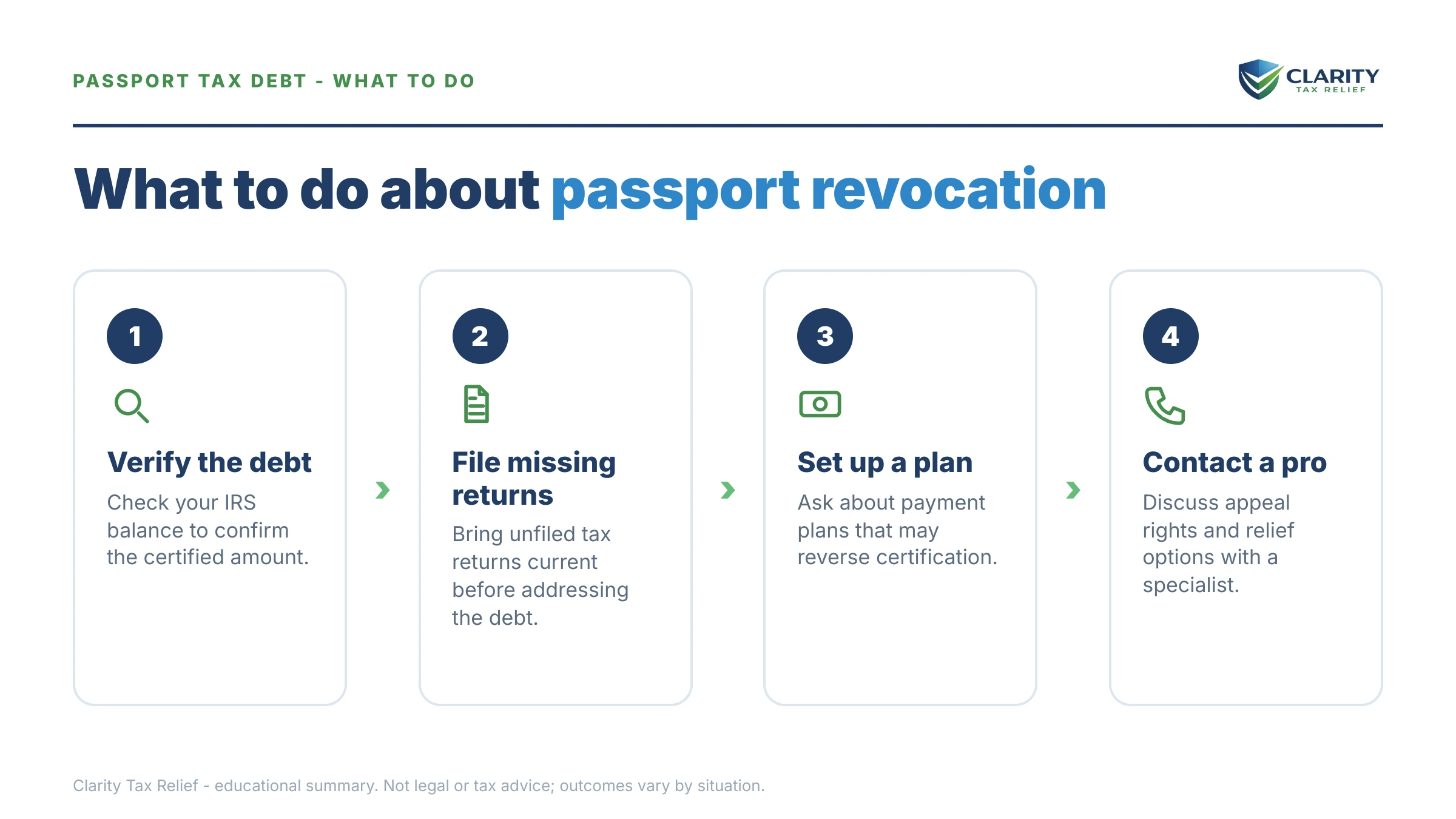
- Pull your exact balance. Log in to your IRS online account and add up the total assessed balance (tax, penalties, and interest) across every year, then compare it to the $66,000 line.
- Check for a CP508C. Search your mail and your account transcripts for Notice CP508C. If it was issued, your debt is already certified to the State Department.
- Stop the growth. File any unfiled returns and pay what you can now. The failure-to-file penalty (5% per month) is ten times the failure-to-pay penalty (0.5% per month), so filing always comes first.
- Get into a qualifying arrangement. Set up an installment agreement or another qualifying arrangement so the debt is no longer seriously delinquent. Balances of $50,000 or less can usually be set up online for up to 72 months.
- Confirm the reversal. If you were certified, watch for Notice CP508R confirming the IRS reversed the certification, and keep a copy with your travel documents.
Red flags that put your passport at risk
- Adding up only the tax. The threshold counts penalties and interest too, across every year. A $48,000 tax bill can top $66,000 on accruals alone.
- An LT11 or Letter 1058 with the 30-day window running. Once CDP rights lapse and a lien or levy follows, a balance over $66,000 is certifiable.
- Unfiled years. No agreement can exist until they are filed, and the failure-to-file penalty is ten times the failure-to-pay penalty.
- Paying down to just under the line after certification. That does not reverse anything. Only full payment or a qualifying arrangement does.
- Assuming next year's higher threshold will decertify you. It will not.
- Waiting for a person at the IRS. Certifications run on automated systems that never paused during the 2025 staffing cuts.
- Travel already booked with a CP508C in hand. That is the situation where the order and speed of the fix matter most.
Can you handle this yourself?
If your balance is comfortably under $66,000 and you can fund a payment plan, you can usually handle this without professional help. Setting up a short-term plan (up to 180 days, $0 setup fee) or an online installment agreement takes an afternoon, and either one keeps the certification machinery from ever reaching you. If money is tight, a Low Income Taxpayer Clinic may represent you at no charge. Our guide to free help with IRS tax debt lists every no-cost option.
Experienced help changes outcomes in a narrower set of situations. You have already received a CP508C and have travel booked. You have multiple unfiled years that must be filed before any agreement can exist. Your balance is over $50,000 and the IRS wants full financial disclosure. A Social Security levy is already running. Or you think your finances support an Offer in Compromise, where the math has to be right the first time. And if you owe the IRS while living or planning to live overseas, where a passport is not optional, see our guide on what happens when you owe the IRS and are moving abroad.
Terms on your notice, decoded
- Seriously delinquent tax debt: an unpaid, legally enforceable federal tax debt over the annual threshold (more than $66,000 in 2026) that has reached the lien or levy stage.
- Certification: the IRS formally reporting your debt to the State Department under IRC Section 7345, which authorizes passport action.
- Notice CP508C: the letter telling you the IRS has certified your debt; it is mailed to your last known address.
- Notice CP508R: the letter confirming the IRS has reversed a certification after you resolve the debt or enter a qualifying arrangement.
- IRC Section 7345: the statute that created the passport certification program and its inflation-adjusted threshold.
- Collection Due Process (CDP): your right to a formal hearing before certain enforcement. A timely CDP request keeps the debt from being certified while it is pending.
The bottom line
Your passport is at risk only when your combined IRS balance tops $66,000 in 2026 and the debt has reached the lien or levy stage. Add up every year, including penalties and interest, before you assume you are safe. An installment agreement paid on time, a timely CDP request, or any other qualifying arrangement keeps the debt out of the seriously delinquent definition, and once certified, only full payment or one of those arrangements brings the CP508R reversal. File first, get into a plan, and move fastest if a CP508C has already arrived.
Passport threshold questions, answered
What is the tax debt threshold for passport revocation in 2026?
The 2026 threshold is more than $66,000 in seriously delinquent tax debt — the total of assessed tax, penalties, and interest across all years combined. Once you cross it, the IRS can certify the debt to the State Department under IRC Section 7345 using Notice CP508C. The figure is adjusted for inflation every year: it was $64,000 in 2025, $62,000 in 2024, and $59,000 in 2023.
Can the IRS take my passport if I owe less than $66,000?
No — certification requires a seriously delinquent tax debt of more than $66,000 in 2026, so a smaller balance cannot be certified. But the threshold counts penalties and interest, not just tax, and the failure-to-pay penalty adds 0.5% every month. A balance in the high $50,000s or low $60,000s can drift over the line within a year or two of inaction.
Will paying my balance below $66,000 get my passport back?
Usually not. Once the IRS has certified your debt, paying it down below the current year's threshold does not by itself reverse the certification. Reversal generally requires paying the debt in full, having it become legally unenforceable, or making it no longer seriously delinquent — for example, by entering an installment agreement or an accepted Offer in Compromise that you are paying on time.
How do I know if the IRS certified my tax debt to the State Department?
The IRS mails Notice CP508C to your last known address at the time it certifies the debt. It does not call, text, or email about certification. If you have moved, you may never have seen it, so check your IRS online account and account transcripts for your balance and notice history. The State Department will also notify you in writing if it denies a passport application because of a certification.
Can the State Department revoke a passport I already have?
Yes. Once the IRS certifies a seriously delinquent tax debt, the State Department can deny a new application, refuse to renew an existing passport, or revoke the one in your wallet. Denial of new applications and renewals is the more common pressure point, but revocation of a valid passport remains legally available until the IRS reverses the certification.
Does an installment agreement stop passport certification?
Yes. Tax debt you are paying on time under an approved installment agreement is excluded from the definition of seriously delinquent, so it cannot be certified, and if you were already certified, entering the agreement triggers a reversal. Balances of $50,000 or less can generally be set up online over up to 72 months. Larger balances require financial disclosure but can still qualify.
I'm a retiree on Social Security — does the passport rule still apply to me?
Yes. Certification depends only on the size of the balance, not your income or age, so a retiree owing more than $66,000 can be certified like anyone else. Separately, the IRS can take up to 15% of Social Security benefits through the Federal Payment Levy Program on the same debt. If paying anything would cause genuine hardship, currently-not-collectible status may protect both your benefits and, under current IRS practice, your passport.
Your next 24 hours
- Find your total. Log in to your IRS online account and add every year's balance (tax, penalties, and interest) then write down how far you are from $66,000. If you hold a CP508C, the certified amount and tax years are printed on it.
- Gather three things: your most recent tax return, every IRS notice you've received. A simple list of your monthly income and expenses. That's everything needed to identify which arrangement fits.
- Get the free case review. Call (888) 825-7779 or use the 2-minute form and an experienced tax professional will map where you sit in the certification sequence, while penalties and interest are still small enough to matter.
Threshold figures on this page come from the IRS's official page on the revocation or denial of passports in cases of certain unpaid taxes. Payment-plan terms are set out on the IRS payment plans page, and if certification is blocking urgent travel and normal channels have failed, the Taxpayer Advocate Service can intervene.
This guide is general information, not tax or legal advice for your specific situation. Eligibility for IRS programs depends on individual facts and circumstances; no outcome is guaranteed.