
IRS Data & Statistics
IRS Failure to Pay Penalty Statistics: Rates, Growth, and What It Really Costs (2026)
Read the transcript
Host: So you pulled your balance for a refinance, wrote the number down, and two weeks later the number's different. Bigger. And nobody sent you a letter explaining why.
Tax specialist: Right. And that's the failure-to-pay penalty doing exactly what it's designed to do. It's half a percent of the unpaid tax every month, or partial month, and it caps at twenty-five percent of the balance.
Host: Partial month meaning -
Tax specialist: Meaning day one of a new month counts as the whole month. There's no proration. That's IRC 6651(a)(2).
Host: Okay. Half a percent doesn't sound like much.
Tax specialist: On its own it isn't. The thing people miss is that the rate isn't fixed. It moves in three directions, and it moves based on what you do.
Host: Give me the three.
Tax specialist: Standard, nothing in place, half a percent a month. Get an approved installment agreement on a return you filed on time, and it's cut in half to a quarter percent. Let the notices run until the IRS issues a final intent-to-levy notice, and shortly after that it doubles to one percent a month.
Host: So same debt, four times the monthly cost between the best and worst version.
Tax specialist: Same debt. Four times.
Host: Put dollars on it, because half a percent is abstract.
Tax specialist: The article walks a $61,200 balance. At the standard rate that's $306 in new penalty every month. On a plan, $153. After an unanswered final levy notice, $612.
Host: $306, $153, $612. Got it.
Tax specialist: And that's penalty only. Interest is a separate charge running at the same time - quarterly rate, federal short-term rate plus three points, compounding daily, and it has no cap.
Host: Even after the penalty maxes out?
Tax specialist: Even then. Penalty stops at twenty-five percent. Interest keeps compounding on everything, including the penalty.
Host: Hm. Okay, back up on the cap for a second. How long does it take to hit twenty-five percent?
Tax specialist: Fifty straight months of nonpayment. Just over four years.
Host: Fifty months. So most people who are worried about this -
Tax specialist: Are still in the growth phase, yeah. Not capped. Which is the part that actually matters, because growth is the thing you can stop.
Host: There's a number in here about a passport that I want you to explain, because I read it twice.
Tax specialist: So on that $61,200 balance. The 2026 threshold for passport certification - where the State Department can deny or revoke a passport over seriously delinquent tax debt - is $66,000. That balance starts $4,800 under the line.
Host: And?
Tax specialist: Penalty alone crosses it by month 18. Add the daily interest and the crossing comes sooner, probably closer to a year.
Host: So the balance walks itself over a threshold while you're deciding what to do about it.
Tax specialist: That's the mechanism. Nobody at the IRS has to make a decision for that to happen.
Host: Which brings up something else. Say that thing about no human review, but simpler.
Tax specialist: The penalty is posted by computer the moment a balance goes unpaid past the due date. Nobody reads your file first. Tens of millions of assessments in a typical year, per the Data Book - it's one of the most frequently assessed civil penalties there is. And in 2026, with the IRS workforce down about twenty-seven percent after the 2025 cuts, the assessments haven't slowed at all.
Host: Because they never touched a person to begin with.
Tax specialist: Right. Same with the notice stream. CP14 is the first bill, usually about 21 days to respond. Then CP501, CP503 - reminders. CP504 is Notice of Intent to Levy, and at that stage they can take your state refund. Then LT11 or Letter 1058, which is the final notice, 30-day clock, and that's where your Collection Due Process rights attach.
Host: And the rate doubling is right after that stage.
Tax specialist: Shortly after. And that happens on automation whether or not anyone ever looks at your account.
Host: Okay. What actually stops it.
Tax specialist: Different tools do different things, and that's worth being precise about. Paying in full stops accrual the day the payment posts. A short-term plan, up to 180 days, no setup fee - penalty keeps running but the escalation stops. An installment agreement is the one that cuts the rate to a quarter percent.
Host: With the filing condition.
Tax specialist: With the filing condition. The half-rate only applies if the underlying return was filed on time. That's a real limit, not a footnote.
Host: What about removing penalty that's already sitting there?
Tax specialist: Two main routes. First-time abatement, which requires a clean compliance record for the prior three years - if your record isn't clean, you don't get it. And starting summer 2026 that's being replaced by the Automatic Exemption from Penalty, AEP, which applies without a request.
Host: And if the three years aren't clean?
Tax specialist: Then it's reasonable cause, Form 843, tied to documented events - serious illness, disaster, that category. Free to file, weeks to months to get an answer, and it lives or dies on the documentation.
Host: Currently Not Collectible? Offer in Compromise?
Tax specialist: Currently Not Collectible pauses collection but penalty and interest keep accruing - people get that one wrong. An Offer in Compromise resolves tax, penalty and interest together if it's accepted, but it's a $205 fee plus twenty percent down, waived for qualifying low-income filers, and it runs months to two years. In FY2024 roughly one in five offers were accepted. Whether any particular account fits depends entirely on the financial facts.
Host: Wait - one more thing. The transcript code.
Tax specialist: Code 276. That's the line showing a failure-to-pay penalty posted. It recurs as the penalty compounds, so you'll see it more than once.
Host: Code 276. And that tells you which years are involved.
Tax specialist: Which years, and the assessed amount per year. That's the number that's actually removable.
Host: So if someone's sitting there with this. What's the order?
Tax specialist: Transcript first - find the code 276 lines, total the penalty by year. Then file any unfiled returns, because the failure-to-file penalty runs five percent a month. Ten times bigger. Shut that one off first.
Host: Ten times.
Tax specialist: Ten times. Then stop the accrual - pay what you can, get a plan in place. Then ask for relief. And honestly, the order is where money gets lost. Returns, then accrual, then abatement. Get the sequence backwards and you pay for it.
Host: When does someone not need help with this?
Tax specialist: One year, you agree with the number, you can pay inside 180 days - free short-term plan online, done. A streamlined agreement under $50,000, also a do-it-yourself job. Clean three years and you want first-time abatement? That can be one phone call.
Host: And the harder versions.
Tax specialist: Over $50,000, where financial disclosure sets your payment. Several years stacking differently. Unfiled returns. Or a lien about to collide with a refinance - a filed Notice of Federal Tax Lien stops most underwriting until it's paid, released, or subordinated.
Host: So today. Log into the IRS online account or pull the account transcript, find the code 276 lines, total them by year. Pull your last return, every notice you've got, and a rough monthly income and expense picture - that's what a plan gets priced on.
Tax specialist: And if the balance is large or multi-year, an Enrolled Agent can pull the transcripts with you and map the sequence before you commit to anything. That's the free case review - (888) 825-7779.
Host: Nothing here is advice for your specific account, and eligibility for any IRS program depends on your own facts.
Tax specialist: But the clock's the one thing that isn't ambiguous. It's monthly, and it doesn't wait for anybody.
The short answer: the key IRS failure to pay penalty statistics are these — the penalty is 0.5% of your unpaid tax per month, capped at 25% of the balance. It drops to 0.25% monthly on an approved payment plan and doubles to 1% after a final intent-to-levy notice. Interest accrues separately on top.
You're pulling numbers together for a refinance, and one number refuses to hold still: a tax balance that gets bigger every time you check it, because the IRS failure to pay penalty statistics work against you month by month. Here's the good news. This penalty is one of the most predictable, and most fixable, charges the IRS assesses. Once you know the rates, you can do the math, stop the growth, and often remove some of it.
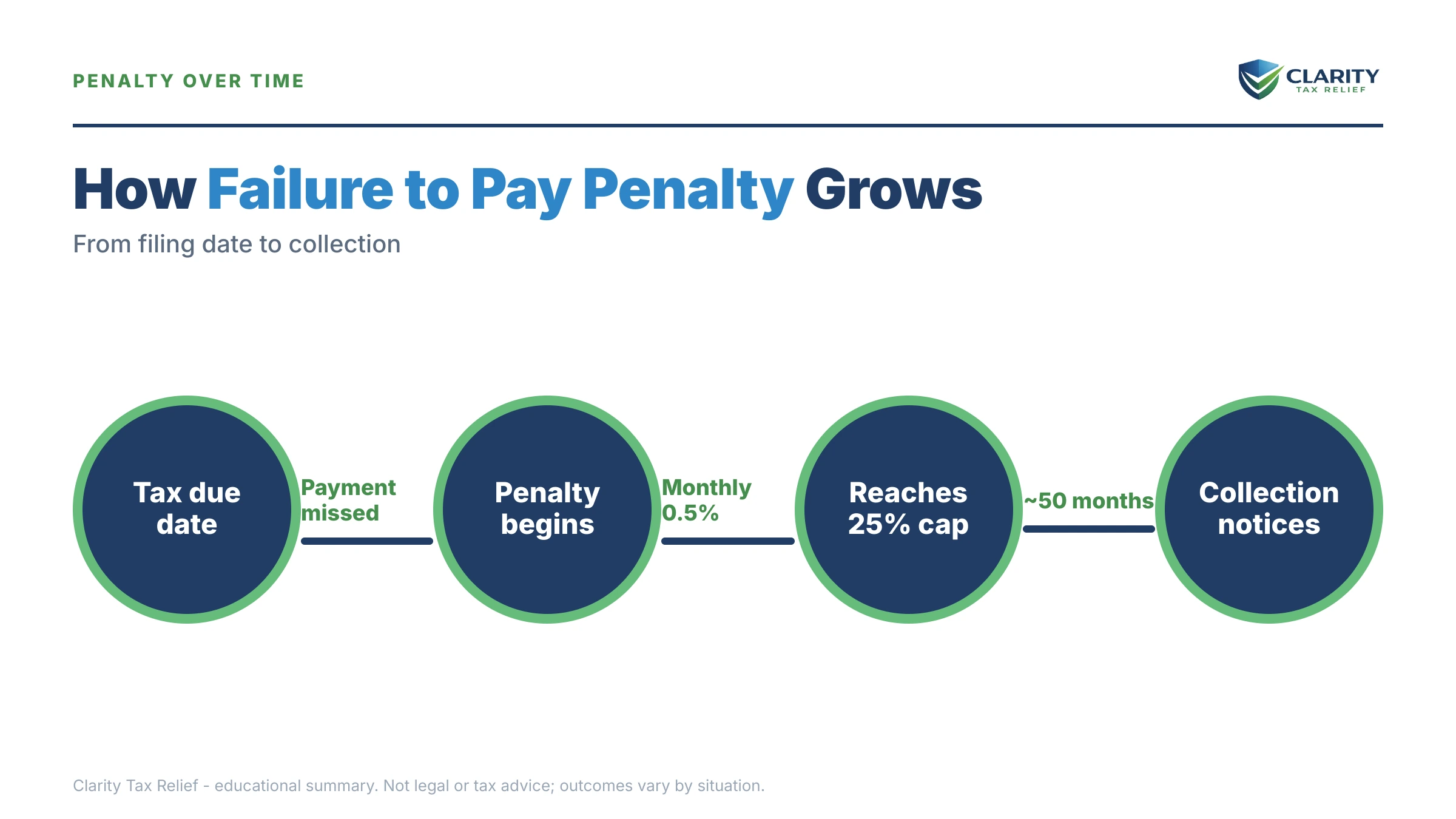
Every figure that matters is laid out below — how the rate changes in three different situations, how long it takes to hit the cap, and exactly what it costs on a real balance. The image below shows how the penalty's growth curve looks over time, so you can see where your balance sits on it.
⏱ The ongoing clock: there is no response deadline on a penalty that's already accruing — every month adds another 0.5% of the unpaid tax. On a $61,200 balance, that's $306 in new penalty each month, plus daily-compounding interest, until you pay, get on a plan, or the penalty hits its 25% cap.
IRS failure to pay penalty statistics: the 2026 numbers that matter
The IRS failure-to-pay penalty is 0.5% of the unpaid tax for each month or partial month, up to a maximum of 25% of the balance. That top-line rate hides the statistic most people miss: the rate isn't fixed. It moves in three directions depending on what you do.
Get an approved installment agreement in place on a return you filed on time. The rate is cut in half to 0.25% per month. Ignore the collection notices until the IRS issues a final intent-to-levy notice, and shortly afterward the rate doubles to 1% per month. Same debt, four-times difference in monthly cost — driven entirely by your response.
| Situation | Monthly rate | Monthly cost on $61,200 |
|---|---|---|
| Standard — balance unpaid, no arrangement | 0.5% | $306 |
| Approved installment agreement (return filed on time) | 0.25% | $153 |
| After a final intent-to-levy notice goes unanswered | 1% | $612 |
| Lifetime cap | 25% of the tax | $15,300 maximum |
Two more statistics frame how common this penalty is. First, scale: the IRS Data Book consistently shows failure-to-pay as one of the most frequently assessed civil penalties, with tens of millions of assessments in a typical year. It is assessed by computer the instant a balance goes unpaid, with no human review. Second, duration: at the standard rate, it takes 50 straight months of nonpayment to hit the 25% cap, so most balances are still in the growth phase, not the capped phase.
One clarifying comparison: this penalty is a tenth the size of its sibling. The failure-to-file penalty runs 5% per month, ten times the failure-to-pay rate, which is why the single most valuable move for anyone behind is filing, even without payment. The full comparison is in our guide to failure to file penalty vs failure to pay. And if your balance came from skipped quarterly payments rather than an unpaid April bill, that's a different charge with different math — see our IRS estimated tax penalty statistics.
“The failure to pay penalty is 0.5% of the unpaid taxes for each month or part of a month the tax remains unpaid. The penalty won’t exceed 25% of your unpaid taxes.”
— Failure to Pay Penalty (IRS.gov)
Why you were charged the failure-to-pay penalty
The penalty applies automatically under IRC §6651(a)(2) whenever tax shown on a return isn't paid by the original due date. You didn't get singled out. The IRS master file compared your assessed tax against your payments, found a gap, and posted the penalty. It appears on your account transcript as code 276, usually re-posting periodically as the charge compounds.
Three triggers cover almost every case: you filed but couldn't pay in full, an extension made you think the payment deadline moved (it didn't — an extension extends filing, not payment), or the IRS adjusted your return upward after filing and the penalty attached to the new balance. In 2026, with the IRS workforce down roughly 27% after the 2025 cuts, these assessments haven't slowed at all. They never touched a human to begin with.
For how this penalty stacks with interest and the failure-to-file penalty across multiple years, the full math lives in our hub on how much are IRS penalties on back taxes. This page stays focused on the failure-to-pay numbers specifically.
What the failure to pay penalty costs on $61,200: a worked example
On a $61,200 unpaid balance, the failure-to-pay penalty adds $306 every month it goes unaddressed. Say you're a homeowner planning to refinance later this year and you owe exactly that — here's the hypothetical math, penalty only, before interest:
| Months unpaid | Penalty accrued | Penalty in dollars | Balance before interest |
|---|---|---|---|
| 6 | 3% | $1,836 | $63,036 |
| 12 | 6% | $3,672 | $64,872 |
| 18 | 9% | $5,508 | $66,708 |
| 24 | 12% | $7,344 | $68,544 |
| 50 (cap) | 25% | $15,300 | $76,500 |
Notice month 18. The 2026 threshold for passport certification — where the State Department can deny or revoke your passport over seriously delinquent tax debt — is $66,000. A $61,200 balance starts $4,800 below that line, and the penalty alone crosses it by month 18. Add daily-compounding interest and the crossing comes sooner, likely closer to a year. Details are in our guide to the passport denied tax debt $66,000 threshold.
The refinance angle is just as concrete. As an unpaid balance grows past $50,000, a Notice of Federal Tax Lien becomes a real risk. A filed lien stops most refinance underwriting cold until it's paid, released, or subordinated. If you're in that position, read can I refinance with an IRS lien and the workaround in tax lien subordination. The cheapest version of this problem is the one you resolve before the lien exists.
Want your own numbers instead of a hypothetical? You can estimate your accrued penalties and interest with our Penalty & Interest Calculator.
What happens if you ignore it: the escalation sequence
The failure-to-pay penalty never triggers enforcement by itself. But the unpaid balance underneath it moves through an automated collection sequence. The penalty rate rises as it does. Here's the order:
- Silent accrual — the penalty runs at 0.5% per month from the original due date, before any letter arrives.
- CP14 — the first bill, showing tax, penalty, and interest broken out, typically with about 21 days to respond.
- CP501 / CP503 — reminder notices. Still just bills, but the balance compounds through each one.
- CP504 — Notice of Intent to Levy. The IRS can now take your state tax refund, and lien filing becomes likely on a balance this size.
- LT11 / Letter 1058 — Final Notice of Intent to Levy, starting a 30-day clock and your Collection Due Process rights. Shortly after an intent-to-levy notice, the penalty rate doubles to 1% per month — $612 monthly on $61,200.
- Lien and levy — a recorded federal tax lien blocks the refinance, and wage or bank levies become available to the IRS.
Every stage of that sequence is issued by automation. The 2025 workforce cuts made humans harder to reach. But they didn't slow the notice stream — which means the rate doubling at stage five happens whether or not anyone at the IRS ever reads your file.
Watching a balance grow $306 a month?
Before penalties and interest push your account past the lien or passport thresholds, get a free case review. An experienced tax professional will pull your transcripts, confirm exactly what's been assessed, and map the cheapest way to stop the accrual — no pressure, no obligation.
Your options: what stops, reduces, or removes the penalty
Every resolution path affects the failure-to-pay penalty differently — some stop future accrual, some cut the rate, and some erase penalties already assessed. Here's how they compare on cost and speed:
| Option | Upfront cost | Effect on the penalty | Typical timeline |
|---|---|---|---|
| Pay in full | The balance | Accrual stops the day payment posts | Immediate |
| Short-term plan (up to 180 days) | $0 setup fee | Penalty continues, but escalation stops | Set up online same day |
| Installment agreement | Setup fee varies by method; low-income waivers exist | Rate cut in half to 0.25%/month | Often approved online; balances over $50k need financials |
| First-time abatement / AEP | $0 | Removes the assessed penalty for a qualifying year | Often resolved in one phone call; AEP is automatic starting summer 2026 |
| Reasonable-cause abatement (Form 843) | $0 to file | Removes penalties tied to documented hardship | Weeks to months |
| Currently Not Collectible | $0; full financial disclosure required | Collection pauses; penalty and interest keep accruing | Weeks, after financial review |
| Offer in Compromise | $205 fee + 20% down (waived for qualifying low-income filers) | Accepted offer resolves tax, penalty, and interest together | Months to 2 years; roughly 1 in 5 offers accepted in FY2024 |
A few specifics worth flagging. The half-rate on an installment agreement only applies if the underlying return was filed on time — one more reason filing always comes first. On a $61,200 balance you're above the $50,000 streamlined line, so the IRS will want financial disclosure unless you pay the balance down below it first. Our walkthrough on how to set up an IRS payment plan online covers both routes. The fee tiers are in our guide to the IRS payment plan setup fee.
On removal: first-time penalty abatement requires a clean compliance record for the prior three years, and it's being replaced by the Automatic Exemption from Penalty (AEP) starting summer 2026 — automatic, no request needed. If your record isn't clean, reasonable-cause penalty abatement covers documented events like serious illness or disaster. How often these requests actually succeed is its own data story — see our IRS penalty abatement statistics.
How to respond to a growing failure-to-pay penalty, step by step
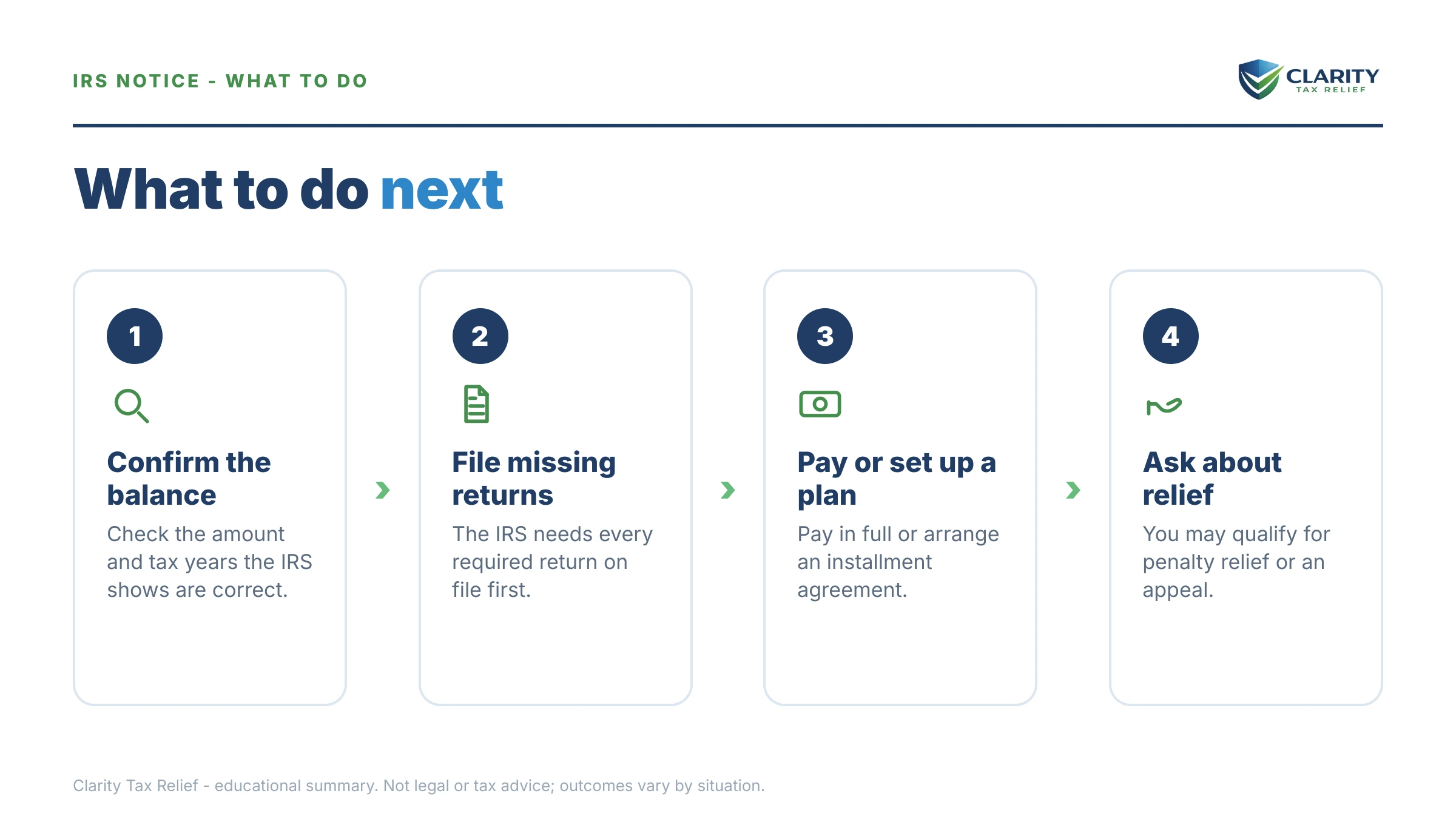
- Pull your IRS account transcript. Confirm which years carry the penalty by finding transcript code 276 on each year's account transcript, and note the assessed penalty amount for every year involved.
- File any unfiled returns. The failure-to-file penalty runs at 5% per month, ten times the failure-to-pay rate, so filing immediately shuts off the most expensive penalty first.
- Stop the monthly accrual. Pay what you can now, then set up a payment plan. An approved installment agreement cuts the monthly penalty rate in half, from 0.5% to 0.25%.
- Request penalty relief. Ask for first-time abatement if your prior three years are clean, or file Form 843 with a reasonable-cause explanation for the year the penalty covers.
- Get experienced help for large or multi-year balances. If you owe $50,000 or more, have several years involved, or a lien threatens a refinance or sale, have an experienced tax professional review the sequence before you commit to a plan.
When you can handle this yourself
Plenty of failure-to-pay situations don't need professional help. If you owe one year, agree with the number, and can pay within 180 days, a free short-term plan set up online solves it completely. If you qualify for first-time abatement, a single phone call to the IRS can remove the penalty — no representative required. A simple streamlined installment agreement under $50,000 is likewise a do-it-yourself task.
Experienced help changes the outcome in the harder versions: a balance over $50,000 where financial disclosure determines your monthly payment, multiple years with penalties stacking differently on each, unfiled returns feeding the 10×-larger failure-to-file penalty, or a lien that's about to collide with a refinance or home sale. In those cases, the order you fix things in — returns first, then the accrual, then abatement — often matters more than any single form, and getting the sequence wrong costs real money.
Terms on your account, decoded
- Failure-to-pay penalty: the 0.5%-per-month charge under IRC §6651(a)(2) for paying tax after its due date, capped at 25%.
- Failure-to-file penalty: the separate 5%-per-month charge for filing late — ten times larger, which is why filing always comes first.
- Code 276: the transcript line showing a failure-to-pay penalty posted to your account; it recurs as the penalty compounds.
- Abatement: the IRS removing an assessed penalty — through first-time abatement, reasonable cause, or the new AEP.
- Underpayment interest: a separate charge set quarterly at the federal short-term rate plus 3 points, compounding daily with no cap, even after the penalty maxes out.
- Notice of Federal Tax Lien: the IRS's recorded public claim against your property; the item that stops refinance underwriting.
The IRS's own summaries are worth bookmarking: the official failure to pay penalty page, the payment plans and installment agreements page. The annual penalty assessment data published in the Data Book at IRS.gov/statistics.
Every current penalty rate, including how the failure-to-pay charge changes once you are on an installment agreement, is listed in our IRS penalty rates reference.
Failure to pay penalty questions, answered
How much is the IRS failure to pay penalty?
The failure-to-pay penalty is 0.5% of your unpaid tax for each month or partial month the balance goes unpaid, capped at 25% of the tax owed. On a $10,000 balance that is $50 per month; on $61,200 it is $306 per month. Interest is charged separately on top. The rate changes if you get on a payment plan (0.25%) or ignore a final levy notice (1%).
What is the maximum failure to pay penalty?
25% of the unpaid tax. At the standard 0.5% monthly rate, it takes 50 months, just over four years, of nonpayment to reach the cap. Once the penalty maxes out it stops growing, but underpayment interest keeps compounding daily on the entire balance, including the penalty, until everything is paid.
How many taxpayers get the failure to pay penalty each year?
Tens of millions. The IRS Data Book consistently shows failure-to-pay as one of the most frequently assessed civil penalties. It is applied automatically by computer the moment a balance goes unpaid past the due date — no human reviews your file first. That is why the penalty keeps appearing even in years when the IRS is badly understaffed.
Can the failure to pay penalty be removed?
Yes, in three main ways: first-time abatement if your prior three years were clean, reasonable-cause relief for circumstances like serious illness or disaster, and, starting summer 2026, the IRS's Automatic Exemption from Penalty (AEP), which applies qualifying relief without a request. Interest tied to a removed penalty comes off with it, but interest on the underlying tax does not.
Is the failure to pay penalty the same as interest?
No. They are separate charges that accrue at the same time. The penalty is a flat 0.5% per month capped at 25%. Interest is set quarterly at the federal short-term rate plus 3 percentage points and compounds daily with no cap. Penalties can often be abated; interest generally cannot be, except when it stems from an abated penalty or an IRS error.
Does a payment plan reduce the failure to pay penalty?
Yes. While an approved installment agreement is in effect on a return you filed on time, the monthly rate drops from 0.5% to 0.25% — a 50% cut. On a $61,200 balance, that saves $153 every month. The plan also stops the escalation toward levy notices, which would otherwise eventually double the rate to 1% per month.
Will a failure to pay penalty stop me from refinancing my house?
The penalty itself will not, but the tax debt behind it can. Once the IRS files a Notice of Federal Tax Lien — an increasingly real risk as an unpaid balance grows past $50,000 — most lenders will not close a refinance until the lien is resolved, subordinated, or paid at closing. Getting on a payment plan before a lien is filed is usually the cleanest path.
Does the failure to pay penalty apply if I filed an extension?
An extension gives you more time to file, not more time to pay. If you did not pay at least 90% of your total tax by the original April deadline, the failure-to-pay penalty runs from that April date even with a valid extension. The extension does protect you from the much larger failure-to-file penalty while it lasts.
Your next 24 hours
- Find your real number. Log into your IRS online account or pull your account transcript, find the code 276 lines, and total the penalty assessed for each year — that's what's actually removable.
- Gather three things: your most recent tax return, every IRS notice you've received on the balance. A rough picture of your monthly income and expenses (that's what a payment plan is priced on).
- Get a free case review. With $306 in new penalty accruing every month on a balance like $61,200, plus daily interest, the cheapest month to act is this one. Call (888) 825-7779 or use the 2-minute form and we'll map your options before the lien and passport thresholds come into play.
This guide is general information, not tax or legal advice for your specific situation. Eligibility for IRS programs depends on individual facts and circumstances; no outcome is guaranteed.