
Employee Retention Credit
IRS ERC Fraud and Disallowed Claims: What They Mean and What to Do (2026)
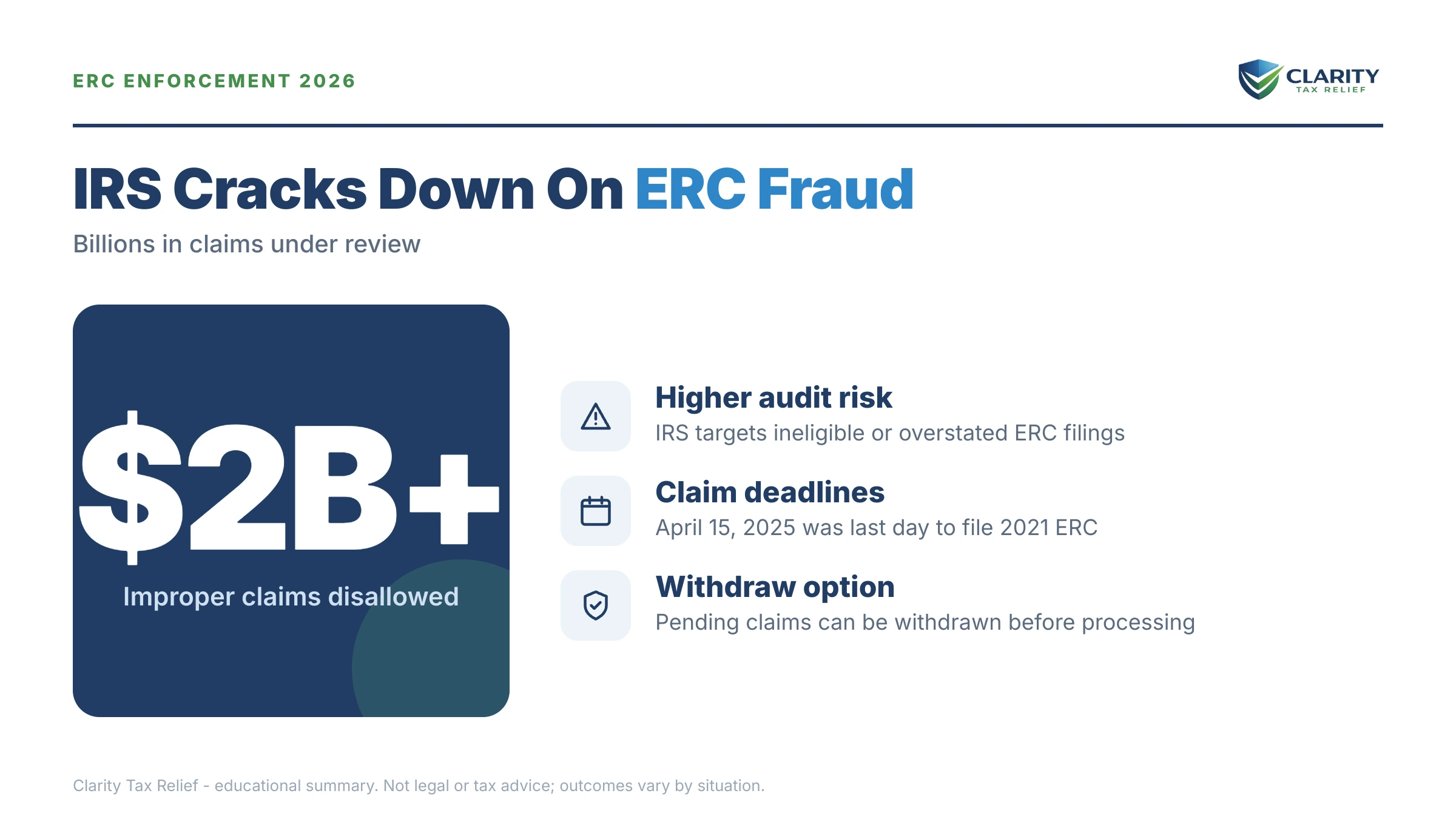
The short answer: the IRS disallowed roughly 28,000 Employee Retention Credit claims worth about $5 billion in a single 2024 sweep, and it is pursuing criminal cases now approaching $7 billion. If your ERC claim was disallowed, you can appeal it, withdraw it, or repay through a disclosure path, but you must act within the window printed on your letter.
If you're searching for answers on IRS ERC fraud disallowed claims, here's where things stand in 2026: enforcement is heavy, the letters are automated, and honest mistakes are being swept up alongside real fraud. You filed for the Employee Retention Credit, maybe a promoter told you it was easy money, and now a letter says the claim is denied, or that the money you already got is coming back.
Being disallowed is not the same as being accused of fraud, and it is not the end of the road. The image below shows what an ERC disallowance letter looks like and where to find the deadline that controls your next move.
The most important thing to know first: a disallowance letter can be appealed, and a bad claim you haven't been paid on can often be withdrawn cleanly. What you cannot do is nothing.
⏱ Your deadline: the response window printed on your disallowance letter, often a 30-day window to file an administrative protest. You generally have up to two years from the disallowance date to file a refund suit in court. If the claim was already paid and is being recaptured, interest runs from the date the IRS sent you the money.

Why the IRS disallowed or flagged your ERC claim
The IRS disallows an ERC claim when its records show your business didn't meet the eligibility rules for the quarter you claimed. The credit was narrow: you generally qualified only if a government order fully or partially suspended your operations, or your gross receipts dropped enough against the same quarter of 2019. Thousands of claims failed one of those two tests.
Aggressive promoters, "ERC mills", drove much of the problem. They filed on gross fees, told business owners a general slowdown counted, and rarely documented an actual shutdown order. About 3.6 million ERC claims had been processed by the September 2023 moratorium the IRS imposed to stop the flood. The agency has been unwinding the bad ones ever since. If a promoter filed your claim, you are still the taxpayer on the hook.
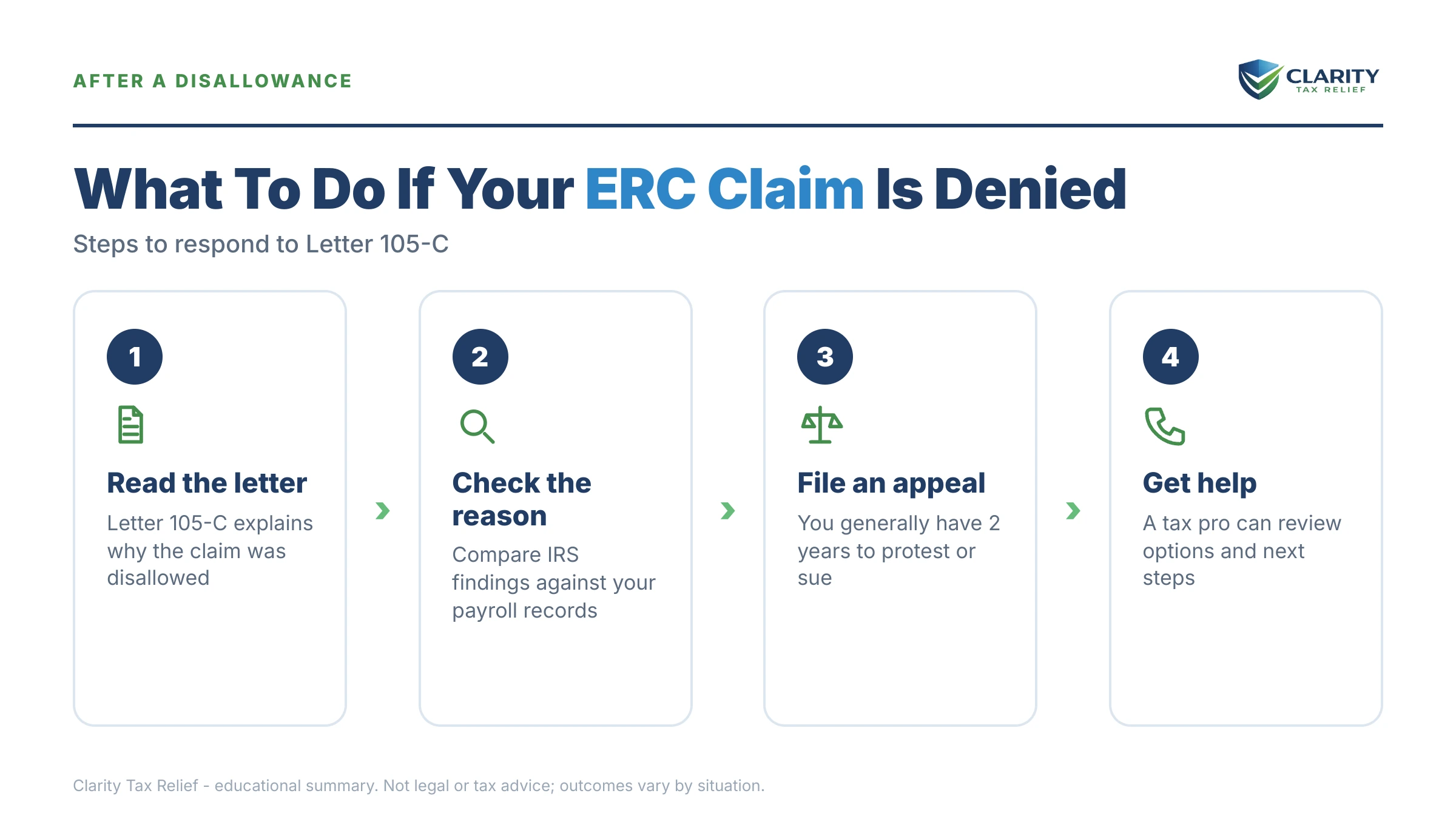
Common disallowance reasons include: no qualifying government order, gross receipts that never dropped enough, claiming wages already used for PPP forgiveness, or a business that didn't exist during the eligible period. A full denial arrives on Letter 105-C; a partial denial arrives on Letter 106-C.
| What the IRS reported | The figure |
|---|---|
| Disallowance letters sent in one 2024 sweep (IR-2024-203, Aug. 8, 2024) | 28,000 letters, up to $5 billion in improper payments prevented |
| ERC criminal cases initiated by IRS Criminal Investigation (as of July 1, 2024) | 460 cases, nearly $7 billion in potentially fraudulent claims |
| IRS-CI ERC investigations in FY2024 | 493 investigations, over $5.5 billion, 42 federal charges to date |
| First ERC Voluntary Disclosure Program (closed March 2024) | More than 2,600 applications, $1.09 billion in improper credits disclosed |
| ERC claims processed by the September 2023 moratorium | About 3.6 million claims |
| Tax fraud identified by IRS-CI in FY2025 | $4.5 billion, up 111.8% from FY2024 |
“If the IRS disallowed your ERC claim with Letter 105-C and you disagree, you may request an administrative appeal, review by the IRS Independent Office of Appeals, or file suit.”
— Employee Retention Credit (IRS.gov)
What happens if you ignore a disallowed ERC claim
Ignoring a disallowance letter forfeits your appeal rights and lets the IRS escalate on its own automated schedule. The consequences depend on whether you were already paid, but the sequence is predictable:
- Disallowance becomes final. Miss the protest window and the denial locks in — an unpaid claim simply dies. A paid claim moves to collection.
- Recapture is assessed. For a credit you already received, the IRS books the money back as an erroneous refund, with interest running from the date it paid you.
- Penalties attach. An accuracy-related penalty of 20% can be added. In cases the IRS treats as intentional, a civil fraud penalty of 75% is on the table.
- Normal collection kicks in. Unpaid recapture flows into the standard notice stream — balance-due notices, then a Notice of Intent to Levy, then a Final Notice with levy power.
- Criminal referral in the worst cases. Knowing, large-scale fraud can be referred to IRS Criminal Investigation — the unit that opened 493 ERC investigations in FY2024.
The ERC statute of limitations gives the IRS a long runway. The claim window closed April 15, 2025. But the One Big Beautiful Bill Act extended the assessment statute of limitations to six years for Q3 and Q4 2021 claims specifically, so 2021 credits stay reviewable well into the future.
Got an ERC disallowance letter?
Send us a photo. An experienced tax professional will tell you whether to appeal, withdraw, or repay, and flag the exact deadline on your letter — free, confidential, no pressure.
Your options after an ERC disallowance
You have more than one path. The right one turns on two facts: whether the claim was actually valid, and whether the IRS already paid you. Here's how the main options line up against who they fit.
| Option | Who it fits | What it does / costs |
|---|---|---|
| Appeal the disallowance | Your claim was legitimate and documented | File a protest within the letter's window; no fee. You keep the credit if you win. |
| Withdraw the claim | Claim was wrong and not yet paid or refunded | Pulls an unprocessed claim as if never filed; avoids penalties on that claim. |
| ERC Voluntary Disclosure Program | You were paid on a claim you weren't entitled to | Repay on defined terms with reduced penalty exposure (terms change by round). |
| Repay via recapture + payment plan | Recapture stands and you can't pay in full | Installment agreement spreads the balance; interest keeps accruing. |
| Currently Not Collectible / hardship | Repaying would cause genuine hardship | Pauses collection; the debt remains and interest continues. |
Not sure how big your exposure is? This band table maps the amount at stake to a realistic starting point. It compresses the shared payment-and-settlement mechanics that live in our guide on how to settle tax debt yourself.
| Recapture amount | Realistic options |
|---|---|
| Under $10,000 | Pay in full if you can; a guaranteed installment agreement is straightforward. Ask about penalty relief. |
| $10,000 – $50,000 | Streamlined installment agreement over up to 72 months, usually without detailed financials. |
| $50,000 – $100,000+ | Financial disclosure likely; hardship status or a business payment plan; professional review strongly advised. |
| Any amount, aggressive claim | Get an experienced tax professional first — recapture, penalties, and possible fraud exposure interact. |
A worked example: a $7,400 ERC claim disallowed
Say you run a small contracting outfit and also work as a 1099 contractor. A promoter filed an ERC claim on the two employees you carried in 2021, and it paid you $7,400. A disallowance letter now says you never met the government-shutdown or gross-receipts test.
If the claim hadn't been paid yet, the disallowance just kills it. You get nothing, and if you withdraw it cleanly there's no penalty on that claim. But you were paid, so the IRS recaptures the $7,400 as an erroneous refund, with interest running from the date the check cleared.
If the IRS adds the 20% accuracy-related penalty, that's another $1,480 — bringing your exposure to roughly $8,880 before interest. You can estimate how fast that interest builds with our IRS penalty and interest calculator. If you can show the claim was defensible, you appeal instead and may owe nothing. If it wasn't, a disclosure path or a payment plan keeps the $8,880 from snowballing through collection. This is a hypothetical. Your numbers depend on your quarters and facts.
How to respond, step by step
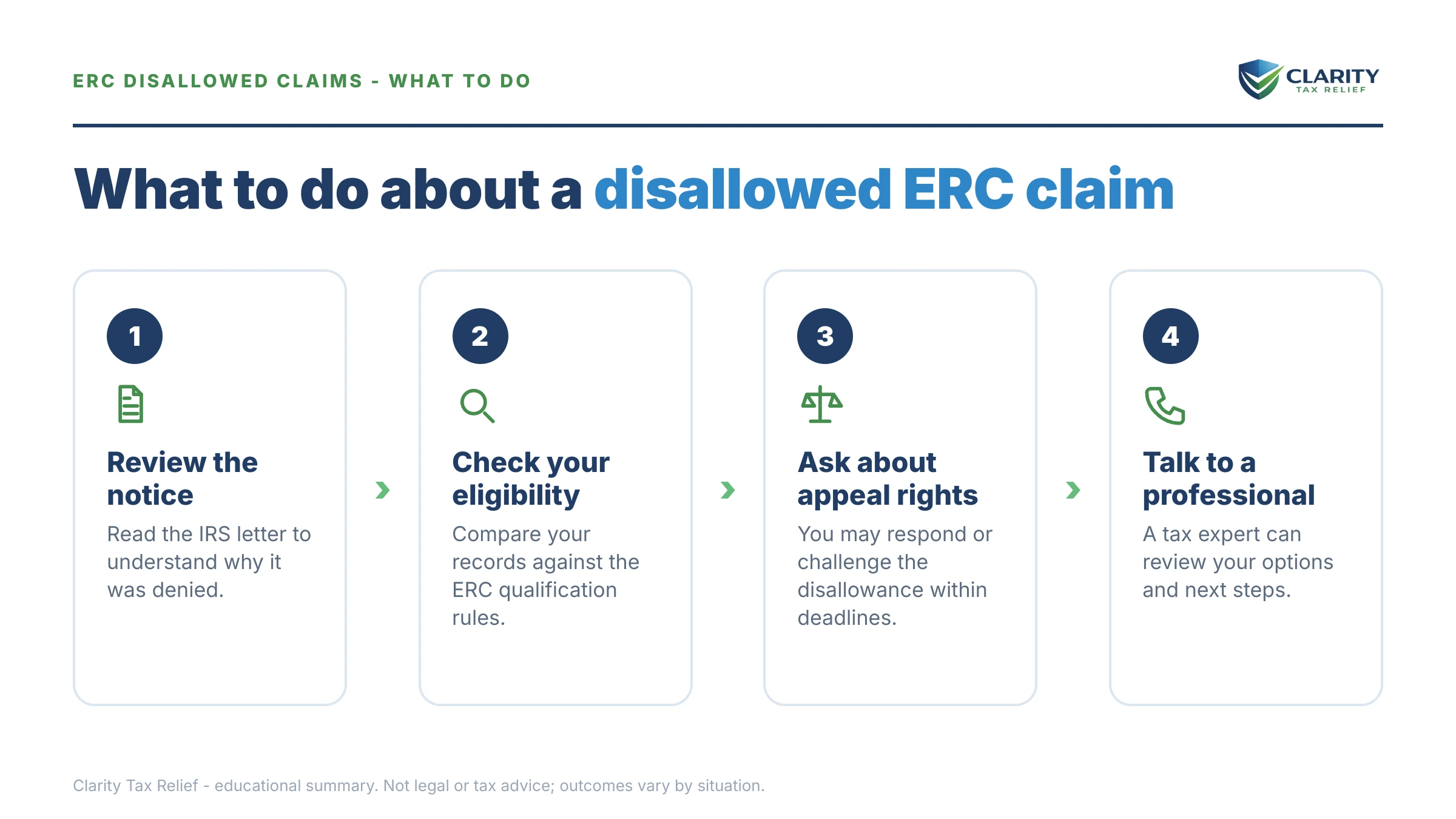
- Read the letter and find the deadline — identify whether you have a Letter 105-C full disallowance or a Letter 106-C partial disallowance, and note the response window.
- Pull your eligibility proof — payroll records, quarterly gross-receipts figures, and the exact government shutdown order you relied on.
- Decide: defend, withdraw, or disclose — appeal a defensible claim, withdraw an unpaid bad one, or look at repayment for a paid bad one.
- Respond in writing before the deadline — file your protest or documentation with the office named on the letter and keep copies with proof of mailing.
- Set up repayment if you owe — if recapture stands and you can't pay in full, arrange an installment agreement or hardship status.
- Get a professional review for large or fraud-adjacent claims — if the amount is significant, a mill filed the claim, or the facts look aggressive, have an experienced tax professional review it first.
When you can handle this yourself, and when you shouldn't
You can often handle a small, clear-cut disallowance on your own. If you agree the claim was wrong, the amount is modest, and it hasn't been paid, withdrawing it or accepting the denial is simple. A small recapture you can pay in full needs nothing more than a check and, possibly, a first-time penalty abatement request.
Experienced help changes outcomes when the stakes rise. If the disallowance is wrong and you have a defensible claim, an appeal built on the right payroll and shutdown documentation is worth far more than the fee. If an ERC mill filed your claim, if the recapture is large, if you have multiple quarters at issue, or if the facts look aggressive enough to raise fraud questions, get representation before you say anything to the IRS. What to say and in what order can be the difference between a civil bill and a criminal referral. If you were paid on a claim you can't afford to return, our guide on what to do when you can't repay ERC walks through the alternatives.
Terms on your ERC letter, decoded
Disallowance (Letter 105-C): the IRS fully denied your claim; you receive no credit for that quarter.
Partial disallowance (Letter 106-C): the IRS allowed part of your claim and denied the rest.
Recapture: the reversal of a credit already paid to you, assessed back as an erroneous refund with interest.
Erroneous refund / accuracy-related penalty: a 20% penalty the IRS can add to a recaptured credit for a substantial understatement.
ERC mill: a promoter that mass-filed ERC claims for a fee, often without verifying eligibility.
Voluntary Disclosure Program: an IRS path to repay an improper ERC on defined terms with reduced penalty exposure.
ERC disallowance and fraud questions, answered
What does it mean if the IRS disallowed my ERC claim?
It means the IRS reviewed your Employee Retention Credit claim and decided you did not qualify, so it will not pay it — or, if it already paid, it wants the money back. A full denial comes on Letter 105-C and a partial denial on Letter 106-C. Disallowance by itself is not a fraud charge; it is a determination you have the right to challenge.
Can I go to jail for a wrong ERC claim?
An honest mistake that gets disallowed is a civil matter, not a criminal one. You repay, you may owe penalties, and it ends there. Criminal exposure is reserved for knowing fraud. The IRS is pursuing it: IRS Criminal Investigation had initiated 460 ERC criminal cases as of July 1, 2024, with potentially fraudulent claims worth nearly $7 billion. If you knowingly inflated wages or invented a shutdown, get an experienced tax professional before you talk to anyone.
What's the difference between an ERC disallowance and ERC recapture?
Disallowance stops a claim the IRS has not yet paid. You simply don't receive the refund. Recapture reverses a credit you already received, so the IRS assesses the money back as an erroneous refund with interest running from the date it was paid to you. Which one you face depends entirely on whether the check already cleared.
Can I appeal an ERC disallowance?
Yes. A disallowance letter is not the final word. You can request an administrative appeal within the window printed on the letter. You generally have two years from the disallowance date to file a refund suit in court. To win, you need contemporaneous proof: payroll records, gross-receipts figures by quarter, and the specific government order that suspended your operations.
What if an ERC mill filed my claim without my knowledge?
You are still legally responsible for what was filed under your business's name, even if a promoter prepared it and took a percentage. The IRS knows mills drove much of the improper filing, which is why it opened withdrawal and disclosure paths. Gather your engagement paperwork and the numbers the promoter used, because your defense, or your repayment terms — turns on what you can actually document.
Do I have to repay ERC money I already received?
If the credit is disallowed after payment, yes — the IRS recaptures the full amount plus interest. It can add a 20% accuracy-related penalty. The first ERC Voluntary Disclosure Program let more than 2,600 businesses disclose $1.09 billion in improper credits on reduced terms before it closed in March 2024. If you can't repay in full, a payment plan or hardship status may apply.
How long can the IRS come after my ERC claim?
The ERC claim window closed April 15, 2025, but the assessment clock runs longer. The One Big Beautiful Bill Act extended the assessment statute of limitations to six years for Q3 and Q4 2021 claims specifically. That means the IRS has a long runway to review, disallow, and recapture 2021 credits — do not assume time has run out.
What is the ERC Voluntary Disclosure Program?
It is an IRS path that lets a business that received an ERC it wasn't entitled to repay on defined terms and reduce its exposure to penalties. The first round drew more than 2,600 applications disclosing $1.09 billion in improper credits before closing in March 2024. Terms change between rounds, so confirm current eligibility before applying. It isn't right for every situation, especially a defensible claim.
Your next 24 hours
- Find the deadline. On your letter, locate whether it's a Letter 105-C or 106-C and note the response window, often 30 days to file a protest.
- Gather your proof. Pull the ERC filing, your 2019–2021 quarterly gross receipts, payroll records, and the government order you relied on.
- Get a free case review. Use the 2-minute form or call (888) 825-7779 — an experienced tax professional will tell you whether to appeal, withdraw, or repay before your window closes.
This guide is general information, not tax or legal advice for your specific situation. Eligibility for IRS programs depends on individual facts and circumstances; no outcome is guaranteed.
Primary sources: the IRS newsroom update on ERC claim processing and improper-claim enforcement, the IRS Employee Retention Credit page, and the Taxpayer Advocate Service.