
IRS Data Studies
ERC Voluntary Disclosure Program Results: What 2,600 Businesses and $1.09 Billion Reveal (2026)
The short answer: More than 2,600 businesses used the IRS's first ERC Voluntary Disclosure Program to disclose over $1.09 billion in improper Employee Retention Credits — repaying just 80% of what they received, with no penalties or interest. A second window (Aug 15 – Nov 22, 2024) raised repayment to 85%. Both are now closed.
If you're searching for ERC voluntary disclosure program results, you're probably not writing a term paper. You claimed the Employee Retention Credit, or a promoter claimed it for you, and you want to know how things turned out for the businesses that came forward, and what that means for the ones that didn't. The honest answer: the businesses that disclosed got the best deal the IRS will likely ever offer on this credit, and everyone still holding a questionable claim in 2026 is on the enforcement side of the ledger.
That's fixable, but the fixes available now cost more than the ones that closed. This page lays out the verified numbers from both disclosure windows, the math on what disclosure saved versus what recapture costs, and every option still open to you. Here is how the two windows compared at a glance — keep the 80% and 85% figures in mind as you read through your own options.
⏱ The clock now: both ERC disclosure windows are closed, and no third has been announced. The clock that IS running is enforcement: interest and penalties accrue on any improper credit the IRS recaptures, and the assessment window on 2021 ERC claims is still open in 2026 — later-2021 quarters carry a longer-than-normal statute.

ERC voluntary disclosure program results: the numbers from both windows
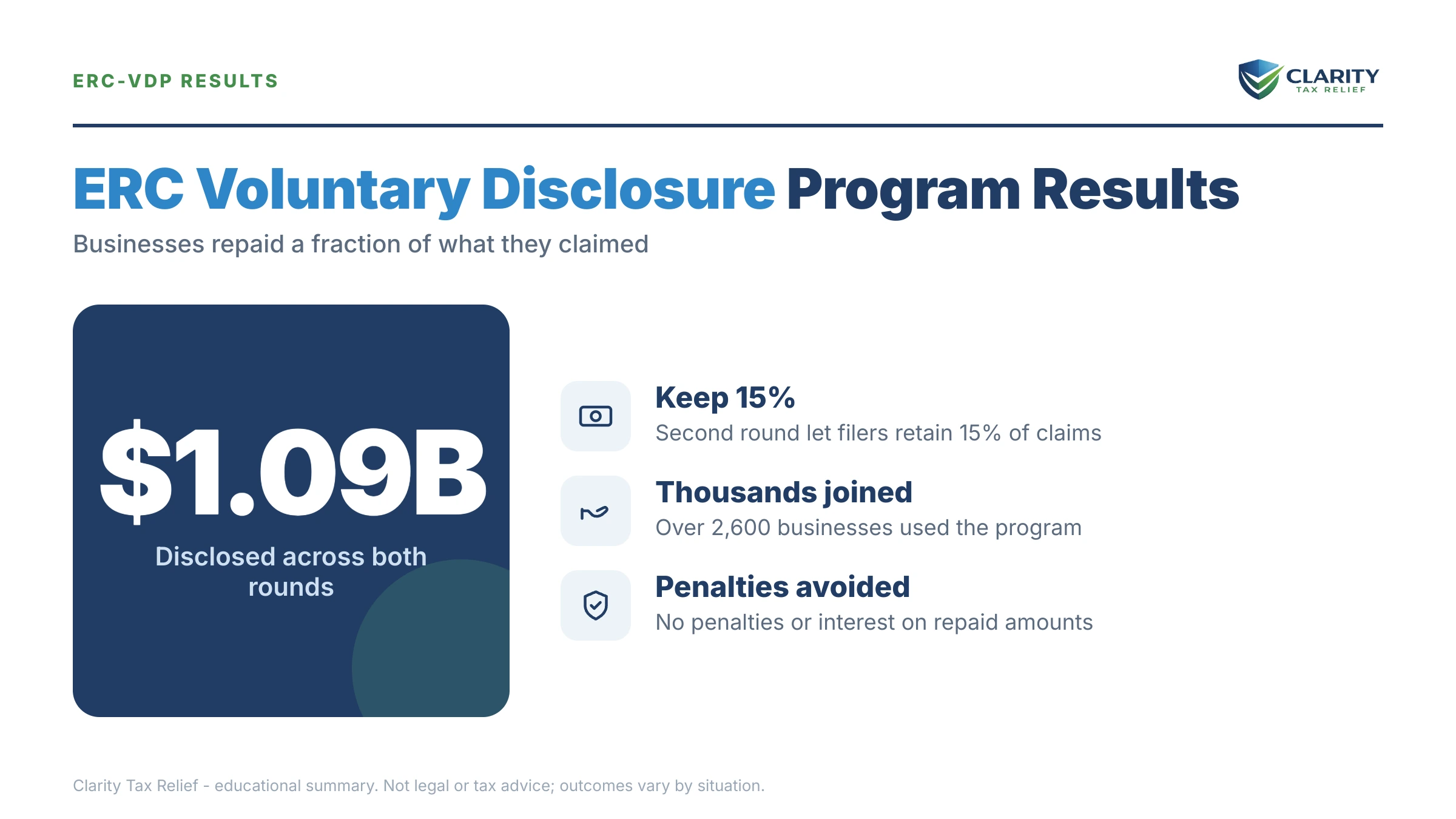
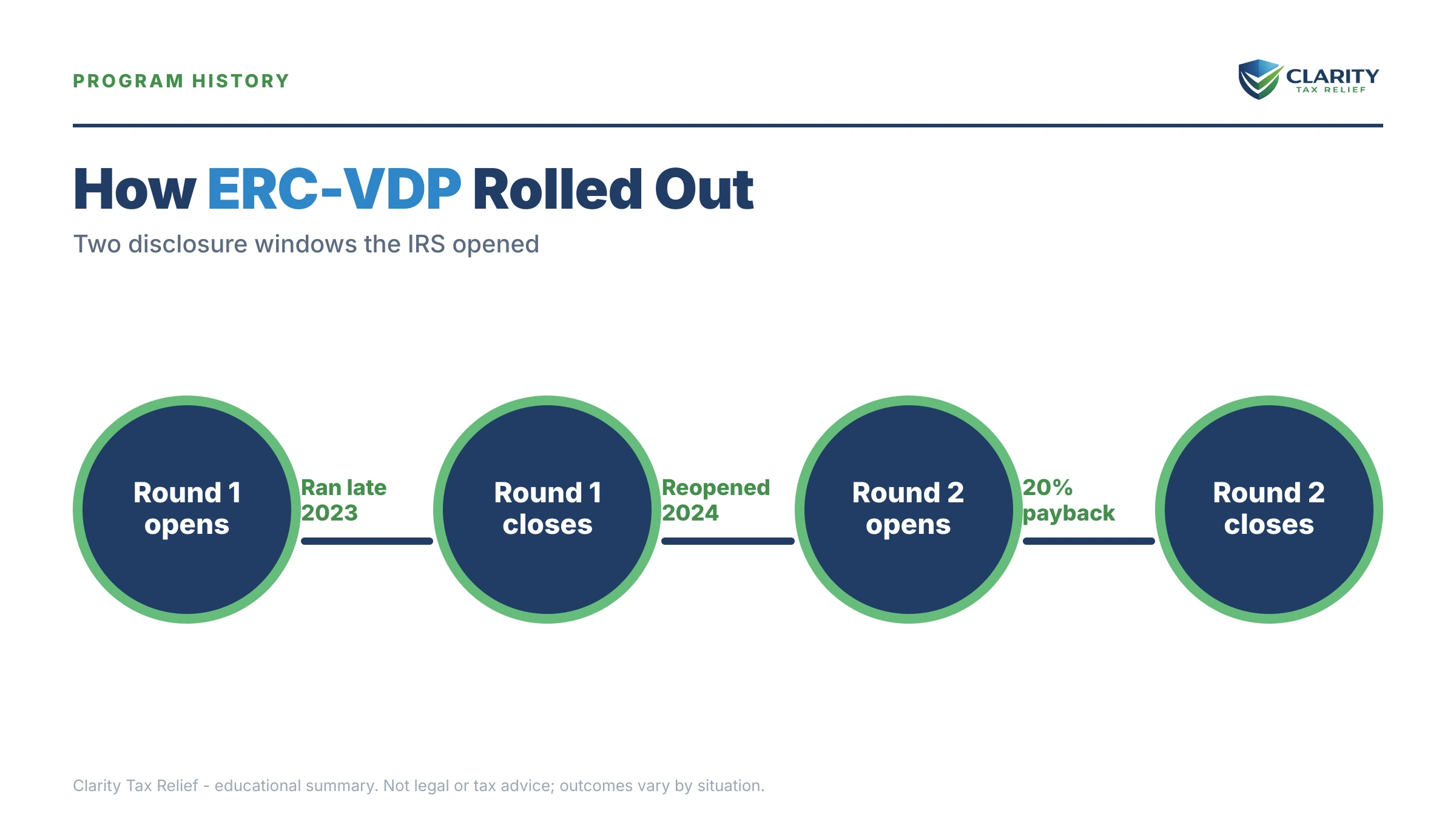
The first ERC Voluntary Disclosure Program produced more than 2,600 applications disclosing over $1.09 billion of improper ERC claims before it closed on March 22, 2024. Under the first program's terms, accepted businesses repaid only 80% of the ERC received — a 20% discount, with no interest or penalties.
One number gets misquoted constantly, so let's be precise. At 80%, the ~$1.09 billion disclosed corresponds to roughly $872 million actually repaid — the $1.09B is the amount disclosed, not the amount returned. When you see headlines saying the program "recovered over a billion dollars," that's the disclosed figure, not the cash.
The IRS then reopened the door once. The second ERC-VDP ran Aug 15 – Nov 22, 2024, and required participants to repay only 85% of the ERC received — a 15% discount, no penalties or interest. The second round covered tax periods in 2021 only; 2020 periods were no longer eligible. Announcing the reopening, the IRS said it was sending up to 30,000 letters to address more than $1 billion in errant claims (IR-2024-212) — a clear signal that businesses declining the discount would meet the recapture machine instead.
“You need to repay only 85% of the ERC you received as a credit on your return or as a refund. You don’t need to repay any interest you received on your ERC refund.”
— Employee Retention Credit - Voluntary disclosure program (IRS.gov)
Why the IRS paid businesses 20% to give its own money back
The 20% discount existed because most improper ERC claims weren't hatched by the businesses that filed them. ERC promoters — the "mills" that blanketed radio and robocalls in 2022 and 2023 — typically charged contingency fees of roughly 20–25% of the refund. A business that repaid 80% could come out approximately whole on net, having handed the promoter's cut back to the Treasury instead of eating it twice.
It was also arithmetic on the IRS side. Auditing hundreds of thousands of employment tax claims one by one, in an agency that would go on to shed roughly 27% of its workforce in 2025, was never realistic. A self-service disclosure form (Form 15434) that required applicants to name the promoter who prepared the claim gave the IRS repayment and an enforcement map of the mills — the same intelligence now feeding the cases tracked in our IRS ERC fraud criminal investigation statistics study. If a promoter filed your claim and you're only now questioning it, our guide to ERC mill claim problems walks through that specific mess.
The shrinking discount between rounds — 20% down to 15%, with 2020 quarters dropped entirely — is the single most useful signal in the data. Each time the IRS reopened the door, the deal got worse. Anyone waiting for a friendlier third round is betting against the trend line.
First vs. second ERC-VDP: how the terms and results compare
The two windows shared a structure but not a price. Here is the side-by-side:
| Program detail | First ERC-VDP | Second ERC-VDP |
|---|---|---|
| Window | Closed March 22, 2024 | Aug 15 – Nov 22, 2024 |
| Repayment required | 80% of the ERC received | 85% of the ERC received |
| Effective discount | 20% | 15% |
| Penalties and interest | None on disclosed amounts | No penalties or interest |
| Tax periods covered | 2020 and 2021 | Tax periods in 2021 only |
| Published results | More than 2,600 applications; over $1.09 billion disclosed (~$872 million repaid at 80%) | Totals not published; IRS sent up to 30,000 letters addressing more than $1 billion in errant claims (IR-2024-212) |
Both programs shared two quieter benefits worth naming. Participants didn't have to amend their income tax returns to reverse the wage-deduction adjustment on the disclosed credits — a paperwork and cash savings that ERC recapture outside the program doesn't offer. And disclosure resolved the employment tax side civilly for claims that weren't willfully fraudulent, which is why the program sat alongside, not inside, the IRS's broader IRS voluntary disclosure practice for willful conduct.
The math: what disclosure saved, and what recapture costs now
A business that disclosed under the first window kept 20 cents of every improper ERC dollar and paid zero penalties or interest. A business caught today repays every dollar plus additions. Here's the gap in real numbers.
Say you're the sole owner of a small S corporation — recently divorced, cash tight, splitting business records with a lawyer's help — and back in 2021 a promoter filed claims that put $120,000 of ERC in the company account, credits you now doubt were valid:
- Under the first ERC-VDP: repay 80% — $120,000 × 0.80 = $96,000. You'd have kept $24,000 (roughly the promoter's fee) with no penalties or interest and no amended income tax returns.
- Under the second ERC-VDP: repay 85% — $120,000 × 0.85 = $102,000, keeping $18,000.
- Today, if the IRS recaptures the claim: the full $120,000 comes back. An accuracy-related penalty of 20% could add $120,000 × 0.20 = $24,000 — $144,000 before interest, with interest compounding on top. You can estimate the additions on your own numbers with our IRS penalty and interest calculator.
This is a hypothetical. Your facts control — some recaptured claims draw no accuracy penalty, some willful ones draw a 75% civil fraud penalty instead. But the direction never changes: every month since the windows closed, the cost of the same mistake has gone up, not down.
What happens if you ignore an improper ERC claim now
An unaddressed improper ERC claim eventually becomes 100% repayment plus penalties and interest — the disclosure discount is gone. The enforcement sequence runs in stages, and each stage removes options:
- Disallowance. The IRS denies the claim in full with a Letter 105-C or in part with a Letter 106-C. Each carries appeal rights and starts a two-year window to contest the disallowance in court. Our IRS ERC claims disallowed statistics study tracks how many claims are meeting this fate.
- Recapture. For claims already paid, the IRS assesses the credit back as an employment tax liability, with penalties and interest attached, unlike either disclosure window.
- Collection. The recaptured balance enters the standard IRS collection sequence: a first bill, escalating notices, and ultimately levy authority against business bank accounts and receivables.
- Examination of the underlying quarters. Later-2021 quarters carry an extended assessment window — see our guide to the ERC statute of limitations — so "they haven't found it yet" is not the same as "they can't."
- Criminal referral. Willfully fraudulent claims can move from civil recapture to IRS Criminal Investigation. This is rare and reserved for knowing fraud, not honest promoter victims, but it's the stage with no discount of any kind.
The IRS is still working through a mountain of ERC claims — our erc claims backlog irs inventory statistics study covers the queue — but the backlog cuts both ways. It buys some claimants time; it does not make any claim disappear, because the extended statute keeps late-2021 quarters reachable.
Holding an ERC claim you're not sure about?
The disclosure discounts are gone, but the order you fix things in still changes what you pay. An experienced tax professional will review your quarters, your promoter paperwork. Your exposure — free and confidential, before interest adds another month to the bill.
Your options now that both disclosure windows are closed
Five real paths remain for a questionable ERC claim in 2026, and which one fits depends on whether the claim was paid and whether it was actually valid:
| Option | Who it fits | What it does |
|---|---|---|
| Claim withdrawal | Claim filed but not yet processed, or refund check received but not cashed (confirm current availability on IRS.gov) | Claim is treated as if it was never filed — no repayment issue is created |
| Correct and repay (Form 941-X) | Claim was paid and you now know it was improper | Fixes the quarters and stops the problem compounding; penalties and interest may still apply, but self-correction beats discovery |
| Appeal a disallowance | You received Letter 105-C or 106-C and believe the claim is valid | Preserves the credit through IRS Appeals; a two-year suit window (extendable by Form 907) backs it up |
| Audit substantiation | Claim is legitimate and under examination | Documenting the government order or gross-receipts decline per quarter keeps a valid credit |
| Installment agreement or hardship status | You owe recapture and can't pay in full | A payment plan or, in genuine hardship, collection relief — see can't repay ERC |
For the payment-side mechanics — how installment agreements, hardship status, and penalty relief work in general — our hub on how to settle tax debt yourself covers the shared ground so this page can stay on ERC specifics. For the full terms both closed windows offered, our companion guide to the ERC voluntary disclosure program preserves the details.
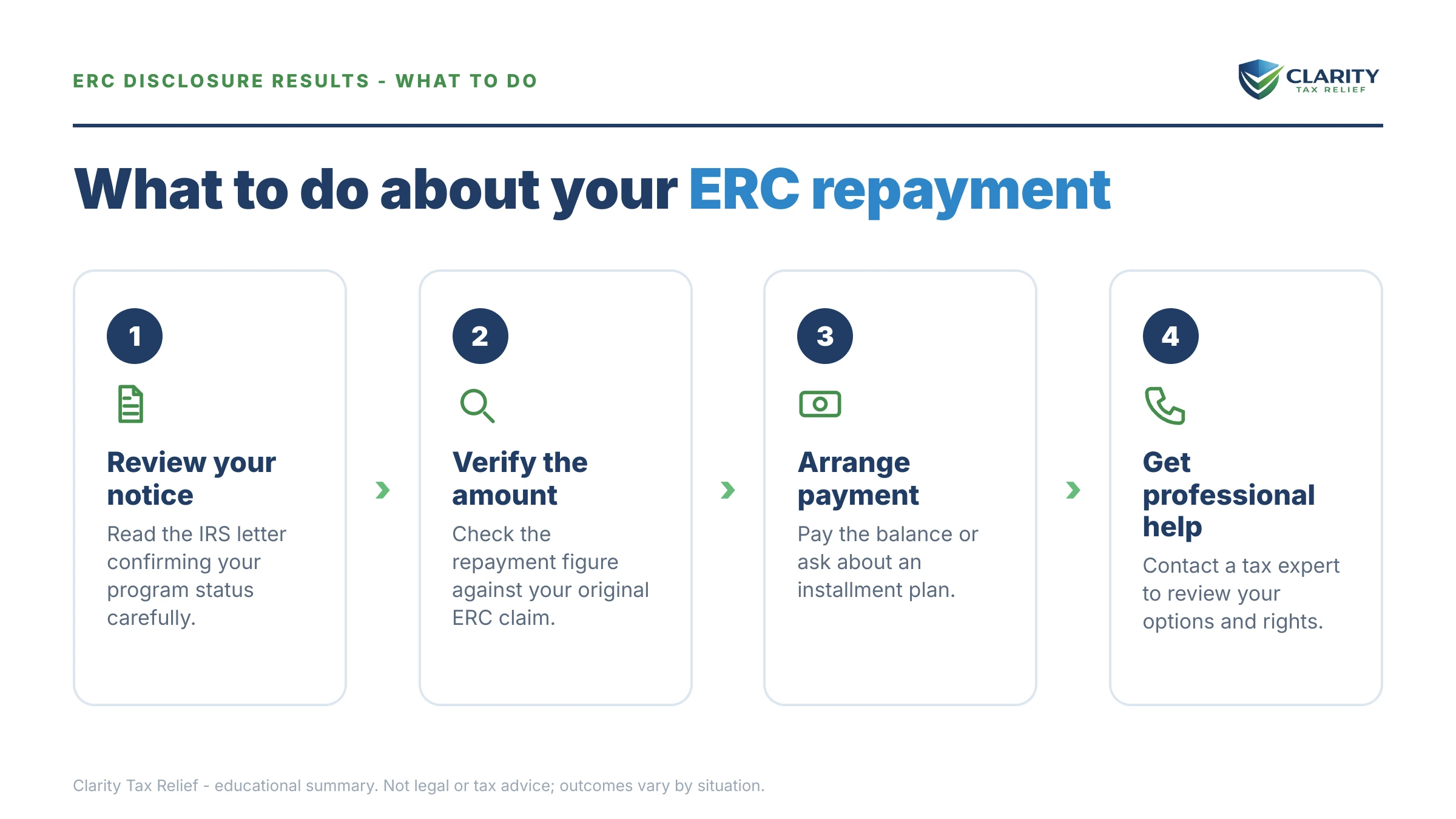
How to respond if your ERC claim was improper, step by step
- Pull the paperwork — gather every Form 941-X that claimed the credit, the refund amounts received per quarter, and whether each check was cashed.
- Test eligibility honestly — for each quarter, confirm a qualifying government order actually suspended operations or the gross-receipts decline actually met the threshold — supply-chain theories rarely hold up.
- Withdraw any unpaid claim — if a claim hasn't been processed (or the check is uncashed), request withdrawal so it's treated as never filed.
- Correct and repay claims already paid — file a corrected Form 941-X for the bad quarters and repay, or set up an installment agreement if you can't pay in full.
- Get a professional review before answering any IRS letter — have an experienced tax professional review promoter contracts and your response before you reply to a disallowance, recapture, or audit letter.
ERC letters and forms decoded
If your claim is on the IRS's radar, one of these documents is likely how you'll find out:
| Letter / form | What it means | What to do |
|---|---|---|
| Letter 105-C | Your ERC claim was disallowed in full | Appeal or prepare to contest — the letter starts your two-year window to sue |
| Letter 106-C | Your claim was partially disallowed | Verify the IRS's quarter-by-quarter math before accepting or appealing the reduced amount |
| Recapture letter | The IRS is clawing back a credit it already paid | Respond by the letter's date; dispute if the quarter was valid, arrange payment if not |
| Form 907 | An agreement extending your two-year deadline to sue on a disallowed claim | Consider signing if your appeal is still pending as the deadline nears — get advice first |
| Form 15434 | The (now historic) ERC-VDP application | None — both windows are closed; keep a copy if you participated |
Terms in the ERC disclosure story, decoded
- Disclosed vs. repaid: "disclosed" is the improper credit a business admitted to; "repaid" is the discounted cash actually returned — over $1.09 billion versus roughly $872 million in the first window.
- Recapture: the IRS assessing a paid credit back as a tax debt, with penalties and interest — the no-discount version of disclosure.
- ERC mill / promoter: a firm that mass-filed aggressive claims for contingency fees; VDP applicants had to name theirs.
- Government order test: eligibility based on a governmental COVID order that fully or partially suspended your operations during the quarter claimed.
- Gross receipts test: the alternative eligibility route, based on a sufficient quarter-over-quarter revenue decline versus 2019.
- Willful: knowing the claim was false when it was filed — the line between civil recapture and criminal exposure.
When you can handle this yourself, and when to get help
You likely don't need professional help if your claim is small, clearly valid, and documented — a genuine gross-receipts decline you can show on two bank statements defends itself. Withdrawing a single unprocessed claim is also a straightforward, self-service process on IRS.gov.
Experienced help changes outcomes in four situations: a paid claim you now believe is improper (the correction-and-repayment sequencing affects both employment tax and income tax). A disallowance letter with real money at stake and a two-year clock running. A promoter who signed or ghost-prepared your filings, which shifts how you present the claim's history. And any hint of willfulness, where what you say to the IRS first matters most. In those cases, a review before you respond is worth far more than one after.
ERC voluntary disclosure questions, answered
What were the results of the ERC voluntary disclosure program?
The first ERC Voluntary Disclosure Program drew more than 2,600 applications disclosing over $1.09 billion of improper ERC claims before it closed on March 22, 2024. Because accepted businesses repaid only 80% of the ERC received, the $1.09 billion disclosed corresponds to roughly $872 million actually repaid. The IRS has not published equivalent totals for the second window, which ran Aug 15 – Nov 22, 2024.
Is the ERC voluntary disclosure program still open in 2026?
No. The first program closed March 22, 2024, and the second ran Aug 15 – Nov 22, 2024, covering tax periods in 2021 only. The IRS has not announced a third window. If your claim was filed but never paid, the separate claim withdrawal option may still be available — confirm its current status on IRS.gov before assuming you have no exit.
How much did businesses have to repay under the ERC voluntary disclosure program?
First-round participants repaid only 80% of the ERC received — a 20% discount, with no interest or penalties. The second round required businesses to repay only 85% of the ERC received — a 15% discount, no penalties or interest. Under both programs' terms, participants also avoided amending income tax returns to reverse the wage-deduction adjustment tied to the disclosed credits.
Will the IRS open a third ERC voluntary disclosure program?
No third program has been announced. The trend line argues against waiting: the discount shrank from 20% in the first window to 15% in the second. The second window dropped 2020 periods entirely. Meanwhile, interest keeps accruing on any improper credit the IRS eventually recaptures — waiting for a better deal is a bet with a running meter.
What happens if I kept an improper ERC claim and never disclosed?
You remain exposed to full recapture: 100% of the credit back, plus penalties and interest, if the IRS disallows or claws back the claim. Late-2021 quarters carry a longer-than-normal assessment window, so 2021 claims are still very much reachable in 2026. Willfully fraudulent claims can also be referred to IRS Criminal Investigation — the disclosure programs never protected willful fraud, and their closure doesn't either.
Can I still withdraw my ERC claim if the IRS hasn't paid it?
As of this writing, the IRS's separate claim withdrawal process remains available for claims that haven't been processed, and for refund checks received but not cashed or deposited. A withdrawn claim is treated as if it was never filed. If you already cashed the refund, withdrawal is off the table. Your path is correcting the quarter on Form 941-X and repaying, with a payment arrangement if needed.
Did using the ERC voluntary disclosure program mean admitting fraud?
No. The program was built for businesses whose claims were wrong but not willfully fraudulent, often because a promoter misapplied the eligibility rules. Applicants did have to identify any preparer or promoter who assisted with the claim, which fed the IRS's enforcement work against ERC mills. Willful fraud was never eligible and remained subject to criminal investigation regardless of the program.
Why did the IRS let businesses keep 20% of an improper credit?
The 20% discount roughly mirrored the contingency fees many promoters charged, so a business that paid a mill 20–25% of its refund could come out approximately whole by repaying 80%. It was also cheaper for the IRS than auditing thousands of claims one by one. The second window's smaller 15% discount signaled that the generosity was shrinking, not growing.
Your next 24 hours
- Find your ERC numbers. Pull each Form 941-X, note the credit claimed per quarter, the refund received, and whether every check was cashed. That one detail decides whether withdrawal is still on the table.
- Gather the eligibility file. Promoter contracts and fee agreements, the government orders cited for your area, and gross receipts by quarter for 2019–2021.
- Get the free review. Both disclosure discounts are gone, and interest accrues on anything the IRS eventually recaptures — have an experienced tax professional map your cheapest path out now, at the 2-minute form or (888) 825-7779.
Sources: program terms and results are from the IRS's Employee Retention Credit Voluntary Disclosure Program page and the IR-2024-212 reopening announcement. If ERC enforcement is causing hardship your business can't absorb, the Taxpayer Advocate Service is an independent resource within the IRS.
This guide is general information, not tax or legal advice for your specific situation. Eligibility for IRS programs depends on individual facts and circumstances; no outcome is guaranteed.