
IRS Data & Studies
Ghost Tax Preparer Penalties: What 2026 Enforcement Data Shows (and Who Really Pays)
The short answer: ghost tax preparer penalties in 2026 include permanent federal injunctions and six-figure clawbacks — one Michigan preparer was ordered to disgorge $697,797, and three Florida preparers $988,789.56 in the aggregate. But the person who usually pays the most is the client: you stay legally responsible for every number on your return.
You paid someone who promised a bigger refund than anyone else could get, and when you looked at your copy of the return, the paid-preparer box near the signature line was blank. Now the numbers don't match your W-2, and the name on the return is yours, not theirs. That's fixable, and the fix is cheapest right now. This page shows you the enforcement data, your exposure, and the exact steps to take.
Federal courts are shutting down "ghost" tax preparers and clawing back hundreds of thousands of dollars in ill-gotten fees. In one Indiana case, the government estimated a single operation's false returns cost the government over $1 million each filing season. The full 2024 case data is in the table below.
⏱ Your real clock: there is no response window printed on a ghost-prepared return — the clock is interest. Interest and the 0.5%-per-month failure-to-pay penalty accrue on any understated tax from the return's original due date, so correcting it this month always costs less than correcting it next month.

Ghost tax preparer penalties in 2026: what federal courts are actually doing
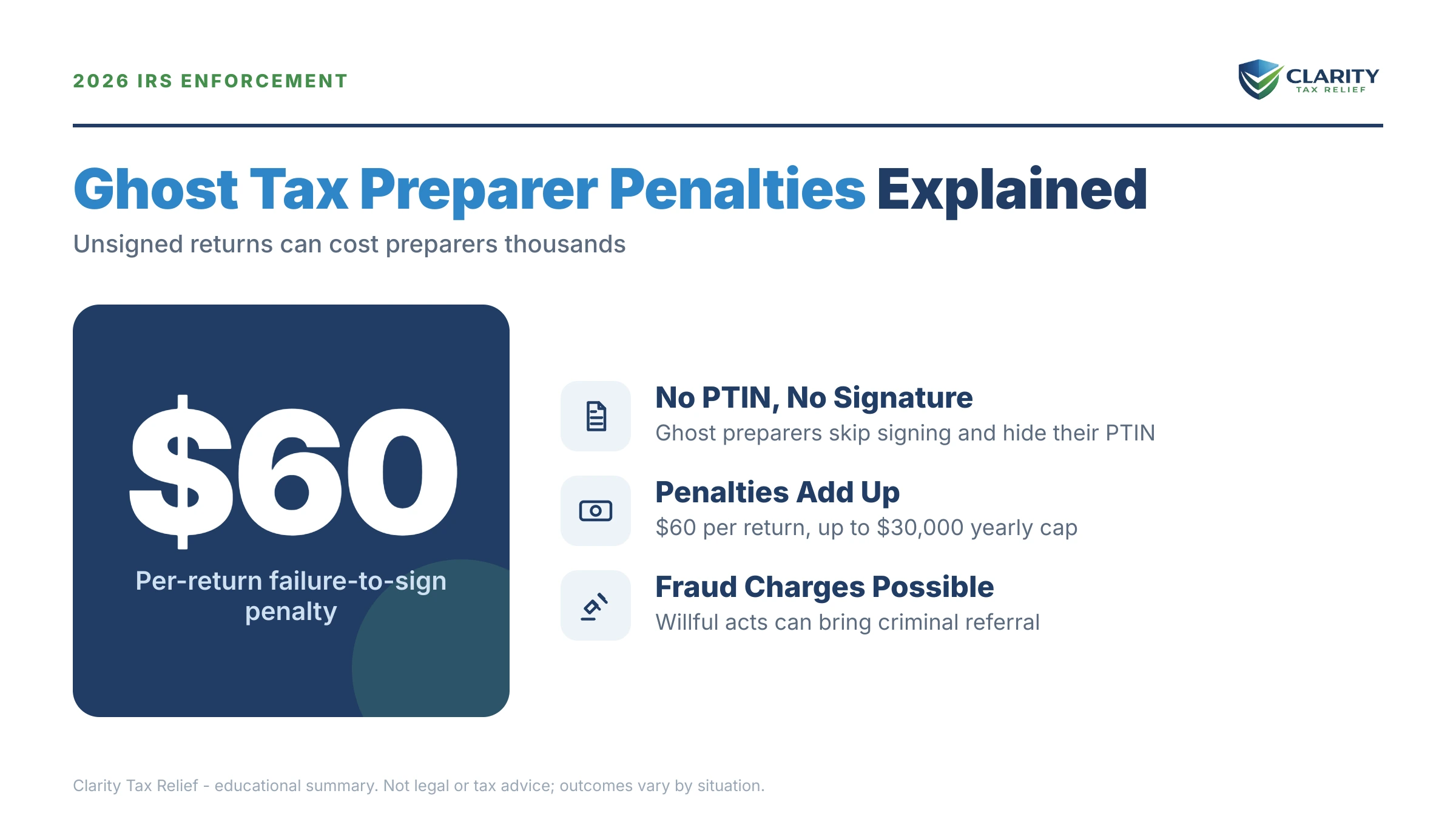
In 2024 alone, federal courts permanently banned multiple ghost preparer operations and ordered them to repay a combined $1.68 million-plus in ill-gotten fees. A "ghost" preparer is someone paid to prepare returns who refuses to sign them or include their Preparer Tax Identification Number (PTIN) — which, the IRS notes, makes them far harder to track. That refusal is itself a violation: IRC §6695 imposes a per-return civil penalty (adjusted annually for inflation) for failing to sign or failing to furnish a PTIN on a paid-prepared return.
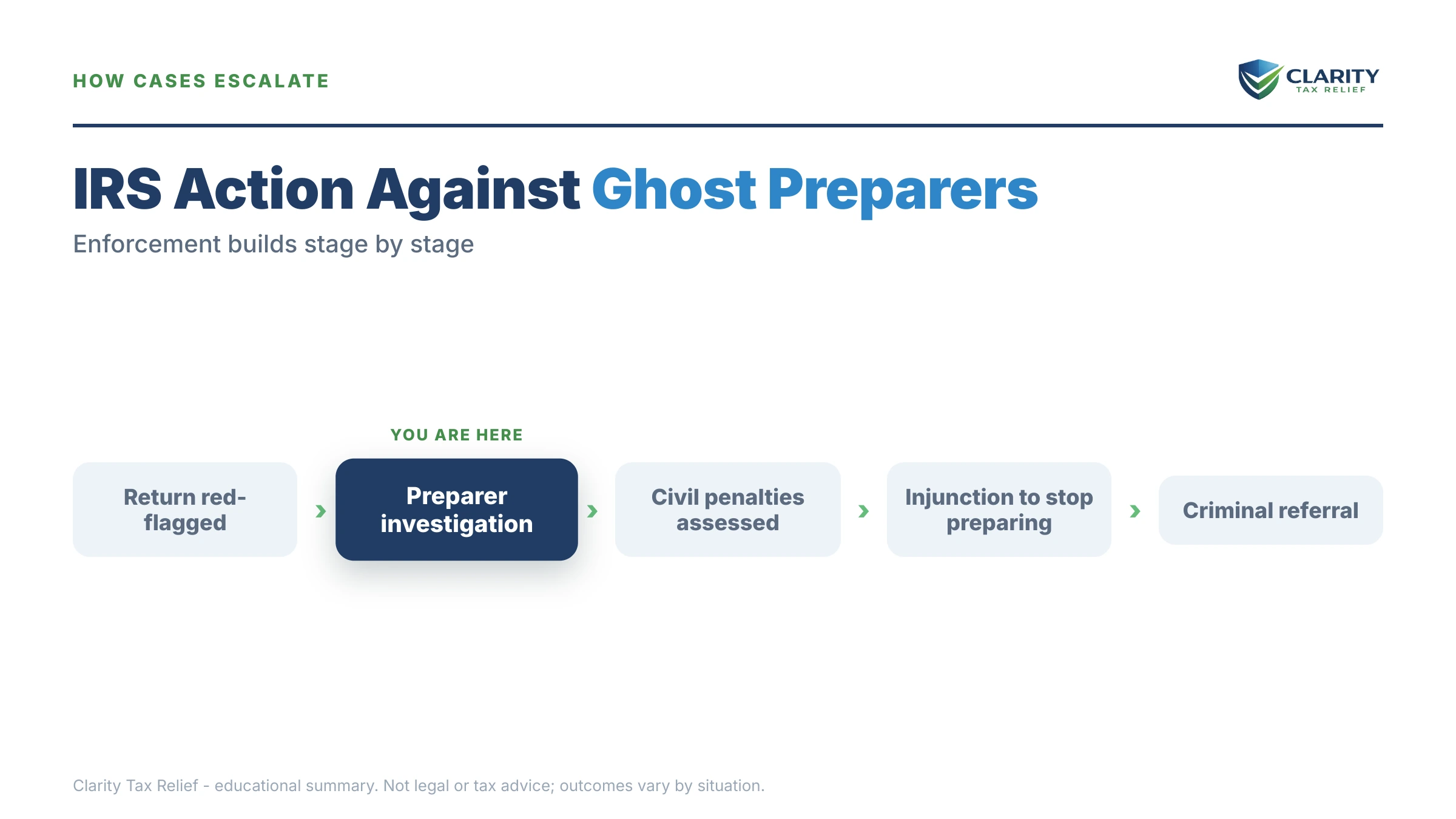
When the conduct goes beyond unsigned returns into fabricated deductions and invented credits, the Justice Department's Tax Division sues to shut the operation down entirely. Three 2024 outcomes show the pattern:
| Operation | Court & date | Outcome | Financial consequence |
|---|---|---|---|
| Juan Santiago's tax business (Madison Solutions LLC) | S.D. Indiana, Oct. 28, 2024 | Permanently enjoined from preparing returns | The government estimated the false returns cost the government over $1 million each filing season |
| Annetta Powell and seven businesses | E.D. Michigan, Mar. 29, 2024 | Permanently enjoined after a 12-day trial | Ordered to disgorge $697,797 in ill-gotten profits |
| Gerald Vito, James Eleby, and a third preparer (Thomas) | S.D. Florida, 2024 | Held in civil contempt for violating a 2021 injunction | Ordered to disgorge $988,789.56 in the aggregate across the three preparers |
The Florida case matters for a reason beyond the dollar figure: those three preparers had already been enjoined in 2021 and kept preparing returns anyway. Courts responded with civil contempt and a disgorgement order — proof that an injunction isn't the end of the government's leverage. That some ghost operations keep filing even after being banned. If yours did, returns may still be going out under your information.
The proposed felony: what the TAS Act would change
A bipartisan Senate discussion draft — the Taxpayer Assistance and Service Act (TAS Act, S. 3931) — would add Section 7218 to the tax code, making willful failure to furnish a PTIN a felony punishable by up to $50,000 ($100,000 for a corporation) and/or two years in prison. As of mid-2026, this is proposed legislation, not current law. Today, ghost preparers who cross into fraud are prosecuted under existing false-return and fraud statutes. The TAS Act would give prosecutors a direct charge aimed at the ghost behavior itself — the missing signature and PTIN.
“Anyone who prepares or assists in preparing federal tax returns for compensation must have a valid 2026 PTIN before preparing returns.”
— PTIN requirements for tax return preparers (IRS.gov)
Why the bill lands on you, not the ghost
You are legally responsible for every figure on your tax return, no matter who prepared it. When you signed (or e-signed) the return, you did so under penalty of perjury, so when the IRS corrects fabricated credits or phantom business losses, the understated tax, interest, and proposed penalties are assessed against you. The disgorgement orders above send money to the government, not to the clients left holding corrected bills.
Ghost preparers target this exact asymmetry. Their profit model is volume: invent Fuel Tax Credits, fake Schedule C losses, inflated withholding, or dependents that don't belong on the return — a scheme that also traps clients in disputes like the one covered in both parents claimed child irs — then charge a fee tied to the refund size and disappear before the IRS's matching systems catch up. Some route the refund into their own account first and pass along only part of it. By the time the correction notice arrives, the preparer is a burner phone number.
If a preparer filed a return you never authorized at all, that's a different problem — identity theft, not just misconduct — and the path in someone filed taxes in my name (including Form 14039) applies instead.
What happens if you ignore a ghost-prepared return
A false return becomes your debt the moment the IRS's automated document-matching system catches it, and in 2026, with the IRS workforce down roughly 27%, those automated systems are doing more of the enforcement, not less. The sequence runs in stages:
- Matching flags the return. The IRS compares the W-2s and 1099s employers filed against what's on your return. Fabricated credits, phantom businesses, and inflated withholding surface without any human pulling your file.
- A correction letter arrives. Typically a cp2000 notice or an audit letter proposing additional tax, usually with a 20% accuracy related penalty irs stacked on top. Where the IRS believes the taxpayer participated in the fraud, a 75% civil fraud penalty is possible.
- No response → statutory notice of deficiency. A 90-day letter gives you one last window to petition Tax Court. After it closes, the balance is formally assessed.
- Assessment → collections. The standard notice ladder begins: a CP14 bill (about 21 days to respond), escalating to a CP504 and eventually an LT11 final notice, which starts a 30-day clock before wage or bank levies.
- Credit bans in the worst cases. Reckless or fraudulent refundable-credit claims (like the Earned Income Tax Credit) can trigger multi-year bans on claiming those credits, even when the ghost invented the claim, if you can't show good-faith reliance.
One fear worth defusing: owing corrected tax because a preparer lied is a civil collection problem, not a crime on your part. Jail is reserved for willful fraud and evasion, as explained in can you go to jail for owing irs — a client who hands over accurate records and gets deceived is not in that category.
A worked example: what the correction actually costs
Say you're a W-2 employee filing single, and your real numbers produced a $900 refund. A ghost preparer invented $14,000 in Schedule C losses and a fuel tax credit, generating a $7,300 refund, and charged you $800 in cash. When the IRS corrects the return:
- Understated tax to repay: $7,300 − $900 = $6,400
- 20% accuracy-related penalty: $6,400 × 0.20 = $1,280 (potentially removable — see below)
- Interest, compounding daily from the return's original due date, on top of both
That's roughly $7,680 plus interest — while the ghost keeps the $800 fee and answers to no one unless the DOJ finds them. You can estimate how a corrected balance grows month by month with our IRS penalty and interest calculator.
Did a ghost preparer put fake numbers on your return?
Every month you wait, interest and the late-payment penalty grow the corrected balance. Send us your copy of the return — an experienced tax professional will confirm what was actually filed, what you truly owe, and which penalties you can fight. Free and confidential.
Your options after a ghost preparer filed a false return
Correcting the return yourself before the IRS contacts you is almost always the cheapest path, and being the one who came forward is powerful evidence when you ask for penalties to be removed. The full self-help playbook for resolving any resulting balance lives in our guide on how to settle tax debt yourself. Here's how each option applies to this specific situation:
| Option | Who it fits | Cost & what it does |
|---|---|---|
| File Form 1040-X to correct the return | You found the fake numbers before the IRS did | No filing fee; you pay the corrected tax plus interest, and coming forward first strengthens every penalty-relief argument |
| Respond to the CP2000 or audit letter | The IRS already flagged the mismatch | Free; agree only to what's genuinely accurate and dispute the rest — the proposed figures aren't final until you accept them or the window closes |
| Short-term payment plan | You can clear the corrected balance within 180 days | $0 setup; interest and the 0.5%/month late-payment penalty continue until paid |
| Long-term installment agreement | Balance up to $50,000; up to 72 months, set up online | Setup fee applies; stops enforced collection while you pay down the corrected tax |
| Penalty abatement (reasonable cause or first-time) | You gave the ghost accurate records in good faith, or your prior 3 years are clean | Free to request (Form 843 or by letter); removes penalties but not the tax or interest |
| Form 14157 / 14157-A preparer report | The preparer altered your return or diverted your refund | Free; builds the misconduct record the IRS and DOJ use in cases like the three above, and documents your good faith |
Two clarifications that save people money. First, penalty relief and interest relief are different animals: reasonable-cause reliance on a preparer can remove the accuracy-related penalty, but interest on the tax itself almost never goes away — the narrow exceptions are covered in can irs interest be waived. Second, once your balance is fixed and any dispute is resolved, choosing the right payment channel matters; best way to pay the irs compares direct pay, direct debit, and plan options so the fix doesn't cost more than it should.
If the fake numbers went the other direction — the ghost understated your refund or the corrected math actually favors you — an amended return can cut what you owe rather than raise it. See amend return to reduce tax debt.
How to respond if a ghost preparer filed your return, step by step
- Pull your IRS records. Get your account transcript and wage-and-income transcript online so you can see exactly what was filed under your Social Security number and how it compares to your real income documents. (Walkthrough: how to get irs transcript online.)
- Check the paid-preparer box. Look at your copy of the return for the preparer's signature and PTIN near the signature line. A blank box on a return you paid for confirms you used a ghost preparer.
- Correct the return. File Form 1040-X with accurate figures if the IRS hasn't contacted you yet — or, if a CP2000 or audit letter already arrived, respond by the letter's date stating what you agree with and what you dispute.
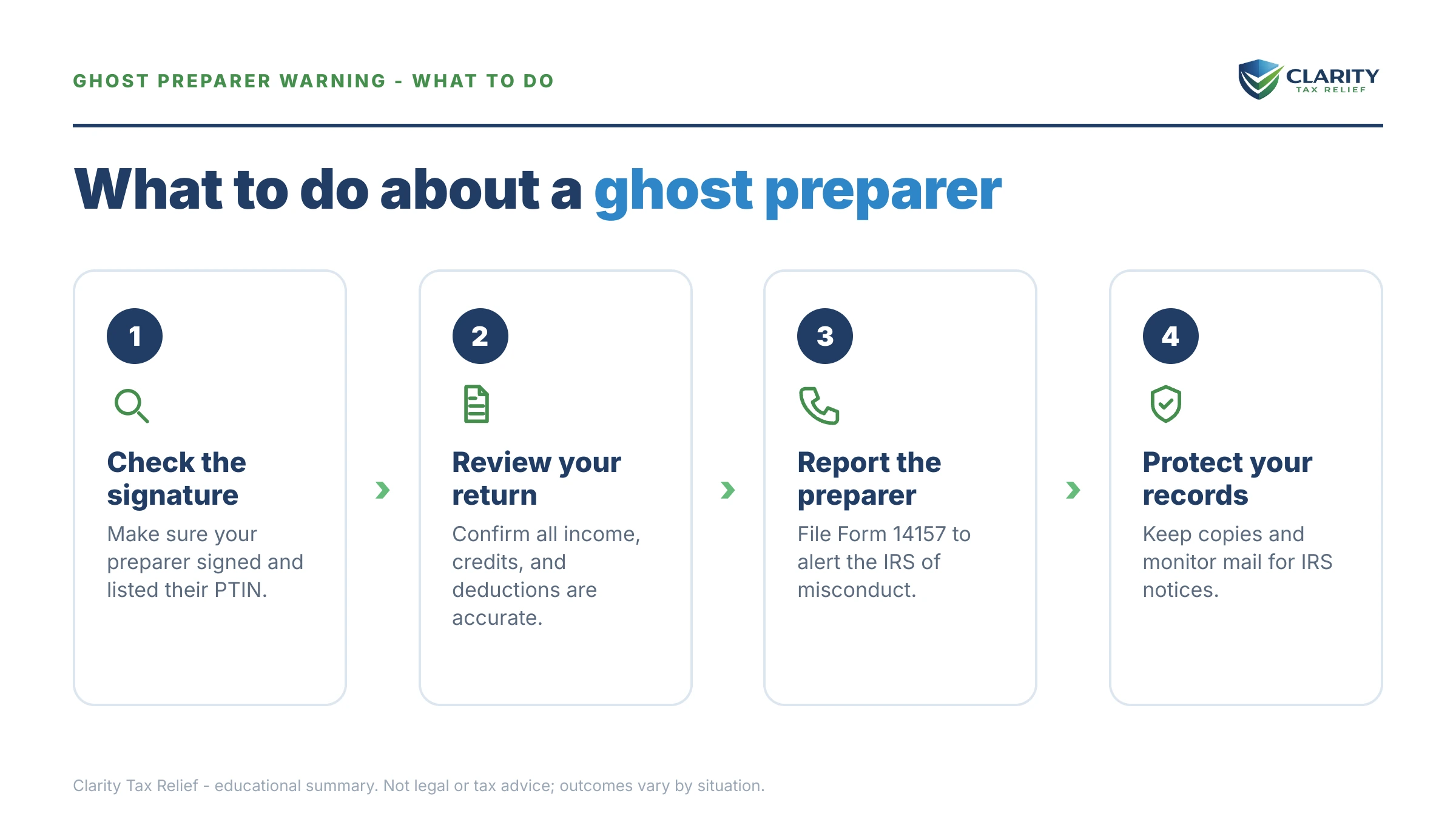
- Report the preparer. Send the IRS Form 14157, and add Form 14157-A if the preparer altered your return without consent or diverted your refund. Attach a copy of the return and proof of what you paid.
- Resolve the balance. Set up a payment plan for any corrected tax you can't pay in full, and request penalty relief based on your good-faith reliance on the preparer.
When you can handle this yourself, and when help changes the outcome
If one year is affected, you have your real documents. The corrected balance is something you can pay within 180 days, you can genuinely do this alone: amend, report the preparer, set up a short-term plan online. The IRS processes self-corrections like these routinely, and no professional fee will beat free.
Experienced help earns its cost in four situations: multiple years of ghost-prepared returns (the order you fix them changes total penalties). The IRS has proposed a civil fraud penalty or a refundable-credit ban against you. The ghost diverted your refund and you need to trace it while also correcting the return. Or collections have already started and a levy clock is running. In those cases, the reasonable-cause narrative — proving you were the victim, not the architect — is the whole ballgame, and it's built from documentation most people don't know to assemble. Relief requests like first time penalty abatement are also easy to burn on the wrong year if you don't sequence them.
Terms in these cases, decoded
- Ghost preparer — someone paid to prepare returns who won't sign them or include a PTIN, leaving the return looking self-prepared.
- PTIN — Preparer Tax Identification Number; the IRS-issued ID every paid preparer must put on every return they prepare.
- Injunction — a court order barring a preparer from the tax-preparation business, sometimes temporarily, often permanently.
- Disgorgement — a court order forcing a wrongdoer to hand over profits earned from the misconduct, like the $697,797 and $988,789.56 orders above.
- Civil contempt — the penalty for defying a court order, such as continuing to prepare returns after being enjoined.
- Accuracy-related penalty — the standard 20% add-on to tax understated through negligence or substantial understatement. The penalty most ghost-preparer clients face and most often can fight.
Ghost preparer questions, answered
What are the penalties for a ghost tax preparer?
Federal courts can permanently ban ghost preparers from the tax business and force them to repay their fees. In 2024 alone, one Michigan operation was ordered to disgorge $697,797 and three Florida preparers $988,789.56 in the aggregate. On top of injunctions, every unsigned paid-prepared return carries a per-return civil penalty under IRC §6695, and fraudulent conduct can be prosecuted criminally.
Is it illegal for a tax preparer not to sign your return?
Yes — anyone paid to prepare a federal return must sign it and include a valid PTIN. Skipping either triggers a per-return civil penalty, adjusted annually for inflation, and refusing to sign is the defining mark of a ghost preparer. If your copy shows a blank paid-preparer box but you paid someone, that person broke IRS rules the moment the return was filed.
Can a ghost tax preparer go to jail?
Yes, under existing fraud statutes — the Justice Department pairs civil injunctions with criminal prosecution when preparers file false returns. A pending Senate proposal, the Taxpayer Assistance and Service Act (TAS Act, S. 3931), would go further: it would make willfully failing to furnish a PTIN a felony punishable by up to $50,000 ($100,000 for a corporation) and/or two years in prison. As of mid-2026, that provision is proposed legislation, not current law.
Am I responsible if my tax preparer lied on my return?
Yes, for the tax and interest. You signed the return under penalty of perjury, and the IRS collects the understated tax from you regardless of who invented the numbers. Penalties are a different story: if you gave the preparer accurate records and reasonably relied on them, you can argue reasonable cause to remove the accuracy-related penalty. The sooner you correct the return, the stronger that argument becomes.
How do I report a ghost tax preparer to the IRS?
File Form 14157, Return Preparer Complaint. If the preparer changed your return without your consent or diverted your refund, add Form 14157-A, the fraud or misconduct affidavit, along with a copy of the return and any receipts. These reports feed the same Justice Department enforcement pipeline that produced the 2024 injunctions. They document that you came forward, which helps your own penalty case.
How can I tell if my tax preparer was a ghost?
Look at the paid-preparer section near the signature line of your Form 1040: a ghost leaves it blank or marks the return self-prepared even though you paid them. Other tells include fees based on a percentage of the refund, refunds routed into the preparer's bank account, cash-only payment, and refusing to give you a complete copy. You can verify any legitimate preparer's credentials in the IRS's public directory.
Will the IRS waive penalties if my preparer committed the fraud?
Often, yes — reasonable-cause relief applies when you gave the preparer complete, accurate information and had no reason to know the return was false. First-time abatement can also remove penalties if your prior three years are clean, and starting summer 2026 the IRS's new Automatic Exemption from Penalty (AEP) applies some relief automatically, with no request needed. Interest on the underlying tax itself is rarely waived.
Your next 24 hours
- Find your copy of the filed return and look at the paid-preparer section near the signature line. Signature and PTIN present, or blank? That one box tells you whether you're dealing with a ghost.
- Gather your real records: your W-2s and 1099s, receipts for what you paid the preparer, their name and contact info. Your IRS account transcript showing what was actually filed.
- Get a free case review. Interest and the monthly late-payment penalty are growing any corrected balance right now — an experienced tax professional can map the fix in one call. Use the 2-minute form or call (888) 825-7779.
Sources and further reading: the Justice Department's summary of these injunction and disgorgement cases is in its release on efforts to stop unlawful tax return preparers. You can verify any credentialed preparer in the IRS guidance on choosing a tax professional, and the Taxpayer Advocate Service offers independent help when preparer misconduct leaves you stuck in IRS processing.
This guide is general information, not tax or legal advice for your specific situation. Eligibility for IRS programs depends on individual facts and circumstances; no outcome is guaranteed.