
IRS Data & Studies
Government Impersonation Scam Losses 2024: Americans Reported $789 Million to the FTC (2026 Update)
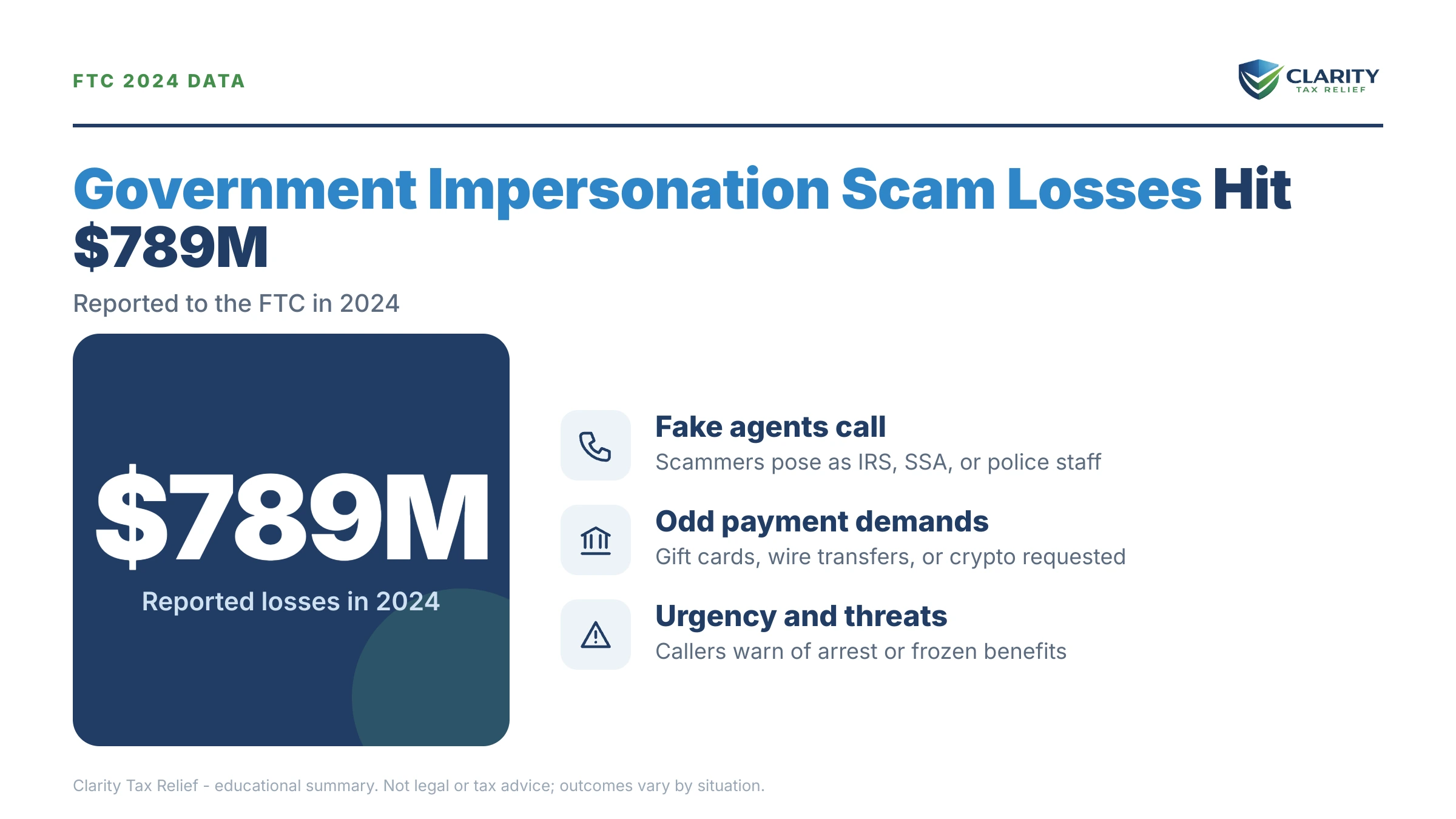
Government impersonation scam losses 2024: Americans reported losing $789 million to government impersonation scams in 2024 — a $171 million jump in a single year, per the FTC. Combined with business impersonation, imposter losses hit $2.95 billion, part of $12.5 billion in total reported fraud, up 25% from the prior year.
The call came from a number tagged "IRS," and the voice said a warrant would issue tonight unless you paid. Part of you knew it was fake, but part of you froze, because you actually do have unfiled returns, and someone with a badge number just recited your home address.
That split second of doubt is precisely what this industry monetizes, and the 2024 numbers show how well it's working. The first table below puts every FTC figure in one place, and the second shows you how to tell a real IRS contact from a fake one in under a minute — the image below also shows you exactly what this data looks like at a glance.
⏱ Two real clocks are running. Money sent to a scammer by gift card, wire, or crypto becomes nearly impossible to recover within hours — call your bank the same day. And if scam fear is making you ignore real IRS mail, remember: the failure-to-file penalty runs 5% per month — ten times the 0.5% monthly failure-to-pay rate — whether or not the caller was fake.

Government impersonation scam losses 2024: what the FTC data shows
Americans reported losing $789 million to government impersonation scams in 2024 — a $171 million jump in a single year, per the FTC. The figure comes from the FTC's Consumer Sentinel Network 2024 Data Book, the largest single database of U.S. fraud reports.
The category covers criminals posing as the IRS, Social Security Administration, Medicare, and other agencies. Fold in business impersonators — fake Amazon, fake banks, fake tech support — and impersonation scams alone caused $2.95 billion in consumer losses in 2024.
Zoom out and the scale gets worse. U.S. consumers reported losing $12.5 billion to fraud overall in 2024, up 25% from the prior year, across 6.5 million consumer reports received by Consumer Sentinel. And the trend didn't reverse: people reported losing $3.5 billion to imposter scams in 2025, per the FTC's June 2026 release — a broader category spanning government, business, and other impersonators.
One caveat cuts in only one direction: these are reported losses. Many victims never file a report — out of embarrassment, or because they never realize the "agent" was fake — so the true total is almost certainly higher.
| Figure | What it measures | Source |
|---|---|---|
| $789 million | Reported losses to government imposter scams in 2024 | FTC Consumer Sentinel Network 2024 Data Book |
| $171 million | The one-year jump in government imposter losses from 2023 to 2024 | FTC |
| $2.95 billion | Combined 2024 losses to business and government impersonation scams | FTC |
| $12.5 billion | Total reported fraud losses in 2024, up 25% from the prior year | FTC |
| 6.5 million | Consumer reports received by Consumer Sentinel in 2024 | FTC |
| $3.5 billion | Reported losses to imposter scams (all types) in 2025 | FTC, June 2026 release |
“Demands or threats - Impersonators want you to pay “now or else.” They threaten arrest or deportation. They don’t let you question or appeal the amount of tax you owe.”
— Recognize tax scams and fraud (IRS.gov)
Why IRS impersonation scams work so well
IRS impersonation works because the fear is real: millions of Americans genuinely owe back taxes or have unfiled years, and they expect the IRS to come looking. A scammer doesn't have to convince you a debt exists. Your own anxiety does that part for free.
Three conditions in 2026 make it worse. First, caller-ID spoofing lets criminals display "IRS" or a real IRS office number on your phone. Second, breached personal data means the caller may recite your name, address, or part of your Social Security number — details that feel like proof but prove nothing.
Third, the IRS itself is harder to reach: the workforce was cut roughly 27% in 2025, so a scared taxpayer who tries to call and verify often can't get through, and calls the scammer back instead. If you're wondering whether the agency ever initiates phone contact at all, see does the irs call you. For texts and DMs, the answer is even simpler — does the irs text you covers why any tax-debt text is fraud.
The same criminal ecosystem runs on the business side too — promoter fraud around pandemic-era credits triggered thousands of federal cases, detailed in our IRS ERC fraud criminal investigation statistics study.
What happens if you fall for it, and what keeps running underneath
Money sent to a government imposter by gift card, wire, or crypto is almost never recovered. The damage then unfolds in a predictable sequence:
- Your money converts instantly. Gift cards are drained within minutes, wires are forwarded through mule accounts, and crypto moves offshore. Recovery odds fall sharply after the first few hours.
- You get marked as a payer. Victims land on shared "sucker lists," and the follow-up wave arrives: "recovery" scammers claiming, for an upfront fee, that they can get your money back. Paying twice is common.
- Any real IRS balance keeps growing, untouched. Paying a scammer credits nothing. If you genuinely owe, the automated notice sequence — CP14, then CP501/CP503 reminders, then CP504, then a final levy notice — keeps advancing, with penalties and interest compounding at every stage. That machine runs even when the government itself stalls, as our guide on government shutdown irs collections continue explains.
- If you shared your SSN, identity misuse follows. Fraudulent refund returns and account takeovers filed in your name can take months to unwind — which is why the affidavit in form 14039 identity theft exists.
Got a call, text, or letter and can't tell if it's real?
Don't pay anyone until you know where you actually stand. An experienced tax professional will pull your real IRS account, confirm whether any balance exists, and map your genuine options — free, confidential, no pressure. Interest and penalties on real debt accrue monthly; a scammer's "deadline" doesn't.
How to tell a real IRS contact from an impersonator
The real IRS starts virtually every case with a letter delivered by the U.S. Postal Service, not a call, text, email, or social-media message. That single fact defeats most of the $789 million problem, and our guide on how to tell if an irs letter is real walks through verifying the mail itself.
| Signal | The real IRS | An impersonator |
|---|---|---|
| First contact | A mailed notice with a notice number (CP14, CP504, etc.) you can verify online | A call, text, email, or DM out of nowhere |
| Payment | Only to the United States Treasury, through IRS.gov or by mailed check | Gift cards, wire transfers, crypto, or payment apps |
| Tone | Deadlines in writing, with appeal rights spelled out on the notice | Arrest threats, "warrants," pay-in-the-next-hour pressure |
| Verification | Everything it claims appears in your IRS online account | Discourages you from hanging up or checking independently |
| In person | Ended most unannounced visits in 2023; revenue officers now schedule by mailed letter | May claim agents are "on the way" to your home |
Two legitimate exceptions confuse people. The IRS does assign some older accounts to a small number of contracted collectors, but only after mailing you notice first, and even they can't take payment directly. See irs private collection agency to verify a collector. And revenue officers do exist for large or business cases, but in 2026 they announce themselves by letter, not by surprise phone demand.
The fastest universal check takes five minutes: log into your IRS account and look at the balance yourself. If you've never set one up, irs online account setup shows the process step by step.
If you actually owe the IRS: the real options scammers imitate
Every real IRS resolution program can be applied for directly through IRS.gov, for free or a modest setup fee — no gift cards, no "processing agent," no same-day ultimatum. The full DIY playbook lives in our guide on how to settle tax debt yourself; here's the short version:
| Option | Who may qualify | Cost and terms |
|---|---|---|
| Short-term payment plan | Anyone who can pay in full within 180 days | $0 setup; interest and penalties continue until paid |
| Long-term installment agreement | Balances of $50,000 or less can be set up online, up to 72 months | Modest setup fee; monthly payment; accrual continues |
| Guaranteed installment agreement | Balances of $10,000 or less with filing compliance | The IRS must accept if you meet the statutory conditions |
| Offer in Compromise | Means-tested — only when assets and income genuinely can't cover the debt | $205 fee and 20% down on lump-sum offers (both waived with low-income certification); roughly 1 in 5 offers accepted in FY2024 |
| Currently Not Collectible | Paying anything would create genuine hardship | $0; collection pauses, but the debt and interest remain |
| Penalty relief | Clean compliance for the prior 3 years (First-Time Abate); Automatic Exemption from Penalty (AEP) begins rolling out summer 2026 | $0 to request; AEP will apply automatically with no request needed |
For how to actually send money to the Treasury safely — Direct Pay, EFTPS, card, check — see the best way to pay the irs.
A worked example: the fake demand vs. the real fix
Say you drive for two delivery apps and haven't filed for three years. A caller "from the IRS" says a warrant issues tonight unless you send $4,800 in gift cards. That $4,800 would vanish, and your actual IRS account wouldn't change by a cent.
Now the real path. Suppose filing those three returns shows you owe $4,200, $3,900, and $3,400 — $11,500 in tax. The failure-to-file penalty caps at 25% of each year's unpaid tax, so worst case adds about $2,875 across the three years, plus failure-to-pay penalties and interest. Call it roughly $14,375 before interest.
On a 72-month installment agreement, that's about $200 a month ($14,375 ÷ 72 ≈ $199.65), set up online, with penalty relief potentially trimming the total further. This is hypothetical, your numbers will differ. But the shape holds: the real fix is a manageable monthly payment. The scam is $4,800 gone in an afternoon. You can estimate the penalty and interest on your own figures with our IRS Penalty & Interest Calculator, and if unfiled years are the root fear, start with haven't filed taxes in 3 years.
How to respond to an IRS impersonation attempt, step by step
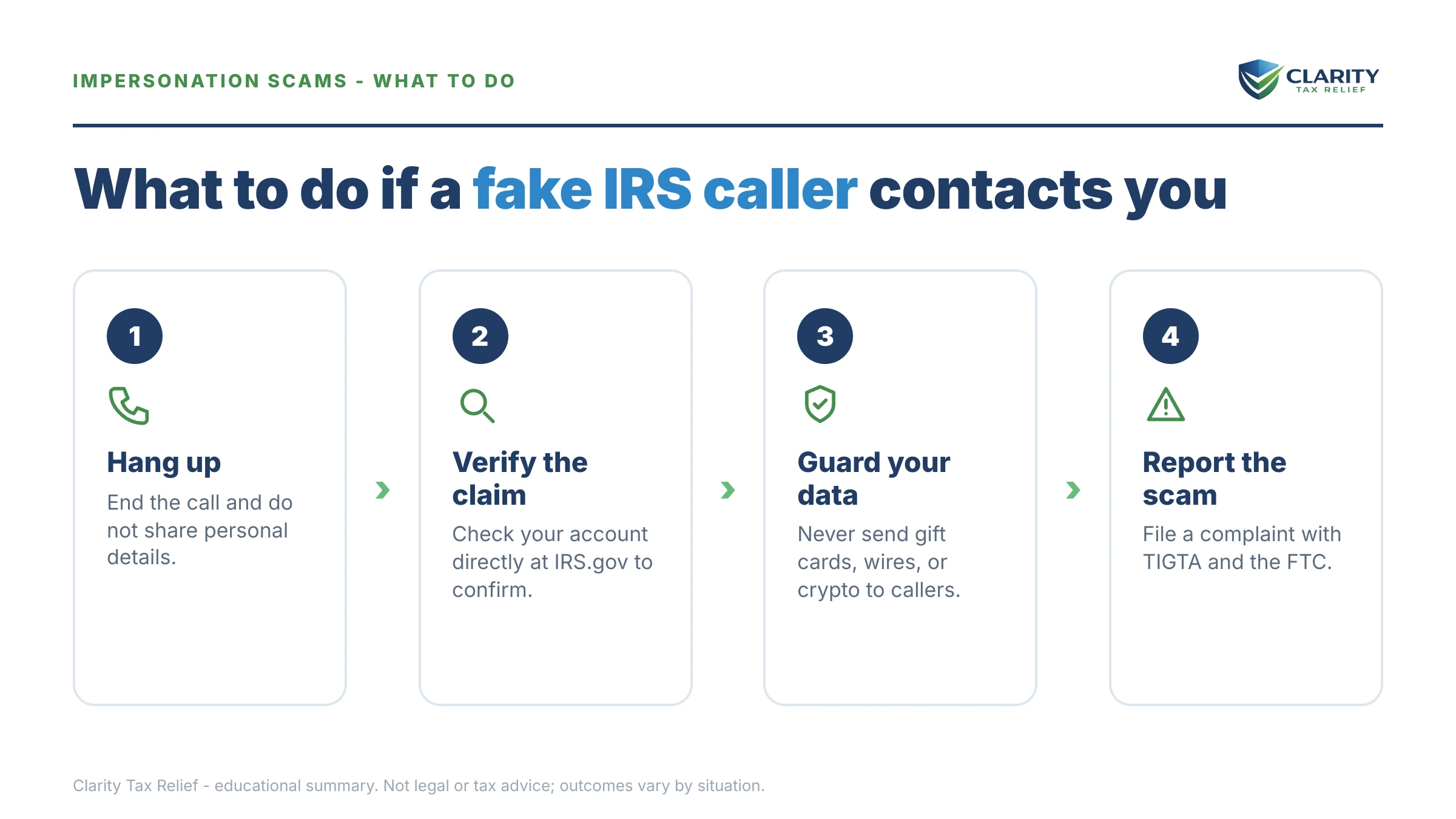
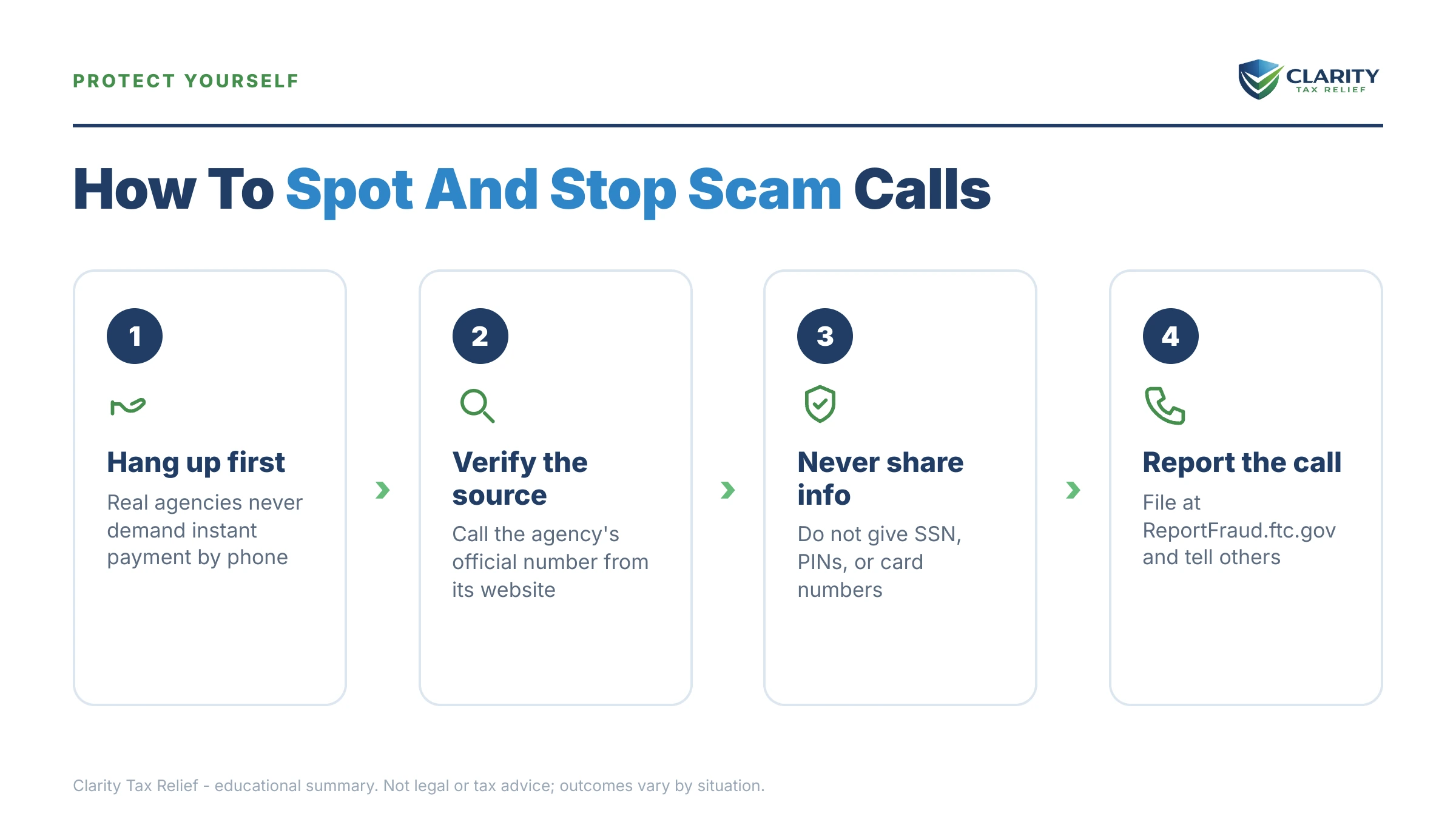
- Stop all contact. Hang up, don't reply to the text, and don't click any link — engaging at all confirms your number is live and invites more attempts.
- Verify your real balance. Log into (or create) your IRS online account at IRS.gov; any genuine debt, notice, or payment plan appears there.
- Report the scam. File a report at ReportFraud.ftc.gov and with TIGTA, which investigates IRS impersonation specifically.
- Call your bank immediately if you paid. Ask for a reversal or fraud claim the same day. For gift cards, call the card issuer with the card numbers before they're drained.
- File Form 14039 if you shared personal data. The identity-theft affidavit flags your IRS account against fraudulent returns filed in your name.
- Fix any real tax problem behind the fear. File unfiled returns and set up a genuine IRS resolution — a payment plan, hardship status, or an Offer in Compromise if your finances qualify.
The reporting agencies are real and free: the Treasury Inspector General for Tax Administration (TIGTA) handles IRS impersonation directly, and any legitimate federal tax payment routes only through IRS.gov/payments.
When you can handle this yourself, and when help changes the outcome
If you hung up in time and your IRS account shows no balance, you're done: report the attempt to the FTC and TIGTA, warn family members who get the same calls, and move on. No professional needed.
Same if you owe a small, correct balance you can pay within 180 days — set up the $0-fee short-term plan yourself at IRS.gov in about fifteen minutes.
Experienced help changes outcomes in the messier cases: you paid a scammer and a real balance exists underneath. You have multiple unfiled years and don't know what you'd owe. You shared your SSN and now fraudulent activity is tangled up with genuine debt. Or a real levy is already in motion while you sort out what was fake. And if you do hire help, vet the helper — the tax-resolution industry has its own imposters, covered in tax relief scams. Anyone promising to settle for "pennies on the dollar" before seeing your finances is running the same play as the phone scammer, just slower.
Terms in the scam data, decoded
- Imposter scam: any fraud where the criminal pretends to be someone you'd trust — a government agency, a business, or a family member — to extract money or data.
- Consumer Sentinel Network: the FTC's national fraud-report database, which received 6.5 million consumer reports in 2024 and feeds law enforcement nationwide.
- TIGTA: the Treasury Inspector General for Tax Administration — the federal watchdog that investigates IRS impersonation and misconduct.
- Spoofing: faking the caller ID or sender address so a scam call or text appears to come from a real IRS number.
- Smishing: phishing by SMS — fake "IRS" texts with links to counterfeit payment or "refund claim" pages.
- Recovery scam: a second-round fraud targeting prior victims, charging an upfront fee to "get your money back."
Government impersonation scam questions, answered
How much money was lost to government impersonation scams in 2024?
Americans reported losing $789 million to government impersonation scams in 2024, per the FTC's Consumer Sentinel Network — a $171 million jump in a single year. Combined with business impersonation, imposter losses reached $2.95 billion. Because these figures only count losses people actually reported, the true total is almost certainly higher.
Does the IRS ever call or text you?
The IRS never initiates contact by text message or social media, and it almost never calls before mailing you multiple letters first. Legitimate calls happen only deep into an existing case you already know about, and even then, no IRS employee will demand gift cards, wire transfers, or payment apps. If a call is your first contact about a supposed debt, treat it as a scam and verify through your IRS online account.
How do scammers know I owe the IRS?
Usually they don't. They dial and text at massive scale and rely on the odds that some recipients genuinely have tax problems. Some operations buy breached personal data, which lets them recite your name, address, or even part of your Social Security number to sound credible. Personal details prove nothing; the payment demand is what exposes the fraud.
Can I get my money back after paying an IRS impersonator?
Sometimes, but speed decides it. Call your bank or card issuer immediately to attempt a reversal, and if you bought gift cards, contact the card company with the card numbers — cards not yet drained can occasionally be frozen. Wire transfers and crypto are rarely recoverable. Report to the FTC and TIGTA regardless, and beware follow-up 'recovery' scams that charge a fee to retrieve your loss.
Did impersonation scam losses keep rising in 2025?
Yes. People reported losing $3.5 billion to imposter scams in 2025, per the FTC's June 2026 release — a category that spans government, business, and other impersonators. Total reported fraud losses had already hit $12.5 billion in 2024, up 25% from the prior year, and imposter scams remain one of the largest slices of that total.
Where do I report an IRS impersonation scam?
Report it twice: to the FTC at ReportFraud.ftc.gov, which feeds the Consumer Sentinel database, and to the Treasury Inspector General for Tax Administration (TIGTA), which specifically investigates IRS impersonation. If the scam arrived by email, forward it to phishing@irs.gov. If you shared your Social Security number, also file Form 14039 so the IRS flags your account for identity theft.
What if I actually owe the IRS and can't tell which contact is real?
Skip the contact entirely and go to the source: log into (or create) your account at IRS.gov to see your real balance, notices, and payment options. Every legitimate collection action shows up there, and every real payment routes to the United States Treasury through IRS.gov — never through a caller's link. If you owe and can't pay, real programs like payment plans and hardship status exist; a scammer's 'today only' deal does not.
Your next 24 hours
- Check the source, not the contact. Log into your account at IRS.gov and see whether any balance, notice, or collection action actually exists under your Social Security number.
- Gather the evidence. Save screenshots, the phone number, the exact amount demanded, and, if you paid, gift-card numbers or wire details. You'll need all of it for your bank, the FTC, and TIGTA.
- If a real balance or unfiled years sit underneath the scare, get a free case review — the 2-minute form at /#consult or (888) 825-7779. The scammer's deadline was fake, but penalties and interest on real debt accrue every month you wait.
Primary source: the loss figures in this study come from the FTC's Consumer Sentinel Network data, announced in the agency's release New FTC Data Show a Big Jump in Reported Losses to Fraud to $12.5 Billion in 2024, with the 2025 imposter figure from the FTC's June 2026 release.
This guide is general information, not tax or legal advice for your specific situation. Eligibility for IRS programs depends on individual facts and circumstances; no outcome is guaranteed.