
Consumer Protection
Tax Relief Scams in 2026: How to Spot Them, Avoid Them, and Find Real Help
The short answer: tax relief scams sell real IRS programs with fake promises attached — "pennies on the dollar," guaranteed settlements, a "Fresh Start deadline" that doesn't exist. The IRS accepted only about 1 in 5 Offers in Compromise in FY2024, and no legitimate firm quotes a settlement before reviewing your IRS transcripts.
The voicemail said you'd been "pre-approved" for a hardship program that could make your tax debt disappear, and with three years of unfiled returns and a stack of 1099s in a drawer, part of you wanted it to be true. That wanting is exactly what these operations bill against. The real programs exist, the fake pitches are wrapped around them, and you can learn to tell them apart in the next ten minutes.
⏱ The real clock: there's no letter deadline on a scam, but there is a meter running. While a bad firm "investigates," the failure-to-file penalty grows at 5% per month (up to 25% per year) on unfiled years, failure-to-pay adds 0.5% per month, and interest compounds. Every month of stalling has a price you pay, not them.
How tax relief scams work in 2026
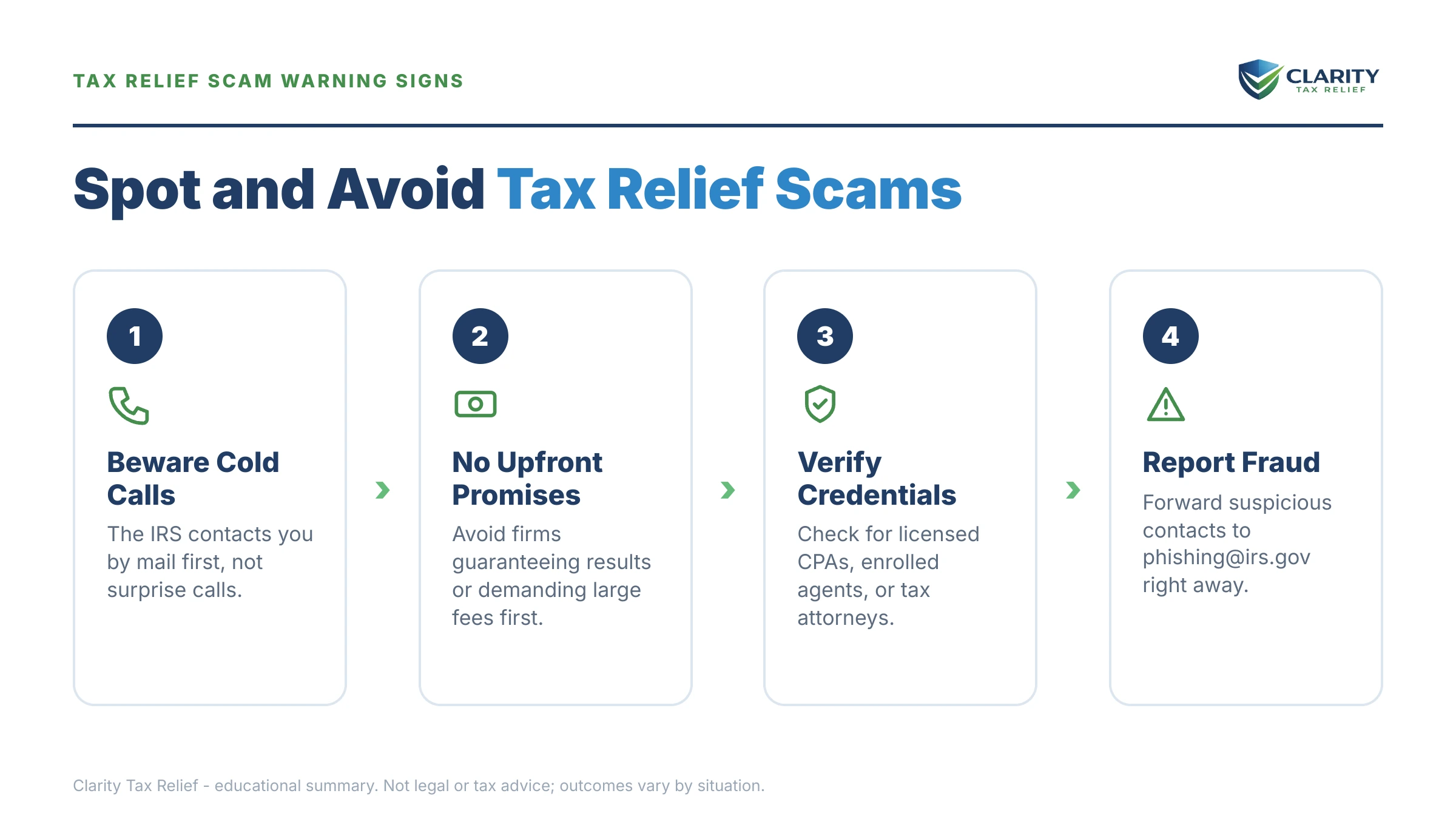
Every tax relief scam quotes you a result before anyone has seen a single page of your IRS file. That is the defining move, and it never varies. The ad (radio, robocall, social feed) routes you to a commissioned salesperson, not a tax professional. The salesperson quotes a settlement figure, invokes a fake deadline, collects a large upfront fee, and hands you to an "investigation phase" that goes quiet.
Want to test these checks on us? See Is Clarity Tax Relief legit? How to verify us yourself — every claim on that page comes with an independent way to check it.
Two different species share this territory, and they need different defenses. The first is the outright criminal: an IRS impersonator calling, texting, or emailing to demand payment right now. The second is a real, registered company that does file paperwork — just far less than it promised, for far more money than the work is worth. The offer in compromise mill is the classic example of the second kind.
Both thrive on the same 2026 conditions: you can't easily reach a human at the IRS, you're scared. They answer on the first ring.
| The scam | How it works | The tell |
|---|---|---|
| Offer in Compromise mill | Quotes a settlement figure on the first call, charges thousands upfront, then files a weak offer, or none at all. | A settlement amount quoted before anyone pulls your IRS transcripts. |
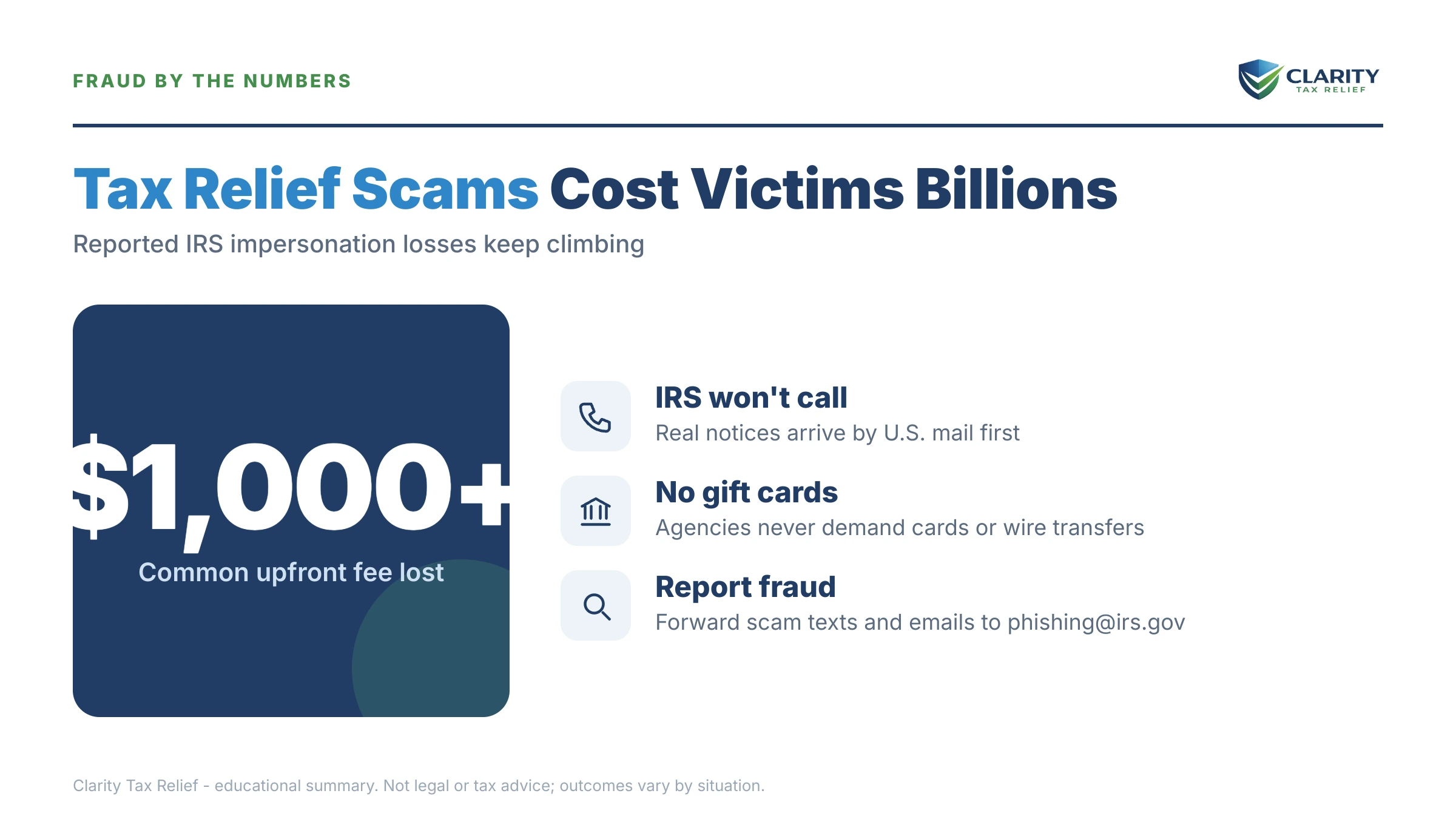
| IRS impersonation call/text/email | A criminal posing as the IRS demands immediate payment by gift card, wire, or payment app, often under threat of arrest. | The IRS's first contact is postal mail. It never demands those payment methods. See does the IRS call you. |
| "Fresh Start enrollment" pitch | Robocalls and ads claim a "zero tax program" or an enrollment deadline closing this week. | Fresh Start has no application, no enrollment, and no deadline. |
| Ghost preparer | Prepares your catch-up returns for cash but refuses to sign them as the paid preparer, leaving you holding any errors alone. | The paid-preparer signature line on your return is blank. |
| Fee-escalation firm | Hooks you with a small "investigation fee," then invents surprise "resolution phase" charges mid-case while IRS notices keep arriving. | The total cost of the case was never quoted in writing up front. |
| ERC / credit mill (business owners) | Files pandemic-credit claims your business never qualified for and takes a cut — the IRS claws back the refund from you, not the mill. | Anyone promising a government credit "everyone gets" without reviewing your payroll records. |
Why scammers target people who owe back taxes
The IRS cut its workforce by roughly 27% in 2025, and scam operations built their entire 2026 pitch on that fact: "you'll never get through to the IRS. But we have a direct line." No one has a special line. The automated notice-and-levy machinery, however, kept running without the humans, which makes the fear real and the pitch effective.
Targeting isn't random. Federal tax liens are public records, and lead brokers turn courthouse filings into call lists within days. Gig and 1099 workers get extra attention because unfiled years plus no withholding equals a big, scary number that's easy to inflate on the phone. Small-business owners get a separate funnel built around payroll debt and pandemic credits, if that's you, start with our tax relief for small business guide instead.
If a caller claims you were "flagged" or "selected," reverse the logic: they bought your name from a list. The IRS notifies you by mail, not by cold call.
What falling for a tax relief scam actually costs
The costliest part of a tax relief scam is not the fee — it's that the IRS's automated collection sequence never pauses because you hired someone. Hiring a firm creates no legal hold on your account. Only a filed agreement, offer, or hardship determination does. So while the scam stalls, the machine keeps stepping forward:
- You pay the upfront fee — often thousands of dollars, charged before anyone credentialed has reviewed your account.
- The "investigation phase" goes quiet — calls stop being returned; status updates become copy-paste.
- IRS notices keep escalating on schedule — CP14 bill, then CP501/CP503 reminders, then CP504 (the IRS can now take your state tax refund), then LT11, the final notice that opens a 30-day clock to wage and bank levies.
- Unfiled years get worse on their own — filing penalties stack toward their 25% cap per year. The IRS can file a substitute return for you with zero deductions, inflating the balance.
- The ask for more money arrives, or the firm goes dark, and you're left with the same debt, months more penalties and interest, and less cash to fix any of it.
That last line is the whole scam in one sentence: they don't take your debt. They take your best months for solving it.
Heard a pitch that sounds too good to be true?
Before you sign anything, theirs or anyone's, get a free case review from an experienced tax professional. We'll pull your real numbers and tell you, in plain English, which IRS programs your situation actually fits. Penalties and interest accrue monthly while a bad firm stalls; an honest answer costs you nothing.
What scam pitches promise vs. what the IRS actually offers
Every fake promise is a distorted version of a real program — the IRS accepted roughly 1 in 5 offers in FY2024, which means the settlement program is real and most people who apply don't get it. Here's each pitch matched to the actual rules behind it. (For the full walkthrough of each program, see how to settle tax debt yourself.)
| The pitch | The real program | What eligibility actually requires |
|---|---|---|
| "Settle for pennies on the dollar" | Offer in Compromise (Form 656) | Means-tested: the IRS computes the most it could ever collect from your assets and income. $205 fee, 20% down on lump-sum offers — both waived if your AGI is at or below 250% of the poverty line. Roughly 1 in 5 offers accepted in FY2024. |
| "Enroll in Fresh Start before the deadline" | Fresh Start (2011–2012 policy changes) | No application, no enrollment, no deadline. It loosened lien and payment-plan thresholds, nothing more. See is the IRS Fresh Start program real. |
| "Zero-down payment plan, approval guaranteed" | IRS payment plans | Short-term: up to 180 days, $0 setup fee. Long-term: balances up to $50,000 can stretch to 72 months, set up online. A guaranteed installment agreement (the official program name) exists only for balances of $10,000 or less. All required returns must be filed first. |
| "We'll stop all collections instantly" | Collection holds (CNC status, appeals, pending agreements) | Conditional, not instant: hardship must be documented on a Form 433 financial statement, and interest plus penalties keep accruing during any hold. |
| "One-time forgiveness erases everything" | First-time penalty abatement / AEP | Requires a clean compliance history for the prior 3 years; being replaced by the Automatic Exemption from Penalty starting summer 2026. Removes penalties only — never the tax. See IRS one-time forgiveness. |
Notice the pattern: every real program is conditional, documented, and math-driven. Every scam version is unconditional and urgent. Conditions are how you know you're looking at the real thing.
What a scam costs vs. doing it right: a $23,800 example
Say you're a gig worker with three years unfiled and roughly $23,800 in tax owed across those years — a completely hypothetical but very common profile.
The scam path: a salesperson quotes "settle it for $2,400 — guaranteed" and charges $4,800 upfront. Eight months later, no returns have been filed and no offer has been submitted. Meanwhile, the failure-to-file penalty on unfiled years runs 5% per month up to 25% per year — on $23,800 that's up to $5,950 in filing penalties alone if each year maxes out — plus 0.5% per month failure-to-pay and compounding interest. You're out the $4,800 fee, the balance grew, and nothing changed. You can estimate how much of your own balance is penalties and interest with our penalty & interest calculator.
The honest path: file the three returns first — the IRS won't approve any agreement or offer while returns are missing, and filing your own returns often beats the inflated substitute returns the IRS creates for non-filers. At $23,800, you're under the $50,000 online threshold, so a 72-month plan works out to roughly $331 a month ($23,800 ÷ 72 ≈ $330.56) before accruing interest — pay more when gig income is strong and the total interest shrinks. If your Form 433 numbers genuinely can't fund that payment, Currently Not Collectible status or an Offer in Compromise may fit. But the numbers decide that, not a sales script. If the unfiled years are the part keeping you up at night, start with our guide for people who haven't filed taxes in 3 years.
Same debt, two paths: one costs $4,800 plus eight months of penalty growth and ends where it started. The other starts at $0 in fees if you do it yourself.
How to vet a tax relief company before you pay, step by step
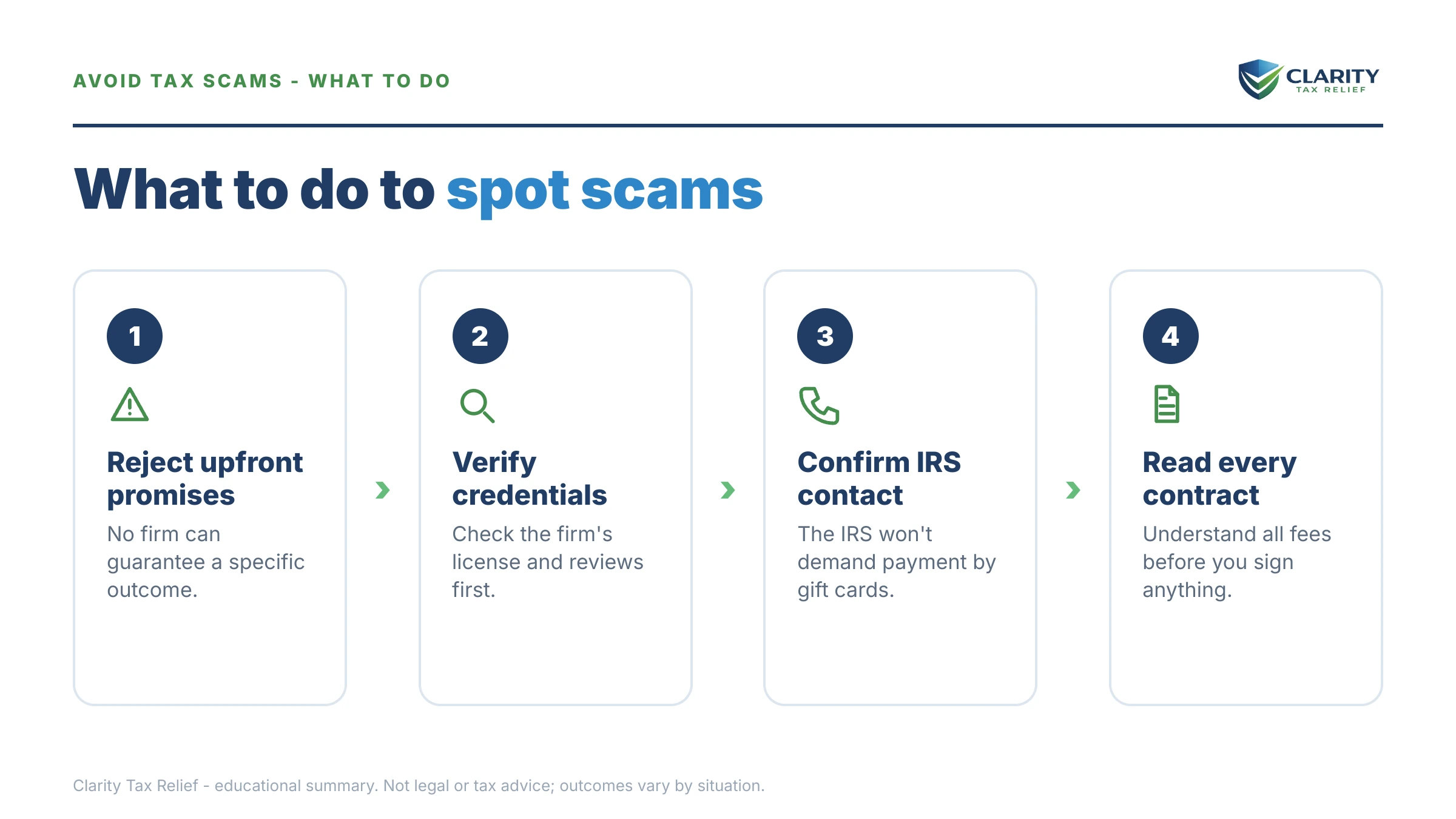
Five checks, one afternoon, and no legitimate firm will resist any of them — the pivot point is Form 2848, the power of attorney only a credentialed representative can sign. Our questions to ask a tax relief company — see the full checklist — goes deeper; here is the core:
- Verify your real balance first: Log into your IRS online account before any consultation, so a salesperson can't invent or inflate the number you supposedly owe.
- Ask who will actually represent you: Get the name and credential — enrolled agent, CPA, or attorney — of the person who will sign Form 2848 as your representative. Not the salesperson's name; the representative's.
- Get the total fee in writing: Demand a flat, itemized quote covering the entire case before you pay anything. Percentage-of-savings pricing and vague "phase two" fees are walk-away signals.
- Walk away from any promised outcome: No one can promise a settlement amount, an acceptance, or an instant collection freeze before the IRS has reviewed your finances. A promise made sight unseen is the scam itself.
- Check the firm's record: Search your state attorney general's complaint records and recent court actions, then get a second quote from a different firm before signing anything.
For the longer buyer's framework — pricing models, credentials, contract terms — see how to choose a tax relief company, and keep our tax relief company red flags checklist open during any sales call.
When you can handle this yourself
The best scam defense is knowing when you don't need anyone at all, and if your returns are filed and you owe under $50,000, you can set up the same payment plan a firm would charge thousands for in about 20 minutes on IRS.gov. A first notice you agree with and can pay within 180 days needs no professional either — the short-term plan has no setup fee. The step-by-step DIY playbook lives at how to settle tax debt yourself.
Experienced help earns its fee in specific situations: multiple unfiled years that need transcript reconstruction before anything can be negotiated, a levy already in motion, business or payroll tax debt where personal liability is on the table, or an Offer in Compromise where the Form 433 math is genuinely close and preparation quality changes the outcome. In those cases the fee buys expertise, not access. There is no access to buy.
Already paid a firm that isn't delivering?
Move on two fronts at once: recover what you can, and stop the bleeding at the IRS. Demand an itemized accounting in writing, dispute the charge with your card issuer or bank, and revoke any power of attorney the firm filed so it can no longer speak for you. Report the company to your state attorney general and to the FTC at reportfraud.ftc.gov — the FTC permanently banned a major tax-relief operator in June 2026 over exactly these practices, and complaints are what build those cases.
Then deal with your actual balance, because it grew the entire time. If the IRS itself has mishandled your case or a levy is causing hardship, the independent Taxpayer Advocate Service is free. Our full recovery guide: a tax relief company took my money.
Terms scam pitches throw around, decoded
- Fresh Start: shorthand for IRS policy changes from 2011–2012, not a program you enroll in, and there is no deadline.
- Offer in Compromise (OIC): the real IRS settlement program, filed on Form 656 and decided by financial math, not by whoever answers a hotline.
- Reasonable Collection Potential (RCP): the IRS's calculation of the most it could ever collect from you — it, not a salesperson, sets any acceptable offer amount.
- Form 2848: the power of attorney a real representative files with the IRS. If no credentialed person has signed one, nobody is actually representing you.
- Currently Not Collectible (CNC): a documented hardship pause on collection — the debt remains and interest keeps accruing.
- "Investigation phase": in honest hands, pulling your IRS transcripts to establish what you truly owe; in a scam, a billing line for silence.
Tax relief scam questions, answered
Is tax relief a scam, or are there real programs?
Real IRS relief programs exist — payment plans, Currently Not Collectible status, penalty abatement, and the Offer in Compromise are all written into law. The scam is the sales pitch: companies that promise a specific settlement before anyone has reviewed your transcripts or run the eligibility math. The IRS accepted roughly 1 in 5 offers in FY2024, so any firm guaranteeing acceptance is lying about a program that is otherwise legitimate.
How can I tell if a tax relief company is legitimate?
A legitimate firm names the enrolled agent, CPA, or attorney who will represent you, files Form 2848 so the IRS deals with them directly, and puts a flat, itemized fee in writing before you sign. It will also tell you when you don't need them — for example, a simple payment plan you can set up yourself. If the person quoting a settlement figure is a salesperson who has never seen your transcripts, that is the tell.
Is the IRS Fresh Start Program real or a scam?
Fresh Start is real, but it is not what the ads describe. It was a series of IRS policy changes starting in 2011 that loosened lien thresholds and payment-plan rules. There is no application, no enrollment window, and no deadline. Any pitch about 'enrolling before the Fresh Start deadline closes' is manufacturing urgency around a program that has no such thing.
Does the IRS call, text, or email people about tax debt?
No — first contact about a balance due comes by postal mail, and the IRS never texts, emails, or DMs you about a debt. It also never demands gift cards, wire transfers, or payment-app transfers; real payments go only to the United States Treasury or through IRS.gov. The narrow exception is private collection agencies, which the IRS announces by letter before they ever call, and even they cannot take enforcement action.
Can a company really settle my tax debt for less than I owe?
Only if the IRS's own math says so. The Offer in Compromise lets you settle for less when your assets and future income genuinely cannot cover the balance. But the IRS calculates that figure, called your Reasonable Collection Potential, not the company. It accepted roughly 1 in 5 offers in FY2024. A skilled firm can prepare a strong offer; it cannot manufacture eligibility you don't have.
What should I do if a tax relief company took my money and did nothing?
Act on two fronts at once. First, cut the firm off: demand an itemized accounting in writing, dispute the charge with your card issuer or bank, and revoke any power of attorney they filed so they can no longer speak for you. Second, report them to your state attorney general and to the FTC at reportfraud.ftc.gov, then deal with the IRS directly, because your balance kept growing the entire time they stalled.
How much does legitimate tax relief cost?
Legitimate fees are flat, itemized, and quoted after a professional has reviewed your IRS transcripts — commonly a modest investigation fee first, then a fixed resolution fee based on what your case actually needs. Warning signs: a four-figure quote on the first phone call, fees charged as a percentage of promised 'savings,' and new charges invented mid-case. The IRS's own costs are small — the Offer in Compromise application fee, for example, is $205, waived for low-income applicants.
Is 'IRS one-time forgiveness' a real program?
There is no IRS program named 'one-time forgiveness'. It is a marketing label. The closest real thing is first-time penalty abatement, which removes certain penalties if you were compliant for the prior three years, and starting in summer 2026 the IRS is replacing it with an Automatic Exemption from Penalty that applies without any request. Neither forgives the underlying tax; they remove penalties only.
Your next 24 hours
- Pull your real numbers. Log into your IRS online account and see your actual balance and unfiled years — the number the IRS has, not the number a pitch gave you.
- Gather the paper. Any contract or receipts from a firm you've paid, your last filed return, your 1099s for the unfiled years, and every IRS notice you've received.
- Get an honest read on your options. Use the free case review at the 2-minute form or call (888) 825-7779 — an experienced tax professional will tell you which programs your numbers actually fit, while penalties and interest are still accruing monthly on whatever you owe.
This guide is general information, not tax or legal advice for your specific situation. Eligibility for IRS programs depends on individual facts and circumstances; no outcome is guaranteed.