
IRS Letter Templates
Trust Fund Recovery Penalty Protest Letter Sample: Responding to Letter 1153 in 2026
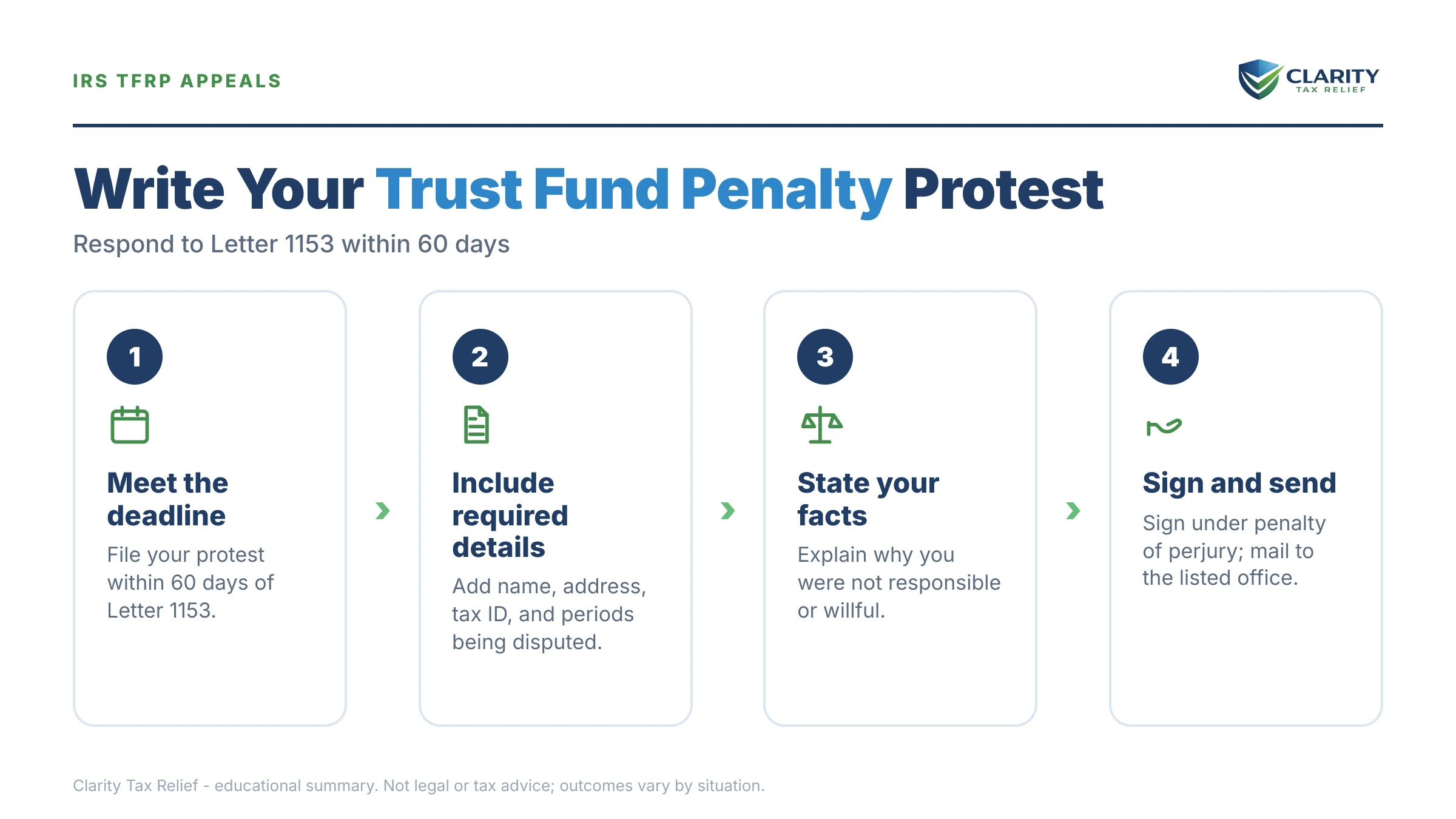
The short answer: this trust fund recovery penalty protest letter sample must be mailed to the address on your Letter 1153 within 60 days of the letter's date. It has to dispute both legal prongs — that you were a “responsible person” and that you acted “willfully” — and request a conference with IRS Appeals.
You ran the kitchen and the dining room while a partner or manager ran the books, and now Letter 1153 says the IRS wants the restaurant's unpaid payroll withholding from you, personally, out of your own bank account and house. The proposal isn't final yet. A written protest sends your case to an independent Appeals officer before a single dollar is assessed against your Social Security number.
The image below shows exactly what Letter 1153 looks like and where to find the two things your protest is built on: the letter date that starts your 60-day clock, and the Form 2751 breakdown of the proposed amount by quarter.
⏱ Your deadline: you have 60 days from the date printed on Letter 1153 to file a written protest. Interest on the TFRP itself doesn't start running until the penalty is assessed — which means the protest window is the one cheap stretch of this entire process. Miss it and the assessment goes through automatically.

Why you received Letter 1153, and what a protest letter has to do
Letter 1153 means a revenue officer has concluded you are personally liable for a business's unpaid trust fund taxes under Internal Revenue Code §6672. Those are the amounts withheld from employees' paychecks — income tax plus the employees' share of Social Security and Medicare — that were never paid over. The Letter 1153 trust fund penalty guide covers the letter itself; this page owns the response.
The proposal usually follows a Letter 3164 TFRP investigation and a Form 4180 interview, where the revenue officer asked who signed checks, who hired and fired, and who decided which bills got paid. Your answers there, and everyone else's — are the raw material your protest either confirms or corrects.
A protest letter is not an apology, a hardship plea, or a payment negotiation. It is a fact document that attacks one or both legal prongs — responsibility and willfulness — and asks the IRS Independent Office of Appeals to review the case before assessment. If your role changed over time, it can also argue quarter by quarter: liable for none, or liable for fewer periods than proposed.
One structural rule before you draft: if the proposed penalty for any single quarter exceeds $25,000, the IRS requires a formal written protest — the sample below. At $25,000 or less per period, a small case request via Form 12203 is allowed, though the same facts still need to be attached.
What happens if you don't protest within 60 days
If day 60 passes with no protest, the IRS assesses the full proposed penalty against you personally — no hearing, no review. The sequence from there runs in stages:
- The protest right lapses. The §6672 penalty is assessed against your Social Security number. It is now your personal debt, separate from anything the business owes.
- Notice and demand arrives. Personal balance-due notices begin, and interest on the TFRP starts accruing from the assessment date.
- A federal tax lien becomes possible. The lien attaches to your personal assets — your home, your accounts — not the restaurant's.
- A final notice of intent to levy follows. That notice opens a 30-day window to request a Collection Due Process hearing on Form 12153. After it, the IRS can levy personal bank accounts and wages.
- Your remedy narrows to pay-first. Post-assessment, the standard path is to pay the trust fund portion for one employee for one quarter, file a Form 843 refund claim, and litigate if it's denied — a route that requires money up front and can take years.
That last stage is the real cost of silence: the same arguments you could make free today, through Appeals, later require payment and possibly a courtroom. The TFRP appeal defense guide walks through the post-assessment options if you're already past the window.
Holding a Letter 1153 right now?
Get your Letter 1153, and your draft protest — reviewed free before the 60-day window closes. An experienced tax professional will look at who actually controlled the money and tell you which quarters are genuinely in play.
Responsibility and willfulness: the two prongs your protest must attack
The TFRP requires the IRS to prove both prongs, a responsible person who acted willfully, and failing either one defeats the penalty for that period. Responsibility is about actual authority over the company's money, not your title or ownership percentage. Willfulness is about knowing the taxes were unpaid and letting other creditors get paid anyway — no bad intent required, but knowledge plus control is.
Your letter wins or loses on documents, not adjectives. Here is what the IRS weighs, the evidence that helps, and where each factor goes in the sample below:
| Factor | Evidence that helps you | Where it goes in the letter |
|---|---|---|
| Check-signing authority | Bank signature cards and bank resolutions showing who could (and couldn't) sign, and from what dates | Paragraph 3 — responsibility facts |
| Who decided which creditors got paid | Emails or texts directing payments, accounting-software user logs, the bookkeeper's statement | Paragraph 3 — responsibility facts |
| Hiring, firing, and payroll oversight | Operating agreement, org chart, job descriptions showing duties split between owners | Paragraph 3 — responsibility facts |
| Title and ownership vs. actual control | Meeting minutes or agreements documenting a passive or operations-only role | Paragraph 3 — responsibility facts |
| When you learned deposits were missed | Dated IRS notices, the payroll provider's alerts, the email or text that first told you | Paragraph 4 — willfulness facts |
| What you did after learning | Proof of federal tax deposits made afterward, loan applications, written instructions to pay the IRS first | Paragraph 4 — willfulness facts |
| Whether unencumbered funds existed | Bank statements showing balances and which creditors were paid during the shortfall | Paragraph 4 — willfulness facts |
Trust fund recovery penalty protest letter sample (copy and edit)
A valid formal protest must identify you, the letter. The periods. State which findings you dispute. Lay out your facts and the law. And be signed under penalties of perjury. Replace every bracket with your specifics — the guidance notes between sections tell you what evidence each paragraph is carrying.
[Your Full Name]
[Street Address]
[City, State ZIP]
[Daytime Phone] · [Email]
[Date]
Internal Revenue Service
[Office name and address shown on your Letter 1153]
Attn: [Revenue Officer name and ID number, if shown]
RE: Formal Written Protest — Proposed Trust Fund Recovery Penalty
Taxpayer: [Your Full Name], SSN ending [last four digits]
Business: [Business Legal Name], EIN [XX-XXXXXXX]
Letter 1153 dated: [date printed on the letter]
Tax periods: [e.g., Form 941 quarters ending 3/31/2025, 6/30/2025, 9/30/2025]
Proposed penalty: $[amount shown on Form 2751]
To the IRS Independent Office of Appeals:
1. I received Letter 1153 dated [date], proposing a Trust Fund Recovery Penalty of $[amount] against me under Internal Revenue Code §6672 for the periods listed above. I disagree with the proposed penalty, I do not consent to assessment, and I request that this protest be forwarded to the Independent Office of Appeals and that a conference be scheduled.
Guidance: take the date, amount, and quarters directly from Letter 1153 and the enclosed Form 2751 — mismatched figures are the fastest way to slow a protest down. If you dispute only some quarters, say so here ("I disagree with the proposed penalty for the quarters ending [dates]").
2. Findings I disagree with. I disagree with the determination that I was a “responsible person&rdquo. Required to collect, account for, and pay over the trust fund taxes of [Business Name], and with the determination that any failure to pay those taxes was “willful&rdquo. On my part, for [all periods listed above / the following periods: ___].
3. Facts — I was not a responsible person. During the periods at issue, I [describe your actual role — e.g., “owned 50% of [Business Name] and managed kitchen and dining-room operations”]. I did not control the company's financial decisions. Specifically:
(a) [Name and title] held sole authority over the company's bank accounts and decided which creditors were paid and when. [I was not an authorized signer on the operating or payroll accounts until [date] / My signing authority was limited to ___, as shown on the enclosed bank signature cards.]
(b) Payroll processing and federal tax deposits were handled by [name — the office manager, bookkeeper, or payroll provider], who reported to [name], not to me.
(c) I did not [prepare or sign the Forms 941 / negotiate with creditors or lenders / review the company's bank statements / hire or fire the employees who handled the company's finances].
Guidance: this paragraph carries the check-signing and control evidence from the table above. Be concrete and dated — “I was added to the payroll account on March 14, 2025&rdquo. Beats “I wasn't really involved in the finances.” If a co-owner or manager genuinely ran the money, name them and their authority; Appeals expects it. It is a factual defense, not an accusation. If your Form 4180 answers were incomplete or taken out of context, correct them here explicitly.
4. Facts — any failure was not willful. I first learned that federal payroll tax deposits had not been made on [date], when [how you learned — e.g., “the payroll provider's termination notice was forwarded to me” / “the revenue officer contacted the business”]. Before that date, I had no knowledge that the deposits were delinquent, and [name/title] provided me with [financial reports / assurances] indicating taxes were current.
After learning of the shortfall, I [what you did — e.g., “directed that all available funds be applied to federal tax deposits beginning with the payroll of [date], as the enclosed deposit records show” / “had no authority to direct the company's payments, and no unencumbered funds were available, as the enclosed bank statements show”].
5. Law. Section 6672 imposes liability only on a person who was both (1) responsible for collecting, accounting for, and paying over trust fund taxes, and (2) willful in failing to do so. Title or ownership alone does not establish responsibility; the inquiry turns on actual authority over the company's finances. Willfulness requires knowledge of the unpaid taxes combined with the power to pay them and the decision to pay other creditors instead. As the facts above show, I do not meet [either prong / both prongs] for [the periods at issue / any period before [date]].
6. Evidence enclosed. In support of this protest, I enclose: [list — e.g., bank signature cards. Operating agreement. Payroll provider records. Bank statements for the periods at issue. Dated emails. A copy of Letter 1153 and Form 2751].
7. Relief requested. I respectfully request that the Office of Appeals not sustain the proposed penalty [or: sustain the penalty, if at all, only for the periods after [date]], and I request a conference to discuss this matter. Please contact me at the number above if any additional information is needed.
Under penalties of perjury, I declare that I have examined the facts stated in this protest, including any accompanying documents, and to the best of my knowledge and belief, they are true, correct, and complete.
_________________________
[Your Full Name]
[Date]
Enclosures: [list]
Guidance: the perjury declaration is not optional — a protest without it can be rejected as invalid. If an experienced tax professional signs the protest for you, they substitute a representative's declaration (stating whether they know personally that the facts are true) and attach a Form 2848 power of attorney. Notice what the letter never says: it never claims the penalty will be removed. It argues facts and requests Appeals consideration. That is exactly what a protest is for.
Worked example: an $87,000 proposed TFRP against a restaurant co-owner
Say your restaurant fell behind on five quarters of Form 941 deposits totaling $131,000. The trust fund portion — $58,000 of withheld income tax plus $29,000 of employee-side Social Security and Medicare — comes to $87,000. The employer's matching $29,000 and roughly $15,000 of late-deposit penalties and interest stay with the business. Only the $87,000 can be proposed against you personally on Form 2751.
Now suppose you were an operations-only co-owner with no bank access until March 2025, when your partner left and you took over the accounts. The missed quarters run from Q1 2024 through Q1 2025. Your protest argues you weren't responsible for the four 2024 quarters at all. That willfulness for Q1 2025 could only begin when you gained both knowledge and control. If Appeals agreed with that timeline, the exposure in play could fall from $87,000 to the trust fund portion of a single quarter — perhaps $17,000 — though the outcome always depends on what your signature cards, emails, and bank records actually show. This is hypothetical arithmetic, not a promised result; it illustrates why quarter-by-quarter facts matter more than an all-or-nothing argument.
How to file your TFRP protest letter, step by step
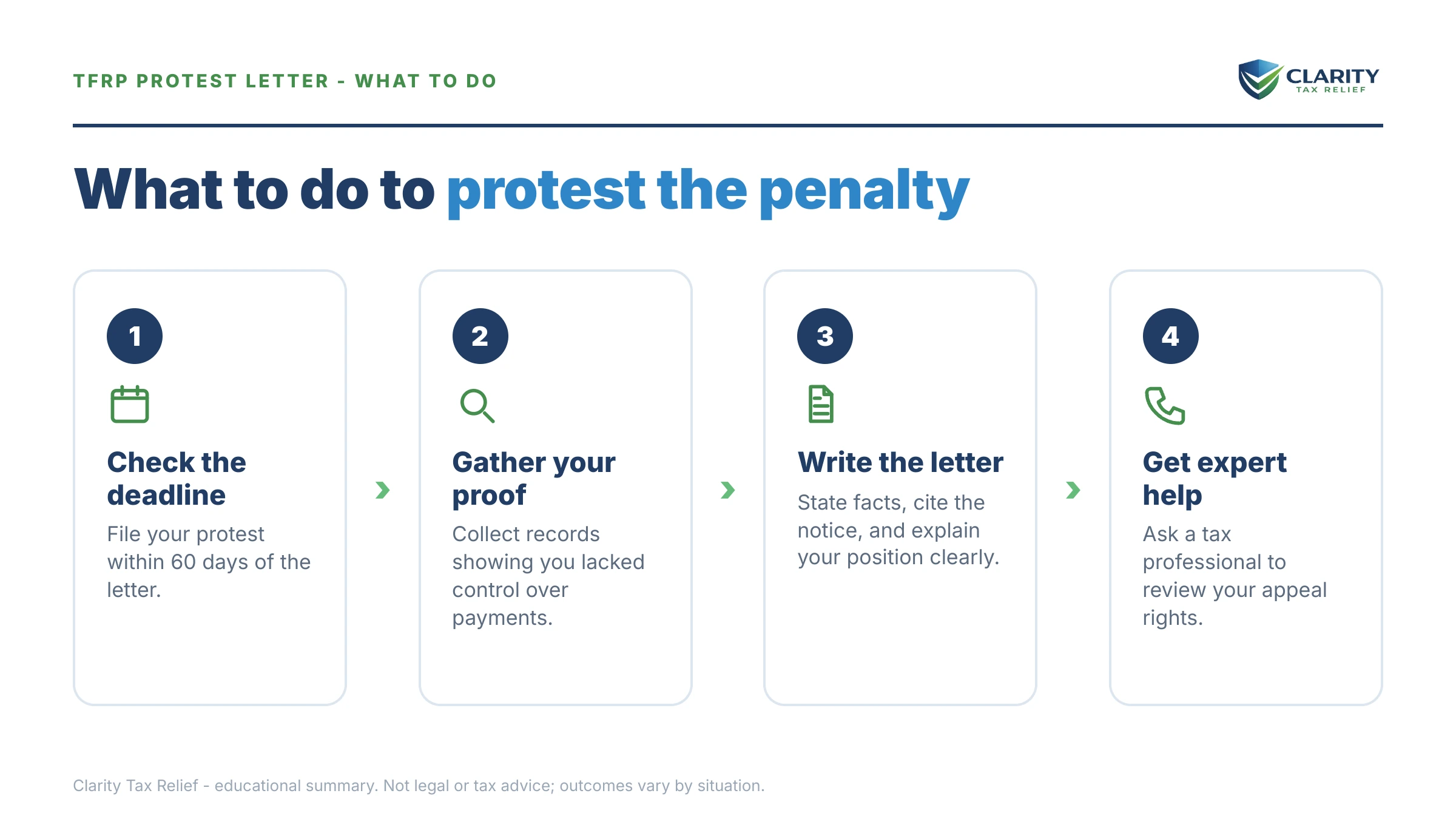
- Confirm your deadline. Find the date printed at the top of Letter 1153 and count 60 days forward — put it on your calendar, and plan to mail at least a week early.
- Gather your evidence. Pull bank signature cards, the operating agreement, payroll records, and every email or text showing who controlled which bills got paid.
- Draft the protest from the sample above. Fill every bracket with your specific facts, addressing responsibility and willfulness separately, and quarter by quarter if your role changed.
- Sign the penalties-of-perjury declaration. An unsigned protest can be rejected as invalid. If a representative signs for you, they use the representative declaration and attach Form 2848.
- Mail it by certified mail to the address on Letter 1153. Keep the green-card receipt and a complete copy of everything you sent, and do not sign or return Form 2751.
- Prepare for the Appeals conference. Organize your documents quarter by quarter so you can show exactly when you had knowledge of the shortfall and when you had control of the money.
TFRP protest timeline: what happens at each stage
A timely protest holds the assessment while Appeals reviews the case — here is the whole sequence from investigation to resolution:
| Stage | What happens | Your move |
|---|---|---|
| Investigation (Letter 3164, Form 4180) | A revenue officer interviews owners and staff to identify responsible persons | Prepare before the interview; get representation if the exposure is large |
| Letter 1153 + Form 2751 arrive | The IRS formally proposes the penalty against you; the 60-day clock starts on the letter's date | Calendar day 60; do not sign Form 2751 if you disagree with anything |
| Days 1–60 | Your one pre-assessment window — a written protest routes the case to independent Appeals | Mail the protest certified, well before the deadline |
| Appeals review and conference | A settlement officer weighs your responsibility and willfulness evidence and can withdraw, reduce, or sustain the proposal | Present documents organized quarter by quarter |
| No protest, or penalty sustained | The TFRP is assessed against you personally and individual collection notices begin | Payment arrangements, or the pay-and-refund-claim route via Form 843 |
Two things run on separate tracks the whole time. The business still owes its full 941 back taxes. Its penalties and interest keep accruing regardless of your protest — a restaurant still operating should look at the restaurant payroll and sales tax debt guide for stabilizing the entity side while the personal side goes to Appeals.
When you can write this protest yourself, and when to get help
You can reasonably handle a TFRP protest yourself when the facts are clean and documented: you were never a signer on any account, your role was demonstrably passive, one quarter is at issue. The paper trail is short. In that situation, the sample above plus certified mail is a legitimate DIY response.
Experienced help changes outcomes when the facts are mixed — which, at an $87,000 proposal, they usually are. If you had some financial authority, the case becomes line-drawing: which quarters, from what date, with what knowledge. If your Form 4180 answers already hurt you, they need careful correction, not contradiction. If multiple owners are pointing at each other, each protest shapes the others' cases. And if the business is still running with ongoing deposit obligations, one wrong move, like missing another payroll tax deposit, can undercut the willfulness argument you just made. A deeper question, whether you're exposed at all, is covered in am I personally liable for payroll taxes.
Worth knowing in 2026: with the IRS workforce down sharply, reaching a human about your case is harder than ever, but TFRP assessments and the collection notices that follow are generated automatically. The 60-day window doesn't wait for staffing to improve.
Terms on your Letter 1153, decoded
- Trust fund taxes — money withheld from employees' paychecks that the business holds “in trust&rdquo. For the government. It was never the company's money to spend.
- Responsible person — anyone with actual authority over the company's finances: who gets paid, who signs checks, who files the 941s. Titles don't decide it; control does.
- Willfulness — knowing the taxes were unpaid and paying other creditors anyway. It requires no bad intent — just knowledge plus the power to pay.
- Form 2751 — the agreement form enclosed with Letter 1153. Signing it consents to assessment and ends your pre-assessment appeal rights.
- Form 4180 — the interview the revenue officer used to decide who was responsible; your protest can correct or contextualize those answers.
- Jointly and severally liable — each person assessed owes 100% of the penalty. But the IRS collects the trust fund money only once in total.
- Assessment — the moment the proposed penalty becomes a legal debt on your personal IRS account. Everything before it is still a proposal.
Trust fund penalty protest questions, answered
How long do I have to respond to Letter 1153?
You have 60 days from the date printed on Letter 1153 to file a written protest. Mail it by certified mail so you can prove the date it was sent. If the deadline passes, the IRS assesses the penalty against you personally and your pre-assessment appeal right is gone — the remaining remedies cost money up front and take far longer.
Do I need a formal written protest, or can I use Form 12203?
If the proposed penalty for any single tax period is more than $25,000, the IRS requires a formal written protest like the sample on this page. At $25,000 or less per period, a small case request such as Form 12203 is allowed, but attach the same responsibility and willfulness facts, because the form alone does not argue your case.
What happens if I miss the 60-day protest deadline?
The IRS assesses the Trust Fund Recovery Penalty against your Social Security number and personal collection begins. Your main remaining path is to pay the trust fund portion for one employee for one quarter, file a Form 843 refund claim, and litigate if the claim is denied. That route can work, but it requires paying first and often takes years — the 60-day protest is the cheaper door.
Should I sign Form 2751?
Only if you fully agree with the penalty. Form 2751 is your written consent to assessment of the Trust Fund Recovery Penalty, and signing it gives up your right to a pre-assessment Appeals protest. If you disagree with anything — the amount, the quarters, or being named at all — do not sign it; file the protest instead.
Can the IRS propose the TFRP against more than one person?
Yes. The penalty can be proposed against every person the IRS considers responsible — co-owners, officers, a controller, even an outside bookkeeper. Each person is liable for the full amount, though the IRS collects the trust fund money only once in total. Each person protests separately, and showing who actually controlled payments is a legitimate defense, not blame-shifting.
Does filing a protest stop IRS collection?
A timely protest generally keeps the penalty from being assessed against you personally while Appeals reviews the case, so no personal liens or levies flow from the TFRP during that window. It does nothing to pause collection against the business for the underlying Form 941 balances. The business's penalties and interest keep accruing the entire time.
Does the TFRP include the employer's share of payroll taxes?
No. The Trust Fund Recovery Penalty equals only the trust fund portion of the unpaid payroll taxes: income tax withheld from employees plus the employees' share of Social Security and Medicare. The employer's matching share, late-deposit penalties, and interest on the 941s stay with the business — which is why the amount on Form 2751 is smaller than the business's total balance.
Will a protest letter get the Trust Fund Recovery Penalty removed?
No letter can promise that — outcomes depend entirely on the facts you can document. What a well-built protest does is force an independent Appeals review of both legal prongs before assessment, and Appeals can withdraw the penalty, drop specific quarters, or sustain it based on the evidence. That is why the evidence column in the factor table above matters more than the wording.
Your next 24 hours
- Find the date on Letter 1153, top of the first page, and write down the day exactly 60 days out. That is your protest deadline, and every decision runs backward from it.
- Gather the control documents: bank signature cards, the operating agreement, payroll records for the quarters on Form 2751, and any email or text showing who decided which bills got paid.
- Get a free case review before you mail anything. Send us the Letter 1153 and your timeline — the 2-minute form or (888) 825-7779 — and an experienced tax professional will tell you which prongs and which quarters your evidence actually supports, while the 60-day window is still open.
For the primary sources, see the IRS's overview of the Trust Fund Recovery Penalty, the IRS Independent Office of Appeals, and the Taxpayer Advocate Service if IRS delays are jeopardizing your rights.
This guide is general information, not tax or legal advice for your specific situation. Eligibility for IRS programs depends on individual facts and circumstances; no outcome is guaranteed.