
Tax Basics
What Is Imputed Income? Why It's on Your Paycheck and How It's Taxed in 2026
What is imputed income? It's the value of a non-cash benefit — group-term life insurance over $50,000, a domestic partner's health coverage, personal use of a company car — that your employer must add to your taxable wages. You never see it as cash, but you pay Social Security, Medicare, and income tax on it.
You're staring at a paystub line labeled IMP or GTL in the earnings column, your gross pay reads a few dollars higher than your salary should be, and your net pay is a little lighter than last month. Nothing about your job changed, but a benefit you barely think about just became taxable wages. It's not a mistake and it's not a mystery: this page decodes exactly what the line is, what it costs you, and when it's worth acting on.
Two reference tables below cover the ground almost no one explains in one place: every common imputed-income item with its taxable-or-not status, and every W-2 box and paycheck code where imputed income hides. The image below shows you exactly what this looks like on a real W-2 and where to look for yours.

What is imputed income? The plain-English meaning
Imputed income is the fair market value of a non-cash benefit that federal law requires your employer to treat as taxable wages. The IRS's default rule for fringe benefits is simple: everything an employer gives you is taxable unless a specific law excludes it. Health insurance for you and your family is excluded. Free life insurance above $50,000, a gym stipend, or coverage for a partner who isn't your tax dependent is not, so its value gets "imputed" (assigned) to your pay.
Here's the part that confuses almost everyone: the benefit's value is added to your wages, but only the tax on that value comes out of your pay. The imputed line sits in the earnings section of your paystub, not the deductions column. It inflates your gross so payroll can withhold tax on it — then it disappears before net pay, because you already received the benefit itself.
One quick disambiguation: family courts also "impute income" — assigning a parent earning capacity for child support purposes. That's an unrelated legal concept. This article covers the payroll and tax meaning, which is what your paystub and W-2 are showing you.
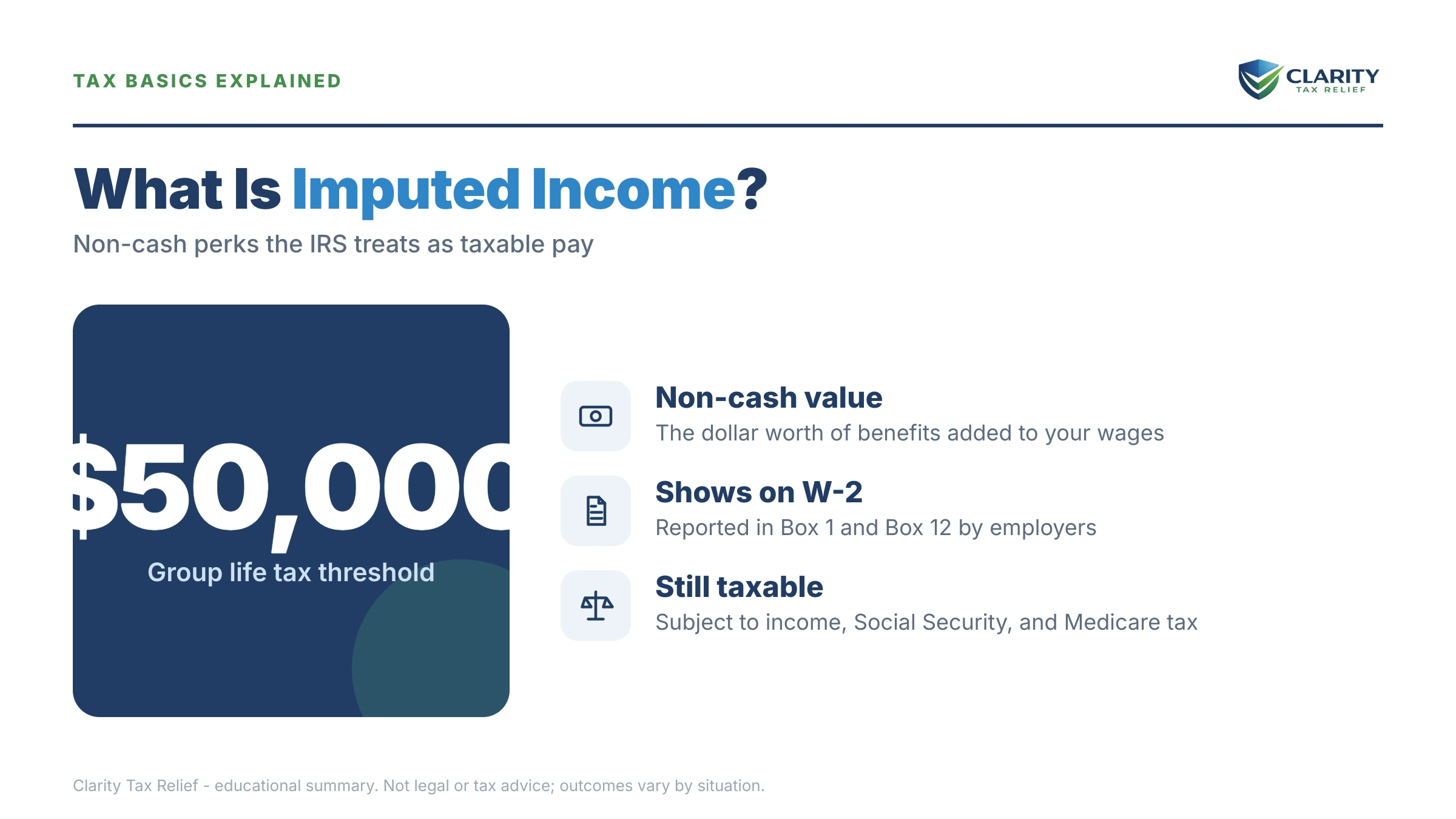
“The imputed cost of coverage in excess of $50,000 must be included in income, using the IRS Premium Table, and is subject to Social Security and Medicare taxes.”
— Group-term life insurance (IRS.gov)
How imputed income withholding works, and why your paycheck dropped
Imputed income raises your taxes without raising your take-home pay: your employer must withhold 7.65% in Social Security and Medicare tax on value you never receive as cash. That FICA withholding is mandatory for every taxable fringe benefit, every pay period the value posts.
Federal income tax is where employers split. For most imputed items — domestic partner coverage, gym reimbursements, taxable moving reimbursements — the employer also withholds income tax, usually at the flat supplemental rate or by adding the value to your regular wages. For group-term life insurance specifically, income tax withholding is optional, and many employers skip it. You still owe the income tax; you just pay it when you file, through a slightly smaller refund or a balance due.
So the mechanics of the "drop" are: gross pay up by the imputed value → taxes calculated on the higher gross → imputed value backed out before net → net pay down by exactly the extra tax. If the imputed item is small, the drop is pocket change. If it's domestic partner health coverage, it can be $50–$80 a paycheck — the kind of shortfall that, like working two jobs and owing taxes every year, quietly compounds into an April surprise if no income tax is being withheld on it.
Common imputed income examples: what's taxable and what's not
The most common imputed income item is group-term life insurance over $50,000, which IRC Section 79 makes taxable above that threshold, but it's one of a dozen benefits that can generate the line. Here is the full map:
| Benefit | Imputed income? | Threshold / detail |
|---|---|---|
| Group-term life insurance over $50,000 | Yes | Excess coverage valued by age-based IRS Table I rates; W-2 Box 12, Code C |
| Group-term life insurance of $50,000 or less | No | Fully excluded under IRC Section 79 |
| Health coverage for a non-dependent domestic partner | Yes | Employer's cost of the partner's coverage, often the largest imputed item |
| Health coverage for you, your spouse, and tax dependents | No | Fully excluded from federal wages |
| Personal use of a company car | Yes | Value of personal miles only; business use stays tax-free |
| Dependent care assistance over the annual exclusion | Yes | Amount above $7,500 for 2026 (half that if married filing separately) |
| Educational assistance over $5,250 | Yes | Excess is taxable unless it qualifies as job-related training |
| Gym memberships and off-site fitness reimbursements | Yes | An on-premises employer facility can be excluded; a paid gym membership can't |
| Moving expense reimbursements | Yes | Taxable for nearly everyone; active-duty military moves are the exception |
| Employee discounts beyond IRS limits | Yes | Taxable above 20% off services, or above the gross-profit percentage on goods |
| Life insurance on a spouse or dependent over $2,000 face value | Yes | If coverage tops $2,000, the full employer cost is taxable, not just the excess |
| De minimis perks (occasional snacks, low-value holiday gifts) | No | Too small and infrequent to account for — cash and gift cards never qualify |
Note the pattern: the exclusions have hard edges. One dollar of life insurance over $50,000, one dollar of tuition help over $5,250, and imputed income switches on for the amount above the line — except spouse/dependent life coverage, where crossing $2,000 makes the whole cost taxable.
The group-term life $50,000 rule: a worked example on a $52,000 salary
Say you earn $52,000 and your employer provides free life insurance at two times salary — $104,000 of coverage. This is entirely hypothetical, but it's the exact math behind the IMP line most employees find.
The first $50,000 of coverage is tax-free. The excess is $104,000 − $50,000 = $54,000. The IRS doesn't care what the insurance actually costs your employer; it values the excess using its age-based Table I rates. At age 42, the rate is $0.10 per $1,000 of coverage per month:
54 × $0.10 = $5.40 per month → $64.80 per year of imputed income. Paid biweekly, that's about $2.49 added to the earnings side of each of your 26 paychecks. The real cash cost? Payroll withholds 7.65% FICA on it — roughly $0.19 per check, under $5 for the whole year — plus the income tax you'll settle at filing (about $14 in the 22% bracket). Annoying to see, trivial to pay. If you contribute to the coverage with after-tax dollars, your payments reduce the imputed amount further.
Now contrast the benefit that actually moves paychecks. Say the same $52,000 employee adds a non-dependent domestic partner to the health plan. The employer's cost of the partner's coverage is $450 a month. That's $5,400 a year of imputed income — about $207.69 per biweekly check. Withholding at 22% income tax plus 7.65% FICA takes roughly $61.58 out of every paycheck, about $1,601 a year, for coverage that never appears in your bank account. Same mechanism as the GTL line; twenty-five times the bite.
Where imputed income shows up: your W-2 boxes and paycheck codes decoded
Imputed income never gets its own box on a W-2 — it's folded into your wage totals, with Box 12, Code C as the only labeled breakout (for group-term life over $50,000). The image below shows exactly where these codes sit on the form so you can trace your own numbers. Here's the full decoder:
| Where you'll see it | Code or label | What it means |
|---|---|---|
| Paystub — earnings section | IMP, IMPINC, IMP INC, GTL, GRP TRM | The imputed value added to taxable wages. It's not cash in and not a deduction out. |
| Paystub — tax withholding section | Standard tax lines | The FICA (and any income tax) withheld on the imputed amount — the only part that reduces net pay |
| W-2 Box 1 | Wages, tips, other compensation | Includes all imputed income for the year — nothing to add separately on your return |
| W-2 Boxes 3 and 5 | Social Security / Medicare wages | Also include imputed income (Box 3 stops at the annual Social Security wage base) |
| W-2 Box 12 | Code C | The taxable cost of group-term life over $50,000 — informational; already inside Box 1 |
| W-2 Box 12 | Codes M and N | Uncollected Social Security / Medicare tax on group-term life for former employees and retirees |
| W-2 Box 14 | DP, IMP, employer's own labels | Optional itemization of other imputed items, like domestic partner coverage |
| W-2 Box 10 | Dependent care benefits | Total dependent care assistance; any amount over the exclusion also lands in Box 1 |
If your paystub's year-to-date imputed total doesn't reconcile with your W-2's Box 1, that's a payroll question first, and if the W-2 itself looks wrong or never arrives, see our guide to what to do when your employer didn't send a W-2.
Special cases: domestic partners, S-corp owners, and retirees
Three situations change the standard imputed-income answer more than any others.
Domestic partners. The federal exclusion for employer health coverage covers only you, a spouse, and tax dependents. If your partner qualifies as your tax dependent (you provide over half their support and they live with you all year, among other tests), the imputed income goes away — tell HR and provide the certification they ask for. Marriage ends it too. And states diverge: California, for example, doesn't impute the value for state income tax when the partner is a registered domestic partner, so your state wages may be lower than Box 1. When in doubt, check with your state tax agency rather than assuming the federal treatment carries over.
S-corporation owners. Shareholders owning more than 2% of an S-corp lose several fringe exclusions ordinary employees keep. The $50,000 group-term life exclusion doesn't apply to them at all, and health insurance premiums the company pays are added to their W-2 Box 1 wages (though generally not to FICA wages). If you own the company, your "imputed income" lines follow different rules than your employees' — worth confirming before payroll runs year-end.
Retirees and former employees. If your old employer keeps group-term life on you after you leave, the over-$50,000 value is still imputed, but there's no paycheck to withhold from. You'll get a W-2 with Codes M and N in Box 12 for the uncollected Social Security and Medicare tax, which you settle on your own return. Retirees are routinely blindsided by a W-2 from a company they haven't worked at in years; this is why.
What happens if imputed income is reported wrong, or not at all
The IRS computer-matches every W-2 against the return you file, so imputed income that's missing or misreported surfaces on its own schedule, usually about a year after you file. The sequence runs in stages:
- The employer corrects it. If payroll forgot to impute a benefit (it happens, especially with domestic partner coverage), the fix is a corrected W-2c. If you already filed, you may need to amend, and you'll owe tax on wages you never saw as cash.
- The mismatch gets flagged. If the W-2 on file shows more wages than your return, the Automated Underreporter program generates a CP2000 notice proposing extra tax, usually with an accuracy-related addition.
- The proposal hardens. Ignore the CP2000 and the IRS issues a statutory notice of deficiency, giving you 90 days (150 days if the notice is addressed to you outside the United States) to petition Tax Court before the amount becomes final. The exact deadline is printed on the notice itself, and it can't be extended.
- It becomes a collectible debt. The balance is assessed, a CP14 notice bill goes out. The failure-to-pay penalty (0.5% per month) plus interest accrue until it's resolved. You can estimate what those additions cost with our IRS penalty & interest calculator.
The other failure mode is quieter: everything is reported correctly, but no income tax was withheld on a large imputed item. You discover at filing that you've filed taxes and owe more than expected. Same money, less warning, and if you can't pay it by the deadline, the options in our guide to what to do when you can't pay taxes by April 15 apply.
Did imputed income leave you with an IRS balance?
If a corrected W-2, a CP2000, or under-withheld imputed income turned into a tax bill you can't pay, get it reviewed free before interest and the monthly late-payment penalty grow it further. An experienced tax professional will confirm the numbers and map your options — no pressure, no obligation.
How to check your imputed income, step by step
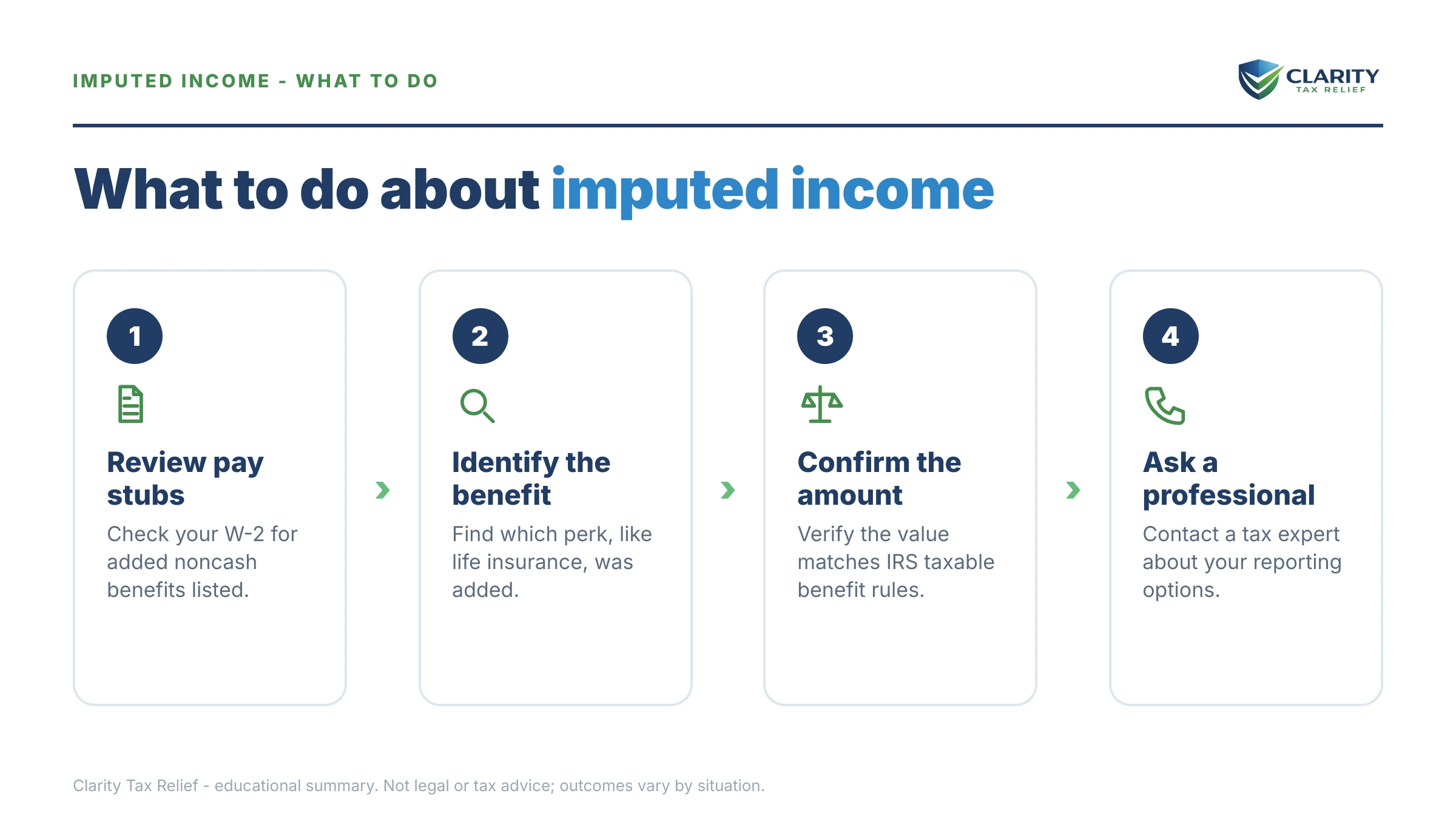
Verifying an imputed line takes about fifteen minutes with your paystub and last W-2 in hand:
- Find the line. Look in the earnings section of your paystub, not the deductions column, for a code like IMP, IMPINC, or GTL, and note both the per-check amount and the year-to-date total.
- Ask payroll what it represents. Your employer must be able to tell you which benefit the amount reflects and how the value was calculated — for group-term life, that means your coverage amount and your age bracket.
- Match it to your W-2. Confirm the year-to-date amount is inside Box 1 wages, check Box 12 for Code C if it's group-term life, and look for an itemized note in Box 14.
- Check your withholding. Run the IRS Tax Withholding Estimator with the imputed amount included so you know whether enough income tax is coming out, especially if the imputed item is large, like domestic partner coverage.
- Adjust or opt out. Update your W-4 if you'll be under-withheld, or ask HR whether you can change the benefit — capping employer-paid life insurance at $50,000 stops that imputed income entirely.
If you want to confirm what employers actually reported to the IRS under your Social Security number, your IRS wage and income transcript shows every W-2 and 1099 on file. And note that the W-4 lever works both ways: chronically under-withholding can eventually draw a withholding lock-in letter ordering your employer to withhold at a set rate.
When you can handle this yourself, and when to get help
Most imputed-income questions need no professional at all. If the line is a few dollars of GTL, the math above is the whole story — verify it, budget the small income-tax difference, and move on. If it's domestic partner coverage, a W-4 adjustment or a dependency review with HR usually solves it. Even a modest balance at filing is a do-it-yourself fix: you can set up an IRS payment plan online in minutes for balances the IRS's streamlined thresholds cover.
Experienced help changes the outcome in narrower situations: a CP2000 proposing tax on imputed income you believe was double-counted or valued wrong, a W-2c that forces amended returns across multiple years, an S-corp where owner fringe benefits were run through payroll incorrectly, or an assessed balance that's already drawing collection notices. Those cases turn on documentation and sequencing, and getting the response right the first time is cheaper than unwinding a wrong assessment later.
Terms on your paystub and W-2, decoded
The vocabulary around imputed income comes straight from IRS Publication 15-B, the employer's fringe-benefit rulebook. The six terms you're most likely staring at:
- Fringe benefit: anything of value your employer provides beyond cash wages — taxable by default unless a specific exclusion applies.
- Fair market value (FMV): what the benefit would cost you to buy on your own — the starting point for valuing most imputed items.
- Section 79: the tax-code section that excludes the first $50,000 of employer-paid group-term life insurance and taxes the rest.
- Table I rates: the IRS's age-banded monthly rates per $1,000 of coverage, used to value excess group-term life regardless of the actual premium.
- De minimis benefit: a perk so small and infrequent that accounting for it is unreasonable — excluded from wages. Cash and gift cards never qualify.
- W-2c: a corrected W-2, issued when wages (including missed imputed income) were reported wrong the first time.
Imputed income questions, answered
What does imputed income mean on my paycheck?
It means your employer added the value of a non-cash benefit — most often group-term life insurance over $50,000 or a domestic partner's health coverage — to your taxable wages. You never receive the amount as cash. It appears in the earnings section so payroll can withhold Social Security and Medicare tax on it. It flows into Box 1 of your W-2.
Is imputed income deducted from my paycheck?
No — imputed income is added to your taxable wages, not taken out of your pay. Only the tax withheld on it reduces your check. A $10 imputed line typically costs you about $1 to $3 in real money, depending on your bracket.
Do you pay taxes on imputed income?
Yes. It's subject to Social Security and Medicare tax plus federal income tax, and most states with an income tax count it in state wages too.
What does GTL mean on a paystub?
GTL stands for group-term life insurance. When your employer-paid coverage exceeds $50,000, the IRS values the excess using its age-based Table I rates. That value posts to your paystub as imputed income. It also appears in Box 12 of your W-2 with Code C. Coverage at or below $50,000 generates no GTL line at all.
Can I avoid imputed income?
Sometimes. You can often cap employer-paid life insurance at $50,000, decline a benefit you don't use, or, for domestic partner coverage, the imputed income ends if your partner qualifies as your tax dependent or you marry. You can't avoid it by refusing to report it: your employer is required to put it on your W-2 either way.
Why is my domestic partner's health insurance imputed income?
Federal law excludes employer-paid health coverage only for you, your spouse, and your tax dependents. A domestic partner who isn't your tax dependent doesn't fit any of those categories, so the employer's cost of the partner's coverage, often $300 to $600 a month, is added to your federal taxable wages. Some states, including California for registered domestic partners, don't impute it for state income tax.
Where does imputed income go on my W-2?
It's already inside Box 1 and Boxes 3 and 5 — never a separate line you report yourself. If your state doesn't tax an imputed item, your Box 16 state wages can be lower than Box 1.
Does imputed income affect my tax refund?
It can shrink it, since it raises taxable wages that often have no income tax withheld on them. A large imputed amount can also lift your adjusted gross income enough to trim income-based credits — a second, less obvious hit to a refund.
Your next 24 hours
- Pull your latest paystub and find the imputed line in the earnings section — note the code, the per-check amount, and the year-to-date total.
- Gather your benefits enrollment summary and last W-2 so you can match the imputed item to the benefit and confirm it's inside Box 1 (details on the form itself are at IRS.gov's Form W-2 page).
- If imputed income helped create an IRS balance you can't pay, get a free case review — the 2-minute form at claritytaxrelief.com/#consult or (888) 825-7779. Interest and the failure-to-pay penalty accrue every month a balance sits, so the review is worth doing this week, not this quarter.
This guide is general information, not tax or legal advice for your specific situation. Eligibility for IRS programs depends on individual facts and circumstances; no outcome is guaranteed.