
IRS Forms
Form 843 Instructions: How to Claim a Refund or Request Penalty Abatement (2026)
The short answer: Form 843 is the IRS Claim for Refund and Request for Abatement — the form for removing penalties, recovering penalties you already paid, and abating interest caused by IRS error. It's a one-page paper form, filed once per tax period, and refund claims must land within the 3-year/2-year deadline.
You're a sole proprietor, the penalty on your notice has a comma in it, and someone — a forum, a bookkeeper, the IRS itself — pointed you to Form 843. Good instinct: it's the right form for most penalty fights. The catch is that it's short on space and heavy on judgment calls, and one wrong checkbox routes your claim to the wrong unit.
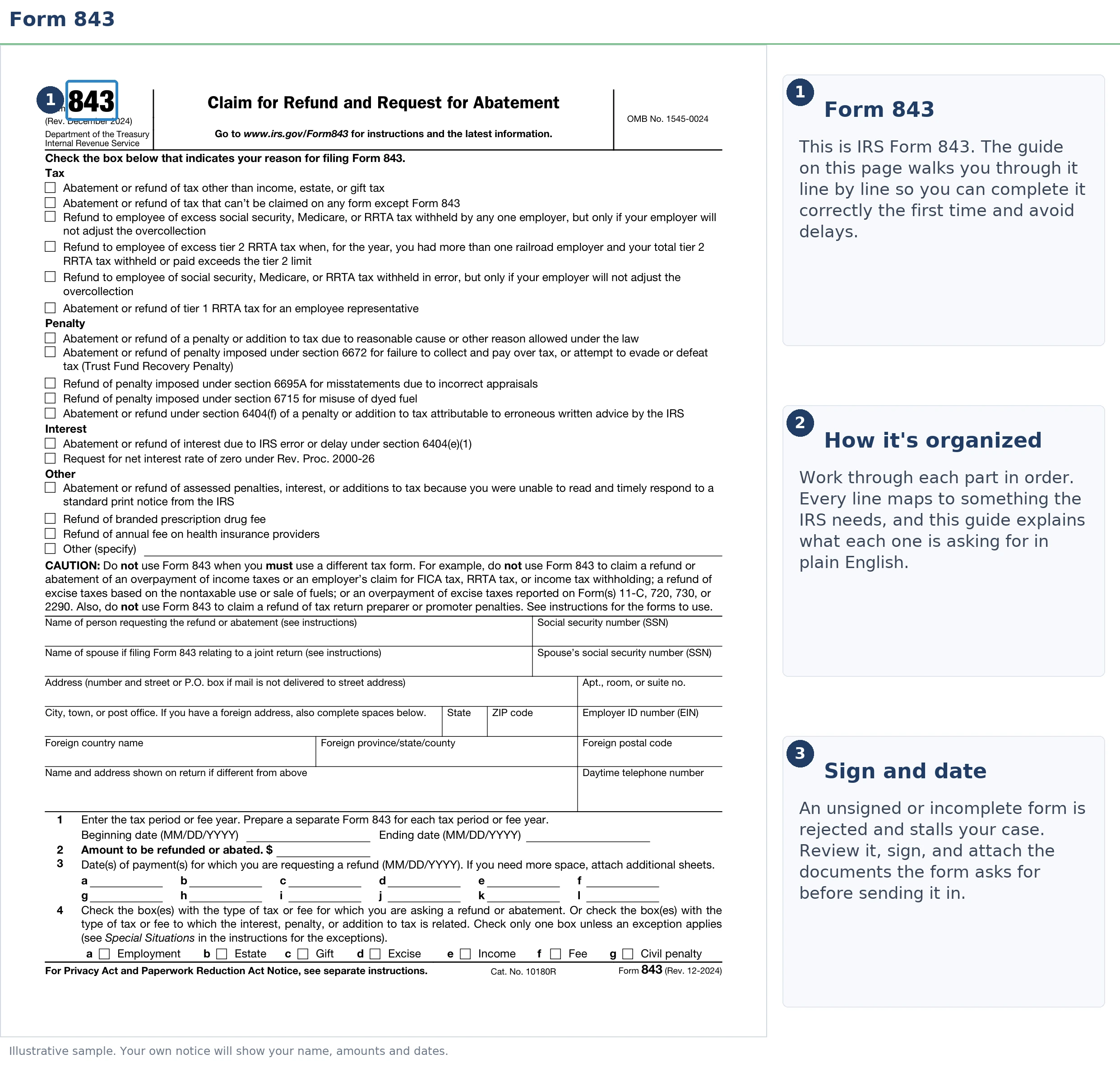
These Form 843 instructions walk every line, in order, with the evidence the IRS actually reads. The image below shows you exactly what the form looks like and where the entries that decide your claim sit — worth a look before you start writing, because two of the seven lines do most of the work.
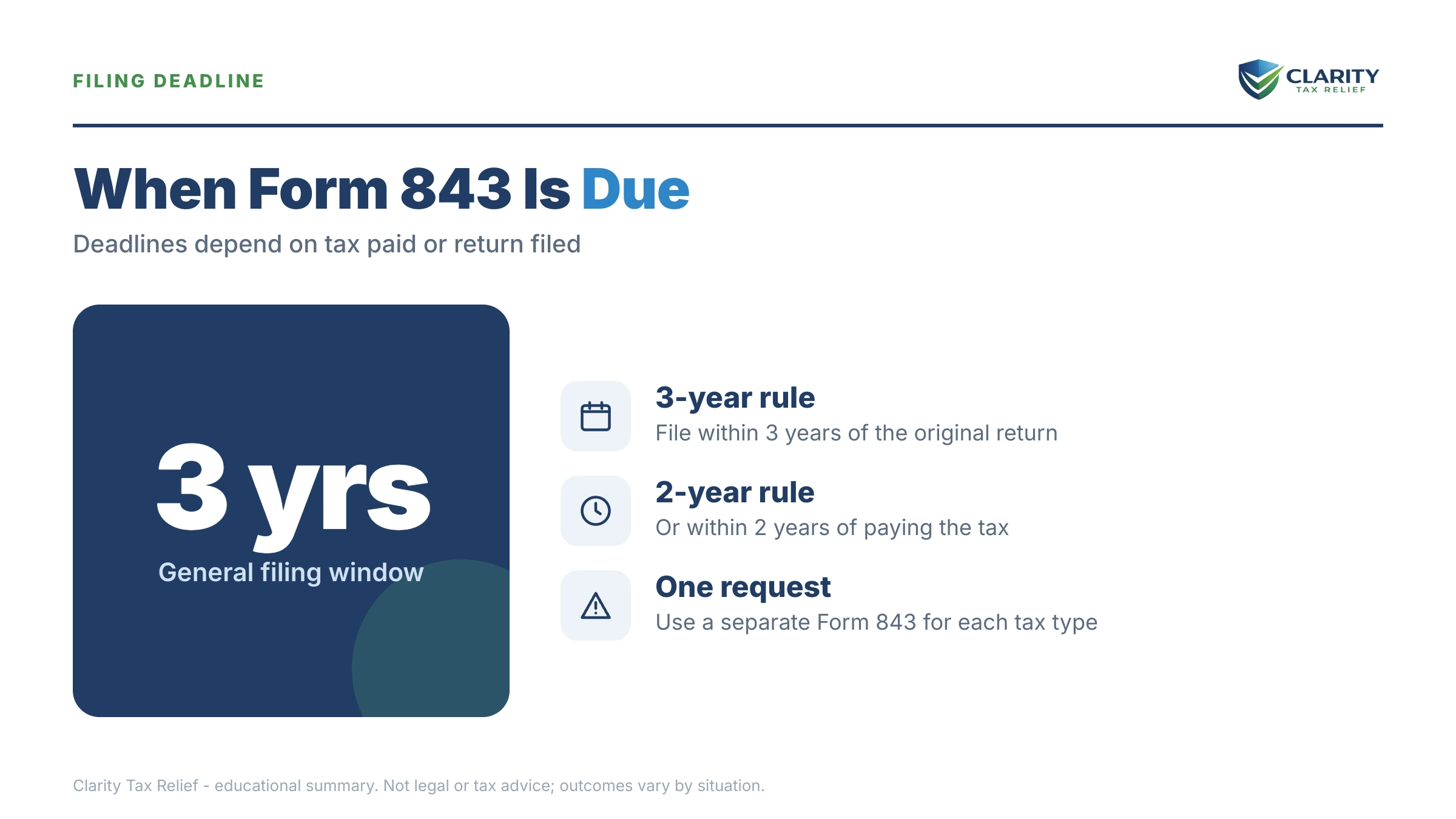
⏱ Your deadline: a Form 843 refund claim must generally be filed within 3 years of filing the return or 2 years of paying the tax or penalty — whichever is later. Miss that window and the money is unrecoverable, even with a winning argument. Abatement requests for unpaid penalties have no fixed deadline, but interest accrues on the penalty until it's removed.
What Form 843 is used for, and what it can't do
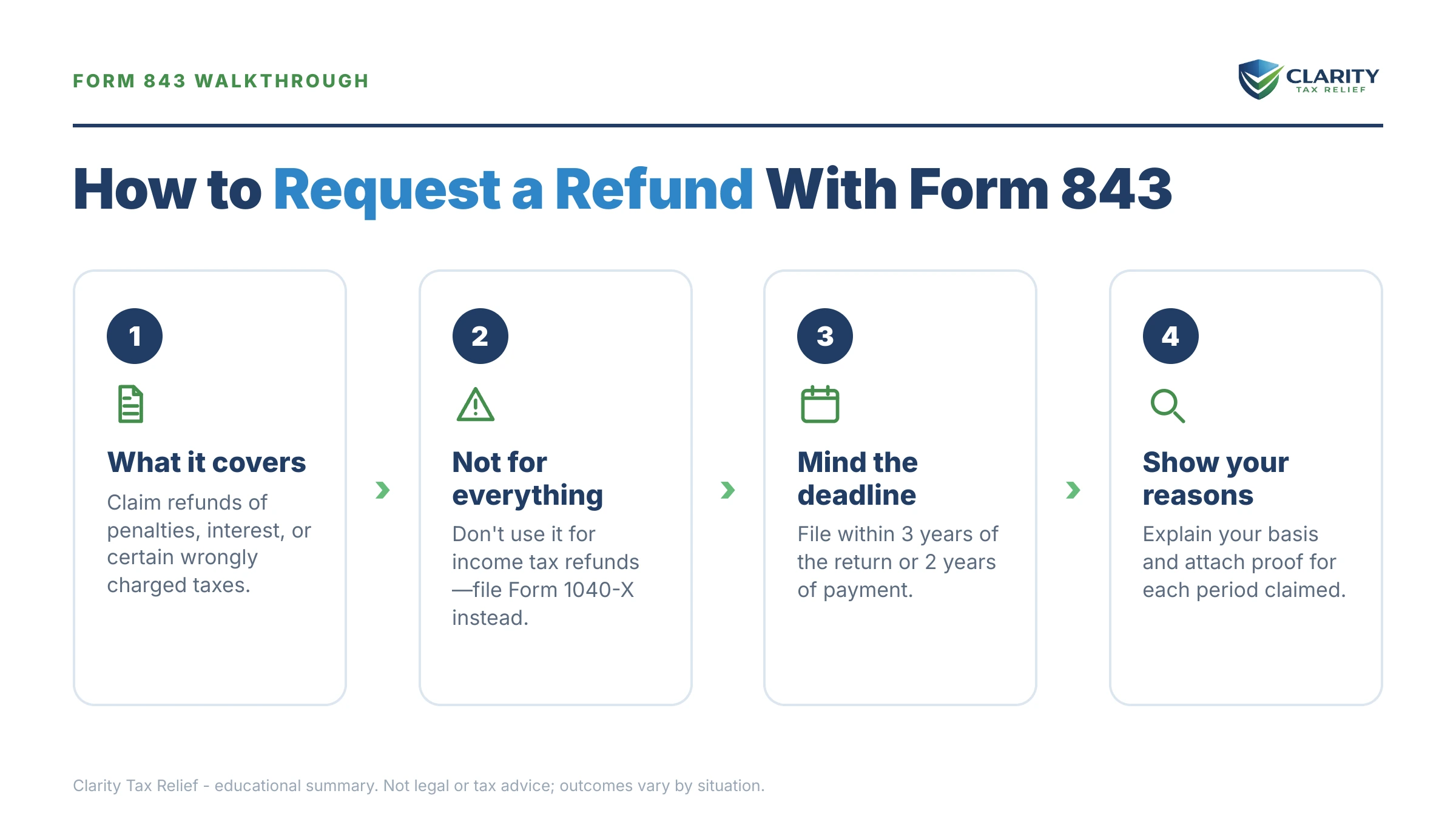
Form 843 covers penalties, interest caused by IRS errors or delays, and certain non-income taxes and fees, but never income tax itself. That single boundary is where most rejected 843s die. If your complaint is "the IRS charged me a penalty I don't deserve" or "the IRS's own delay generated this interest," you're on the right form. If your complaint is "my tax bill itself is wrong," you're not.
In practice, taxpayers file Form 843 for four things:
- Abating an unpaid penalty, usually with a reasonable cause penalty abatement argument: serious illness, disaster, records destroyed, death in the family.
- Refunding a penalty you already paid — the same argument, filed after payment. Our guide to penalty abatement after paying covers that variant in depth.
- Abating interest under IRC §6404 — only when an unreasonable IRS error or delay in a ministerial or managerial act caused the interest, or when you relied on erroneous written IRS advice. See IRS interest abatement for what actually qualifies.
- Refunding certain other taxes and fees — including Social Security or Medicare tax withheld in error when your employer won't correct it, and some excise taxes and fees.
Because so many problems look like Form 843 problems, route yours first:
| Your problem | Correct form or route | Why |
|---|---|---|
| Remove or refund a penalty (reasonable cause) | Form 843 | This is the form's core job — one form per period and penalty type |
| Interest caused by IRS error, delay, or bad written advice | Form 843 (§6404) | Check the matching box on line 5a; attach the paper trail |
| You overpaid income tax itself | Form 1040-X | Form 843 is barred from income tax refunds — amend instead |
| Estimated-tax underpayment penalty waiver | Form 2210 | That penalty has its own waiver form filed with your return |
| Employer correcting a payroll return | Form 941-X | Employers adjust employment tax on the X-series, not 843 |
| Relief from a spouse's tax debt | Form 8857 | Innocent spouse relief has its own process — see the Form 8857 walkthrough |
| First-time penalty abatement | Phone call (or Form 843) | FTA is a records test; a call often resolves it same-day |
If you haven't decoded which notice put the penalty on your account in the first place, start with why did I get a letter from the IRS — the notice number tells you which penalty you're fighting and which IRC section goes on line 4.
What happens if you wait too long
An unchallenged penalty doesn't sit still. It compounds, escalates, and eventually becomes unrecoverable. The sequence runs on autopilot whether or not your abatement case is strong:
- The penalty posts and interest starts riding on it. Interest accrues on the penalty balance itself, not just the tax, so a $10,000 penalty quietly grows every month it sits unaddressed.
- The failure-to-pay penalty keeps stacking. At 0.5% per month, it climbs toward its 25% cap on any unpaid tax, independent of the penalty you're disputing.
- The collection notice stream continues. A pending grievance doesn't pause the automated sequence — bills give way to intent-to-levy notices while your unfiled 843 sits in a drawer.
- The refund window closes. Once the later of 3 years from filing or 2 years from payment passes, a paid penalty is gone permanently. The IRS cannot refund it even if it agrees you were right.
- Collection escalates to levy territory. If the underlying balance goes unresolved, the sequence ends in final notices and levy authority — a far worse position from which to argue about penalties.
The 2026 wrinkle cuts both ways: the IRS workforce is down roughly 27% after the 2025 cuts, so human review of your 843 is slower. But the automated penalties and notices never slowed down. Filing early is how you get your claim in the queue before the clock does damage.
Staring at a penalty Form 843 might remove?
Send us the notice. An experienced tax professional will tell you, free, whether your facts support abatement, whether a faster path exists, and how close your refund window is to closing. No pressure, no obligation.
Your deadlines and rights on a Form 843 claim
Every Form 843 request carries a deadline and a built-in right if the IRS says no, and both differ by request type.
| What you're requesting | Deadline | Your right if the IRS says no |
|---|---|---|
| Abatement of an unpaid penalty | No fixed statute, but file before collection escalates and interest compounds | Written appeal to the IRS Independent Office of Appeals |
| Refund of a penalty you paid | Later of 3 years from filing the return or 2 years from the payment | Appeal; then generally 2 years from the disallowance notice to sue in federal court |
| Interest abatement — IRS error or delay (§6404) | Tied to the interest period; paid interest follows the refund-claim window | Written appeal; limited court review exists for §6404 denials |
| Erroneous written IRS advice (§6404(f)) | Follows the refund-claim window for amounts paid | Written appeal — the written advice itself is the make-or-break evidence |
Two practical notes on that table. First, the 2-year-from-payment prong rescues a lot of old years: even if the 3-year mark passed long ago, a penalty you paid 14 months ago is still claimable. Second, a denial is genuinely appealable — the penalty abatement appeal process exists precisely because first-look reviewers apply the rules mechanically and Appeals officers weigh hazards of litigation.
Check the cheaper paths before you file
Not every penalty needs a Form 843. If the penalty year is your first slip after a clean prior three years, first-time penalty abatement is a records test the IRS can apply over the phone — no form, no essay, often same-call. And starting summer 2026, the Automatic Exemption from Penalty (AEP) begins replacing FTA entirely: qualifying penalties come off automatically, with no request at all. Save the 843 for what it does best — reasonable-cause cases that need evidence, refund claims, and §6404 interest arguments.
The math: what a successful Form 843 is worth
Say you're a self-employed sole proprietor who owed $48,300 on your Schedule C year but filed five months late — a hospitalization wiped out your filing season. You have the records to prove it. Here's the penalty stack:
- Failure-to-file: normally 5% per month, reduced to 4.5% when failure-to-pay runs alongside it. Five months × 4.5% = 22.5% of $48,300 ≈ $10,868.
- Failure-to-pay: 0.5% per month = about $242/month, continuing until the tax is paid.
- Interest: accruing on the tax and on both penalties.
A Form 843 built on the hospitalization — admission and discharge records, dates matched to the filing deadline, proof you filed promptly once able — targets that $10,868 failure-to-file penalty plus every dollar of interest that accrued on it. The failure-to-pay penalty may be abatable on the same facts. On a hypothetical like this, the form is worth well over $11,000; the difference between winning and losing is almost always documentation, not eloquence. To see how your own penalties and interest are stacking before you file, run the numbers through our Penalty & Interest Calculator. It estimates the exposure a successful claim would remove.
Note what the 843 does not touch in this example: the $48,300 of tax itself. That's why filing even when you can't pay is always the right move — the failure-to-file penalty is ten times the failure-to-pay penalty (though in months where both apply, the failure-to-file portion drops to 4.5%, for 5% combined), and Form 843 can only clean up the damage afterward.
Is Form 843 worth it at your penalty size?
| Penalty at stake | Realistic path |
|---|---|
| Under $500 | Try FTA by phone first; from summer 2026, AEP may remove it automatically. A mailed 843 is usually overkill. |
| $500 – $5,000 | Form 843 with a tight reasonable-cause narrative and 2–4 documents. Very DIY-able if your facts are clean. |
| $5,000 – $15,000 | Form 843 with a full evidence package; get the argument reviewed before mailing. You get one clean first impression. |
| Over $15,000, multiple years, or payroll penalties | Professional handling. Sequencing across years, FTA/reasonable-cause stacking, and appeal posture change the outcome. |
Form 843 instructions, line by line
Form 843 is one page, but two entries — the line 5a reason box and the line 7 explanation — decide the outcome. Here's each line in order:
Name, SSN, and address block. Use the name and taxpayer ID exactly as they appear on the return the claim relates to. Sole proprietors: this is your SSN (or your EIN if the penalty sits on an employment tax account), not a mix of both.
Line 1 — tax period. The period the penalty or interest belongs to, copied from your notice. One period per form; multiple years means multiple forms.
Line 2 — amount. The exact dollar amount you want refunded or abated. Pull it from the notice or your account transcript — don't estimate. If interest on the penalty should fall with it, say so in line 7.
Line 3 — type of tax or fee. Check the box matching the account the penalty sits on: income, employment, estate, gift, excise, or fee. A late-filing penalty on your 1040 is an income-account penalty even though the form can't touch income tax itself.
Line 4 — type of penalty. Enter the Internal Revenue Code section of the penalty. It's printed on your notice — failure-to-file is §6651(a)(1), failure-to-pay is §6651(a)(2). If your notice doesn't show it, your account transcript's penalty code will point to it; when in doubt, get help before guessing.
Line 5a — the reason box. Three choices: interest caused by IRS errors or delays, erroneous written advice from the IRS, or reasonable cause / other reason. Check the one that matches your actual theory. This routes your claim, and a mismatch between the box and your line 7 story is a common denial trigger. Line 5b asks for the dates you paid, which is what proves your 2-year window.
Line 6 — original return type. The form number the claim relates to: 1040 for most individuals, 941 for payroll periods, 706/709 for estate and gift.
Line 7 — your explanation. This is the claim. State what happened, when it happened, why it prevented compliance, and what you did to comply as soon as you could. Dates matter more than adjectives: the IRS is matching your timeline against the missed deadline. Attach evidence — medical records, insurance claims, death certificates, disaster declarations — and reference each attachment in the text. Our library of reasonable cause examples shows which fact patterns actually win and which ("my bookkeeper quit," "I didn't know") reliably lose.
Signature. Sign and date under penalties of perjury. On a joint-return penalty, both spouses should sign. An unsigned 843 goes straight back to you, with your deadline still running.
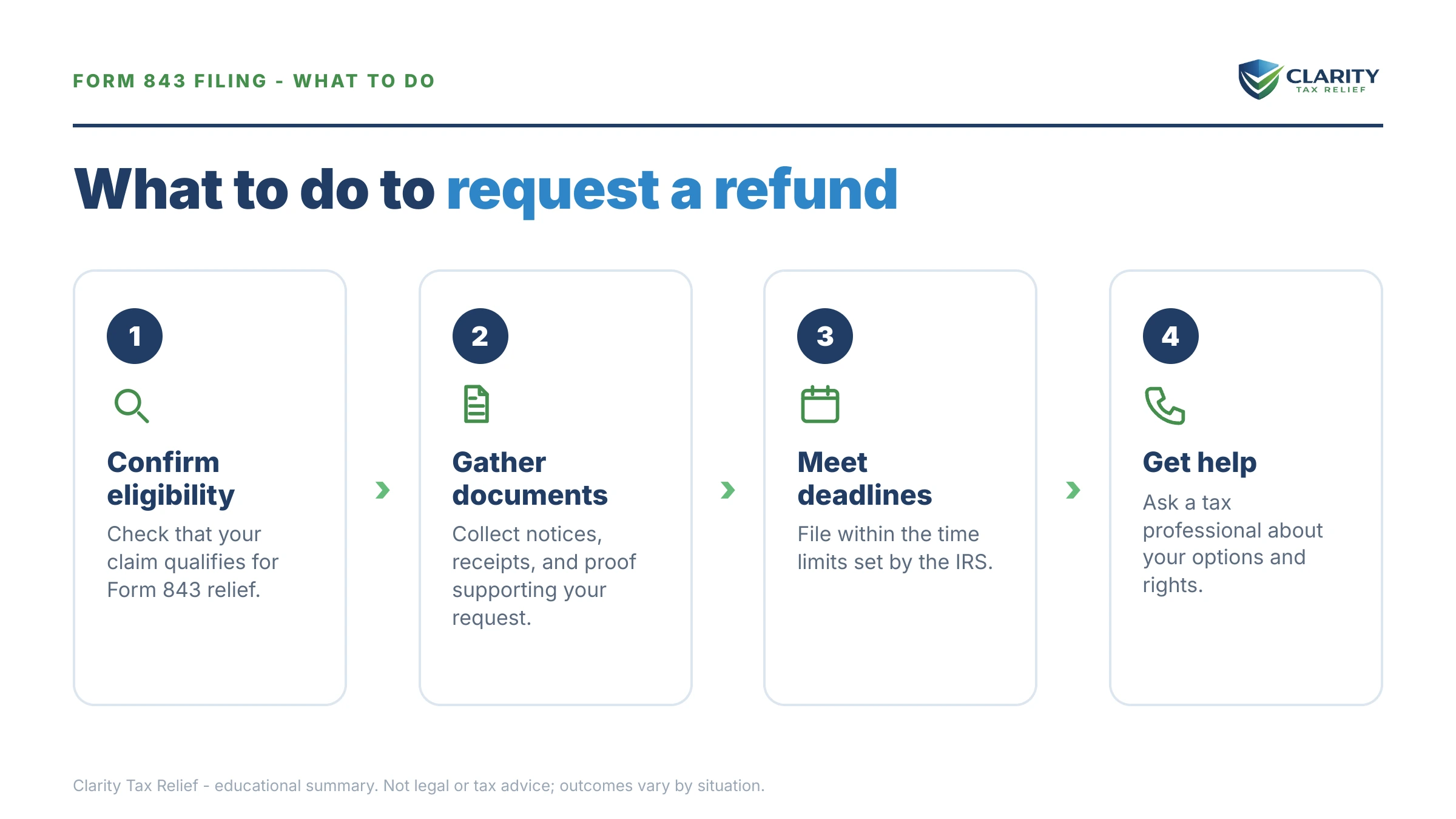
How to file Form 843, step by step
- Pull the penalty details from your notice — the tax period, the penalty type, the IRC section. The exact dollar amount, all printed on the notice or your account transcript.
- Check the cheaper paths first — first-time abatement by phone and, from summer 2026, the Automatic Exemption from Penalty, which may remove the penalty with no form at all.
- Complete one Form 843 per tax period — check the correct reason box on line 5a, cite the IRC section on line 4, and attach your evidence to the line 7 explanation.
- Mail the form to the right address — the address on your IRS notice if you received one, otherwise the service center where you filed the related return — by certified mail, and keep a dated copy.
- Calendar the follow-up and appeal if denied — expect several months of processing, and if the IRS disallows the claim, file a written appeal. Refund claims generally carry a two-year window to sue after disallowance.
When you can handle Form 843 yourself
Many Form 843 filings are genuinely DIY territory. If you're contesting one penalty for one year, your reasonable-cause story is simple and documented — a hospitalization, a house fire, a federally declared disaster — and the dollars are modest, you can complete the form in an evening and mail it yourself. Same if you're only chasing FTA: a phone call may beat the form entirely.
Experienced help changes the outcome in specific situations: penalties across multiple years (where stacking FTA on one year and reasonable cause on others is a sequencing decision — see first time abatement multiple years), payroll and trust-fund penalties where personal liability is in play, five-figure penalties where the first-look denial rate makes appeal posture matter, and §6404 interest cases, which turn on proving what the IRS did wrong inside its own timeline — an argument that lives in your transcripts. If a professional handles it, they'll file a Form 2848 power of attorney to speak to the IRS for you, or a Form 8821 tax information authorization just to pull your records first.
Not sure which side of that line you're on? A free review of the notice takes minutes — the 2-minute form or (888) 825-7779 — and if it's a one-form DIY case, we'll tell you that.
Terms on Form 843, decoded
- Abatement — the IRS removing a penalty or interest from your account before you've paid it. A refund claim is the after-you-paid version of the same request.
- Reasonable cause — the legal standard for penalty relief: circumstances beyond your control that prevented compliance despite ordinary business care and prudence.
- RSED (Refund Statute Expiration Date) — the date your refund claim dies: the later of 3 years from filing or 2 years from payment.
- §6404 — the Code section allowing interest abatement when an unreasonable IRS error or delay, or erroneous written IRS advice, caused the interest.
- Ministerial or managerial act — the kind of IRS processing or personnel action whose delay can qualify interest for §6404 abatement. Delays you caused don't count.
- Claim disallowance — the formal denial letter; it starts your appeal options and, for refund claims, generally a 2-year clock to sue.
Form 843 questions, answered
What is IRS Form 843?
Form 843 is the IRS Claim for Refund and Request for Abatement — the form for removing penalties, recovering penalties you already paid, and abating interest caused by IRS error. It's a one-page paper form, filed once per tax period, and refund claims must land within the 3-year/2-year deadline.
Can I file Form 843 electronically?
No — Form 843 is a paper form you mail (or, in some cases, fax to the number printed on an IRS notice). There is no e-file option through tax software or your IRS online account. Send it by certified mail with a return receipt so you can prove the date you filed, which matters if your refund window is close to closing.
How long does the IRS take to process Form 843?
Several months is typical, and with the IRS workforce cut roughly 27% in 2025, waits in 2026 are running longer than usual. There is no online tracker for Form 843 the way there is for refunds. If you hear nothing after a few months, call the number on your notice or the IRS main line, and keep your certified-mail receipt as proof of when the clock started.
Can Form 843 get me an income tax refund?
No. If you overpaid income tax itself — a missed deduction, a wrong filing status, unreported withholding — the correct form is Form 1040-X, an amended return. Form 843 covers penalties, interest caused by IRS error or delay, and certain other taxes and fees. Filing the wrong form doesn't just get rejected; it burns time while your refund deadline keeps running.
Do I need a separate Form 843 for each tax year?
Yes. The IRS requires one Form 843 per tax period and per type of tax or penalty. If you're contesting failure-to-file penalties for 2022 and 2023, that's two forms. If you're also contesting a separate penalty type for one of those years, that's a third. Each form needs its own explanation and evidence, though the underlying documentation can overlap.
Can Form 843 remove IRS interest?
Only in narrow situations. Interest on a correct tax balance is statutory — the IRS cannot waive it just because you ask. Form 843 can remove interest in two main cases: interest caused by an unreasonable IRS error or delay under IRC Section 6404, and interest that accrued on a penalty that later gets abated (when the penalty goes, the interest that rode on it goes too).
What happens if my Form 843 is denied?
You get a disallowance letter. You have real appeal rights — a written protest to the IRS Independent Office of Appeals is the usual next step, and Appeals reverses a meaningful share of first-look denials. For a denied refund claim, you generally also have two years from the date of the disallowance notice to file suit in federal court. A denial is a setback, not the end.
Do I have to pay the penalty before filing Form 843?
Not if you're requesting abatement of an unpaid penalty. You can ask the IRS to remove it before paying a dime. If you're claiming a refund, then by definition you've already paid. Your claim must land within the later of 3 years from filing the return or 2 years from the payment. Paying a disputed penalty first does stop interest from accruing on it while the claim is pending.
Is first-time abatement requested on Form 843?
It can be. But it usually doesn't need to be — a phone call to the number on your notice is often enough, because first-time abatement is a records test (a clean prior three years), not a judgment call. Starting summer 2026, the Automatic Exemption from Penalty (AEP) begins replacing FTA and applies with no request at all. Save Form 843 for reasonable-cause cases and refund claims that need evidence.
The official form and its IRS instructions live at About Form 843 on IRS.gov. If you also need to pay or arrange the underlying tax while the claim is pending, start at IRS.gov/payments. If your claim stalls for many months with no response and the delay is causing hardship, the Taxpayer Advocate Service can intervene at no cost.
Your next 24 hours
- Find three things on your notice: the tax period, the IRC section next to the penalty, and, if you already paid, the payment date. That date starts your 2-year refund clock, so pin it down first.
- Gather your evidence: the notice, the related tax return. The documents behind your reasonable-cause story (medical records, disaster declarations, correspondence) with dates that line up against the missed deadline.
- Get the claim reviewed free before you mail it: call (888) 825-7779 or use the 2-minute form. You get one clean first impression with the IRS, and interest keeps riding on the penalty until it comes off.
This guide is general information, not tax or legal advice for your specific situation. Eligibility for IRS programs depends on individual facts and circumstances; no outcome is guaranteed.