
IRS Data & Studies
IRS Penalties by Type: Individual Taxpayers' $44.4 Billion Breakdown (2026 Data Study)
The short answer: in FY2023 the IRS assessed 38.2 million penalties worth $44.4 billion against individual (and estate/trust) income-tax filers. By dollars, failure-to-file (delinquency) penalties dominated at $20.68 billion, 46.5% of the total, while failure-to-pay penalties were the most numerous at 18,599,109 assessments.
You looked up IRS penalties by type for individual taxpayers because a penalty just landed on you — a line on your transcript or a notice with a number bigger than the tax itself — and you want to know how it compares and whether it can come off. Both answers are in the data below. You're one of tens of millions this year, and a meaningful share of these penalties do get removed.
This data study breaks down the IRS Data Book's official penalty figures by type — which penalty is most common, which one costs the most per person, and how FY2025 shifted the picture. The image below shows how those dollars split across penalty types, and why the smallest bucket by count turns out to be the biggest by dollars.
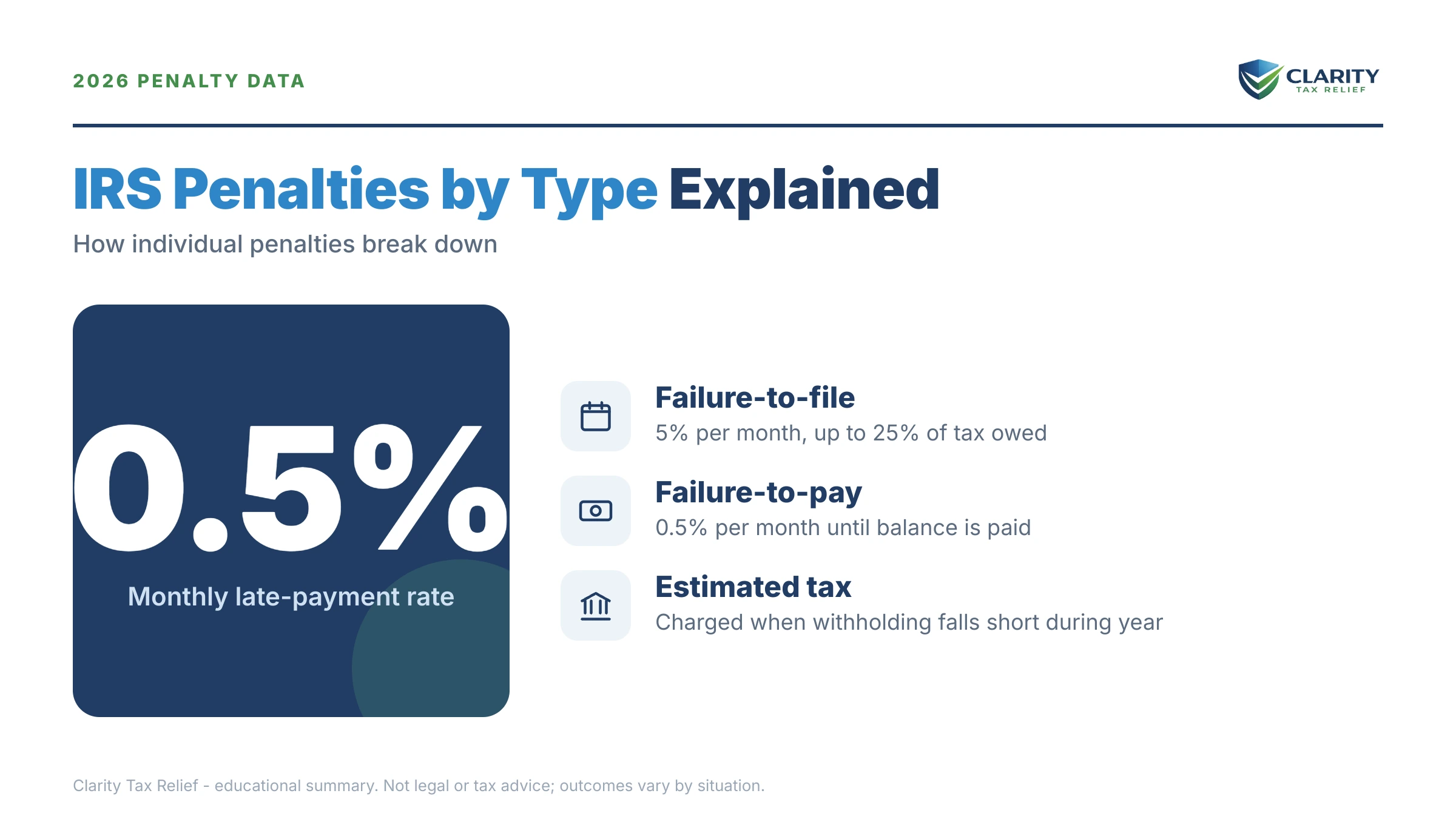
⏱ The real clock: there's no notice deadline behind these statistics — the clock is monthly accrual. An unfiled return adds 5% of the unpaid tax per month (capped at 25%); an unpaid balance adds 0.5% per month. Every month of not filing costs ten times a month of not paying.

IRS penalties by type for individual taxpayers: the FY2023 breakdown
The IRS assessed 38,165,237 civil penalties worth $44,436,047 thousand ($44.44 billion) against individual, estate, and trust income-tax filers in FY2023, per IRS Data Book Table 28. Three penalty types account for nearly all of it, and they behave very differently.
| Penalty type | Penalties assessed | Dollars assessed | Share of dollars |
|---|---|---|---|
| Delinquency (failure-to-file) | 3,292,863 | $20.68 billion ($20,678,979K) | 46.5% |
| Failure-to-pay | 18,599,109 | $14.87 billion ($14,874,227K) | ~33% |
| Estimated tax | 14,204,564 | $7.00 billion ($7,004,996K) | ~16% |
| All other (accuracy, fraud, information, etc.)* | ~2,068,701 | ~$1.88 billion | ~4% |
| Total | 38,165,237 | $44,436,047 thousand ($44.44 billion) | 100% |
*"All other" is the remainder after subtracting the three named categories from Table 28's total.
Divide dollars by counts and the story sharpens. The average delinquency penalty runs roughly $6,280 per assessment. The average failure-to-pay penalty is about $800. The average estimated tax penalty is about $493. Same taxpayer base, wildly different price tags, and the difference is entirely about which rule you broke.
“The penalty is 5% of the tax due (less any tax paid on time and available credits) for each month or partial month the return is late. The penalty accrues up to a maximum of 25%.”
— Failure to file penalty (IRS.gov)
Why failure-to-file dominates the dollars
Failure-to-file penalties made up 46.5% of individual penalty dollars in FY2023 (20,678,979/44,436,047 = 46.54%) despite being only 3.29 million (3,292,863) of the 38.2 million penalties assessed. That's less than 9% of the penalties producing nearly half the money.
The mechanics explain it. The failure to file penalty vs failure to pay gap is 10-to-1: 5% of the unpaid tax per month versus 0.5%. A return that sits unfiled for five months hits the 25% cap — a quarter of the balance added before interest.
The practical takeaway from the data is blunt: the single most expensive mistake an individual taxpayer makes is not filing. If April arrives and the money isn't there, the answer to should I file if I can't pay is always yes — filing on time sidesteps the $6,280-average penalty and leaves you facing only the $800-average one.
Failure-to-pay and estimated tax: the volume penalties
Failure-to-pay was the most common individual penalty in FY2023 at 18,599,109 assessments — nearly half of all penalties by count. It totaled $14.87 billion ($14,874,227K), and because it accrues at only 0.5% per month, most assessments stay in the hundreds of dollars. It's also continuous: it keeps compounding month after month until the balance is paid, which is why an ignored bill from three years ago carries a penalty far bigger than the original notice showed. The full year-by-year trend lives in our irs failure to pay penalty statistics study.
The estimated tax penalty is the quiet third giant: 14,204,564 assessments worth $7.00 billion ($7,004,996K). This one lands disproportionately on self-employed people — sole proprietors, gig workers, and 1099 contractors with no employer withholding tax for them. Miss or underpay a quarterly payment, and the penalty is calculated automatically when the return is processed. No notice warns you in advance; the first you hear of it is the bill. We break down who gets hit and how hard in irs estimated tax penalty statistics.
Between them, these two "volume" penalties account for roughly 86% of penalty counts but only about half the dollars — the mirror image of failure-to-file.
The small slice that isn't small if it's yours
Everything else — accuracy-related, civil fraud, information-return, and miscellaneous penalties — is the remainder: roughly 2.07 million penalties and about $1.88 billion in FY2023. Statistically tiny; personally enormous. The accuracy related penalty irs adds a flat 20% of the understated tax in one hit, typically after a CP2000 or audit, and civil fraud runs 75%. These penalties are also the most contestable, because unlike the automated three above, they involve judgment calls about your return that can be challenged before and after assessment.
FY2023 vs FY2025: more penalties, fewer dollars, more relief
By FY2025 the individual/estate/trust penalty total was $33.10 billion ($33,102,432K) assessed across 46,748,796 penalties, with $7.51 billion ($7,513,461K) abated, per IRS Data Book Table 4-2. Compare that with FY2023, when the IRS abated 3,185,987 penalties worth $2,850,144 thousand ($2.85 billion).
| Fiscal year | Penalties assessed | Dollars assessed | Dollars abated |
|---|---|---|---|
| FY2023 | 38,165,237 | $44,436,047 thousand ($44.44 billion) | $2,850,144 thousand ($2.85 billion), across 3,185,987 penalties |
| FY2025 | 46,748,796 | $33.10 billion ($33,102,432K) | $7.51 billion ($7,513,461K) |
Two trends matter for you. First, penalty counts rose while dollars fell — more small, automated penalties going out even as the IRS workforce shrank about 27% in 2025, per TIGTA reporting, because these assessments are computer-generated and never required a human. Second, abatement dollars more than doubled, which means removed penalties went from about 6% of assessed dollars to well over 20%. Relief is being granted at a scale the averages of five years ago never showed, but in almost every case, someone had to ask. Our companion study on how often the IRS removes or abates penalties digs into that gap.
What one late return looks like: a worked example
The FY2023 averages — $6,280 vs. $800 vs. $493 — come alive on a single return. Say you're a self-employed sole proprietor who owes $10,000 on a Schedule C return, and you skipped quarterly payments too.
Scenario A: you file on time in April but can't pay until September. Five months of failure-to-pay penalty at 0.5% is $50/month — about $250 total, plus interest and the estimated tax penalty for the missed quarterlies.
Scenario B: you don't file until September, then pay. The combined late-filing and late-payment penalties accrue at 5% per month, so five months adds roughly $2,500, ten times Scenario A, plus the same interest and estimated tax penalty on top. One decision (filing) changed the cost by about $2,250 on the exact same debt. You can estimate your own numbers with our IRS penalty and interest calculator.
What happens if you ignore an assessed penalty
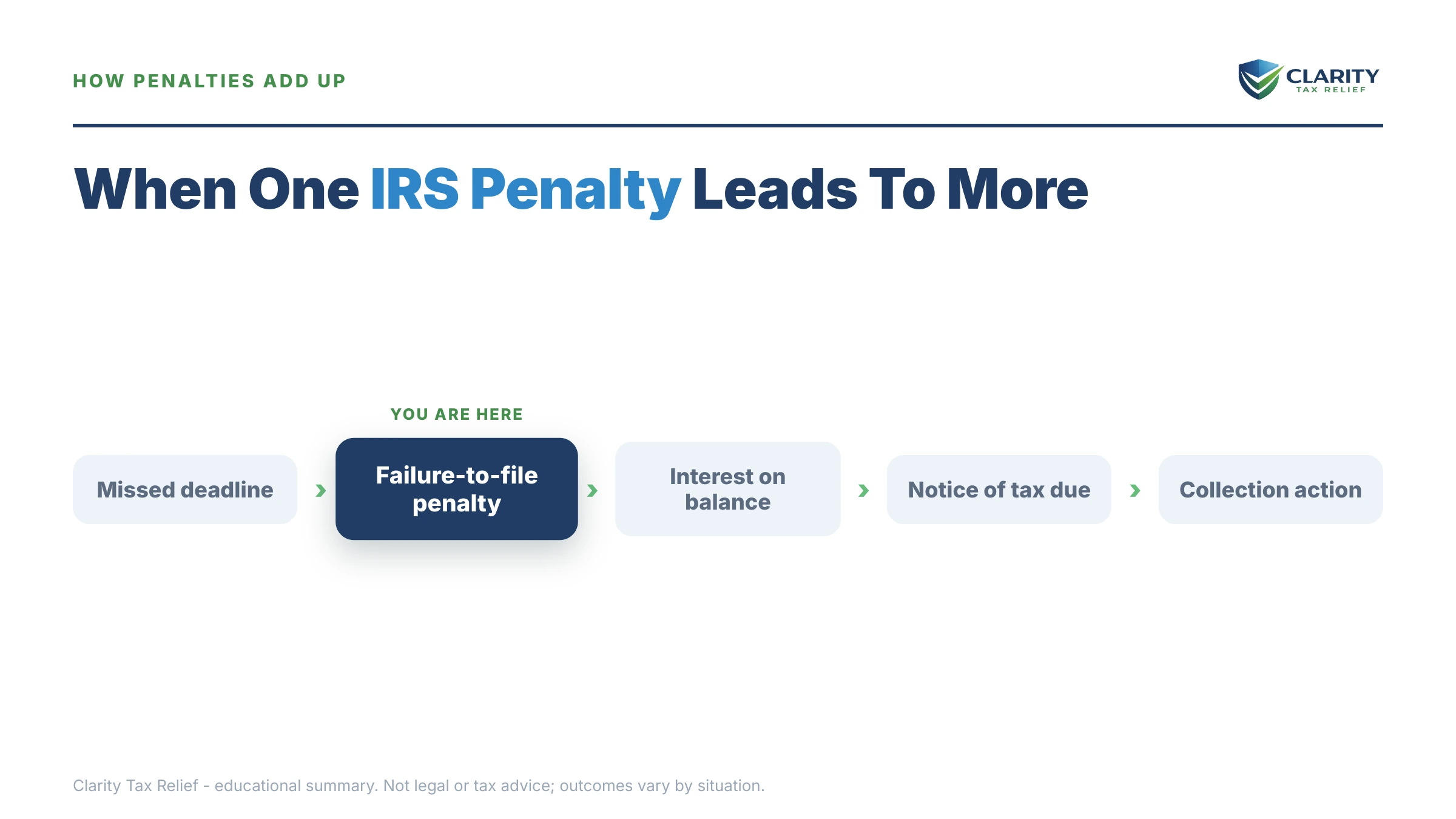
A penalty doesn't sit in its own bucket. It merges into your balance and rides the IRS collection sequence with the tax itself. The escalation is automated and runs in this order:
- Assessment — the penalty posts to your account and starts accruing interest immediately. Failure-to-pay keeps adding 0.5% per month on top.
- CP14 — the first bill, typically giving about 21 days to pay before the sequence advances.
- CP501 / CP503 — reminder notices, each arriving with a larger balance than the last.
- CP504 — Notice of Intent to Levy: the IRS can seize your state tax refund, and a federal tax lien becomes a live possibility.
- LT11 / Letter 1058 — the final notice, starting a 30-day clock before wage and bank levies, with Collection Due Process appeal rights you must invoke in time.
The abatement data cuts the other way, too: penalties removed early are cheaper to remove, because you stop the failure-to-pay accrual and the interest riding on it. The longer a wrong or abatable penalty sits, the more it costs even after it's granted relief.
Penalties stacking up on your IRS account?
The IRS abated $7.51 billion in individual penalties in FY2025 — almost always because someone asked correctly. A free case review will tell you which of your penalties are removable and in what order to attack them, while failure-to-pay penalty and interest are still accruing every month.
Your relief options, penalty by penalty
Each penalty type has its own relief path — what removes a late-filing penalty won't touch an estimated tax penalty. The dollar side of every option is covered in our hub on how much are IRS penalties on back taxes. Here's the map by type:
| Penalty type | Best relief route | Cost & what it takes |
|---|---|---|
| Failure-to-file / failure-to-pay | First time penalty abatement | Free; a phone call or letter; requires a clean compliance record for the prior 3 years. Starting summer 2026, the automatic exemption from penalty aep 2026 applies qualifying relief with no request at all. |
| Failure-to-file / failure-to-pay (FTA doesn't fit) | Reasonable cause penalty abatement | Free; written request with documentation (illness, disaster, circumstances beyond your control); expect weeks to months for a decision, with appeal rights if denied. |
| Estimated tax | Limited statutory waiver (Form 2210) | Free but narrow — FTA does not cover this penalty; waivers apply only in specific circumstances such as casualty or disaster. Prevention (paying quarterlies) is the real fix. |
| Accuracy-related / fraud | Challenge before assessment; reasonable cause after | Free to contest; respond to the CP2000 or exam report before agreeing. These judgment-based penalties are the most winnable disputes. |
| Interest on any of the above | Generally not waivable | Interest is statutory and only abatable for IRS errors or delays, but removing the underlying penalty removes the interest charged on it. |
How to check and remove your own penalties, step by step
- Pull your IRS account transcript. Penalty assessments appear as dated transaction codes with exact dollar amounts, one line per penalty per tax year.
- Match each penalty to its type. Late-filing, late-payment, and estimated tax penalties follow different relief rules — identify which you're actually facing before requesting anything.
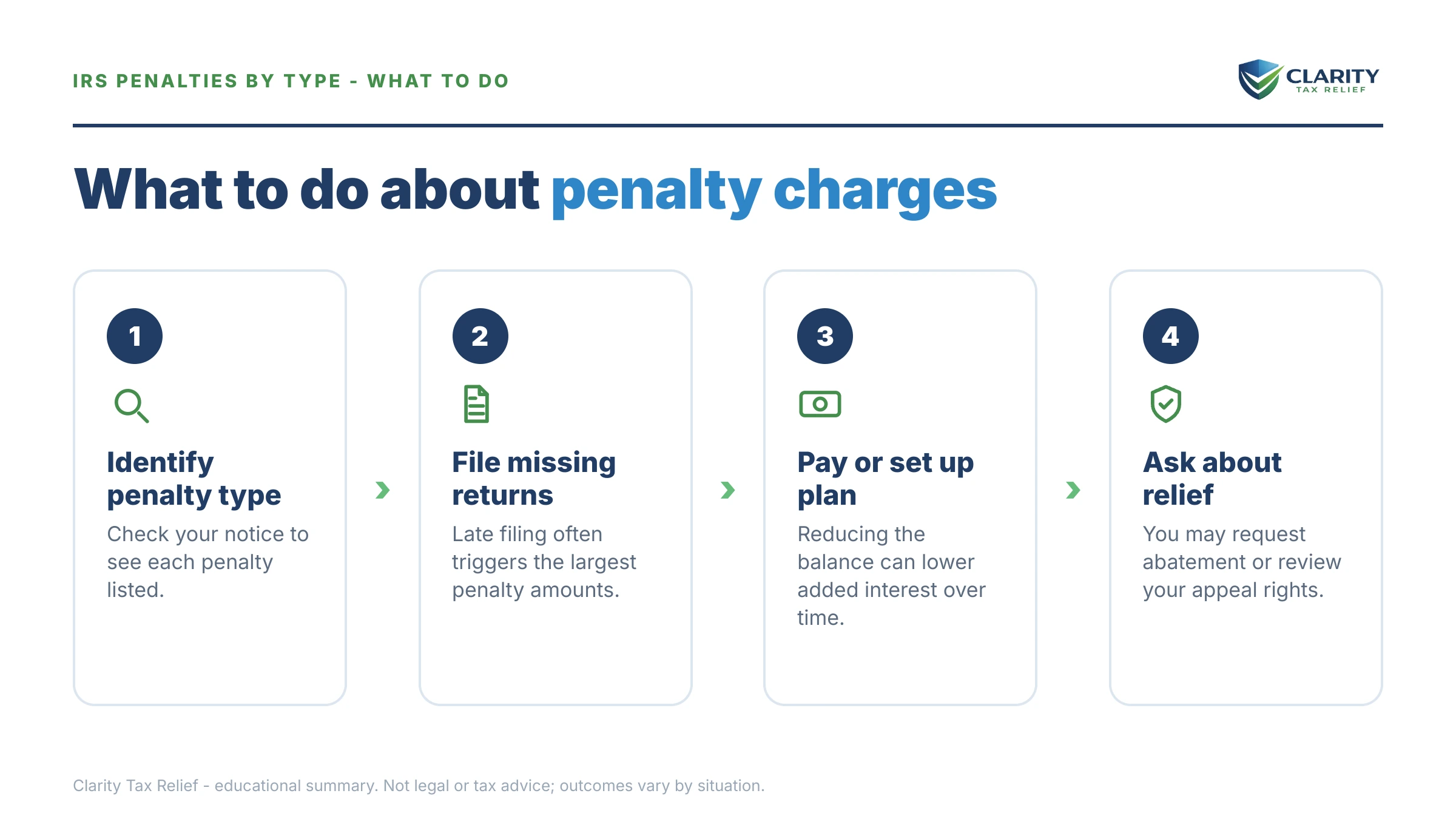
- Stop the accrual first. File any unfiled return immediately and arrange payment on the balance; abatement only helps once the penalty stops growing.
- Request First-Time Abate if your prior three years are clean. A phone call or written request can remove failure-to-file and failure-to-pay penalties for a qualifying year — no hardship story required.
- Document reasonable cause for anything FTA doesn't cover. Illness, disaster, or circumstances beyond your control, backed by records and submitted with Form 843 penalty abatement request or a written statement.
When you can handle this yourself
Most single-penalty situations don't need professional help. If you have one failure-to-file or failure-to-pay penalty, a clean prior three years. A balance you can pay or put on a simple plan, a phone call requesting First-Time Abate is genuinely a do-it-yourself job, and from summer 2026, AEP may handle qualifying cases before you even call. A small estimated tax penalty as a first-year sole proprietor is usually a pay-it-and-fix-your-quarterlies situation, not a case.
Experienced help changes outcomes when the facts stack: multiple years of penalties (the order you request relief in affects which years FTA can cover), unfiled returns feeding fresh delinquency penalties each season, an accuracy-related or fraud penalty you dispute, or a balance already deep in the collection sequence with a levy in motion. In those cases the difference between a well-sequenced request and a generic one is often the difference between the FY2025 abatement statistics working for you or passing you by. If your case is genuinely straightforward, the Taxpayer Advocate Service also offers free help when you're stuck in IRS processing (taxpayeradvocate.irs.gov).
Terms in the data, decoded
- Assessed — the penalty was officially added to your account balance; it's now collectible debt.
- Abated — the penalty was removed or reduced after assessment, usually because the taxpayer requested relief.
- Delinquency penalty — the IRS's formal name for the failure-to-file penalty: 5% of the unpaid tax per month, capped at 25%.
- Estimated tax penalty — the charge for underpaying required quarterly payments during the year; technically an interest-like calculation, reported as a penalty.
- First-Time Abate (FTA) — an administrative waiver removing certain penalties for taxpayers with a clean prior three years.
- AEP (Automatic Exemption from Penalty) — the program replacing FTA starting summer 2026, applying qualifying relief automatically with no request needed.
IRS penalty statistics: your questions answered
What is the most common IRS penalty for individual taxpayers?
The failure-to-pay penalty is the most common by count: the IRS assessed 18,599,109 of them against individual, estate, and trust income-tax filers in FY2023. It runs 0.5% of the unpaid tax per month, which is why the average assessment is small — roughly $800. The estimated tax penalty is close behind at 14,204,564, and it falls heavily on self-employed people who miss quarterly payments.
Which IRS penalty costs individuals the most money?
The failure-to-file (delinquency) penalty dominates the dollars: $20.68 billion in FY2023, 46.5% of all individual penalty dollars, from only 3.29 million (3,292,863) assessments. That works out to roughly $6,280 per penalty, because it accrues at 5% of the unpaid tax per month, ten times the failure-to-pay rate. Filing on time, even when you can't pay, avoids the most expensive penalty on the books.
How many penalties does the IRS assess against individuals each year?
In FY2023 the IRS assessed 38,165,237 civil penalties worth $44,436,047 thousand ($44.44 billion) against individual, estate, and trust income-tax filers. By FY2025 the count had climbed to 46,748,796 penalties, though the dollar total fell to $33.10 billion ($33,102,432K). Almost all of these are assessed automatically by computer, not by a human reviewing your file.
How often does the IRS remove individual penalties?
In FY2023 the IRS abated 3,185,987 individual penalties worth $2,850,144 thousand ($2.85 billion) — a small fraction of what it assessed. By FY2025 abatements had grown to $7.51 billion ($7,513,461K) against $33.10 billion assessed. Relief is real but rarely automatic today: most abatements happen because the taxpayer asked, through First-Time Abate or a reasonable-cause request.
What is the average failure-to-file penalty?
Roughly $6,280, based on FY2023 data: $20.68 billion in delinquency penalties spread across 3,292,863 assessments. Compare that with the failure-to-pay penalty's average of about $800 across 18,599,109 assessments. The gap exists because failure-to-file accrues at 5% per month (capped at 25%) while failure-to-pay accrues at 0.5% per month — the single strongest argument for filing even when you can't pay.
Why do so many self-employed people get the estimated tax penalty?
Because no employer withholds tax from 1099 or business income, the IRS expects quarterly payments, and 14,204,564 individual filers missed the mark in FY2023, generating $7.00 billion ($7,004,996K) in estimated tax penalties. The average is about $493, small per person but the third-largest bucket overall. Waivers exist but are narrow, so prevention beats abatement for this penalty.
Can I get an IRS penalty removed in 2026?
Often, yes — failure-to-file and failure-to-pay penalties qualify for First-Time Abate if your prior three years are clean, and reasonable cause (illness, disaster, records you couldn't get) works for messier situations. Starting in summer 2026, the IRS's Automatic Exemption from Penalty (AEP) begins applying qualifying relief automatically, with no request needed. Estimated tax penalties are the exception: FTA doesn't cover them, and waivers are limited to specific circumstances.
Why did individual penalty dollars fall from FY2023 to FY2025?
The Data Book shows dollars assessed fell from $44.44 billion to $33.10 billion even as the penalty count rose to 46,748,796. The IRS doesn't publish a single explanation. But the math points to mix: delinquency penalties average thousands of dollars each while failure-to-pay and estimated tax penalties average hundreds, so a year heavier in small automated penalties produces more assessments and fewer dollars. Abatements also more than doubled, to $7.51 billion ($7,513,461K).
Your next 24 hours
- Find your penalty lines. Log into your IRS online account or pull your account transcript and note each penalty's type, tax year, and dollar amount — that's the raw material for every relief request.
- Gather your filing history. Your last three years of returns (or filing dates) determine First-Time Abate eligibility, and any hardship records — medical, disaster, or otherwise — support a reasonable-cause case.
- Get a free penalty review. Use the 2-minute form or call (888) 825-7779. Failure-to-pay penalty and interest keep accruing every month a removable penalty sits on your account — the sooner it's off, the less the whole balance costs.
Data source: figures in this study come from the IRS Data Book — Civil Penalties Assessed and Abated, by Type of Tax and Type of Penalty (Table 28) for FY2023 and Table 4-2 for FY2025. If you're paying a penalty balance, use official channels only: IRS.gov/payments.
This guide is general information, not tax or legal advice for your specific situation. Eligibility for IRS programs depends on individual facts and circumstances; no outcome is guaranteed.