
IRS Data Study
How Often Does the IRS Remove or Abate Penalties? 2026 Data Study
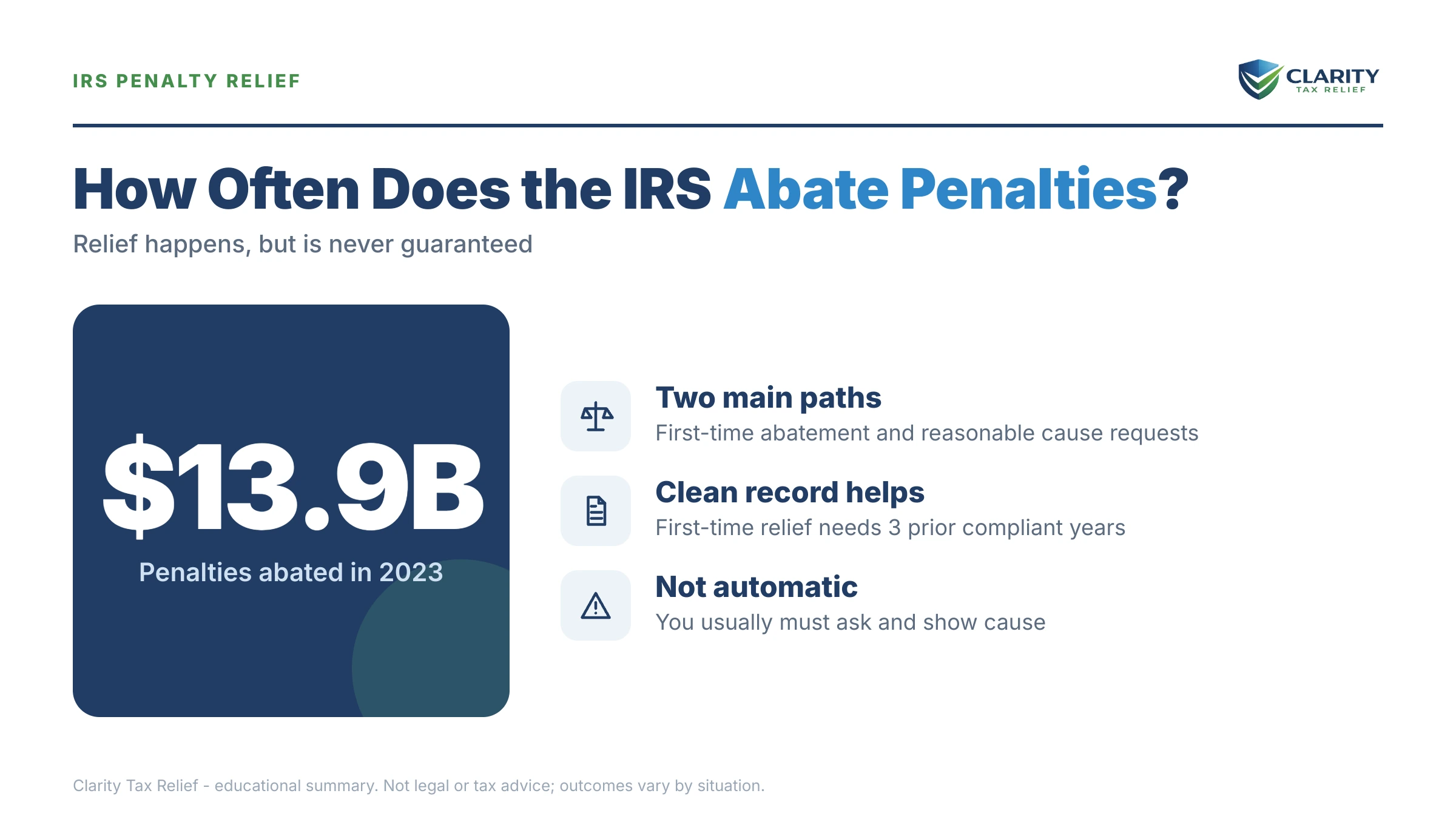
The short answer: how often does the IRS remove or abate penalties? Often. In FY2023 the IRS assessed $65.6 billion in civil penalties and abated $13.0 billion of them — roughly 1 in 5 penalty dollars removed. But abatement is almost never automatic: taxpayers who request it, in the right format with the right facts, are the ones who get it.
You're looking at a penalty line on an IRS notice — a late payroll deposit, a late-filed return, a balance that grew while the business was keeping the lights on — and wondering whether asking the IRS to remove it is a real path or a long shot. The government's own numbers answer that: billions of penalty dollars come off every single year. The map below shows who gets that relief and how to be one of them.
The image below shows exactly how assessed and abated penalty dollars stack up side by side — the gap between the two bars is where taxpayers who never ask leave money on the table.
⏱ The real clock: there's no printed deadline to request abatement, but the failure-to-pay penalty adds 0.5% of your unpaid tax every month and interest compounds daily until the balance, including any removable penalty, is resolved. And if you already paid a penalty, the window to claim that money back is limited; don't sit on it.

How often does the IRS remove or abate penalties? The government's own numbers
The IRS abated $13.0 billion of the $65.6 billion in civil penalties it assessed in FY2023 — 19.8% of assessed dollars, per the agency's own Data Book. In raw counts, that was 45,545,154 civil penalties assessed totaling $65,574,052 thousand ($65.57 billion), against 4,664,075 penalties abated totaling $13,012,834 thousand ($13.01 billion).
Notice what the counts reveal: the dollar share removed runs well ahead of the count share. Larger penalties get challenged more often, and removed more often. The taxpayers with the most at stake are the ones pushing back, and the data says pushing back works.
The individual picture is more sobering. In FY2023, individual, estate, and trust income tax penalties totaled $44.44 billion assessed ($44,436,047 thousand) against just $2.85 billion abated ($2,850,144 thousand) — a far smaller share than the all-taxpayer average. Businesses, with professionals watching their accounts, ask for relief constantly. Most individuals never do.
By FY2025, the totals turned surreal: $1,247,074,030 thousand ($1.247 trillion) in civil penalties assessed, with $1,210,426,532 thousand ($1.210 trillion) abated, per IRS Data Book FY2025 Table 4-2. Nearly all of that swing sits outside the individual line — enormous non-individual assessments that were subsequently reversed. The meaningful benchmark for most readers is the individual row: $33.10 billion assessed ($33,102,432 thousand) and $7.51 billion abated ($7,513,461 thousand) — 22.7% of dollars removed. Individual abatement rates aren't just real; they're rising.
| Category and year | Assessed | Abated | Share of dollars removed |
|---|---|---|---|
| All civil penalties, FY2023 | 45,545,154 penalties; $65,574,052 thousand ($65.57 billion) | 4,664,075 penalties; $13,012,834 thousand ($13.01 billion) | 19.8% of assessed dollars |
| Individual, estate & trust income tax, FY2023 | $44,436,047 thousand ($44.44 billion) | $2,850,144 thousand ($2.85 billion) | Well below the all-taxpayer average |
| All civil penalties, FY2025 | $1,247,074,030 thousand ($1.247 trillion) | $1,210,426,532 thousand ($1.210 trillion) | Nearly all — driven by non-individual categories (see note) |
| Individual, estate & trust income tax, FY2025 | $33,102,432 thousand ($33.10 billion) | $7,513,461 thousand ($7.51 billion) | 22.7% of assessed dollars |
Note on FY2025: the trillion-dollar totals reflect mass assessments and reversals concentrated outside individual income tax. They're a reminder of how mechanical penalty assessment is, the system posts first and corrects later. But the individual row is the honest benchmark for a person or small business reading this page.
“You may qualify for penalty relief if you tried to comply with tax laws but were unable due to circumstances beyond your control.”
— Penalty relief (IRS.gov)
Why the IRS assesses so many penalties, and why so many come off
Nearly every civil penalty is assessed by a computer, with no human judgment applied before it posts to your account. A return arrives late, a payment posts short, a payroll deposit misses its date — the system calculates the penalty and mails the bill. That's why the IRS assessed over 45 million penalties in FY2023 alone.
Abatement exists because that machine can't see context. It doesn't know your bookkeeper quit mid-quarter, that a hospital stay swallowed filing season, or that this is your first miss in fifteen years of clean compliance. The abatement process is where a human finally reviews what the computer assessed, and roughly one dollar in five doesn't survive that review.
Which penalty you're holding matters, because relief paths differ by type. The two workhorses — covered in our data study on IRS failure to file vs failure to pay penalties — are the most commonly abated. The failure-to-file penalty runs 5% per month, ten times the 0.5% monthly failure-to-pay rate (though in any month both penalties apply, the failure-to-file portion drops to 4.5%, for a 5% combined rate), which is why filing on time even when you can't pay is the single cheapest move in tax. The accuracy related penalty requires arguing substance, not just history, and the IRS civil fraud penalty is a different fight entirely — first-time abatement doesn't touch it. For how each penalty is calculated in the first place, see our full guide to how much are IRS penalties on back taxes, and for the frequency rankings, IRS most common penalties.
What happens if you never request penalty abatement
An unchallenged penalty never shrinks. It gets folded into your balance and fed into the same automated collection sequence as the tax itself. Here's the stage order if you do nothing:
- The penalty is assessed and billed. It appears on a balance-due notice (CP14 for individuals, CP161 for businesses) blended into one total, so most people never realize which part of the number is removable.
- The balance grows monthly. The failure-to-pay penalty adds 0.5% of the unpaid tax each month, and interest compounds daily on the whole balance — tax, penalties, and prior interest alike.
- Reminder notices escalate to CP504. At the CP504 stage the IRS can seize your state tax refund under IRC §6331(d) to apply against the balance — including the penalty portion you could have had removed.
- LT11 / Letter 1058 arrives — the final notice. This starts a 30-day clock and your Collection Due Process rights (requested via Form 12153). After it runs, the IRS can levy bank accounts and garnish wages to collect penalty dollars that the data says come off nearly 20% of the time when challenged.
One more 2026 reality: the IRS workforce shrank roughly 27% in 2025, per TIGTA reporting, so reaching a human to fix things is harder. But the automated systems assessing penalties and issuing levies never slowed down. The machine that adds penalties doesn't need staff; the process that removes them needs you to start it.
Staring at a penalty on your notice right now?
Every month a removable penalty sits on your account, the failure-to-pay penalty and daily interest keep compounding on top of it. An experienced tax professional can review your notice and your compliance history free and tell you which penalties are realistic candidates for removal, before the balance gets fed deeper into collections.
Your penalty-relief options in 2026
The IRS has five distinct paths to penalty removal. They differ sharply in what they cost, what they require, and what they can reach.
| Option | Cost to request | Who typically qualifies | What it can remove |
|---|---|---|---|
| First time penalty abatement | Free, often granted by phone | Clean filing and payment history for the prior 3 years | Failure-to-file, failure-to-pay, and deposit penalties for one period |
| Automatic Exemption from Penalty (AEP) | Free — no request needed | Same clean-history concept, applied automatically starting summer 2026 | Replaces first-time abatement for qualifying penalties |
| Reasonable cause penalty abatement | Free — written statement plus documentation | Illness, disaster, death, records destroyed, reliance on bad advice — facts beyond your control | Most penalty types, multiple years if the cause spans them |
| Form 843 refund claim | Free to file | Anyone who already paid a penalty that qualifies for abatement | Refund of the paid penalty plus the interest charged on it |
| Penalty abatement appeal | Free — written protest | Anyone whose initial request was denied | Reverses computer-generated denials on human review |
Two edge cases worth flagging. Business and payroll penalties follow the same framework but with higher stakes — a pattern of missed deposits can put trust-fund exposure on the owner personally, which is why 941 penalty abatement is its own discipline. And interest is not a penalty: it generally survives abatement except in narrow IRS-error situations, though interest charged on an abated penalty comes off with it — details in can irs interest be waived.
What removal is actually worth: a worked example
Say you run a small business with payroll and your personal return went in five months late with $18,000 unpaid — a rough year, not a pattern. The failure-to-file penalty runs 5% per month, but in any month the failure-to-pay penalty also applies, the failure-to-file portion drops to 4.5% (for a 5% combined rate). Over those five months that's roughly 4.5% × 5 = 22.5% of $18,000, or about $4,050 in round numbers. The failure-to-pay penalty adds 0.5% per month, about $450 over those same five months, and keeps running until the tax is paid, with daily interest compounding on everything.
If your prior three years are clean, first-time abatement (or AEP, once it takes effect) can remove those penalties — call it about $4,500 off, plus the interest that was charged on the penalty amounts. The $18,000 in tax and the interest on the tax remain. But a five-minute eligibility check just changed the bill by a quarter of the tax owed. This is hypothetical arithmetic, not a promised result; you can estimate your own penalty and interest buildup with our Penalty & Interest Calculator.
How to request penalty abatement, step by step
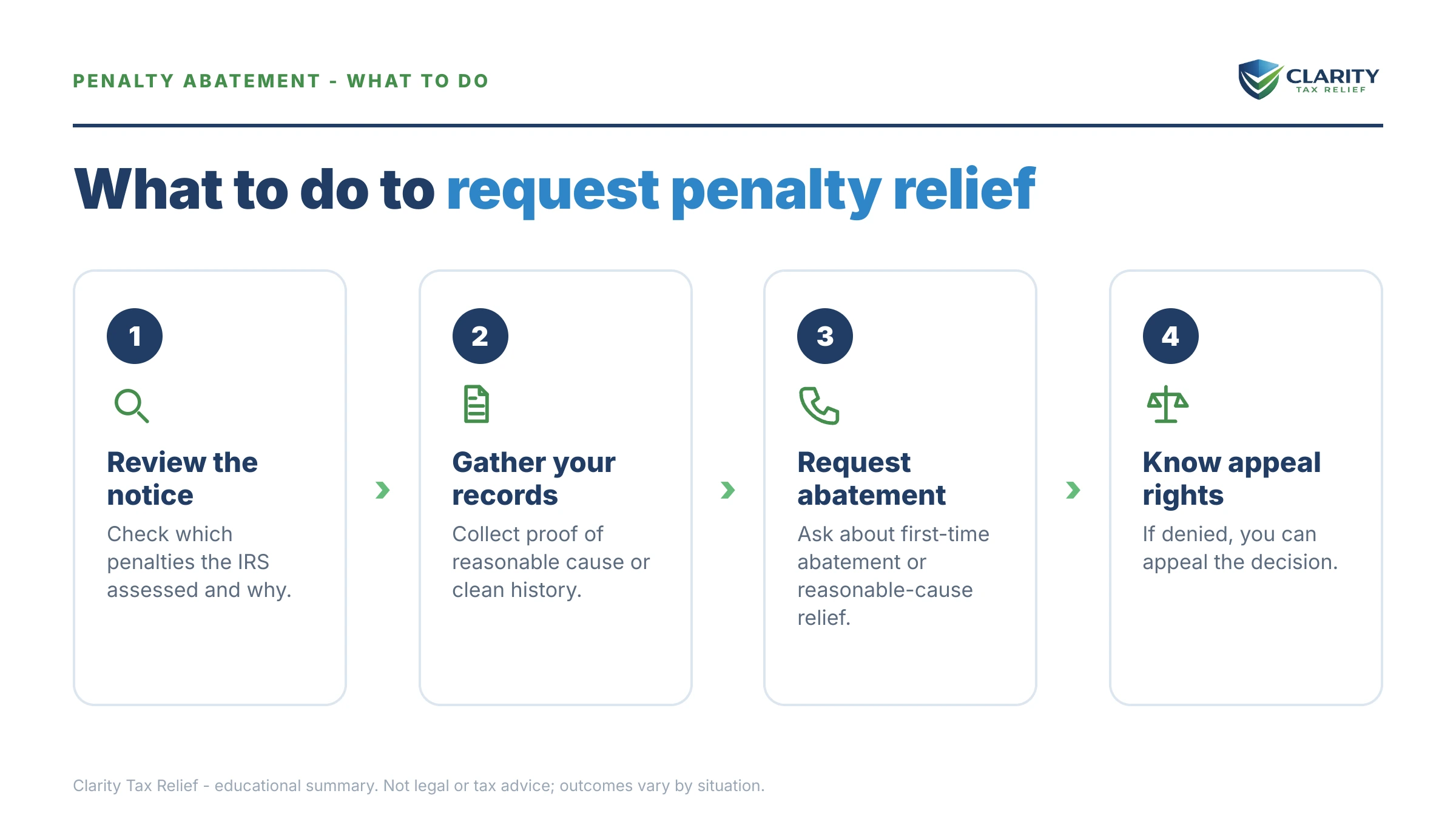
- Pull your account transcript. Identify every penalty by type, tax year, and amount before you ask for anything — abatement requests are made penalty by penalty, year by year.
- Check first-time-abatement eligibility. If you filed and paid on time for the three prior years, the most common penalties can be removed on your compliance record alone — no explanation needed.
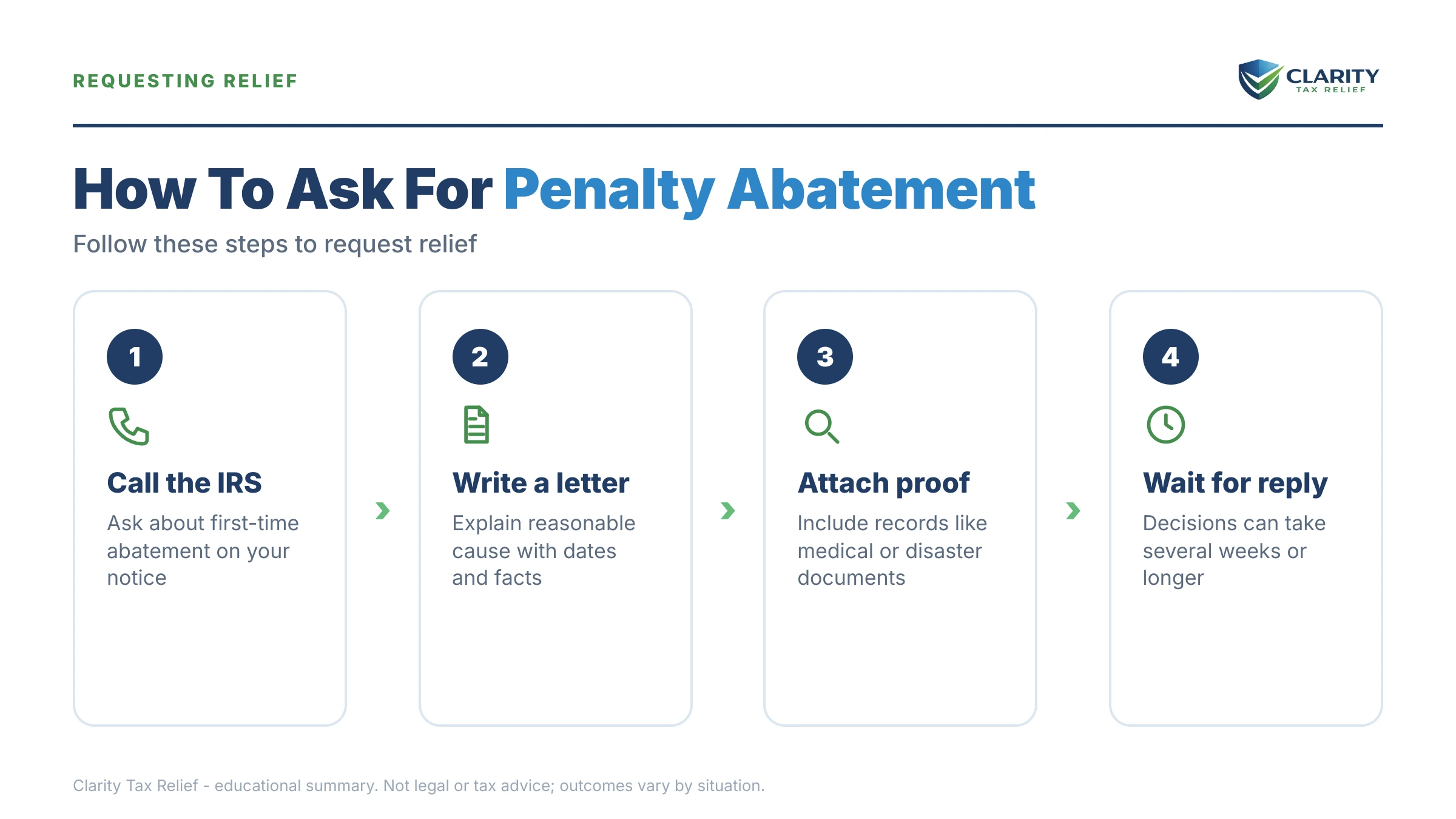
- Make the request. Call the number on your notice for a first-time abatement request, or mail a written reasonable-cause statement with documentation for anything the phone can't resolve.
- File Form 843 if you already paid. A paid penalty can still be abated and refunded — use Form 843 to claim it back rather than writing the money off.
- Appeal a denial in writing. Initial denials are frequently computer-generated. A written appeal puts your facts in front of a human reviewer with authority to reverse.
When you can handle penalty abatement yourself
Plenty of penalty abatement is genuinely do-it-yourself work. If you have one penalty, one tax year, and three clean prior years, a first-time abatement request is a phone call — no professional needed, no fee, and often an answer on the call itself. The same goes for a small penalty on a notice you agree with, where the ask is simple and the record speaks for itself.
Experienced help changes the outcome in a narrower set of situations: multiple years of penalties (first-time abatement only reaches one period — the sequencing across years matters), payroll and deposit penalties where trust-fund exposure could land on you personally, five- and six-figure reasonable-cause cases where how the facts are documented decides the result, and denied requests headed to appeal. In those cases, the FY2023 gap — individuals recovering $2.85 billion while all taxpayers recovered $13.01 billion — is largely a gap in who asked, and how well.
Terms in the penalty data, decoded
- Assessment — the formal act of recording a tax or penalty on your IRS account; it's what makes the amount legally collectible.
- Abatement — the reversal of an assessed penalty, removing it (and the interest charged on it) from your balance.
- First-Time Abate (FTA) — the IRS administrative policy that removes common penalties based purely on three prior years of clean compliance.
- Automatic Exemption from Penalty (AEP) — FTA's replacement starting summer 2026, applied automatically with no request required.
- Reasonable cause — the legal standard for penalty relief based on circumstances beyond your control, proven with documentation.
- IRS Data Book — the agency's annual statistical report; its civil-penalty tables are the source of every figure on this page.
Penalty abatement questions, answered
How often does the IRS actually remove penalties?
By dollar value, roughly 1 in 5 penalty dollars gets removed. In FY2023 the IRS assessed 45,545,154 civil penalties totaling $65,574,052 thousand ($65.57 billion) and abated 4,664,075 penalties totaling $13,012,834 thousand ($13.01 billion) — 19.8% of assessed dollars. The catch: almost none of that happens on its own. Abatement overwhelmingly goes to taxpayers who ask, in the right format, with the right facts.
What percentage of individual income tax penalties get abated?
In FY2025, individual, estate, and trust income tax penalties saw $33.10 billion assessed ($33,102,432 thousand) and $7.51 billion abated ($7,513,461 thousand) — 22.7% of dollars removed. In FY2023, individuals fared worse: $44.44 billion assessed against $2.85 billion abated, well below the 19.8% all-taxpayer average. The gap suggests individuals ask for relief far less often than businesses do, not that they qualify less often.
Why were FY2025 penalty abatements so enormous?
The IRS Data Book for FY2025 shows $1,247,074,030 thousand ($1.247 trillion) in total civil penalties assessed and $1,210,426,532 thousand ($1.210 trillion) abated — figures that dwarf every prior year. Almost none of that swing sits on the individual income tax line, which shows $33.10 billion assessed and $7.51 billion abated. The totals reflect enormous assessments in non-individual categories that were subsequently reversed; for a typical taxpayer, the individual line is the meaningful benchmark.
Do I have to pay a penalty before I can request abatement?
No. You can request abatement while the penalty is still unpaid, and doing so early stops the balance from being fed into the collection notice sequence. If you already paid, the penalty can still be abated and refunded: you file Form 843 to claim the money back. The window to claim a refund of a paid penalty is limited, so do not sit on it for years.
Does first-time penalty abatement really work?
Yes. It is an administrative policy, not a favor. The IRS grants it when you meet the test: a clean filing and payment history for the prior three years. It covers the most common penalties (failure to file, failure to pay, and failure to deposit) for a single period. The IRS can often grant it over the phone in one call. Starting summer 2026, its replacement, Automatic Exemption from Penalty (AEP), begins applying qualifying relief automatically, with no request needed.
Can the IRS remove interest too?
Only narrowly. Interest on the underlying tax generally cannot be waived just because paying is hard. It comes off mainly when it stems from an IRS error or unreasonable delay. The good news: when a penalty is abated, the interest that was charged on that penalty comes off with it automatically. You do not need a separate request for that piece.
Will requesting penalty abatement trigger an audit?
No. An abatement request is a routine administrative matter handled by the IRS accounts side, not the exam function. It does not reopen your return or invite scrutiny of your deductions. The FY2023 data shows 4,664,075 penalties were abated in a single year; these requests are processed by the millions. The only real risk of asking is a denial, which you can appeal.
Your next 24 hours
- Find the penalty lines. On your most recent IRS notice, locate the breakdown between tax, penalties, and interest. The penalty portion is the part the data says is removable roughly 1 dollar in 5.
- Gather your compliance picture. Pull your last three years of returns (or your IRS account transcript) plus the notice itself and any documentation of what went wrong. That's everything an eligibility check requires.
- Get a free penalty review. Use the 2-minute form or call (888) 825-7779. An experienced tax professional will tell you which of your penalties are realistic abatement candidates while the failure-to-pay penalty and daily interest are still compounding on them.
Source: all assessed and abated figures on this page come from the IRS's own annual statistical reporting — see IRS Data Book Table 28, civil penalties assessed and abated by type of tax and type of penalty. The IRS's overview of relief options is at IRS.gov penalty relief, and if a penalty dispute stalls inside the agency, the Taxpayer Advocate Service is an independent escalation path.
This guide is general information, not tax or legal advice for your specific situation. Eligibility for IRS programs depends on individual facts and circumstances; no outcome is guaranteed.