
IRS Audits
IRS EITC Audit Rate in 2026: How Often EITC Returns Really Get Audited
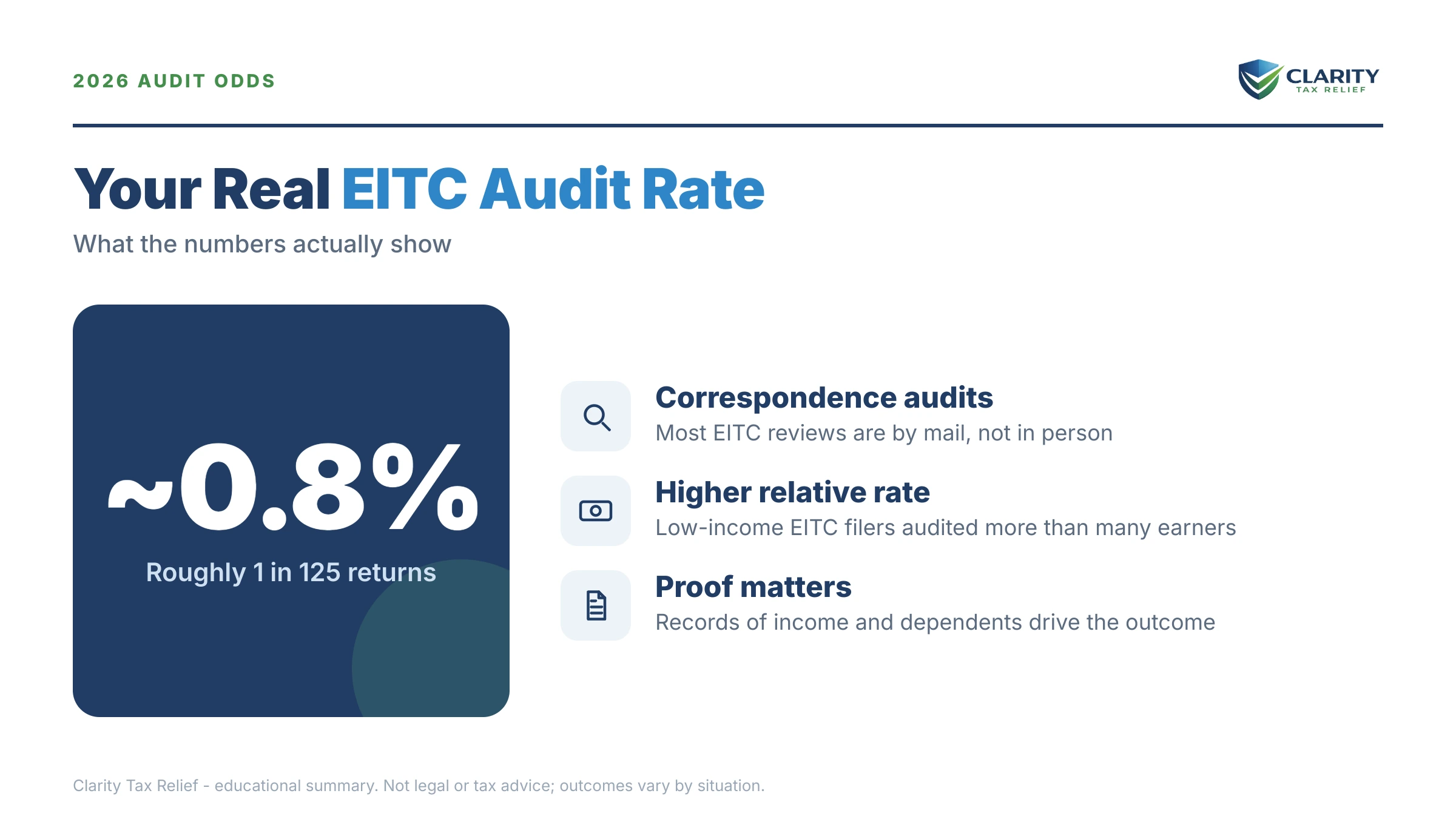
The short answer: the IRS EITC audit rate runs several times higher than the audit rate for other taxpayers at similar incomes — in some recent years, EITC audits made up more than a third of all individual audits. Nearly all are automated mail audits that begin with a CP75 letter and hold your refund while the IRS verifies your qualifying children.
You claimed a credit Congress built for working families, and now you're reading that claiming it makes your return one of the most-audited in America. Maybe a CP75 is already sitting on the kitchen table, or maybe you're heading into a refinance this year and can't afford an IRS surprise showing up mid-underwriting. Either way, the odds are knowable, the triggers are specific, and the audit itself is winnable with the right paperwork.
If a letter is what brought you here, the image below shows exactly what an EITC audit notice looks like and where to look for the parts that matter — the tax year under review and the response date that controls your case.
⏱ Your deadline: if a CP75 audit letter is already in your hands, your deadline is the response date printed on it, typically 30 days from the notice date. Miss it and the IRS disallows the credit by default, keeps your frozen refund, and starts the assessment machinery. If you haven't been audited, there's no clock, but the screening happens automatically every year you claim the credit.
The IRS EITC audit rate: what the numbers actually show
EITC claimants have been audited at several times the rate of other taxpayers with similar incomes, and in some recent years EITC audits accounted for more than a third of all IRS individual audits. Meanwhile the overall individual audit rate has run well under 1% — meaning a family earning $30,000 with two kids has often faced better odds of an audit than households earning ten times as much.
Why does a low-income credit draw so much of the IRS's audit attention? Cost, mostly. An EITC audit is a computer-generated letter — no examiner visits anyone, no agent works the file until you respond. Audits of complex, high-income returns require trained staff the IRS increasingly doesn't have. That imbalance is documented in the agency's own annual Data Book, and it's the pattern behind the numbers on our companion pages covering the IRS audit rate by income and the IRS millionaire audit rate.
2026 sharpens the gap. The IRS workforce was cut roughly 27% in 2025, which hit labor-intensive field audits hardest. Automated correspondence audits — the kind that screen EITC claims before refunds go out — run on systems that didn't get laid off. If audit rates fall this year, expect them to fall least for EITC returns.
One honesty note: precise EITC audit rates shift year to year with budgets and policy, so any page quoting a single decimal-point figure as "the" 2026 rate is guessing. What has held for decades is the structure — EITC returns are screened automatically, audited by mail, and audited disproportionately.
“While we accept most returns as filed, we select some for examination. We examine (or audit) some federal tax returns to determine if income, expenses, and credits are being reported accurately.”
— Understanding your CP75 notice (IRS.gov)
Why EITC returns get audited so often
The EITC is audited heavily because it is a refundable credit — an error doesn't just reduce tax, it sends the Treasury's cash out the door. The IRS has estimated for years that roughly a quarter or more of EITC dollars are paid improperly, and Congress leans on the agency to police that number. "Improper" rarely means fraud; most errors trace to genuinely confusing rules about who counts as a qualifying child.
The specific triggers the screening systems catch:
- Two people claiming the same child. Divorced or separated parents, or a parent and grandparent in the same extended family, each claim the child — the computer flags both returns instantly. If this is your situation, start with our guide to both parents claimed the same child.
- Residency doubts. The child's address in IRS and Social Security records doesn't match yours, or the child was claimed from a different address last year. Residency — the child living with you more than half the year — is the single most-audited EITC test.
- Self-employment income at the credit's sweet spot. The EITC rises with earned income, peaks, then phases out. A Schedule C reporting income that lands exactly at the peak — especially cash income with no 1099s and few expenses — is a classic flag. Cash-heavy filers face the same scrutiny described in our cash business audit guide.
- Income mismatches. Your reported wages don't match employer W-2/1099 filings, changing where you fall on the credit curve.
- Filing status questions. Head-of-household claims that conflict with another return, or married-filing-separately claims — MFS filers generally can't take the EITC at all, apart from a narrow rule for certain separated spouses.
Selection is almost entirely automated. Being audited doesn't mean a human decided you look dishonest. It means your return tripped a filter that millions of honest returns trip too.
What an EITC audit looks like: the CP75 letter
Nearly every EITC audit is a pre-refund correspondence audit that opens with a CP75 notice — the IRS freezes the EITC portion of your refund (often the Additional Child Tax Credit too) and asks you to prove the claim by mail. No one comes to your house; the entire exam runs on paper, like every IRS correspondence audit.
Inside the envelope is Form 886-H-EIC, the checklist of documents the IRS will accept for each test being questioned. The audit is genuinely winnable, but only on the IRS's document terms and inside its timeline. Here is the full sequence, with the right you hold at each stage:
| Notice / stage | What it means | Your window & rights |
|---|---|---|
| CP75 / CP75A | Audit opened; the EITC (and often ACTC) portion of your refund is frozen while the IRS verifies your claim | Respond with documents by the printed date, typically 30 days |
| Letter 525 + exam report | The IRS proposes disallowing the credit, often with a 20% accuracy-related penalty | Typically 30 days to agree, send more proof, or request an appeal |
| CP3219A (Notice of Deficiency) | Formal, final proposal to assess the tax | 90 days to petition U.S. Tax Court — statutory and unforgiving |
| CP79 | Credit disallowed; future EITC claims require Form 8862 | Attach Form 8862 to your next return (unless banned) |
| CP14 | The disallowed amount is assessed and billed as a balance due | About 21 days before automated collection notices begin |
How far back can this reach? Generally three years from filing — six for large income omissions, unlimited for fraud or unfiled years. The full rules live in our hub on how far back can the IRS audit. In practice, most EITC audits open within months of filing because screening happens before the refund is released.
What happens if you ignore an EITC audit
An unanswered CP75 doesn't stall your case. It decides it, against you, by default. The stages run in a fixed order:
- Your refund stays frozen. The held EITC and ACTC money is not released while the audit sits unanswered, and it will not release itself.
- The credit is disallowed on paper. An exam report arrives (Letter 525) proposing that you repay the credit, usually with the 20% accuracy-related penalty added.
- The 90-day letter issues. A CP3219A Notice of Deficiency gives you 90 days to petition Tax Court. Your last pre-assessment right, and the one people most regret losing.
- The debt becomes real. The IRS assesses the balance and bills it (CP14, about 21 days), and interest plus the monthly failure-to-pay penalty start compounding.
- Collections takes over. The automated notice sequence marches toward lien filings and levies, and every future refund gets offset against the balance until it's gone.
- Future credits are jeopardized. You'll need Form 8862 to claim the EITC again. A default disallowance makes it easier for the IRS to conclude "reckless disregard" and impose a 2-year ban.
Every stage on that list is cheaper to fix than the one after it. The frozen-refund stage costs you documents and postage; the assessed-balance stage costs you money.
Holding a CP75 with the clock running?
In an EITC audit, silence is a decision — the credit is disallowed by default. Get your CP75 and documents reviewed free before the response date printed on your notice passes, so what you send the first time actually closes the case.
If the audit ends with a bill: your real options
A lost EITC audit becomes an ordinary IRS balance, and every ordinary resolution tool applies. The right one depends on the amount, your finances, and whether you actually agree with the disallowance:
| Your situation | Realistic option | Key threshold or cost |
|---|---|---|
| You agree and can pay within 6 months | Short-term payment plan (up to 180 days) | $0 setup fee; interest and the 0.5%/month late-pay penalty continue until paid |
| Balance is $10,000 or less | Guaranteed installment agreement | Approval is automatic if your returns are filed and you can pay within 3 years |
| Balance up to $50,000 | Streamlined installment agreement, up to 72 months | No financial statement up to $25,000, or up to $50,000 with direct debit |
| You disagree with the disallowance | Appeal before assessment, or audit reconsideration after | Free to request; reconsideration needs documents the auditor never saw |
| You genuinely can't pay anything | Currently Not Collectible status or an Offer in Compromise | OIC: $205 fee, waived with low-income certification; the IRS accepted roughly 1 in 5 offers in FY2024 |
Two option-specific notes. First, the 20% accuracy-related penalty can be contested on reasonable-cause grounds — that you made a genuine, defensible mistake on genuinely confusing rules — and on EITC cases that argument often has real traction. Our guide to the accuracy related penalty irs rules walks through it. Second, audit reconsideration is the rescue path for people who found this article after the deadline passed: if you now have the school and medical records you couldn't gather in 30 days, the case can be reopened even after assessment.
A worked example: a $7,400 EITC audit bill before a refinance
Say you're a homeowner planning to refinance this fall. A CP75 audit of last year's return ends badly: $6,150 of EITC disallowed, plus a 20% accuracy-related penalty of $1,230 — roughly $7,400 once the first months of interest post. (This is a hypothetical, not a client story.) Here's the realistic math:
- Pay in full within 180 days: $0 setup fee, and interest stops when the balance hits zero. But draining $7,400 of cash right before underwriting may hurt the reserves your lender wants to see.
- Guaranteed installment agreement: because $7,400 is under the $10,000 threshold, approval is automatic if your returns are filed and you pay within 3 years — about $206/month over 36 months ($7,400 ÷ 36), plus accruing interest, with the monthly late-pay penalty typically dropping to 0.25% once the agreement is active.
- The refinance angle: lien filings generally target larger unresolved balances. An agreement in place with on-time payments is a far better underwriting story than an ignored bill. If a lien has already been filed, the path is different — see can i refinance with an irs lien.
- Fight instead of pay: if your child genuinely lived with you and you can now prove it, reconsideration or appeal can erase the entire $7,400 — the cheapest outcome of all.
Before choosing, you can estimate what penalties and interest add to your specific balance over time with our IRS penalty and interest calculator.
How to respond to an EITC audit, step by step
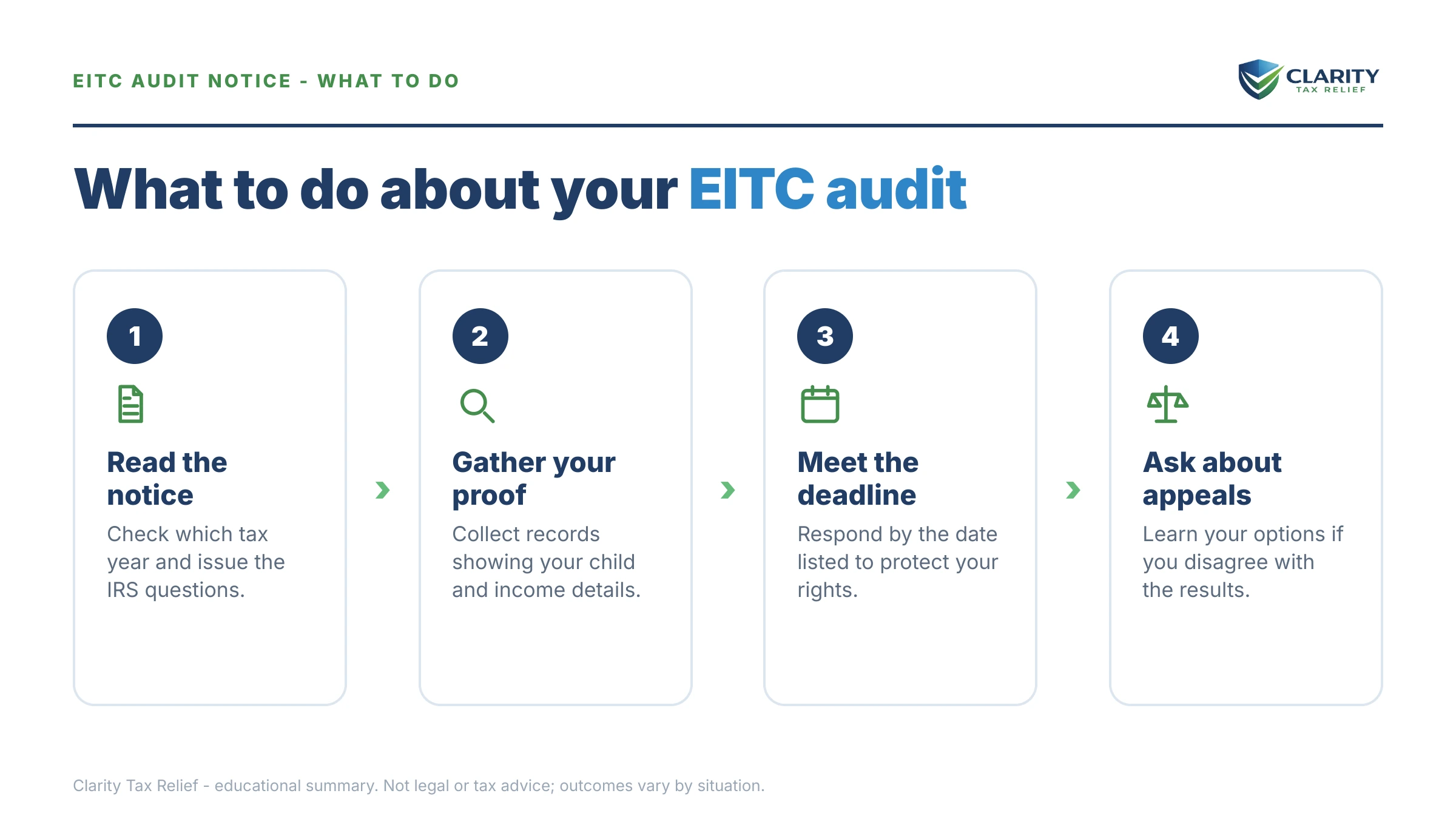
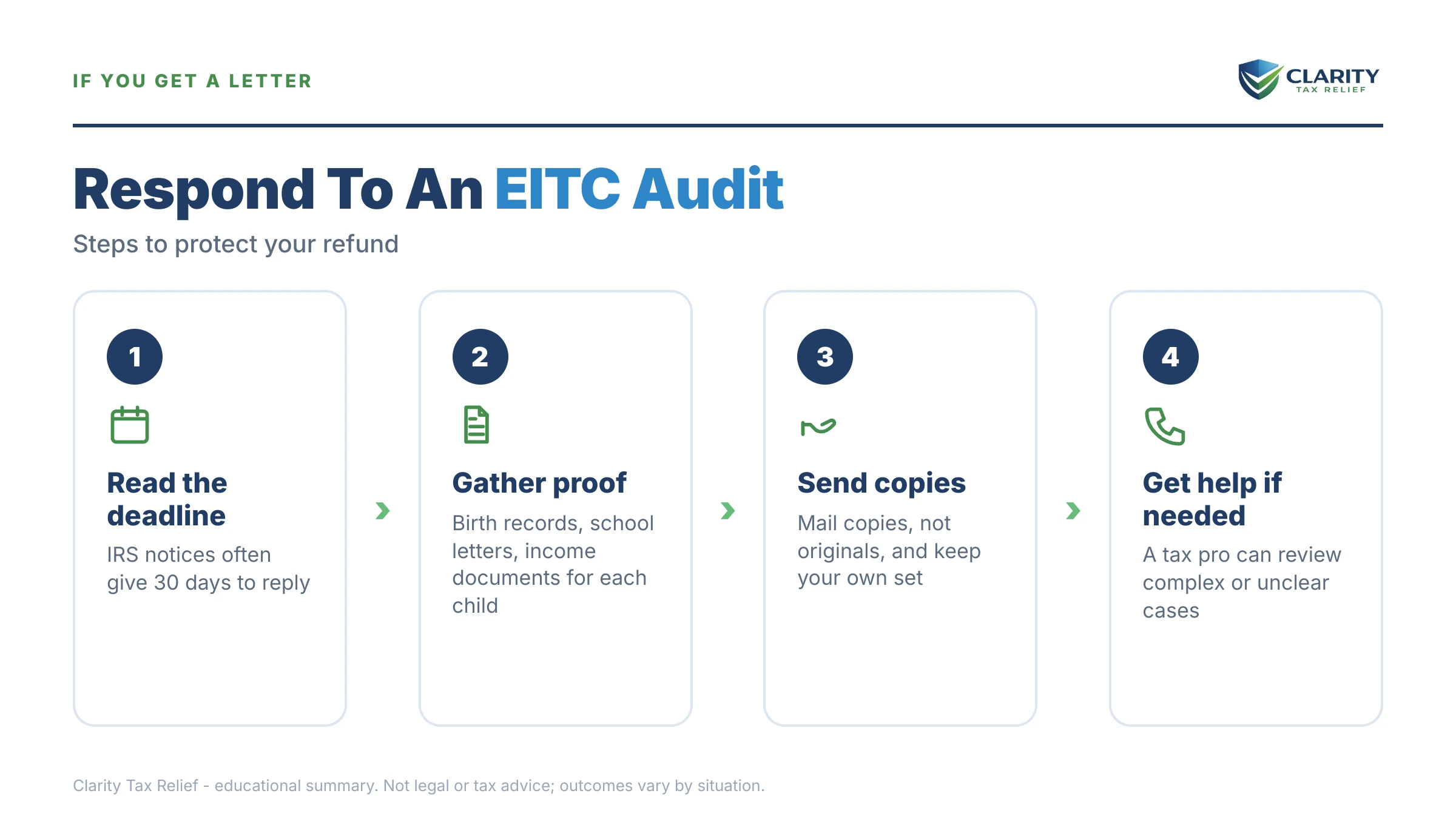
- Find your response date. It's printed on the CP75, typically 30 days from the notice date. Every other decision works backward from it.
- Match the request to the tests being questioned. The enclosed Form 886-H-EIC tells you exactly which tests — relationship, residency, age, or income — the IRS wants proved. Answer only what's asked, completely.
- Gather third-party records for the audited year. School, medical, daycare, and lease records showing your child at your address carry the most weight. Letters on official letterhead fill gaps.
- Send copies of everything at once, by the deadline. Never originals. Use the reply method on the notice, and keep proof of delivery — a partial or late response is treated like no response.
- Escalate if the IRS still says no. You can request an appeal when the exam report arrives. You have 90 days to petition Tax Court once a CP3219A is issued. After assessment, audit reconsideration can reopen the case with new documents.
- Resolve any balance before it ages. If some of the credit is genuinely disallowed, set up a payment arrangement quickly — that keeps the case out of the collection sequence and away from lien territory.
The documents are the whole game, so here is what actually wins each test — drawn from the IRS's own Form 886-H-EIC checklist:
| Test in question | What you must show | Documents that typically work |
|---|---|---|
| Relationship | The child is your child, stepchild, sibling, grandchild, niece/nephew, or foster/adopted child | Birth certificates linking the child to you (sometimes through a chain of certificates); adoption or foster placement papers; court records |
| Residency | The child lived with you in the U.S. more than half the tax year | School, medical, or daycare records showing your address; a lease naming the child; dated letters on letterhead from a school official, doctor, landlord, or social-service agency |
| Age / student status | Under 19, under 24 and a full-time student, or permanently and totally disabled | Birth certificate; official school enrollment records; a doctor's statement of disability |
| Self-employment income | Your Schedule C income is real, complete, and correctly stated | Business ledgers, invoices, bank statements, 1099s, and expense receipts for the year |
Residency is where most audits are won or lost, and where reconstruction takes the most creativity — our dedicated guide to EIC audit proof of residency covers what to do when the school records show grandma's address.
When you can handle this yourself
Most single-year EITC audits with good records don't need professional help. If one tax year is questioned, your child clearly lived with you. You can pull school, medical, or lease records tying the child to your address, a careful DIY response by the printed deadline wins the majority of these cases. If your income qualifies, a low income taxpayer clinic will represent you for free — a genuinely good option the IRS itself funds. And if the audit is simply stuck in processing limbo, the Taxpayer Advocate Service at taxpayeradvocate.irs.gov exists for exactly that.
Experienced help changes outcomes in specific situations: when the audit questions Schedule C income (because a document request about your kids can quietly become an exam of your whole business), when multiple years are open at once, when the IRS proposes a 2-year ban for reckless disregard, when both households claimed the child and the tiebreaker rules decide it, or when the deadline already passed and the case has to be reopened through reconsideration. In those cases, the first response filed shapes everything after it.
If your audit involves self-employment income, more than one year, or a proposed ban, get a free read on your case before you respond, or call (888) 825-7779.
Terms on your notice, decoded
- CP75 / CP75A: the letter that opens an EITC audit and freezes the credit portion of your refund until you prove the claim (the IRS's own explainer is at Understanding your CP75 notice).
- Form 886-H-EIC: the enclosed checklist of documents the IRS accepts as proof for each EITC test.
- Qualifying child: a child who passes the relationship, age, residency, and joint-return tests — the requirements at the heart of nearly every EITC audit.
- Residency test: the requirement that the child lived with you in the U.S. for more than half the tax year — the most commonly disputed test.
- Form 8862: the form you must attach to future returns to claim the credit again after any disallowance.
- Two-year ban (IRC §32(k)): the penalty barring you from the EITC for 2 years if the IRS finds reckless or intentional disregard of the rules — 10 years for fraud.
- Statutory notice of deficiency: the "90-day letter" (CP3219A) that is your final chance to contest the disallowance in Tax Court before the debt is assessed.
For the credit's current-year income limits and eligibility rules, the primary source is the IRS's Earned Income Tax Credit page, with three or more qualifying children, the maximum credit tops $8,000, which is exactly why the IRS checks and why the audit is worth fighting.
One more edge case worth knowing: many states pay their own EITC calculated from your federal credit. A federal disallowance usually flows through to a state adjustment too, so winning the federal audit protects both refunds.
Frequently asked questions
What is the IRS audit rate for EITC returns?
EITC returns are audited at several times the rate of other returns with similar incomes, and in some recent years EITC audits made up more than a third of all IRS individual audits. By contrast, the overall individual audit rate has run well under 1%. Exact figures move year to year with IRS budgets, but the gap between EITC claimants and everyone else has stayed wide for decades.
Why does the IRS audit EITC claims so often?
Three reasons: the credit is refundable, so an error sends cash out the door. The qualifying-child rules are complicated enough that honest families get them wrong. And EITC audits are cheap, automated mail audits that don't require an examiner to visit anyone. The IRS has also estimated for years that roughly a quarter or more of EITC dollars are paid improperly, which keeps congressional pressure on enforcement.
What triggers an EITC audit?
The most common triggers are two people claiming the same child, a child whose address in IRS records doesn't match yours, self-employment income that lands exactly where the credit peaks, and income that doesn't match W-2 or 1099 data. Selection is almost entirely automated — the IRS's screening systems flag returns before refunds go out, so an audit doesn't mean a human singled you out.
Does an EITC audit happen before or after I get my refund?
Usually before. Most EITC audits are pre-refund audits: the CP75 letter arrives and the IRS holds the EITC (and often the Additional Child Tax Credit) portion of your refund until you prove the claim. Separately, the PATH Act bars the IRS from releasing any EITC refund before mid-February. Post-refund audits also happen. Those end in a bill instead of a frozen refund.
What happens if I fail an EITC audit?
You repay the disallowed credit, often with a 20% accuracy-related penalty and interest. You must attach Form 8862 the next time you claim the credit. If the IRS decides you claimed it with reckless or intentional disregard of the rules, it can ban you from the credit for 2 years, and 10 years for fraud. Those bans are worth fighting, because they cost far more than one year's credit.
Can I claim the EITC again after it was disallowed?
Yes, in most cases. You attach Form 8862, Information to Claim Certain Credits After Disallowance, to your next return and the IRS re-verifies your eligibility. The exceptions are the 2-year ban for reckless disregard and the 10-year ban for fraud. During a ban you cannot claim the credit even if you now clearly qualify. Expect the 8862 return to process more slowly than a normal one.
How far back can the IRS audit my EITC claim?
Generally three years from the date you filed the return, which is the standard assessment window. That stretches to six years if you omitted more than 25% of your income, and there's no time limit at all if the IRS can show fraud or if you never filed. In practice, most EITC audits open within months of filing, because the screening happens before the refund is released.
Do I need a professional for an EITC audit?
Not always. If one year is in question and you have solid records — school, medical, or lease documents tying your child to your address — many parents handle a CP75 successfully on their own. Experienced help changes outcomes when the audit questions self-employment income, covers multiple years, proposes a 2-year ban, or when you already missed the deadline and need audit reconsideration. Low Income Taxpayer Clinics represent qualifying taxpayers for free.
Will an EITC audit affect my mortgage or refinance?
The audit itself is not public and won't appear on a credit report. The risk is what follows: an assessed, unpaid balance can lead to a federal tax lien, which is public record and can complicate underwriting, and many lenders ask about unresolved IRS debt directly. If you're heading into a refinance, resolving the audit, or getting a payment agreement in place, before you apply is the safer sequence.
Your next 24 hours
- Find your controlling date. If you have a CP75, circle the response date printed near the top. If you don't have a letter but your refund is stuck, log into your IRS online account and check whether an exam hold is on your file.
- Start the document pile. Pull the audited year's return, the notice, and one third-party record per child — a school record, medical record, or lease showing your address. Everything else builds from those.
- Get a free case review. Send us a photo of your notice through the 2-minute form or call (888) 825-7779, before your printed response date if you have one, and before the frozen refund or growing balance gets any older if you don't.
This guide is general information, not tax or legal advice for your specific situation. Eligibility for IRS programs depends on individual facts and circumstances; no outcome is guaranteed.