
IRS Data & Studies
ERC Claims Backlog: IRS Inventory Statistics for 2026
Read the transcript
Host: You filed an ERC claim, the money was supposed to steady the business, and every quarter since it's been the same nothing. No check. No denial. No letter. So — where is it?
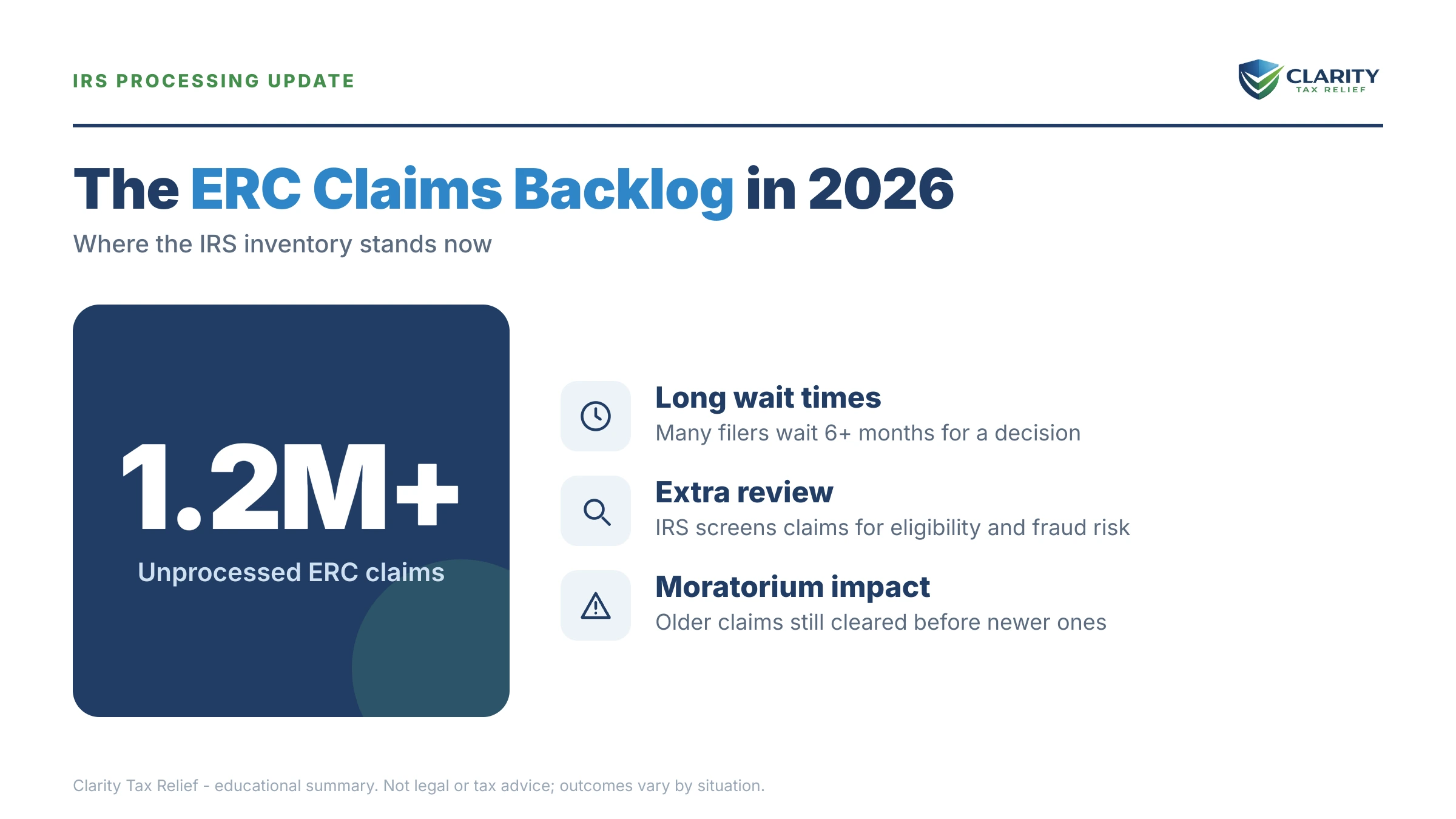
Tax specialist: Statistically, it's in one of five places. And that's actually the useful part of this data study. As of May 2025 the National Taxpayer Advocate said over 597,000 ERC claims were still sitting in IRS inventory. By the week ending 5/30/2026, that was down to about 20,600.
Host: 597,000 down to 20,600.
Tax specialist: Right. More than a 96 percent reduction.
Host: Okay, so that sounds like good news, but if you're one of the 20,600 —
Tax specialist: You're in a harder pile than the people who got paid in 2024. That's the honest read. The clean, low-risk claims mostly got resolved first — paid or denied. What's left skews toward claims the IRS wants to test.
Host: Back up one step. Why did any of this freeze in the first place?
Tax specialist: The moratorium. September 14, 2023, the IRS stopped processing newly filed ERC claims because promoter-driven filings were flooding in. So they stopped the conveyor belt and risk-scored the whole pile. Legitimate filers got frozen right alongside the bad ones.
Host: And staffing didn't help.
Tax specialist: Per TIGTA reporting, the IRS workforce shrank roughly 27 percent in 2025. And every ERC claim is a Form 941-X — paper-heavy amended payroll return, needs a human to look at it. That's the slowest possible work for a smaller agency. Meanwhile the automated side never slowed down. Disallowance letters, recapture notices, those kept going out on schedule.
Host: Hm. So the part that pays you slowed and the part that bills you didn't.
Tax specialist: That's the asymmetry, yeah.
Host: Give me the five buckets.
Tax specialist: Week ending 5/30/2026. About 3,500 under review — still being evaluated, no decision. About 4,000 pending payment or disallowance, meaning the decision's effectively made and the letter or check is in process. About 5,500 under audit. About 6,000 awaiting disallowance-response review. And about 1,600 in Appeals.
Host: Say the 6,000 one again, slower.
Tax specialist: Awaiting disallowance-response review. That's a business that got denied, disputed the denial, and the IRS hasn't ruled on the dispute yet. Six thousand of those.
Host: Wait — that's the biggest single group.
Tax specialist: That's the thing people miss. The most common state for a so-called backlogged ERC claim in 2026 isn't waiting to get paid. It's fighting a denial.
Host: Okay. And 5,500 under audit out of 20,600 — that's more than one in four.
Tax specialist: Roughly 27 percent. And an audit isn't a fraud accusation. It's a demand that you prove eligibility with records. Which claims got routed there? High-risk markers — very large credits relative to payroll, thin eligibility support, a promoter's fingerprints on the filing.
Host: Let's do the clock, because that's the part I want the listener to actually hear.
Tax specialist: So. The backlog pauses a lot of things. It does not pause this one. If the IRS disallowed your claim — Letter 105-C is a full disallowance, Letter 106-C is partial — the response deadline printed on that letter controls. And it runs while roughly 6,000 responses sit in the IRS's own queue.
Host: So their delay doesn't buy you time.
Tax specialist: None. Miss the window and disputing the denial gets dramatically harder. After that, the general path is a refund suit in court within a two-year window from the disallowance, and you confirm the controlling date against your own letter, not against anything we say here.
Host: And that court piece — that's not something Clarity does.
Tax specialist: Correct. Litigation sits outside what we handle. If it comes to that, talk to your own counsel about it. What we can do is figure out which stage your claim is in and what your strongest response looks like before that door is the only one left.
Host: What if somebody just keeps waiting? Walk the sequence.
Tax specialist: Silence first — no letters, no interest paid yet, no way to know which bucket you're in without asking. Then a decision letter: a refund check, often with interest, or a 105-C or 106-C. Then, if you don't protest in time, the denial hardens. Then recapture, if you were paid and the IRS later determines the claim was ineligible, it claws the money back with penalties and interest, often through a CP320B notice. Then that unpaid balance flows into normal collections. Bills, then lien and levy notices, like any other tax debt.
Host: CP320B. Got it.
Tax specialist: And there's a criminal referral lane for knowingly false claims, but that's rare and worst-case. Ordinary eligible-but-delayed filers are not in that lane.
Host: There's a dollar example in the article I want you to do, because it surprised me.
Tax specialist: The café one. Hypothetical — a Form 941-X claiming $46,500 across two 2021 quarters, still unpaid. If it's in the pending-payment group, you'd get the $46,500 plus overpayment interest for the delay, and that interest is taxable income in the year you receive it, so budget for the tax on it.
Host: Fine. Now the part that got me.
Tax specialist: If it's under audit and eligibility isn't proven, you get zero. But say the business is a C corporation that already amended its 2021 return to reduce the wage deduction by that $46,500. That amendment raised its income tax by about $46,500 times 21 percent — $9,765. A denied claim means unwinding that too, or you've paid extra tax on a credit you never got.
Host: So a stuck claim isn't just a late check. It's an open item sitting inside returns you already filed.
Tax specialist: That's it exactly.
Host: What can somebody actually pull on right now?
Tax specialist: Four levers, and which one fits depends on your stage, not on how long you've waited. One, wait, but prepared. Assemble the eligibility file now, because an audit notice typically gives you weeks, not months, to produce records for 2020 and 2021 quarters. Two, escalate through TAS with Form 911 if the delay is causing genuine hardship — payroll strain, debt taken on against the expected refund. And set expectations honestly there: as of May 2025, nearly 11,000 of the Advocate's own ERC cases were still unresolved, even with about 64 percent of TAS-submitted claims processed.
Host: So TAS is a lever, not a shortcut.
Tax specialist: And it works best when your claim is simply stuck, not under active audit. Three is the refund-suit route — federal law generally allows it after six months without a decision — real costs, weigh it with an experienced tax professional, not as a first move. Four, fight a disallowance properly, inside the window the letter states.
Host: One door that's closed?
Tax specialist: The ERC voluntary disclosure windows for repaying questionable claims at a discount have expired. If you were paid on a claim you now doubt, there are still options, but that specific door isn't one of them.
Host: Who genuinely doesn't need to hire anyone?
Tax specialist: If your claim's simply queued, your eligibility is solid — clean gross-receipts decline calculation or a documented government order — and you've received no letters, your job is organization, not representation. File the records, calendar a quarterly check-in, file the Form 911 yourself if hardship builds.
Host: And when does help matter?
Tax specialist: Active audit, because your first response frames the whole exam. A promoter-prepared claim you never fully understood. You need to know whether it's defensible before you defend it. A disallowance with six figures at stake where the wording of the protest matters. And a recapture balance you can't repay, where it stops being ERC law and becomes collection strategy.
Host: Next 24 hours. Short list.
Tax specialist: Find your Form 941-X copies and the proof of when the IRS received them. That date anchors everything. Pull your gross-receipts numbers or shutdown orders for each quarter claimed. Then search your mail for anything numbered 105-C, 106-C, or CP320B, or an audit notice. If one of those exists, the date printed on it is the thing that matters most this week.
Host: And if you want a second set of eyes, the review's free and confidential — (888) 825-7779. Our Enrolled Agents will tell you which of the five stages your claim is in and what your options are from there.
Tax specialist: Before a clock nobody can pause runs out on you.
The short answer: more than 597,000 Employee Retention Credit claims were still stuck in the IRS's inventory as of May 2025, per the National Taxpayer Advocate. By the week ending 5/30/2026, about 20,600 ERC claims remained — roughly 3,500 under review, 5,500 under audit, and 1,600 in Appeals.
You filed your ERC claim years ago, the money was supposed to keep your business steady, and every quarter since has been the same answer: nothing — no check, no denial, no letter. These ERC claims backlog IRS inventory statistics explain why, and where a claim like yours most likely sits right now.
This is a data study, not a status checker, but the numbers map directly to action. Each of the five inventory stages the IRS reports has a different next move, and one of them carries a deadline that keeps running whether or not the IRS is behind. The image below shows how the backlog shrank and how today's inventory breaks down by stage, so you can orient yourself before reading the detail.
⏱ The one clock the backlog does NOT pause: if the IRS disallowed your claim with a Letter 105-C or Letter 106-C, the response deadline printed on that letter controls, and it runs even while roughly 6,000 disallowance responses sit in the IRS's own review queue. Miss it, and disputing the denial gets dramatically harder.

The headline ERC claims backlog IRS inventory statistics
Even after the filing window closed, more than 597,000 Employee Retention Credit claims were still stuck in the IRS's inventory, with nearly 11,000 cases escalated to the Taxpayer Advocate still unresolved. That May 2025 snapshot from the National Taxpayer Advocate is the clearest official measure of how deep the ERC hole went.
Her exact words carry the weight here. She reported that "over 597,000 ERC claims remain in the IRS's inventory" — nearly two years after the IRS moratorium on processing new ERC claims began September 14, 2023. She also flagged "nearly 11,000 cases submitted through my office, TAS, that remain unresolved," even though "the IRS has processed about 64 percent of TAS-submitted claims." In other words: even claims with a federal advocate pushing them still sat in the pile by the thousands.
Then the pile finally moved. As of the week ending 5/30/2026, IRS inventory data showed about 20,600 ERC claims remained — a reduction of more than 96 percent from the May 2025 figure (20,600 ÷ 597,000 ≈ 3.5 percent of the old backlog still standing). Good news for most filers. Complicated news for the roughly 20,600 businesses still waiting, because what's left is not a queue — it's a screening gauntlet.
| Date | Event | Claims affected |
|---|---|---|
| September 14, 2023 | IRS moratorium on processing new ERC claims begins | Every claim filed after this date sat unprocessed; the backlog builds |
| May 2025 | National Taxpayer Advocate reports the ERC claim period has closed with the backlog unresolved | Over 597,000 ERC claims remain in the IRS's inventory; nearly 11,000 TAS cases unresolved |
| Week ending 5/30/2026 | IRS inventory data shows the backlog reduced to its hard core | About 20,600 ERC claims remain across five review stages |
Why your ERC claim got stuck in the first place
The backlog exists because the IRS froze processing on September 14, 2023 to stop a flood of promoter-driven claims. Aggressive "ERC mill" marketing had pushed ineligible businesses into filing, so the IRS stopped the conveyor belt and risk-scored every claim in the pile — legitimate filers got frozen alongside the bad claims.
That screening is why "when will I get paid?" has no single answer. Low-risk claims were largely paid or denied first. Claims with high-risk markers — very large credits relative to payroll, thin eligibility support, or a promoter's fingerprints — were routed into audit and disallowance tracks. If a promoter prepared yours, our guide to ERC mill claim problems covers how to assess what was actually filed under your EIN.
The staffing picture made it worse. The IRS workforce shrank roughly 27 percent in 2025, per TIGTA reporting, and ERC claims are paper-heavy Form 941-X amendments that require human review — the exact kind of work a smaller agency does slowest. The automated side of the IRS, meanwhile, never slowed: disallowance letters and recapture notices kept going out on schedule.
Where the remaining 20,600 ERC claims sit, and what each stage means for you
As of the week ending 5/30/2026, the roughly 20,600 remaining ERC claims were split across five distinct stages. Your realistic next move depends entirely on which one holds your claim. Notably, ~5,500 claims, more than one in four of everything left, were under audit, which tells you the remaining inventory skews toward claims the IRS wants to test, not just pay.
| Stage | Approx. claims | What it means | Your move |
|---|---|---|---|
| Under review | ~3,500 | The IRS is still evaluating the claim; no decision yet | Organize eligibility records; consider TAS if the delay causes hardship |
| Pending payment or disallowance | ~4,000 | A decision has effectively been made; the output letter or check is in process | Watch the mail closely — a 105-C here starts a real deadline |
| Under audit | ~5,500 | An examiner is testing eligibility and credit computation | Respond fully and on time; get representation before your first reply |
| Awaiting disallowance-response review | ~6,000 | The business disputed a denial and the IRS hasn't ruled on the response | Confirm your protest was received; calendar your court-window date |
| In Appeals | ~1,600 | The dispute is before the IRS Independent Office of Appeals | Prepare a documented hazards-of-litigation case; professional help matters most here |
Two of those buckets deserve a second look. The ~6,000 claims awaiting disallowance-response review are the largest single group — meaning the most common state for a "backlogged" claim in 2026 is not waiting to be paid, it's fighting a denial. And the ~4,000 pending payment or disallowance are the closest to resolution: those businesses will learn their outcome soonest, for better or worse. For the denial-side data in depth, see our companion study on IRS ERC claims disallowed statistics.
What happens if you just keep waiting
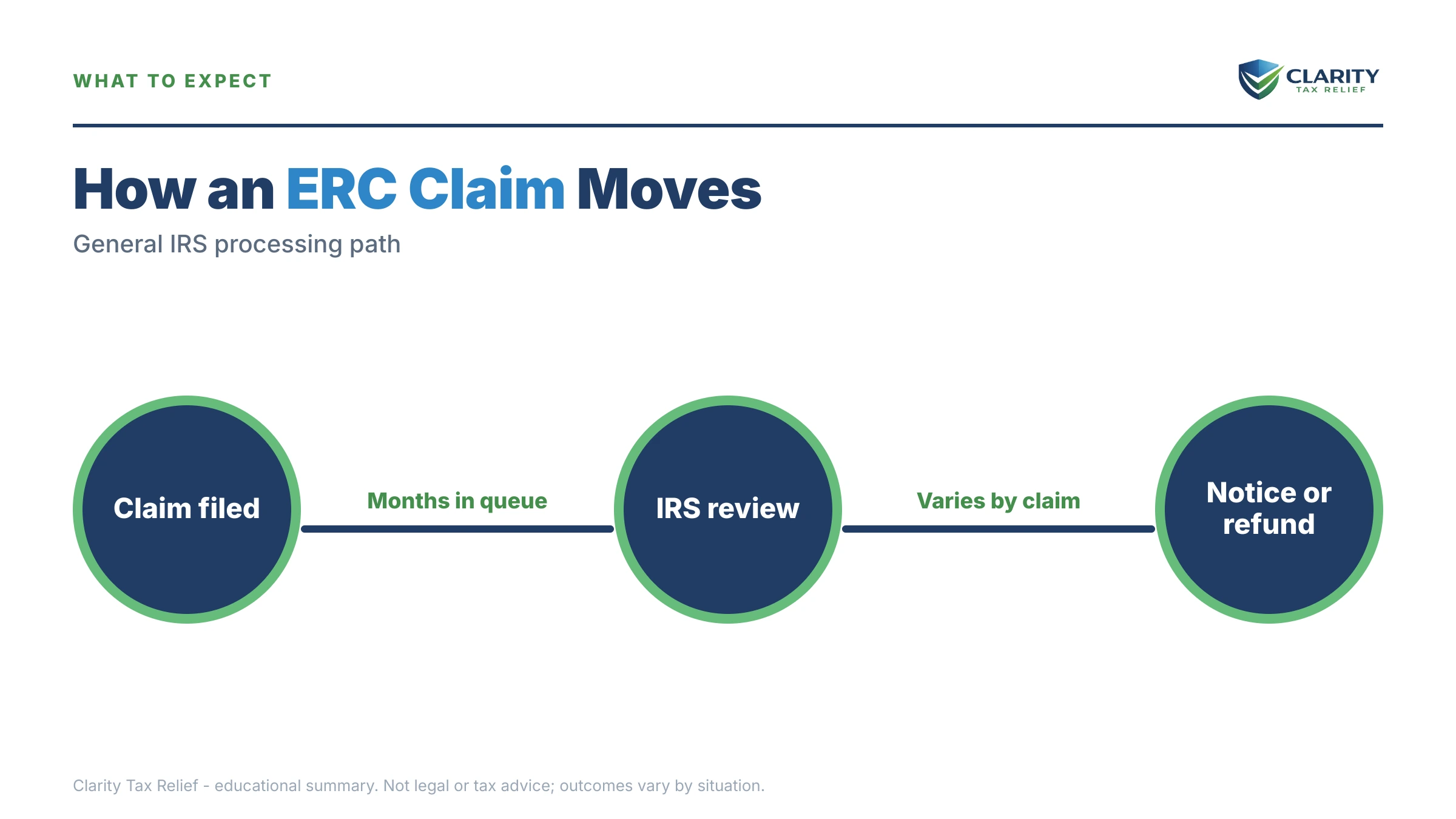
An ERC claim in the 2026 inventory doesn't simply resolve itself. It moves through a decision sequence, and later stages carry deadlines and dollar consequences that silence-so-far doesn't hint at. Here is the order things happen if you take no action:
- Silence — your claim sits in review or audit queue. No letters, no interest paid yet, no way to know which bucket you're in without asking.
- Decision letter — a refund check (often with interest), or a Letter 105-C (full disallowance) or 106-C (partial). The disallowance letters start response windows that the backlog does not extend.
- Missed window — if you don't protest a disallowance in time, the denial hardens. Your remaining path is generally a refund suit in court within a two-year window from the disallowance — confirm the controlling date on your own letter.
- Recapture — if you were paid and the IRS later determines the claim was ineligible, it claws the money back with penalties and interest, often via CP320B notice. Our data study on IRS ERC recapture letters statistics shows how actively that program is running.
- Collection — an unpaid recapture balance flows into the standard IRS collection stream: bills, then lien and levy notices, like any other tax debt.
- Criminal referral (rare, worst cases) — knowingly false claims can be referred for investigation. The numbers are in our study on IRS ERC fraud criminal investigation statistics. Ordinary eligible-but-delayed filers are not in this lane.
Is your ERC claim one of the 20,600 still stuck?
Whether it's frozen in review, under audit, or already disallowed, an experienced tax professional can find out where it sits and what your strongest response is, before a disallowance letter starts a clock you can't pause. The review is free and confidential.
Your options while your claim sits in inventory
A backlogged ERC claim gives you four realistic levers, and which one fits depends on your stage in the table above, not on how long you've waited.
- Wait, but prepared. If your claim is clean and simply queued, waiting is legitimate, but assemble your eligibility file now. An audit notice typically gives you weeks, not months, to produce records covering quarters from 2020–2021.
- Escalate through TAS. If the delay is causing genuine financial hardship — payroll strain, debt taken on against the expected refund — the Taxpayer Advocate Service can intervene. Start with Form 911 taxpayer advocate. Set expectations honestly: TAS moved many claims, but thousands of its own cases sat unresolved in the 2025 backlog.
- Sue for the refund. When the IRS sits on a refund claim long enough, generally six months without a decision, federal law lets you file a refund suit rather than wait indefinitely. It's a real lever for large claims, but litigation has real costs; weigh it with an experienced tax professional, not as a first resort.
- Fight a disallowance properly. A 105-C or 106-C is not final if you act inside its window. The protest process is covered in our guide to an erc disallowance appeal, and the ~6,000-claim disallowance-response queue proves the IRS is actively reading these protests.
One door that has closed: the ERC voluntary disclosure windows for repaying questionable claims at a discount have expired. If you were paid on a claim you now doubt, you still have options — see erc voluntary disclosure program for what replaced those windows, and if repayment itself is the problem, can't repay erc. If you'll owe a recaptured balance, you can estimate how penalties and interest stack on it with our Penalty & Interest Calculator. And if the recapture balance becomes ordinary tax debt, the full menu of resolution options is in our hub on how to settle tax debt yourself.
A worked example: what the backlog stages mean in dollars
Say your café filed a Form 941-X claiming $46,500 in ERC across two 2021 quarters, and it's still unpaid in mid-2026. Statistically, your claim sits in one of five buckets, and the dollar outcomes diverge sharply. (This is a hypothetical illustration, not a client case or a prediction.)
- If it's in the ~4,000 pending payment: you'd receive the $46,500 plus overpayment interest for the years of delay. But that interest is taxable income in the year received, so part of the windfall goes back out at tax time.
- If it's among the ~5,500 under audit (roughly 5,500 ÷ 20,600 ≈ 27 percent of remaining claims): nothing is paid until you prove eligibility. Lose the audit and you get $0, and here's the second hit most owners miss: if your business is a C corporation that already amended its 2021 return to reduce its wage deduction by the $46,500 credit, that amendment raised its income tax by about $46,500 × 21% = $9,765. A denied claim means unwinding that too, or you've paid extra tax on a credit you never received.
- If it was disallowed and you protested (the ~6,000 bucket): the $46,500 is in limbo. But your leverage is intact as long as you calendared the court window from your 105-C.
The lesson of the math: a stuck claim isn't just a delayed check. It can be an unresolved liability sitting inside your already-filed income tax returns. That interplay is exactly what erc recapture rules govern.
How to respond to the ERC backlog, step by step
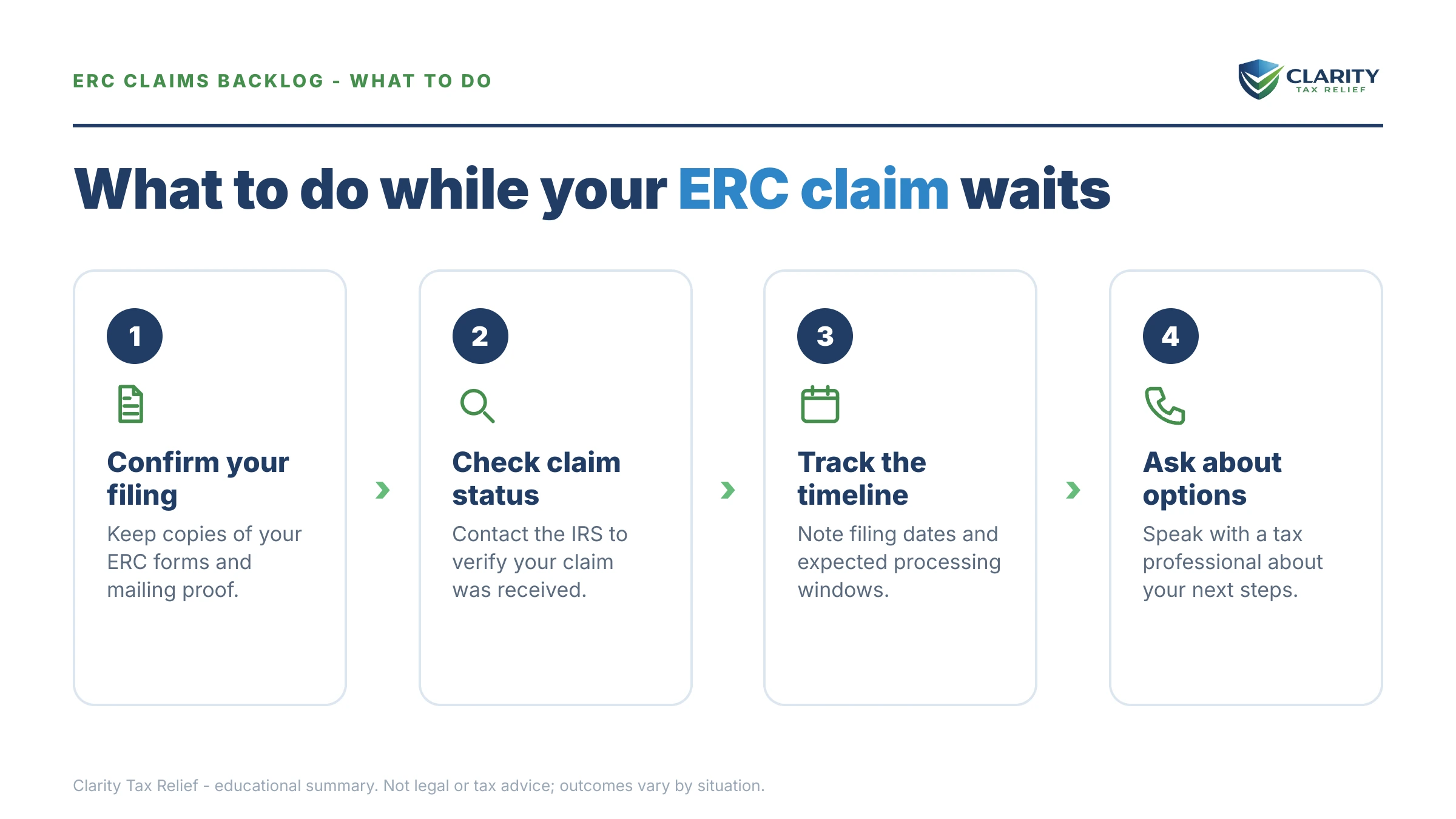
- Pull your filing proof — find your Form 941-X copies and the certified-mail or transmission records showing which quarters you claimed and when the IRS received them.
- Check every IRS letter — search your mail for Letter 105-C, Letter 106-C, CP320B, or an audit notice. The deadline printed on any of them controls. The backlog does not extend it.
- Rebuild your eligibility file — assemble gross-receipts calculations or government-order documentation for each quarter claimed now, before an examiner asks for it on a short deadline.
- Escalate strategically, if the delay is causing financial hardship, request Taxpayer Advocate Service help with Form 911. Discuss the refund-lawsuit option with an experienced tax professional if your claim has sat unanswered.
- Get a professional review before you respond, if your claim was promoter-prepared, is under audit, or was disallowed, have an experienced tax professional assess its strength before you reply or repay anything.
When you can handle this yourself, and when help changes the outcome
Most businesses whose claims are simply queued can manage the wait without paying anyone. If your eligibility is solid — you have a clean gross-receipts decline calculation or a documented government shutdown order — and you've received no letters, your job is organization, not representation: file your records, calendar a quarterly check-in, and file Form 911 yourself if hardship builds.
Experienced help changes outcomes in four situations. First, an active audit. Your first response frames the entire exam, and the ~5,500 claims in that bucket are being tested hard. See erc audit for what examiners request. Second, a promoter-prepared claim you never fully understood. You need to know whether it's defensible before you defend it. Third, a disallowance where six figures are at stake and protest wording matters. Fourth, a recapture balance you can't repay, where the question shifts from ERC law to collection strategy. Also worth knowing before an audit letter arrives: how long the IRS has to act at all, covered in erc statute of limitations.
Terms in the ERC backlog data, decoded
- Moratorium — the IRS's freeze on processing newly filed ERC claims, which began September 14, 2023 and created the backlog these statistics measure.
- Form 941-X — the amended payroll return used to claim the ERC. Every backlogged claim is one of these, which is why processing requires human review.
- Letter 105-C / 106-C — the IRS's full and partial claim disallowance letters; each prints the response deadline that controls your dispute rights.
- Recapture — the IRS reclaiming an ERC refund it already paid after determining the claim was ineligible, converting your refund into a tax debt.
- TAS (Taxpayer Advocate Service) — the independent office inside the IRS that intervenes in stalled cases; the source of the 597,000-claim backlog figure.
- Appeals — the IRS Independent Office of Appeals, which resolves disputes without litigation; ~1,600 ERC claims sat there as of late May 2026.
ERC backlog questions, answered
How many ERC claims are still in the IRS backlog in 2026?
About 20,600 ERC claims remained in IRS inventory as of the week ending 5/30/2026, down from over 597,000 in May 2025. Of those, roughly 3,500 were under review, 4,000 were pending payment or disallowance, 5,500 were under audit, 6,000 were awaiting disallowance-response review, and 1,600 were in Appeals. If your claim is unpaid and not withdrawn, it almost certainly sits in one of those five buckets.
Is the IRS still processing ERC claims in 2026?
Yes, but only the claims already in its inventory, since the filing window has closed and no new claims can be submitted. The IRS stopped processing newly filed claims when its moratorium began September 14, 2023, then spent 2024–2026 working the pile down. What remains now is the slow tail: audits, disallowance disputes, and Appeals cases that take months or years each, not weeks.
How long does the IRS take to pay an ERC claim now?
There is no published average, and the fast, clean claims have largely already been paid or denied. The roughly 20,600 claims left as of late May 2026 sit in human-review stages — audit, disallowance-response review, Appeals — that routinely run many months. Even claims escalated through the Taxpayer Advocate moved slowly: as of May 2025 the IRS had processed about 64 percent of TAS-submitted claims, leaving thousands still open.
Can the Taxpayer Advocate Service speed up my ERC refund?
Sometimes — TAS can push a stalled claim toward a decision, especially if the delay is causing financial hardship for your business. You request help with Form 911. But TAS is not a magic lever: the National Taxpayer Advocate reported nearly 11,000 of her office's own ERC cases were still unresolved as of May 2025. TAS works best when your claim is simply stuck, not when it is under active audit.
What should I do if my ERC claim was disallowed while stuck in the backlog?
Respond by the deadline printed on your Letter 105-C or 106-C — the backlog does not pause that clock. You can generally protest to IRS Appeals within the window the letter states. You generally have a two-year window from the disallowance to contest it in court. Confirm both dates against your own letter. About 6,000 of the remaining claims were awaiting disallowance-response review as of late May 2026, so a well-documented reply is genuinely being read.
Does the IRS pay interest on delayed ERC refunds?
Generally yes — when the IRS pays a refund claim late, it typically adds overpayment interest for the delay, calculated at the IRS's quarterly interest rates. The catch is that this interest is taxable income in the year you receive it, separate from the credit itself. If your claim has been pending since 2023, the interest portion of an eventual check can be meaningful, so budget for the tax on it.
Why is my ERC claim under audit instead of being paid?
Because the IRS risk-scored every claim during the moratorium, and claims with high-risk markers — promoter-prepared filings, thin eligibility support, unusually large credits relative to payroll — were routed to exam instead of payment. Roughly 5,500 of the 20,600 claims still in inventory as of late May 2026 were under audit, more than one in four of everything left. An audit is not a fraud accusation; it is a demand that you prove eligibility with records.
Can I still file a new ERC claim in 2026?
No. The ERC claim period has closed — the filing deadlines for all eligible quarters have passed. The IRS is only working the claims already in its inventory. If you filed before the window closed, your claim is still alive somewhere in the pipeline even if you have heard nothing. If you never filed, the credit is no longer available, and anyone offering to file one for you now is a red flag.
Your next 24 hours
- Find your 941-X paperwork. Locate the copies for every quarter you claimed and the proof of when the IRS received them. That filing date is the anchor for every option above.
- Gather your eligibility evidence. Pull the gross-receipts numbers or shutdown orders supporting each quarter, plus any IRS letter you've received, especially anything numbered 105-C, 106-C, or CP320B.
- Get a free case review. Send us what you have through the 2-minute form or call (888) 825-7779 — an experienced tax professional will identify which inventory stage your claim is in and what your strongest move is, before penalties, interest, or a hardened disallowance make it more expensive.
Sources
Backlog and TAS case figures: National Taxpayer Advocate, "The ERC Claim Period Has Closed" (NTA Blog, May 2025). Current inventory stage counts for the week ending 5/30/2026: IRS.gov ERC inventory reporting. Program background at the IRS's Employee Retention Credit page. Hardship escalation: the Taxpayer Advocate Service.
This guide is general information, not tax or legal advice for your specific situation. Eligibility for IRS programs depends on individual facts and circumstances; no outcome is guaranteed.