
IRS Data Studies
How Long Does the IRS Take to Process an Amended Return? 2026 Data Study
What this episode covers
- How long does the IRS take to process an amended tax return in 2025?
- What do IRS transcript codes 971 and 977 mean on an amended return?
- Does filing an amended return stop IRS collection on an existing balance?
- When should I escalate a delayed amended return to the Taxpayer Advocate Service?
The short answer: in FY 2025 the IRS took an average of over 5 months to process individual amended returns (Form 1040-X), and over 13 months for business amended returns. That's far longer than the 8 to 12 weeks the IRS's own guidance promises. Check status about three weeks after filing with Where's My Amended Return.
You filed your 1040-X back in the winter, the tracker has said "Received" for months, and you're starting to wonder whether it fell into a shredder somewhere in Kansas City. It almost certainly didn't — it's sitting in the largest amended-return paper inventory the IRS has had in decades. Here's what the real wait looks like, and what you can actually do about it.
The numbers in this study come from the National Taxpayer Advocate's annual report to Congress covering fiscal year 2025 — the most current government data on amended return processing. The image below shows exactly how the official timeline stacks up against what actually happened, and where your return likely sits in that gap.
⏱ The clock that actually matters: you generally have 3 years from the date you filed your original return (or 2 years from when you paid the tax, whichever is later) to file an amended return claiming a refund. Slow IRS processing does not extend that window — the date you file your 1040-X is what counts, not the date the IRS finishes with it.

How long does the IRS take to process an amended return? The FY 2025 numbers
In FY 2025 the IRS took an average of over 5 months to process individual amended returns (Form 1040-X) and over 13 months to process business amended returns. The individual average covers 3.7 million returns; the business average covers 1.6 million returns.
Compare that to what the IRS tells you when you file. Official IRS guidance still says to allow 8 to 12 weeks (up to 16 weeks in some cases). The actual FY 2025 individual average ran well past even the 16-week outer bound, and business amendments took roughly quadruple it.
| Return type | Average processing time | Volume |
|---|---|---|
| Individual amended returns (Form 1040-X), FY 2025 | Over 5 months | 3.7 million returns |
| Business amended returns, FY 2025 | Over 13 months | 1.6 million returns |
| What official IRS guidance says to allow | 8 to 12 weeks (up to 16 weeks in some cases) | — |
One bright spot: the IRS launched its 1040-X 'Non-Complex' Amended Returns Processing Automation on July 28, 2025 to speed non-complex amended returns for tax years 2023 and 2024. If your amendment is a simple fix — a corrected W-2 figure, a missed credit — for one of those two years, you may land on the fast track. Complex amendments, older years, and anything filed on paper do not.
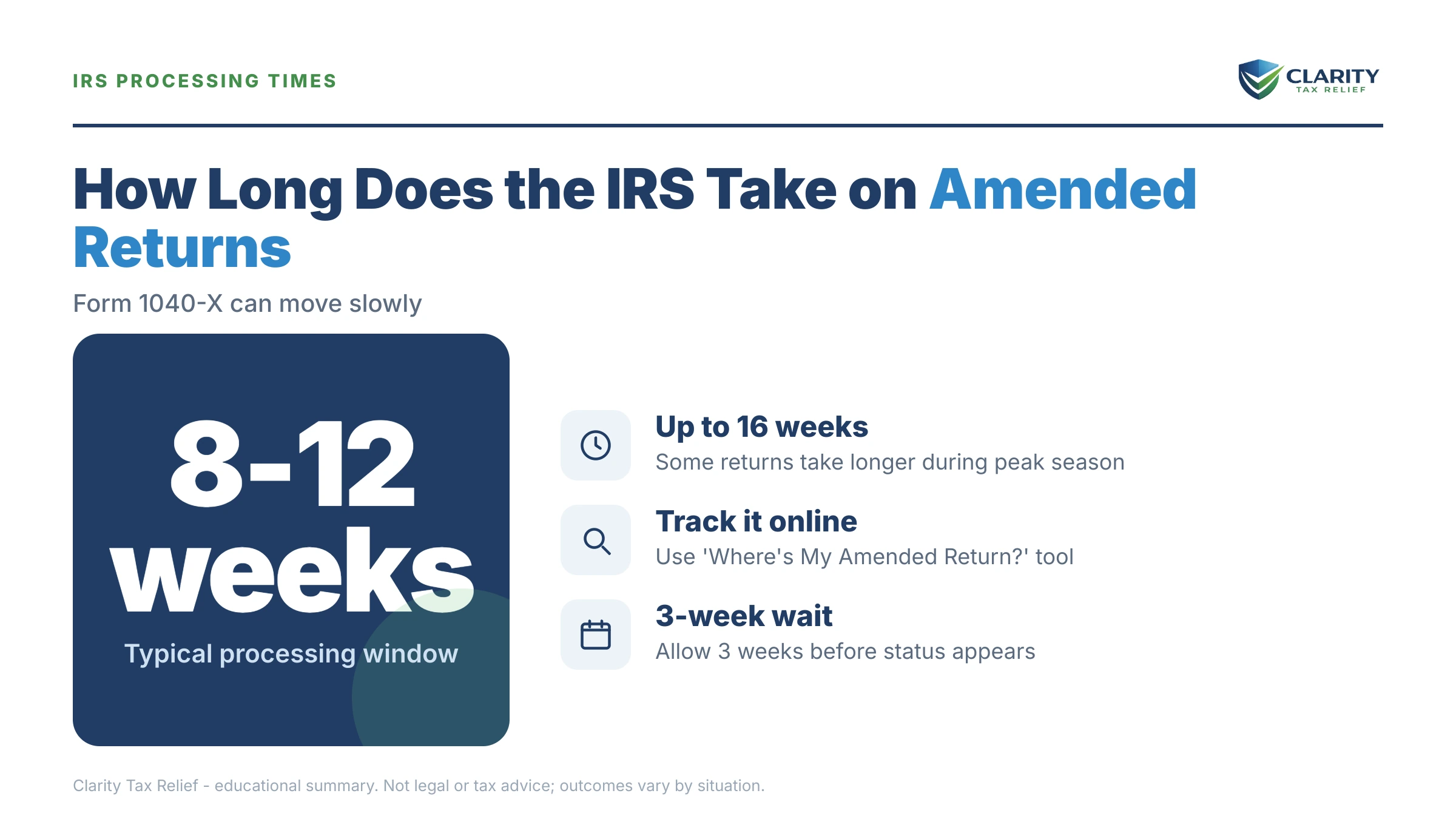
“You can check the status of an amended return around 3 weeks after you submit it. You should generally allow 8 to 12 weeks for your Form 1040-X to be processed. However, in some cases, processing could take up to 16 weeks.”
— Where’s My Amended Return? (IRS.gov)
Why your amended return is taking so long
Amended returns are the most paper-bound work the IRS does, and paper is exactly where the agency fell furthest behind. Per the National Taxpayer Advocate, paper inventories, particularly amended returns, grew to levels not seen in decades and backlogs remained higher than normal as of the end of 2025.
Two forces collided. First, the IRS workforce shrank roughly 27% in 2025, and amended returns, unlike original e-filed returns, usually need a human to review the changes line by line. Fewer humans, same paper. Our guide to IRS layoffs 2026 processing delays covers what else slowed down.
Second, an amended return is inherently a manual product. Even an e-filed 1040-X gets compared against the original return, the account, and third-party data before anyone approves a refund or an abatement. Any mismatch — an identity-verification flag, a math discrepancy, a year already under review — diverts it to a slower queue. For a sense of how long other manual IRS workstreams run, see how long the IRS takes to resolve identity theft cases.
If you're mid-wait and searching for answers, our companion guide where's my amended return taking so long walks through the specific stuck points and what each one means.
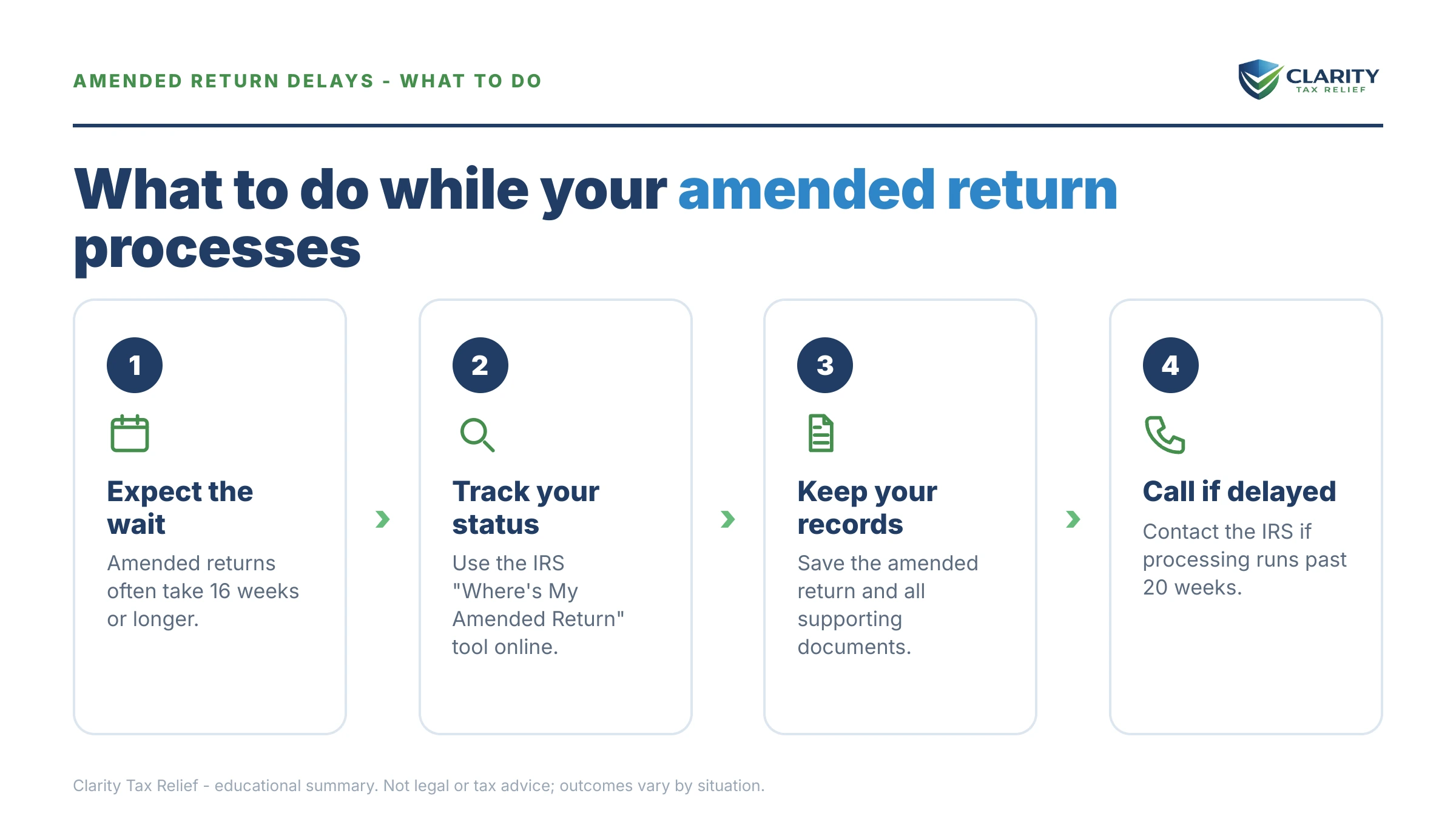
What happens while you wait: the stages your amendment moves through
Every amended return moves through the same sequence, and knowing which stage yours is in tells you whether waiting is normal or something is wrong:
- Filed. An e-filed 1040-X enters the electronic queue immediately. A paper 1040-X, and nearly all business amendments — waits to be opened, sorted, and keyed in by hand before anything else happens.
- Received. The IRS logs the return. Where's My Amended Return shows "Received," and your account transcript posts code 971 irs transcript and code 977 irs transcript entries confirming the amendment is in the system.
- Processing. The longest stage. Non-complex 2023 and 2024 individual amendments may route through the automation; everything else waits for a human. Diversions here — review referrals, verification holds, a year already in exam — add months, not days.
- Adjusted. The IRS has made the change to your account. A transcript code 290 (additional tax assessed, sometimes $0) or 291 (tax abated) posts. You're close, but money hasn't moved yet.
- Completed. The IRS mails the outcome: a refund — watch for the 846 refund issued date on your transcript — a bill, or a letter explaining a change to what you claimed.
One critical warning while you wait: filing an amended return does not pause IRS collection on a balance already assessed for that year. If you amended to shrink a debt the IRS is actively billing, the collection notices keep coming for the full original amount until the amendment posts — which averaged over 5 months in FY 2025. If that's your situation, read amended return processing time owe taxes before you decide to just wait it out.
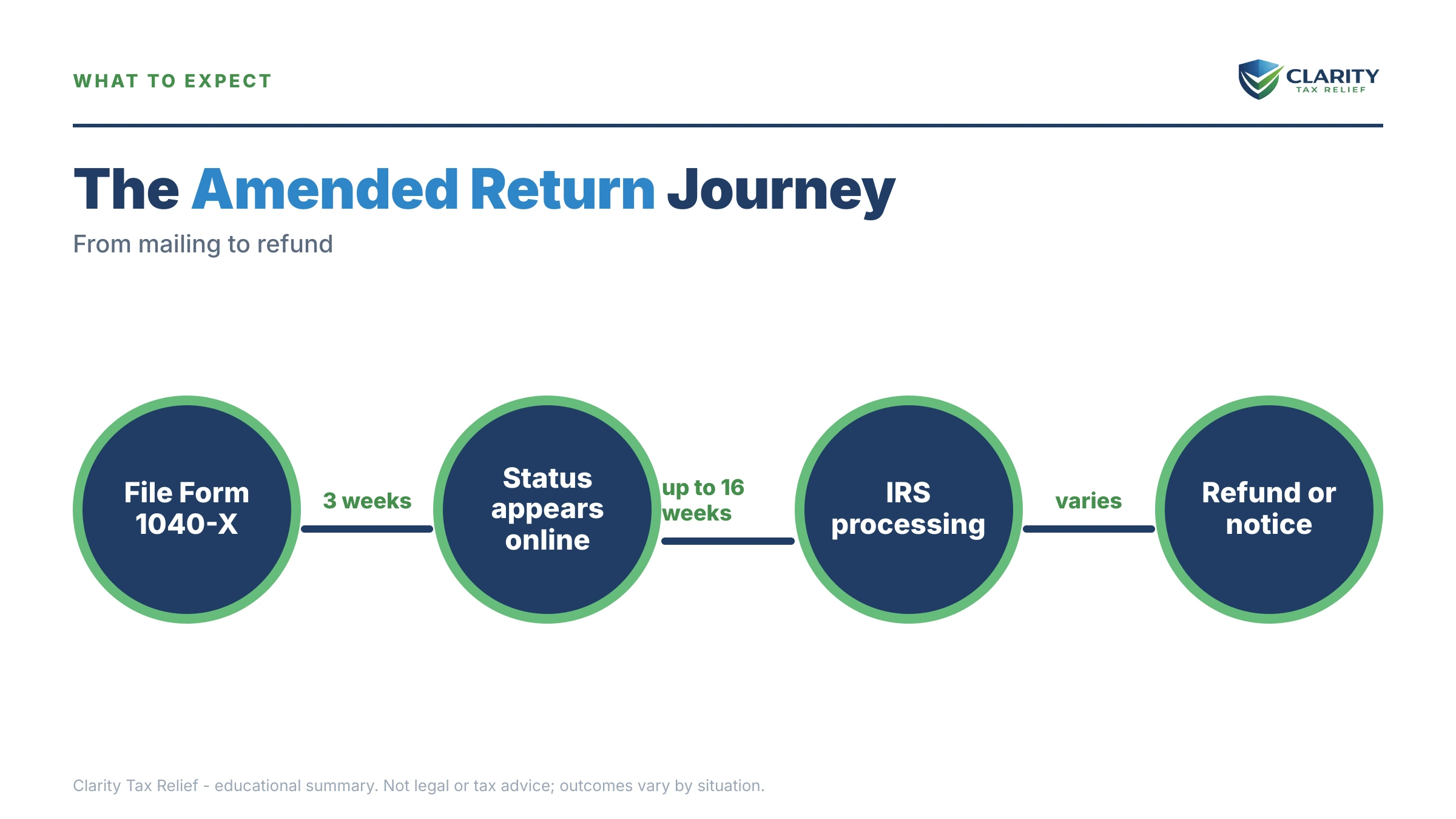
Amended return stuck, with a balance growing while you wait?
If your amendment is months past the 16-week guidance and interest or collection notices are stacking up on the original balance, don't wait for the queue. Get a free case review from an experienced tax professional — we'll pull your transcript, find where the return actually sits, and protect you from collection in the meantime.
How to read your transcript while your amended return processes
Your account transcript shows amended-return progress weeks before Where's My Amended Return updates. Pull it free — here's how to get irs transcript online — and look for these codes:
| Code | What it means | What to do |
|---|---|---|
| 971 | Amended return or claim forwarded for processing — the IRS logged your filing. | Nothing. This confirms receipt; save the date it posted. |
| 977 | Amended return filed — the 1040-X posted to your account. | Start your realistic clock here: over 5 months was the FY 2025 individual average. |
| 290 | Additional tax assessed, often the amendment's adjustment posting (can show $0). | Compare the amount to your 1040-X. A $0 code 290 usually means review finished with no extra tax. |
| 291 | Tax abated — the IRS reduced the tax, matching a refund-type amendment. | Good sign. A refund code typically follows; keep watching weekly. |
| 846 | Refund issued. Your amended-return refund is on the way. | Expect a paper check for many amended refunds, even if you e-filed. |
If no 971/977 pair appears within several weeks of filing, the IRS may not have logged your return yet — that's a reason to verify, not to file a duplicate. A second 1040-X for the same year creates a conflict that slows both copies down.
When to check, when to escalate, and when to get help
Use elapsed time, not anxiety, to decide your next move. The escalation points below are anchored to the official guidance window and the actual FY 2025 averages:
| Time since filing | What to do |
|---|---|
| About 3 weeks | Check Where's My Amended Return for "Received." Pull your transcript for codes 971/977 if the tracker shows nothing. |
| 16 weeks | You've passed the outer edge of official guidance. Call the IRS for a status and note who you spoke with and when. |
| Past 5–6 months (individual) | You've passed the FY 2025 average. If the delay causes financial hardship, request Taxpayer Advocate Service help with Form 911. |
| Past 13 months (business) | You've passed the FY 2025 business average. Escalate through TAS and consider a professional transcript review to find the hold. |
| Any point, if collection is active | Don't wait at all — the IRS collects the original balance while the amendment sits. Get the collection side handled in parallel. |
If your amendment exists to fix a debt problem — reducing a balance, unwinding a substitute return, responding to a mismatch — the amendment is only half the plan. The other half is managing the balance meanwhile. Our hub on how to settle tax debt yourself covers payment plans, hardship status, and settlement options in one place.
A worked example: what the wait actually costs
Say you run a small business with payroll. Two things happen in the same quarter: your CPA finds that a payroll correction entitles the business to a refund, filed on Form 941-X. Your personal 2024 return understated income, so your 1040-X shows you owe $4,000 more.
On the personal side, waiting to pay until the IRS processes the amendment is expensive. The failure-to-pay penalty runs 0.5% per month: $4,000 × 0.5% = $20 per month in penalty alone, plus daily-compounding interest. Over the FY 2025 individual average of over 5 months, that's roughly $100 in penalties before interest — all avoidable by paying when you file. You can estimate your own exposure with our IRS Penalty & Interest Calculator.
On the business side, the 941-X sits in the paper queue that averaged over 13 months in FY 2025. The IRS generally adds overpayment interest to a slow refund, but interest doesn't make payroll. If your business is counting on that money, plan cash flow as if the refund arrives next year, not next quarter. (This is a hypothetical illustration, not a client result.)
How to respond, step by step
- Confirm the IRS has your amendment. Check Where's My Amended Return about three weeks after filing, or pull your account transcript and look for codes 971 and 977.
- Pay any balance you already know you owe. Interest and the 0.5% monthly failure-to-pay penalty run from the original due date — they don't pause while your amendment sits in the queue.
- Calendar two dates. Mark 16 weeks — the outer edge of official guidance and your trigger to start pressing — and the realistic average: over 5 months for a 1040-X, over 13 months for a business return.
- Escalate at 16 weeks or at hardship. Call the IRS to request a status, and if the delay is causing financial harm, file form 911 taxpayer advocate with the Taxpayer Advocate Service.
- Get a professional review if the amendment touches collections. If the amended year also carries a balance, a CP2000, or payroll tax exposure, the order you resolve things in changes what you pay.
When you can handle this yourself, and when help changes the outcome
Most amended-return waits are handled fine with patience and a transcript login. If your amendment is a simple individual fix, no balance is at stake. You can afford to wait out the average, you don't need anyone — check the tracker monthly and let the queue do its slow work. The 2023–2024 automation makes that even more true for non-complex filings.
Experienced help earns its cost in four situations. First, active collection on the year you amended — the IRS will levy for the original balance while your correction waits, and someone needs to hold collection off. Second, business and payroll amendments: a 941-X interacting with trust-fund exposure or an ERC issue is not a wait-and-see document. Third, multiple amended years with balances, where sequencing determines total cost. Fourth, an amendment the IRS partially or fully rejects — appeal windows are short, and the processing delay doesn't extend them.
If any of those describe you, a free transcript review with an experienced tax professional will show where your amendment actually sits and what's at risk while it waits — start at the 2-minute form or call (888) 825-7779.
Terms on your tracker, decoded
- Form 1040-X: the form individuals use to correct a tax return the IRS has already processed — the only way to change income, deductions, credits, or filing status after the fact.
- Where's My Amended Return (WMAR): the IRS's online amended-return tracker. It shows one of three statuses — Received, Adjusted, or Completed — usually starting about three weeks after you file.
- Adjusted: the IRS has changed your account but hasn't finished — the refund, bill, or explanation letter comes at the Completed stage.
- Codes 971 and 977: the transcript pair that proves the IRS received and posted your amendment — your earliest confirmation, often weeks before WMAR updates.
- Overpayment interest: interest the IRS adds when it takes too long to refund you; it's taxable income in the year you receive it.
- Superseding return: a corrected return filed before the filing deadline that replaces your original entirely — when you catch an error early enough, it's usually faster than amending.
Where this data comes from
The FY 2025 processing averages, volumes, and backlog findings in this study come from the National Taxpayer Advocate's annual report to Congress, the independent watchdog office inside the IRS. You can learn more about the office and its case-assistance role at the Taxpayer Advocate Service. We update this page as new fiscal-year data is released.
Amended return processing questions, answered
How long does it really take the IRS to process an amended return in 2026?
Plan on an average of over 5 months for an individual Form 1040-X. That was the FY 2025 average across 3.7 million returns, per the National Taxpayer Advocate. Business amended returns averaged over 13 months across 1.6 million returns. Non-complex 1040-X filings for tax years 2023 and 2024 may move faster because of automation the IRS launched on July 28, 2025, but complex or paper-heavy amendments still routinely run past six months.
Why does the IRS still say 8 to 12 weeks for an amended return?
The 8 to 12 weeks (up to 16 weeks in some cases) figure is the IRS's published guidance, not a measured result. The National Taxpayer Advocate found paper inventories, particularly amended returns, grew to levels not seen in decades, and backlogs remained higher than normal as of the end of 2025. Treat the 16-week mark as your trigger to start pressing for a status, not as a realistic delivery date.
How do I check the status of my amended return?
Use the IRS Where's My Amended Return tool, which typically shows a status about three weeks after you file, or pull your account transcript and look for codes 971 and 977, which confirm the IRS received your amendment. The tracker moves through three stages — Received, Adjusted, and Completed. If nothing appears after several weeks, your return may not have been logged yet; keep your proof of mailing.
Should I pay now if my amended return shows I owe more tax?
Yes — pay the extra tax when you file the amendment, not when the IRS finishes processing it. Interest runs from the original due date of the return. The failure-to-pay penalty adds 0.5% per month, so waiting out an average processing time of over 5 months only makes the bill bigger. Paying up front stops the penalty clock even while the paperwork sits in the queue.
Does the IRS pay interest on an amended return refund?
Generally yes. When the IRS takes longer than its allowed window to issue an overpayment refund, it adds overpayment interest to the check. That interest is taxable income — expect a Form 1099-INT if it comes to $10 or more, and report it the following year. Interest doesn't fix cash-flow damage, though, which is why a hardship escalation through the Taxpayer Advocate Service can matter far more than the interest itself.
Why do business amended returns take over 13 months?
Business amendments averaged over 13 months across 1.6 million returns in FY 2025 largely because most of them are still processed on paper. Payroll corrections like Form 941-X and many corporate amendments can't ride the automation the IRS built for individual 1040-X returns, so they sit in the same paper inventories the Taxpayer Advocate flagged as the largest in decades. If your business amendment claims a refund, build that wait into your cash-flow planning now.
Can the Taxpayer Advocate Service speed up my amended return?
Yes, in two situations: your amendment has been pending well past normal processing timeframes, or the delay is causing financial hardship — a levy in motion, payroll you can't meet, an eviction risk. File Form 911 to request assistance. TAS can't jump the line for ordinary impatience, but for a return stuck past the averages with real consequences attached, a case advocate can force movement that phone calls can't.
Your next 24 hours
- Find your filing date. Pull your proof of e-file acceptance or your certified-mail receipt and count how many weeks you're in. Under 16 weeks is normal; past the FY 2025 average of over 5 months means it's time to escalate.
- Gather three documents: a copy of the amended return, the original return for that year. Your newest account transcript showing whether codes 971 and 977 have posted.
- Get a free case review if your amendment is past the averages, tied to a growing balance, or a business filing your cash flow depends on — the 2-minute form or (888) 825-7779. Interest and penalties on any balance keep accruing while the paperwork waits; your plan shouldn't.
This guide is general information, not tax or legal advice for your specific situation. Eligibility for IRS programs depends on individual facts and circumstances; no outcome is guaranteed.