
Reaching the IRS
How to Get Your IRS Balance by Phone or Mail (No Online Access) in 2026
The short answer: to get your IRS balance by phone, call the individual line at 1-800-829-1040, Monday–Friday, 7 a.m.–7 p.m. local time, and an assistor reads you the balance for each tax year after verifying your identity. No online account or ID.me is needed. Prefer mail? Order an account transcript at 1-800-908-9946.
You tried to check what you owe online, and ID.me wouldn't verify you — a frozen credit file, no cell phone in your name, or a mismatched address stopped you cold. That's frustrating, but it doesn't lock you out of your own account. The IRS still keeps two offline doors open: the phone and the mail, and both read from the exact same account data the website would have shown you.
Two things are worth knowing before you dial. First, the number you're quoted on the phone is a snapshot, not a fixed payoff — the image below shows where each figure lives and why the number keeps moving. Second, in 2026 the hold times are brutal, so it pays to call prepared and at the right hour.
⏱ The clock that never stops: there's no "deadline" to check your balance, but the balance itself grows every day you don't act. The failure-to-pay penalty adds 0.5% a month and interest compounds daily, so any number the IRS gives you is already climbing. Ask for a "payoff good through" a future date so your payment actually covers it.
Why you can't see your balance online
Most people who search for their IRS balance by phone have already hit a wall at the online account door. The wall is almost always identity verification, not the balance itself.
ID.me, the third-party service the IRS uses, needs to match your identity against outside records. It fails when your credit file is frozen, when you don't have a smartphone or a U.S. mobile number in your own name, when your address doesn't match your last return, or when you're verifying for a business. If that's you, our ID.me / idverify.irs.gov problems, solved guide walks through the fixes, but you don't have to solve it to learn your balance today.
A few balances also simply don't appear online yet: a freshly assessed amount, a return the IRS just processed, or certain business accounts. The phone and mail routes pull straight from IRS master file records, so they often show a number before the website catches up.
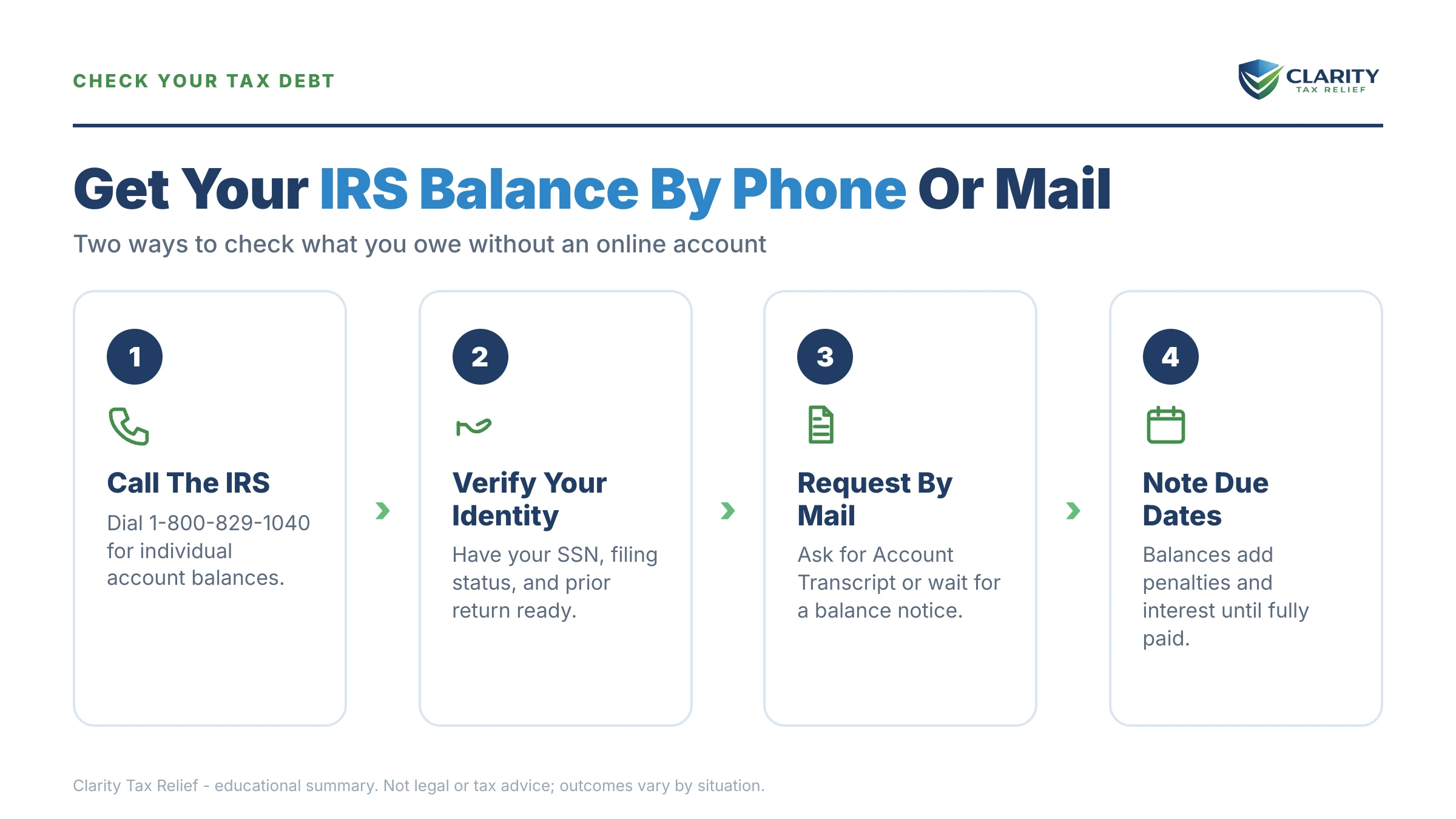
Three ways to get your IRS balance without online access
You have exactly three offline paths, and they trade speed for effort. The phone gets you a live number the same day if you can get through; the mail needs zero hold time but takes over a week; a tax professional does the calling for you.
| Method | What you need | How long it takes |
|---|---|---|
| Call the IRS (1-800-829-1040) | SSN/ITIN, filing status, prior-year return, patience | Same day, if you reach an assistor |
| Account transcript by mail (1-800-908-9946 or Form 4506-T) | SSN, address of record, DOB | 5–10 calendar days |
| Authorize a tax professional (Form 2848 or 8821) | Signed authorization form | Depends on the firm; pros use a priority line |
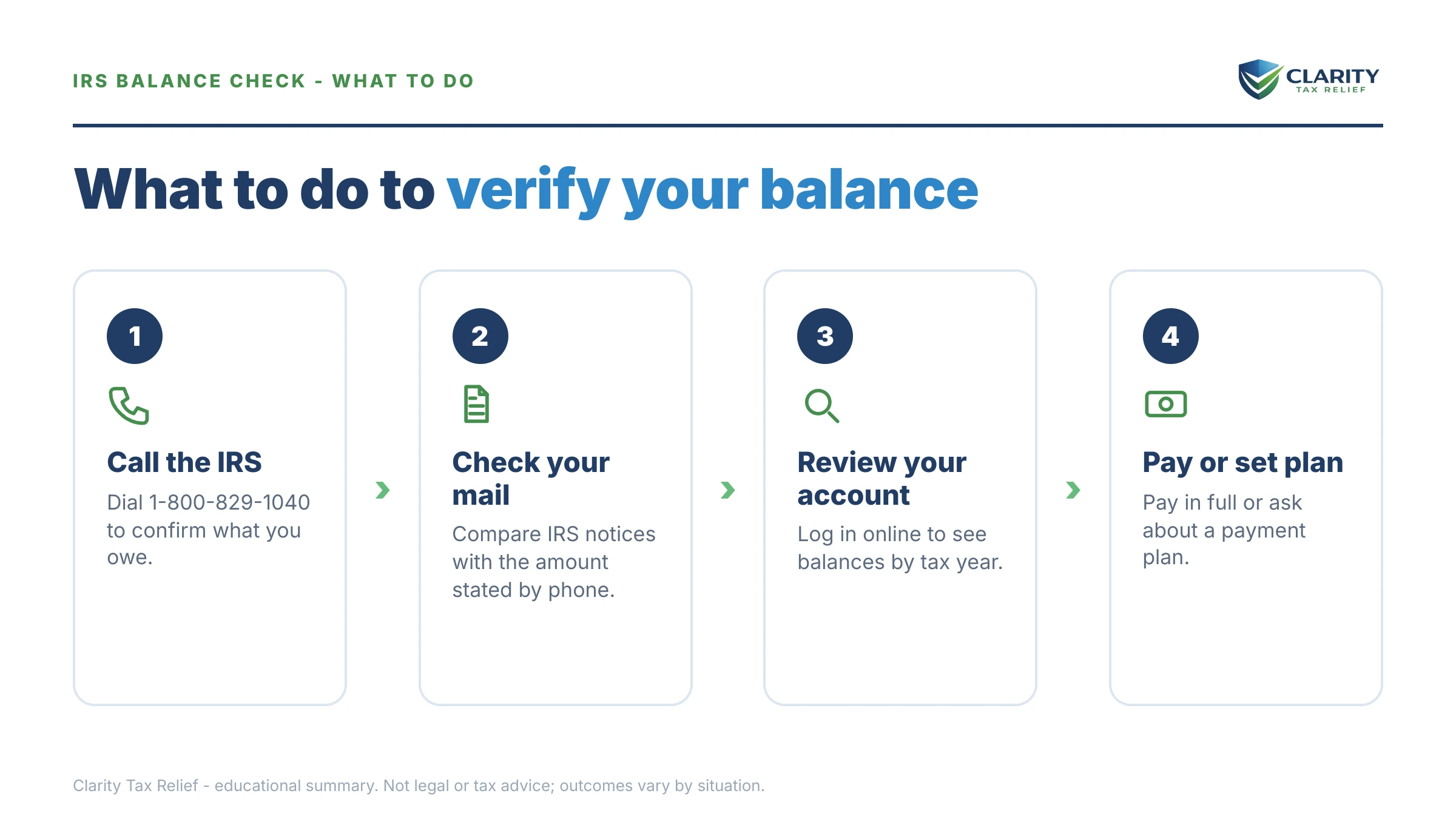
Getting your IRS balance by phone
The individual balance-due line is 1-800-829-1040, open Monday–Friday, 7 a.m.–7 p.m. in your local time zone. Businesses use 1-800-829-4933. An assistor can read you the balance for every open tax year — the part the automated menu often won't.
Expect to verify your identity before they'll say a number out loud. Have your Social Security number or ITIN, date of birth, filing status, current mailing address, and a copy of your most recent return in front of you. If a specific notice brought you here, keep it handy. They may ask for the notice number to confirm it's really you.
Because the IRS workforce shrank roughly 27% in 2025, hold times are long and some calls drop. Call early in the morning, midweek, and avoid Mondays and the weeks around filing deadlines. Our guides on the best time to call the IRS and what to do when you can't reach the IRS on the phone cover the workarounds, including the IRS callback service. And before you dial, it's worth reading our scripts for calling the IRS about back taxes so the call does double duty.
| Line | Number | Hours (local time) |
|---|---|---|
| Individual accounts & balance | 1-800-829-1040 | Mon–Fri, 7 a.m.–7 p.m. |
| Business accounts & balance | 1-800-829-4933 | Mon–Fri, 7 a.m.–7 p.m. |
| Automated transcript by mail | 1-800-908-9946 | Automated — 24/7 |
One habit that saves a second call: don't just ask "what do I owe?" Ask for the balance broken out by tax year, and ask for a payoff amount good through a specific future date — say, the day you plan to pay. Write down the balance per year, the assistor's ID badge number, and the date. That record matters if the figure is ever disputed.
Getting your IRS balance by mail
If you can't sit on hold, order an account transcript. It lists the balance and every posting (assessments, payments, penalties, interest) for a tax year. It's the same document a professional reads to reconstruct a case.
Two mail routes exist. The fastest is the automated Get Transcript by Mail line at 1-800-908-9946 — punch in your SSN, date of birth, and the numbers of your street address exactly as they appear on your last return, and the transcript ships to your address of record in 5 to 10 calendar days. The second is Form 4506-T, mailed or faxed, which takes longer but lets you request years the automated line won't.
Because the transcript goes only to your address of record, mail is a poor fit if you've recently moved and haven't filed Form 8822. If the numbers on a transcript look foreign to you, our guide on how to read an IRS account transcript decodes each line, and if you'd rather try the digital route again later, here's getting your transcripts online and the full IRS online account setup walkthrough.
Let a professional pull it for you
You can authorize someone else to get your balance so you never touch the phone. A tax professional files a Form 2848 Power of Attorney or a Form 8821 Tax Information Authorization, then pulls your full account through the Practitioner Priority Service line — a queue that moves faster than the public line.
The difference in 2026 isn't just speed. A pro reads the transcript for what it means: whether the balance includes penalties that can be removed, whether a return is missing, and whether the collection clock is running. A raw number tells you what you owe; a trained eye tells you what to do about it.
Worked example: why the phone number keeps moving
Say you think you owe about $8,400 from your 2023 return and you call to confirm. The assistor quotes $8,400 as of today. But that's a still photo of a moving target.
The failure-to-pay penalty runs 0.5% a month — roughly $42 on this balance — and interest compounds daily on top of it, adding tens of dollars more each month. So the balance the IRS quotes in, say, mid-August is close to $100 higher by late September. If you mail a check for exactly $8,400 six weeks later, you'll get another notice for the shortfall. That's why you ask for a "payoff good through" your intended pay date — the assistor bakes in the accruing penalty and interest so your one payment closes the account. (Curious how the interest math actually stacks up? See how big IRS penalties get, or estimate it with our IRS penalty & interest calculator.) This is a hypothetical to show the arithmetic, not a promise about any specific balance.
What happens if you never check the balance
Not knowing your balance doesn't pause it — the IRS keeps mailing, and the automated collection sequence keeps advancing whether or not you ever open the letters.
- The balance grows silently. Penalties and interest compound every month you don't act.
- CP14 — the first balance-due bill. Just a bill, but the clock is ticking.
- CP501 / CP503 — reminder notices, each with a larger number.
- CP504 — Notice of Intent to Levy your state tax refund, and a federal lien becomes possible.
- LT11 / Letter 1058 — Final Notice of Intent to Levy. After 30 days the IRS can garnish wages and levy bank accounts, though you gain formal appeal rights here.
The whole point of learning your balance today is to get ahead of that ladder — see the full order of IRS collection letters if you're trying to place where you stand.
Can't reach the IRS to get your balance?
We can pull your full account — every year, every penalty, the real payoff — usually faster than the public phone line, and tell you what your options are. Free, confidential, no pressure. Interest and penalties keep accruing while you wait, so the sooner you know the number, the more you can do about it.
What to do once you know what you owe
Knowing the number is step one; deciding what to do with it is where the money is. Which path fits depends on the size of the balance and whether you can pay.
| If your situation is… | The likely fit | What it costs |
|---|---|---|
| You can pay within ~180 days | Short-term payment plan | $0 setup; interest/penalty continue |
| You owe ≤ $50,000, need time | Streamlined installment agreement (up to 72 months) | Setup fee; interest/penalty continue |
| Paying anything causes hardship | Currently Not Collectible | No payment; debt stays, collection pauses |
| Assets/income can't cover the debt | Offer in Compromise (means-tested) | $205 fee (waivable if low-income) |
| First slip in 3 clean years | First-time penalty abatement | Free; removes the penalty portion |
How to get your IRS balance by phone, step by step
- Gather your identity documents — SSN or ITIN, filing status, your most recent return, and any recent notice, all in front of you before you dial.
- Call the right IRS line — 1-800-829-1040 for individuals (1-800-829-4933 for businesses), Monday–Friday, 7 a.m.–7 p.m. local time.
- Verify your identity — answer the assistor's questions, typically your SSN, date of birth, filing status, and details from a prior-year return.
- Ask for the balance by tax year and a payoff good-through date — request each year separately and a payoff good through your intended pay date, since interest and penalties keep accruing.
- Write down everything and ask about relief — record the balance per year, the assistor's ID number. The date, then ask about payment plans or hardship options before you hang up.
When you can handle this yourself, and when help changes things
If you just need the number and the balance is small and current, handle it yourself. Calling 1-800-829-1040 or ordering a transcript by mail is free and straightforward — no professional required to read you a figure or set up a simple payment plan you can afford.
Experienced help changes the outcome when the number is a surprise, spans multiple years, or comes with unfiled returns behind it. A pro can file the authorization, pull the full history, spot penalties that qualify for removal, and set the resolution order so you don't overpay. If a levy or garnishment is already in motion, or you owe well into five figures, that's the moment to stop guessing and get a review — see every real free-help option first if cost is the worry.
Terms on your notice and transcript, decoded
Account transcript — the year-by-year record of your tax, payments, penalties, and interest; the document that shows your true balance.
Payoff amount — the balance projected forward to a specific future date, including accruing penalty and interest, so a single payment fully closes it.
Practitioner Priority Service (PPS) — the dedicated IRS phone queue tax professionals use to pull client accounts faster than the public line.
Form 2848 vs. Form 8821 — 2848 lets a representative speak and act for you; 8821 lets someone only receive your tax information. Either one lets a pro get your balance.
Address of record — the address the IRS has on file; where a mailed transcript goes, so it must be current.
IRS balance by phone and mail: questions, answered
Can I get my IRS balance by phone?
Yes. Call the IRS individual line at 1-800-829-1040, Monday through Friday, 7 a.m. to 7 p.m. local time, and an assistor can tell you your balance for each tax year after verifying your identity. You'll need your SSN, filing status, and a prior-year return handy. There's no fee, but expect long hold times in 2026 — the IRS workforce shrank about 27% in 2025.
What number do I call to check my IRS balance?
Individuals call 1-800-829-1040; businesses call 1-800-829-4933. Both run Monday through Friday, 7 a.m. to 7 p.m. in your local time zone. To order an account transcript by mail instead of speaking to anyone, use the automated line at 1-800-908-9946, which mails your transcript in 5 to 10 calendar days.
Can I check my IRS balance without an online account or ID.me?
Yes. You have three offline routes: call the IRS by phone, order an account transcript by mail, or authorize a tax professional to pull it for you. None of them require ID.me or a smartphone. The mail transcript is the slowest but needs no phone hold time. The phone line gets you a live number the same day if you can get through.
How do I get my IRS balance by mail?
Request an account transcript, which shows the balance and every posting for a tax year. Use the automated Get Transcript by Mail line at 1-800-908-9946, or mail or fax Form 4506-T. The transcript arrives at your address of record in 5 to 10 calendar days, so mail is best when you don't need the figure today.
Why can't I see my IRS balance online?
The most common reason is failing ID.me identity verification — a frozen credit file, no U.S. cell phone in your name, or a mismatch on your address can all block sign-up. Newly assessed balances and certain business accounts also may not display online yet. When the online account won't work, the phone and mail routes see the same account data.
Can someone else call the IRS and get my balance for me?
Only if you authorize them. A tax professional needs a Form 2848 Power of Attorney or a Form 8821 Tax Information Authorization on file to discuss your account. They use a dedicated Practitioner Priority Service line. A family member helping you can be added as a designee, or you can put them on the line after you verify your own identity.
What information do I need to verify my identity on the phone?
Have your Social Security number or ITIN, date of birth, filing status, current mailing address, and a copy of your most recent tax return. The assistor may ask about specific line items or a recent notice number to confirm it's really you. Without a matching prior-year return, verification often fails and you'll be asked to call back.
Is the balance I'm quoted by phone the exact payoff amount?
No — it's a snapshot as of that day. Interest compounds daily and the failure-to-pay penalty adds 0.5% a month, so the number grows between the call and the day you actually pay. Ask the assistor for a "payoff amount good through" a specific future date so your payment covers the balance in full.
Your next 24 hours
- Find your paperwork. Pull your Social Security number, your filing status, and your most recent tax return, plus any IRS notice you've received. You can't get a balance without them.
- Write down the years you're asking about. Note every tax year you think you owe for, so you can ask for each balance separately instead of one vague total.
- Get the number. Call 1-800-829-1040 early in the morning, order a transcript at 1-800-908-9946, or let us pull your full account — start a free case review at the form or call (888) 825-7779. Every month you wait, the balance climbs.
This guide is general information, not tax or legal advice for your specific situation. Eligibility for IRS programs depends on individual facts and circumstances; no outcome is guaranteed.