
Tax Debt Relief
Free Help With IRS Tax Debt: Every Real Option in 2026
The short answer: free help with IRS tax debt is real. The Taxpayer Advocate Service, Low Income Taxpayer Clinics, the IRS's own online tools, and built-in fee waivers all cost nothing. Most are means-tested — LITCs generally serve incomes under roughly 250% of the federal poverty level — but the IRS's free tools are open to everyone.
You're staring at a levy warning on the kitchen table, rent is due, and every ad in your search results wants $3,000 you don't have to "fight the IRS for you." Here's what none of those ads lead with: Congress funds an entire layer of genuinely free help — advocates, clinics, hearings, and fee waivers — and a levy threat is exactly the situation it was built for. This guide maps every free option, who qualifies for each, and the deadlines that keep them alive.
⏱ The real clock: there's no application deadline for free help, but your balance grows every month it waits. The failure-to-pay penalty adds 0.5% per month, plus compounding interest. And if an LT11 or Letter 1058 is in your stack, the 30-day date printed on it is a hard deadline for your free Collection Due Process hearing.
Who actually provides free IRS tax debt help, and why it exists
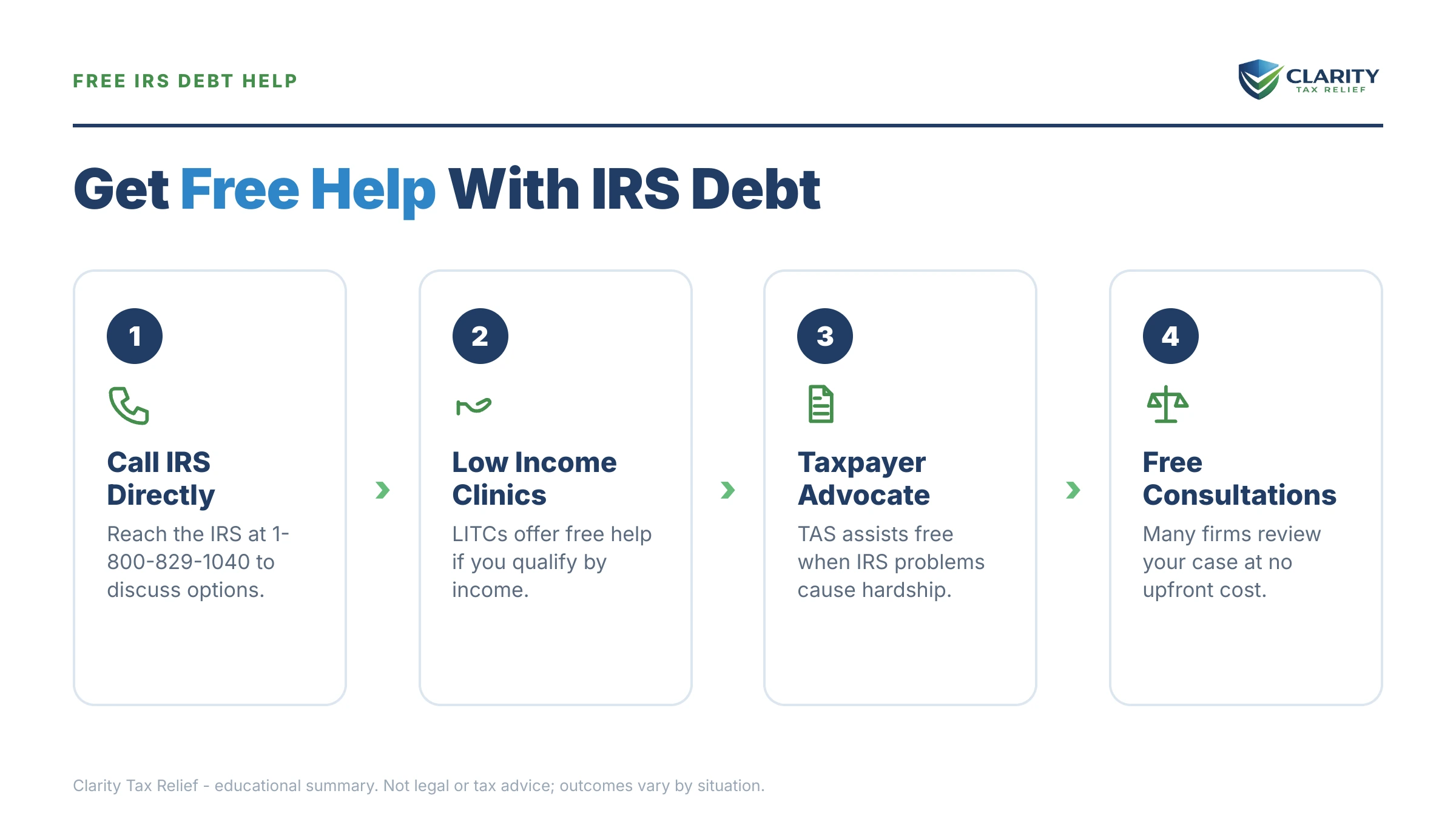
Free help with IRS tax debt comes from four real sources: the IRS's own free tools, the Taxpayer Advocate Service, Low Income Taxpayer Clinics, and fee waivers built into IRS programs themselves.
None of this is charity from the collections side of the IRS. Congress created the Taxpayer Advocate Service (TAS) as an independent organization inside the agency, specifically to intervene when IRS action, like a levy, causes financial harm. It funds grants to Low Income Taxpayer Clinics, which are independent legal clinics (often at law schools) that represent lower-income taxpayers in collection disputes for free.
Two more layers cost nothing. Your appeal rights — including the Collection Due Process hearing that can pause a levy — are free to every taxpayer who exercises them on time. And several IRS programs waive their own fees for lower incomes: the Offer in Compromise application fee, the payment-plan setup fee, and more.
Free does not mean second-rate. LITC attorneys take cases all the way to Tax Court, and TAS can order account holds that a paid firm can only request. What free help cannot do is skip the means tests — which is why knowing the thresholds matters more than knowing the phone numbers.
What happens if you do nothing
An unpaid $41,800 balance grows by roughly $209 a month in failure-to-pay penalty alone, before interest, while the collection notices escalate on an automated schedule. Free help gets weaker at every stage, because each notice burns a right you could have used.
- First bills (CP14, CP501, CP503) — pure billing stage. Every free option is still open, and setting up even a $0-fee short-term plan stops the sequence.
- CP504 — Notice of Intent to Levy — the IRS can now seize your state tax refund, and a federal tax lien becomes realistic. Still not the final notice.
- LT11 / Letter 1058 — Final Notice — starts a 30-day clock. Inside that window, a free Collection Due Process hearing request generally blocks levy on those periods. Miss it, and that protection is gone.
- Levy — a bank levy freezes funds with a 21-day hold before the money leaves. A wage levy is continuous until released; Social Security can be levied up to 15% through the Federal Payment Levy Program. Free releases still exist here, but you're negotiating while money disappears.
- The threshold problem — a growing balance can eventually cross the $66,000 passport-certification threshold for 2026. At $41,800 you're under it today; years of accrual can change that.
Don't count on staffing chaos to save you. The IRS budget cuts 2026 made humans harder to reach, but the notices, liens, and levies come from automated systems that never got smaller. If you're wondering what a wage levy would actually leave in your paycheck, you can estimate it with our IRS Wage Garnishment Calculator.
Levy threat on the table and no room in the budget?
Send us your notices. An experienced tax professional will map which free options your numbers actually support, and which deadlines still protect you, before penalties and interest add another month to the balance. The review is free, confidential, and pressure-free.
Every free tax debt resource, and who qualifies
Eight distinct free resources exist, and eligibility for each turns on a different test. Your income, your notice, or nothing at all.
| Free resource | Who qualifies | What it does at no cost |
|---|---|---|
| IRS online account & Direct Pay | Everyone | See balances, penalties, and transcripts; make payments; set up most plans without calling |
| Short-term payment plan | Anyone who can pay within 180 days | $0 setup fee; stops the notice escalation while you pay |
| Taxpayer Advocate Service (Form 911) | Financial hardship or IRS system failure | Independent advocate who can intervene in levies and stuck cases |
| Low Income Taxpayer Clinic | Income generally ≤ ~250% of the federal poverty level | Free representation in collection disputes, appeals, and Tax Court |
| Collection Due Process hearing (Form 12153) | Anyone within 30 days of an LT11/Letter 1058 or lien notice | Free hearing that generally pauses levy on those periods while pending |
| Penalty relief (FTA / AEP) | Clean compliance for the prior 3 years | Removes qualifying penalties; AEP becomes automatic starting summer 2026 |
| OIC low-income certification | AGI ≤ 250% of the federal poverty level | Waives the $205 fee, the 20% down payment, and payments during review |
| VITA / TCE free filing | Lower and moderate incomes, age 60+, disabilities, limited English | Free preparation of current and unfiled returns, often step one of any resolution |
A few of these deserve one extra sentence. If unfiled years are part of your problem, VITA free tax help can prepare the missing returns at no cost, and no resolution program will accept you until they're filed. If a levy is causing genuine hardship — you can't cover rent, utilities, or food — the IRS is required to consider release under §6343. The request is free. Our guide to emergency levy release for hardship walks through it. And penalty relief is free by design: see first-time penalty abatement now. The new automatic exemption from penalty (AEP) that replaces it starting summer 2026.
The deadlines that protect your free rights
A timely Collection Due Process request — free, filed on Form 12153 — generally bars the IRS from levying the covered tax periods while your hearing is pending. Every free right in the collection process works this way: it's attached to a window, and the window is printed on a notice.
| What happened | Your window | The free right at stake |
|---|---|---|
| CP504 arrived | The pay-by date printed on it | Resolving before the state-refund levy and before the final notice issues |
| LT11 / Letter 1058 arrived | 30 days from the notice date | CDP hearing (Form 12153) — generally pauses levy on those periods and preserves Tax Court review |
| CDP window missed | Generally up to 1 year | An "equivalent hearing" — still free, but it doesn't pause levy or preserve Tax Court rights |
| Bank levy served | 21 days before the bank releases funds | Time to win a hardship release, plan, or TAS intervention before the money leaves |
| Wage levy in effect | None — continuous until released | Free §6343 hardship release request; every pay period before release is reduced |
If your levy is already causing you to miss basic bills, that's the trigger for the Taxpayer Advocate — the request is Form 911, and "the levy threatens my housing" is precisely the kind of hardship TAS exists to act on.
A worked example: $41,800 owed, a renter, and a levy notice
Say you owe $41,800 across two tax years, rent your apartment, earn $38,000 as a single filer, and an LT11 arrived this week. Here's how the free options stack up, with the math shown. (This is a hypothetical, not a client case.)
- The cost of waiting: 0.5% × $41,800 = about $209 per month in failure-to-pay penalty, plus compounding interest on top. Doing nothing for a year adds thousands.
- The obvious paid-in-full path: $41,800 is under $50,000, so a streamlined 72-month plan is available online. $41,800 ÷ 72 ≈ $581/month before continuing interest — brutal on roughly $3,167/month gross income with rent to cover.
- The means tests: at $38,000, a single-person household is typically at or below 250% of the federal poverty level — confirm against the current-year guideline. If so, two doors open: free LITC representation, and the OIC low income certification, which waives the $205 fee, the 20% down payment, and payments while the offer is reviewed.
- The free move this week: file Form 12153 within the 30-day window. Levy action on those periods is generally paused while the hearing is pending, and in the hearing you can propose alternatives: a lower payment based on a Form 433-F budget, Currently Not Collectible status, or an OIC.
- The honest OIC caveat: if rent, utilities, food, and transportation consume nearly all of $38,000, the IRS's collection math may support a low offer. But the IRS accepted roughly 1 in 5 offers in FY2024, so treat it as one option to test, not a promise.
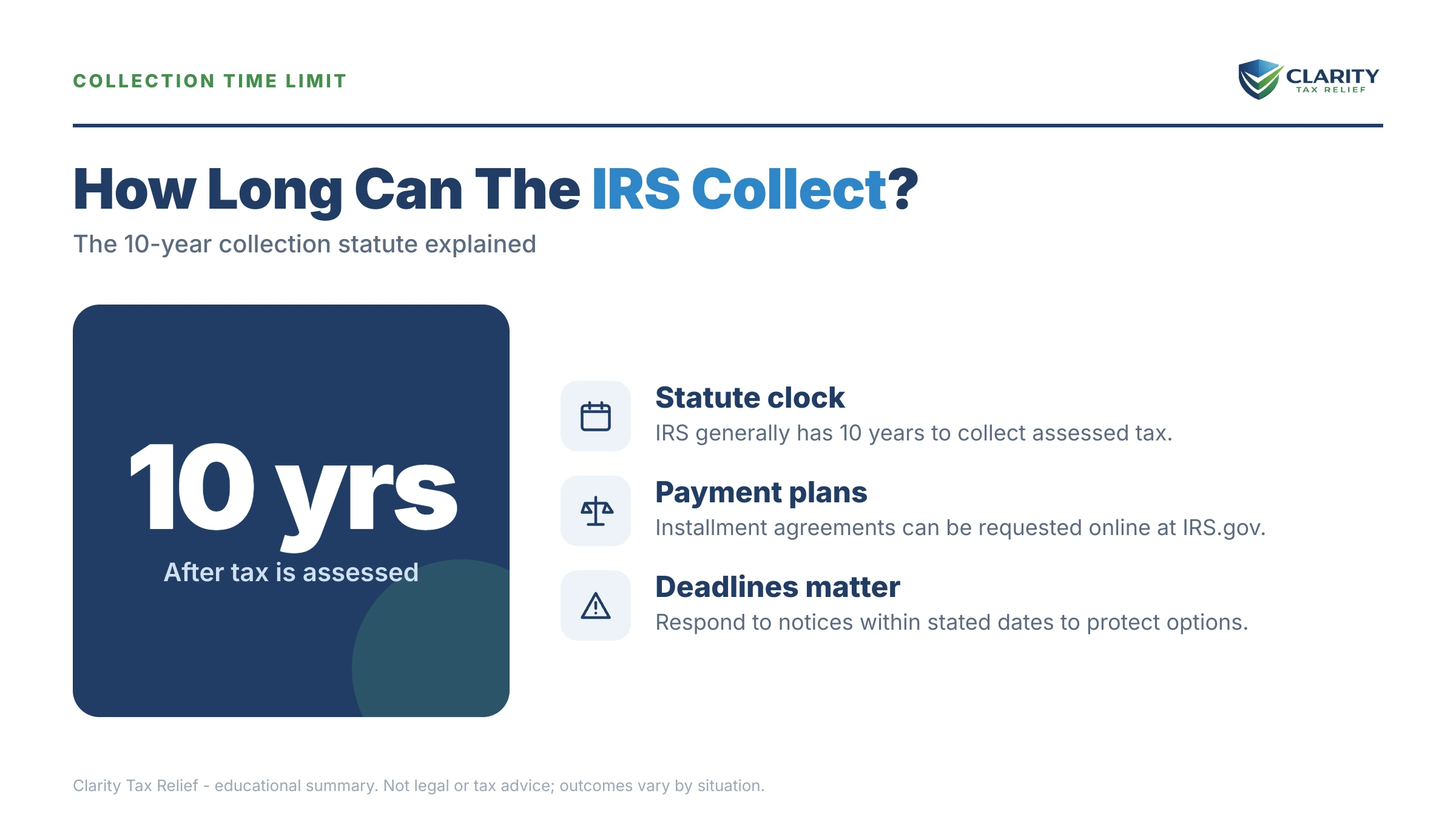
- The fallback: Currently Not Collectible pauses collection entirely if your budget shows no room. The debt remains and refunds get offset each year, but the 10-year collection statute keeps running the whole time.
Total out-of-pocket for that entire sequence — CDP request, LITC representation, hardship documentation, even a low-income OIC — can genuinely be $0.
How to get free help with IRS tax debt, step by step
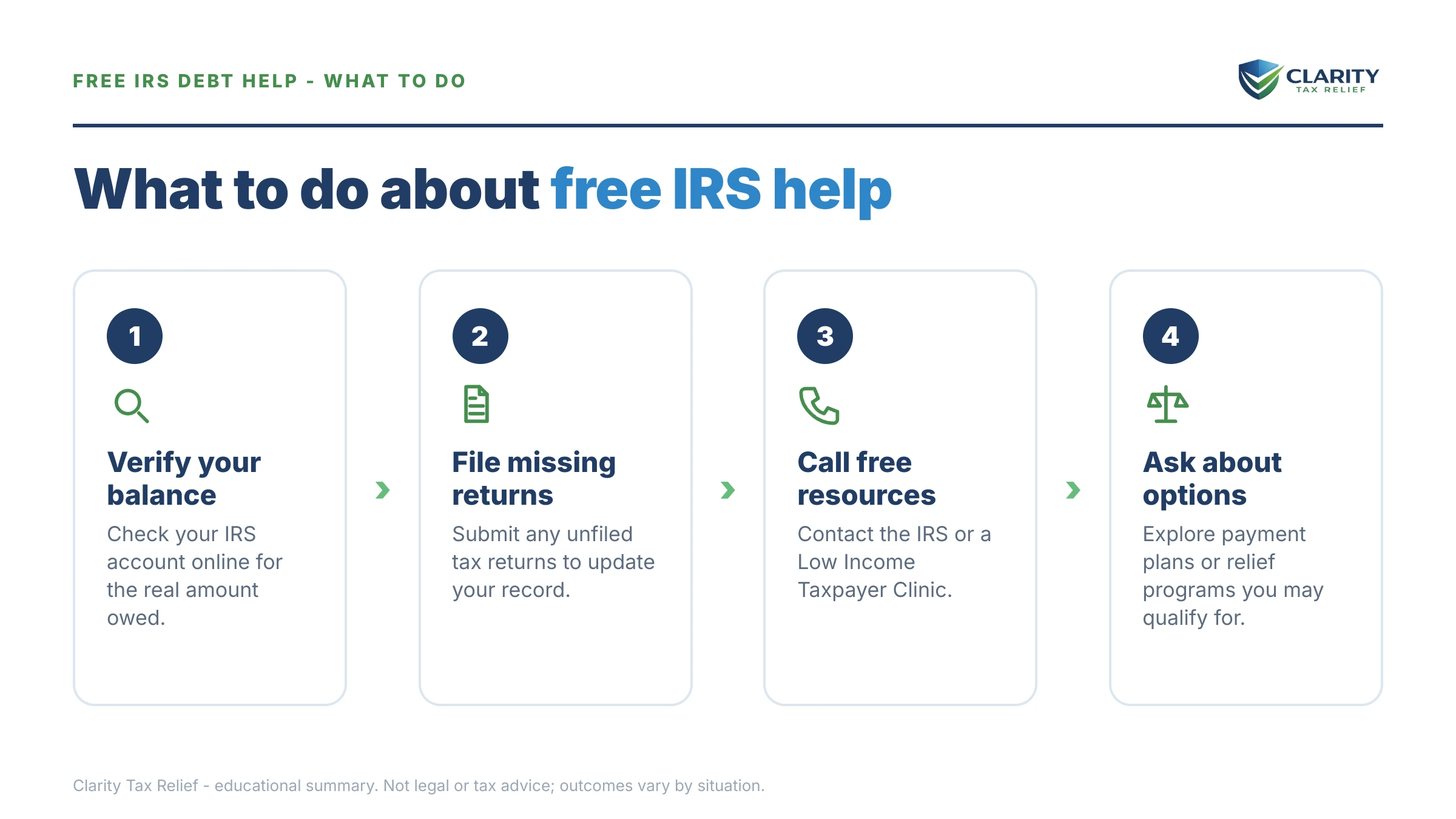
- Pull your IRS records free. Create an IRS online account to see every year's balance, penalties, and filed returns — the same data any professional would start with.
- Circle every deadline in your stack. Find the date on each notice. If one is an LT11 or Letter 1058, the 30-day Collection Due Process window is your most valuable free right.
- Run the means tests on your income. Compare your household income to 250% of the current federal poverty level. Under it, LITC representation and the OIC low-income certification both open up.
- File the free requests that fit. Form 12153 for a CDP hearing, Form 911 for the Taxpayer Advocate, a penalty abatement request, or a $0-setup short-term payment plan at IRS.gov.
- Pressure-test the plan with a free consultation. Before you commit to any option, have an experienced tax professional confirm the numbers — the review costs nothing.
When free help is enough, and when paid help changes the outcome
Most people who owe under $25,000, agree with the balance, and aren't facing active enforcement can resolve the debt themselves online at no cost beyond the tax. If that's you: set up a plan through the walkthrough in how to set up an IRS payment plan online, request penalty abatement, and you're done — our hub on how to settle tax debt yourself covers the full DIY path.
Free help fits best when you're clearly inside its lanes: income under the LITC threshold, a hardship TAS will recognize, or a single clean deadline like a CDP window. Where experienced help tends to change outcomes: a levy already in motion with the 21-day clock running, multiple unfiled years that have to be sequenced before any program will accept you, business or payroll debt, income just above the free-help thresholds, and OIC math — where a miscalculated offer wastes months and gets rejected. Above six figures, the IRS handles cases differently altogether; see our guide to large tax debt help for what changes at that level.
One more honest note: LITCs and TAS are stretched thin in 2026, and clinics decline cases when they're full. Free is the right first check, but it's not always available on the timeline your notice demands.
"Free tax relief" offers that aren't
Real free help never opens with a settlement promise. In June 2026, federal regulators permanently banned a national tax-relief operation over exactly that playbook — "pennies on the dollar" pitches and guaranteed savings claims that no honest professional can make, because every IRS program is means-tested against your specific finances.
Three tells separate a real free resource from a sales funnel dressed as one. First, real free help never asks for payment to "unlock" the free part — TAS, LITCs, and IRS tools have no upsell. Second, real help starts by looking at your transcripts and budget, not by quoting a settlement figure on the first call. Third, the IRS never initiates contact by text, email, or social media — an unsolicited "you've been approved for the forgiveness program" message is a scam, full stop. A legitimate firm's free consultation (including ours) reviews your numbers and tells you plainly when a free resource is your best move.
Terms you'll see, decoded
- Levy vs. lien: a levy takes property (wages, bank funds); a lien is a legal claim against it that secures the debt without seizing anything.
- TAS: the Taxpayer Advocate Service — an independent organization inside the IRS that intervenes free of charge when IRS action causes hardship.
- LITC: Low Income Taxpayer Clinic — an independent, grant-funded clinic providing free representation to income-qualified taxpayers.
- CDP: Collection Due Process — your free right to a hearing (Form 12153) within 30 days of a final levy notice or lien filing.
- CNC: Currently Not Collectible — a hardship status that pauses IRS collection while your budget shows no ability to pay.
- Low-income certification: the OIC provision that waives the $205 fee, 20% down payment, and payments during review when AGI is at or below 250% of the federal poverty level.
Primary sources worth bookmarking: the Taxpayer Advocate Service (TAS and the LITC finder), your free IRS online account. The payment options hub at IRS.gov/payments.
Free IRS tax debt help: your questions answered
Is there a free IRS tax debt forgiveness program?
No. There is no blanket forgiveness program, free or paid. The closest real option is an Offer in Compromise, which settles for less only when the IRS's own math shows you cannot pay in full. The IRS accepted roughly 1 in 5 offers in FY2024. If your AGI is at or below 250% of the federal poverty level, the $205 application fee and required payments are waived, so applying can genuinely cost nothing.
Is the Taxpayer Advocate Service really free?
Yes — the Taxpayer Advocate Service is an independent organization inside the IRS, and its help costs nothing. You request it with Form 911. It takes cases where IRS action or inaction is causing financial harm, like a levy that threatens your housing. It is not a shortcut for routine cases. If you simply owe and can pay over time, TAS will point you back to normal channels.
Who qualifies for a Low Income Taxpayer Clinic?
LITCs generally serve taxpayers whose income is at or below roughly 250% of the federal poverty level, and most limit cases to disputes of about $50,000 or less per tax year. They provide free representation in audits, appeals, and collection matters, including levy defense. Clinics are independent of the IRS, many are run by law schools and nonprofits, and most also serve taxpayers who speak English as a second language.
Can free help stop an IRS levy that has already started?
Sometimes, and speed decides it. A bank levy comes with a 21-day hold before your bank sends the money, which is enough time to request a hardship release, set up a payment plan, or get the Taxpayer Advocate involved. A wage levy is continuous until released, so the same free requests still work, but every paycheck before the release date is reduced.
Does the IRS charge for payment plans?
A short-term plan, full payment within 180 days, has a $0 setup fee. Longer monthly installment agreements carry a setup fee, but low-income taxpayers can have it waived or reimbursed, and balances of $50,000 or less can usually be set up online in minutes. Interest and the late-payment penalty continue on any plan, so pay it down as fast as your budget allows.
Are tax relief companies' free consultations actually free?
The consultation itself usually is, ours included, but any representation after it is paid work. A legitimate firm uses the free call to review your notices and transcripts and tell you which options your finances actually support, including free ones like an LITC. Walk away from anyone who quotes a settlement amount or demands a full fee before seeing your financial details.
Can IRS penalties be removed for free?
Yes — requesting penalty relief costs nothing. First-Time Abate removes certain penalties if you were compliant for the prior three years, and starting summer 2026 the IRS is replacing it with an Automatic Exemption from Penalty that applies with no request at all. Reasonable-cause relief is also free to request for illness, disaster, or similar circumstances. Interest on the tax itself generally cannot be waived unless the IRS caused the delay.
Will the IRS help me for free if I just call?
Yes — IRS phone agents can set up payment plans, mark accounts as hardship, and explain balances at no cost, but reaching one is the hard part. The IRS workforce shrank roughly 27% in 2025, so hold times are long while automated collection notices keep going out on schedule. Start with your free IRS online account instead; it handles balances, transcripts, and most plan setups without the wait.
Your next 24 hours
- Find the letter number and date in the top corner of every IRS notice in your stack. If any says LT11 or Letter 1058, circle the date 30 days after the notice date — that's your Collection Due Process deadline, and it's the one free right that pauses a levy.
- Gather three things: the notices, your last filed tax return, and a rough monthly budget (rent, utilities, food, transportation). Every free resource — TAS, an LITC, or the IRS itself — will ask for exactly these.
- Get a free case review — call (888) 825-7779 or use the 2-minute form at the top of this page. We'll tell you which free options your numbers support before anything else, while penalties and interest are still adding to the balance every month it waits.
This guide is general information, not tax or legal advice for your specific situation. Eligibility for IRS programs depends on individual facts and circumstances; no outcome is guaranteed.