
IRS Payment Plans
IRS Payment Plan Setup Fee in 2026: Every Fee Tier, Waiver, and the $0 Paths
The short answer: the IRS payment plan setup fee ranges from $0 to $178 in 2026. A short-term plan (up to 180 days) is free. A long-term installment agreement costs $29 online with direct debit, $69 online without it, and $107–$178 by phone or mail. Low-income taxpayers get the fee waived or reimbursed.
You've made the decision — you're setting up a plan for the balance you and your spouse owe — and now the IRS application is asking how you want to apply and how you want to pay, and the fee keeps changing: $22, $69, $107, $178. The number isn't random, and it isn't negotiable. It's decided by exactly two choices, and getting both right takes about one minute.
This guide covers the complete 2026 fee schedule, the waiver most people don't know they qualify for, the $89 fee that hits later if your plan defaults, and — because the fee is the smallest number in this transaction — what actually drives the cost of paying the IRS over time. The graphic below lays out every fee tier side by side; it's worth a look before you open the IRS application so you know exactly which line you're aiming for.
⏱ The real clock: there's no application deadline for a payment plan, but until one is in place, the failure-to-pay penalty adds 0.5% of your balance every month and interest compounds daily. On a $13,600 balance, that's roughly $68 per month in penalty alone, before interest. Deliberating over the fee costs more than the fee.
IRS payment plan setup fee in 2026: the full fee schedule
The IRS payment plan setup fee in 2026 runs from $0 to $178. The difference is decided entirely by how you apply and how you agree to pay. It is a one-time federal user fee charged per agreement, not per tax year, not per month, and not per person on a joint balance.
| Plan and application method | Payment method | Setup fee |
|---|---|---|
| Short-term plan (up to 180 days), any method | Any | $0 |
| Long-term plan — online application | Direct debit | $29 |
| Long-term plan — online application | Check, money order, card, or manual payments | $69 |
| Long-term plan — phone, mail, or in person | Direct debit | $107 |
| Long-term plan — phone, mail, or in person | Other payment methods | $178 |
| Long-term plan — low-income taxpayer, direct debit | Direct debit | $0 (waived) |
| Long-term plan — low-income taxpayer, no direct debit | Other payment methods | $43 (reimbursed when the plan is completed) |
Two patterns jump out of that table. First, applying online instead of calling or mailing Form 9465 cuts the fee by $78–$109 for the identical agreement. Second, choosing direct debit always lands you in a cheaper tier than paying manually. The cheapest long-term setup for most people is $29 — online with direct debit. The most expensive is $178 for the same plan requested on paper with manual payments.
One more quirk worth knowing: because the fee is charged per agreement, owing for three different years doesn't mean three fees. All of your balances are combined into one installment agreement with one setup fee, and in fact the IRS generally requires that every open balance be included.
“If the IRS approves your payment plan (installment agreement), one of the following setup fees will be charged to cover the cost of providing the payment plan (installment agreement).”
— Payment plans; installment agreements (IRS.gov)
Why the IRS charges a setup fee, and why direct debit is cheaper
The setup fee is a federal user fee meant to cover the cost of administering the agreement, which is why the price tracks how much work your plan creates. An online, direct-debit agreement is nearly self-running: no employee processes the application, and no one chases missed payments. A mailed application with monthly paper checks requires human handling at both ends, so it costs eight times more.
Direct debit isn't just the cheap tier; it's the safe one. A direct debit installment agreement can't be derailed by a forgotten due date, and missed payments are what push plans into default — which triggers its own fee, covered below. For balances between $25,000 and $50,000, direct debit isn't even optional: it's required to qualify for the streamlined online path at all.
IRS payment plan fee waiver: how to pay $0 or get it back
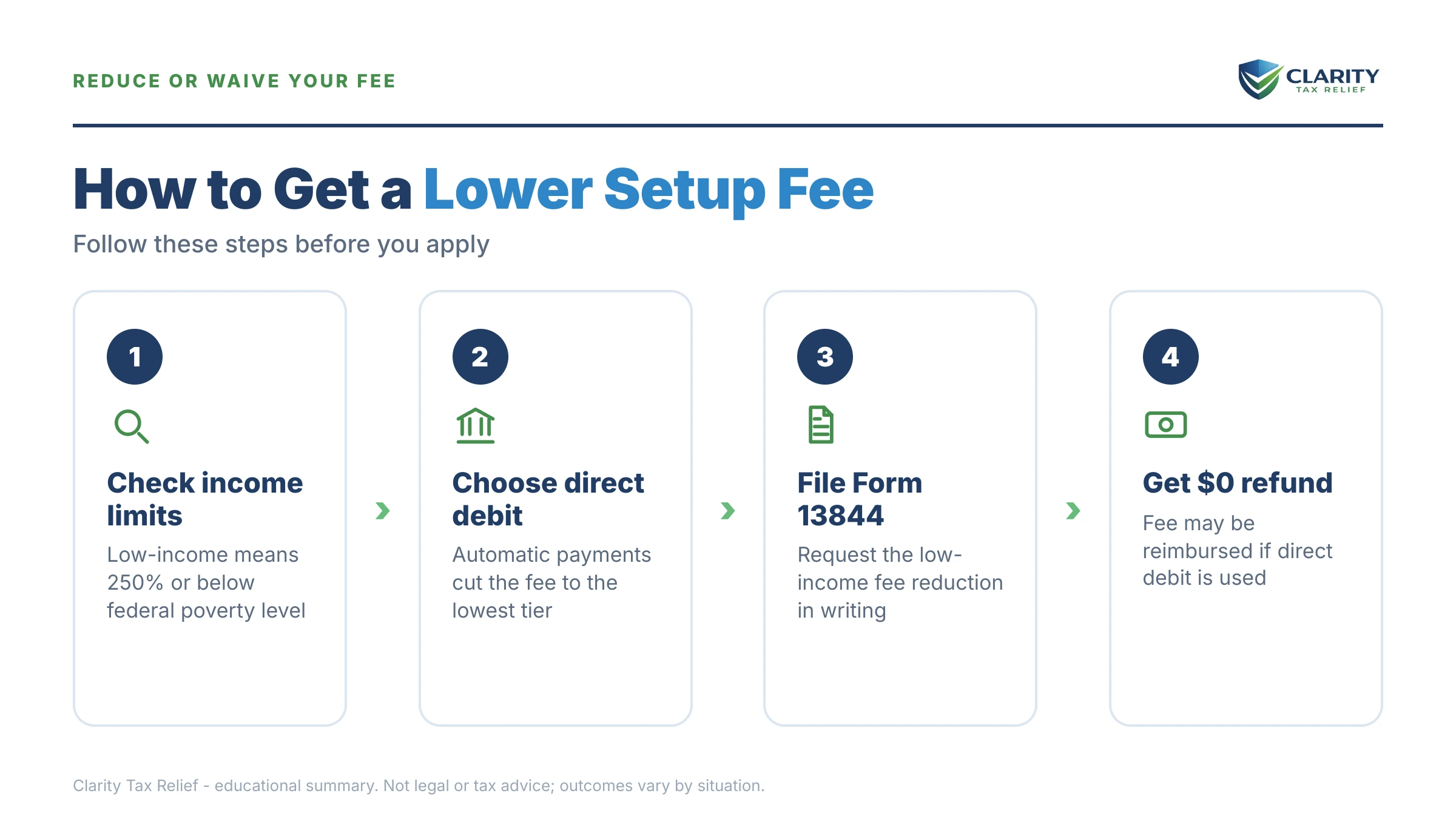
The IRS waives the setup fee entirely for low-income taxpayers who apply online with direct debit. "Low-income" here means your adjusted gross income is at or below 250% of the federal poverty guidelines — the same threshold the IRS uses for the Offer in Compromise fee waiver. For a married couple filing jointly, that threshold is meaningfully higher than most people assume, so check before you pay a fee you may not owe.
Here's how the waiver breaks down:
- Low-income + direct debit: the fee is waived. You pay $0 to set up the plan.
- Low-income without direct debit (for example, no bank account): you pay a reduced $43 fee. The IRS reimburses it when you successfully complete the agreement.
- Not applied automatically? The online system usually flags low-income status from your most recent return. If it doesn't, or you applied by phone or mail — submit Form 13844 (Application for Reduced User Fee for Installment Agreements) within 30 days of the date on your agreement acceptance letter.
There is no general fee waiver above the low-income threshold. If your income is over 250% of the poverty guidelines, your only $0 path is the short-term plan — pay in full within 180 days and no setup fee applies at any income level.
What the setup fee doesn't cover: the real cost of paying over time
The setup fee is the smallest number in an installment agreement — interest and penalties are what actually determine what your balance costs. Interest compounds daily at the federal rate. The failure-to-pay penalty continues while you're on the plan, though it drops from 0.5% to 0.25% per month once your agreement is in effect. Over a multi-year plan, those accruals routinely add up to many multiples of even the $178 worst-case fee.
That has two practical consequences. First, pay as much up front as you can and set the monthly payment as high as your budget honestly allows — the fee is fixed, but accrual is proportional to balance and time. Second, don't let the fee tiers distract you from the rate math: our guide to the installment agreement interest rate walks through what a plan truly costs per year. You can estimate your own accrual with our Penalty & Interest Calculator.
Also note: your federal refunds get applied to the balance every year the plan runs, and that offset does not replace your monthly payment. Details in will the IRS take my refund on a payment plan.
What happens if you skip the payment plan entirely
An unpaid IRS balance with no agreement in place moves through an automated notice sequence that ends in levy power, and in 2026, with the IRS workforce down roughly 27%, those notices are generated by systems that never got smaller. Ignoring the balance doesn't buy quiet; it buys escalation:
- CP14 — the first bill. You typically have about 21 days from the notice date before the sequence advances. See the full CP14 notice guide.
- CP501 / CP503 — reminder notices. Still just bills, but the balance grows with each one.
- CP504 — Notice of Intent to Levy. The IRS can now seize your state tax refund, and a federal tax lien becomes a live possibility.
- LT11 / Letter 1058 — the final notice. A 30-day clock starts on your Collection Due Process rights (requested with Form 12153). After it runs, the IRS can levy bank accounts and garnish wages.
- Levy — a bank levy freezes funds for 21 days before they're sent to the IRS; a wage levy is continuous until released.
| Stage | What the IRS can do | Your window |
|---|---|---|
| CP14 first bill | Nothing yet — penalties and interest accrue | Typically 21 days from the notice date |
| CP501 / CP503 reminders | Balance grows; account moves toward enforcement | Set up a plan any time — cheapest here |
| CP504 intent to levy | Seize your state tax refund; lien filing likely | Before the next notice issues |
| LT11 / Letter 1058 final notice | Full levy power after the clock runs | 30 days to request a CDP hearing (Form 12153) |
| Levy | Bank funds held 21 days, then taken; continuous wage levy | Until released, paid, or an agreement is in place |
Here's what makes the setup fee question almost funny in context: a $29 direct-debit agreement stops this entire ladder. Once an installment agreement is in effect, the IRS generally doesn't levy — the whole enforcement machine stands down for as long as you keep paying.
Owe the IRS and not sure which plan, or fee tier, fits?
Tell us your balance and situation. An experienced tax professional will map out which agreement you qualify for, what it will actually cost with interest, and whether penalty relief can shrink the number first. Free and confidential, and worth doing before another month of penalties and interest posts. Call (888) 825-7779 or use the 2-minute form.
Which IRS installment agreement you qualify for, and its lowest fee
Your combined balance determines which agreement types are open to you, how much paperwork they require, and which fee tiers you can reach. The cutoff that matters most is $50,000 — at or below it, you can set up a long-term plan online with no financial disclosure. Above it, the online door closes and financial statements enter the picture.
| Agreement type | Balance limit | Financial disclosure | Lowest setup fee |
|---|---|---|---|
| Short-term plan (180 days) | Under $100,000 combined | None | $0 |
| Guaranteed installment agreement | $10,000 or less in tax | None — must full-pay within 3 years, all returns filed | $29 (online, direct debit) |
| Streamlined installment agreement | $25,000 or less ($50,000 with direct debit) | None | $29 (online, direct debit) |
| Long-term online agreement | $50,000 or less combined | None — up to 72 months | $29 (online, direct debit) |
| Over $50,000 | Any amount | Form 433-F financials; apply by phone or mail | $107 (direct debit) |
A few notes on the rows. The guaranteed installment agreement is the official IRS program name for balances of $10,000 or less, if you meet its conditions, the IRS must accept the plan. The streamlined installment agreement is the workhorse for most households: no financial statement, no negotiation, just a monthly amount that clears the balance within the allowed window.
Above $50,000, everything changes. You can't apply online, the IRS reviews your income and expenses on Form 433-F, and the fee starts at $107 instead of $29. If that's you, read IRS payment plan over $50,000 before you call, because what you disclose shapes the payment you get. And if you set up a direct-debit plan by phone or mail, expect Form 433-D — the installment agreement confirmation form — where you provide your banking details and signature.
Worked example: a $13,600 joint balance, three ways
Say you and your spouse filed jointly and owe $13,600 — tax, penalties, and interest combined — after an unexpected balance on last year's return. That amount sits comfortably in streamlined territory (under $25,000), so no financial disclosure is required and every online option is open. Here's how the three realistic paths compare:
- Path A — short-term plan, $0 fee. If your budget can absorb roughly $2,270 per month for six months ($13,600 ÷ 6 ≈ $2,267), the short-term plan costs nothing to set up and minimizes accrual, because the balance is gone in half a year.
- Path B — long-term online plan with direct debit, $29 fee. The minimum payment on a 72-month schedule is about $189 per month ($13,600 ÷ 72 ≈ $188.89). At that pace, accrual does real damage: the failure-to-pay penalty alone starts at about $34 per month (0.25% × $13,600), and daily interest compounds on top. Bump the payment to $400 per month and the principal clears in roughly 34 months instead — same $29 fee, dramatically less accrual.
- Path C — the same long-term plan set up by phone, $107 fee. Identical agreement, identical terms, $85 more — purely for applying by phone instead of online. The only good reasons to take this path are a balance over $50,000 or an account issue that blocks the online tool.
Because this is a joint balance, one agreement covers both of you — the liability is joint and several, meaning the IRS can collect the full amount from either spouse, and one plan resolves it for both. The direct debit can come from a joint account or either spouse's individual account. One planning note for couples: as long as the plan runs, any joint refund each spring gets offset to the balance, so adjust your withholding now if you'd rather not lend the IRS money it will keep anyway.
How to set up your IRS payment plan and pay the lowest fee, step by step
For a click-by-click walkthrough of the application screens themselves, see our guide to how to set up an IRS payment plan online. The fee-optimized sequence is:
- Confirm your full balance. Log into your IRS online account and note the combined total across every year you owe — a plan must cover all of it. The total decides which fee tiers you can use.
- Choose short-term or long-term. If you can pay everything within 180 days, take the short-term plan — the setup fee is $0. If not, you are setting up a long-term installment agreement.
- Apply through the Online Payment Agreement tool. Applying online at IRS.gov is the only way to reach the $29 fee tier. The same agreement set up by phone or mail costs $107 to $178.
- Select direct debit. Direct debit drops the online fee from $69 to $22, qualifies low-income applicants for a full waiver, and prevents the missed-payment defaults that trigger an $89 reinstatement fee later.
- Apply the low-income certification if your AGI is at or below 250% of the federal poverty guidelines. The system should apply it automatically based on your last return. If it does not, submit Form 13844 within 30 days of the date on your acceptance letter.
- Save the confirmation and calendar your first draft date. Screenshot the acceptance page, note the monthly amount and due date, and make sure the funds are in the account — a missed payment starts the default clock.
The official terms, thresholds, and application links live on the IRS's payment plans and installment agreements page, and one-time payments of any amount can always be made at IRS.gov/payments — paying down the balance before you apply lowers both your required monthly payment and your accrual.
Fees to change, restructure, or reinstate an existing plan
The setup fee isn't the only user fee in the installment agreement system — changing or reviving a plan costs money too. Restructuring an agreement (changing the monthly amount) or reinstating one after default carries an $89 fee, reduced to $43 for low-income taxpayers. Simple housekeeping — updating your bank account or shifting the payment date — generally doesn't trigger the restructuring fee, and can usually be handled through the online tool.
Default is where these fees ambush people. Miss payments or fail to file a new return on time and the IRS issues a CP523 — notice of intent to terminate your agreement. Now you're paying the reinstatement fee and facing the collection ladder again, because a terminated agreement puts levy power back on the table. If that letter is in your hands, start with our CP523 notice guide, then the walkthrough on how to reinstate an IRS payment plan.
If the payment itself is the problem — the plan was set too high and your budget can't sustain it — restructure before you default, not after. Paying the $89 fee proactively to lower your IRS monthly payment is far cheaper than a default, a CP523, and a reinstatement.
One scope note: everything on this page is federal. If you also owe your state, the state runs its own payment plan program with its own fees and thresholds — California's, for example, is covered in our FTB payment plan guide. Never assume an IRS figure applies to a state balance.
When you can set this up yourself (most people can)
Honest answer: if you agree with the balance, your returns are all filed. You owe $50,000 or less, you do not need professional help to set up a payment plan. The online application takes about twenty minutes, the $22 direct-debit tier is available to anyone who can log in, and nothing about the streamlined process involves negotiation. Paying someone hundreds of dollars to fill out a self-service form is a bad trade.
Experienced help changes the outcome in a narrower set of situations: the balance is over $50,000 and the IRS wants Form 433-F financials (what you disclose drives the payment you're assigned). A levy or CP523 default is already in motion. You have unfiled years that must be resolved before any agreement can exist. The debt is business or payroll tax, where personal liability rules apply. Or the monthly payment the IRS wants simply doesn't fit your budget, because then the real question isn't the fee, it's whether a partial-pay agreement, hardship status, or an offer fits better than a standard plan. Penalty relief belongs in that review too: removing penalties first means financing a smaller number. And if you're stuck between options with no budget for help at all, the Taxpayer Advocate Service exists for exactly the cases the normal system is mishandling.
If your situation is on that second list — over $50,000, defaulted, unfiled years, or a payment that doesn't fit — get a free case review or call (888) 825-7779 before you lock in terms the IRS chose for you.
Terms on the IRS payment plan application, decoded
- User fee: the one-time federal charge for setting up (or restructuring) an installment agreement — the $0–$178 figures on this page.
- Direct debit installment agreement (DDIA): a plan where payments pull automatically from your bank account. The cheapest fee tier and the hardest plan to accidentally default.
- Streamlined installment agreement: a plan approved without a financial statement — available at $25,000 or less, or up to $50,000 with direct debit.
- Guaranteed installment agreement: the IRS program name for plans on balances of $10,000 or less that the IRS must accept if you meet the conditions, including full payment within 3 years.
- Low-income certification: AGI at or below 250% of the federal poverty guidelines — the status that waives the setup fee (with direct debit) or gets the $43 fee reimbursed.
- Reinstatement fee: the $89 charge ($43 low-income) to restructure a plan or restart one after default.
IRS payment plan setup fee: your questions, answered
How much is the IRS payment plan setup fee in 2026?
The fee ranges from $0 to $178 depending on how you apply and how you pay. A short-term plan of up to 180 days is free. A long-term installment agreement costs $29 online with direct debit, $69 online with other payment methods, $107 by phone or mail with direct debit, and $178 by phone or mail without it.
How can I avoid the IRS setup fee completely?
Two paths get you to $0. First, a short-term payment plan (up to 180 days) has no setup fee at any income level. Second, if your adjusted gross income is at or below 250% of the federal poverty guidelines and you set up a direct-debit agreement online, the fee is waived entirely.
Is the setup fee refundable if I'm low-income but can't use direct debit?
Yes — reimbursed, not waived. Low-income taxpayers who can't set up direct debit (for example, no bank account) pay a reduced $43 fee. The IRS reimburses it when the installment agreement is completed. Request the reduced fee with Form 13844 if the IRS doesn't apply it automatically.
Is the IRS payment plan fee monthly or one-time?
It's a one-time charge when the agreement is approved. There is no monthly service fee. What does continue monthly is the failure-to-pay penalty (reduced to 0.25% per month while an installment agreement is in effect) and daily-compounding interest, so the real cost of a plan is time, not the fee.
Do I pay the setup fee up front or is it added to my balance?
You don't send a separate check. The IRS typically collects the user fee out of your first payment (or first payments) before applying money to your tax balance. That means your balance drops slightly slower in month one, but you never have to make a distinct fee payment.
Is there a fee to change or restructure an existing payment plan?
Yes. Restructuring or reinstating an installment agreement — changing the monthly amount, or resetting a defaulted plan — carries an $89 fee, reduced to $43 if you qualify as low-income. Simple updates like changing your bank account or payment date generally don't trigger the restructuring fee.
Does setting up a payment plan stop penalties and interest?
No. This is the most common misconception about installment agreements. Interest keeps compounding daily and the failure-to-pay penalty continues, though it drops from 0.5% to 0.25% per month once your agreement is in effect. A plan stops enforcement, levies and escalating notices, not accrual.
Do businesses pay the same payment plan setup fee?
Generally the same user-fee schedule applies. But the online thresholds for businesses are lower, so many operating businesses, especially those with payroll tax debt, can't use the self-service tool and land in the phone or mail fee tiers. Payroll balances also carry trust-fund exposure that changes the whole strategy, so the fee is the least of the analysis there.
Will the IRS still take my tax refund while I'm on a payment plan?
Yes. The IRS applies (offsets) any refund you're owed to your back balance for as long as the agreement runs. The offset doesn't count as your monthly payment. Your regular payment is still due that month. Many couples on a joint plan are surprised by this the first spring after setting one up.
Can married couples set up one payment plan for a joint balance?
Yes — a balance from a jointly filed return is one liability, and one installment agreement covers it. Each spouse is fully responsible for the entire debt (joint and several liability). The direct debit can come from a joint or individual bank account. If either spouse owes for other years too, those balances generally must be folded into the same agreement.
Your next 24 hours
- Find your exact combined balance. Log into your IRS online account (or pull the "amount due" box from your most recent notice) and confirm the total across every year. That one number tells you which fee tier and plan type you're in.
- Gather three things: your last filed return (the AGI decides whether the low-income waiver applies), your bank routing and account numbers for direct debit. An honest monthly payment figure your household budget can sustain.
- Get a free case review before you lock in terms. If your balance is over $50,000, a plan has already defaulted, or the payment the IRS wants doesn't fit, call (888) 825-7779 or use the 2-minute form — every month without an agreement adds another round of penalties and interest to the number you'll finance.
This guide is general information, not tax or legal advice for your specific situation. Eligibility for IRS programs depends on individual facts and circumstances; no outcome is guaranteed.