
IRS Payment Plans
Missed IRS Payment Plan Payment: What Happens Next in 2026
What this episode covers
- Does one missed payment cancel an IRS installment agreement?
- What is IRS notice CP523 and what does its termination date mean?
- How much does it cost to reinstate a terminated IRS installment agreement?
- What steps must the IRS take before levying after an installment agreement default?
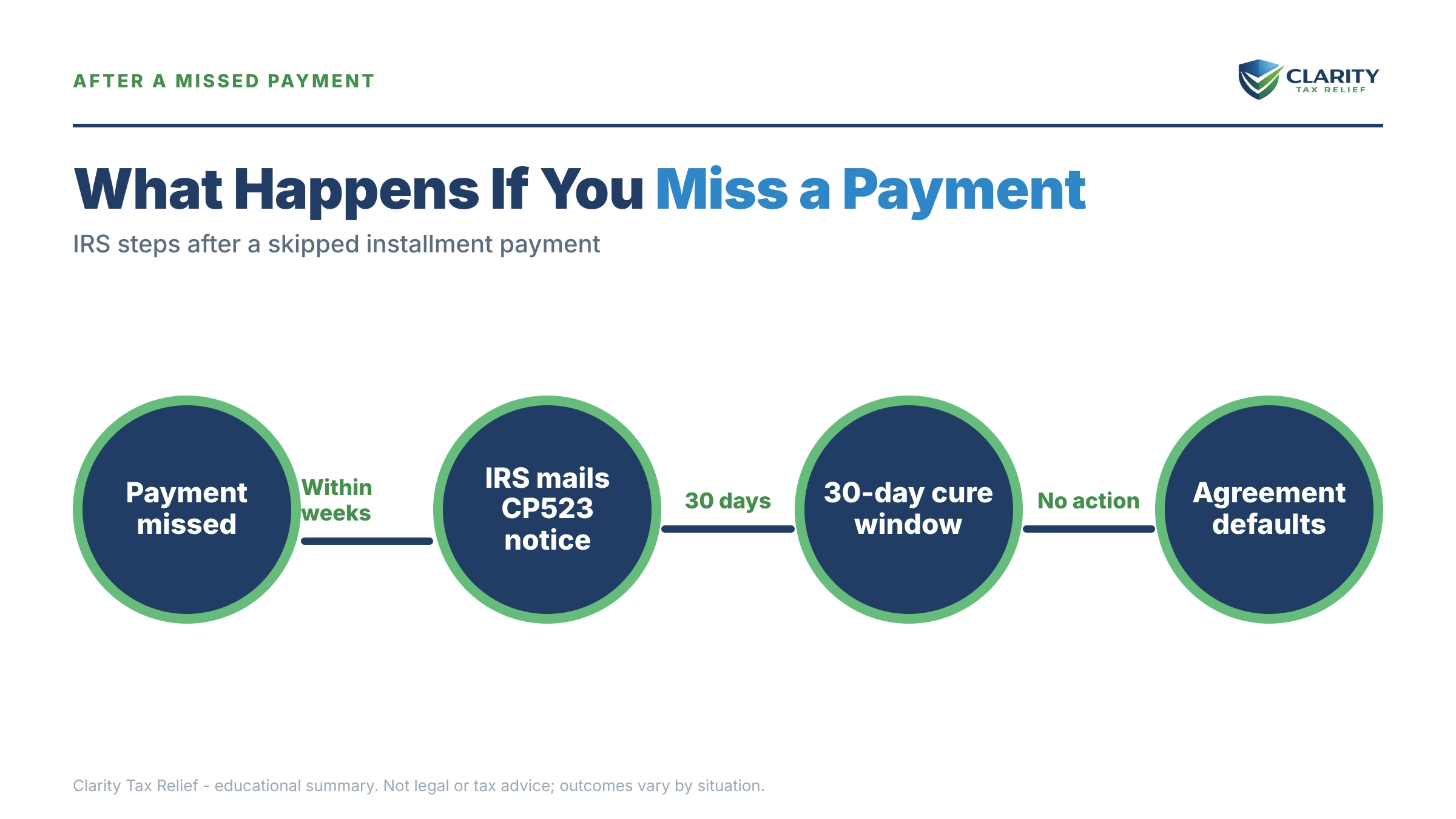
The short answer: a missed IRS payment plan payment does not automatically cancel your installment agreement. The IRS flags your account, keeps charging interest, and, only if you don't catch up, mails a CP523 notice of intent to terminate, which typically gives you about 30 days to cure the default before the plan actually ends.
This guide covers what happens after a missed IRS installment agreement payment: why the miss happened, how long you have to fix it, what each stage costs if you wait, the ways back onto a plan, and when the problem is big enough to need help. The due date came and went, the money was not there, or the debit bounced after you switched banks, and now you are bracing for a frozen account or a garnished paycheck over one bad month. That fear is normal. It is also ahead of reality. Between a missed payment and any levy sits a built-in warning system with a cure window at every stage, and right now you are at the cheapest one.
If your plan slips far enough, the IRS's warning arrives as a specific letter, a CP523. The image below shows what that notice looks like and where to find the date that controls your deadline. Everything here is organized around beating that date.
⏱ Your real clock: there is no levy the day you miss a payment. The deadline that matters is the termination date printed on a CP523, typically about 30 days from that notice's date. Until a CP523 arrives, your only running cost is interest plus a 0.25%-per-month late-payment penalty, accruing on the full balance.
Can I skip an IRS installment agreement payment?
The IRS treats every missed installment payment the same way at first. The right fix depends entirely on why it happened. Before you call anyone, put your situation in one of these buckets:
- You could not afford it this month. A one-time cash crunch is curable by catching up. If the payment is chronically too high, the answer is restructuring rather than white-knuckling it until the next miss.
- A direct debit failed. A changed account number, a closed account, or insufficient funds on debit day all read as "missed" to the IRS computer. You may get a CP166 notice saying the bank payment could not be processed, and a dishonored-payment penalty can attach if funds were short. See how direct debit installment agreement payments differ from mail-in plans, because the notice trail differs too.
- You mailed a payment and it did not post. Checks get misapplied to the wrong year or lost. Your IRS online account shows what posted. Check before you double-pay.
- You filed a new return with a balance due. This defaults plans even when every monthly payment was made on time. Your agreement covers only the years written into it, and a new unpaid year breaches it. Self-employed readers hit this constantly when quarterly estimates run short.
- You skipped a required filing or a financial update. Not filing a return while on a plan is a default trigger. So is ignoring a financial-review request on plans that require them, like a partial payment installment agreement, which the IRS re-reviews every two years.
Mechanical failures (bank, mail) are fixed with proof and a corrected payment. Affordability failures need a structural fix. New-balance defaults need the new year rolled in. Matching the fix to the cause is most of the battle.
How long do I have to fix a missed IRS payment?
An IRS installment agreement stays legally in effect until the IRS formally terminates it, and termination requires advance notice. A single missed payment puts the account in pre-default status. If it is not cured, the IRS mails a CP523 notice ("Notice of Intent to Terminate Installment Agreement") with a termination date printed on it, typically about 30 days out. Cure the default before that date and the original agreement generally survives, with no reinstatement fee.
Two protections most people do not know they have:
- Levies are generally barred by law while your agreement is in effect, for 30 days after the IRS proposes to terminate it, and while a timely appeal of that termination is pending. A missed payment alone cannot trigger a bank or wage levy.
- The reduced penalty rate holds until termination. While an installment agreement is in effect (and your return was filed on time), the failure-to-pay penalty runs at 0.25% per month instead of 0.5%. Default the plan and the rate snaps back to double.
One thing the cure period does not protect: your tax refund. The IRS keeps refunds and applies them to the balance even on a plan in good standing. Here is exactly will irs take refund on payment plan and how the offset works.
How you monitor a plan matters too. Mail-pay plans get a CP521 notice every month showing the amount due and any past-due amount, which is your early-warning system. Direct-debit plans usually do not get monthly statements, so a bounced debit can go unnoticed until the CP523 lands. The notice pictured below is the one to watch your mailbox for.
What happens if you ignore a missed IRS installment agreement payment?
How an ignored miss escalates toward levy
An ignored missed payment moves through five automated stages, ending in a levy. Each stage is more expensive to fix than the one before it. The sequence looks like this:
- The miss itself. No enforcement. Interest (at the federal underpayment rate, which adjusts quarterly and compounds daily) plus the 0.25%-per-month failure-to-pay penalty keep accruing on the whole balance, not only the missed amount.
- Past-due flags. On mail-pay plans, the next CP521 shows the missed amount as past due. On direct-debit plans, a failed debit may generate a CP166. This is the free fix window: pay the missed amount and nothing else happens.
- CP523, intent to terminate. The agreement is still alive, and levies are still barred. The printed termination date is now the controlling deadline. This is the last stage where the original agreement can be saved as-is.
- Termination. The plan is dead. The entire remaining balance becomes immediately collectible, the failure-to-pay penalty doubles back to 0.5% per month, and getting back on a plan now means a reinstatement fee and, sometimes, fresh financial disclosure. What happens from here is its own topic. See irs payment plan defaulted.
- Final notice, then levy. Before levying, the IRS must issue a final notice, an LT11 notice or Letter 1058 that starts a 30-day window to request a Collection Due Process hearing on Form 12153. One caution: if a final notice was already issued for those tax years before your plan started, the IRS may not need to send a new one and can move faster. After that, a bank levy freezes funds for 21 days before the bank sends them, and a wage levy runs continuously until released.
In 2026 there is no human mercy built into this sequence. The IRS workforce shrank roughly 27% in 2025, which makes the phone lines slower. The default, termination, and levy notices are generated by computers that never got cut. Silence is read as refusal.
| Notice / stage | What it means | Your window | What passes if you wait |
|---|---|---|---|
| CP521 (past-due) / CP166 | Payment missed or debit failed; plan still in good standing | Until a CP523 issues | The free fix — cure now and no fee, no default on record |
| CP523 | Intent to terminate the agreement; default declared | The termination date printed on it (typically ~30 days) | The right to keep your original agreement without a reinstatement fee |
| Termination | Plan dead; full balance collectible; penalty rate doubles | Roughly 30 days of statutory levy protection after the proposed termination | The low-friction reinstatement window; CAP appeal leverage |
| LT11 / Letter 1058 | Final notice of intent to levy | 30 days to file Form 12153 | Your Collection Due Process hearing rights for those periods |
| Levy | Bank funds held 21 days, then sent; wage levy continuous | Release requires action. It doesn't expire on its own | Cash and paycheck, until you negotiate a release |
What happens after a CP523 notice
Send us the notice. An experienced tax professional will confirm whether your agreement can still be saved before the termination date printed on it — free, confidential, no pressure. If no CP523 has arrived yet, we'll help you cure the miss before one does.
Will the IRS reinstate my installment agreement?
Every path back costs less before the CP523 termination date than after it. Here is the full menu, what each costs, and who it fits. (If you are comparing plan types from scratch, the setup mechanics live in our guide to how to set up irs payment plan online. This table assumes you already have one and it slipped.)
| Option | Upfront cost | How fast | Best when |
|---|---|---|---|
| Catch up before the CP523 date | The missed amount + accrued penalty/interest; no fee | Same day at IRS.gov | One-time cash crunch; you can cover it now |
| Call and ask to adjust the due date or schedule | $0 (expect a long hold) | One call | Timing problem, not an affordability problem |
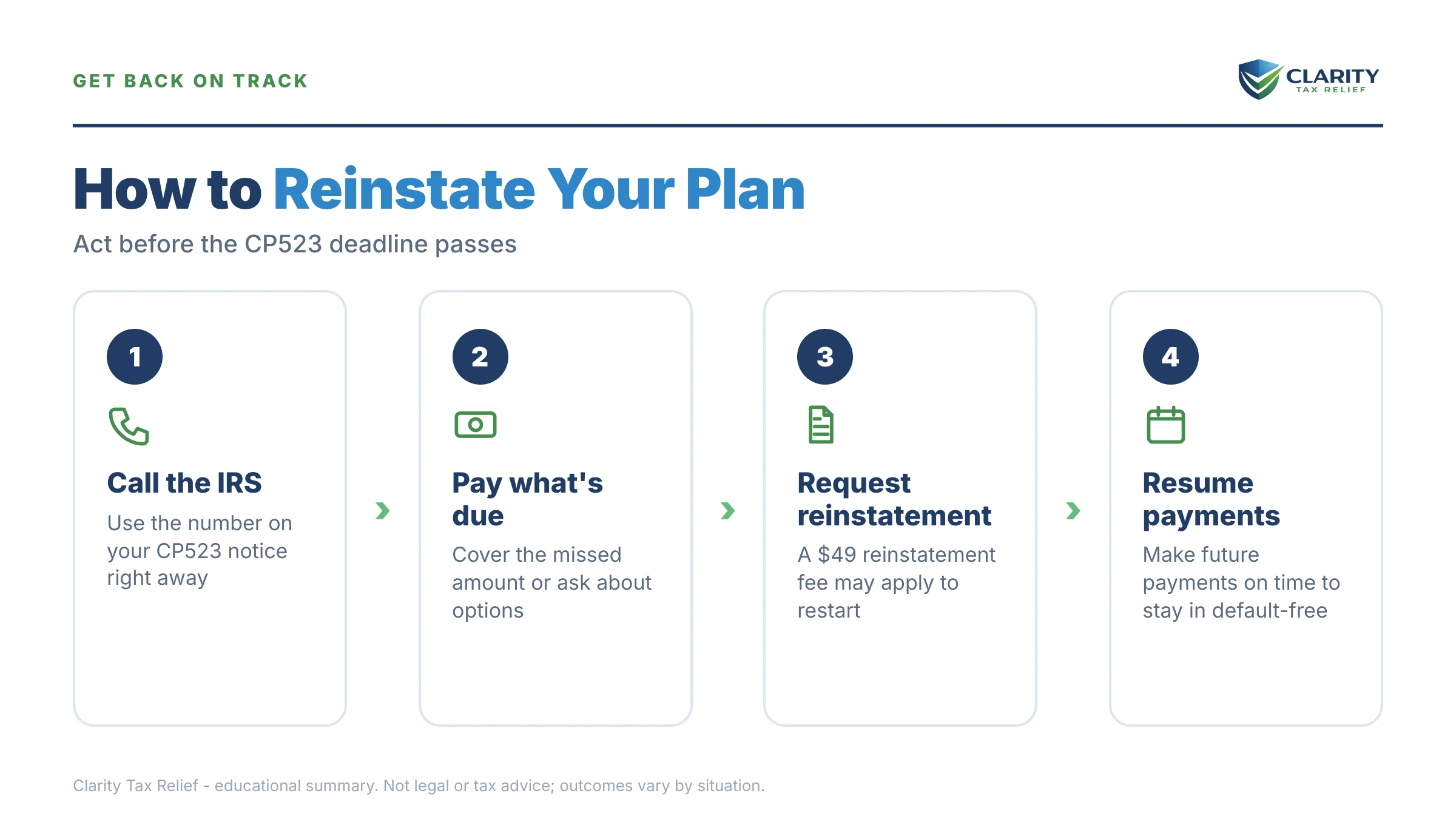
| Reinstate after termination | Reinstatement fee: $6 online, $89 by phone ($43 low-income), plus required catch-up | Days to weeks | The CP523 date already passed but no levy yet |
| Restructure to a lower monthly payment | Restructuring fee may apply | One call to a few weeks | The payment was never realistic — fix the amount, not the month |
| Partial-pay installment agreement | Financial disclosure (Form 433-F); fees comparable to restructuring | Weeks | You can pay something monthly, but never the full balance before the 10-year deadline |
| Currently Not Collectible status | $0 fee; full financial review | Weeks | Any payment would leave you unable to cover basic living costs |
| Offer in Compromise | $205 fee + 20% down on lump-sum offers (both waived with low-income certification) | Months to ~2 years | Your assets and income genuinely can't cover the debt — the IRS accepted roughly 1 in 5 offers in FY2024, so eligibility math comes first |
One quiet advantage of acting during the cure window: whatever you switch to, you keep the momentum of an account that was trying to pay. Terminated-and-silent accounts get routed to enforcement. Accounts in active negotiation do not.
Does the amount you owe change your options?
Yes. The smaller your remaining balance, the more automatic your path back becomes. The thresholds below are the same ones that governed your original setup, and they still apply after a default:
| Remaining balance | Realistic path back | What the IRS will want |
|---|---|---|
| Under $10,000 | Cure or reinstate easily. This is guaranteed installment agreement territory, the IRS's most forgiving tier | Little more than the catch-up payment and current-year compliance |
| $10,000–$25,000 | Streamlined reinstatement or restructuring, usually by phone or online | Typically no financial statement |
| $25,001–$50,000 | Streamlined terms still available, up to 72 months, with direct debit often expected at the upper end | Bank routing info for the debit; still usually no full financials |
| Over $50,000 | Restructuring with financial disclosure; see irs payment plan over 50000 for what changes at this tier | Form 433-F (or 433-A) with income, expense, and asset detail |
Married filing jointly? A defaulted joint-liability plan exposes both spouses' wages and accounts, so cure decisions should be made together. Business and payroll-tax plans run under stricter rules entirely, and a default there draws revenue-officer attention much faster than an individual plan does.
Worked example: $7,400 behind, a levy threat, and the math at each stage
Say you owe $7,400 and you are paying $150 a month, renting an apartment, no assets beyond a checking account and a paycheck. Here is what a missed payment costs, clearly hypothetical, arithmetic shown:
- While the plan is in effect: failure-to-pay penalty at 0.25%/month = 0.0025 × $7,400 ≈ $18.50/month, plus daily-compounding interest at the federal underpayment rate.
- You miss August; September's debit bounces after a bank switch. You are now $300 behind. Cure cost if you act in early October: $300 plus October's $150. That is $450 total, no fee, plan intact.
- You wait. A CP523 arrives. Same cure cost, now with a hard printed deadline. Miss it and the plan terminates.
- After termination: the penalty doubles (0.005 × $7,400 = $37/month) and the entire ~$7,300 remaining is collectible at once. Getting back on a plan now means the reinstatement fee on top of the catch-up: about $306 if the online tool will take it, or $389 by phone, against the $300 it took a few months earlier.
- An LT11 arrives. As a renter, there is no house for a lien to complicate. The IRS's practical targets are your checking account and your paycheck. A bank levy would hold whatever is in the account for 21 days before the bank sends it. A wage levy would attach to every paycheck until released. The LT11 itself hands you 30 days to file Form 12153, which stops levy action while your hearing is pending, and a balance under $10,000 makes a new agreement one of the easiest resolutions an appeals officer can approve.
The lesson in the numbers: the same $7,400 problem costs $450 in October, about $389 plus doubled monthly penalties in December, and a frozen bank account in February. You can estimate what is accruing on your own balance with our Penalty & Interest Calculator. It estimates, and the exact figure lives on your IRS account, but it will show you the direction and speed.
How to respond to a missed payment, step by step
- Check where you stand. Log in to your IRS online account to confirm which payments posted, what is past due, and whether a CP523 has been issued. Mailed notices lag reality by days.
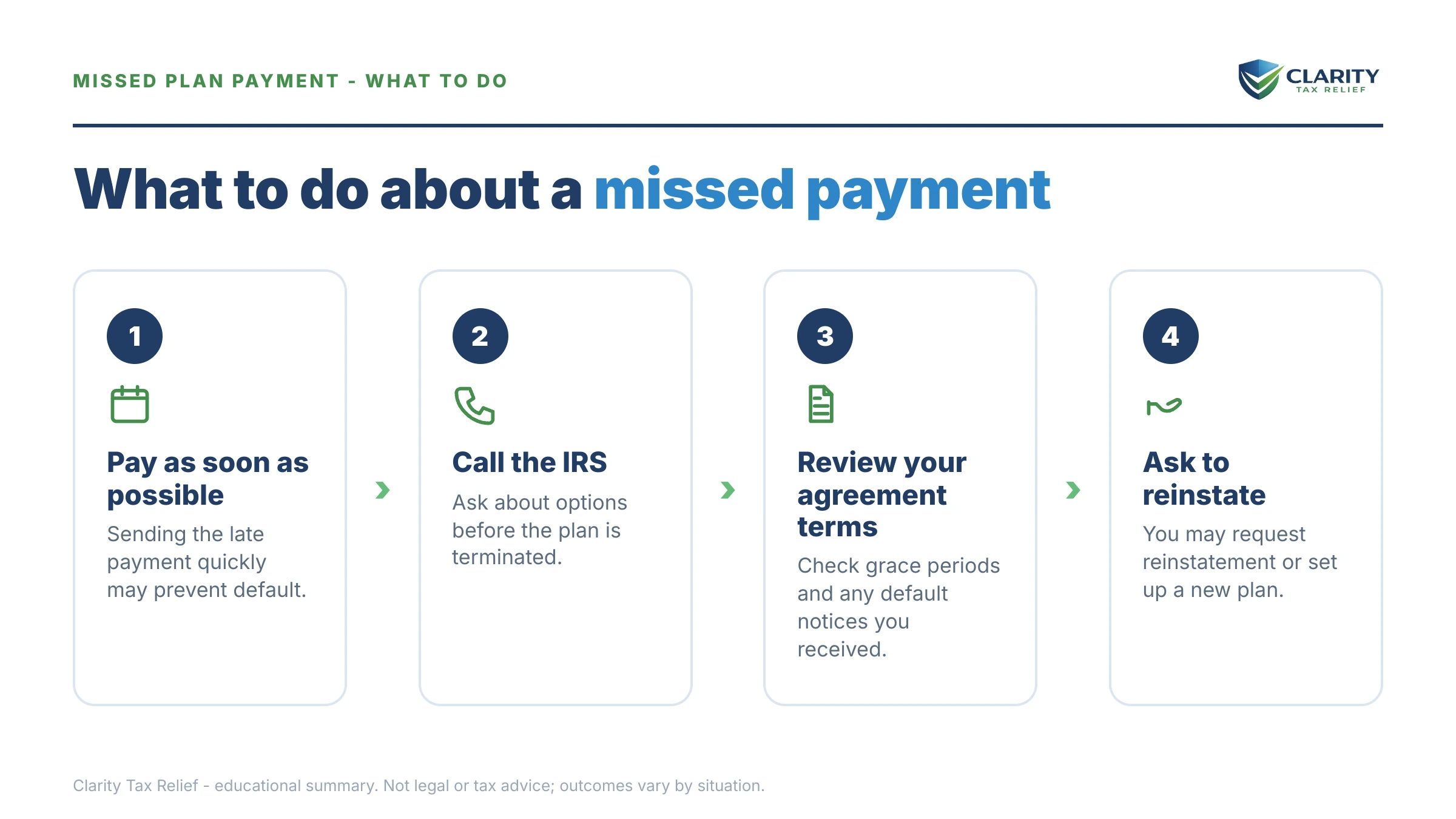
- Make the missed payment if you can. Pay directly at IRS.gov and apply it to the correct tax year. An account cured before the CP523 termination date usually keeps the original agreement alive with no fee.
- Call the IRS before the termination date if you can't catch up. Ask to move the due date or add the missed amount to the back of the plan. The phone number on your CP521 or CP523 routes to the unit handling your agreement.
- Restructure if the payment no longer fits your budget. A lower monthly amount, a partial-pay agreement, or hardship status all beat silently defaulting month after month.
- Appeal if termination is already in motion. A CAP appeal on Form 9423, filed before the CP523 deadline, asks an appeals officer to review the termination, and levies stay off the table while it is pending.
- Get experienced help if a final levy notice has arrived. An LT11 starts a 30-day clock on your Collection Due Process rights (Form 12153). That window is where experienced help changes outcomes most.
For the appeal route in step 5, our guide to irs cap appeal collection walks through Form 9423 in detail. If your plan has already terminated, the process (and paperwork) to reinstate irs payment plan is slightly different from curing a live one. That guide covers the reinstatement path specifically.
Red flags to check after a missed payment
- A direct-debit plan with no monthly statement. A bounced debit can go unnoticed until the CP523 lands. Log in and confirm the last draft posted.
- A CP166 in the mail. The bank payment could not be processed, and a dishonored-payment penalty can attach if funds were short.
- A new return filed with a balance due. That defaults the plan even if every monthly payment was on time. The new year has to be rolled in.
- A return you have not filed while on the plan. Not filing is a default trigger on its own.
- A financial-review request you ignored. Partial-pay agreements are re-reviewed every two years, and skipping the request counts as a default.
- A final notice issued for those years before the plan started. The IRS may not need to send a new LT11 and can move faster.
- A payment that was never realistic. Catching up buys one month. Fix the amount instead.
- Counting on a refund to cover the miss. The IRS keeps refunds and applies them to the balance even on a plan in good standing. The offset does not replace the monthly payment.
When should you handle this yourself, and when does help change the outcome?
Most single missed payments are a do-it-yourself fix. You do not need anyone's help, including ours, if:
- You missed one payment, can cover it now, and no CP523 has arrived. Pay online, confirm it posted, done.
- A direct debit failed for a mechanical reason. Fix the bank details, make the payment manually, confirm the next debit date.
- Your balance is under $25,000 and you need the payment lowered. The IRS can often adjust streamlined plans by phone or online. Our guide to lower my irs monthly payment shows how.
Experienced help earns its cost in the harder versions of this problem:
- The agreement terminated and an LT11 is on the table. The 30-day CDP window is a one-shot procedural right. Using it well requires knowing what resolution to propose at the hearing.
- The payment was never affordable. Choosing correctly between restructuring, a partial-pay agreement, hardship status, and an Offer in Compromise is a financial-analysis question. The wrong pick locks in years of overpaying or a rejected offer.
- The default came from a new balance plus unfiled or underpaid years. Sequencing matters (returns first, then penalties, then the plan) and doing it out of order costs money.
- It is a business or payroll-tax plan. Those defaults escalate to revenue officers and personal-liability questions far faster than individual plans.
If your situation is on the second list, a free case review before the CP523 date passes is the cheap move: start with the 2-minute form and an experienced tax professional will map the options against your actual numbers.
Terms on your notices, decoded
- Default: a breach of the agreement's terms (missed payment, new balance, unfiled return). It endangers the plan but does not end it by itself.
- Termination: the formal end of the agreement, effective when the date printed on the CP523 passes without a cure. The full balance becomes collectible at once.
- Cure: fixing whatever caused the default (usually catching up the missed payments) before the termination date, which keeps the original agreement alive.
- Reinstatement: restarting a terminated agreement, usually with a fee. Restructuring means changing its terms, like the monthly amount, at the same time.
- CDP rights: your right to a Collection Due Process hearing (requested on Form 12153 within 30 days of a final levy notice), which pauses levy action while pending.
- CSED: the 10-year collection statute expiration date. Your plan payments run down the balance without touching the clock. Some alternatives, like an Offer in Compromise, pause it.
The bottom line on a missed IRS payment plan payment
One missed payment does not end your agreement. The IRS has to mail a CP523 first, and the date printed on it is the deadline that counts. Cure before that date and there is no fee and no default on record. Wait past it and the penalty rate doubles, the full balance becomes collectible, and getting back on a plan costs a reinstatement fee on top of the catch-up. So log in today, confirm what posted, and pay the missed amount or call to adjust the schedule. If the payment was never affordable, restructure now rather than missing again next month.
Missed payment plan questions, answered
Will the IRS cancel my payment plan if I miss one payment?
Common questions about missed plan payments
Not immediately. One missed payment puts your agreement into pre-default status. But the plan stays alive until the IRS mails a CP523 notice of intent to terminate and the deadline printed on it passes, typically about 30 days after the notice date. If you catch up the missed amount, or call the IRS and work something out, before that date, the agreement usually continues without a formal default.
How many payments can you miss on an IRS installment agreement?
There is no official grace count — treat every payment as required. In practice, the IRS's automated system flags a missed payment and can issue a CP523 after a single miss, especially on mail-in plans. A direct-debit payment that fails once because of a bank error is sometimes flagged with a CP166 first, but two consecutive misses almost always triggers the termination process.
What is a CP523 notice?
A CP523 is the IRS's notice of intent to terminate your installment agreement. It states why the plan is in default — usually a missed payment or a new unpaid balance — and prints a termination date, typically about 30 days out. Cure the default before that date and the agreement generally survives. Ignore it and the full balance becomes collectible, with levy action possible after a final notice.
Can I skip a month on my IRS payment plan?
Not on your own, but you can ask. If you call the IRS before the due date, it can sometimes move a due date or adjust the schedule for a genuine short-term hardship. What you cannot do is silently skip: an unexplained missed payment starts the default process. If money will be tight for more than a month or two, ask about permanently lowering the payment instead of skipping.
My direct debit payment bounced — does that default my agreement?
A single failed direct debit does not instantly terminate the plan. But it starts the same default track as any missed payment. The IRS may add a dishonored-payment penalty if your bank returned it for insufficient funds. You will typically see a CP166 notice saying the bank payment could not be processed. Fix the account issue, make the payment manually at IRS.gov, and confirm the next debit date.
Can the IRS levy my bank account right after a missed payment?
No. The law generally bars levies while an installment agreement is in effect, for 30 days after the IRS proposes to terminate it, and while a timely appeal of that termination is pending. A levy becomes possible only after the agreement actually terminates and the IRS has issued a final notice of intent to levy with its 30-day appeal window, or already issued one before your plan started.
How much does it cost to reinstate a defaulted installment agreement?
The IRS charges $6 to revise or reinstate a plan through its Online Payment Agreement tool, or $89 by phone, mail or in person, reduced to $43 if you meet the IRS's low-income criteria. That is on top of whatever catch-up the plan requires. That is separate from the penalties and interest that kept accruing. If you cure the default before the CP523 termination date, you can often avoid the fee entirely by keeping the original agreement alive.
Does missing an IRS payment plan payment hurt my credit score?
No — the IRS does not report installment agreements or missed payments to credit bureaus, and tax liens were removed from consumer credit reports in 2018. The real costs sit with the IRS itself: the failure-to-pay penalty rate doubles from 0.25% to 0.5% per month once an agreement defaults. A terminated plan reopens the door to bank and wage levies.
Will filing a new tax return with a balance due default my payment plan?
Yes — a new unpaid balance is one of the most common default triggers, even if you never missed a monthly payment. Existing agreements cover only the tax years written into them. If you expect to owe on this year's return, pay it with the return or call the IRS before filing to have the new year rolled into a restructured agreement.
The IRS's own references are worth bookmarking: the IRS payment plans and installment agreements page covers plan terms and fees, the agency's explainer at Understanding your CP523 notice describes the termination notice itself, and any catch-up payment can be made directly at IRS.gov/payments.
Your next 24 hours
- Find your controlling date. If a CP523 arrived, the termination date printed on it is your deadline, circle it. If no CP523 has come, log in to your IRS online account and confirm exactly which payment is showing as missed.
- Gather three things: your most recent tax return, every notice from the plan (CP521, CP166, or CP523). A realistic number for what you can actually pay monthly going forward.
- Get the free case review. Use the 2-minute form or call (888) 825-7779, if a CP523 clock is running, we'll work against that printed date. If it isn't, acting now simply stops the penalty and interest from compounding on your full balance another month.
This guide is general information, not tax or legal advice for your specific situation. Eligibility for IRS programs depends on individual facts and circumstances; no outcome is guaranteed.